2022 CCUG + TPVD meetings week #11 summary: mirrors! (maybe)

Aurora Falls, February 2022 – blog post

The following notes were taken from:

  • My audio recording and chat log of the Content Creation User Group (CCUG) meeting held on Thursday, March 17th 2022 at 13:00 SLT.
  • My audio recording and the video recording by Pantera (embedded at the end of this piece, my thanks to her as always for recording the meetings) from the Third-Party Viewer Developer (TPVD) meeting on Friday, March 4th, 2022 at 13:00  SLT.

These meetings are chaired by Vir Linden, and their respective dates and times can be obtained from the SL Public Calendar.

This is a summary of the key topics discussed in each meeting and is not intended to be a full transcript of either. However, the video does provide a complete recording of the TPVD meeting, and timestamps to the relevant points within it are included in the notes below.

Available Viewers

[Video: 0:35-3:15 + notes from CCUG]

  • The Performance Floater project viewer updated to version 6.5.4.569531, on March 18th. This viewer includes the Lab’s implementation of automatic adjustments to the viewer to try to maintain FPS. Monday, March 21st: Appears to have either been rolled back, or update to official viewers list was premature.

The list below reflects the rest of the currently available official Second Life viewers:

  • Release viewer: version 6.5.3.568554 – formerly the Maintenance J&K RC viewer, promoted Monday, February 28 – No Change
  • Release channel cohorts (please see my notes on manually installing RC viewer versions if you wish to install any release candidate(s) yourself).
    • MFA RC viewer, version 6.5.4.569309, issued on March 15.
    • Performance Improvements RC viewer version 6.6.0.569349, dated March 14.
    • Lao-Lao Maintenance RC viewer, version 6.5.4.569191, issued on March 11.
  • Project viewers:
    • Mesh Optimizer project viewer, version 6.5.2.566858, dated January 5, issued after January 10.
    • Legacy Profiles viewer, version 6.4.11.550519, dated October 26, 2020.
    • Copy / Paste viewer, version 6.3.5.533365, dated December 9, 2019.

General Viewer Notes

  • It is hoped that those using the official viewer and who are in the Performance Improvements RC cohort (or opt to manually install this viewer) will see noticeable performance improvements in terms of frame rates and fewer viewer stalls, when compared to previous SLV releases.
    • The RC has already seen some new bugs raised against it, and these are being worked on (e.g. BUG-231936).
    • It is still hoped this will be the next promotion to de facto release status, but this hinges on bug fixing and a decision on whether or not to release MFA as a dedicated viewer.
    • It is acknowledged that the work in this viewer and the Performance Floater project viewer needs to be reconciled with the work carried out by Beq Janus of the Firestorm team, whose code will be in the upcoming Firestorm 6.5.3 release.

MFA Viewer

  • Summary:
    • Multi-factor authentication (MFA) is coming to the viewer.
    • As MFA is implemented in the official viewer, there will be a “grace” period to allow TPV adopt the viewer code.
    • During this period, users will be able to access SL on TPVs as they currently do now, regardless of whether or not they have opted-in to MFA.
    • After this “grace” period, all users who have opted in to MFA will be required to authenticate themselves when using any viewer to log-in to Second Life (with the usual 30-day period of valid authentication, as per secondlife.com MFA), but those who have not opted-in to MFA will see no difference in their log-in steps, regardless of whether the viewer they are using supports MFA.
  • The RC version of the viewer, version 6.5.4.569309, was released on March 15th. This appears to have an authentication bug – BUG-231938 – related to how pass codes are parsed by the viewer.
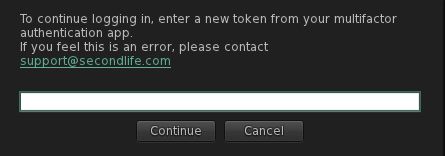
The MFA RC viewer prompts those who have opted in to SL’s MFA capability to provide an authentication code / key (once every 30 days) in order to log-in to SL
  • [CCUG meeting] The decision has yet to be taken on whether to maintain MFA as a dedicated viewer update or possibly merge it with another RC viewer (e.g. the Maintenance RC) to streamline the number of active viewer versions and the QA process.

Mirrors! (Maybe)

[Video: 4:05-16:29]

  • In-world mirrors that reflect that reflect their surroundings – including avatars – have long been a requested capability in SL. Over the years, various attempts have been made to fake mirrors, such as using Linden Water and static photographic sets, though to “cheating” using projectors (albeit sans reflecting avatars) and the old means of duplicating sections of a build and inverting it so it appears to be reflections on a polished floor.
  • In 2014, Zi Ree of the Firestorm team developed a means of generating real time reflections, including avatars, within the viewer, and produced a video on the idea. At the time, due to various reasons (most notably the impact on performance), LL decided mirrors could not be supported, which has tended to remain their position since.

  • However, Mojo Linden (VP of Engineering) is now prepared to consider possibly enabling some implementation of mirrors in SL, although how this might be done is open to discussion, particularly as the potential for a massive performance impact is still very much a concern.
  • Suggestions made by Mojo on how this might be done included:
    • To have user-initiated “mirrors” (that is, there are “mirror” objects in a space, but the rendering of their “reflections” is only triggered for a viewer based on something like their proximity to the object).
    • To possibly limit mirrors in terms of what they reflect (such is things that are directly in front of them, rather than much further in the background or only render avatars with the background left white.
  • In terms of “triggering” mirrors, there was discussion on whether this should be automated or with user-controlled input:
    • Automated within the viewer:
      • The viewer detects the “mirror” object based on proximity, per above & renders the reflections. Discussion on this included the ideas that there could also be a Graphics preference option to completely enable or disable all mirror rendering by the viewer and a slider / drop-down to set the overall quality of the rendering of reflections (as is we already have for graphics quality (slider) and water reflections quality (drop-down)).
      • Automated via LSL (setting / unsetting flags on objects that trigger “reflection” rendering) or possibly using the interest list.
    • User controlled input: reflections are toggled in a manner similar to Media On A Prim: the user touches the “mirror” surface  and “reflections” are rendered only by their viewer – although this seems clunky / immersion breaking, even if it is an approach taken by games such as Cyberpunk 2077.
  • One suggestion from those at the meeting was to take the Linden Water planar reflections (which are rendered anyway, whether the Linden Water is visible or not) and render them at a lower resolution in screen space.
    • Using the Water planar could help with things like reflective floors, mirror walls, etc., although screen space rendering in SL can be subject to clipping.
    • Screenspace reflections (SSR) have appeared in some TPVs – like Firestorm and Niran’s Viewer, but how well these work is open to question – for Firestorm, there were issues with the release of materials that resulted in the code being removed.
    • One  suggestion make for limiting performance impact was to limit the viewer to rendering only the nearest mirror surface and either use SSR for the remaining mirrors or, don’t render them at all
  •  A lot depends on potential use-cases, and whether expectations can be managed – as there is a potential that any solution will not be able to meet all requirements, simply because of the risk of performance impact.
  • Everything on mirrors is purely at the discussion stage right now and there is currently no formal project – and indeed, there might never actually be any project to implement mirrors; however, that the topic is being discussed by LL marks a significant shift in thinking.

In Brief

From the Content Creation Meeting

A lot of general discussion on a number of topics, none of which is currently the focus of any Lab project, including:

  • Using physics to allow more “wiggling parts” – such as ears, etc., – on mesh avatars: a lot of this would come down to positioning the most suitable bones and rigging to them.
  • Controlling / ordering joint position overrides (BUG-231904 / BUG-231579): this is currently handled by mesh UUID – which can be random from the POV of the user. However, trying to order using the order things are added to an avatar could lead to race conditions, as the outfit system doesn’t have any concept of prioritising attachments, therefore a more structured schema – such as adding a specific field that could be set for objects – but even this could have conflicts and also likely to be a non-trivial piece of work.
  • Expansion of supported upload formats for mesh (e.g. glTF) and use of techniques such as PBR, with a stated preference (from creators) for SL handling of reflections / reflectivity to be overhauled before any attempt is made to add PBR support.
  • Expanding Bakes on Mesh to support materials – which as noted over the last several meetings would require a significant update to the Bake Service, which LL is not planning on doing in the foreseeable future.
    • A further complexity here is managing the proper ordering of the additional maps. Example: some users may want their shirt partially blended with their bra / vest normal; others might want their shirt to cover their bra /vest normal map whilst others may not want their bra / vest to have a normal at all; so how can these three states be collectively handled in terms of layering?
  • Further discussion on terrain – which is the subject of a project for 2022, although there is some split about increasing the texel density / increasing the resolution/repeats (and thus reducing the blurriness) + allowing normal maps, or allowing more in the way of mesh terrain (heightmaps, etc.).
    • Another request for terrain has been to allow greater compositing of textures (e.g. for more graduation in changes of textures by height or offering greater depth to terrain by layering-up textures.
    • A further request has been to allow terrain painting – e.g., being able to “paint in” dirt patches on grass, etc.
  • A request for a scripted means to apply EEP settings to oneself beyond the inventory Apply to Self such that (as an example), you buy a pair of sunglasses or tinted goggles, and they apply EEP setting that make your surrounding look darker. This would require a means to read and apply the contents of an object,

From the TPVD Meeting

  • [Video: 16:31-27:45 and 28:58-42:30] A broad-ranging discussion on the viewer build process and tool chain, moving to more recent graphics APIs (the likes of Vulkan and Metals are under consideration), resource utilisation within the Lab, future work on improving the viewer’s threading capabilities, etc.
    • Outside of the ongoing (/periodic) tool chain updates and graphics API investigations, none of discussion points are subject to any immediate / near-term project.
    • It was again pointed out that a issue in considering replacements for / alternatives to OpenGL is that a lot of users run older PC harder which is incapable of running more recent APIs like Vulkan.
    • As most of which will likely only be of interest to viewer devs, please refer to the video.
  • [Video 42:44-43:28] ARCTan project and Legacy Profiles:
    • Initiated in 2020, ARCTan is an attempt to re-evaluate both avatar rendering costs and the cost of in-world scene rendering, with the initial focus on avatar rendering cost / impact, itself running on two tracks:
      • Developing a new UI element in the viewer pull together information from various menus / debugs to display useable information on avatars / attachments that are heavy in rendering cost, and what can be done.
      • Gathering data with the intent to revise and improve the actual formulas used for calculating avatar complexity, making them more relevant.
    • ARCTan effectively went into hibernation as a singular project in the latter part of 2021, and is currently awaiting development bandwidth.
    • [Video 45:09-46:05] One of the issues with ARCTan was being able to pull together the data in a fine enough detail to make any UI used to make changes worthwhile. Beq Janus has tackled a lot of this work for the upcoming Firestorm release, and this is liable to be fed into projects like ARCTan and the Lab’s own work in improving viewer performance and making options visible to users.
    • Legacy Profiles is a project to move avatar profile information back into the viewer and away from using web pages. There is project viewer (see the list at the top of this article), but it has been awaiting some back-end server work to be completed, and it is hoped that the project will be moving forward “Soon™”.
  • [Video: 43:54-44:44] CEF: Chrome Embedded Framework (CEF) is the API used to manage media in SL. The SL version is now running several releases behind the current CEF version, and while a need to update has been noted, it is liable to require some significant work (e.g. updated UI elements as well as under-the-hood changes).
  • [Video 46:05-end] miscellany text conversations, mostly on the topics noted above.

Spring at Nelipot in Second Life

Nelipot, March 2022 – click any image for full size

I dropped back into Nelipot, the Homestead region held and designed by Shawn Shakespeare (SkinnyNilla) and Lien (Lien Lowe) to both catch it in its Spring 2022 dress and to give the Firestorm implementation of the 360º snapshot floater, which will soon be coming up for release. Not because the implementation really needed testing – Firestorm look to have adopted LL’s code pretty much “as is” – but just to satisfy myself; plus – and quite frankly, Nelipot deserves to be seen in its full glory.

For its spring 2022 look, Nelipot moves from what had been something of a North American lean to something perhaps a little more European in tone.

The landing point sits on one of two small islands that brace the main land mass for the region. Sitting to the south-west of the region, this landing point island sits in the jaws of the main land area, separated from it on either side by the waters of an inlet that cuts its way into the region. To reach the rest of the setting, people can either swim or – as might be easier – jump into the pedal boat moored at the island’s little dock and paddle across the bay (don’t double / single-click TP off of the boat when you get to shore or you’ll be returned to the landing point; instead, stand and wade ashore).

Nelipot, March 2022

The core of the main part of the island is given over to a small farm that appears to be split between growing grapes and raising livestock. Given its Tuscan look, the farmhouse and the vines suggest this might be somewhere in Italy – but that’s for visitors to decide.

Across the bay, and bracketing the farmhouse, are two windmills sitting at the end of the finger of land. The wharf and barn here suggest the farm might supplement its income by offering tourists the chance to go fishing out on the surrounding waters, or simply take a kayak or rowing boat out onto those same waters.

To the north-west lies the second little island, another low hump of land rising from the waters, this one the home of an old shack, now used as another fishing retreat. Across the water from it and back on the main island, what might be a holiday cottage lies nestled on the far side of a low rise which separates it from the farm.

With a hilltop café providing a picturesque view across the water to the farmhouse and several places to sit, the pedal boats available for paddling around on the waters in the bay and around the island, and plenty to photograph and explore in-doors and out, Nelipot once again offers a lot to appreciate and enjoy.

Nelipot, March 2022

SLurl Details

  • Nelipot (Safe Haven, rated Moderate)

SL19B: theme, music festival & performer applications


June 2022 will mark the 19th anniversary of Second Life opening to public access – and as we’ve all come to expect, a portion of the month will be given over to celebrations at the Second Life Birthday (SLB).

On Thursday, March 17th, Linden Lab officially announced the 2022 Birthday event and it’s theme, and also opened applications for the (now traditional) Music Fest that kicks-off the official celebrations, and also applications for those wishing to perform during the celebrations as a whole.

Dates and Theme

This year the SLB festivities will open on Thursday, June 16th, with the Birthday regions open through until Tuesday, July 5th, and the main celebration events taking place from June 16th through to Sunday, June 26th, 2022. The theme this year is Steampunk.

via Linden Lab

Music Fest

Now in its 8th year, the Music Fest has become the traditional opener for the official celebrations, and this year it will provide three days of live music entertainment between Thursday, June 16th and Saturday, June 18th inclusive.

The Lab is seeking at least a dozen performers, both veteran Second Life musicians and those new to the scene, to provide the music for the festival. Full details on requirements / policies can be found in the Music Fest application form; however, and in brief:

  • Previous sets at the festival run to an hour in length including any required set-up time.
  • There is a 350LI allowance for props and rezzable items for your show, which must be set-up as a part of the performance time.
  • Accepted acts are requested to be at the venue one hour ahead of their appearance, in order to complete final check-out with SLB personnel to ensure everything is ready for their set.
  • There is no payment for participation – however performers will be permitted the use of tip jars, subject to the festival policy notes.
  • All performances and song lyrics must be G-rated.
  • Applications will close on Sunday, April 10th, 2022.

Performer Applications

Linden Lab are looking for all types of performers to join the week-long festivities taking place between June 19th and June 26th, inclusive. DJs, live performers, dance troupes, particle performers and more are welcome to apply.

Performers for the week are asked to complete the official performer application form. Note that applications must be made by the end of Sunday, May 8th, 2022.

Related Links

Questions on the real and the Unreal in Second Life

Vibes Gallery: Axiomatic Clarity – RealUnreal
What is it to take a picture?
I ask that to myself and I let that question absorb me subconsciously, continuously as I render what I see into a frame so that elements of composition, light and background fuse in a balance in dependent from the subject.
The subject means nothing. 

– from the introduction of RealUnreal

What is the real nature of a photograph? Once upon a time, cameras and photographs were a means to freeze a moment in time; a memory, something that might become an instant marked in history or a simple sharing of a family activity, a moment of friendship or love or something else.

Vibes Gallery: Axiomatic Clarity – RealUnreal

Today, however, almost everyone has a camera at their fingertips. From the advent of the basic point-and-click “instant” camera through the rise of digital camera to the merging of camera and cellphone / smartphone, we have all become photographers. And with the increase in digital editing software readily accessed through ‘phone and computer, we have all become self-styled digital artists. Further, such is the skill we have developed in using such post-processing editing tools that it perhaps prompts the question: how much of an image remains true – remains real – to its subject, and how much is “unreal”, the result of the photographer imposing their subjective interpretation of their subject through cropping, light and colour adjustments, changes in focus, and other editorial techniques?

These are some of the questions posed in  a new exhibition of images  by Axiomatic Clarity, gathered from both the physical world and Second Life, which is currently on display at Eviana Robbiani’s Vibes Gallery. The title of the exhibition is RealUnreal – which itself references the fact the images offered are from both the physical and virtual realms.

Vibes Gallery: Axiomatic Clarity – RealUnreal
Although the methodology is a good compromise it still does not grasp what I am looking at. Do I know what that is, do I like how it manifests, do I let it change myself?

– from the introduction of RealUnreal

Across the three gallery halls and the spaces between, Axiom presents a marvellous collection of predominantly black-and-white or monochrome images, with two of the halls focused on images from the physical world, and one on images from Second Life. They are all evocative; all have a story to tell. They challenge us to see them as images offered for display and how the artist arrived at their finished appearance; that is, what is the reality of their focus and content, and how much is “unreal” – the result of that subjective imposition placed on each by the artist through the editorial process? Indeed, what does each say about the artist’s approach to photography and developing a balance between the subject of each image, and the story the photographer feels drawn to tell?

Is it possess[ion], is it obsession, is it a form of growth?
The deeper to discriminate at a deeper and abstract level, a level where the photographic language borders the inexpressible and even replaces the subject entirely … and I tentatively find that balance.

– from the introduction of RealUnreal

Vibes Gallery: Axiomatic Clarity – RealUnreal

These are complex questions, worthy of being pondered given they are central to the photographer’s approach and execution of their art, with RealUnreal mixing fabulously expressive we have a complex, visually compelling selection of art that draws us into the questions of “reality” vs. “unreality” and the drives that govern a photographer in the creation of their art.

SLurl Details

2022 SUG meetings week #11: summary

Wonderland 2.0, February 2022 – blog post
The following summary notes were taken from the Tuesday, March 8th, 2022 Simulator User Group (SUG) meeting. It forms a summary of the items discussed, and a video of the entire meeting is embedded at the end of the article – my thanks to Pantera for recording it.

Server Deployments

Please refer to the server deployment thread for any latest updates.

  • Tuesday, March 15th saw the SLS Main channel updated to server release 569051, bringing it to parity with the RC channels. This release makes some improvements to the processes of simulator start-up and shutdown, as well as fixing a crash and a subtle bug in LSL math functions.
  • Wednesday, March 16th should see the RC channels restarted without any deployment.

Available Official Viewers

The Performance Improvements viewer was promoted to RC status with the release of version 6.6.0.569349 on March 14th. This viewer may have also absorbed the Tracy Integration viewer updates, which have been withdrawn as a dedicated RC viewer.

All official viewer pipelines remain as follows:

  • Release viewer: version version 6.5.3.568554 – formerly the Maintenance J&K RC viewer, promoted Monday, February 28 – No Change
  • Release channel cohorts:
    • Lao-Lao Maintenance RC viewer, version 6.5.4.569191, issued on March 11.
  • Project viewers:
    • Mesh Optimizer project viewer, version 6.5.2.566858, dated January 5, issued after January 10.
    • Performance Floater project viewer, version 6.4.23.562625, issued September 2.
    • Legacy Profiles viewer, version 6.4.11.550519, dated October 26, 2020.
    • Copy / Paste viewer, version 6.3.5.533365, dated December 9, 2019.

In Brief

  • The Land Team still have yet to settle on a suitable EEP setting for the Mainland in order to alleviate the generally dark see to the day environment there.
  • BUG-231876 “llRequestSimulatorData() frequently and silently fails” – this issue has reproduced by the Lab and is being actively worked on.
  • Further discussions on the issue of vehicles hitting a parcel ban  / ban lines are “bounced” (much like they do on reaching an edge of the grid) rather than avatars being unseated / dumped and the vehicle returned to the owner’s Lost and Found. Feature request BUG-231802 “Prevent vehicles from entering parcels their riders cannot access” has been accepted, but no ETA on implementation.
  • Additional discussions on scripting, and on media control.
    • Scripting options included further requests for parcel teleport routing capabilities, accurately positioning / seating avatars.
    • As conversations at SUG meetings tend to cover the same ground re: certain requests like these, a request was made for LL to provide a general workplan / response to such requests, so that people know what to expect.
  • Feature request BUG-231929 “llCanRez or something equivalent to check if an object can rez at the location it will try to in the future” is a request for a better way of detecting if a prim can be rezzed by an object on land rather than having to write a LSL function.
  • Multi-Factor Authentication (MFA) was raised, with the Lab re-iterating that the capability is being rolled out in stages. As I’ve reported in recent TPVD summaries, the next element is liable to be extending the MFA capability to the viewer – see: SL Wiki: Login MFA.
  • Whilst not a simulator issue per se, some creators at the meeting requested (again) that LL provide in-world mesh editing capabilities and “get rid of primitives” as “you can’t make much of anything with primitives anymore” – a comment that many of us who routinely build with primitives would likely strongly dispute. While there are no plans for LL to “replace” prims, what is likely required are broader options for importing content created using third-party tools.

A Trip to Seagull Rock in Second Life

Seagull Rock, March 2022 – click on any image for full size
Inara, unfortunately I have to inform you that Sheepville is gone. Since my retirement, I can only commit to running half a region, and I think that eight years of running Sheepville are enough 🙂 . I hope that you will visit my new location, I think it looks nice also even its just half of a region.

With these words, Micky Woodget both informed me of the sad passing on Sheepville, his charming village setting I first visited in 2013, and to which I returned in 2021 (Return to Sheepville in Second Life), a timeless setting both in terms of them mix of eras found within it and in terms of Second Life, where regions can so easily come and go or change beyond recognition from build to build, and invited to visit Seagull Rock, his new setting – and invitation I could hardly refuse.

Seagull Rock, March 2022

Although “only” occupying a quarter Homestead, Seagull Rock captures the spirit of Sheepville perfectly; while the buildings may be more modern in looks than the Tudoresque shops and houses of Sheepville, they sit around a piazza shaded here and there by mature trees and with a fountain sitting towards its centre, all of which helps the setting provide an echo of Sheepville.

Unlike Sheepville, however, Seagull Rock abuts the sea via a small fishing harbour tucked into the south-west corner of the town and from which fresh fish are delivered to the local restaurant as it sits just behind the wharves, and the fish market next door. In fact Seagull Rock takes fresh food very seriously, as can be seen at the local butcher shop, bakery and fresh produce market shop, all of which suggest the local countryside has some rich farmlands tucked away beyond the trees.

Seagull Rock, March 2022

North of the square, a country track winds its way past a meadow that has been given over to a camp site that allows visitors to make use of the local beach, to arrive at a set of steps leading up to a country pub – the Sheep Inn. This again offers a hint of Sheepville in its look and feel; and although this appears to be a popular stopping-off point for locals (and visitors!), it doesn’t prevent the local fallow deer wandering out of the woodlands (which are presented as a backdrop image to one side of the parcel) and availing themselves of the local pond.

The deer, together with some of the signage to be found within the setting (perhaps most notably at the Post Office, complete with its distinctive pillar box outside) once again suggest this is a place for be found somewhere in the UK – although one of the town buildings offers a touch of Tuscany in its lines.

Seagull Rock, March 2022

South of the town, and passing by way of an arch, another track leads to a small cottage. Whilst it might stand empty, the track that connects it with the southern headland’s lighthouse suggests it might have once been the home of a lighthouse keeper, a role that might no longer be required in this age of automation.

One of the things that gives Micky’s builds a certain charm is that although he uses mesh extensively in his designs – the majority of the buildings are those he has made himself – they carry with them a nostalgic feel of being “classic” Second Life, something that can catch the eye and raise a smile among long-term SL users.

Seagull Rock, March 2022

Also, with Sheepville, Micky added a degree of depth to the setting through this use of his own animated characters; with Seagull Rock he continues this theme, but using static characters of the kind that have, over the course of the last year or so, become a staple of many public regions. While no longer his own creations, these characters nevertheless again give Seagull Rock a further depth.

Nicely photogenic under a number of EEP settings, easy to explore, rich in detail and nostalgia, Seagull Rock is a delightful successor to Sheepville, carrying much of its memory while offering something entirely new to appreciate. My thanks to Micky for the invitation!

Seagull Rock, March 2022

SLurl Details