Getting back to work and an Opportunity for comparisons

CuriosityThe Mars Science Laboratory rover Curiosity resumed full science operations on March 23rd, with the delivery of a second portion of cuttings to the Sample Analysis at Mars (SAM) instruments inside the rover. Earlier, on March 21st, Curiosity resumed continuous environmental monitoring of the “Yellowknife Bay” area of Gale Crater.

Full-scale operations with the rover had been halted following the discovery of a computer glitch in the primary computer system the so-called “A-side” computer, which prompted mission controllers to order the rover to switch to the redundant “B-side” computer.

Since then, engineers and scientists on Earth have been working to both recover the “A-side” computer while simultaneously working to transfer all relevant data and command sets to the “B-side” computer and run Curiosity through a series of tests in order to ensure the “B-side” computer can increasingly take over day-to-day operations on the rover.

The “A-side” problem was traced to the unit’s memory module which acts as the “table of contents” for accessing the computer’s memory, preventing data and instructions from being accessed and causing the computer to enter into an “endless loop”. The computer has now been fully recovered and is available as a back-up once more, should it be required.

Recovery to the “B-side” computer was drawn-out due to the need for the computer to “understand” various aspects of the rover’s condition, including the placement of the robot arm, so that it could correctly take-on command and control. This involved a series of tests carried out early in March. More recently, engineers had to confirm the “engineering camera” sets, were functioning correctly.

In all, Curiosity uses some seventeen camera systems. Of these, 12 are paired sets of “engineering cameras” comprising the black-and-white Navigation Cameras (Navcams) mounted on the rover’s mast, the black-and-white front Hazard Avoidance Cameras (Hazcams) mounted at the front of the rover’s body, and the rear black-and-white Hazcams. Of these cameras, three pairs (of Navcams and front/rear Hazcams) are hard-wired to the “A-side” computer, and three pairs are hard-wired to the “B-side” computer.

The last time the “B-side” engineering cameras had been used was in April 2012, when the Mars Science Laboratory was still en route to Mars (the “B-side” computer was used to “look after” the rover and its ancilliary systems during the long flight from Earth to Mars). As the rover was switched-over to the “A-side” computer shortly after arrival on the surface of Mars, the “B-side” cameras had never been actively used on the planet, and thus needed to be run through a similar set of commissioning tests and check-outs which marked Curiosity’s initial activities back in August 2012.

Looking at Curiosity’s left-front and left-centre wheels and tread marks, using the left Navcam on the rover’s mast, which is hard-wired directly to the “B-side” computer. Captured on March 22nd, 2013, or Sol 223 of the mission, this image marks the first time the “B-side” engineering cameras have been used in more than six months – and the first time they have been used by the rover on the surface of Mars. For reference, the wheels are 50 cm (20 in) in diameter.

Bringing the “B-side” computer up to a point where it could take over all on-board operations  was further delayed when it also suffered a glitch on March 16th which, although relatively minor in scope, caused engineers on Earth to order Curiosity back into a “safe mode” of operations while the glitch was investigated, diagnosed and corrected.

Continue reading “Getting back to work and an Opportunity for comparisons”

Water, white balance, rocks and glitches

CuriosityFollowing the announcement that Curiosity had found chemical and mineral signatures pointing towards Mars – or at the very least, Gale Crater – once being wet enough to create the right conditions in which micro-organisms may have once survived, the mission team has continued to analyse data returned by the rover over the last several weeks. In doing so, they have uncovered further evidence as to role of water in area during wet periods of Mars’ past.

The most recent findings from the Mars Science Laboratory team was presented to the Lunar and Planetary Science Conference, being held in Texas, on March 18th, in which the team discussed the use of the infrared-imaging capability of the Mastcam system and the neutron-firing Dynamic Albedo of Neutrons (DAN) instrument to find further evidence of the hydration of minerals in the area.

Mastcam’s ability to capture infra-red images means it can be used as a mineral-detecting tool and as a means of observing hydration in surface rock features, where the ratio of brightness in images captured at different near-infrared wavelengths can indicate the presence of hydrated minerals. The technique was used to check rocks in the “Yellowknife Bay” area and has revealed some rock formations in the area to be crisscrossed with bright veins.

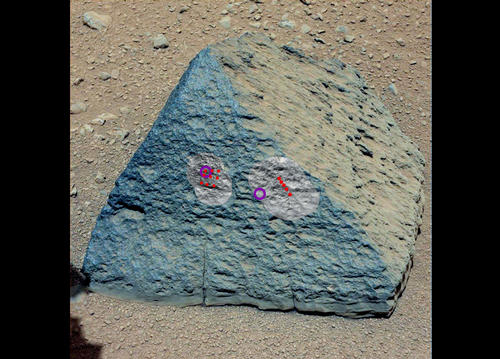
An area of the target rock “Knorr” at “Yellowknife Bay”, some 25 cm (10 inches) across, mapping the amount of mineral hydration indicated by a ratio of near-infrared reflectance intensities as detected by Curiosity’s Mastcam. The scale on the right shows the assignment of colours for relative strength of the calculated signal for hydration. The map shows that the stronger signals for hydration are associated with pale veins and light-toned nodules in the rock. This image and data were recorded on Sol 133 (Dec. 20, 2012) – click to enlarge

“With Mastcam, we see elevated hydration signals in the narrow veins that cut many of the rocks in this area,” said Melissa Rice of the California Institute of Technology, Pasadena. “These bright veins contain hydrated minerals that are different from the clay minerals in the surrounding rock matrix.” She went on to explain, “What Mastcam is seeing is water that is bound in the mineral structure of the rocks. This water is left over from a previous wet era and is now trapped and preserved in these hydrated minerals.”

The Russian-made DAN instrument on Curiosity detects hydrogen beneath the rover. At the rover’s very dry study area on Mars, the detected hydrogen is mainly in water molecules bound into minerals. “We definitely see signal variation along the traverse from the landing point to Yellowknife Bay,” said DAN Deputy Principal Investigator Maxim Litvak of the Space Research Institute, Moscow. “More water is detected at Yellowknife Bay than earlier on the route. Even within Yellowknife Bay, we see significant variation.”

Findings from the Canadian-made Alpha Particle X-ray Spectrometer (APXS) on Curiosity’s arm-mounted turret indicate that the wet environmental processes that produced clay at Yellowknife Bay did so without much change in the overall mix of chemical elements present, and confirmed the elemental composition of the outcrop Curiosity drilled into matches the composition of basalt, the most common rock-type on Mars. The APXS findings were initially affected by the dust layer common to most surfaces on Mars, which masked the basaltic signature of the rocks until the rover’s wire brush was used to scrub a section of rock clean of the dust.

“By removing the dust, we’ve got a better reading that pushes the classification toward basaltic composition,” Curiosity science team member Mariek Schmidt said. The sedimentary rocks at Yellowknife Bay likely formed when original basaltic rocks were broken into fragments, transported, re-deposited as sedimentary particles, and mineralogically altered by exposure to water.

Continue reading “Water, white balance, rocks and glitches”

Water good enough to drink

CuriosityAfter just six months on Mars, Curiosity looks to have taken a significant step towards fulfilling its primary science mission: to determine whether conditions on the planet once provided a suitable environment in which life might have arisen.

Despite recently suffering a serious computer glitch – of which more later – Curiosity’s initial analysis of cuttings gathered from inside bedrock dubbed “John Klein”, so named in honour of the late John W. Klein, MSL’s former Deputy Project Manager, and which is located in the “Yellowknife Bay” region of  Gale Crater, reveals very strong evidence that ancient Mars could have supported living microbes.

Commenting on the findings, Michael Meyer, lead scientist for NASA’s Mars Exploration Programme, said, “A fundamental question for this mission is whether Mars could have supported a habitable environment. From what we know now, the answer is yes.”

The initial findings came via the rover’s Chemistry and Mineralogy (CheMin) and Sample Analysis at Mars (SAM) instruments, which each received a portion of the rock cuttings gathered from within “John Klein” on Sol 182 (February 8th / 9th). The deliveries of the samples took place on Sols 195 (February 22nd) and 196 (February 23rd) respectively, the delay between sample gathering and delivery being down to a combination of the need to “clean” the sample holding and transfer elements of dill bit and concerns over the long-term status of a filter in part of the turret-mounted sample handling mechanism (see Getting the scoop on drilling).

The area of “Yellowknife Bay” sits at the end of what mission scientists believe to be an ancient river system, and which may have been a part of a larger lake bed in planet’s ancient past. During the drive from Bradbury Landing, where it arrived on Mars in August 2012, Curiosity has come across strong evidence for liquid having once flowed freely through the region. Rock formations commonly associated with stream and river beds have been found and imaged, and the “Yellowknife Bay” area itself bears all the hallmarks of having been formed as a result of material being carried in free-flowing liquid – most likely water. These findings have supported evidence from orbit, where images taken by various spacecraft have long pointed to large parts – if not all – of Gale Crater having been subjected to aqueous activity in the distant past. This evidence includes a broad alluvial fan of water-deposited materials located close to the landing area planned for the rover, and regarded as a valuable back-up science target should post-landing issues with the rover prevent it from undertaking the long trek up onto “Mount Sharp”.

A false colour image of the MSL landing area, showing the position of the alluvial fan of water-laden material seen from orbit and which hinted that the region had a strong aqueous past. The slopes of “Mount Sharp” can be seen in the lower right-hand corner of the image,coloured light grey (click to enlarge)

The “John Klein” bedrock itself shows strong evidence on its surface for  having been formed by aqueous activity spanning numerous wet periods in the planet’s history. However, this is not what has excited scientists – evidence for water having flowed freely on Mars has been found right across the planet, both from orbit and on the ground. During their explorations of Mars, for example, both of the Mars Exploration Rovers – Spirit (before its demise) and Opportunity – came across rock formations which had most likely been formed in the presence of liquid water.

What makes the findings returned from “Yellowknife Bay” exciting for scientists is that previously, those areas of rock thought to have been formed as a result aqueous activity also showed strong signs that the water was likely to have been highly acidic and had what is referred to as a “low energy gradient”, both of which would have made the chances of life arising within it exceptionally challenging.

Continue reading “Water good enough to drink”

Even a robot can have a memory lapse

CuriosityOn Wednesday February 27th, after some 200 days of near-flawless operations on Mars, Curiosity had its first major malfunction. Up until that point, the rover had been operating using one of its two on-board computers – the so-called “A-side”, to process all command instructions and manage its activities on Mars.

The problem was first noticed by mission planners when the rover failed to send any recorded information during routine uplinks to Earth, instead only sending current status information. On examination, this data revealed the computer had failed to enter its usual “sleep mode” as planned during the overnight period on Mars. Diagnostic work using one of the test rigs at JPL indicated that the problem appeared to be a corruption in the A-side computer’s flash memory module.

As a result of this finding, all science work on the rover – including the analysis of samples obtained from inside the “John Klein” bedrock were suspended on Thursday February 28th, as the rover was instructed to switch-over to the “B-side” computer, which was powered-up into a “safe mode” of operation in order that the rover’s functions could be maintained while investigations as to the cause of the corruption on the A-side could be further investigated.

“We switched computers to get to a standard state from which to begin restoring routine operations,” Richard Cook, project manager for the Mars Science Laboratory Project at JPL, commented at the time of the switch-over.

Mars Odyssey: swapped computer "sides" in November 2012
Mars Odyssey: swapped computer “sides” in November 2012

Memory corruptions aboard space vehicles are not uncommon, so the majority of NASA’s space missions carry redundant computer configurations. Corruptions can be the result of several things; recently, for example, the Mars Odyssey orbiter vehicle had to switch-over from its “A-side” to its “B-side” due to 11 years of constant operation finally taking its toll on the “A-side”; wearing it out. High-energy solar and cosmic ray strikes can also cause problems, even when the vehicle is shielded (as Curiosity is).

What made the problem with the MSL rover critical is that it occurred with the memory module which acts as the “table of contents” for accessing the computer’s memory, preventing data and instructions from being accessed and causing the computer to enter into an “endless loop”.

Also commenting on the switch-over, Magdy Bareh, leader of the mission’s anomaly resolution team at JPL said, “While we are resuming operations on the B-side, we are also working to determine the best way to restore the A-side as a viable backup.”

Continue reading “Even a robot can have a memory lapse”

It probably doesn’t taste like chicken …

CuriosityMission managers have confirmed that Curiosity has “ingested” samples gathered from inside the rock dubbed “John Klein” and is now analysing them.

As reported last time around, the sample gathered by the rover’s turret-mounted drill has been used to clean the drill’s internal sample-handling mechanism. Originally, it had been thought the material might be dumped after this work, and a fresh sample obtained for analysis. However, concerns about the very long-term security of a filter required for processing samples meant the decision was taken to use the sample both for clean activities and for delivery to the on-board Chemistry and Mineralogy (CheMin) and Sample Analysis at Mars (SAM) science instruments.

Prior to delivery, the sample was processed by CHIMRA, the Collection and Handling for In-Situ Martian Rock Analysis system, also mounted in the turret at the end of the robot arm. This comprised vibrating the entire turret so that material of 150-microns or smaller could be deposited into a sample delivery mechanism which would then transfer small amounts to both CheMin and SAM over a two-day period.

The first delivery of a sample of the powder obtained from inside “John Klein”, equivalent to around half as much material as in an aspirin tablet, was made to CheMin on Sol 195 (February 22nd). Then, on Sol 196, a sample of equal size was delivered to SAM.

The left Mast Camera (Mastcam) took this image of Curiosity’s sample-processing and delivery tool just after it had delivered a portion of powdered rock to SAM on Sol 196. Mounted on CHIMRA, the portion delivery tube can be seen in the centre of the image, surrounded by a C-shaped windshield. The opening is about 4mm (0.16 inch) in diameter. Portions containing about half as much material as in an aspirin tablet were dropped through that opening into CheMin and SAM. This image was taken to check whether sample material remained in the tube opening after portion delivery, and has been white-balanced to show the scene under natural daylight on Earth.

“Data from the instruments have confirmed the deliveries,” said Curiosity Mission Manager Jennifer Trosper, of NASA’s Jet Propulsion Laboratory, following the successful transfers to both instruments. The samples will now be subjected to a range of on-board tests using CheMin’s X-ray diffraction instrument, a process which generally takes a minimum of 10 hours and according to mission notes can be spread out over two or more consecutive Martian nights, and well as by the suite of instruments which comprise SAM.

Please use the page number below to continue reading this article

Getting the scoop on drilling

CuriosityCuriosity is continuing to work towards the delivery of samples obtained from inside a rock dubbed “John Klein” to the onboard Chemical and Mineralogy (CheMin) and Sample Analysis at Mars (SAM) suites of instruments aboard the rover itself.

As reported in my last update, Curiosity obtained its first sample from inside “John Klein” on Sol 182 – the 182nd Martian day since Curiosity arrived in Gale Crater, which equates to the period of the 8th/9th February on Earth.

A series of three images from Curiosity’s forward Hazard Avoidance cameras (Hazcam), primarily used by the rover when manoeuvring / driving, put together to create a “video” showing the drill operation in progress

The drilling operation, which cut a hole some 6.4cm (2.5 in) deep into the rock, collected around a tablespoon’s worth of material. In order to help avoid the risk of material from the surface of the rock, which has been affected by the environmental conditions on the surface of Mars, from contaminating drill samples, the actual sample gathering with the drill doesn’t commence until the bit is some 2 centimetres inside the rock. So in the case of “John Klein” the collected material comes from a depth of between two and five centimetres inside the bedrock layer.

The sample was gathered as cuttings from the drill’s boring into the rock were forced up into the drill bit shroud and delivered to one of two holding chambers (Chamber A in the diagram below) located in the head of the drill bit mechanism.

How the drill works: On the left, a view of the drill mechanism mounted on the rover's turret, with the drill bit centre bottom. On the right a cutaway showing the sample collection mechanism in the drill bit
How the drill works: On the left, a view of the drill mechanism mounted on the rover’s turret, with the drill bit centre bottom. On the right a cutaway showing the sample collection mechanism in the drill bit

Following collection, the sample was used to initiate “cleaning” operations designed to remove microscopic Earth- based contaminants left within the drill as a result of its construction to prevent them unduly affecting any later analysis of sample material by CheMin and (particularly, given its sensitivity) SAM.

The first part of this “cleaning” work actually occurred during the drilling operation itself, due to the vibrations caused by the drill’s percussive (hammer) action agitating the material in the collection chamber, causing it to scour the chamber walls. Once drilling had been completed, and the robot arm returned to its stowed configuration, cleaning resumed, this time using the mechanical vibration system which forms a part of CHIMRA – the Collection and Handling for In-Situ Martian Rock Analysis system. This vibrates the entire turret at high speed, causing the gathered deposits to “swish” around the drill’s sample chambers so that friction created between the cuttings and the chamber walls would help scour the latter clean.

Part of this work was delayed after two software bugs were reported by the rover. While these were subsequently shown to be of no significant concern, they did result in a pause in cleaning operations while the software was evaluated Earthside for potential impact on operations. However, with initial cleaning work deemed to have been completed on Sol 193 (February 20th), the sample was transferred directly to the rover’s sample gathering scoop so that it could be imaged using Curiosity’s Mastcam, and visually analysed as to its suitability for onward processing through CHIMRA.

Continue reading “Getting the scoop on drilling”