Space Sunday: minerals, ice, rockets and capsules

CuriosityNASA’s Curiosity rover has resumed its long, slow climb up the slopes of “Mount Sharp”, the 5 km high mound abutting the central impact peak of Gale Crater on Mars.

For the last few months, the rover has been easing its way over what is called the “Murray Formation”, a transitional layer marking the separation points between the materials deposited over the aeons to create the gigantic mound, and the material considered to be common to the crater floor. Named in honour of the late co-founder of The Planetary Society, Bruce Murray, the formation comprises a number of different land forms, which the rover has been gradually examining.

On June 4th, 2016, Curiosity collected its latest set of drilling samples – the 11th and 12th it has gathered since arriving on Mars – on the “Naukluft Plateau”, a further region of sandstone within the Murray Formation, similar to the area dubbed the “Stimson Formation”, where the rover collected samples in 2015.
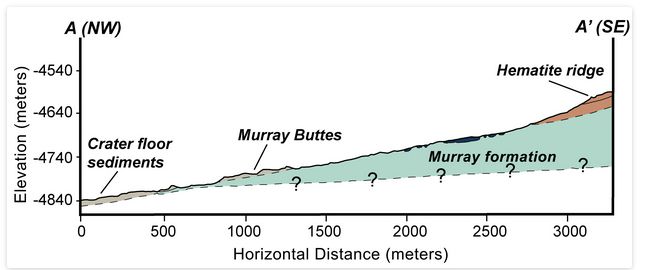
The Murray formation extends about 200 metres (650ft) up the side of "Mount Sharp". Starting at the "Pahrump Hills" below "Murray Buttes" in late 2014, Curiosity is about one fifth of the way across the region, spending extended periods examined various features within the formation. Credit: NASA JPL
The Murray formation extends about 200 metres (650ft) up the side of “Mount Sharp”. Starting at the “Pahrump Hills” below “Murray Buttes” in late 2014, Curiosity is about one fifth of the way across the region, spending extended periods examined various features within the formation. Credit: NASA JPL

The aim is to carry out comparative geology between the two sites to determine whether or not their formation is related. The “Stimson Formation” sandstone strongly suggested it has been laid down by wind after the core slopes of “Mount Sharp” had been laid down by sedimentary processes the result of Gale Crater once being home to s huge lake, but which had then been subjected to fracturing by the passage of water. These bands of fractured sandstone have become more prevalent as the rover has continued up through the “Murray Formation”, so it is hoped that by obtaining samples from “Naukluft Plateau”, the science team will gain further understanding of precisely what part water played in the evolution of the slopes of “Mount Sharp” after the lake waters had receded.
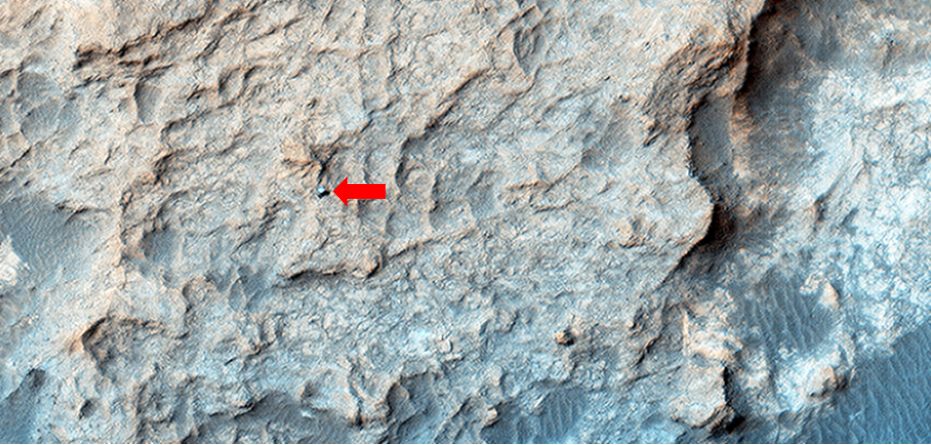
The HiRise imaging system on the Mars Reconnaissance Orbiter (MRO) captured the the Mars Science Laboratory rover Curiosity on the Naukluft Plateau in May 2016 (credit: NASA/JPL / University of Arizona)
The HiRise imaging system on the Mars Reconnaissance Orbiter (MRO) captured the Mars Science Laboratory rover Curiosity on the Naukluft Plateau in May 2016 Credit: NASA/JPL / University of Arizona

Since completing the drilling operations, Curiosity has turned south, and is now climbing the mound “head on”, rather than gradually zig-zagging its way upwards.

The MSL rover has also provided geologists with another surprise. In mid-2015, the rover collected samples from a rock dubbed “Buckskin”. Reviewing the analysis of the minerals in the samples, as discovered by Curiosity’s on-board laboratory suite, scientists have found significant amounts of a silica mineral called tridymite.

“On Earth, tridymite is formed at high temperatures in an explosive process called silicic volcanism. Mount St. Helens, the active volcano in Washington State, and the Satsuma-Iwojima volcano in Japan are examples of such volcanoes,” said Richard Morris, a NASA planetary scientist at Johnson Space Centre. “The tridymite in the Buckskin sample is thought to have been incorporated into “Lake Gale”  mudstone as sediment from erosion of silicic volcanic rocks.”

The find is significant because although volcanism did once take place on Mars, it has never been thought of as being silicic volcanism, which is far more violent that the kind of volcanism associated with the formation of the great shield volcanoes of the Tharsis Bulge and other regions of Mars. So this discovery means geologists may have to re-think the volcanic period of Mars’ early history.

China Launches Long March 7

Saturday, June 25th saw the inaugural launch of China’s Long March 7 booster, a vehicle I wrote about back in April 2016. The launch was also the first from China’s fourth and newest space launch facility, the Wenchang Satellite Launch Centre, located on Hainan Island, the country’s southernmost point.

The Long March 7 is a core component to China’s evolving space ambitions. Classified as a medium lift vehicle, it can carry around 13.5 tonnes to low Earth orbit (LEO), it will operate alongside China’s upcoming heavy lift launcher, the Long March 5. This craft will be capable of lifting around the same payload mass directly to geosynchronous orbit, and around 25 tonnes to LEO. Both vehicles will play a lead role in China’s plans to expand her explorations of the Moon, establish a permanent space station in Earth orbit by 2022, and reach Mars with automated missions.
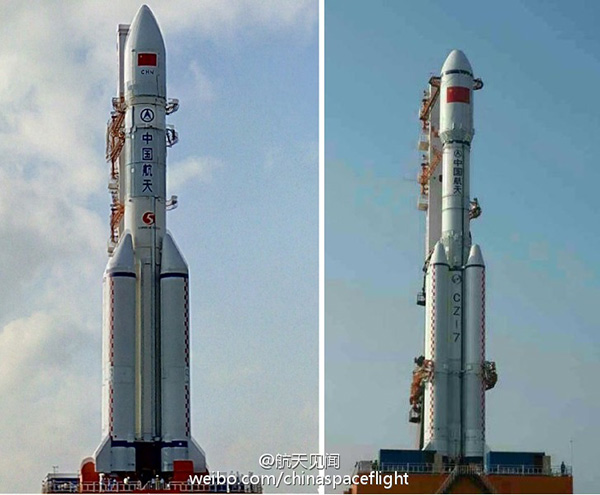
China's Long March 5 (l) and Long March 7 (r) next generation launch vehicles
China’s Long March 7 (right) launched on it inaugural flight on Saturday, June 25th. The bigger Long March 5 (left) is due to launch later in 2016. Credit: China state media

The inaugural launch of the Long March 7 took place at noon GMT on Saturday, June 25th (20:00 local time). It carried a Yuanzheng 1A upper stage and a scale model of China’s next generation crewed orbital vehicle into an orbit of 200 km (120 mi) by 394 km (244 mi) as confirmed by US tracking networks.

Yuanzheng is an automated “space tug” China has used numerous times to deliver payloads to their orbits, and is capable of re-using its engine multiple times. It is most often used to boost China’s communications satellites into higher orbits.

The sub-scale capsule was used to carry out an atmospheric re-entry test to gather data which will be use to further refine and improve the re-entry vehicle which will form a part of China’s replacement for its ageing, Soyuz-inspired Shenzhou crew vehicle. This unit returned to Earth, landing in a desert in Inner Mongolia on Sunday, June 26th, after orbiting the planet 13 times. Also aboard the vehicle was a “cubesat” mission to test a navigation system, and a prototype refuelling system.

Continue reading “Space Sunday: minerals, ice, rockets and capsules”

Space Sunday: Martian tsunamis, Indian space planes, Chinese telescopes

Mars as seen from 80 million km (50 million mi): a Hubble Space Telescope image of Mars captured during opposition on May 12th, 2016. Coincidentally, the Arabia Terra, one of the subjects in the report below, is the dark area in the centre of the image,
Mars as seen from 80 million km (50 million mi): a Hubble Space Telescope image of Mars captured during opposition on May 12th, 2016. Coincidentally, the Arabia Terra, one of the subjects in the report below, is the dark area in the centre of the image, together with Xanthe Terra. Cryse Planitia (Plain of Gold) is in the lower part of the light-coloured circular area dipping into the dark mass of Arabia and Xanthe Terra. North is to the top of the image, south to the bottom. Credit: NASA / ESA

It has long been believed that Mars once had oceans which covered most of the northern hemisphere lowlands about 3.4 billion years ago. Radar mapping from orbit has revealed layers of water-borne sediment similar to those found on Earth’s ocean floors, sitting on top of a layer of volcanic rock. In addition, there is strong evidence for an ancient shoreline and coastal areas around the rim of the ocean. The problem is, the evidence for the coastal areas is far from complete, leading to one of Mars’ many mysteries: if the lowlands were once home to a vast ocean, where did the shoreline go?

Alexis Rodriguez of the Planetary Science Institute in Tucson Arizona believes a study she and her colleagues have been carrying out may hold the key: sections of the Martian coastline may have been washed away as a result of massive tsunamis. And when I say huge – I mean waves towering some 120 metres (400ft) into the air.

The northern hemisphere of Mars when it was once home to an world-circling ocean, 3.4 billion years ago

The time of the Martian ocean coincides when the end of the period known as the Late Heavy Bombardment, when the planets of the inner solar system were subject to a disproportionately large number of asteroid impacts. Rodriguez and her colleagues have suggested that two particularly large meteoroids smashed into the northern hemisphere during this period, driving the tsunamis and reshaping the ancient shoreline.

The focus of the study is a region on Mars where the Arabia Terra upland region meets the lower-lying Chryse Planitia, and which should form a part of the ancient shoreline. Within it, Rodriguez and her team have identified two separate geological formations which may have been created by two separate tsunami events.

In this image
This set of images show the region where Arabia Terra flows down to Chryse Planitia. In figure A, the red line denotes the original ancient shoreline of the region. The grey area below and to the left of it denotes depositions believed to be the result of the first tsunami, together with outflow channels carved by the receding flood (blue arrows). The black line indicates the much younger shoreline of the region at the time of the second impact, which saw the formation of icy lobes in the region, and the embaying of features by slurry and material deposit by the receding waters. Images B and C focus on the coastal areas of deposition and embayment. Image created by Esri’s ArcGIS® 10.3 software

The older of the two looks every bit like a coastal region struck by a huge wave which deposited boulders over 10 metres across. As the water then receded back into the ocean, it cut large backwash channels through its debris and boulder field, depositing large amounts of surface material back into the ocean. Then, several million years later, the second impact took place.

This later event came at a time when Mars was effectively entering an ice age, and caused not so much massive tidal waves, but huge ice slurries which spread across the landscape, much of it freezing out, forming lobes of ice. The material which did make it back into the ocean also “embayed” older features there, partially burying them in the slurry.

Radar imaging has revealed subsurface large lobes of icy deposits along the outwash plains and channels in the Arabia Teraa / Chryse Planitia abutment, indicative of the study's suggestion that some of the material deposited after the second tsunami event froze out before it could flow back to the ancient sea
Radar imaging has revealed subsurface large lobes of icy deposits along the outwash plains and channels in the Arabia Teraa / Chryse Planitia abutment, indicative of the study’s suggestion that some of the material deposited after the second tsunami event froze out before it could flow back to the ancient sea

The study isn’t conclusive, but does offer up some strong supporting evidence. Rodriguez and her team are the first to admit more research is required before the tsunami hypothesis might be confirmed or refuted. They are now examining other areas where the ancient coastline is “missing” to see if they exhibit similar evidence for tsunami events.

Continue reading “Space Sunday: Martian tsunamis, Indian space planes, Chinese telescopes”

Space Sunday: naming a (dwarf) planet and weather watching on Mars

A revised infographic of the six largest dwarf planets, showing 2007 OR10's revised 3rd place
A revised infographic of the six largest dwarf planets, showing 2007 OR10’s revised 3rd place

While opinions may be in a state of flux over what constitutes a dwarf planet – the recent discoveries around Pluto’s interaction with the solar wind once again highlighting the debate, the fact remains that there are a fair few to be found in the solar system, with the largest five, as traditionally listed in descending order of volume, being: Pluto, Eris, Haumea, Makemake and … 2007 OR10.

These worlds are so small and so far away – in relative terms – that gathering data on them without actually paying them a visit, as we’ve done with Pluto, isn’t easy. In the case of 2007 OR10, this lack of information means it has been left without a name, only a designation related to its year of discovery.

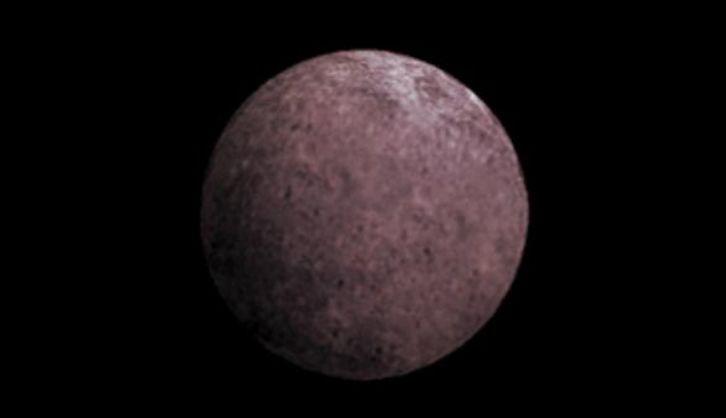
An artist's conception of 2007 OR10. Astronomers suspect that its rosy color is due to the presence of irradiated methane. Credit: NASA
An artist’s conception of 2007 OR10. Astronomers suspect that its rosy color is due to the presence of irradiated methane. Credit: NASA

However, all this might now be changing after data gathered by the Kepler observatory (about which I’ve written in recent Space Sunday reports) has helped reveal the dwarf planet – which orbits the Sun once every 547.5 years – is actually the third largest such body beyond the orbit of Neptune, sitting behind Pluto and Eris, and thus it could be a lot more interesting than first thought.

Up until now, it had been thought 2007 OR10 was about 1280 km (795 mi) in diameter. However, such is the sensitivity of Kepler’s instruments in measuring light variations whilst seeking extra-solar planets orbiting nearby stars, that the observatory has been able to precisely measure variations in the brightness of this unusually dark little world. These measurements, combined with data obtained from the Herschel Space Observatory, suggest that 2007 OR10 is around 1535 km (955 mi) in diameter, or about 255 km (160 mi) larger than previously thought.

2007 OR10The upshot of this is the dwarf planet is liable to be a far more interesting place than previously thought, potentially covered in volatile ices of methane, carbon monoxide and nitrogen, and may even be somewhat active as a result of its interaction with the solar wind. It also means that it is really overdue for a decent name.

According to convention, the honour of naming it goes to the planet’s discoverers, in this case Meg Schwamb, Mike Brown and David Rabinowitz. They discovered it in 2007 during a search for distant bodies in the Solar System. In fact, Mike Brown has already suggested a name: Snow White, in recognition of the planet’s ice surface composition.

However, this hasn’t stopped suggestions rolling in from the general public – up to and including, “Dwarfy McDwarfface”, in recognition of the recent public voting on the name for the UK’s new polar research ship.

I have to admit that – and indifference to Mike Brown’s suggestion, which doesn’t take into account 2007 OR10’s likely rusty complexion – my personal favourite suggestion has to be that from Greenwood Space Travel Supply Co (shown above right), which puts forward a very strong case for the name of this little world.  I’m also wearing my Dwarf Planet Pride Day badge with … pride!

Two Years of Weather Reporting on Mars

NASA’s Curiosity rover has completed its second year on Mars – its second Martian year, that is; August 2016 will actually mark the end of its fourth Earth year of operations in Gale Crater. This milestone is important, as it means that the rover has been able to accumulate data on two full cycles of Martian seasons and weather.

Gathering data over so long a period helps distinguish seasonal effects from sporadic events. For example, a large spike in methane in the local atmosphere during the first southern-hemisphere autumn in Gale Crater was not repeated the second autumn; it was an episodic release, albeit still unexplained. However, the rover’s measurements do suggest that much subtler changes in the background methane concentration may follow a seasonal pattern; while measurements of temperature, pressure, ultraviolet light reaching the surface and the scant water vapour in the air at Gale Crater show strong, repeated seasonal changes.

Monitoring the modern atmosphere, weather and climate fulfils a MSL mission goal, supplementing the better-known investigations of conditions billions of years ago. Back then, Gale Crater had lakes and groundwater that could have been good habitats for microbes, if Mars has ever had any. Today, though dry and much less hospitable, environmental factors are still dynamic.

Curiosity’s Rover Environmental Monitoring Station (REMS), supplied by Spain’s Centro de Astrobiología, has measured air temperatures from 15.9o C (60.5o F) on a summer afternoon, to -100o C (-148o F) on a winter night.

Comparing temperatures at Mars’ Gale Crater (lower set of bars) to temperatures in Los Angeles. It shows key differences both in how much colder the Martian site is throughout the year, and also how much greater the difference between daily highs and lows. Mars has only about one one-hundredth as much atmosphere as Earth, and without that thick blanket of atmosphere the air temperature around Curiosity usually plummets by more than  55o C (100o F) between the afternoon high and the overnight low.

Continue reading “Space Sunday: naming a (dwarf) planet and weather watching on Mars”

Space Sunday: rockets, water, wind and transits

For the second time in less than a month, SpaceX has landed the first stage of a Falcon 9 rocket on a platform at sea, bringing the total of successful landings the company has so far achieved to three.

The landing came at 05:30 GMT on the morning of Friday, May 6th, just nine minutes after the rocket had lifted-off from Cape Canaveral Air Force Station in Florida on a successful mission to carry the Japanese communications satellite JCSAT-14 to orbit.

Following separation, the first stage of the Falcon 9 1a rocket performed a series of flight manoeuvres referred to as “boost back”, which culminated in the first stage making a successful touch-down on the deck of the drone ship Of Course I Still Love You, the same craft used to recover the first stage of the Falcon 9 rocket to lift the CRS-8 resupply mission to a safe rendezvous with the International Space Station in April.

The recovery of the booster stage was actually an unexpected event – SpaceX had believed that the nature of the mission would more than likely result in a failure to achieve a successful landing.

“Given this mission’s GTO [Geostationary Transfer Orbit) destination, the first stage will be subject to extreme velocities and re-entry heating, making a successful landing unlikely,” SpaceX representatives stated ahead of the launch.

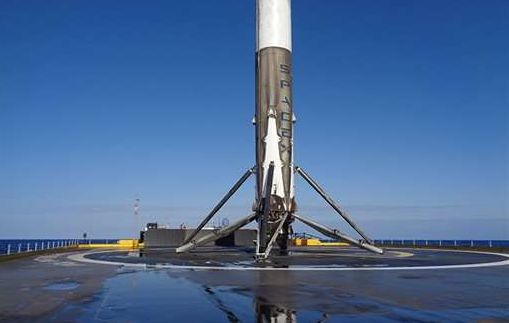
The Falcon 9 1a first stage secured on the deck of Of Course I Still Love You, following the successful May 6th landing
The Falcon 9 1a first stage secured on the deck of Of Course I Still Love You, following the successful May 6th landing. Credit: SpaceX

Ideally, the company would like to bring all of its boosters back to a touch-down on land, as was the case with their first successful landing in December 2015. However, some mission profiles mean that the Falcon 9 cannot carry sufficient fuel reserves to complete a set of “boost back” manoeuvres that would be enough for it to make landfall, so some landings at sea are inevitable if SpaceX is to get anywhere close to recovering the majority of its launchers.

Nevertheless, with three successful landings under its belt, and three first stage rockets requiring refurbishment in order to be able to fly again, SPaceX boss Elon Musk jokingly conceded, in a Tweet made after the landing, “May need to increase size of rocket storage hangar!”

The “Boiling” Waters of Mars

An international team from  France, the UK and the USA have produced the strongest evidence yet that the distinctive recurring slope lineae (RSL) features seen on the slopes of Martian craters are produced by liquid water. And not just any water; the study suggests the water is “boiling”.

RSLs have been the subject of intense debate and discussion since 2011; in essence, they are ridges and rills which appear on the slopes of hills and craters, notably in the equatorial regions of Mars during the summertime. The significance here being that on Earth, identical features are always the result of free-flowing water. As the “recurring” in the title suggests, the Martian RSLs appear to be active – frequently renewing themselves on a seasonal basis, with new RSLs sometimes also appearing at the same time.

Two images showing the flank of the same crater, revealing what appear to be active RSL, periodically renewed during the Martian summer
Two images showing the flank of the same crater, revealing what appear to be active RSL, periodically renewed during the Martian summer. Credit: NASA/JPL

However, the low pressure of Mars’ atmosphere means that water cannot survive long on the surface unprotected: it will either freeze or sublimate. So the idea of it surviving long enough to create trails in the sides of craters had many scientists scratching their heads. Then, in 2015, a NASA study put forward evidence RSLs might actually be the result of water containing a strong suspension of mineral salts – magnesium perchlorate, magnesium chlorate and sodium perchlorate. Such minerals could be sufficient enough to prevent water exposed to the surface environment on Mars either immediately freezing or sublimating.

Building on this idea, the French-led international team used blocks of water ice containing the same minerals and placed them on the slope of a simulated Martian crater housed inside a special Mars Chamber at the Open University in the UK. When the pressure in the chamber was reduced to the ambient surface pressure on Mars and the temperature adjusted to a typical Martian summer’s day, the team found the ice would melt, producing a liquid mix which effectively “boiled” filtering into the sand and moving down-slope. As it did so. the resultant vapour “blasted” sand grains upwards, creating ridges which would collapse onto themselves when they became too steep, forming channels almost identical in form to Martian RSLs.

Continue reading “Space Sunday: rockets, water, wind and transits”

Space Sunday: back to Mars with NASA and SpaceX

CuriosityIt’s been a while since there has been any major news from NASA’s Curiosity rover as it explores “Mount Sharp” in Gale Crater.

The last time I covered the rover’s activities, it was investigating a series of sand dunes which are slowly descending down the slopes of “Mount Sharp” as a result of a combination of gravity and wind action.

This work was completed in March, when the rover resumed its progress up the flank of the mound, climbing onto “Naukluft Plateau”, a roughly flat area cut into the side of “Mount Sharp” where aeons of wind erosion has carved the sandstone bedrock into ridges and knobs which were thought could offer a challenge for the rover in terms of wear and tear on the wheels.

The plateau lay between the rover and the next major area of scientific interest for the mission, so the drive team have been edging the rover across the rough terrain in the hope of reaching smoother ground on which it can continue upwards without exposing its six aluminium wheels to risk of severe damage.

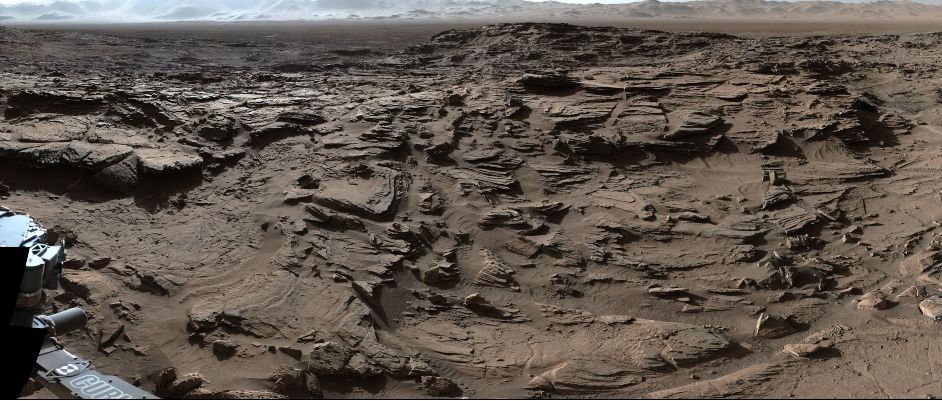
 "Naukluft Plateau", which Curiosity has been traversing since March 2016, shown in close-up, revealing how the surface has been shaped and scoured by the wind over the aeons. In the distance can be seen the rim hills of Gale Crater
“Naukluft Plateau”, which Curiosity has been traversing since March 2016, shown in close-up, revealing how the surface has been shaped and scoured by the wind over the aeons. In the distance can be seen the rim hills of Gale Crater. This image was captured om April 4th, 2016, the rover’s1,302nd Sol (Credit: NASA / JPL)

The roughness of the terrain on the plateau had raised concern that driving on it could be especially damaging to Curiosity’s wheels, as it is very similar to terrain the rover crossed in 2013 while en route to “Mount Sharp”, resulting in visible damage to some of Curiosity’s wheels, punching holes and tears into the aluminium, and prompting the mission team to undertake extensive tests on the wheels and their performance following such damage, using a duplicate of the rover here on Earth.

Because of the previous damage caused to the wheels, Curiosity was instructed to periodically image the condition of its wheels during the drive, a process which slowed progress but also revealed any damage being caused was not accelerating beyond what was projected to occur.

“We carefully inspect and trend the condition of the wheels,” said Steve Lee, Curiosity’s deputy project manager. “Cracks and punctures have been gradually accumulating at the pace we anticipated, based on testing we performed at JPL. Given our longevity projections, I am confident these wheels will get us to the destinations on Mount Sharp that have been in our plans since before landing.”

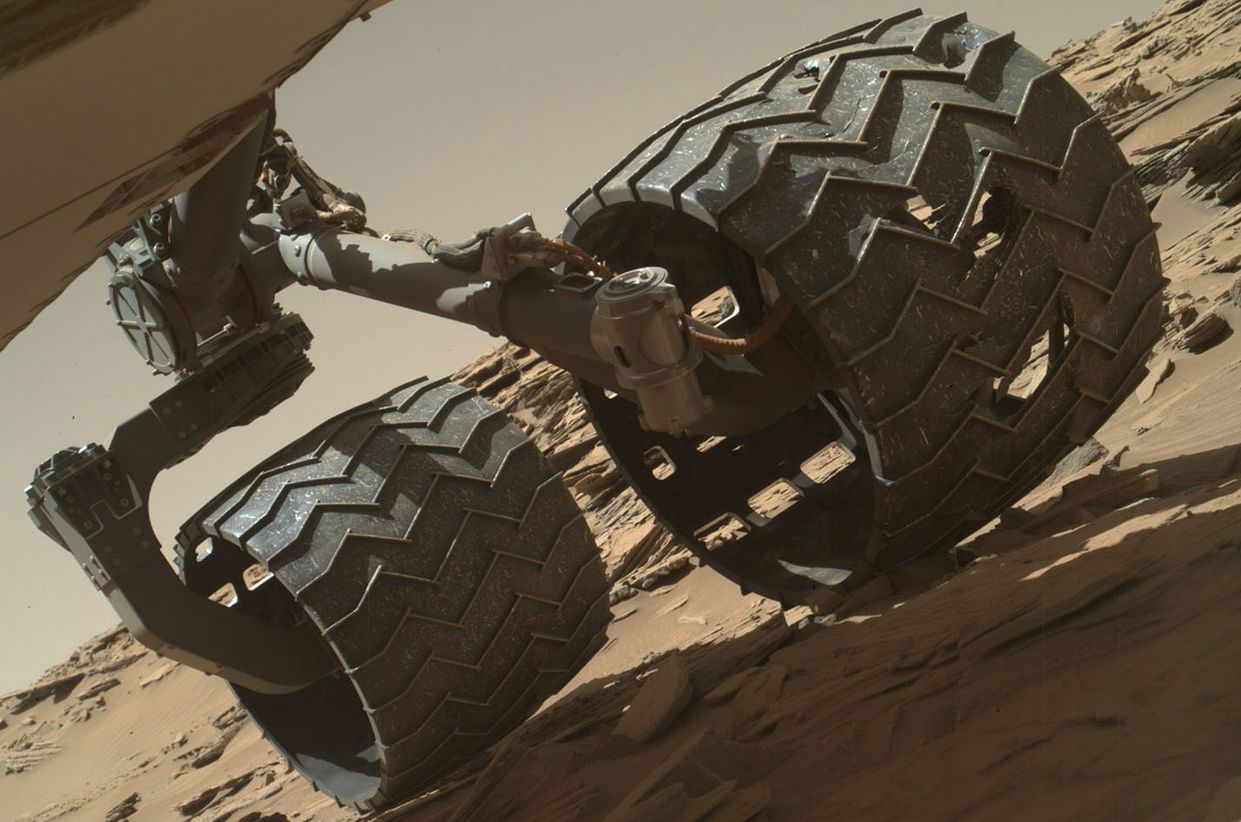
This image taken on April 18th, 2016 (Sol 1,315) by the Mars Hand Lens Imager (MAHLI) camera on the rover's robot arm revels areas of damage on Curiosity's centre left wheel, the result of periodically traversing very rough terrain since the rover arrived on Mars in 2012
This image taken on April 18th, 2016 (Sol 1,315) by the Mars Hand Lens Imager (MAHLI) camera on the rover’s robot arm revels areas of damage on Curiosity’s centre left wheel, the result of periodically traversing very rough terrain since the rover arrived on Mars in 2012 (Credit: NASA / JPL)

In particular, the mission team is watching for breaks or tears which damage the zig-zag treads – called grousers – on the 50cm / 20 in wheels. If three of these grousers are significantly broken, Earth-based tests suggest the damaged wheel will have reached about 60% of its serviceable life.

However, since Curiosity’s current odometry of 12.7 km (7.9 mi) is about 60 percent of the amount needed for reaching all the geological layers planned in advance as the mission’s science destinations, and no grousers have yet broken, the accumulating damage to wheels is not expected to prevent the rover from reaching those destinations on Mount Sharp.

“Naukluft Plateau” is a part of the larger “Stimson formation” which includes a fracture area the rover reached a late April. Dubbed “Lubango”, the area was the target for the rover’s 10th drilling and sample gathering campaign, which was completed on Sol 1320, April 23rd, 2016.

“We have a new drill hole on Mars!” reported Ken Herkenhoff, a MSL science team member, when reporting on the sample gathering in an MSL update on April 28th.

After transferring the cored sample to the CHIMRA instrument for sieving it, a portion of the less than 0.15 mm filtered material was successfully delivered this week to the CheMin miniaturized chemistry lab situated in the rover’s body, which is now analysing the sample and will return mineralogical data back to scientists on earth for interpretation.

“Lubango” was selected for sample gathering after it had been determined following examination using the ChemCam laser and spectrometer,  that it was altered sandstone bedrock and had an unusually high silica content.  To complement the analysis of “Lubango”, the science team has been using the rover’s camera systems to locate a suitable target of unaltered Stimson bedrock as the 11th drill target.

“The colour information provided by Mastcam is really helpful in distinguishing altered versus unaltered bedrock,” MSL science team member Lauren Edgar explained in describing the current work. One possible target, dubbed “Oshikati” has been identified.

A white-balanced telephoto view of Gale Crater's rim, as seen from the flank of "Mount Sharp"
A white-balanced telephoto view of Gale Crater’s rim, as seen from the flank of “Mount Sharp” (Credit: NASA / JPL)

The ChemCam laser has already shot at the “Oshikati” to gather data for an initial analysis of the rock and assess its suitability for drilling operations. If all goes according to plan, Curiosity should make an attempt to gather samples from the rock on Sunday, May 1st.

SpaceX To Launch NASA-Supported Mars Mission in 2018

On April 27th, SpaceX announced it plans to launch an automated mission to Mars in 2018 as a part of a new space act agreement the company has signed with NASA. This will see the US space agency provide technical support to SpaceX with respect to an automated landing of a SpaceX vehicle on Mars, and provide scientific support for the mission.

an artist's impression of Red Dragon arriving on Mars (credit: SpaceX)
An artist’s impression of Red Dragon arriving on Mars (credit: SpaceX)

SpaceX will undertake the mission using Red Dragon, an automated version of the Dragon 2 capsule vehicle which will enter service in 2018 to fly crews two and from the International Space Station.

Red Dragon has been on the drawing boards at SpaceX almost since the inception of the Dragon 2 programme. Designed to be launched atop the upcoming Falcon 9 Heavy launcher, due to enter operations later this year, it is specifically intended to carry science payloads almost anywhere in the solar system, and could potentially deliver as much as 4 tonnes of cargo to the surface of Mars (that’s  the equivalent of delivering 4.5 Curiosity rovers to Mars in one go).

The 2018 mission is primarily intended to look at using a purely propulsive means of achieving a soft landing of a heavy vehicle on Mars. While parachutes could, in theory, be used to help slow a vehicle’s descent through the Martian atmosphere, recent NASA tests of the kind of large-scale “supersonic” parachutes required to slow large space vehicles during their descent haven’t proved overly successful during comparable testing at high altitude on Earth.

The Falcon 9 Heavy, which could lift scientific payloads aboard the Dragon 2 carrier vehicles almost anywhere in the solar system - compared to the current Falcon 9 (Credit: SpaceX)
The Falcon 9 Heavy, which could lift scientific payloads aboard the Dragon 2 carrier vehicles almost anywhere in the solar system – compared to the current Falcon 9 (Credit: SpaceX)

Dragon 2 has been specifically designed so that a series of 8 rocket engines – called Super Draco motors – are embedded in the base of the vehicle. These can be used both as a launch abort system – firing a crew clear of a malfunctioning rocket during lift-off –  and as a means of the vehicle achieving a “soft landing” on land rather than splashing down in the ocean (although the Dragon 2 is capable of this as well).

On Red Dragon, these super Draco motor allow the vehicle to slow itself down through its descent through the tenuous Martian atmosphere, and then act as a final cushioning break as the craft comes into land. Tethered tests here on Earth have already demonstrated Dragon 2 is fully capable of maintaining a hover until the thrust from the engines, and these tests will be expanded upon during the run-up to the mission.

The Red Dragon initiative is a commercial endeavour, funded entirely by SpaceX. NASA will not be contributing to the cost of the mission, but will be providing Earth-side logistical support and a suitable science payload of around 1 tonne. The exact nature of this payload will be defined in the future,  but will likely include a diverse range of instruments which might be used to further characterise the Martian atmosphere, study and Martian weather and soil, and image the surface of Mars. Both SpaceX and NASA will share the data gathered during what is referred to as the EDL phase of the mission – the Entry, Descent and Landing. NASA will also supply a scientific payload for the flight.

Red Dragon marks the first phase of an ambitious programme SpaceX will be announcing in September, but which has been under development for about the last 6 years, for undertaking human missions to Mars in the 2020 / 2030s. I’ll have more on this later in the year.

Space Sunday: China’s ambitions, Dawn’s success and Kepler’s return

China's space station, as it should look in 2022 (credit: China Manned Space Engineering)
China’s space station, as it should look in 2022 (credit: China Manned Space Engineering)

China has confirmed a series of ambitious new goals for its growing space endeavours, starting with the launch later this year of a new orbital facility, and progressing through 2018 with the launch of the core module for a large-scale space station, and which includes further mission to the Moon and to Mars.

The first orbital facility launched by China, Tiangong-1 (“Heavenly Palace-1”), was launched in 2011. Referred to as a “space station”, the unit was more a demonstration test-bed for orbital rendezvous and docking capabilities. While it was visited by two crews in 2012 and 2013, neither stayed longer than 14 days, and sinc 2013,  Tiangong-1 has operated autonomously, although it has suffered a series of telemetry failures in that time.

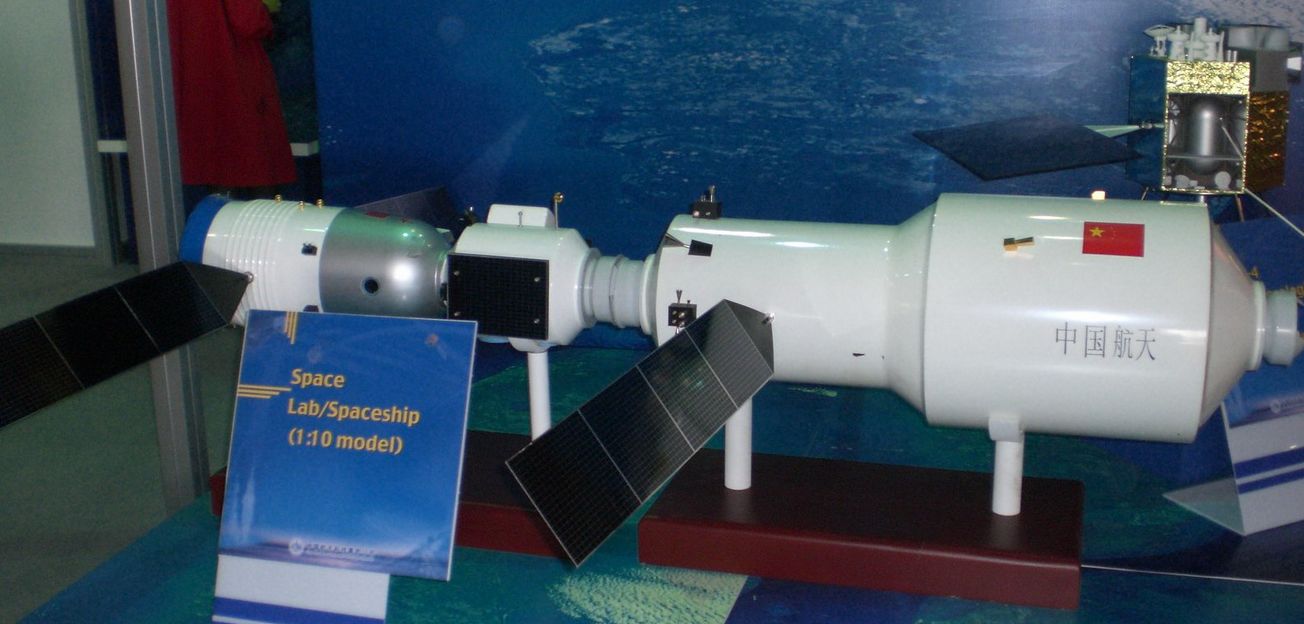
A model of Tiangong-2, which will be 14.4 metres (47 ft) in length, 4.2 metres (14 ft) in diameter and mass 20 tonnes, seen docked with a crewed Shenzhou ("Divine Craft") orbital vehicle on the left (Credit: unknown originating source)
A model of Tiangong-2, which will be 14.4 metres (47 ft) in length, 4.2 metres (14 ft) in diameter and mass 20 tonnes – almost 3 times the mass of the Tiangong-1 unit, seen docked with a crewed Shenzhou (“Divine Craft”) orbital vehicle on the left (Credit: unknown originating source)

Tiangong-2 will be launched later in 2016, and is designed to build on the experiences gained with the original facility, helping to pave the way for China’s first “genuine” space station. In particular, Tiangong-2 will provide an experiments bay, improved living facilities for longer-during stays, and allow China to verify key technologies such as propellant refuelling while in orbit, and undertake fully automated docking activities using uncrewed vehicles, when the nation’s first automated resupply vehicle, Tianzhou-1 (“Heavenly Vessel-1”) docks with the facility in 2017.

Tiangong-2 will be followed, in 2018 by the launch of the larger Tianhe-1 (“Sky River-1”) unit, which will form the core module for China’s first dedicated space station. Over the four years from 2018, this will grow with the addition of up to three other pressurised modules,  together with a docked “Hubble-class” space telescope. It be supported and maintained by automated re-supply mission from Earth using the Tianzhou, and provide living and working space for up to 6 crew,

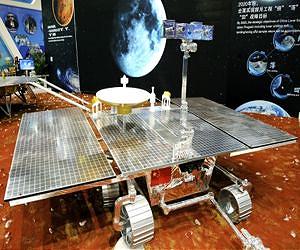
A prototype model of the propsed Mars rover China plans to launch in 2020 as part of a 3-phase mission involved an orbiter / carrier vehicle, a static lander and the rover (credit:
A prototype model of the proposed Mars rover China plans to launch in 2020 as part of a 3-phase mission involved an orbiter / carrier vehicle, a static lander and the rover (credit: China National Space Administration)

Nor does it end there. At the end of March, I wrote about China’s aggressive approach to Mars exploration.

As a part of the series of announcements made by the Chinese authorities in the run-up to their first national Space Day on April 24th, 2016 – being the anniversary of the launch of China’s first satellite, Dongfanghong-1 (‘The East is Red’) – it was confirmed that the planned orbiter / rover mission to the red planet will be launched in 2020.

The rover element of the mission will build on experience gained during the deployment and operation of the Yutu vehicle on the Moon in 2013, and will be used to investigate the planet’s soil, atmosphere, environment, and look for traces of water.

As part of the preparations for this mission – although it is also a mission in its own right – China plans to land the its Chang’e-4 (“Moon Goddess”) probe, on the far side of the Moon in 2017, an operation which will be carried out fully autonomously of Earthside intervention.

To ensure all this happens, China is developing two new launch vehicle – the Long March 5 and the Long March 7. The Long March 5 will form the backbone of China’s space activities, offering a family of 6 launch vehicle variants, the largest of which will be capable of placing up to 25 tonnes in low Earth orbit (LEO), 14 tonnes in geosynchronous transfer orbit (GTO) for missions to the Moon, Mars or elsewhere, putting it in the same class of launch vehicles as America’s Atlas V and Delta IV launchers, and the commercial SpaceX Falcon 9 launcher.

Using non-toxic and pollution-free propellant, the 60-metre-long vehicle has a core diameter of 5 metres, and will be equipped with four strap-on booster 3.5 metres in diameter, Long March 5 is the first of China’s launch vehicles to specifically designed for both cargo / satellite launches and crewed mission launches.  The maiden flight of the vehicle is expected to be the Chang’e-4 mission to the far side of the Moon.

China's Long March 5 (l) and Long March 7 (r) next generation launch vehicles
China’s Long March 5 (l) and Long March 7 (r) next generation launch vehicles (credit: Sina Weibo)

The Long March 7 vehicle will be slightly smaller, capable of lifting 13.5 tonnes to LEO, although this will be enhanced over time to allow the vehicle to lift up to 20 tonnes to LEO. It will form the launch vehicle for the  Tianzhou resupply missions to Tiangong-2 and Tianhe-1, and over time will be uprated to crewed launch vehicle status. It is slightly smaller than the Long March 5, with a height of 53 metres, a core diameter of 3.35 metres, and used 4 2.25 metre diameter liquid-fuelled strap-on boosters. The first launch of a Long March 7 vehicle is expected later in 2016, when it lifts Tianzhou-1 for a rendezvous with Tiangong-2.

Continue reading “Space Sunday: China’s ambitions, Dawn’s success and Kepler’s return”