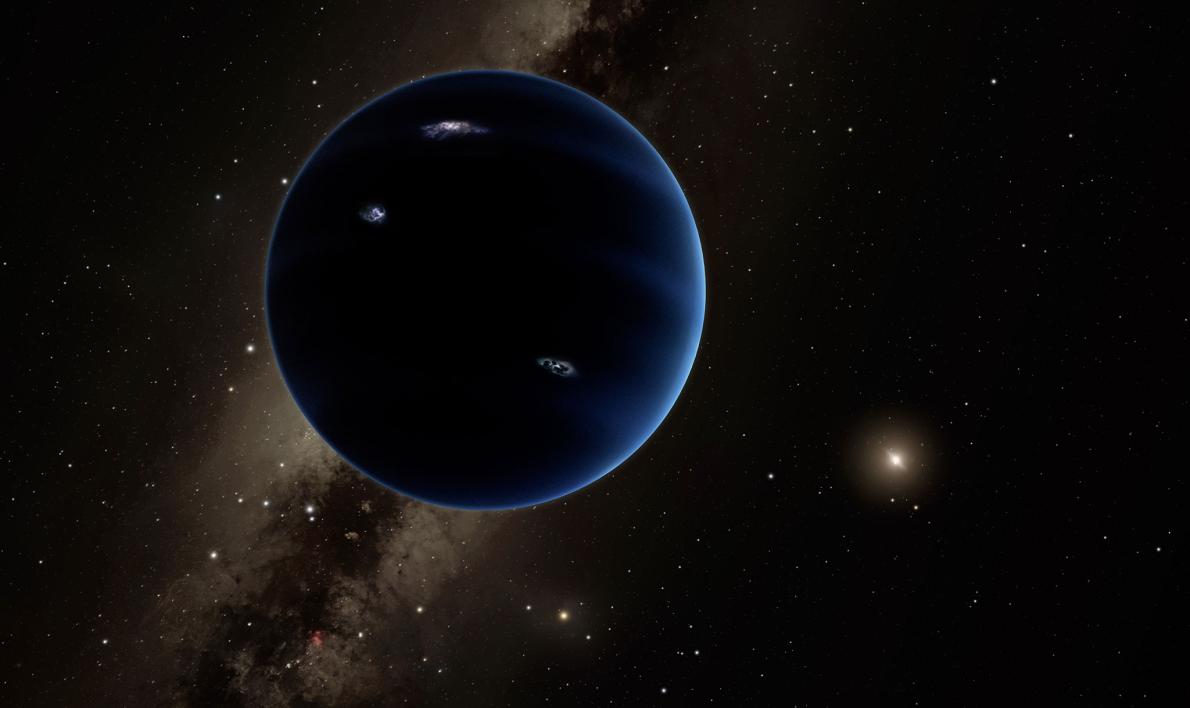
In January and February 2016, I wrote about Planet Nine (or Planet X, George, Jehoshaphat, or Planet of the Apes, depending your preference), the Neptune-sized world believed to be orbiting the sun on the very edge of the solar system in a highly eccentric orbit. Since then, the search for this mysterious world has continued, and while it has yet to be located, evidence that it exists has been mounting. Not only that, but astronomers now believe it might explain why the solar system is “tipped”.
The Hunt started after Mike Brown, a leading planetary astronomer at the California Institute of Technology (Caltech), and his colleague Konstantin Batygin developed a computer model which showed that the very eccentric orbits of six Trans-Neptunian Objects (TNOs) located in what is called the scattered disk, a sparsely populated region of space between 30 100 AU from the sun, overlapping with the Kuiper belt, could have been due to the influence of a massive, distant planet. At the time, they noted that if the model was correct, other TNOs would likely occupy equally distinct orbits.

At the joint European Planetary Science Congress (EPSC) and American Astronomical Society’s Division for Planetary Sciences (DPS) in October, it was revealed more TNOs fitting the model have been discovered over the past several months. Two of them, 2013 FT28 and 2014 SR349, precisely fit the same type of orbit seen the original six objects used by Brown and Batygin model. Five more have been found in orbits which are effective perpendicular to Planet Nine’s believed orbit around the Sun, something predicted by the computer model.
All of this is helping to narrow down Planet Nine’s potential orbit around the Sun, and the arc of that orbit where it might be found. So much so that Batygin, Brown have teamed with original proponents for Planet Nine Chad Trujillo and Scott Sheppard to use the 8-metre Subaru Telescope atop Mauna Kea in Hawaii to carry out a search of the night sky. Sheppard and Trujillo are also using two telescopes in Chile to search the possible sweep of the planet through the southern hemisphere’s night sky. And they are not alone.

Also at the planetary conference, graduate student Elizabeth Bailey, using Brown and Batygin’s data presented a paper proposing how the odd tilt to the solar system’s major planets relative to the Sun might be due to Planet Nine.
With the exceptional of Mercury, all the major planets in the solar system orbit along a plane tilted by about six degrees from the Sun’s equator. This suggests either the Sun was somehow tipped on its axis in the past, or the planets have been pulled from their original alignment along the Sun’s equatorial plane. Of these two ideas, the preferred option has been for exotic interactions between the early Sun’s magnetic field and the primordial disk of gas surrounding it, inclining the latter, which then formed the planets. However, Bailey’s simulations suggest that a large body occupying Planet Nine’s predicted orbit could have had sufficient influence on the Sun over some 4 billion years to have slowly tipped it over by six degrees. Bailey’s hypothesis was supported by a Brazilian team of astronomers, who used a different analytical method while working independently from her, and reached the same conclusion.

Even so, some remain sceptical that the mysterious world exists. “I give it about a 1% chance of turning out to be real,” says astronomer JJ Kavelaars, of the Dominion Astrophysical Observatory in Victoria, Canada. Interestingly, his fellow researcher and collaborator Cory Shankman, has created models with the exact orbits of the original six TNOs used by Brown and Batygin, and found that a massive planet would not maintain their tell-tale clustering for long periods.
Thus, the search for the solar system’s mysterious Planet Nine, continues.
ETs Phone Home?
Are aliens sending signals using their own stars? That’s what might be happening, according to astrophysicists Ermanno Borra and Eric Trottier, from Laval University in Quebec; although they admit it’s only one possible explanation for what they appear to have discovered.
It was in 2012 that Borra predicted intelligent aliens might use the light from their own stars to signal their existence to the cosmos. Using data from the Sloan Digital Sky Survey, Borra and Trottier analysed the spectra of 2.5 million stars to see if this might be the case – and found 234 which seem to be broadcasting a signal of the kind predicted by Borra.
The “signals” are pulses in the stars’ light, separated by a constant time interval. What’s more, all 234 stars are predominantly in the F2 to K1 spectral range, which is the small range of stars centred on the spectrum of our own life-supporting Sun, and thus the broad group of stars thought might support life on planets orbiting them.

However, as Borra and Trottier note in their paper – which has yet to be comprehensively peer-reviewed – the pulses could be the result of natural factors such as rotational transitions in molecules or the Fourier transform of spectral lines. It might even be due to rapid pulsations in the stars themselves. Nevertheless Borra and Trottier have tended to dismiss rotational transitions on the grounds that such behaviour isn’t common to these types of star. They also think it unlikely a Fourier transform is responsible.
Instead, they lead towards either the “signals” being an artefact produced by data reduction on the part of the Sloan instrument, or the work of ET, with a slight emphasis towards the ET side of their thinking. Others, having read their paper, are far more sceptical.
“It seems unlikely that 234 separate alien societies would be sending out such similar signals more or less simultaneously” Seth Shostak, a senior astronomer at the SETI (Search for Extraterrestrial Intelligence) Institute in Mountain View, California said. “It would be like expecting us to send the same signals as the Abyssinians — it doesn’t make a whole lot of sense.” Instead, Shostak leans towards the data reduction explanation; as does Occam’s Razor.
But a further possible explanation has been suggested: that the signals are due to highly peculiar chemical compositions in a small fraction of galactic halo stars which has never been previously encountered. While not as exotic as aliens using their stars as signalling devices, should this prove to be the case, it would still be a remarkable new discovery.
Continue reading “Space Update: Planet Nine, “signalling” stars and a quick round-up”









 Inara Pey: Living in a Modemworld