Space Sunday: big rockets and (possible) ISS troubles

A shot from the “flap cam” on Starship, showing the Super Heavy immediately after separation during IFT6. Note the residual gases burning within the hot staging ring. Credit: SpaceX

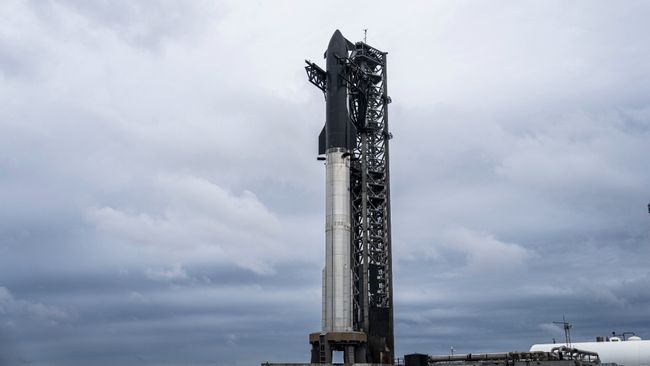
The sixth integrated flight test (IFT-6) of the SpaceX Starship / Super Heavy behemoth took place on Tuesday, November 19th, 2024, and proved to be perhaps the most successful test yet of the system, even though the core aspect of the first part of the flight didn’t occur.

The vehicle lifted-off from the SpaceX Starbase facility at Boca Chica, Texas at 22:00 UTC. All 33 Raptor-2 engines on the Super Heavy booster ignited, and the massive vehicle lifted-off smoothly. All continued to run, and the initial phases of the flight passed without incident: the vehicle passed through Max-Q, reached Most Engines Cut-Off (MECO) at 2 minutes 35 seconds, leaving it with just three motors running.  Seven second later, hot staging occurred, Starship firing all 6 of its engines and then separating from the booster.

Starship IFT6 rising from the launch facilities, November 19th, 2024. Credit: Redline Helicopter Tours

This was followed by the booster flipping itself onto a divergent trajectory to Starship and re-igniting the ring of 10 inner fixed motors to commence its “boost back”: gradually killing it ascent velocity and bringing it to a point where it could commence a controlled fall back to Earth, and then a powered final descent into being caught b the Mechazilla system on the launch tower, as seen during the October flight.

However, during the boost-back, the call was made to abort the attempt at capture, and to instead direct the booster to splashdown in the Gulf of Mexico. The booster then went through a nominal descent, dropping engines first (and causing them to glow red-hot during the compression of air inside their nozzles, despite the fact none were firing).

Booster in the water: seconds after splashdown, a single motor still running, the Super Heavy booster sits in the Gulf of Mexico. Credit: SpaceX

At just over 1 km altitude, the 13 inner motors did right, all of them firing for some 7 seconds and reducing the rocket’s descent from 1,278 km/h to just 205 km/h. At this point nine of the ten motors on the inner fixed ring shut down, with one appearing to run a second or so longer. When it shut down, there was a belch of flame of the base of the booster, which might indicate an issue.

Nevertheless, the three central motors continued to operate, gimballing to bring the booster to a vertical position and a brief hover right above the water before cutting off and allowing the rocket to drop end-first into the sea. Remaining upright for a moment, the booster then started to topple over. However, as the live stream cut away at that point, it was down to other camera to capture the subsequent explosion due to water ingress around the super-hot engines, etc., which destroyed the rocket.

“There’s the kaboom!” Shots from onlookers demonstrating that 13 super-heated engines and their plumbing and residual gases in propellant tanks don’t play nice with cold sea water, as the Super Heavy booster explodes

The Starship vehicle, meanwhile, made it to orbit and continued on over the Atlantic and Africa to  the Indian Ocean, where it went through its de-orbit manoeuvres.

Whilst in the coast phase of the flight, the vehicle had been due to re-ignite one of its vacuum engines to demonstrate this could be done in space. This occurred at 37 minutes 46 seconds into the flight, the motor running for about 4 seconds. Although brief, the re-light was a milestone – Starship will need the capability while on orbit in the future.

A camera in Starship’s engine bay captures the steady firing of one of its vacuum Raptor-2 motors during the flight’s orbital coast phase. Credit: SpaceX

The Starship’s return to Earth was anticipated as being potentially “whackadoodle”, and subject to possible vehicle loss. This was because SpaceX had removed elements of the thermal protection system designed to protect the vehicle from burning-up during atmospheric re-entry.

The purpose in removing tiles from the vehicle was to expose parts of the hull where, if Starship is also to be “caught” by the Mechazilla system on its return to Earth, it will need exposed elements on the side bearing the brunt of the heat generated by re-entry into the atmosphere, and SpaceX wanted data on how the metal of the vehicle held-up to being exposed to plasma heat, particularly given the previous two flights had seen plasma burn-through of at least one of the exposes hinges on the vehicle’s aerodynamic flaps.

The leading edge of a flap show clear signs of impending burn-through during re-entry – but the damage is a lot less than previous flights. Credit: SpaceX

As it turned out, the vehicle managed very well during re-entry; there was a significant amount of very visible over-heating on the leading edge of a flap, but even this was less than seen in IFT4 and IFT 5. It’s not clear as to how much damage the exposed areas of the vehicle suffered were TPS tiles had been removed, but given the vehicle survived, any damage caused was clearly not sufficient to compromise its overall integrity.

The drop through the atmosphere was visually impressive, the flight so accurate that as the vehicle flips itself upright at less than 1 km above the ocean, the landing zone camera buoy anchored ready to record the splashdown can clearly be seen. Immediately after entering the water, the Starship toppled, bursting into flame – but this time not immediately exploding.

After fling half-way around the world, the Starship vehicle is about to splashdown just a handful of metres from the camera buoy (arrowed, top right)at the landing zone. Credit: SpaceX

Whilst a booster catch might not have been achieved, IFT6 can be classified a success. All criteria but the catch of the booster was achieved, and even though the later was lost as a result of a forced splashdown, the successful diversion of the booster to do so demonstrates an ability for SpaceX to divert a vehicle away from a landing tower in the event of an issues with the tower – providing said issues are spotted earl enough.

The flip side of this is that it exposes an inherent weakness in the system; the reason for the abort was that the actual launch of the vehicle had caused damage to the launch tower and its communications systems, calling into question its ability to make the catch. Tower / launch stand damage has been a recurring theme with Super Heavy launches, although the degree of damage caused has been dramatically reduced.

The moment before splashdown, as seen from the Starship flap cam (l) and the remote camera buoy (r). Credit: SpaceX

Even so, the fact that comms systems could be KO’d reveals how vulnerable the system is to a potential loss of vehicle (and the knock-on impact in terms of “rapid reusability”), particularly if there is no close-at-hand and available launch / catch tower available to take over the role. And while this abort was called when the vehicle was still 87 km altitude, with lots of time to bring it safely into a splashdown, can the same be said if an issue occurs when the vehicle is just 13 km above ground? Or ten? Or two? Or if the malfunction occurs in the final engine burn?

ISS Reports “Toxic Smell” and Atmosphere Scrubbed

Update: Several hours after this article was published, NASA issued a statement on the event described below.

Reports are surfacing of possible toxic contamination board a resupply vehicle at the International Space Station (ISS). Initial news on the situation was broken by the highly-reliable Russian Space Web, operated by respected space journalist and author, Anatoly Zak, but that the time of writing this piece, western outlets had not reported the story, which is still breaking.

On November 21st Russia launched the automated Progress MS-29 resupply vehicle to the International Space Station (ISS), carrying some 2.487 tonnes of supplies, including 1.155 tonnes of pressurised supplies, 869 Kg of propellants; 420 kg of water and 43 kg of nitrogen gas.

Cosmonauts Ivan Vagner and Alexei Ovchinin monitor the automated approach and docking of Progress MS-29 at the Poisk module of the Russian section of the ISS. The majority of Progress dockings are automated, but members of the crew are on hand to manually intervene if required. Credit: Roscosmos / NASA

After being placed in an initial parking orbit, the vehicle rendezvoused with the ISS on November 23rd, manoeuvring to dock with the zenith port of the Poisk module (mini research module – MSM 2), attached to the Zvezda main module of the Russian section of the station. Following docking, the vehicle was secured and the pressure between the module and Progress vehicle pressurised to allow the hatches between the two to be opened.

However, the hatch to the Progress has to be immediately closed due to a “toxic smell” and a potential contamination hazard in the form of free-floating droplets. Following the securing of the hatches, NASA’s flight controllers apparently ordered the activation of the Trace Contaminant Control Sub-assembly (TCCS) in the International section of the ISS, a system designed to remove traces of potential airborne contaminants, effectively scrubbing the atmosphere in the ISS, with the Russian crew activating a similar system within the Russian section for around 30 minutes, with the cosmonauts themselves donning protective equipment (as reported last week, the main hatch between the two sections of the station is now kept shut due to a continuous leak of air through the Russian Zvezda module).

Progress MS-29 approaching the ISS, November 23rd, 2024. Credit: Roscosmos

The cause of the smell and the overall status of the MS-29 vehicle have yet to be determined; this is a developing story.

New Glenn Gets Ready

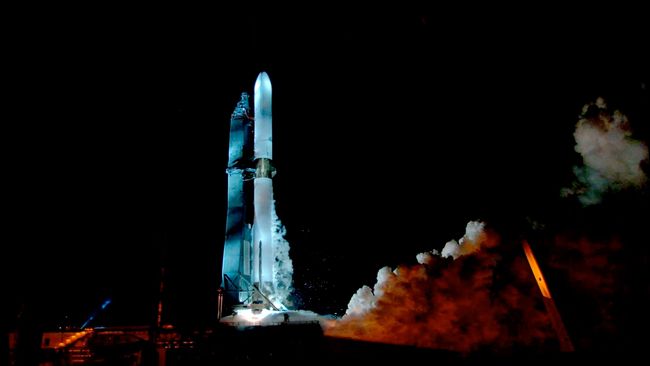
Blue Origin is approaching a readiness to launch their new heavy lift launch vehicle (HLLV), the New Glen rocket.

Earlier in November I reported on the new rocket’s first stage being rolled from the Blue Origin manufacturing facilities at Kennedy Space Centre to the launch preparation facilities at Space Launch Complex 36 (SLC-36), Cape Canaveral Space Force Station. These facilities already held the rocket’s upper stage, which had undergone a series of static fire tests of its motors whilst on a test stand at the pad earlier in the year.

Integrating the first and upper stages of the first New Glenn rocket to fly. Credit: Blue Origin

Since the arrival of the 57.5 metre long first stage at the integration facility at SLC-36, Blue Origin engineers have been preparing the vehicle for launch. By November 14th, the first and second stages of the rocket has been integrated with each other, and worked moved to integrating the payload and its protective fairings to the rocket.

Originally, the inaugural flight for the massive rocket – capable of lifting up to 45 tonnes to low Earth orbit (LEO) – was to have been the NASA EscaPADE mission to Mars. However, due to complications, the flight will now be the first of two planned launches designed to certify the system for the United States Space Force’s National Security Space Launch (NSSL) programme. The payload for the flight will be a prototype of Blue Origin’s Blue Ring satellite platform, a vehicle capable of delivering satellites to orbit, moving them to different orbits and refuelling them.

The fully assemble rocket, two stages plus the payload and its protective fairings, backs towards launch pad SLC-36, Cape Canaveral Space Force Station, November 21st, 2024. Credit: Blue Origin

On November 21st, the completed rocket – over 80 metres in length – rolled out of the integration facility and delivered to SLC-36, where it was raised to a vertical position, mounted on the 476-tonne launch table designed to support it and keep it clamped to the pad.

The actual launch date for the mission has yet to be confirmed, but it will see the company both launch the rocket and attempt to recover the reusable first stage, called So You Think There’s a Chance? Following separation from  the upper stage of the rocket, the first stage will attempted to make and controlled / power decent to and landing on the Blue Origin’s Landing Platform Vessel 1 (LPV-1) Jacklyn.

The New Glenn rocket mounted on its 476-tonne launch table at SLC-26, November 21st, 2024. Credit: Blue Origin

Artemis 2 Vehicle Progress

Even as NASA’s Space Launch System (SLS) continues to face a potentially uncertain future due to its per-launch cost, the second fully flight-ready vehicle continues to come together at NASA’s Kenned Space Centre in readiness for the Artemis II mission.

The mission, which is targeting a launch in late 2025, is due to carry a crew of four – Reid Wiseman (Commander); Victor Glover Pilot; Christina Koch, flight engineer and Jeremy Hansen (Canada), mission specialist – on an extended flight of up to 21 days, commencing with the crew aboard their Orion Multi-Purpose Crew Vehicle (MPCV), being placed in low Earth orbit, prior to transiting to a high Earth orbit with a period of 24 hours.

The Artemis II mission profile – click for full size, if required. Credit: NASA

Once there, they will carry out a series of system checks on the Orion and its European Service Module (ESM), as well as performing rendezvous and proximity flight tests with the rocket’s Interim Cryogenic Propulsion Stage (ICPS), simulating the kind of rendezvous operations future crews will have to do in order to dock with the vehicles that will actually carry them down to the surface of the Moon and back. After this, the crew will make a trip out and around the Moon and back to Earth.

The Orion capsule for the mission is nearing completion, with core assembly completed and the internal fixtures, fittings and systems on-going. Earlier in November 2024, and sans its outer protection shell and heat shield, it was subjected to a series of pressure tests to simulate both the upper atmosphere and space to ensure it had no structural integrity issues.

The core stage of the Artemis II SLS rocket, complete with its four main engines, inside NASA’s gigantic Vehicle Assembly Building (VAB). One of the base segments of a solid rocket booster (SRB) can be seen in the background. Credit: NASA

Meanwhile, the SLS vehicle itself has commenced stacking. The core stage, with is massive propellant tanks and four RS-25 “shuttle” engines, arrived at the Vehicle Assembly Building (VAB), Kennedy Space Centre, in July 2024, and since this has been undergoing much work whilst still lying on its side.

More recently, work on stacking the two solid rocket boosters (SRBs) developed from those used with the space shuttle, that will help power it up through the atmosphere has also commenced.

A crane inside the VAB prepares to lift one of the SRB motor sections and its assembly gantry, ready to place it on the back of a transport vehicle. November 13th, 2024. Credit: NASA

The SRBs comprise 5 individual segments which need to be manufactured and then bolted together, prior to being filled with their wet cement-like solid propellant mix. The base segments of these boosters include the rocket motor and guidance controls, and on November 13th, these were rolled into the Vehicle Assembly Building on special transport / stacking gantries. Over the next several months, the two SRBs will be assembled vertically in one of the bays within the VAB, and then loaded with their propellant and capped off.

Once the SRBs are ready and their avionics, etc., checked out, the core stage of the SLS will be hoisted up into one of the VAB’s high bays, moving to a vertical orientation as it does so. It will then be lowered between the two SRBs so that they can all be joined together. After this the ICPS will be moved up into position and mated to the top of the core stage of the rocket, and then work can commence stacking the Orion and its ESM and their launch fairings.

The SRB motor and its mounting gantry on the transporter, ready to be moved to the VAB bay where stacking can commence, November 13th, 2024. Credit: NASA

Whether or not Artemis II makes its planned late 2025 launch (no earlier than September) is open to question; currently, NASA has yet to fully complete the work on ensuring the already manufactured heat shield for the mission’s Orion vehicle is fit for purpose, per my previous report on heat shield issues.

Space Sunday: more from China, Skylon and an air leak

An artist’s impression of the Haolong automated resupply vehicle, intended to support China’s Tiangong space station. Credit: CCTV

China’s space programme is perhaps the most aggressive in the world in terms of ambitions and speed of development. In the last two decades, the country has been embarked on one of the most forward-thinking human spaceflight programmes, quickly moving from two small orbital laboratories to a fully-fledged space station whilst setting its eyes firmly on the Moon. At the same time, it has shown itself to be the equal of both the United States and Europe in the field of robotic exploration of the Moon and Mars, whilst also seeking to match the United States in pioneering the use of uncrewed reusable vehicles.

Most notably in this latter regard has been the Shenlong orbital vehicle, which I first wrote about in 2023, and which completed its second 200+ day orbital mission September 2024. Whilst not as long in duration as those of America’s X-37B, which it matches in terms of size and secrecy, Shenlong could be broadly as capable. And it will soon be joined by a second Chinese automated spaceplane, one with a similar purpose to America’s upcoming Dream Chaser vehicle.

Called Haolong, this new vehicle is one of two finalists in an 18-month selection process initiated by the China Manned Space Engineering Office (CMSEO) to determine the next generation of resupply vehicles intended to support the country’s Tiangong space station. In May 2023, CMSEO sought proposals from government agencies and China’s growing private sector space industry for vehicles capable of delivering a minimum of 1.8 tonnes of materiel to the Tiangong space station at a cost of no more than US$172 million per tonne. From the 10, in September 2023 four were selected to move forward to a more intensive design and review phase lasting just over a year, with the potential for two of them to be picked for full vehicle development.

A model of the Haolong automated cargo vehicle displayed at the Zhuhai Air Show, November 2024. Credit: China News Agency

On October 29th, 2024, the winning proposals were announced, with the Haolong spaceplane immediately gaining the the most interest due to its nature and the fact it was heavily promoted at China’s annual Zhuhai Air Show, complete with videos showing it in operation and images showing the full-size proof-of-concept development model.

Haolong’s development is being undertaken by an unlikely source: the Chengdu Aircraft Design and Research Institute, operated by the state-owned Aviation Industry Corporation of China (AVIC). Neither Chengdu, which is largely responsible for military aircraft development, nor AVIC has been involved in space vehicle development until now. At a length of 10 metres and a span of 8 metres with its wings deployed, Haolong is very slightly longer and wider than America’s Dream Chaser (9 metres long with a 7-metre span). Like the American vehicle, Haolong is designed to be vertically launched via a rocket, its wings folded to fit within a payload fairing, ready to be deployed once it reaches orbit and separates from its carrier rocket.

Haolong docked at Tiangong, note the open doors with the solar arrays and thermal radiators. Credit: CCTV

Exactly what to overall payload capability for the vehicle might be is unclear; Chengdu have only confirmed it will be able to lift the required 1.8 tonnes to orbit. This is less than one-third the total load carried by the current automated (and completely expendable) Tianzhou resupply vehicle, which can carry up to 6 tonnes to orbit – a capacity Dream Chaser can match.

However, given Haolong’s size and pressurised cargo space – coupled with the fact that the CMSEO requirement included a provision the new resupply vehicles can dispose of / return to Earth up to 2 tonnes of waste / materiel – it would seem likely Haolong’s all-up payload capability is liable to be above the 1.8 tonne minimum should it ever be required to fly heavier loads. 

A rendering of the Tianzhou automated resupply vehicle used to support China’s Tiangong space station. Fully expendable, the 14-tonne Tianzhou is itself based on China’s first two orbital laboratories, also confusingly called Tiangong (1 and 2). Credit: Shujianyang

But even if this isn’t the case, Haolong still scores over Tianzhou, as it’s all-up mass is expected to be less than half that of the older vehicle, potentially enabling it to be launched by a selection of Chinese rockets rather than being restricted to the expensive Long March 7. It could, for example even come to be launched atop the semi-reusable Long March 2F (if this enters production), or the rumoured semi-reusable variants of either the Long March 8 or long March 12B, as well as the expendable versions of Long March 2.

Details of the second vehicle to be selected, the Qingzhou cargo spacecraft, are somewhat scant, including its overall reusability. However, it will be launched via the upcoming Lijian-2 rocket being developed by CAS Space. The latter is commercial off-shoot of the Chinese Academy of Sciences, so technically its use as the launch vehicle for a space station resupply craft marks the first time a commercial entity will participate directly in China’s national space programme.

Long March 9: China’s Answer to Starship / Super Heavy?

Also present at the Zhuhai Air Show were further models of China’s in-development super heavy launch vehicle, the Long March 9 (Changzheng 9 or CZ-9) booster, together with the first models of China’s answer to (or near-clone of, if you prefer) the SpaceX Starship vehicle.

First announced in 2011, Long March 9 has been through a number of iterations and design overhauls. As first envisaged, the vehicle would comprise a 10-metre diameter core stage supported by up to four 5-metre diameter liquid-fuelled boosters (essentially Long March 10 first stages), giving it the ability to lift an upper stage with a payload capacity up to 140 tonnes to low-Earth orbit (LEO). With minor variations, this remained pretty much the baseline design until around 2019.

The Long March 9 super heavy launch vehicle as originally envisioned in 2016, to scale with other launch system, notable the SpaceX BFR, the precursor to Starship / Super Heavy. Credit: Wikipedia (2018)

A substantial redesign then appeared in 2021. This saw the elimination of the strap-on boosters and the first stage diameter increased 10.6 metres. To compensate for the loss of the strap-on boosters, the first stage of the vehicle had its original four engines replaced by 16 kerosene / liquid oxygen (LOX) motors, each one generating some 300 tonnes of thrust at sea level, allowing it to haul up to 160 tonnes of payload up to LEO.

Then in 2022, the decision was made to make the first stage of the rocket reusable. The LOX / kerosene motors were swapped for 26 of the more efficient YF-135 methane / LOX motors, the exact number compensating for the reduction in overall thrust. However, as 26 main engines required an 11-metre diameter first stage to fit them and their additional propellants, the design was then scaled back to keep the 10.6 metre diameter, and the number of motors reduced to 24 first stage engines. A further change at this point small the vehicle’s optional third stage increased in diameter from 7.5 metres to 10.6 metre as well, unifying all three stages.

This design carried over to 2023, where it was displayed at that year’s Zhuhai Air Show. However, the engine configuration had again changed for the first stage, with 30 of the more compact YF-215 motors now being used. In this configuration, Long March 9 was touted as being capable of delivering somewhere over 100 tonnes but less than 160 tonnes of payload to LEO in a two-stage variant and between 35 and 50 tonnes of payload to the Moon in a 3-stage version.

A drawing of the 2023 version of Long March 9 from the 2023 Zhuhai  Air Show, showing the 30-stage variant, said to be capable of delivering up to 53 tonne to the surface of the Moon; the 2- stage version with 100-160 lift capability and the proposed “Starship” variant with a 100-tonne capability to LEO and full reusability. Credit: CALT / CCTV

Also revealed at the 2023 Air Show were drawings of CALT’s take on the SpaceX Starship. At the time, the idea was defined as a “possible” iteration of the Long March 9 design, and unlikely to be ready for use – if pursued – until the 2040s. However, at the 2024 Air Show held in early November, it was clear CALT is invested in making a fully reusable Long March 9 launch system; on display were a set of models, one showing the Long March reusable first stage with the “starship” vehicle sitting on top of it, with two smaller models showing the “starship” vehicle on the lunar surface and a Long March 9 first stage resting on its “catch gantry” at the end of a flight.

According to CALT representatives at the show, work has now commenced on fabricating the first Long March 9 test vehicle, indicating the core design for the rocket’s first stage is now largely finalised, and the focus will initially be on developing this and the expendable second and third stages, with the first launch of an integrated rocket targeted for 2030. However, the representatives also indicated that the development of the reusable upper stage vehicle is seen as more integral to China’s lunar aspirations, and that they are looking to introduce it possibly as soon as the mid-to-late 2030s.

Scale models of the proposed “starship” upper stage of the Long March 9 sitting on the Moon (l) and the first stage booster resting on its landing gantry’s movable arms. Note how the deployable grid fins are used to support the mass of the booster on the gantry arms. Credit: CCTV

While making no secret of the fact they are directly emulating SpaceX with their design, CALT noted their vehicle would be more flexible in its application. As well as being able to deliver 100 tonnes to LEO, it was suggested it will be able to deliver smaller payloads to other orbits – such as MEO, GEO, GTO and SSO, and deliver as much as 50 tonnes to TLI, all apparently without the need for on-orbit refuelling (which Starship currently requires in all these cases).

If the lack of refuelling is accurate, then it suggests CALT are considering different internal layouts for their “starship”, such as utilising payload space for additional propellant tanks to enable their vehicle a wider range of operational capabilities; however, until CALT are more forthcoming on exactly how they envisage vehicle operations to work, this is purely speculative.

Reaction Engines in Administration

Reaching orbit using rockets – even reusable ones – is a costly business.  Rockets require complex, high-performance (and costly) motors, have to carry a lot of propellants to feed them, and require a lot of specialised infrastructure to operate them. Because of this, one of the holy grails of access to space has been the SSTO – single stage to orbit – vehicle; a craft capable of taking off in a manner akin to that of an aircraft, reaching orbit and then returning to Earth and again landing like a conventional aircraft.

In the 1980s, Britain in particular worked on an SSTO concept called HOTOL (Horizontal Take-Off and Landing), an uncrewed vehicle roughly the size of an MD-80 airliner. It would have utilised a unique air-breathing engine underdevelopment by Rolls Royce (the RB-545) to carry up to 8 tonnes of payload to orbit , using the air around it as an oxidiser for its rocket motors, mixing it with on-board supplies of liquid hydrogen until the atmosphere became too rarefied for this, and the engines would switch to using on-board LOX with the liquid hydrogen. But despite initial government backing, interest from the European Space Agency and the United States, HOTOL floundered and ultimately died in 1989, and Rolls Royce shelved development of the RB-545.

A cutaway diagram of REL’s Skylon vehicle. Credit: Reaction Engines Ltd

Undeterred by this, one of HOTOL’s originators, Alan Bond, co-founded Reaction Engines Ltd (REL), a company dedicated to developing both a new air-breathing engine to supersede the RB545 and a new SSTO spaceplane to use it. The motor, called SABRE (Synergetic Air Breathing Rocket Engine) and the vehicle, called Skylon, have been in development ever since, with SABRE in particular seeing much progress and both national and international interest. In fact, as recently as 2019, things looked remarkably rosy for SABRE and Reaction Engines.

This is why the announcement that REL had entered administration, with all staff laid-off, is deeply saddening. An eight-week process has commenced to either restructure or sell the company; if neither proves viable, it will enter liquidation and all assets sold-off. No formal reason for the company’s failure to continue to gain funding has been given; however, it has been suggested that the fact SABRE and Skylon would only be able to operate from specially reinforced runways, rather than any suitably-equipped airport facility, may have been a contributing factor.

The SABRE engine. Credit: Reaction engines Ltd

NASA and Roscosmos at Loggerheads over ISS Leak

For the last five years the International Space Station (ISS) has been suffering from an atmospheric leak within one of its oldest modules, the Russian Zvezda Service Module. Launched in 2000 as the third major element of the space station, Zvezda is actually approaching its 40th birthday, the core frame and structure having been completed in 1985 when Russia was still engaged in its Mir space station programme.

As such, the unit is well beyond its operational warranty period, and since 2019, the short airlock tunnel connecting the Zvezda’s primary working space with the aft docking port has been suffering an increasing number of microscopic cracks that have allowed the station’s atmosphere to constantly leak out. Whilst the overall volume of atmosphere lost is small, by April 2024 it had reached a point where attempts to patch some of the cracks were made. While this did reduce the amount of air being lost for a short time, the volume has once again be rising of late.

The Russian Zvezda Module (also called the PrK module), seen from its aft end, with the Progress dock post visible. The airlock tunnel where the leaks are occurring is the cream-white cylinder just inside the module’s main structure, surrounding the docking port. Credit: NASA

Whilst the leaks are still far short of being any risk to the station’s crew, NASA and Roscosmos cannot reach an agreement on either their root cause or their potential to become a significant hazard. Roscosmos remains of the opinion that the cracks are purely down to thermal contraction as the module expands and contracts as it passes in and out of the Sun’s light and heat, and therefore no different to the thermal wear on all other parts of the station.

However, while agreeing agreeing thermal expansion and contraction has a role to play in the leaks, NASA does not agree that it is the only cause. Instead, they see the continued use of the aft docking port – primarily used to receive Progress resupply vehicles – as putting additional stress on the tunnel’s walls, and this, couple with the aging of the module in general and the thermal expansion / contraction is causing the cracks. What’s more, NASA is concerned that if use of the after docking port continues, it is elevating the risk of a high-rick failure within the tunnel which could seriously compromise station operations.

A Progress resupply vehicle docked at the rear end of the Zvezda Module. NASA believes the cracks causing the atmospheric leaks inside the module are in part the result of stresses induced on the module by Progress docking / undocking operations. This image was captured during a station “flyaround” by the shuttle Discovery during STS-102, March 2001. Credit: NASA

Given this, NASA would like to see Roscosmos discontinue the use of the docking port – which Roscosmos argues is not necessary. While both agree the issue is unlikely to result in a complete and catastrophic failure within the tunnel culminating in a lost of the station as a whole; NASA engineers and mission controllers are concerned that any failure within the tunnel could impact operations throughout the station. As such, they have ordered the hatch between the Russian elements of the ISS and the US / international modules to be kept closed other than during crew passage between the two sections of the station.

Space Sunday: New Glenn, Voyager and Orion

Blue Origin’s New Glenn first stage rolls past NASA’s Vehicle Assembly Building (VAB) for its first trip to the launch facilities at SLC-36, Cape Canaveral Space Force Station in February 2024. Credit: NSF

In the world of commercial space development, there is a tendency to pooh-pooh the efforts of Blue Origin, the company founded by billionaire Jeff Bezos. This is chiefly done through comparisons with SpaceX, a company which has achieved a lot over the last decade in particular, albeit (and contrary to what SpaceX fans will insist as being the case) largely at the largesse of the US government, from whom the company receives the lion’s share of its revenue.

However, this may all be about to change. Whilst much of the public focus on Blue Origin has been on their sub-orbital New Shepard vehicle catering to the space tourism industry, the company is now gearing-up in earnest for the (somewhat overdue) launch of its massive New Glenn launch system.

Originally targeting a maiden flight in 2020, the 98-metre tall vehicle is now due to launch in November 2024 from Cape Canaveral Space Launch Complex 36. The payload for this mission was to have been NASA’s Mars EscaPADE mission. However, that mission was removed from the flight by NASA over concerns that Blue Origin might miss the required launch window. As a result, the company switched its attention to the second planned flight for New Glenn, a demonstration flight for the United States Space Force’s National Security Space Launch (NSSL) programme, with the payload taking the form of a prototype of Blue Origin’s Blue Ring spacecraft platform.

New Glenn is classified as a heavy lift launch vehicle with a maximum payload capacity to low-Earth Orbit (LEO) of 45 tonnes, with a fully reusable first stage. This compares favourably with Falcon Heavy’s 50 tonnes with all three of its core stages recoverable (although the latter can lift up to 63 tonnes to LEO when all three core stages are discarded).  In addition, New Glenn is designed to deliver up to 13.6 tonne to geostationary transfer orbit (GTO) and up to 7 tonnes to the Moon, as well as the ability to send payloads deeper into the solar system.

As well as the first stage of the rocket being designed from the ground up to be reusable, Blue Origin plan to replace the current expendable upper stage of the system with a reusable stage called Jarvis; however, little has been heard on this front since 2021. If it happens, it will make New Glenn fully reusable.

In September 2024, the company carried out static fire tests of the expendable upper stage of the rocket, and on October 30th, Blue Origin rolled-out the first stage for the maiden launch from its Exploration Park complex at Cape Canaveral Space Force Station for a 37 km, multi-hour road trip to Launch Complex 36 “having to go the long way round” as Dave Limp, Blue Origin’s CEO put it.

The route taken from Blue Origin’s Exploration Park and SLC-36 at Cape Canaveral Space Force Station.

The long journey was the result of the sheer size of the booster and its transporter: a 94.5 metre long behemoth comprising a powerful tractor and two trailers with a total of 22 axles and 176 tyres. Simply put, it’s not the most manoeuvrable transport, with or without a 57.5 metre first stage on its back; as such, the route from factory facility to pad had to reflect this.

The stage in question comprised an engine module which also includes the landing legs, the core tank section and am upper interconnect – the section of a booster onto which the upper stage connects. After being delivered to the vehicle integration facility at SLC-36, Limp confirmed it will be participating in an integrated hot-fire test.

The first stage of the inaugural New Glenn booster rolls into the the vehicle integration facility at SLC-36 on the back of GERT – the Giant Enormous Rocket Transport (yes, really). Credit: Blue Origin

Each New Glenn first stage is designed to be re-used 25 times, with Blue Origin planning a cadence of up to 8 launches per year, and already have a growing list of customers. While this cadence might not sound as extensive as SpaceX and Falcon 9, it should be remembered that the larger percentage of SpaceX Falcon 9 launches are non-commercial / non-government / non-revenue generating Starlink launches; as such, New Glenn’s cadence is potentially in step with the current state of the US commercial and government launch requirements.

As noted, for the inaugural launch, New Glenn will be carrying a prototype Blue Ring satellite platform capable of delivering up to 3 tonnes of payload to different orbits, and capable of on-orbit satellite refuelling (as well as being refuelled in orbit itself) and transporting them between orbits, if required.  It is “launch vehicle agnostic”, meaning it can be flown with payloads aboard any suitable vehicle – New Glenn, Vulcan Centaur, Falcon 9.

An artist’s impression of the Blue Ring space tug. Credit: Blue Origin

The prototype will be flown as the Dark Sky-1 (DS-1) mission, intended to demonstrate the vehicle’s Blue Origin’s flight systems, including space-based processing capabilities, telemetry, tracking and command (TT&C) hardware, and ground-based radiometric tracking in order to prove the craft’s operational capabilities in both commercial and military uses. To achieve this, the vehicle will operation in a medium Earth orbit (MEO), ranging between 2,400 km by 19,300 km.

In addition, the flight will be used to check the New Glenn upper stage’s ability to re-light its motors multiple times. After the launch, the first stage will attempt to make a return to Earth and a landing at sea aboard the company’s Landing Platform Vessel 1 (LPV-1) Jacklyn, as shown in the video below.

The company is targeting the end of November for New Glenn’s inaugural launch. However, given the work still to be completed, it is possible this might slip to December 2024. If successful, the flight will for one of two certification launches for the USSF NSSL programme, both of which are required to clear New Glenn for classified lunches.

As well as these projects – all of which have been directly funded by Bezos himself outside of a modest contract payment made under a Defense Innovation Unit (DIU) payment – Blue Origin is well on the way to developing its Blue Moon Mark 2 lunar lander, capable of supporting up to four astronauts on the surface of the Moon for up to 30 days.

An artist’s impression of the Blue Moon Mark 2 crew lander. Credit: Blue Origin

A cargo variant of the lander, able to deliver between 20 and 30 tonnes (non-reusable) to the lunar surface is also in development. Both versions are intended to be part of NASA’s sustainable lunar architecture to follow the use of the SpaceX HLS vehicle (Artemis 3 and 4). However, there is some speculation that Blue Moon – due to be used with Artemis 5 onwards – is much further along in its development that the SpaceX HLS, and Artemis 5 might fly in the slot in Artemis 3 mission. Time will tell on this as well.

Voyager 1: Communications Issues

I’ve covered the Voyager mission, and its twin spacecraft Voyager 1 and Voyager 2 numerous times in these pages. After 47 years, both craft are now operating beyond the heliopause, and whilst technically still within the “greater solar system” and heading for the theorised Oort Cloud, both craft are now operating in the interstellar medium. However, they are obviously aging, and this is impacting their ability to operate.

As I recently reported, as a result of both vehicles’ declining ability to generate electrical power, NASA has, since 1998, been slowing turning off their science instruments in the hope that they can eke out sufficient electrical power from the RTGs powering both craft to allow them to continue to operate in some capacity into the early 2030s. However, this is far from a given, as again demonstrated in October 2024.

As a part of the “power saving” activities with both Voyager craft, mission engineers periodically power down one of vehicles’ on-board heaters, reducing the electrical load on the RTGs, and then ordering the heater to power-back up as and then powering-down another. On October 16th, 2024, a command was sent to Voyager 1 to power-up one such heater. Due to the distances involved, confirmation that the command had been received and executed would not be received for almost 48 hours. However, on October 18th, NASA’s Deep Space Network (DSN), responsible for (among other things) communicating with all of NASA’s robotic missions, reported it was no longer receiving Voyager 1’s “heartbeat ping” periodically sent from the vehicle to Earth to confirm it was still in communications.

A drawing of a Voyager space craft with the high-gain antenna prominent. The X- and S-band communications systems, located at the centre of the dish, use it to send / receive communications. Credit: NASA/JPL

Both Voyager craft have two primary communications systems: a high-power X- band (8.0–12.0 GHz frequency) for downlink communications from the craft to Earth and a less power-intensive S-band (2 to 4 GHz frequency) for uplink communications from Earth to the craft. However, each also has a back-up S-band capability for downlink communications, but because it is of a lower power output than the X-band, it hasn’t been used since around 1981.

Realising the loss of X-band communications had effectively come on top of the command to turn on a heater, engineers theorised that in trying to power on the heater, Voyager 1 had exceeded its available power budget and entered a “safe” mode, turning off the power-hungry X-band communications system to provide power to the heater. They then trained over to the much lower-power S-band downlink frequency, as any loss of the X-band system should have triggered an automatic switch-over – and sure enough, after a while, Voyager 1’s “heartbeat ping” was received.

This allowed a test to be carried out in sending and receiving commands and responses entirely via S-band, and on October 24th, NASA confirmed communications with the vehicle had been re-established. The work of diagnosing precisely what triggered the “safe” mode & shut down of the X-band system is now in progress, and the latter communications system will remain turned off until engineers are reasonably confident that re-activating it will not trigger a further “safe” mode response.

NASA Confirms Root of Orion Heat Shield Issues – But Won’t (Yet) Disclose

There are, frankly, multiple issues with the US-led Artemis Project to return humans to the surface of the Moon by 2030. They encapsulate everything from the vehicles to be used to reach the Moon and its surface (NASA’s Space Launch System rocket and the SpaceX Human Landing System and its over-the-top mission complexity of anywhere between 10 and 16 launches just to get it to lunar orbit) the supporting Lunar Gateway space station and its value / cost, etc. However, from a crew perspective, one of the most troubling had been with the heat shield used on the Orion vehicle – the craft intended to carry crews to cislunar space and, most particularly, return them to Earth.

Orion has thus far made one, unscrewed, flight to the Moon and back, in November / December 2022 (see here and here for more). While the system as a whole – capsule and service module – operated near-flawlessly, with the capsule making a successful return to Earth and a splashdown on December 11th, 2022, post-flight examination revealed that the craft’s heat shield had suffered a lot more damage – referred to as “char loss” – that had been anticipated.

The moment of splashdown for Artemis 1, December 11th, 2021. Credit: NASA

As with most capsule systems, Orion uses an ablative heat shield which is designed to carry away heat generated during re-entry into the atmosphere through the twin process of melting and ablating to dissipate the initial thermal load, and pyrolysis to produce gases which are effectively “blown” over the surface of the heat shield to form a boundary layer between the heat shield and the plasma generated by the frictional heat of the capsule’s passage into the denser atmosphere, producing a “thermal buffer” again the heat reaching the vehicle.

Ablative materials do not necessarily melt / ablate (the “char loss” process) evenly and can lead to gouges and strakes in the surviving heat shield. However, this is not what happened with the heat shield used in the Artemis 1 mission. Rather than melting and ablating, the heat shield material, known as Avcoat, appeared to crack and break away in chunks, creating a visible debris trail behind the craft during re-entry and leaving the heat shield itself pock-marked with holes and breaks looking like someone had taken a hammer to it.

While the damage was not severe enough to put the capsule itself at risk, it was clearly of concern as it indicated a potential for some form of burn-through to occur in a future flight and put vehicle and crew at risk of loss. NASA and its contractors have therefore been seeking to understand what happened as Artemis 1 Orion capsule was re-entering the atmosphere, and what needs to be done to avoid such deep pitting and damage in future missions.

Most of this work has been carried out well away from the public eye; in fact, the only images of the damage caused to the heat shield were published as part of a report produced by NASA’s Office of Inspector General (OIG) in May 2024.

Two of the official NASA images showing the severe pitting and damage caused to the Orion MPCV heat shield following re-entry into Earth’s atmosphere at 36,000 km/h at the end of the uncrewed Artemis 1 mission, December 11th, 2022. These were made public within the NASA OIG report on the readiness or Orion for the Artemis 2 mission. Credit: NASA / NASA OIG

On October 24th, 2024 NASA indicated, by way of two separate statements, that they now understand what caused to Artemis 1 heat shield to ablate as it did, and know what needs to be done to prevent the problem with missions from Artemis 3 onwards. However, the agency has said it will not disclose the problem or its resolution, as they are still investigating what needs to be done with the Artemis 2 heat shield.

We have conclusive determination of what the root cause is of the issue. We have been able to demonstrate and reproduce it in the arc jet facilities out at Ames. We know what needs to be done for future missions, but the Artemis 2 heat shield is already built, so how do we assure astronaut safety with Artemis 2?

– Lori Glaze, acting deputy associate administrator, NASA Exploration Systems Development Mission Directorate

Artemis 2 was slated for a 2024 launch, but was pushed back to no earlier than September 2025 in order to allow time for the heat shield investigations, and for the upgrade of various electronics in the Orion capsule’s life support systems. Glaze’s comments suggest that NASA might have to completely replace the heat shield currently part of the Orion capsule slated to be used in the Artemis 2 flight. If this is the case, then it could potentially further delay the launch.

Space Sunday: Chinese Space tourism; America’s X-37B

A “boarding pass” for a sub-orbital flight aboard Deep Blue Aerospace’s “Rocketaholic” capsule and Nebula-1 booster. Credit: Deep Blue Aerospace

One of the most expansive space programmes, both national and commercial, is that of China. I’ve covered multiple missions carried out by the Chinese national space programme both in terms of human spaceflight and the establishment of an orbital space station, and robotic missions to the Moon and Mars. I’ve also touched on the country’s growing commercial space sector, some of which seemingly “borrowing” heavily from the likes of SpaceX in terms of vehicle design and development – particularly with regards to reusable boosters.

At the top of the list for the latter is Jiangsu Deep Blue Aerospace Technology. Founded in 2016, the company has been recognised for developing a family of semi-reusable launch vehicles called Nebula – which bear a remarkable resemblance to the SpaceX Falcon 9.

The smaller Nebula-1 vehicle-capable  of lifting payloads in the 2-8 tonnes range – has been undergoing increasingly ambitious launch and landing tests of the vehicle’s first stage over the last several years. The company had been planning to lunch the vehicle on its first orbital flight, including the booster returning to a landing, be the end of 2024. However, the loss of a Nebula-1 first stage during a high altitude launch and recovery flight in late September has now put this in doubt.

The Nebula-2 vehicle, meanwhile, not only resembles Falcon 9 with very similar landing legs and grid fins, but is also a very similar payload capability, including up to 20 tonnes to low-Earth orbit (LEO) in a full expendable mode (compared to Falcon 9’s 22 tonnes when fully expendable). It is due to make its orbital debut in late 2025.

Whether either vehicle can be considered a direct “rip off” of Falcon 9 is perhaps debatable: form follows function when it comes to flight dynamics; but it’s hard to imagine Deep Blue reaching their rocket design and propulsion choice without them taking a long, hard look at SpaceX.

Deep Blue’s capsule and launch vehicle bear a remarkable similarity to the Crew Dragon and Falcon 9 operated by SpaceX. Credit: Deep Blue

This is perhaps even more true when looking at the latest announcement concerning the company’s other planned area of operations: sub-orbital tourist flight to the edge of space. On October 23rd, 2024, the company’s CEO,  Huo Liang, announced these sub-orbital flights will start in 2027, and ticket reservations are now open.

The flights will, according to Huo, be akin to Blue Origin’s New Shepard flights: lift-off using a recoverable booster (in this case, the Nebula-1 first stage), carrying a capsule capable of sitting up to 6 people in two rows of back-to-back seats, prior to the booster separating and returning to a safe landing.

Once separated, the capsule will coast ballistically, passing through the Kármán line at 100km altitude, the passengers getting to enjoy around 5-minutes in weightlessness, prior to gravity making its presence felt once more as the capsule commences its fall back to Earth. Parachutes will be used to slow the descent until just above the ground, when four pairs of mid-mounted motors will be fired for a soft landing. It’s not clear if the capsule will include either a “crush ring” at its base designed to absorb the final impact with the ground (like the New Shepard capsules) or utilise some form of inflatable cushion, as with Boeing’s CST-100 capsules.

What is interesting is the capsule’s uncanny resemblance to the SpaceX Crew Dragon. The two are so similar in overall looks and dimensions, one might be forgiven for thinking they are the product of the same company. The only at-a-glance difference (outside of the paint scheme) being Crew Dragon had two viewports on one side of the vehicle, and the Deep Blue vehicle – which at the October 24th announcement bore the somewhat clumsy name of “Rocketaholic” in slides and literature – has six primary viewports, three on either side and aligned to give all six passengers a view out of the vehicle, and one more to either sides of the seating, for a total of eight.

Internally, the differences are likely to be more noticeable, including the back-to-back seating arrangement of the Deep Blue vehicle and the fact that whilst slightly smaller than Crew Dragon, it potentially has a larger internal volume available to passengers as it does not have any docking and hatch mechanisms in the nose area.

Renderings of Deep blue’s Rocketaholic capsule. Note that like Crew Dragon, the vehicle has an oval, rather than circular cross-section when seen from above. Credit: Deep Blue Aerospace

Whether or not operations do commence in 2027 remains to be seen; it is entirely unclear as to where development of the capsule stands or when practical testing will commence (if it hasn’t already).

Deep Blue is actually the second Chinese entity to “borrow” from SpaceX for space tourism flights. In 2021, CAS Space – a private venture spin-off of the Chinese Academy of Sciences (CAS) – announced they would start conducting fare-paying space tourism flights in 2024, after a (surprisingly) short 3-year flight development and test cycle of a capsule and booster system.

In this, CAS Space perhaps borrowed even more heavily from SpaceX. Not only do full-scale mock-ups of its capsule show it to be another to borrow heavily from Crew Dragon (and which shares pretty much the same dimensions as the Deep Blue capsule), the booster somewhat resembles Blue Origin’s New Shepard –  but is designed to make a return to the launchpad, a-la the SpaceX Starship / Super Heavy – where it is to be grabbed by arms on the launch tower, rather than landing on the ground.

Two views of a full-scale mock-up of the proposed CAS Space sub-orbital space tourism capsule, which is approximately the same size as Deep Blue’s. Credit CAS Space (2022)

Since the initial announcement, CAS Space has (unsurprisingly) revised the date on which they plan to start fare-paying flights, moving it back to (currently) 2028, in order to allow sufficient time for vehicle development and testing. However, they have also indicated plans to operate it not from a spaceport, but from a dedicated “Aerospace theme park”, with one flight taking place roughly every 4 days. Flights on either Deep Blue or CAS are rumoured to be in the US $210,000 per person, and be interesting to see whether either will come to pass.

Space Evasion and Detection Avoidance

In my previous Space Sunday article I wrote a little about the increasing issue of space debris in orbit around Earth and the increasing need for satellites to manoeuvre away from chunks of dead satellites which beak-up in orbit, used rocket parts and so on. However, that’s not the only reason for some satellites requiring an ability to adjust their orbit. Another is to evade or avoid detection.

This is something particularly used by so-called “spy” satellites, like the various families operated over the decades by the US National Reconnaissance Office (NRO). Many of these include the ability to be “re-tasked” – have their orbital periods and inclinations changed – so as to be able to overfly targets of interest or to take longer to pass over a country in order to gather more detailed intelligence. However, the degree to which this is possible has always been somewhat constrained in terms of how much propellant these satellites might carry and how much they can use to achieve orbital adjustments without unduly shortening their anticipated operational life. But that might all be changing in the future, thanks to the US Space Force’s X-37B automated spaceplane.

X-37B 1 sits on the runway after landing at the Shuttle Landing Facility, Kennedy Space Centre, November 12th 2022, the 909th day of the OTV-6 (USA-299) mission. Note the USAF markings, as the vehicle lifted-off in 2020, prior to the official formation of the US Space Force. Credit: Staff Sgt. Adam Shanks, USAF/USSF

Also known as the Orbital Test Vehicle (OTV), the X-37B is a highly-secretive vehicle programme capable of exceptionally long-duration missions in orbit. For example, OTV-6 launched on May 17th, 2020 and returned to Earth on November 12th, 2022, spending a little under 3 hours shy of 909 complete days in space. The USSF / Department of Defense is pretty quiet about the purpose of the two X-37B vehicles, other than stating they are for carrying out research into advanced technologies for space application and the fact that they do carry experiments related to NASA as a part of their payloads.

But in October 2024, the USSF was a little more forthcoming, revealing that the current X-37B flight, which launched in December 2023, has been carrying out a series of aerobraking tests in Earth’s atmosphere to examine the use of such capabilities to radically alter an orbital vehicles trajectory and inclination around Earth.

Aerobraking – using the frictional heat of the upper layers of an atmosphere as a means to both decelerate a space vehicle and / or to alter its orbit – is a process that is well understood on paper and has been used by both NASA and the European Space Agency. The former has used it on their of its Mars missions:  Mars Global Surveyor (MGS), Mars Odyssey and Mars Reconnaissance Orbiter; whilst ESA has used aerobraking in conjunction with its ExoMars Trace Gas Orbiter mission to Mars and its Venus Express mission.

Data from all of these missions was used in the preparations for X-37B to make use of Earth-based aeorbraking to significantly alter its orbital period and orbital shape around the Earth. The attempt – carried out some time between October 10th and October 15th – was designed specifically to lower the overall perigee of the vehicle’s elliptical orbit and make its orbit more circular without the use of propellants, and bring the craft into a position where it can carry out the next phase of the mission.

An artist’s rendering of the U.S. Space Force’s robotic X-37B conducting an aerobraking, using the drag of Earth’s atmosphere, to alter its orbit. Credit: Boeing

Whilst the manoeuvre was fairly basic, it is seen as a precursor to more complex manoeuvres by the vehicle on future missions as the USSF researches the use of aerobraking as a strategic tool which could be employed by future generations of MilSats as well as vehicles like the X-37B.

By carrying out an atmospheric dip of this nature, the X-37B demonstrates its ability to become a very effective operational, rather than experimental vehicle.  Having such a craft that could in theory be deployed to orbit reasonably rapidly and equipped with a range of intelligence-gathering equipment would be exceptionally worrying to another military power.

Under normal circumstances, satellites are highly predictable; locate one, track it for a while, and you can predict when it is going to be below the horizon (and therefore unable to see / hear you) and when it is going to pop back up again. Thus, it is very easy to determine when you might be able to carry out an operation you’d rather others didn’t know about immediately – such as the large-scale movement of troops and materiel to a foreign border or the deployment of a fleet to open sea.

However, if you can never be sure exactly where those eyes are or whether then are looking at your forces, things get a lot more complicated, resulting in potential second-guessing, delay or even backing away from what might be seen as overly aggressive actions.

[The X-37B is] fascinating [because it] can do an orbit that looks like an egg and, when it’s close to the Earth, it’s close enough to the atmosphere to turn where it is. Which means our adversaries don’t know – and that happens on the far side of the Earth from our adversaries – where it’s going to come up next. And we know that that drives them nuts. And I’m really glad about that.

– Former USAF Secretary Heather Wilson

Of course, the flipside of this is the further militarisation of space and the risk of it becoming a future combat environment.

A rare (and rotated) look at the X-37B’s payload bay, looking down over the rear of the vehicle. The payload bay (2.1 m long by 1.2 m wide) is shown with the doors open, but the vehicle’s solar arrays used to generate electrical power in their stowed position. Credit: Boeing

The aerobraking is not the only unique aspect of this mission. During their first 6 flights the two OTV vehicles operated in low Earth orbit. Prior to the mission launching, the USSF indicated that in part it would involve testing the effects of radiation on various materials and technologies whilst in an elliptical orbit sufficient for the vehicle to pass through the Van Allen radiation belts. However, it was not until February 2024 that amateur sleuths who track orbital craft were able to confirm the vehicle’s exact orbit: an inclination of 59.1 degrees to the equator, and ranging between 300 km and 38,500 km from the surface of the planet!

This discovery led to speculation as to how the vehicle would survive re-entry when coming home, as it would be entering Earth’s atmosphere at a speed closer to that of a vehicle returning from the Moon or Mars than from LEO, and thus experience much higher temperature regimes  on a direct passage back into the atmosphere in order to land. Now, with these orbital adjustments carried out, the vehicle has no need to make such a high-speed re-entry, as it is once again operating at a significantly lower orbital velocity.

Quite when the vehicle will return, however, is unclear. Until now, each successive X-37B mission has been longer than the last – but there is no absolute requirement for this. Also the USSF has said on the matter than now it is established in it new LEO, the vehicle will commence the next phase of its mission.

A Second from Disaster

Whatever one’s view of the SpaceX Starship / Super Heavy launch system (and there are multiple reasons to doubt its actual viability as a genuine flight system / revenue earner), the capture of the Super Heavy booster at the landing facility during the recent Integrated Flight Test 5 (IFT 5) on October 13th was a remarkable achievement. However, audio accidentally released on October 25th reveals the flight of the booster almost ended in it striking the ground in close proximity to the launch tower and stand.

I gotta be really up-front about scary shit that happened …We had a misconfigured spin gas abort …and we were one second away from that tripping and telling the rocket to abort and try to crash into the ground next to the tower. We had a whole bunch of new aborts and commit criteria that we tried to double-check really well, but, I mean, I think our concern was well-placed, and one of these came very close to biting us.

– Unnamed SpaceX official

According to SpaceX engineers, the Super Heavy booster used for the October 2024 IFT5 came within once second of flight systems acting on an incorrect abort signal which would have seen the booster smashing into the ground close to the launch stand facilities. Credit: SpaceX

The audio was released inadvertently as a result of SpaceX CEO Elon Musk taking a call from his engineers about a post-flight engineering review whilst apparently more interested in a video game he was playing, and then subsequently releasing a clip of his game-play which included audio of the discussions.

What is striking about the audio is that it is made clear that the engineers had plenty of data indicating the flight was on the edge, and that some of the issues could have been addressed before the flight (fore example, they have evidence the vehicle could lose one or more of the triangular chines running vertically up the booster to protect essential external equipment during its descent – and that’s precisely what happened), and they knew there had been an insufficient amount of time given to a full pre-flight review ahead of IFT5.

We were scared about the fact that we had 100 aborts that were not super-trivial … which were routed in we didn’t do as good a review for pre-flight one lift-off.

– Another SpaceX official discussing the review of IFT5

The audio also includes a hint that the engineers are concerned about the next flight is turning into a struggle between trying to get it ready in a short a period of time as possible and actually having the time to properly address and mitigate the problems identified with IFT5.

Obviously, given the brevity of the recording, it is not clear was was said in the rest of the meeting, or what Musk’s overall response to the concerns raised might have been. However, later the same day he did take to Twitter / X.com to state IFT6 would be happening sooner rather than later.

Space Sunday: launches and pollutants

A Falcon Heavy rises from LC-39A at Kennedy Space Centre, lifting NASA’s Europa Clipper space vehicle on the first leg of a 5.5 year trip to Jupiter. October 14th, 2024. Credit: NASA

NASA finally got its flagship Europa Clipper mission away on Monday, October 14th, with the lift-off of its Falcon Heavy booster having been delayed four days, courtesy of Hurricane Milton.

The launch occurred at 16:06 UTC from the SpaceX launch facilities at LC-39A, Kennedy Space Centre. It marked the start of a 5.5 year flight to Jupiter for the spacecraft, which as I covered in a recent Space Sunday article will study Jupiter’s icy moon of Europa for about 4 years. It will be joined in this effort by Europe’s JUICE mission, which although launched 18 months ahead of the NASA mission, will arrive a year after it, and will also study Jupiter’s two other “icy world” moons: Ganymede and Callisto.

Once at Jupiter, Europa Clipper – the spacecraft – will orbit the planet, not the moon, making periodic fly-bys of the latter. As I previously explained, this is to both minimise its exposure to the extremely harsh radiation regime immediately surrounding Jupiter (and enclosing Europa) which would burn-out the vehicle’s electrical systems in about 6 months, and also to maximise the time available for it (between 7 and 10 days, rather than mere minutes were it orbiting Europa) to transmit the data gathered during each fly-by back to Earth.

A simplified diagram showing how Europa clipper will use an orbit around Jupiter to periodically fly-by Europa and gather data, minimising its exposure to Jupiter’s hard radiation regime (red and orange) and maximising its time for transmitting data to Earth. Credit: NASA

The mission is one of NASA’s most expensive robotic undertakings yet, with an estimated total lifecycle cost (including the four years of operations studying Europa) of US $5.2 billion.

Following launch, none of the three core stages of the rocket – all of them Falcon 9 first stages – were slated for recovery, and five minutes after lift-off the upper stage of the rocket separated and fired its engine whilst also jettisoning the payload shroud protecting the Europa Clipper spacecraft, as it continue to carry the latter up to an initial orbit.

This parking orbit was used to carry out checkouts on the space vehicle as it coasted around the Earth for some 40 minutes prior to the upper stage motor re-lighting for a three minute burn to push its payload onto its initial trajectory away from Earth. Payload separation then came just over an hour after launch, temporarily breaking communications with the spacecraft which had up until that point been using the communications relay on the Falcon upper stage to report its status.

Europa Clipper, solar arrays still stowed, departs its Falcon upper stage, just over an hour after launch. Credit: SpaceX

Signal acquisition took five minutes as the spacecraft had to first “warm up” its communications systems via its onboard batteries. Once the signal had been obtained, initial flight data information and vehicle operating telemetry were returned to mission control at the Jet Propulsion Laboratory, California, the  latter revealing a minor problem in the spacecraft’s propulsion system, but which was not interfering with general operations.

We could not be more excited for the incredible and unprecedented science NASA’s Europa Clipper mission will deliver in the generations to come. Everything in NASA science is interconnected, and Europa Clipper’s scientific discoveries will build upon the legacy that our other missions exploring Jupiter — including Juno, Galileo, and Voyager — created in our search for habitable worlds beyond our home planet.

– Nicky Fox, associate administrator, Science Mission Directorate at NASA Headquarters,  Washington

With the initial check-out complete, the command was sent for the vehicle to start unfurling its two huge solar array “wings”, the largest NASA has ever flown on a deep space mission (with a total vehicle/ array span  just slightly smaller than that of Europe’s Rosetta mission). This was a gentle operation, finally completed some 6 hours after launch, allowing the craft to start generating up to 600 watts of electrical output.

The spacecraft is now heading away from Earth on a heliocentric orbit which will allow it to fly-by Mars in March 2025 prior to a return to Earth in December 2026. It will use Earth’s gravity to assist it on its way to Jupiter, which it will reach in April 2030.

Skyrora First UK Vertical Launch?

Scottish rocket start-up, Skyrora Now looks to be taking pole position in the race to be the first entity to launch a commercial rocket from British soil. In October, the company announced that after months of delay – not all of them related to itself – it expects to receive a launch vehicle license from the UK’s Civil Aviation Authority (CAA) in December 2024 or January 2025. This will allow its first launch to take place in the spring of 2025, from the UK’s SaxaVord Spaceport located on the Lamba Ness peninsula of Unst, the most northerly of the inhabited Shetland Islands.

Based in Edinburgh, Scotland, Skyrora has been operating since 2017, and already has something of an impressive record, developing two sub-orbital test bed vehicles Skylark Nano and Skylark Micro, which helped pave the way for their Skylark L two-stage sub-orbital rocket, capable of lifting payloads of up to 60 Kg to attitudes of around 100km for micro-gravity research.

Skyrora’s suborbital Skylark L rocket mounted on its mobile paunch platform on the Langanes peninsula, Iceland, ahead of the October 8th, 2022 launch. Credit: Skyrora

The company is also working on the tree-stage version of the vehicle, called the Skylark XL, capable of placing payloads of up to 315 kg into a 500-km low-Earth orbit (LEO). In addition, Skyrora has also been developing its own 3D printed engines for its rockets, and plans to offer a “space tug” vehicle along with Skylark XL. This tug will be capable of remaining in orbit post-launch and used to either remove space debris from orbit, and / or replace / maintain satellites in orbit by giving them a little boost.

I’ve covered Skyrora a couple of times in this column, notably in October 2022, when the company attempted its first Skylark L launch. This actually took place from Iceland (as regulatory approval for hosting launches from UK soil had not at that time been granted), and whilst it was ultimately unsuccessful as a result of a software error, it did demonstrate a further unique aspect of Skylark L: a fully mobile launch platform and control facility allows the company to ship a rocket and its launch systems pretty much anywhere in the world and complete a launch without the need for any permanent supporting launch infrastructure.

As well as flying the Skylark L from SaxaVord, Skyrora also intend to use the facilities at the spaceport for its Skaylark XL original launcher, thus becoming one of a number of commercial ventures set to use SaxaVord, which gained its operator’s license from the CAA in May 2024.

A photograph of the Fredo launch facility (with construction work still on-going around it) at SaxaVord Spaceport. Occupying the launch stand is the core stage of a RFA Once booster, constructed by Rocket Factory Augsburg in preparation for its first static fire engine test, which took place in June 2024, utilising 4 of its 9 motors. Credit: Shetland News

In fact, at the time the license was granted, it was widely anticipated that Germany’s Rocket Factory Augsburg (RFA) would be the first to launch from the site. Holding a long-term lease on the facilities most northerly launch pad – called Freddo – RFA commence static fire tests of the first stage of the rocket they hoped to fly, in June 2024, with an initial test of 4 of the nine motors. They then planned a further test of all nine engines in August 2024, with the aim of then assembling the entire vehicle and launching at the end of summer. Unfortunately, and as I reported at the time, the second static fire test resulted in the complete loss of the stage 38 second after motor ignition. RFA now expect to make their first launch attempt from SaxaVord in August 2025.

Starliner: 1st Operational Flight Postponed

Following the uncrewed return for Boeing’s CST-100 Starliner Calypso at the end of a frustrating Crew Flight Test (CFT) which saw significant issues with the vehicle’s service module and its propulsion systems, NASA has confirmed it will not have the vehicle participate in either of the planned crew rotation flights planned for 2025.

The news is hardly surprising; NASA wants to give Boeing and their propulsion system partner Aerojet Rocketdyne as much time as possible to fully diagnose and correct a multitude of problems with the service module propulsions systems – from overheating, through leaks in purge systems to unexpected wear-and-tear on valves – and then determine how best to get the system properly certified for operational use.

September 6th, 20214, the uncrewed Starliner vehicle, comprising the capsule Calypso and a service module, back away from the International Space Station (ISS) under automated control at the start of a belated return to Earth for Calypso. Credit: NASA

In July 2024, prior to Calypso returned to Earth, the US Space Agency made an initial decision to swap the planned crew flights for 2025. Originally, Starliner 1, carrying a crew of four to the ISS, had been due to fly in February 2025 – but NASA swapped that out in favour of SpaceX Crew 10. This left Starliner 1 occupying the late July / early August slot; however, as well as swapping the slots over, NASA also instructed SpaceX to bring forward preparations for its 2026 Crew 11 flight, thus allowing the agency to to seamlessly swap to flying a crew on SpaceX Crew Dragon if Starliner was not in a position to fly a full mission.

Now, in the wake of further deliberation, NASA has opted to fly the July/August 2025 mission using SpaceX Crew 11, meaning the earliest Starliner is likely to fly an operational mission to the ISS will be 2026. However, this does not mean Starliner will not fly at all in 2025; rather it means that NASA have given themselves and Boeing additional space in which to fly a further Crew Flight Test of the vehicle, should the agency decided one is warranted ahead of any final vehicle certification, and to be able to plan and fly any such mission again with minimal disruption to existing schedules.

Space Debris and Re-Entry: Hazards and Pollution

There is an estimated 150 million pieces of space junk / debris orbiting the Earth ranging in size from around 1 cm across to entire satellites and spent rocket stages, all of which constitutes a growing hazard for space operations, crewed and uncrewed. An increasing number of operational satellites routinely have to change altitude / velocity to avoid collisions with such objects – or at least, with those that can be accurately tracked.

On top of that there are hundreds of millions of pieces of debris in the millimetre(-ish) range zipping around the Earth we simply cannot track, but which pose and equal amount of danger – witness what happened to Soyuz MS-22 in December 2022, which what is believe to be a millimetre-sized piece of Micrometeoroid and Orbital Debris (MMODs) punched its way through a vital cooling system radiator.

A visualisation showing a number of satellites believed to have made orbital changes in order to avoid collisions with tracked orbital debris (red) and a number which also made significant manoeuvres consistent with avoiding a threat of collision threat (grey) in a given period. Credit: Leo Labs.

Things like MMODs are really hard to mitigate, and while getting rid of larger debris is a problem multiple companies are actively working on, by far the most common means of disposing of unwanted satellites and used bits of rockets and spacecraft is to push them back into the upper atmosphere and let them burn up. However, there is now growing evidence that this approach is neither wise or sustainable, with studies revealing increasing signs that doing so beginning to have a lasting detrimental impact on the atmosphere, and by extension, the climate, both of which are already subject to other aspects of space launch activities.

In just 10 years, the volume of satellites and rocket elements burning-up in the upper atmosphere has doubled. In their wake they leave soot from engine exhausts, aluminium oxides capable of altering the planet’s thermal balance in favour of faster greenhouse warming (as well as the return of ozone destruction). In particular, three separate studies have shown that concentrations of aluminium oxides in the mesosphere and stratosphere — the two atmospheric layers above the lowest layer, the troposphere have been measurably rising in the same period. One of these reports goes so far as to note that if the current rate of disposal of space junk through atmospheric burn-up continues for as little as 20-30 more years, the volume of  aluminium oxides in the upper atmosphere could increase by 650%.

Satellites from low-orbiting constellations and mega constellations occur almost daily – and can occur multiple times in a given 24-hour period – resulting in tonnes of incinerated and climate-harmful dust being deposited in the upper atmosphere. Image credit: ESA

And this rate of disposal is not to much likely to continue in the next couple of decades – but increase, thanks to the ever increasing number of “megaconstallations” of thousands of satellites in low Earth orbit.

To take Starlink as an example (and as cited by UK-based Space Forge). Since 2019, SpaceX has launch thousands of Starlink satellites which are supposed to be able to remain in orbit for 5 years before re-entering the atmosphere. However, such has been the pace of development, SpaceX has been actively disposing its older, unwanted Starlink units by de-orbiting them to to make space for newer units, reaching a point where they are now responsible for some 40% of all debris re-entering the Earth atmosphere and being incinerated. This equates to half a tonne of incinerated trash – much of it aluminium oxide – being dumped in the mesosphere and stratosphere every day, just by Starlink. And that’s just with an operational fleet of 6,000 satellites; what – researchers ask – will it be like if SpaceX are allowed their requested 40,000 units in orbit?

Light pollution caused by SpaceX’s Starlink megaconstellation, as seen in this short-period exposure captured by the Lowell Observatory, Arizona, is the most visible form of pollution these satellites and others like them produce – but it is far from the most impactful. Credit: Victoria Girgis / Lowell Observatory

And while they are singled-out, SpaceX are not alone, both One Web and Amazon are deploying their own (admittedly fewer in number) constellations which will also likely go through the same continuous evolution at Starlink; then there are military constellations, European constellations and the potential huge Chinese Thousand Sails megaconstellation. Thus, the issue is not going to be diminishing any time soon.

Already researchers have calculated that the amount of ozone depletion directly related to space launch operations is slowly increasing. Not only are there far more satellites being pushed back into the atmosphere – there are more rocket stages going the same way, filled with soot, aluminium oxides, alumina particles in general and chlorine, which are all being dispersed in the upper atmosphere. Again, to take SpaceX as an example: they are performing some 100 launches a year when less than a decade ago the total number of global launches was maybe two dozen. That’s 100 extra upper stages burning up in the atmosphere – from just one company. Add that to the pollutants pushing into the atmosphere during launch from the liquid kerosine SpaceX uses with Falcon 9 and Falcon Heavy, and it is understandable why researchers pin around 12% of ozone depletion from space related activities just on SpaceX.

But again, the company is hardly alone – and through a switch to methane (which despite itself being a greenhouse gas, burns so cleanly in rocket motors so as to produce very little measurable pollution in the scheme of things), they are attempting to reduce that aspect of their footprint. ESA, Roscosmos, JAXA, ULA, NASA, the Indian space industry – even the likes of Virgin Galactic  – continue to dumping harmful waste products into the atmosphere through their use of solid rocket motors and hybrid propellants in their launch vehicles / space planes. These perhaps doe the most significant damage to the atmosphere each and every time they are used.

The problem here, of course is how to regulate without suffocating. And it that, the issue of atmospheric pollution as a result re-entry burn-up is particularly thorny. For while there are multiple national requirements and international agreements relating to environmental protection in countries operating launch services, none of them extend to protecting the atmosphere against the potential harmful impact of using it as a convenient trash incinerator.

Space Sunday: ESA’s Hera and catching a rocket in mid-air

Seconds from capture: Super Heavy Booster 12 descends between the “chopsticks” of the Mechazilla lifting system of the tower from which it and Ship 30 launched less than 8 minutes previously, as the arms close around it in readiness for a safe capture during the fifth integrated flight test of SpaceX’s starship / super heavy launch system. Story below. Credit: SpaceX via the NSF.com livestream.

Hera: Return to Didymos

On November 24th, 2021, NASA launched the Double Asteroid Redirection Test (DART) mission, a vehicle aimed at testing a method of planetary defence against near-Earth objects (NEOs) that pose a real risk of impact, by smashing an object into them and using kinetic energy  to deflect them from their existing trajectory.

To achieve this, the spacecraft was both a science probe and impact device, and it was launched to rendezvous with the binary asteroid 65803 Didymos (Greek for “twin”), comprising a primary asteroid approximately 780 metres across, and a smaller companion called Dimorphos (Greek: “two forms”). These sit within a heliocentric orbit which periodically cross that of Earth whilst also reaching out beyond Mars , which occupy a heliocentric orbit that periodically crosses that of Earth. On reaching the pair, DART smashed into Dimorphos, successfully altering its orbit around Didymos.

A SpaceX Falcon 9 lifts-off from Cape Canaveral Space force station’s SLC-41 on Monday, October 7th, 2024, carrying the European Space Agency’s Hera asteroid mission to the binary asteroids Didymos and Dimorphos. Credit: ESA/SpaceX

I covered the launch of the mission in Space Sunday: a DART plus JWST and TRAPPIST-1 updates, and the aftermath of the impact two years ago in Space Sunday: collisions, gamma bursts and rockets. Since then there has been much reported on what has happened to Dimorphos in the wake of the impact, but scientists have been awaiting a planned follow-up mission to the Didymos pairing which could survey the outcome up close. And that mission is now underway, courtesy of the European Space Agency (ESA).

Launched at 14:52:11 UTC on Monday, October 7th from Canaveral Space Force Station, Florida atop a SpaceX Falcon 9 rocket, ESA’s Hera mission made it away from Earth just ahead of the arrival of Hurricane Milton. Lift-off marked the start of a two-year journey for the 1.1 tonne solar-powered spacecraft – also called Hera, after the mythological Greek goddess, rather than the name being an acronym –, as it heads first for Mars, which it will pass in March 2025 at a distance of between 5,000 and 8,000km. Taking the opportunity to test its science instruments in studying the tiny outermost Martian moon, Deimos as it does so, Hera will use the Martian gravity well to swing itself onto a trajectory so it can rendezvous with Didymos in December 2026.

Hera spacecraft design. The locations of the different payload elements are indicated (AFC = Asteroid Framing Cameras; TIRI = Thermal InfraRed Imager; PALT = Planetary ALTimeter; SMC = Small Monitoring Cameras. Credit: Michael, Kuppers, et al, ESA

The cube-shaped vehicle will have a primary mission of six months orbiting the Didymos pair, split into 5 phases:

  • Initial characterisation (6 weeks): determine the global shape and mass/gravity together with the thermal and dynamical properties of both asteroids.
  • Payload deployment (4 weeks): release two small cubesats, Juventas and Milani. The former will attempt to land on Didymos to conduct direct surface and sub-surface science, the latter will gather spectral data on the two asteroids and the surrounding dust cloud resulting from the DART impact.
  • Detailed characterisation (6 weeks): metre-scale mapping of the asteroids and determination of thermal, spectral, and interior properties.
  • Dimorphos observations (6 weeks): High-resolution investigations of a large fraction of the surface area of Dimorphos, including the DART impact crater.
  • Experimental (6 weeks): study the morphological, spectral, and thermal properties of Dimorphos.

Overall, the mission is designed to accuracy access the overall success of the DART mission if deflecting Dimorphos in its orbit around Didymos (and thus the effectiveness of using kinetic impact to deflect NEOs threatening Earth with an impact) and to characterise both asteroids to help us better understand the composition, etc., of typical NEOs, so that the data obtained might help further refine plans for potential future asteroid redirect missions.

Hera, with the crescent Earth to one side, seen from the SpaceX Falcon 9 upper stage following vehicle separation and prior to solar array deployment. October 7th, 2024. Credit: SpaceX/ESA

One of the major elements of the mission has been the development of sophisticated guidance and mapping software which will allow Hera, using a series of compact sensor systems, to autonomously construct a map of the Didymos system and the space around it. It will then use this map to determine for itself the safest orbital trajectories around the asteroids to avoid impacts with any remaining rock and dust debris remaining in orbit around both bodies from the DART impact, and of a sufficient size to damage it in a collision.

Following launch, Hera successfully separated from the upper stage of the Falcon 9 launch vehicle and called ESA’s mission control to confirm it was operating correctly and ready to start crucial operations such as deploying its solar panels. In November 2024, the vehicle will perform a “mid-flight” adjustment to better align its trajectory to Mars.

Starship Flight 5

October 13th saw the launch of the fifth Starship / Super Heavy combination from the SpaceX facilities at Boca Chica – and the first attempt to bring a booster back to the launch pad and catch it using the “chopsticks” of the Mechazilla mechanism on the launch tower.

A lot of people – myself included – severely doubt(ed) the ability of both the long-term viability of the idea of catching boosters and launch vehicles out of the air, or whether this flight could prove the concept. Credit falls where due, and for this flight we were proven wrong.

A drones-eye via of the starship / super heavy launch facility, Boca Chica, Texas as IFT-5 propellant loading is underway. Note the clouds of liquid oxygen forming as a result of venting from the propellant feeds and vehicle tank vents. Credit: SpaceX livestream

The launch came at 13:25 UTC, with the ignition of the 33 Raptor 2 motors lifting the roughly 5,000 tonne mass of the combined Ship 30 and Booster 12 into the morning skies above south Texas. All 33 motors had a good clean burn, and the stack quickly gained altitude. At 2m 40s after launch, and approximately 50km altitude, the majority of the engines on the booster shut down and the six motors on Ship 30 ignited in the “hot staging” burn ahead of separation. Following separation, the booster immediately commenced a manoeuvre to steer away from the starship, in readiness to commence a flight back towards the launch pad.

This started the critical phase of Booster 12’s flight. Initially it continued to gain height ballistically, reaching an altitude of approximately 100 km whilst performing a “boost back” engine burn to slow its ascent and then start a fall back towards the launch site. The manoeuvre was completed with a level of accuracy such that SpaceX confirmed they would proceed with the “return to base” and attempted booster capture. Had the boost-back been off, the capture phase would have been abandoned and the booster allow to make a controlled splashdown in the Gulf of Mexico.

Boost back: with the hot staging ring a bright dot at the bottom of the image, Booster 12 fall back towards Earth heading towards the launch site. Credit: SpaceX livestream

There followed a series of visible pulses from the booster as it purged excess vapour from this primary propellant tanks while the three central motors gimballed to direct their thrust and steer it away from the jettisoned hot staging ring falling below it. Canting over to being close to horizontal, the booster descended to some 10 km altitude, racing back towards the launch facilities with a speed of 2,860 km/h, before the inner ring of 10 motors fired committing it to an initial braking manoeuvre.

At this point, and abort and splashdown was still possible, but the guidance system on the launch tower was working perfectly, allowing the booster to home into it. At 5km and still travelling at over 1750 km/h the 13 motors that have been firing all shut down, the booster gradually righting itself and decelerating through 1200 km/h before all thirteen re-fired in a final deceleration move before the inner ring of ten engines shut down and the three centre engines took over at at 1 km altitude to steer the booster in for capture.

With propellant vapours also burning form the mid-point vents, Booster 12 approaches the launch tower in readiness for capture. Credit: SpaceX livestream

The final part of the descent witnessed flames rising along two sides of the booster. The first, and larger of the two appeared to originate at the Quick Disconnect ports at the bottom of the booster (the connectors for loading propellants into the booster). The second appears part-way up the booster, possibly at vent ports for the main propellant tanks. This may have been ignited by flames from the lower fire reaching around the vehicle and setting vapours from the vents alight. Neither fire affected the vehicle’s performance as it slowed rapidly and descend precisely between the Mechazilla “chopsticks”, although it did actually come quite close to striking the tower in the process.

At precisely the same time, the “chopsticks” started to close on either side of the booster such that once it was vertical, the arms were close enough for it to gently lower itself onto them using four hard points around its hull (called “pins”, and specifically designed to allow the “chopsticks” take the booster’s unladen weight when raising / lowering it), which came to rest precisely on “shock absorbers” running along the length of the arms, designed to dissipate the weight of the booster as it dropped onto them. At this point, the Raptor engines shut down, and because of the fire, the onboard fire suppression system appeared to activate.

Even so, the fire rocket continued for several minutes, giving rise to fears of a possible post-capture explosion, but vent valves at the top of the booster were opened, allowing any remaining propellant vapours in the header tanks (smaller propellant tanks used for the final decent and capture) to be released away from the vehicle, greatly reducing the rick of explosion, and the vehicle remained intact on the launch tower.

In all, a remarkable achievement for a first attempt. Kudos to SpaceX.

However, the booster’s successful capture just under 8 minutes after launch wasn’t the end of the flight. As Booster was making its return, Ship 30 continued on its way to orbit, reaching a peak altitude of some 211 km as it cruised half-way around the world.

As it passed across Africa, the vehicle started a slow decent back into the atmosphere, passing over the tip of southern Madagascar as it gently dropped from 119 km to 115km. At around 100m altitude, it started to show the first indications of plasma built-up due the frictions created as it pushed the air molecules around it against their neighbours in the increasing atmospheric density, signs which quickly grew in intensity.

Plasma flow around the side of the starship as it passes through the re-entry interface and enters into the period of maximum dynamic stress during descent. Thanks to Starlink, transmissions from the vehicle were largely uninterrupted during the re-entry phase. Credit: SpaceX livestream

At around 75 km altitude, the vehicle entered the period of peak heating – the roughly 10 minute period when the plasma generated around the vehicle reaches its highest temperatures. It was during the period during IFT-4 in June 24, that the starship started to suffer significant burn-through issues and structure loss with one it its aft aerodynamic flaps, and which continued through its decent, destroying pretty much all of the flap in the process. Not of this was evident at this point with Ship 30.

As re-entry progressed, propellant from the header tanks in the vehicle started to be pumped through the three motors that would be used during the final phase of the flight in a “chill down” process to get them down to the desired temperature for full ignition.

At 47 km altitude, and slightly lower than the previous flight, one of the aft flaps on Ship 30 (top left) shows evidence of burn-through along the hinge mechanism. Whilst showing there is is still an issue with the hinges, this time the burn-through did not result in the partial loss of the entire flap. Credit: SpaceX livestream

It was after the period of peak re-entry heating, as the vehicle entered the period of maximum  dynamic stress on its structure that the first hints of plasma burn-through began to make their presence visible on one of the two aft flaps (at roughly 48 km altitude), although there was no visible sign of large pieces of the flaps disintegrating, as had been the case in June.  Transmissions did break up at this point, resuming as the vehicle entered aerodynamic fee-fall (the “bellyflop”), which showed all four flaps functioning despite the burn-through damage to one.

With less than a kilometre to fall, the three Raptors ignited, and the vehicle tipped upright, and 1 hour 5 minutes after launch, it splashed-down at night, precisely on target in the Indian Ocean. There was around a 20-second period where the vehicle appeared to settle in the water prior to it exploding, the event caught via a remote camera on a buoy positioned a short distance from the target splashdown zone.

20 seconds after splashing down in the Indian Ocean and precisely on target, Ship 30 exploded, the moment caught by a remote camera mounted on a buoy anchored close the the landing zone. Even so, IFT-5 can be counted as nothing short of a successful flight. Credit: SpaceX livestream

The cause of the explosion has yet to be determined – but given that Starship isn’t actually designed to land on water, and the mix of super-heated engine elements and cold sea water isn’t a particularly good one, the explosion shouldn’t be surprising, and doesn’t negate the overall success of the flight.

There is still much more to do in testing this system – such as demonstrating these kinds of “return to base” flights and captures can be achieved consistently. There is also much that is questionable about the starship  / super heavy launch system as a whole, particularly in terms of crewed missions to Mars and even in supporting NASA’s Project Artemis lunar aspirations. However, none of this negates what is a remarkable first time achievement for SpaceX with IFT-5.

And here’s another view of the Booster 12 capture – from a camera mounted on the launch tower:

 Europa Clipper  Update

Previewed in my previous Space Sunday update (see: Space Sunday: Europa Clipper, Vulcan Centaur and Voyager 2), Europa Clipper, NASA’s mission to study the Jovian moon Europa, which had been due to lift-off on Thursday, October 10th, suffered a launch postponement courtesy of Hurricane Milton. The launch is now targeted for 16:06 UTC on Monday, October 14th for launch from Launch Complex 39A at Kennedy Space Centre, Florida.