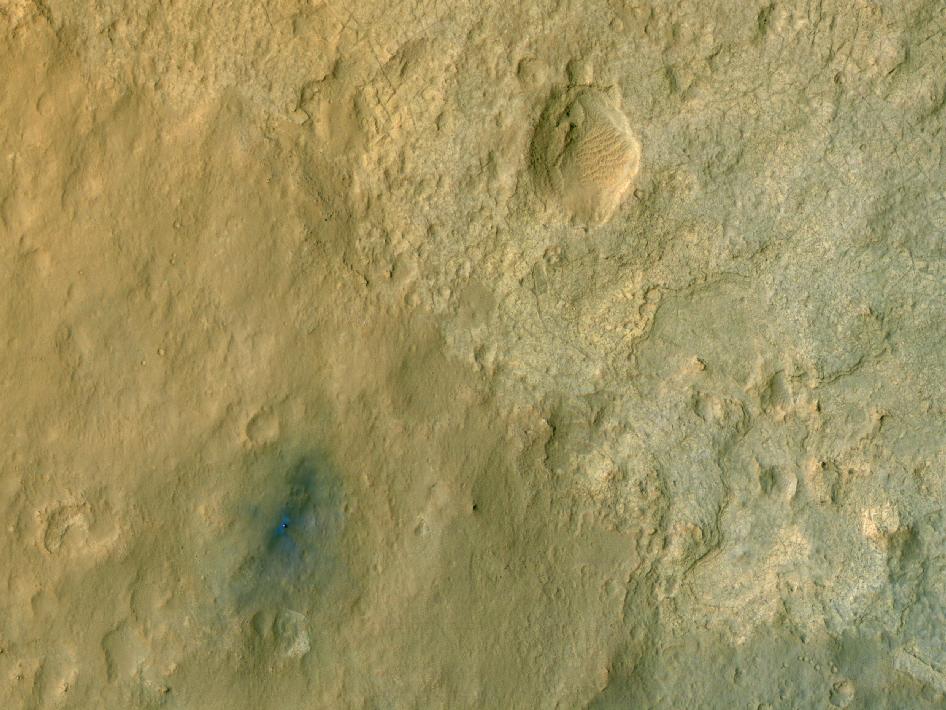
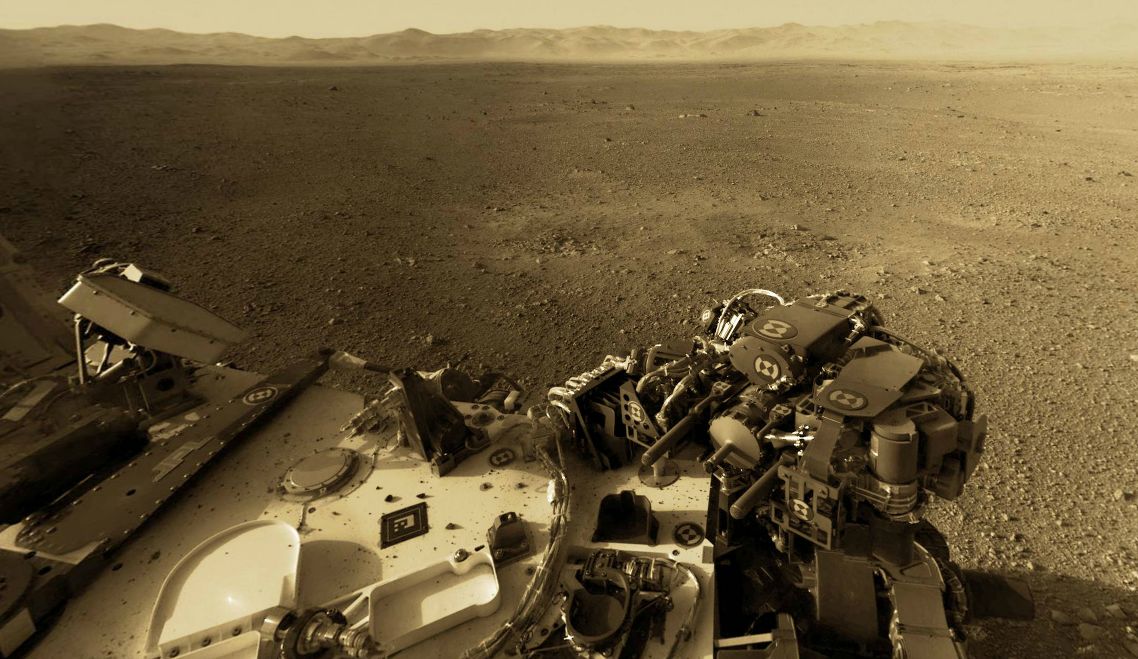
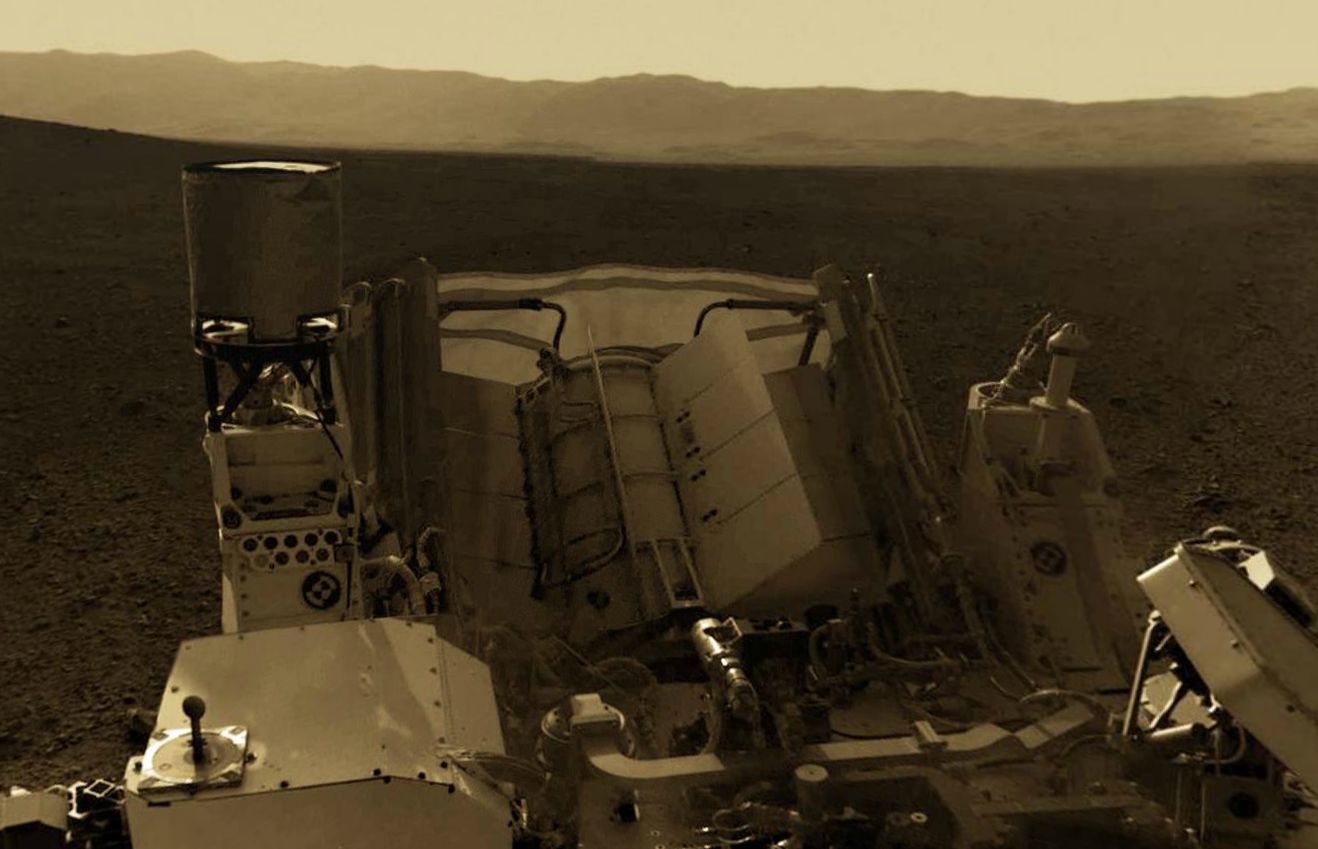
2012: a Martian Curiosity

Update, Monday August 6th: Curiosity arrived on Mars, on time and on target, the start of what promises to be a remarkable mission of exploration. Mars was good, and allowed the rover to pass images over to Mars Odyssey for transmission to Earth. Read my report.

Later today – or in the early hours of the morning of Monday 6th August if you live on the East Coast of the USA or in Europe, something very, very remarkable will take place above the magnificent vistas of Mars: NASA’s latest mission to the Red Planet will arrive in a quite spectacular manner.

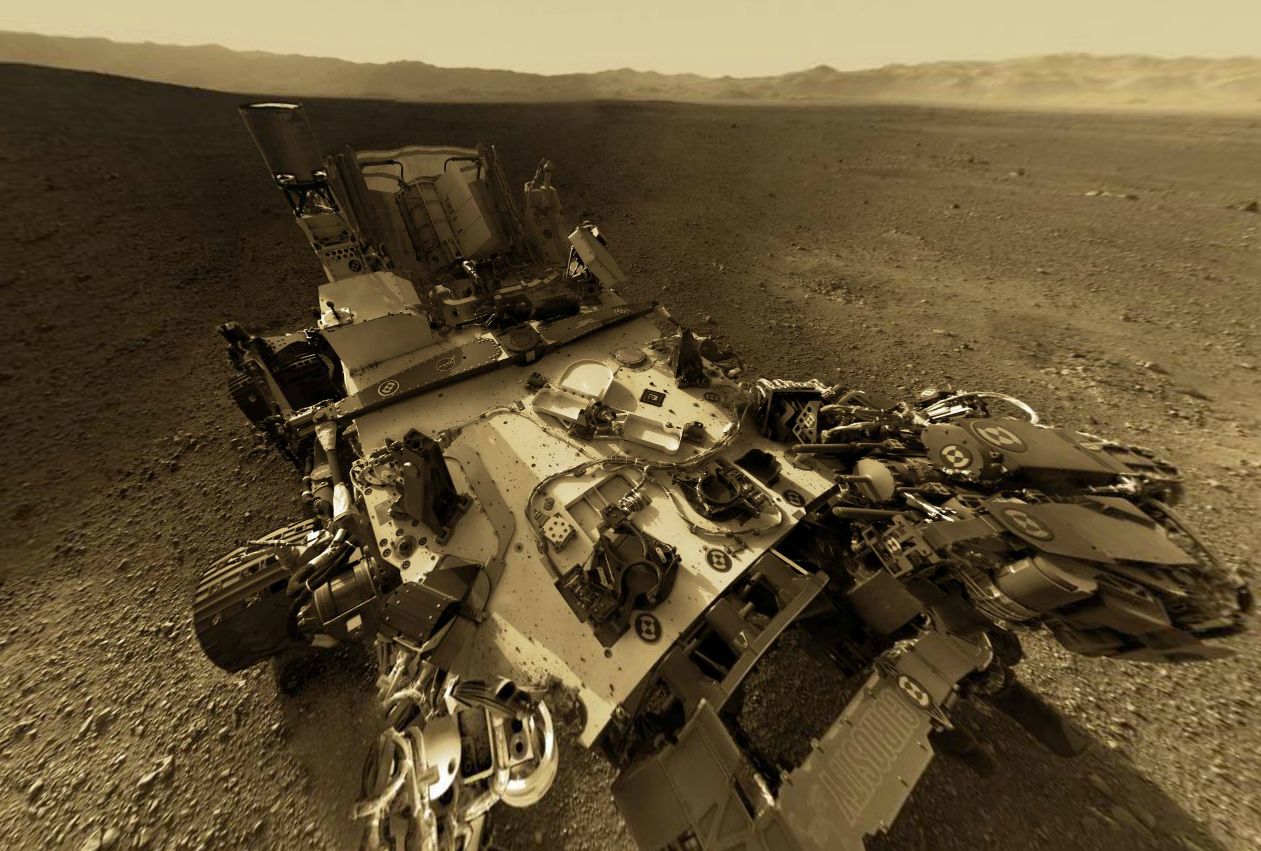
The Mars Science Laboratory (MSL) mission is the biggest single payload yet sent to Mars. It comprises a rover vehicle called Curiosity, weighing-in at almost a tonne, carrying  a sophisticated science laboratory that gives the mission its name. The latter is designed to study the Martian climate and to analyse soil and rock samples to assess what the Martian environment was like in the past in terms of its potential to have been the abode of life. To contribute to thee goals, MSL has six primary mission objectives:

  1. Determine the mineralogical composition of the Martian surface and near-surface geological materials.
  2. Attempt to detect chemical building blocks of life (biosignatures).
  3. Interpret the processes that have formed and modified rocks and soils.
  4. Assess long-timescale (i.e., 4-billion-year) Martian atmospheric evolution processes.
  5. Determine present state, distribution, and cycling of water and carbon dioxide.
  6. Characterize the broad spectrum of surface radiation, including galactic radiation, cosmic radiation, solar proton events and secondary neutrons.

In addition, and while en-route to Mars, the mission has been measuring the radiation exposure experienced by the interior of the vehicle while in interplanetary space in order to better understand that medium in preparation for manned deep-space missions into the solar system.

The Rover

While some to the media descriptions have been prone to exaggeration where Curiosity is concerned (comments like “the size of an SUV” leading people to visualise something the size of a Range Rover or Jeep Cherokee), one should not doubt that, comparatively speaking, the rover is big. At around 3 metres (approx 10ft) in length, Curiosity is almost twice the length of the Mars Exploration Rovers (MER) Opportunity and Spirit already on Mars, while at 900kg (1984 pounds), it is almost two-and-a-half times heavier than their combined weight.

Comparative rover sizes. Foreground: Mars Pathfinder (1997); left: Mars Exploration Rover (2003-present); right: MSL (credit: NASA)

The MERs, which arrived on Mars in 2003, were both solar-powered, as was NASA’s first mission to put a rover on Mars – the tiny Sojourner, which formed a part of the Mars Pathfinder mission of 1997. As such, the MERs were expected to only operate for some 90 days apiece – even though Opportunity is still functioning today (over 3,100 days into the mission). One of the reasons for the 90-day limit placed on the MER missions was the expectation that the rovers solar arrays would become less and less effective as the mission progressed due to the accumulation of Martian dust on their flat surfaces, reducing the amount of sunlight they could convert into power for the rovers’ battery systems. This actually did occur, but so did a series of (initially unexpected) “cleaning events”, which saw the Martian wind periodically remove dust from the arrays, restoring some of their ability to harness sunlight.

MSL is expected to operate for far longer than the MERs – a full Martian year (just under 687 days) being the planned initial mission period. It also carries far more science and other equipment on-board. As such, solar power for the vehicle is impractical. Instead, it will be powered by a radioisotope thermoelectric generator (RTG), which utilises heat from the radioactive decay of plutonium-238. This produces around 110 watts of electrical power, generating around 2.5 kilowatt hours per day (compared to the 0.6 kilowatt hours per day generated by the MERs). In addition, the heat generated by the radioactive decay is used to warm fluids which are circulated through the rover keep electronics and other systems at acceptable operating temperatures during the harsher periods of the Martian / seasons.

MSL is not the first time RTGs have been flown to Mars by the United States; both of the Viking Landers of the 1970s were RTG-powered, and both of them, like Spirit and Opportunity, functioned well beyond their original mission times, with Viking Lander 1 operating for over six years and Viking Lander 2 for just over three-and-a-half years.

The late Carl Sagan and a full-size model of the Viking Lander from the 1970s (the Lander was similar in size and mass to the MSL)

Once on the surface, Curiosity will be able to traverse the terrain at a maximum speed of some 90 metres (300ft)  per hour, with average traverse speeds of around 30m (100ft) per hour. This compares to the MERs traversing around 100 metres per day, and means that over the course of the initial mission period, the rover should cover a minimum of some 19 kilometres (12 miles) during the initial mission period (Opportunity has, to date, travelled some 34.6 kilometres (21.5 miles). The rover will be able to calculate the distance it has travelled by means of the unique pattern the wheel treads will leave in the Martian sand; included in the thread pattern is the Morse code pattern for JPL (·— ·–· ·-··), which will be imprinted on the Martian soil once every revolution (JPL standing for “Jet Propulsion Laboratory, MSL’s “home”).  In addition, Curiosity will be able to roll over obstacles approaching 75 cm (30 in) in height.

Curiosity’s wheel treads include the Morse code pattern for JPL (·— ·–· ·-··) to help the rover calculate the distance it has travelled (credit: JPL)

Science Instruments

Some 80 Kg of Curiosty’s mass comprises the camera systems, scientific instruments, experiments and operating systems themselves. These include two on-board computer systems responsible for managing all of the rover’s operations. Both of these are radiation-hardened, with one forming the back-up to the other in case of unexpected failure. Each computer has just over 2Gb of memory and a RAD750 CPU.  For navigation, the computers are supported by an Inertial Measurement Unit (IMU) that provides 3-axis information on its position.

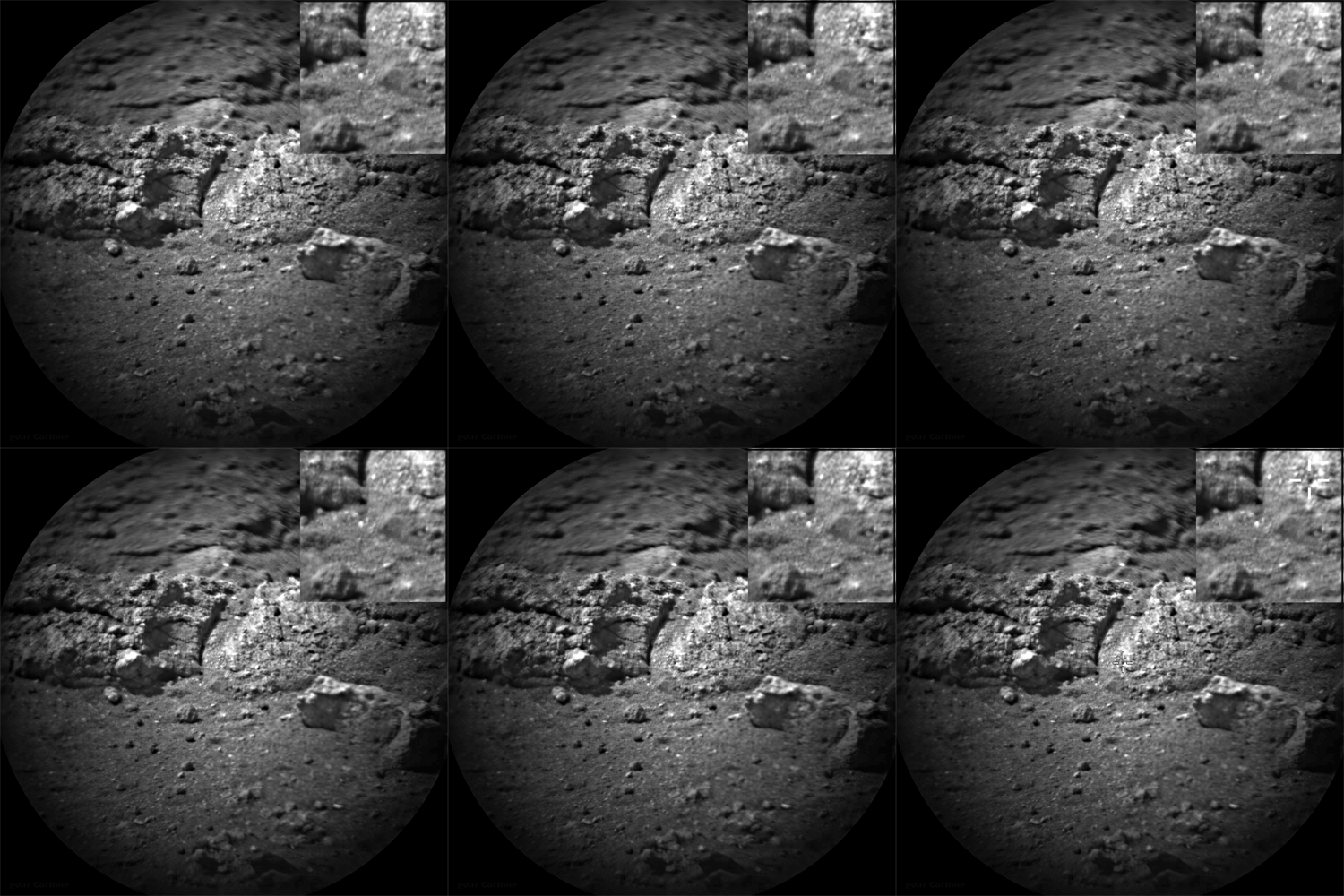
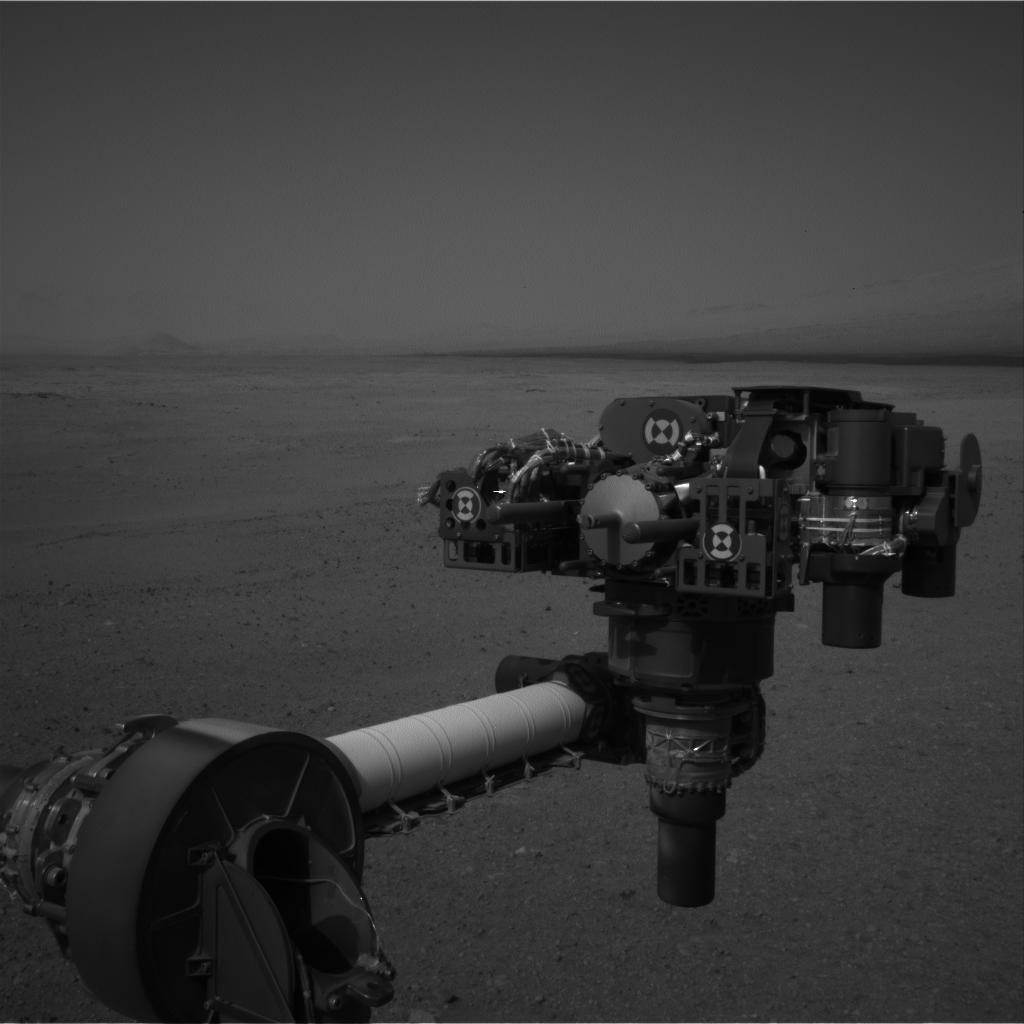
MSL includes a suite of camera systems, which will be used for a range of functions, including autonomous navigation, hazard avoidance cameras (using pairs of black-and-white cameras mounted at each corner of the rover), a “Mars Hand” camera mounted on the rover’s robotic arm (which has a reach of some 2 metres) capable of taking microscopic images of rock and soil, a “ChemCam” which uses an infra-red laser to vaporise rock and soil samples and then collecting a spectrum of the light emitted.

MSL science instruments and cameras (credit: JPL)

From a public perspective, however, the two most interesting camera systems aboard the rover are liable to be the Mars Descent Imager (MARDI) and the MastCam. MARDI will be used during the final moments of MSL’s Martian arrival (dubbed, with good reason, the “seven minutes of terror” – see below). This is designed to start operating when the MSL and its decent unit are some 3.7 km above the surface of Mars and continue through until the vehicle is some 5 metres above the surface. It will take images at 1600×1200 pixel resolution with a 1.3 millisecond exposure time and at a rate of some 5 frame per second.

The MastCam sits (as the name suggests) atop the rover’s mast, some 1.97m above the bottom of the rover’s wheels. This system provides multiple spectra and true color imaging with two cameras. The cameras can take true color images at 1600×1200 pixels and up to 10 frames per second hardware-compressed, high-definition video at 720p (1280×720). As such, it is liable to be images and film from this camera that will capture the imagination of people from around the globe, with the two cameras in the system given between 1.25 and 3.67 higher spatial resolution than the panoramic cameras carried by the MERs when operating at its highest (black and white) resolution of 1024×1024 pixels.

NASA JPL provides a comprehensive overview of the complete science package for those who are interested.

Use the page numbers below left to continue reading

In memory of Sally Ride

 Oh! I have slipped the surly bonds of Earth
 And danced the skies on laughter-silvered wings;
 Sunward I’ve climbed, and joined the tumbling mirth
 of sun-split clouds, — and done a hundred things
 You have not dreamed of — wheeled and soared and swung
 High in the sunlit silence. Hov’ring there,
 I’ve chased the shouting wind along, and flung
 My eager craft through footless halls of air….

 Up, up the long, delirious, burning blue
 I have topped the wind-swept heights with easy grace.
 Where never lark, or even eagle flew —
 And, while with silent lifting mind I have trod
 The high untrespassed sanctity of space,
 – Put out my hand, and touched the face of God.

(Pilot Officer  John Gillespie Magee, Jr., RCAF)

Sally Ride, 1951-2012
First American female astronaut.
Missions flown: STS-7, 1983; STS-41G, 1984.

 www.sallyridescience.com

Transit of Venus

Update June 7th: Two additional images added to this article showing the Black Drop and a wonderful sunset view from Greece.

Well, we didn’t get an in-world venue sorted, but on the night of 5th / 6th of June 2012, a bunch of us gathered (with thousands of others) on Twitter to share in the Transit of Venus. Feeds were widely available from NASA and elsewhere, although many of us stayed with http://www.slooh.com, which provided feeds from telescopes right across the world – Norway, Sweden, mainland USA, Japan, Hawaii, the Pacific, New Zealand, Australia – ten locations in all, hoping to ensure the widest possible coverage should inclement weather interfere with things.

The transit itself has been written about rather a lot – so if you want an overview of the historical context, Wikipedia offers a very informative piece, including the sad tale of Guillaume Le Gentil, which was referred to several times in the SLOOH webcast, and which has itself been immortalised in a the play Transit of Venus. The article also touches on James Cook’s role in observing the transit of 1769.

Balu Pulipaka of Indiana captured this image of the “Black Drop” effect as Venus passes through 2nd Contact
Venus imaged by NASA’s Solar Dynamics Observatory

Today, the Transit is no longer used to help us understand the broader sweep of the solar system per se, but has, in both 2004 and 2012,  been used to assist scientists in the study of exoplanets. In this, the 2012 transit is liable to have been more valuable than 2004, due to increased solar activity as we approach a period of Solar Maximum in the Sun’s (roughly) 11-year cycle.

The view from Greece: Spyros Skikos captures a unique sunset with his camera, Venus prominent against the Sun
A pink-filtered image from the University of Oslo, showing the end of the transit, with Venus between 3rd and 4th contacts. Note the solar prominence on the limb of the sun just below it (image: http://www.slooh.com)

The 2012 event also helped with the calibration of instruments aboard NASA’s Solar Dynamics Observatory, while observations of the event taken from the Svalbard archipelago coupled with those from the European Venus Express mission in orbit around the planet will also hopefully increase our understanding of the planet’s atmosphere and climatology.

Black & white images from Broome, Australia, showing Venus (left) and sunspots on the face of the sun (image: http://www.slooh.com)

For casual observers, the four periods of contact were perhaps the most enthralling – the points where Venus first “touches” the limb of the sun, then slowly moves inside the sun’s disk until it is entirely “inside) (1st and 2nd Contact) and the point at which it touches the limb of the sun on the other side on its way “out” (3rd Contact), before vanishing entirely (4th Contact).

Of these in turn, the 2nd and 3rd contacts are of interest as they give rise to the so-called “black drop”. This is when light distortion possibly due to sunlight refracting through Venus’ atmosphere  appears to “pull” the edge of Venus to the edge of the sun, elongating it into a tear-like shape, with the limb of the sun appearing to “bend in” towards it.

I’ve compiled a modest slideshow of the event from a number of the SLOOH feeds. The first 10 are from the University of New Mexico feed, while the last ten are from Oahu and the Haleakala volcano observatory, Hawaii. You get the opportunity to see the next transit of Venus live until 2117…

(Click here to see the slideshow full screen)

NASA also offer a composite video of the event using images captured by SDO:

A Dragon of a different kind

As I’ve previously posted here on occasion, and as friends on Twitter will know, I has a soft spot for space exploration. Last year I wrote some pieces about the space shuttle Endeavour, and included some favourite images of her prior to her final return to Earth.

Endeavour and the shuttle fleet have now gone; retired to museums and their missions confined to history. However, the last week or so saw the opening of a new chapter in low-Earth orbit space operations as the Dragon space vehicle, developed by Internet entrepreneur Elon Musk’s SpaceX Corporation, became the first privately funded vehicle to dock with the ISS under NASA’s Commercial Orbital Transportation Services programme.

May 22nd 2012: Dragon lifts-off atop SpaceX’s own Falcon 9 launch vehicle (image: SpaceX)

First flown in 2010, the Dragon space vehicle was put through its paces during May 2012 in an aggressive mission to demonstrate its core capabilities of launching a payload to orbit, rendezvousing with the ISS, where it would be captured by a robotic arm on the station and manoeuvred into a hard dock for cargo transfer, before returning to Earth with a payload from the station (in this case, 590 kilos of items, including “quick return” packages intended to demonstrate that SpaceX could return time-critical experiments from the ISS and deliver them to NASA within 48 hours of the Dragon vehicle detaching from the station).

Dragon is designed to be a highly versatile workhorse vehicle, capable of delivering some 3,310kg of cargo to the ISS and returning up to 2,500kg safely to Earth. What’s more the vehicle’s heat shield is designed to withstand re-entry velocities from possible lunar and Mars missions.

Russia’s Progress (l), Europe’s ATV (c) and Japan’s HTV (r)

The ability to make a return to Earth places Dragon is a league of its own compared to the other cargo vehicles currently operating to resupply the ISS. The Russian Progress vehicle, European ATV and Japan’s HTV all burn-up in the upper reaches of the Earth’s atmosphere after departing the space station.

Nor will Dragon be limited to cargo flights: development is under way of the DragonRider variant – a vehicle capable of lifting up to seven people to  / from the ISS. Two further variants of the vehicle are under development: DragonLab, which will see the vehicle operate commercially on its own as an unmanned orbital research platform, with full return-to-Earth capabilities; and RedDragon, which has been proposed as a NASA Discovery mission slated for 2018, which would see a modified version of the unmanned Dragon fly to Mars and deliver a 1-tonne payload to the surface in order to try to sample subsurface water reservoirs.

Dragon approaching the ISS, May 25th 2012 (NASA)

Dragon was launched on its initial COTS mission on May 22nd, 2012. Once successfully in orbit, it commenced a 2-day “chase and rendezvous” flight with the ISS, gradually easing its way up to the space station, where it performed a series of check-out manoeuvres, prior to making its final approach to the station ready for capture and docking on May 25th.

The ISS captured by Dragon’s thermal camera prior to final rendezvous and capture (SpaceX)

Rather than docking directly with the station, as with the likes of the Shuttle, Progress and Europe’s ATV, Dragon gently manoeuvres up close to the station prior to a robotic arm on the ISS itself being used to “grab” the vehicle and then gently ease it into a berthed positioned against the station’s Harmony module.

May 25th capture: “Houston, we have a Dragon by its tail!” Astronaut Don Petit reported upon successfully grappling the vehicle with a robot arm (NASA)

Once successfully docked, Dragon spent several days mated to the ISS while the station crew off-loaded some 460kg of food, water and other items, then packed the vehicle with 560kg of equipment and items for the return to Earth.

Docked! (NASA)

Return operations commenced on May 31st, when the robot arm was used to detach Dragon from the ISS and move it to a distance of some 10 metres before releasing it. Manoeuvring thrusters then gently backed the vehicle away from the ISS prior to it commencing a series of manoeuvres that moved it ahead of the station by a few hundred kilometres, and started the de-orbit process.

Departure (NASA)

After successfully re-entering the Earth’s atmosphere, the main capsule having been detached from the orbital “trunk” of the craft, Dragon safely deployed its parachutes and splashed-down on-target a little under 900 kilometres off the coast of California, where it was recovered by waiting support ships, bringing the flight test phase of the mission to a successful conclusion.

A Dragon in the water (SpaceX)

Dragon is due to fly to the ISS once more in September 2012 in the first official Cargo Resupply Mission, which will see it carry a full load into space. This will be followed in October by Orbital Science’s Cygnus vehicle (which, like Progress et al, is designed to burn-up on re-entry), to mark the further expansion of the COTS programme.

Orbital Sciences’ Cygnus vehicle

For now, however, all eyes remain on SpaceX and their remarkable – and potentially highly versatile – Dragon vehicle; here’s to a successful mission in September! In the meantime, I’ve put together a little slideshow of images from NASA and SpaceX images highlighting the mission.

(Click here to see the slideshow full screen)

Annular eclipse

May 20/21 2012 saw an annular eclipse of the Sun. This is when the disk of the Moon comes between the Earth and the Sun, but the Moon is moving towards apogee in its orbit (the point at which it is furthest from the centre of the Earth), so that while the Sun, the Moon and the Earth are all aligned in syzygy, the disc of the moon is not large enough to cover that of the Sun to leave only the solar atmosphere visible (as with a total eclipse), but instead sits “inside” the disk of the Sun, creating what is called a “ring of fire”.

The eclipse was observable from China through Japan, Canada and much of the US from the west coast through to Texas. Images of the event were carried via a number of streams across the Internet, allowing thousands more to share in it.

I watched the event on-line (the sun having set in the UK a long time before the eclipse took place), along with a number of other SL friends who are also interested in astronomy, leading to a lively discussion about the eclipse itself and the possibility of hosting similar events in-world in the future. Our main stream for watching the event was provided by SLOOH Space Camera, which had cameras active in both California and New Mexico, although I was also keeping an eye on another feed from Reno, Nevada, which was transmitting via Ustream.

Annularity captured by the SLOOH camera in New Mexico, May 20/21 2012

SLOOH is a superb resource for people interested in astronomy and space exploration, regularly hosting events like observing the eclipse and their images are really excellent. I took the liberty of capturing screen shots of the event, as seen through both of the SLOOH cameras and have put them together in a Flickr slideshow (together with some initial images from the Reno feed and a brilliant photo obtained via the BBC) to try to capture the event.

A closer view through the SLOOH New Mexico camera. Note the sunspot close to the black disk of the Moon

The next major astronomical event SLOOH will be covering is the Transit of Venus next month, and if technology allows, there may be a chance people will be meeting-up in Second Life to witness the event, which will not occur again for another 105 years. If this can be arranged, I’ll be carrying information on the gathering on this blog nearer the dates of the transit (June 5/6).

In the meantime, the slideshow:

(Click here to view the slideshow full-screen)

ETA: found this amazing shot of the Moon’s shadow on Earth, seen from the ISS (click to enlarge & enjoy):

Wow…just wow!

Dad e-mailed this video link, shot from Soyuz TMA-20 on the 8th June 2011.