Zapping, scrubbing, eyeing and digesting

Curiosity remains at Rocknest, carrying out further soil sampling operations.

With a sample delivered to the observation tray and then to CheMin on Sol 71, sample gathering resumed on Sol 74 (October 24th) with a fourth scoop of the sand-like material being gathered and examined via camera in preparation for it being delivered into the CHIMRA processing system for further cleaning operations.

The sample was transferred into CHIMRA, which is mounted on the robot arm of the rover (the sample scoop itself forming a part of the overall CHIMRA mechanism) on Sol 75 (October 21st). Further cleaning of the CHIMRA sieves and filters is required to ready them for the delivery of samples to the highly sensitive SAM (Sample Analysis at Mars) system aboard the rover itself. Because SAM is so very sensitive, it was determined to go ahead with further planned cleaning cycles despite visual examination of the scoop and the visible part of the CHIMRA inlet revealing them to be well coated in Martian material.

At the same time as sample gathering was underway, Curiosity continued to monitor its environment with the Radiation Assessment Detector (RAD), Rover Environmental Monitoring Station (REMS – the rover’s weather station) and Dynamic Albedo of Neutrons (DAN) instruments of its science payload.

The laser system on ChemCam was also used to zap the soil around the rover for analysis by ChemCam’s own spectrometer. One target in particular, dubbed “Crestaurum”, was struck 30 times by the laser on Sol 74, resulting in a dark pit some 3 mm (roughly an eighth of an inch) across being created in the target location, 2.7 metres (8 feet) away from the laser at the top of the rover’s mast. The shots themselves brought the total number of laser firings in the mission so far to a staggering 10,000.

Zapping the surface in this way vaporizes the material hit by the laser, allowing the ChemCam telescope system to images of the resultant plasma which can be fed via fibre-optics to ChemCam’s own spectrometer. Working in tandem with both the Chemistry and Minerology (CheMin) and SAM systems, which analyse surface samples directly, ChemCam provides a far broader range of data on soil composition, etc., for return to Earth than has previously been possible with rover missions.

Pew! Pew! Pew! ChemCam zaps the Martian sand at Rocknest. Before and after images capture by ChemCam’s Remote imager, showing the target area prior to being hit 30 times by the ChemCam laser, and the cratered result

Rather than discarding the fourth scoop sample following cleaning operations within CHIMRA, the sample was used for two further activities.

In the first, on Sol 77, around 20 grams of the material was delivered to CheMin for analysis, making it the second sample of surface material delivered to that system.

In the second, on Sol 78 and after CheMin had completed initial analysis of its new sample, a further measure of the material was delivered to Curiosity’s on-board observation tray for visual analysis.

Please use the page numbers below, to continue reading this article

When small and bright can get you discarded

Curiosity remains at Rocknest, its resting place for around the last couple of weeks, continuing with the scooping / CHIMRA / sample operations. When we last left the MSL rover at the end of my last round-up of news, command has been sent to Curiosity to prepare the way for a second sample scoop operation (Sol 65, October 11th).

Originally, the material from this scoop was earmarked for use in further CHIMRA cleaning exercises, designed to “scrub” the insides of the sample processing system clean of any remaining Earth-based contaminants, prior to samples being filtered through it ready for delivery to Curiosity’s on-board analysis systems.

While a sample scoop of material was collected on Sol 66 (October 12th), operations were brought to a halt when images returned by the rover revealed a bright object – another possible FOD (Foreign Object Debris) within the hole created by the scoop when gathering the sample.

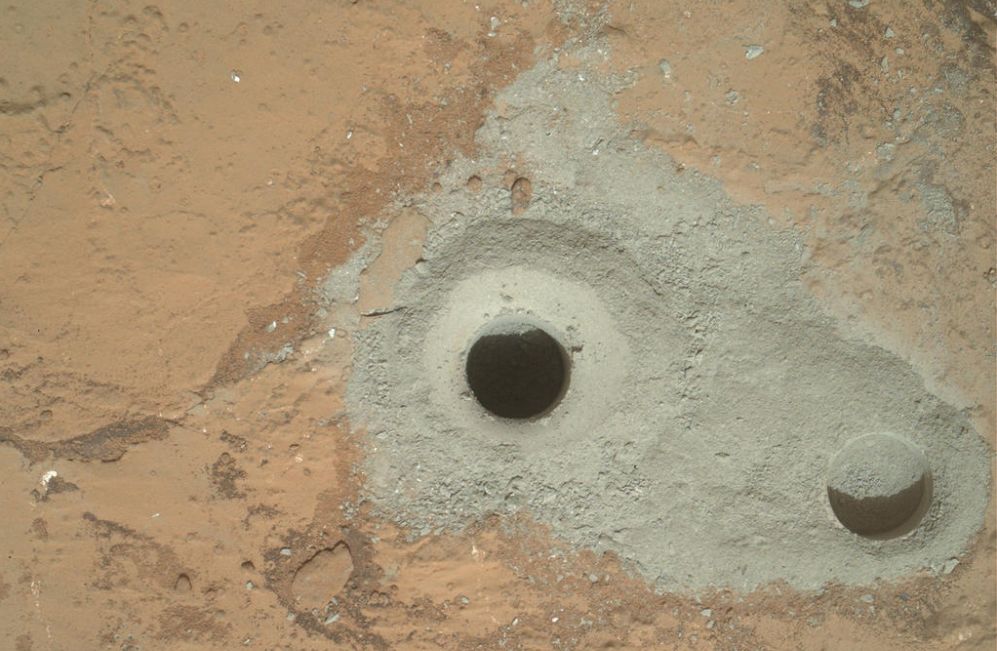
The potential FOD, imaged by the Mars Hand Lens Imager (MAHLI) within the scoop-hole from the second sample collection operation. This image shows an area some 5 centimetres (2 inches) across

As reported in my last update, a small, bright FOD was imaged close to the area of the first sample scoop, and after examination using MAHLI, the mission team determined it was most likely debris which had fallen from the rover itself – possibly a tiny fragment of wiring insulation which had originally fallen from the Descent Stage and lodged on the rover. Because of this, mission scientists were concerned that the object seen in the sample hole might be further debris from the rover itself and that some might have been collected by the scoop. It was therefore decided to abandon the sample on Sol 67, rather than risk having contaminants enter CHIMRA.

However, subsequent additional analysis of the object seen in the scoop hole showed that it was in fact embedded in the Martian soil, and therefore unlikely to have fallen from the rover. Closer examination of the ground immediately around the sample spots recorded more, and similar, bright objects, further pointing to the matter in the scope hole being of Martian origin.

These bright objects, possibly result of small pieces of material shearing apart to reveal their unweathered interior faces, will likely be the subject of further study, together with the original FOD seen on Sol 61. “We plan to learn more both about the spacecraft material and about the smaller, bright particles,” said Curiosity Project Manager Richard Cook of NASA’s Jet Propulsion Laboratory, Pasadena. “We will finish determining whether the spacecraft material warrants concern during future operations. The native Mars particles become fodder for the mission’s scientific studies.”

please use the page numbers, below left to continue reading this article

A spoonful of sand, a question over plastic and an unexpected finding

Not long after I Pressed my last MSL update, Curiosity went ahead and collected its first scoop of Martian sand.

The operation took place over the course of several hours on October 7th (Sol 61), gathered a scoopful of sand and powdery material from the sand ridge the rover had been examining at a location mission managers have dubbed “Rocknest”.

The operation was the first phase in a process which is designed to “clean” the Collection and Handling for In-Situ Martian Rock Analysis (CHIMRA) device mounted on the turret at the end of Curiosity’s robot arm (and which includes the scoop itself). The cleaning process is required to ensure that no contaminants from Earth remain in CHIMRA’s chambers so they do not adversely affect analysis when samples eventually reach the on-board SAM and CheMin instruments.

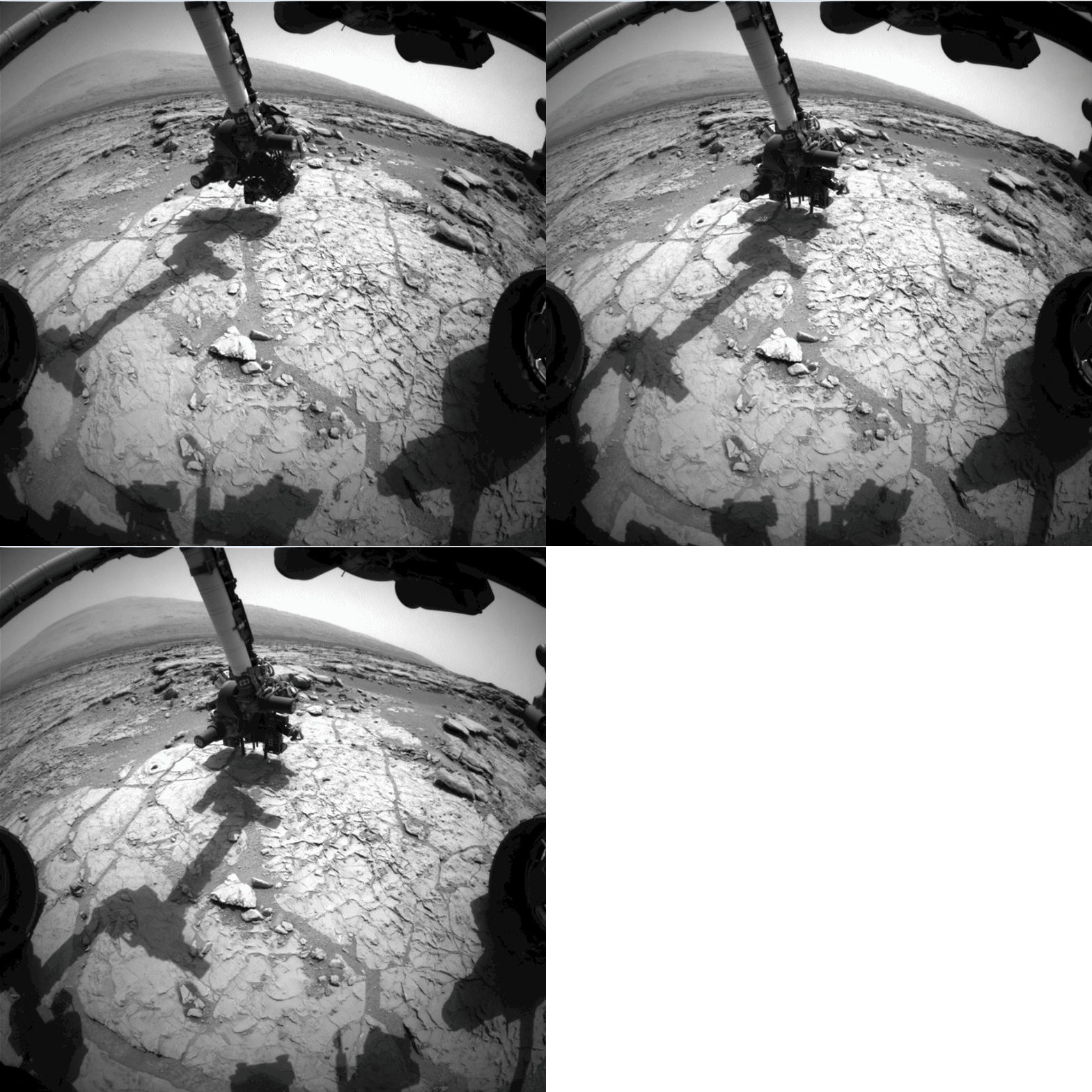
A Hazcam’s view: Curiosity scoops its first load of Martian surface material

The entire process was carefully monitored using several of Curiosity’s camera systems in order to confirm progress and to make sure everything was operating as expected. This made the gathering of the first scoop of material a protracted affair, with the Hazcams at the front of the rover being used to monitor progress from a low angle and both the Navcam and Mastcam systems imaging progress and results. Once the sample has been gathered, the turret was vibrated gently to level the material in the scoop and shake-off any excess.

A Mastcam image of the scoop filled with material and (arrowed) the FOD – Foreign Object Debris – which halted scoop operations. For scale purposes, the scoop is 7 cm (2.8 inches) long, and 4.5 cm (1.8 inches) wide

It was an image from the Mastcam which brought a halt to operations, when a small, bright object was spotted. Believing the object might be something from the rover, mission managers decided to suspend the scoop operations and use the Remote Micro-Imager of the Chemistry and Camera (ChemCam) instrument to study the object in an attempt to ascertain what it might be.

Continue reading “A spoonful of sand, a question over plastic and an unexpected finding”

From Bathhurst Inlet to Rocknest

It’s been a busy week on Mars.

Following the identification of a further rock target for study, Curiosity spent Sol 54 (September 30th) conducting contact science with the rock, dubbed Bathhurst Inlet by mission personnel, using APXS and MAHLI.

These studies were concluded on Sol 55 when Curiosity used the ChemCam laser, telescope and spectrometer to analyse the chemical / mineral composition of the rock. Following this, the rover manoeuvred some 23.5 metres (77 feet) to an area of sand called Rocknest, which Mastcam images had revealed as a possible location in which to test part of Curiosity’s sample acquisition system.

Studying Bathurst Inlet, a raw image returned by Curiosity’s right Navacam system on Sol 54 (Sept 30th)

Rocknest, an area of wind-blown sand, had initially been imaged on Sol 52, and earmarked as a potential location for sample acquisition tests. The area is around 5 metres by 1.5 metres (16ft by 7ft), and the fact that it appeared to comprise wind-blown deposits suggested it would be an ideal target as the sand is liable to be relatively loosely packed and offer samples which can be acquired relatively easily and which could be used to perform an important task.

Rocknest as imaged by Curiosity’s 100mm Mastcam on Sol 52 (Sept 28). The images in this mosaic have been white-balanced so that colours appear as they would if seen in typical Earth sunlight conditions

Samples can be acquired by Curiosity in one of two ways: using a drill system or via a scoop, both of which are located on the turret at the end of the rover’s robot arm. The activities at Rocknest are focused on the use of the scoop, which can acquire around 20 grams of material at a time for delivery to SAM, the Sample Analysis at Mars system, and CheMin, the Chemistry and Mineralogy system, Curiosity’s two on-board sample analysis systems.

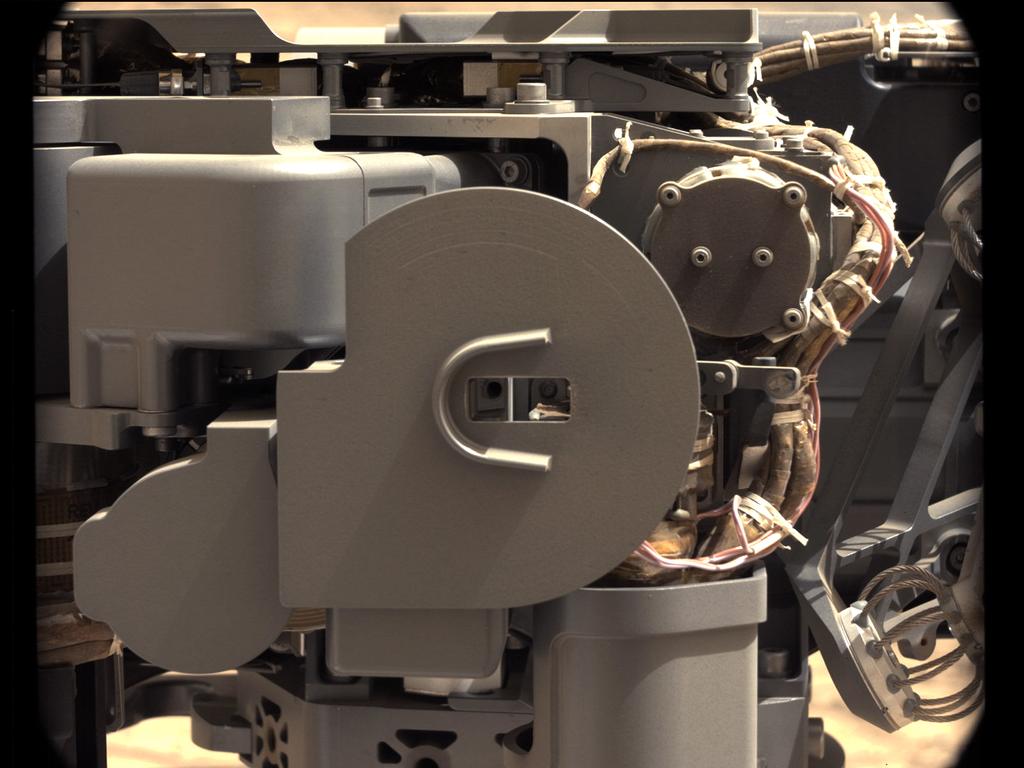
The scoop is part of a complex system called CHIMRA (Collection and Handling for In-Situ Martian Rock Analysis) contained within the turret. This processes samples gathered from both the scoop and the drill system, ready for them to be passed to the rover’s on-board systems. However, before the system can be used, it must be properly prepared and undergo a special “cleaning” process. It is this “cleaning” which is the focus of operations at Rocknest.

The turret science instruments (l) and an internal view of CHIMRA. Note the turret image is inverted in relation to the CHIMRA image (click to enlarge)

On Sol 56, Curiosity further manoeuvred itself a further six metres (20 ft) to get close to a ripple of sand within Rocknest which had been selected for the sample testing. The Dynamic Albedo of Neutrons (DAN) instrument was also used during Sol 56 to measure subsurface hydrogen levels, as was the Radiation Assessment Detector (RAD), designed to characterise the broad spectrum of radiation environment around the rover, and the Rover Environmental Monitoring Station (REMS) – Curiosity’s weather station.

In order to ensure the sand is suitable for the “cleaning” process, mission scientists and engineers needed to understand more about it. To this end, and on Sol 57, Curiosity was commanded to drive onto the ripple, rotate its wheels through 30-degrees and then reverse off. The Purpose of this was two-fold: firstly, it helped to confirm the sand’s consistency and that it is in fact packed loosely enough for the scoop to obtain samples. Secondly, it exposed material beneath the surface layer, allowing it to be further characterised.

Making a mark: a raw image captured by Curiosity’s right Navcam as the rover  roll onto the Rocknest sand ripple, prior to leaving a scuff mark designed to help mission scientists examine the particle-size distribution of the material forming the ripple. To give an idea of scale, Curiosity’s wheels are 40cm (16 inches) wide

Please use the page numbers below left to continue reading this article

To sift the sands of Mars

This last week has been an interesting one for news on NASA’s Mars Science Laboratory, with the release on the 27th September of news that the rover Curiosity has come across extensive evidence for free-flowing water to have once existed in Gale Crater.

Curiosity examines Jake

Prior to this, on Sol 47 (September 23rd) Curiosity commenced contact science on a rock dubbed Jake Matijevic, using the Alpha Particle X-Ray Spectrometer (APXS), mounted on the turret at the end of the rover’s robot arm. Studies of the rock continued through Sol 48, September 24th, with the ChemCam laser being used once more to assist in analysing the rock’s composition, and MAHLI, the Mars Hand Lens Imager, gathering a range of images of the rock from various distances.

On Sol 49, Curiosity resumed its drive towards Glenelg, a region where three different types of terrain, as observed from orbit, come together. Now over half-way to the region, the rover travelled a further 31 metres (102 ft). During the day, the rover also captured more images of its location and observed the Martian sky.

Sol 50 saw the rover complete its longest single drive to date: 48.9 metres (160 ft), bringing the total distance covered to over 400 metres, or close to quarter of a mile. With the drive came a shift in emphasis for the science team, as they start looking for a location where Curiosity can obtain its first sample of Martian soil. Ideally, the team would like to find a sandy spot with planet of loose Martian fines which can be scooped up by the sample system on the robot arm and then delivered to the on-board SAM and CheMin instruments for detailed analysis.

The road to Glenelg: a mosaic of the land immediately before Curiosity and leading up to Glenelg.

Please use the page numbers below left to continue reading this article

Curiosity: the rivers of Mars

NASA has released images returned to Earth by the Curiosity rover of what appears to be an ancient stream bed, together with images showing further evidence of liquid water once having flowed freely within Gale Crater.

The images have been captured at separate locations on the route to Glenelg, with the first images being captured on Sol 27 (September 2nd), with additional images of another location being captured on Sol 39 (September 14th).

The Link outcrop images on Sol 27 using the 100mm Mastcam

The first set of these images were of an outcrop of rock dubbed Link, and showed rounded gravel fragments, called clasts, up to a  few centimetres in size within the rock outcrop. Too large to have been moved as a result of wind action, these clasts have been deemed to be consistent with a sedimentary conglomerate, or a rock that was formed by the deposition of water and is composed of many smaller rounded rocks cemented together.

A close-up of Link (l) compared with similar rocks seen on Earth (r).  Erosion of the outcrop on Mars has resulted in gravel clasts which have fallen onto the ground, creating the gravel pile. The outcrop characteristics are consistent with a sedimentary conglomerate, or a rock that was formed by the deposition of water

On Sol 39, Curiosity imaged a more remarkable outcrop, dubbed Hottah after Hottah Lake in Canada’s Northwest Territories. The exposed bedrock in the images, again captured with the 100mm Mastcam, is made up of smaller fragments cemented together to again form sedimentary conglomerate.

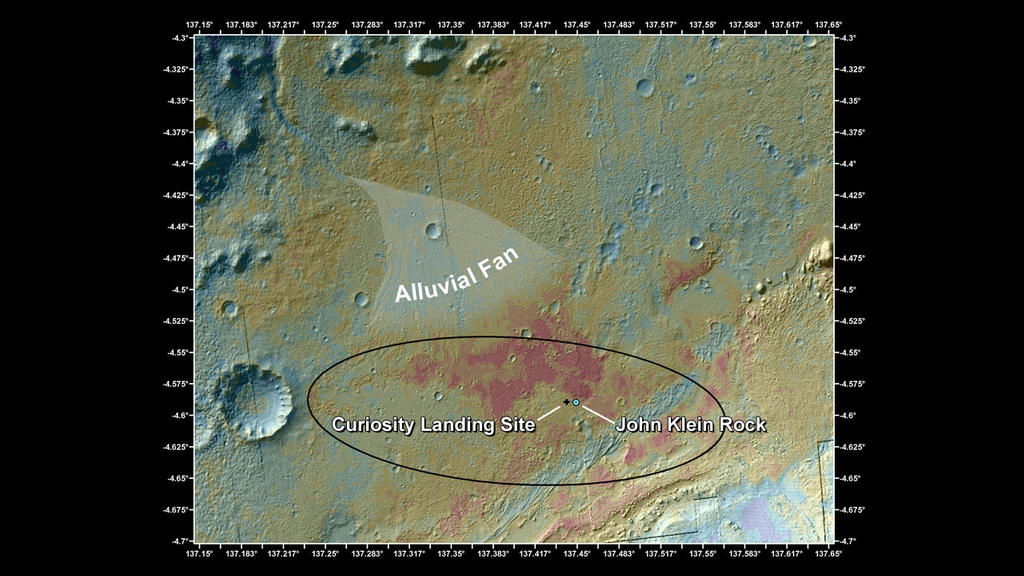
The location of the stream bed lies between the north rim of Gale Crater and the base of “Mount Sharp”, the mound towards the centre of the crater which Curiosity will explore later in the mission. Imaging of the region from orbit shows an alluvial fan of material washed down from the rim, streaked by many apparent channels, sitting uphill of the new finds, further evidence that water was once free-flowing in the region, probably over a reasonably long period of time in Mars’ ancient past. The images of the outcrops themselves show what are referred to as “classic conglomerates”, rocks that are made up of gravels and sand which have been cemented together. The sizes and shapes of stones offer clues to the speed and distance of the ancient stream’s flow.

“From the size of gravels it carried, we can interpret the water was moving about 3 feet [1 metre] per second, with a depth somewhere between ankle and hip deep,” William Deitrich, an MSL science co-investigator said, reviewing the images.

The Hottah outcropping of bedrock – evidence of an ancient stream bed imaged by Curiosity

Use the page numbers below left to continue reading this article