Curiosity: putting a hand on Mars

This last week marked Curiosity’s first month on Mars. It’s been a remarkable period, with the rover undergoing an extensive commissioning period (which will continue into next month, most likely), and returning some of the most amazing images from the surface of Mars we’ve ever seen.

Now the trek has begun, and Curiosity is well and truly on her way to Glenelg, a journey of some 400 metres (1300ft) which should be completed in October.

The trek to Glenelg began in earnest on Sol 24, with Curiosity travelling 21 metres (70 feet) – its longest single drive at that time – heading eastward away from Bradbury Landing. The following day, Sol 25 (August 31st), the rover had a “day off” from driving, which was spent  gathering environmental data and sky images using the Navcam system. Mastcam was also used to capture a 360-degree panorama of its new location.

A mosaic of Navcam images from Curiosity, captured on Aug 30th, showing the rover’s tracks back towards Bradbury Landing

Over the next few days, the rover continued to trek eastward, covering 30 metres (98 feet) on September 1st, in a drive to test its “visual odometry” in using images captured by the Navcam system to analyse the distance it has travelled. The day included further tests of CheMin system, while SAM took samples of the Martian air overnight on the 2nd/3rd Sept (Sol 27/28). The drive then resumed, with Curiosity covering over 30 metres (100ft) on Sol 29, including a manoeuvre to skirt sand.

Making tracks: a remarkable image captured by the HiRISE camera on the Mars Reconnaissance Orbiter (MRO) showing the discolouration of Bradbury Landing and Curiosity as it heads out from the landing zone to explore Gale Crater

Arm Flexing

Having travelled a little under the quarter of the distance to Glenelg, Curiosity halted progress to commence the first six of ten planned consecutive days checking-out the robot arm and its turret of equipment. These will see the arm extensively tested through a series of “teach points” established during testing on Earth, and will include activities such as moving the turret to the inlet ports on the rover’s body to simulate the delivery of sample material to the on-board analytical instruments. The purpose of the tests is for mission engineers to get a better understanding for how the arm functions after the long cruise to Mars and in the different temperature and gravity environments of Mars when compared to the calibration testing carried out on Earth.

These operations – which form part of the overall arc of “characterisation tests” designed to check-out the rover and its range of science equipment and capabilities – were sequenced into the drive to Glenelg following the rover’s arrival on Mars. They require that Curiosity be parked at a specific angle relative to the sun, and on flat ground, which it reached on its Sol 29 drive.

The turret seen from the Matcam. In this image the Turret has been raised level with the 34mm lens of Mastcam and inverted. The pink colouration seen on the MAHLI instrument is the result of the “glue” used in the camera lens bonding process, which turns the inside of the lens pink-red under certain lighting. The wire brush is a dust removal tool which will clean rock surfaces prior to drilling

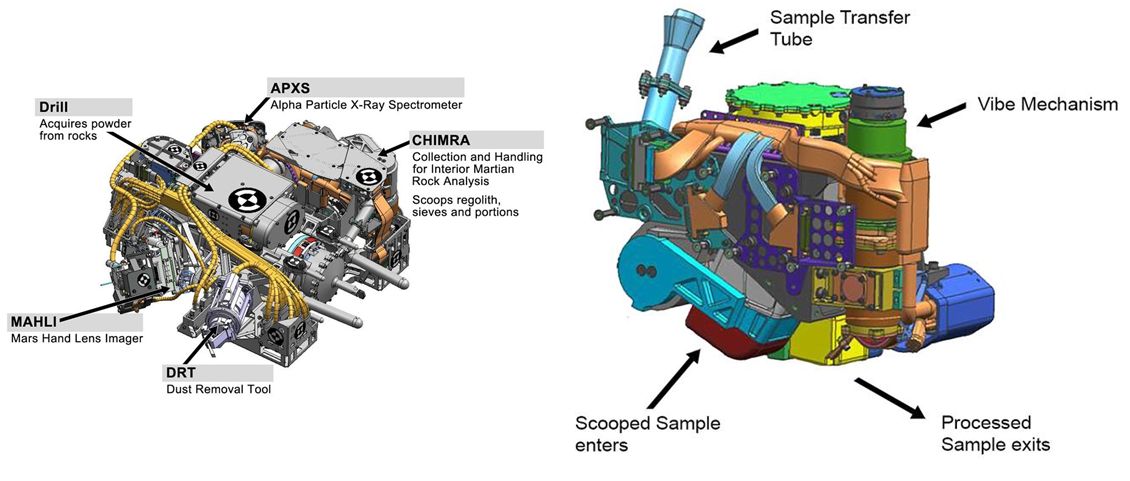
During the calibration tests, the Mars Hand Lens Imager (MAHLI), a camera mounted on the turret, will be tested and calibrated, as will the Alpha X-ray Spectrometer. The arm’s ability to place instruments against rock samples will also be tested as the first steps in preparing the turret for drilling and soil sample collection activities as a part of its science mission.

Use the page numbers below left to continue reading  

Curiosity: the trek begins with a song

NASA’s Trekkin’
Across Gale Crater’s plains,

On rover Curiosity, run by JPL.
NASA’s Trekkin’
Across Gale Crater’s plains

Boldly seeking science, what wonders will it tell?

(To the tune of “Star Trekkin'”)

Singing to us from Mars

The recent broadcast from Mars of a recorded message by NASA Administrator Charles Bolden (Monday 27th August) was followed on Tuesday the 28th by a more ambitious broadcast, designed to be an inspirational fanfare from Mars to encourage young people to get involved in science, technology and engineering.

Written by Will.i.am, Reach for the Stars is the first-ever song written on Earth and transmitted from the surface of another planet. Opening with the lines “Why do they say the sky’s the limit / When I see the footprints on the Moon?”. The song was originally written in February 2012, but following a meeting with NASA representatives, Will.i.am undertook to rework elements of the piece. “I don’t think it’s the right thing to do by sending a computer beat to Mars, so I wanted to put an orchestra together to show human collaboration,” he explained when talking about the song’s evolution. “That robot is going to Mars, but a piece of humanity, of art, should go with it as well.”

As well as an orchestral arrangement for the music, the song features children singing the verse. The entertainer, well-known for his advocacy of science and technology education through his i.am.angel Foundation, said the debut of the song, transmitted from Gale Crater and played during a NASA special event, is a message of inspiration. “Today is about inspiring young people to lead a life without limits placed on their potential,” he said. “And to pursue collaboration between humanity and technology.”

Stereo View

Also on the 28th (Sol 22) Curiosity departed Bradbury Landing on its longest drive to date. Travelling some 16 metres (52 feet) eastwards, the rover stopped at another of the scour marks created by the descent engines as they blasted the Martian “topsoil” away to expose the rock below.

The rover was due to spend around a full Sol at the spot, using the Mastcam to collect a further set of images of the mission’s ultimate driving destination, the lower slopes of “Mount Sharp”. These images, once received on Earth, will be combined with images already gathered from the last location the rover occupied, some 10 metres (33 feet) away, to produce 3D images of the mound, which should help planners determine potential driving routes up the slopes as well as furnishing more information about the surface features and mesas themselves.

On the road: Curiosity’s rear HazCam captures the tracks left by the rover as it moves away from the centre of Bradbury Landing.

After this, on Sol 24 (August 30th), it is expected the rover will be commanded to start its traverse to Glenelg, an intersection of three terrain types some 400 metres (1300ft) from Bradbury Landing. “We are on our way, though Glenelg is still many weeks away,” said Curiosity Project Scientist John Grotzinger, following the initial move to the second scour mark.

One of the reasons a relatively “close” destination is “weeks” away is that mission personnel hope to find a suitable area in which the rover’s robot arm can be further tested, particularly the scoop system which will be used to gather soil samples for analysis. Should a suitable area be found, it is likely the rover will pause there for at least a week while the robot are is further calibrated and the scoop system tested.

There is also a possibility that the drill system and the MAHLI (Mars Hand Lens Imager, the camera mounted on the robot arm’s turret) may be tested en route to Glenelg, should a suitable opportunity arise, although testing of both may not take place until the rover reaches Glenelg.

A wide-angle image of Curiosity’s destination: the lower slopes of “Mount Sharp”, captured by the Mastcam on August 23rd during the focusing calibration exercise

Curiosity reports in this blog

Curiosity: speaking from Mars

Monday August 27th saw NASA host another news briefing on Curiosity’s progress, which included some amazing new images and well as updates on SAM and recent manoeuvrings with the rover.

The briefing started with a message “from Mars”, in the form of a recording of a greeting by NASA Administrator and former astronaut, Charles Bowden. Carried by Curiosity to Mars and then transmitted back to Earth, the message, lasting just over a minute, represents the first broadcast of a human voice from another planet. While primarily of PR value, the broadcast demonstrated the capabilities available with the rover working with (in particular) the Mars Reconnaissance Orbiter (MRO) when transferring large amounts of data to Earth; the speech represented some 4 megabits of voice data, which was transmitted alongside other information. As it is, in just three weeks, Curiosity has returned more data to Earth than the entire Pathfinder and MER rover missions combined.

SAM takes a Sniff

SAM, the Sample Analysis at Mars, is a suite of instruments designed to analyse organics and gases from both atmospheric and solid samples. On Saturday August 25th SAM was allowed to take its first sample of the Martian air, albeit as an engineering calibration exercise rather than a science experiment. After a slight “blip” in the proceedings when traces of calibration gas which should have been evacuated from the system beforehand were measured rather than Martian air, the tests successfully confirmed SAM’s atmospheric sampling capabilities are ready for action. In the future SAM will not only be able to sniff the air (and “taste” samples of Martian rock and soil delivered to it by the robot arm), it should even be able to tell us what Mars smells like (which, given it is thought Gale Crater has levels of sulphur dioxide present, is liable to be, “Ewww! Rotten eggs!”).

Mastcam Demonstrates its Power

The two Mastcam cameras (M100 (telephoto) and M34 (wide-angle)) have almost completed their characterisation check-outs and the Malin Space Science Systems team is getting ready to turn them over to the MSL science team for the start of science operations. Key to this work has been ensuring the cameras are properly focused, a process that has required using the both camera lenses to take high-resolution images across a range of distances. This has resulted in some amazing mosaics of Gale Crater being produced.

In the above image, Mastcam reveals Gale Crater: the grit-like surface on which the rover sits extends outwards to the South-west for about 125m (406ft), and is followed by a slight dip in the land that extends a further 105m (341ft) from the rover to the lip of a small crater about 20m (65ft) across. Beyond the rim of the crater can be seen what is described as a low-lying “moat” surrounding the flanks of “Mount Sharp”, the middle of which is about 3.7km (2.3 miles) from the rover. Beyond this is a field of sand dunes some 5.5km (3.4 miles) distant, with the base slopes of the mound just beyond them. The regions the science team are particularly interested in extend from about 6.6km (4 miles) from the rover out to about 10.7km (6.7 miles).

The image above shows a zoomed-in view of the region of interest, with the dune field in the immediate foreground. The inset image is of a rock roughly the size of Curiosity (the black dot in the inset image), pictured to hep give a sense of scale to the mesas, and show what the rover might look like if it could be pictured from Bradbury Landing once it starts exploring “Mount Sharp”.

While the area of interest is only 10km (6 miles) from Bradbury Landing, it would take Curiosity 100 days to reach it, were it to drive at full speed – which is obviously not what is going to happen, as there is much to study along the way.

On August 27th, NASA released a panoramic movie of Gale Crater and “Mount Sharp” put together using images from the Mastcam captured on the 8th and 18th August (prior to the focus calibrations being completed). The images have been white-balanced to match sunlight levels on earth, with 640×360 and 1280×720 Quick Time version of the movie available on the JPL website (note the 1280 movie is over 242Mb in size and may take time to download and stream).

Continue reading “Curiosity: speaking from Mars”

In memory of Neil Armstrong

Nine summers ago, I went for a visit,
To see if the moon was green cheese.
When we arrived, people on earth asked: “Is it?”
   We answered: “No cheese, no bees, no trees.”
There were rocks and hills and a remarkable view
   Of the beautiful earth that you know,
It’s a nice place to visit, and I’m certain that you
   will enjoy it when you go.

Neil Armstrong, 1978

Neil Armstrong, 1930-2012
First man to walk on the Moon
Missions flown: Gemini 8, Gemini 11, Apollo 11

Curiosity: stretch, wriggle and roll!

This week has been perhaps the busiest to date for the MSL team, with a series of milestones for the project being reached one after another which pretty much complete the initial characterisation phase of the mission (phases 1a and 1b). These have included the first firings of the rover’s laser system, an initial stretching of the instrument-laden robot arm and Curiosity’s first drive.

Zap!

On Sol 13 (19th August), the mission team carried out the first test firings of the ChemCam laser at a surface object. The inaugural target was a small rock some 7 centimetres (3 inches) across which scientists christened “Coronation” to mark the event, but which was previously designated N165. It had been selected as it presented a relatively flat surface to the rover.

The test firing lasted some 10 seconds, during which the rock was struck by 30 pulses from the laser system, each pulse delivering more than a million watts of power for about five billionths of a second to a tiny spot on the surface of the rock, vaporising it into plasma. Light from the plasma was captured by ChemCam’s telescope and fed via fibre-optics to the rover’s three spectrometers for analysis.

A composite image of the test firing. The background image is from Curiosity’s Navcam, showing N165. The two inset images are from ChemCam’s Remote Micro Imager (RMI)

The results were far better than anticipated, prompting ChemCam Deputy Project Scientist Sylvestre Maurice of the Institut de Recherche en Astrophysique et Planetologie (IRAP) in Toulouse, France, to comment, “It’s surprising that the data are even better than we ever had during tests on Earth, in signal-to-noise ratio. It’s so rich, we can expect great science from investigating what might be thousands of targets with ChemCam in the next two years.”

This was followed-up with a further series of firings on Sol 16 at some of the rocks exposed by the motors of the Descent Stage as it hovered in “skycrane” mode to lower the rover onto the surface of Gale Crater. Here the laser was fired some 50 times at three targets in the exposed rocks, which were also photographed by ChemCam’s RMI.

Images from ChemCam’s RMI showing a laser “hit” on Sol 16. The main image shows the rocks roughly 6 metres from the rover. The inset is  a composite “before” and “after” image of a laser strike. It shows an area on the rock 2.5 sq cm in size. RMI can resolve details as small as 0.5 to 0.6 millimetres

Stretch

On Sol 14 Curiosity finally got to give her arm a bit of a stretch. The 2.1-metre (7 foot) long arm includes a 60-centimetre (2 ft) diameter “hand” called the Turret, which contains a range of scientific instruments and tools essential to the mission, including a dedicated camera (the Mars Hand Lens Imager, or MAHLI), a drill system, a scoop for collecting Martian soil (“fines”), and an Alpha-particle X-ray Spectrometer (APXS).

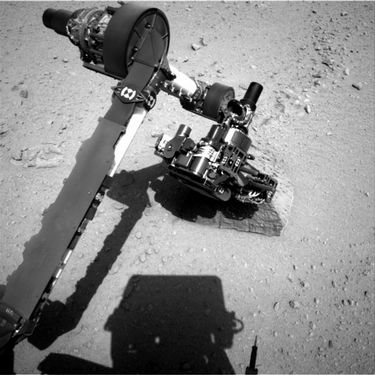
In this initial manoeuvre, the arm was raised, extended and rotated to use all five of its joints prior to it being stowed once more in preparation for Curiosity’s first drive. The manoeuvre marks the first step in calibrating the arm’s movements and preparing it for science operations. Further tests of the arm and its equipment load will take place over the next several weeks, but the system is unlikely to be fully commissioned until around mid-October.

Curiosity raises its turret of equipment as the robot arm is tested (image captured by the black-and-white Navcam system)

Continue reading “Curiosity: stretch, wriggle and roll!”

Curiosity: getting ready to zap around

Mission logo

Work continues on readying Curiosity for surface operations on Mars, with characterisation phase well underway.

The week has seen the rover’s Chemistry and Camera system – ChemCam – undergoing its calibration tests using a target system located towards the back of the rover, while scientists have been looking for candidates for the first full test firing of the system at a suitable surface target.

ChemCam is a complex system split between Curiosity’s mast and body. The mast unit is the large box-like unit at the top of the mast. It contains a laser unit, a remote micro-imager (RMI) and a telescope for focusing both.

The Chemcam mast element

The body unit carries three spectrographs for chemical analysis and has its own power supply and an electronic interface to the rover’s central computer system.

ChemCam has two main functions, split between the laser system (the Laser-induced Breakdown Spectroscopy (LIBS), to give it its proper name) and the Remote Micro-Imager (RMI).

LIBS is designed to fire series of laser pulses at a target spot smaller than 1 millimetre on the surface of rocks and soils, vaporizing it. Light from the resultant plasma is captured by the telescope and sent via fibre-optics to the on-board spectrographs for analysis, which should provide information in unprecedented detail about minerals and micro structures in Martian rocks. Additionally, the laser can be used to remove dust from the surfaces of rocks, allowing the drill on Curiosity’s hand to obtain samples of the rock free from surface contaminants.

The RMI provides black-and-white images at 1024×1024 resolution in a 0.02 radian (1.1 degree) field of view – approximately equivalent to a 1500mm lens on a 35mm camera. RMI has two functions. In the first, it will be used in conjunction with LIBS to identify suitable targets and target locations (targets can be selected autonomously or via Earth-based selection and command). Working independently of LIBS, it will be used to obtain close-up images in support of robot arm-mounted experiments or provide images of very distant objects.

This week, ChemCam was calibrated using a target system mounted on the rear section of the rover, mounted below the UHF antenna. As a result of this, ChemCam was confirmed ready for operations, and is expected to make it first test-firing on an actual Martian rock sample on Saturday August 18th. The sample is provisionally designated N165, and sits a short distance from the rover.

ChemCam’s first Martian target

ChemCam is a joint US / French experiment, with the US Los Alamos National Laboratory providing the body unit, the French national space agency (CNES) proving the mast unit (RMI, laser, etc.) and JPL the fibre-optic link between the two.

Continue reading “Curiosity: getting ready to zap around”