Space Sunday: a look at Betelgeuse

Astro photographer Alan Dyer captured this image of Orion on December 21st, 2019. Betelgeuse (top left) appears to be the same brightness as Bellatrix (top right). Normally, Betelgeuse is the 10th brightest star in our sky and Bellatrix the 27th. Credit: A Dyer

The constellation of Orion is one of the most familiar in the night skies. It is marked by a number of notable features, containing as it does three of the brighter stars in our night sky: Rigel: the 6th brightest star visible from Earth, and serving as Orion’s left foot; Betelgeuse, the 10th brightest, and serving as Orion’s right shoulder (so diagonally opposite Rigel); Bellatrix, the 26th brightest star in our sky, and sits at Orion’s left shoulder; and three  galaxies – the Orion Nebula, the Messier 43 nebula, the Running Man Nebula – all of which can be found in Orion’s “sword”.

Orion  – or more particularly – Betelgeuse – has been occupying a lot of the astronomy-related news cycles of late, with speculation that we might be witnessing the star’s potential move towards a cataclysmic supernova event.

Before I get down to the nitty-gritty of why Betelgeuse has astronomers all a-twitter (quite literally, given the amount of Twitter chat on the subject), some details about the star. Classified a M1-2 red supergiant, Betelgeuse has a very distinctive orange-red colouration that can again be seen with the naked eye. However, it’s exact size is hard to determine, because it is both a semiregular variable star, meaning the brightens and dims on a semi-regular basis as it physically pulses in size, and because it is surrounded by a light emitting circumstellar envelope composed of matter it has ejected.

This means calculations over the years have given many different estimates of the star’s size, suggesting it is roughly 2.7 to 8.9 AU in diameter (1 AU = the average distance between the Earth and the Sun). This means that were the centre of Betelgeuse to be placed at the exact centre of the Sun, then its “surface” would be at least out amidst the asteroid belt between Mars and Jupiter, or lie somewhere between Jupiter and Saturn!
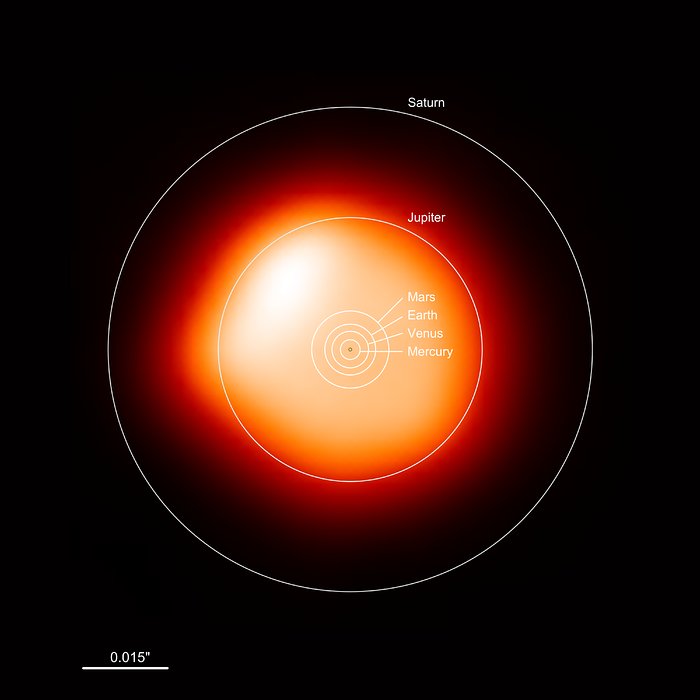
A diagram showing the approximate size of Betelgeuse compared to our solar system. Credit: unknown

That Betelgeuse is pulsating and has a cloud of material around it, also makes it difficult to pin down its precise distance from us. However, the most recent estimates suggest it is most likely around 643 light years from Earth, with a possible variation of around +/- 146 light years.

Red giant stars are of a type that have a comparatively short life, averaging 10-20 million years, depending on how fast they spin (compared to our Sun’s anticipated 9-10 billion years lifespan), with Betelgeuse thought to have a fast spin and an estimated age of about 8.5 million years, putting it close to its end of life, which tends to be a violent affair with stars of this size.

This is because these stars burn through their reserves of fuel at a high speed, although a temperature lower than typically found with Sun-type stars. Eventually, they reach a point where the temperatures generated by the nuclear process is insufficient to overcome the huge gravity created by their size, and they suddenly and violently collapse, compressing to a point where the pressure is so great, they explode outwards even more violently, tearing away most of their mass in an expanding cloud of hot gas called a nebula, leaving behind a tiny, dense core – or even a black hole.

However, while this final collapse and explosion takes place suddenly, the period leading up to it can be marked by observable changes in a star – and this is the reason for the excitement around Betelgeuse.

Comparison chart showing Jupiter, Wolf 359 – a red dwarf star (often featured in this column) – and the Sun, compared in size to other well-known stars in our galaxy, including Betelgeuse and the biggest stars so far discovered. Credit: unknown

Over the last 20+ years Betelgeuse’s radius has shrunk by 15%. While this has not massively altered the star’s brightness over that time, it is still an astonishing amount of mass to lose over so short a period. More recently, however, there has been a further change in the star that has caused excitement: since mid-October 2019, Betelgeuse has gone through a stunning drop in its apparent magnitude – or brightness as seen from Earth’s location – dropping from being the 10th brightest object in our night sky to around the 27th, bringing with it a complete change in Orion’s appearance in our skies.

This sudden drop in brightness has been seen by some as a possible indicator that Betelgeuse may have gone supernova, and we’re now waiting for the light of the actual explosion to reach us. Such has been the interest, reference has been made to monitoring neutrino detectors for the first signs of an explosion. This is because whereas photons have to escape a star’s collapse, neutrinos don’t, and so will reach us ahead of any visible light; so a sudden increase in the number of them detected coming from the region of the sky occupied by Betelgeuse could be indicative of it having exploded.

The clearest image we have of Betelgeuse, captured by the European Southern Observatory’s Atacama Large Millimetre/sub-millimetre Array (ALMA). Credit: ESO / NAOJ/NRAO / E. O’Gorman / P. Kervella.

Continue reading “Space Sunday: a look at Betelgeuse”

Looking at Second Life updates in 2019 and ahead to 2020

Each year through this blog I attempt to track news about, and changes to, Second Life, as driven by Linden Lab. On the technical side, this is do through my weekly SL project summaries, whilst news and general updates are drawn from sources such as Lab comments on the official forums and official blog posts or as a result of attending public meetings and Q&A sessions, etc.

As a lot can happen during the course of the year, so in this article I’ve tried to summarise the more notable updates to occur during the course of 2019.

Land

Mainland Auctions

In March 2019, Linden Lab introduced Mainland user-to-user land auctions. The auction system leveraged Second Life Place Pages as the medium for presenting land for auction and for placing bids, together with a “cover page” listing available parcels up for auction available at https://places.secondlife.com/auctions. At the time of the launch, Linden Lab provided a Land Auctions Walkthrough.

Unfortunately, these auctions had to be suspended in October / November 2019 due to unspecified “abuse” by users. The system is to be revised, but there is currently no indication of when the auctions will be re-enabled.

Premium Homes

The first styles of the new Premium Homes were unveiled at the annual Home and Garden Expo in March 2019 in a single “preview” region that provided both the four types of Traditional homes and four types of Houseboat that would be the first  of the Premium Homes themes that would be issued.

The Homes themselves launched on April 15th, 2019, with the opening of the new Bellisseria continent and a mass release of both Houseboats and Traditional homes.  As with the original Linden Homes, they are available through Premium member’s Land Homes page, accessed through their secondlife.com dashboard.

The new Linden Homes are available to Premium members through the existing Linden Homes registration page

The first mass release of houses and houseboats had been snatched up within 48 hours of the release, with the houseboats proving particularly popular – so much so, that the Lab immediately started planning a 709-parcel add-on to Bellisseria specifically to meet the demand. In the meantime, one of the points noted about the new region was its lack of airstrips and this was addressed with the opening of the continent’s first airstrip in late April 2019.

The new bolt-on for the houseboats opened on May 15th, 2019 – and were all gone within 27 minutes of the release. Then in June 2019, Patch Linden announced that releases would shift to a smaller-scale rolling basis with regions of new houses generally being made available on Mondays, Wednesdays and Fridays.

Also in June, the Lab previewed the next major theme for Linden Homes, the Trailers and Campers, which were introduced in September. In December 2019, the Lab previewed and then released the Victorian theme of Premium Homes.

Fees and Account Changes

Fee Changes

2019 saw the introduction of significant fee changes for Second Life.

From June 2rd, 2019 Private region tiers changed as follows:

  • Full regions were reduced from L$249 a month to US $229.
  • Homestead private regions were reduced from US $195 to US $179.
The changes to Premium fees, announced in June 2019. Source: Linden Lab

These changes were exclusive of VAT, where applicable, and did not apply to Skilled Gaming region; however, Education / Non-profit (EDU/NP) discounted Full islands were be re-priced to maintain their 50% discount off the regularly priced Full island fees.

From June 24th, 2019, Premium fees were increased for the first time in their history:

  • The monthly fee increased from US $9.50 to US $11.99 (an annual increase of 26.21% from US $114 pa to US $143.88 pa)
  • The quarterly subscription increased from US $22.50 to US $32.97 (an annual increase of 46.53% a year from US $90 pa to US $131.88 pa). This fee was to be discontinued to users upgrading to Premium after July 24th, 2019, but a later decision saw it continued on a “temporary” basis that means it is still currently available.
  • The annual fee increased from US $72 to US $99 (an annual increase of 37.5%).
  • In addition, both existing quarterly and monthly subscriptions would again be subject to VAT.

Note: included with the announcement were proposed changes to Basic account users available off-line IMs and total group allowance. However, after receiving wide-ranging feedback (such as this letter from myself), the decision was made to not implement the group changes.

To help sweeten the Premium fees increase, between June 3rd through June 24th, Premium users were offered the chance to “lock-in” their Premium fee for an additional period commensurate to their subscription period from the end of their existing period. In addition, existing annual Premium subscription members were offered the chance to renew their subscription for an additional year from their next renewal date at the Winter Premium discounted rate (10% off).

There was also the 5% increase in Marketplace commission fees which caused some consternation. While the reason for the increase is understandable when put in the proper perspective, it could have been framed a little better.

Account Changes

In July Linden Lab announced that as from August 1st., their subsidiary company, Tilia Inc., would be taking over all responsibility for managing SL user’s USD denominated accounts. In short, this meant that anyone with a US dollar balance on their account would have to agree to the Tilia Terms of Service and Privacy Policy, and in order to process USD amounts out of Second Life, might have to supply personal information to Tilia. See:

Technical Updates

Teleport Disconnects

The early part of 2019 was marked by users experiencing a significant number of teleport disconnects. These proved problematic for the Lab as well,with assorted causes from EEP deployments to server OS updates being suggested as a possible cause. A series of user-involved stress tests on the best (Aditi) grid to help with investigations, allowing adjustments to be made on the simulator side. These helped point towards a race condition, with LL implementing changes and updated monitoring to counter the issue.

Script Processing Changes

Over the course of the year,  number of script-related issues have surfaced:

As a result, LL has worked to improve script handling – such as adjusting how idle scripts are handled to reduce the overhead with place on CPU cycles – and these changes and adjustments have helped to eliminate some, but not all, of the problems encountered through the year.

Marketplace

Release Notes

In May 2019, the Lab introduced new web-based release notes for the official viewer, together with a index page for said release notes. There were some initial teething problems with the system for those who track official viewer releases (sometimes a viewer update would appear on the index page, sometimes on the new Alternate Viewers page, sometimes on both that took a while to smooth out.

Server release notes made a similar move to web pages in September. After this, LL stopped breaking down simulator updates by release channel (e.g. BlueSteel, Magnum and LeTigre), listing all releases as “Second Life Server”, regardless of the actual channel used for a release.

iOS Client

In January, evidence surfaced that Linden Lab are working on a Second Life iOS. After enquiring with the Lab, I received confirmation the app was being actively worked on. As the year progressed, more details were revealed about the app, including: the app should work on both the iPhone and iPad, and will initially be more of a communicator / companion app than a fully-rounded client; it will provide a log-in option, and chat options (e.g. chat, group chat), but will not present users with an in-world location, or rez and avatar in-world. Over time it will be enhanced – but additional capabilities are still TBD. See my mid-year update for more.

Cloud Transition

Work – most of it transparent to users – has continued on the migration of Second Life to the cloud. Most of this work has been on the back-end services, notably the web services. Currently, no public-facing simulators have been transitioned to AWS provisioning. All of this work has been achieved without any significant disruption to services or – more particularly – without users actually being aware the services had been moved, and the Lab reports that the migrated services have been able to achieve almost 100% up time.

Continue reading “Looking at Second Life updates in 2019 and ahead to 2020”

Space Sunday: Starliner’s first orbital flight

Ignition: the United Launch Alliance Atlas V topped by an uncrewed Boeing CST-100 Starliner vehicle lifts-off from Space Launch Complex 41 at Canaveral Air Force Station on its uncrewed Orbital Flight Test mission. Credit: ULA / Boeing

On Friday, December 20th, 2019, NASA and Boeing, together with launch partner United Launch Alliance (ULA), attempted to undertake the first flight of the Boeing CST-100 Starliner commercial crew transportation system to the International Space Station (ISS).

I say “attempted” because while the first part of the mission went precisely to plan and the Starliner successfully reached orbit, a software issue left it unable to reach the ISS. However, while this prevented a core mission objective from being met – that of rendezvousing and docking with the ISS – it did not leave the mission a failure: the ascent to orbit was successful, with a lot of data gathered on the vehicle’s performance, and further data could be gathered while on-orbit and during the vehicle’s return to Earth – also a critical part of the test.

The vehicle was uncrewed for this test flight, but is carrying a range of cargo – including Christmas gifts for the ISS crew; tree seeds that will be planted on Earth after the mission to mark it; a mannequin fitted with a host of sensors to measure the stress placed on a human body during the flight to orbit (the mannequin is called “Rosie the Rocketeer” in reflection of “Rosie the Riveter”, the iconic role model for U.S. women working in factories and on production lines in WWII, and a Snoopy soft toy “zero gee indicator” – Snoopy is the mascot for NASA’s Artemis programme to return humans to the Moon.

The Atlas V, dual Centaur and CST-100 vehicle stack. Credit: ULA

Things started off well enough: following a near-perfect count down, the core booster of the Atlas V and its two strap-on  solid rocket motors ignited precisely on time at 11:36:43 UT (06:36:43EST) on the launch pad of Space Launch Complex 41 at Cape Canaveral Air Force Station, and the vehicle lifted off smoothly into the still-dark early morning sky.

Due to the need to keep the vehicle within a 3.5 G limit during ascent, the Atlas V rose into a “flat” trajectory during its climb, the two solid rocket boosters being  jettisoned some 2 minutes into the flight, the core stage motors continuing to burn for almost three more minutes before BECO – Booster Engine Cut-Off – was called. Shortly after, the core stage of the Atlas V separated from the Centaur upper stage, allowing it to fire its twin RL-10A motors – marking the first time a twin-engined Centaur had been used with the Atlas V booster. Again, the additional power provided by the additional motor was required to push Starliner toward orbit, running for seven minutes in the process.

It was after the Starliner has separated from the Centaur upper stage that the major problem occurred. At this point, the vehicle was supposed to orient itself and then fire the main engine on the service module to push itself into an initial orbit that would allow it to complete further engine burns to both raise its orbit and circularise it, allowing the Starliner to catch-up and rendezvous with the ISS.

However, that initial burn failed to occur on time. Instead the vehicle continued to fire its attitude control thrusters while ignoring commands from Earth to fire the the service module’s motor. Some seven minutes passed before the engine was ignited, allowing Starliner to achieve its initial orbit – but by that time its was “off course” in relation to where it needed to be in order to catch up with the ISS, and had used too much attitude control system fuel to be able to make necessary course corrections and achieve any form of rendezvous with the ISS.

The Boeing Starliner space vehicle experienced an off-nominal insertion. The spacecraft currently is in a safe and stable configuration. Flight controllers have completed a successful initial burn and are assessing next steps. Boeing and NASA are working together to review options for the test and mission opportunities available while the Starliner remains in orbit.

– Kelly Kaplan, Boeing’s spokesperson, after the planned automated engine burn failed

According to initial investigations, it is believed that the mission clock aboard Starliner overseeing all of the vehicle’s automated flight operations – including triggering the engine burn – had incorrect data, causing it to believe the service motor had fired, and thus triggering the use of the attitude control system.  While the issue left Starliner unable to reach the ISS, mission controllers were able to order the vehicle to complete two additional engine burns to put it into a near-circular 250km high orbit, where a range of tests on the vehicle have been made, and from which it could complete its planned EDL – entry, descent and landing.

A couple of important points to highlight here is that had the vehicle been carrying a crew, they would not have been in any danger – in fact, they would likely have been able to correct the initial burn failure, allowing the rendezvous with the ISS to take place.

The stages of a Starliner’s return to Earth. Credit: Boeing

With the issue understood – if not the cause known – the decision was taken to complete the planned orbital tests and then bring the Starliner back to Earth  and a landing at the White Sands Missile Range, New Mexico on Sunday, December 22nd. These orbital test included testing the navigation systems and the vehicle’s flight handling, and communications (including establishing a link with the ISS).

Landing commenced with Starliner turning itself around and using the service module’s motor in a de-orbit burn. This took place at 12:23 UT (06:23 CST at the White Sands landing ground) on December 22nd, slowing the vehicle sufficiently for it to start a decent into the denser part of the Earth’s atmosphere. Three minutes after this, the service module was detached and left to burn-up in the upper atmosphere.

The capsule, protected by a double heat shield system – referred to as the forward heat shield (protecting the upper part of the vehicle: the airlock and the landing system parachutes) and the base heat shield (at the base of the capsule and designed to protect it from the full heat of atmospheric entry) and covered in a thermal protection system – reached “entry interface” some 20 minutes later. This is the point where the atmosphere becomes dense enough to generate friction around the vehicle, both heating up and slowing the vehicle down. At this point, Starliner was some 15 minutes away from landing.

Continue reading “Space Sunday: Starliner’s first orbital flight”

Space Sunday: tiny stars & giant planets, and an interstellar visitor

An artist’s impression of the Neptune-sized world orbiting white dwarf WDJ0914+1914,. While the star is “dead” it is still hot enough for its solar wind to be slowly ripping away the planet’s outer atmosphere, most of which is lost to space, while some of it swirls into a disc, itself accreting onto the white dwarf, further heating it. Credit: ESO / M. Kornmesser

When a star like our own reaches the end of its life, two things happen: first, in a desperate attempt to keep itself burning after using its hydrogen and helium, it expands outwards into a red giant as it burns heavier elements in turn (our Sun will expand to a size sufficient to consume Mercury, Venus and Earth) before it collapses into a hot, white dwarf, a fraction of its former size (perhaps no bigger than the Earth).

But what of any gas giants orbiting the star well beyond the limits of its red giant expansion? What happens to them following the star’s collapse to a white dwarf? Do they simply continue until such time as their own internal heating fails? Might they have some additional interaction with their former parent?

A team from Warwick University, England, appear to have the answer. They’ve discovered a Neptune-sized planet some 4 times larger than its white dwarf host star, and the two have entered into what is – at this point in our understanding of such situations – a unique relationship.

The star is called WDJ0914+1914 and is some 2,000 light years away. Whilst reviewing data on it gathered by the Sloan Digital Sky Survey (SDSS), the astronomers came across something odd: the star was apparently giving off oxygen, sulphur and hydrogen emissions. While the oxygen was to be expected – by this time in a star’s life most of what is left is actually oxygen and carbon – the hydrogen and sulphur simply shouldn’t have been there.

Turning to the Very Large Telescope (VLT), the Warwick team found the emissions corresponded to to a ring of gas surrounding the star. At first they thought they had discovered a binary system in which the mass of one star was being drawn off by the other, forming a dust ring around both. However, further analysis revealed the composition of the disc matches the deeper layers of planets in our own Solar System like Neptune and Uranus, suggesting a planetary body still exists orbiting the star and material from that planet is feeding the disc, allowing it to survive.

While fusion has long since ended at WDJ0914+1914, the star is still radiating at some 28,000ºC – enough energy to tear material from the upper layers of a planet’s atmosphere. Much of this atmosphere would trail outwards from the planet as a hot plume – which the Warwick team detected – while some would collapse to feed the disc of material surrounding the star.

Putting their calculations together, the Warwick team worked out that the planet – which cannot be directly sighted – is likely to be around the size of Neptune, and it is losing its atmosphere at a rate of around 2,700 tonnes per second to both to the disc of material around the star, and eventually onto the star itself – “feeding” it, if you will. Although this sounds a lot, it actually adds up to a relative small amount given the size of the planet, and so the loss is unlikely to alter its overall structure as the star continues to cool.

This discovery at WDJ0914+1914 is unique at the moment – but it makes the case that other white dwarf stars may also be survived by planets, some of which we may be able to detect using the transiting method of observation (WDJ0914+1914 is simply too dim for this to work). Certainly, the Warwick team’s research has opened the door on this form of research, one that could help with our understanding of exoplanet atmospheres.  It also offers a cold look at the far future (roughly 4.5 to 5 billion years from now) of our own solar system.

New Dates For Commercial Crew Test Flights

NASA has issued new dates for the final test flights for the SpaceX Crew Dragon and Boeing CST-100 Starliner that, if passed, should allow both vehicles to move on towards actually transporting astronauts to and from the International Space Station.

On December 20th, 2019, a United Launch Alliance Atlas V will launch the first CST-100 Starliner into orbit on an uncrewed orbital test flight (OTF) to the International Space Station. As well as testing the Starliner’s avionics and flight systems, the flight will also test a new docking system that is intended to become the “”standard docking system for sending humans to Gateway and to Mars” as a part of the Artemis programme, and used to deliver additional supplies and some Christmas / New Year’s extras to the ISS crew.

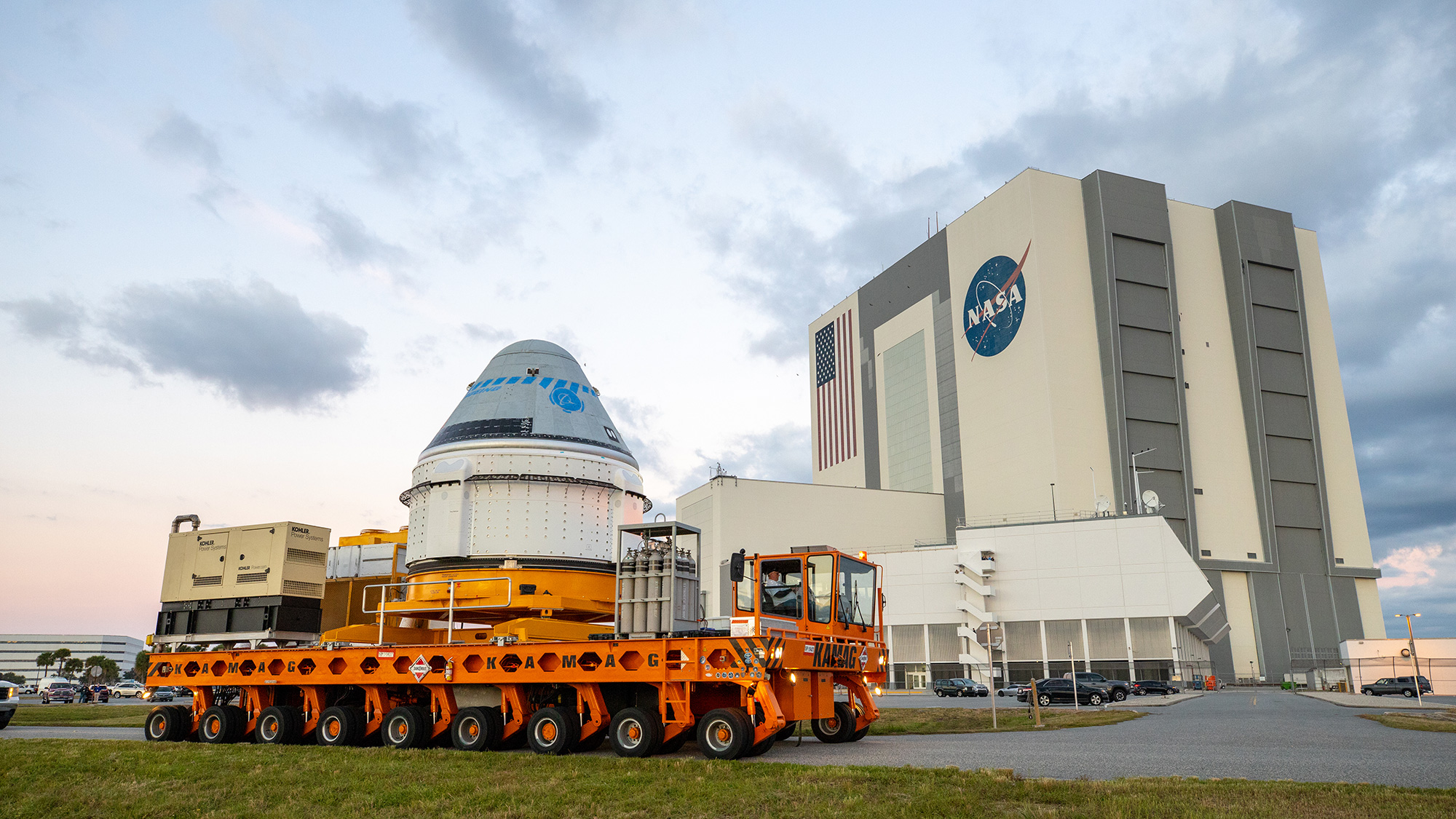
The first Boeing CST-100 vehicle being transported from Boeing’s fabrication centre at Kennedy Space Centre on its way to the Space Launch Complex 41 Vertical Integration Facility at Cape Canaveral Air Force Station in readiness for its flight, November 21st, 2019. Credit: Boeing

Also flying on the vehicle will be a flight test dummy christened “Rosie the Rocketeer”, named for “Rosie the Riveter”, the iconic role model for U.S. women working in factories and on production lines in WW II. The dummy is fitted with an array of sensors to measure critical data including G-forces endured during the flight to inform the team about the stresses a human crew will experience during an ascent to orbit on the vehicle. Results from this data, and all telemetry gathered during the flight will help inform NASA and Boeing on the Starliner’s readiness to commence crewed flights.

The vehicle will not spend long at the ISS – it will be undocked on December 28th and make a return to Earth in a full dress-rehearsal for a crewed landing for the CST-100 capsule. Should weather interfere with the planned launch, both December 21st and 23rd offer suitable windows for the launch to take place.

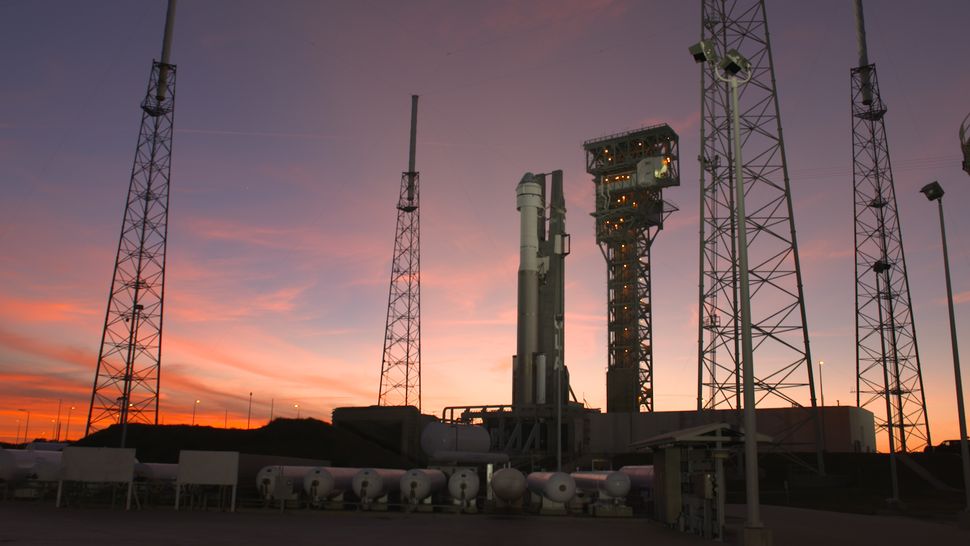
The first Boeing CST-100 mounted atop its United Launch Alliance Atlas V booster at Space Launch Complex 41, Cape Canaveral Air Force Station, December 4th, 2019. Credit: Boeing

Then, on January 4th, 2020, SpaceX is expected to complete an in-flight abort test. For that test, a Falcon 9 will lift off from Launch Complex 39A at Kennedy Space Centre carrying a test Crew Dragon vehicle – which has previously performed  a successful static fire test of its SuperDraco escape motors in November. Around 90 seconds into the flight, and the time of maximum dynamic pressure on the vehicle, the escape system will be triggered, the capsule hopefully escaping the rocket to make a safe splash-down under parachute.

SpaceX had hoped to complete this test before the end of the year, but assorted delays – including that of the CRS-19 resupply mission, which launched earlier in December (see: On the ISS – mighty mice and robots) – meant that target could not be met. If the abort flight test is successful, it should allow NASA and SpaceX to determine when crewed flights to the ISS can commence – an uncrewed test flight of the vehicle to the ISS having been completed in March 2019.

Overall. NASA would like both Boeing and SpaceX to complete their first crewed flights to the ISS – also regarded as test flights – by mid-2020.

Continue reading “Space Sunday: tiny stars & giant planets, and an interstellar visitor”

2019 OpenSimulator Community Conference December 14th / 15th

Image courtesy of the OpenSimulator Community Conference

The 2019 OpenSimulator Community  Conference is in progress over the weekend of December 14th and 15th. An annual event, the conference focuses on the developer and user community creating the OpenSimulator software.  It is organised as a joint production by Core Developers of OpenSimuator and AvaCon, and this year is sponsored and supported by University of California, Irvine, Institute for Virtual Environments and Computer Games, together with members of the Opensim community.

The conference once again features business presentations, talks, panel discussions, workshops, social events and hypergrid activities, covering a wide range of subject areas, including education, social VR, using virtual worlds and environments for historical recreations – and much more besides.

You can find the full schedule of events on the OpenSimulator Community Conference website, together with instructions on how to log-in and join and of the sessions.  Those wishing to register and support the conference can do so through the registration page. This is not required, but those who are willing to do so help to cover the cost of running these conferences.

Image courtesy of the OpenSimulator Community Conference

To encourage interest in the conference, there will be two social events held on Friday, December 13th (as well as during the conference itself). These are:

  • 14:00-16:00 PST- Tour of the International Spaceflight Museum in Kitely: ISM Exhibit Building Chair Mike Lorrey will personally lead and narrate a tour of the ISMuseum region in Kitely, with detailed explanations of the many exhibited rockets, spacecraft, and astronaut/pioneer exhibits. Come prepared to listen in voice. The first hour will be a tour with a considerable narrative explanation.Tour will be followed by a dance party in the Rocket Ring with DJ Rosa Alekseev.
    • Grid Name: Kitely – http://kitely.com.
    • Region Name: ISMuseum.
    • Parcel/Venue Name: ISMuseum Southwest,Rocket Ring.
    • HyperGrid URL: grid.kitely.com:8002.
  • 18:00-19:00 PST: Magnolia Gardens Party: explore Magnolia Gardens of Knowledge, interact with the Digital Teaching Assistants designed to guide new users learning to use the SceneGate Viewer, relax, fish, ride the jet skis, or dance the night away with music throughout.
    • Grid Name: Metaverse Depot.
    • Region Name: IMA Outpost Alpha.
    • Parcel/Venue Name: Magnolia Gardens.
    • Grid Website: http://grid.metaversedepot.com:8002/wifi/welcome.html.
    • HyperGrid URL: http://grid.metaversedepot.com:8002:ima%20outpost%20alpha.
    • Note: if you land in the default Depot region, select Magnolia Gardens on the quick teleport board; if you use the teleport system with the image, select Magnolia Gardens in the list then click the picture to teleport; if you arrive inside the lighthouse, click the yellow cylinder to teleport to the venue.

Related Links

High Fidelity changes direction (3): layoffs & shuttering apps and access

via High Fidelity

In April 2019 during a High Fidelity General Assembly meeting, Philip Rosedale announced the company would no longer be sitting within the content creation / public space provisioning area, and would instead switch to focus on software / platform development. He followed-up on that announcement a few days later with a blog post outlining the company’s move to try to develop a virtual workstation / environment that would allow people to work collaboratively whilst geographically separate.

Since that time, the company has been working on the virtual workspace idea, apparently developing it to a point where a desktop versions has been undergoing widespread testing involving teams from some 75 organisations.

However, in a December 11th blog post, Updates and a New Beginning, Rosedale announced that while the company plans to continue use the technology they’ve developed, and hopefully carry it forward into the future, they  do not plan to commercialise it at present, and are again pivoting to a new project.

Simply put, having taken a close look, while we can see that remote work is going to continue on its growth trajectory and we do have customers using it—the opportunity is not big enough today to warrant additional development. 

The work we’ve done over the past six months has been valuable in helping us understand how to make a 3D VR environment usable, stable, and accessible to first-time, non-gaming audiences, and that is intellectual property we will take forward into future work.  

– Philip Rosedale, December 11th, 2019

The pivot means that the company is shedding a further 50% of its staff (approx 40 people, given 20 people, or 25% of staff were let go in May 2019). Further, and as from January 15th, 2020, High Fidelity will be shuttering public access to its code repositories on Github (although users are welcome to fork them, if they wish), and will also be withdrawing all their apps from the Steam and Oculus stores and from the Apple App Store and Google Play.

For now, Rosedale is not revealing what the new project is, but given the shuttering of the current platform code repositories and a comment in the December 11th blog post, it might be related to a more virtual world style of platform / application.

Giving up on the current generation of HMDs doesn’t mean we’re giving up on Virtual Worlds. A team is already working on a new internal project, and although we aren’t going to talk about it now, we will have more to share about what we are doing when we are ready.

– Philip Rosedale, December 11th, 2019

A FAQ has been produced to accompany the blog post, answering core questions existing user might have about platform accessibility, account registrations, blockchain use, buying / selling HFCs, etc. And those who have a High Fidelity account should refer to that document. 

The announcement comes on the heels of a blog post from Rosedale published on December 9th, 2019, in which he continues to ruminate on the hard realities surrounding the state of VR at this point in time.

In Requiem for the HMD, he admits something that many of us have always felt: the the current generation of HMDs can at best only enjoy a modest success, and the technology as a whole still has a long way to go before it is liable to reach a “mainstream” place in the consumer market. In particular, he notes four things he believes the technology requires in order to reach this point: comfort of wearing, the inclusion of see-through displays and at desktop screen resolutions, and the ability of people to be able to type tat normal speeds in VR. To these I’d actually add more fundamental requirements such as cost per unit, overall ergonomics and compelling use cases – but these are topics for another blog post.

In the meantime, Updates and a New Beginning makes for interesting reading, as it offers a further honest evaluation of VR as it is today from someone who has been one of its strongest evangelists. For those who are having to depart High Fidelity as a result of the company’s further shift in direction, the hope is that they are able to transition smoothly into other work opportunities.

For those users who would like to keep the spirit of High Fidelity’s VR platform alive, as noted, they have until January 15th, 2020 to fork the code into their own repositories. There also the likes of Tivoli Cloud in development by former High Fidelity alumni Caitlyn Meeks and Maki Deprez that may blossom into new homes for HiFi users.

Related Articles