
Such is the pace of development, the first orbital flight of the SpaceX Starship / Super Heavy combination will now not take place as originally planned.
It had been thought that the flight, which has been repeatedly delayed for a number of factors, including slippages in the Federal Aviation Administration being able to publish the final version of its study into the impact of SpaceX’s operations in Boca Chica on the surrounding environment, would be made by Starship No. 20 (“Ship 20”), and Super Heavy booster No 4 (Booster 4), both of which have been going through a wide range of cryogenic and static fire tests since mid-2021, the most recent of the cryogenic tests occurring just over a week and a half ago, with both vehicles stacked together on the launch platform.
However, on Saturday, March 22nd, Starship 20 was “destacked” from Booster 4 and removed from the orbital launch facilities, and 24 hours later, Booster 4 was also removed, with Elon Musk Tweeting that neither would now play a role in the first orbital flight attempt. The reason for this is simple: work on developing and enhancing the design of both the Starship vehicle and the Super Heavy booster now means that Booster 4 and Ship 20 are essentially obsolete.

The major cause for this is that – despite a scary e-mail from Musk at the end of 2021 stating SpaceX could go bankrupt if issues with the powerful Raptor 2 engine were not quickly sorted out and production ramped – the company is now solely focused on boosters and ships built to mount the much more compact Raptor 2 motors, the sea level versions of which (primarily used to power Super Heavy, but three are also used in each Starship) are considerably smaller and less complicated than their Raptor 1 cousins, and generate far more thrust (from 230 to 250 tonnes per Raptor 2 compared to a maximum 185 tonnes for a Raptor 1).

The more compact size of the Raptor 2 makes it possible for SpaceX to increase the total compliment of engines on a Super Heavy from 29 to the planned 33. The reduction in their complexity also makes all of the plumbing required to feed them propellants and the electronics needed to control them a lot easier to manage. For starship vehicles, the smaller Raptor 2 motors should make it easier to increase the number of engines from 6 to the planned 9 (3 sea-level and 6 vacuum engines with their much large exhaust bells).
Booster 7 and Ship 24 are also the first of each design to incorporate other critical design changes. Some of these are to easy the fabrication and assembly process, others are to help improve performance or meet the demands of having more engines, and still other to improve aerodynamics.
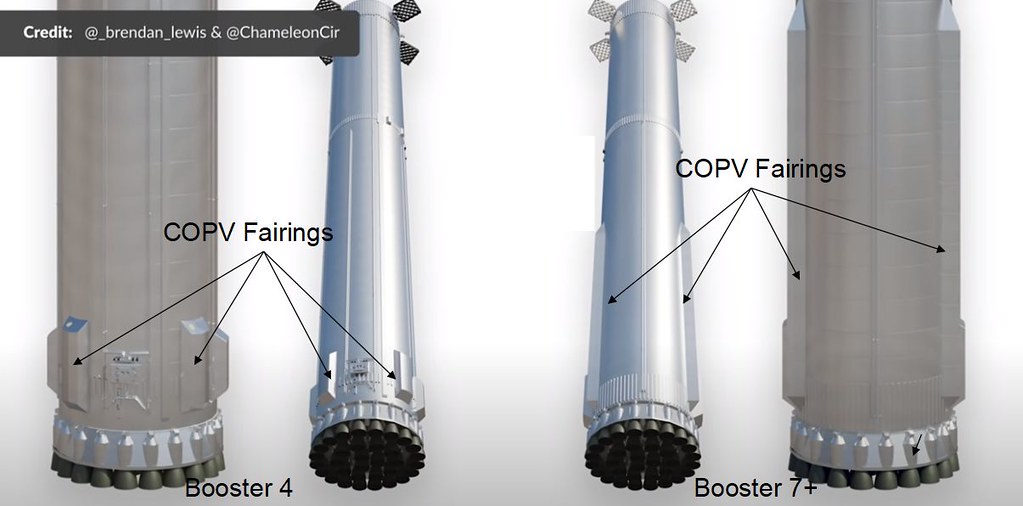
In the case of the Super Heavy booster, one of the cleverest – and most visible – changes is in the number and positioning of the Composite Overwrapped Pressure Vessels (COPVs).
COPV are tanks of hydrogen used in the ignition process for the outer ring of Raptor motors on a Super Heavy. With Booster 4, four pairs of COPVs were placed equidistantly around the base of the booster, covered by steel aeroshells.
However, with the increased number of Raptor engines, Booster 7 and those that follow it require 10 COPVs each. Were the extra two COPV to be paired at the base of the rocket, they would work with the other four pairs to disrupt airflow over the tail of the booster during ascent, generating both drag and potential buffeting / vibration.
To prevent this, Booster 7 is the first Super Heavy to have the COPV stacked vertically along its sides in two sets of five. Not only does this remove the risk of additional drag / buffeting during ascent, it also simplifies the overall plumbing to supply hydrogen to the Raptors, as each set of 5 can use common feedlines down the the engines. However, what is particularly clever is that offsetting each stack of COPVs slightly from the rocket’s centreline, their aerodynamic covers can actually help generate a degree of lift around the base of the rocket during its descent back through the atmosphere, helping to both slow it and provide a greater degree of control during the descent.
As it is the closest to completion, Starship 24 would appear to be the primary candidate for joining booster 7 on the orbital flight attempt (work on ships 21 through 23 having been abandoned / bypassed) – but this far from certain. Recent work on the vehicle has seen it installed with a small prototype payload bay door, suggesting it has been earmarked for a payload bay test flight, something yet to be scheduled. As such, it is possible that Ship 25, also being assembled at Boca Chica, might be selected for the first orbital attempt.
Although the switch to using more recent versions of Super Heavy and Starship means that the first orbital flight attempt is now unlikely to occur before late May 2022, when it does happen, it will allow SpaceX to gather more relevant data on vehicle performance, which should help benefit the programme overall. It also means that by the time the booster / ship combination is ready to go, the FAA’s report on its environmental review of the Boca Chica site should have been published (the release date was recently pushed back again from the end of March to the end of April), and SpaceX should be in a position to know whether or not they are to be granted a licence for their orbital launches from the site.
Continue reading “Space Sunday: Starship, ExoMars and sundry news”








 Inara Pey: Living in a Modemworld