Lab Gab 27 summary: Relay for Life

via Linden Lab

The 27th edition of Lab Gab live streamed on Friday, June 5th, and featured members of the Second Life Relay for Life team Stingray9798 Raymaker, Trager Alter, MamaP Beerbaum, and Nikki Mathieson, to mark the 2020 Relay weekend (which you can read about here). They were interviewed by co-hosts for the session, Strawberry Linden and Patch Linden.

The official video of the segment is available via You Tube, and is embedded at the end of this article. The following is a summary of the key topics discussed and responses to questions asked.

About the RFL Team

  • Trager Alter has been directly involved in Relay for Life of SL since 2017 after being introduce to Stingray by MammaP. He’s been directly involved in Relay Refresh – telling the stories of people who have faced and survived cancer.
  • MammaP became involved with Relay for Life of Second Life at a time when her father was suffering from cancer. It gave her the opportunity to do something practical to help raise money for cancer research whilst simultaneously caring doe her father in the physical world.
  • Nikki Mathieson joined SL alongside of MamaP, and became enamoured with the platform, the opportunities it offers, and realised that it offered huge potential for Relay for Life, and became involved in RFL of RL for that reason.
  • Stingray came to SL through the American Cancer Society, having been the manager for RFL’s on-line content. He was asked to look into RFL activities in SL as a result of RFL of SL volunteers working with ACS’s Innovations Team, and everything had reached a point where the Innovation Team were ready to hand it over to the ACS Relay Team, and he was asked to take the lead, so becoming the official liaison between RFL of SL and ACS.
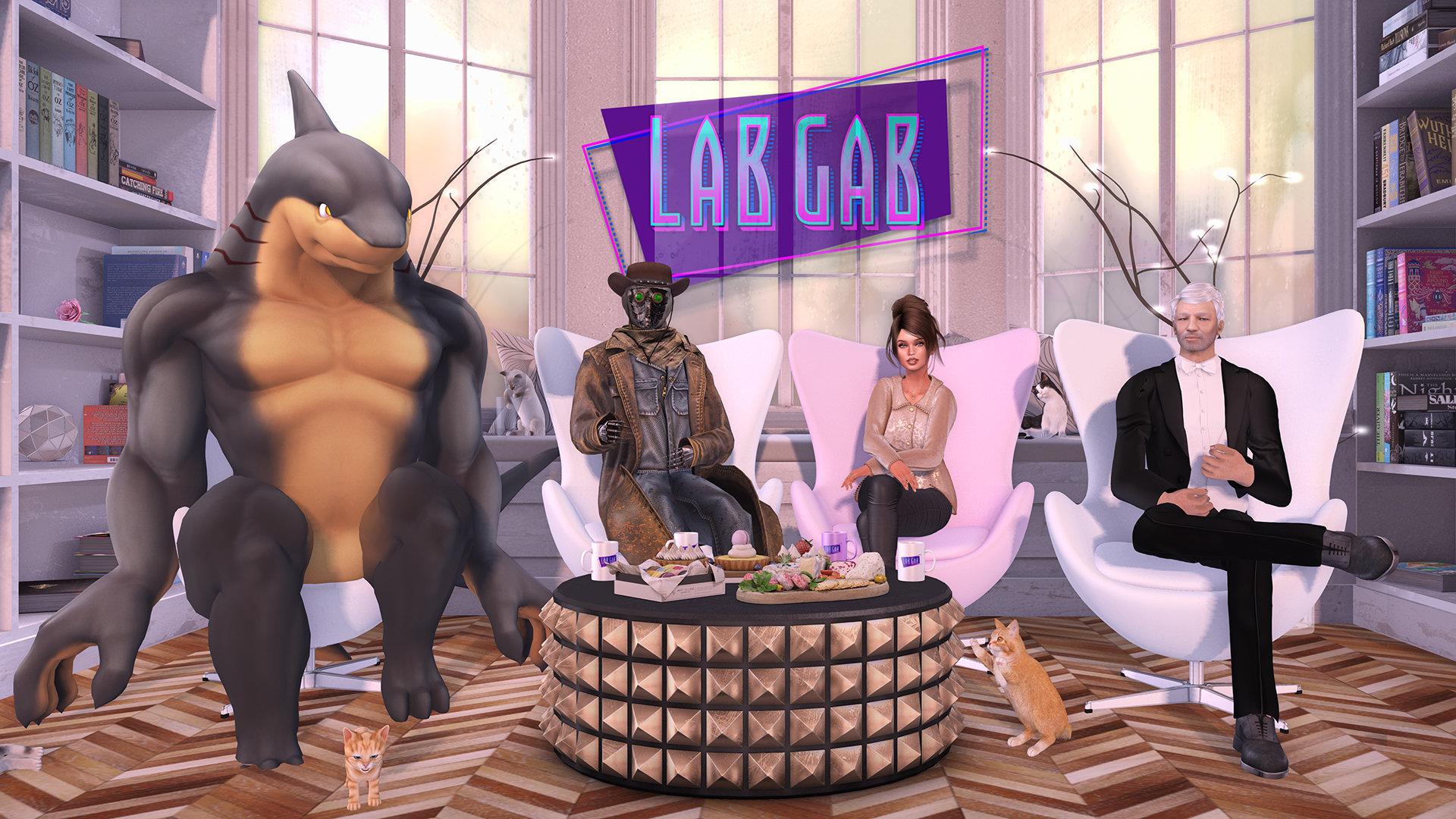
Strawberry Linden (seated left) with (standing) Trager Alter (l), and Stingray9798 Raymaker (r), (seated)Nikki Mathieson (c) MamaP Beerbaum (r)

What is the Relay Weekend?

  • Every year, Relay for Life raises money for the work of the American Cancer Society via a season of events. Many of these are run by individual Relay Teams formed by Second Life residents, and some are “mega events” (such as the Home and Garden Expo, Fantasy Faire, the Sci-Fi Convention, Making Strides Against Breast Cancer and Xmas Expo).
  • The Relay Weekend is the culmination of those events held during the core Relay season (February to June), where all the teams, large and small come together alongside the RFL track, each team with its own parcel to promote the work in providing care, support and treatment for sufferers of cancer in all its forms and their families and carers.
  • The event carries the ideal of Relay events in the physical world by having members of each team take turns to walk around an in-world track for the full 24 hours of the event. This is to symbolise two things:
    • When someone is dealing with cancer, they are no doing it alone, there are others who can support them and be with them.
    • The 24-hour aspect is recognition that cancer never sleeps, and the quest for cures to it cannot rest either.
  • The camp sites and themed regions all offer opportunities to socialise, to make friends and to learn more about cancer and how it can affect lives, be treated, etc., and the role of the ACS in all of this.

How does the Weekend Differ from Physical World RFL Events?

  • Abbreviated history of Relay:
    • In May 1985, Dr. Gordon Klatt, a colorectal surgeon from Tacoma, Washington, raised money for ACS by walking around the track at Baker Stadium at the University of Puget Sound for 24 hours, covering approximately 83 miles around the track.
    • Throughout the night, friends paid $25 to run or walk 30 minutes with him.
    • After this event, Klatt thought about how other people could participate in a similar event in their own community. He recruited a small team of people to host the City of Destiny Classic 24-Hour Run Against Cancer, and from this Relay for Life grew.
  • Relay for Life events now take place in some 30 countries around the world.
  • Events generally comprise:
    • A Survivor Lap, which starts the Relay event.
    • An Opening Lap, in which all the participants take a lap around the track
    • A Luminaria Ceremony, usually with a candlelight vigil
    • A “Fight Back” Ceremony, in which participants pledge to take specific actions against cancer.
  • The SL Relay Weekend comprises the same format and key activities. But differs in execution:
    • It does not require so much central logistical organisation and management.
    • It does however, require far more infrastructure coordination.
    • It is effectively a bigger event, both in terms of virtual vs. physical size (the 2020 track, for example, equates to some 6 miles), and in terms of the numbers of people participating.
    • Teams are able to do more than “just” camp and walk the track: they can directly support fund-raising by organising and running their own mini-events and activities.
    • It is a fully international event.

What is the Luminaria Ceremony?

  • It is the hour of the event (started at 21:00 on the Saturday of the Relay Weekend, roughly half-way through the weekend.
  • At that time, the track is darkened, and everyone in the Relay Regions are asked not to engage in open text or voice chat but to walk the track in silence or stand to one side.
  • During the hour, the names of those to be remembered, as submitted by the Luminaria Dedication Form that has been available for some time before each Relay Weekend, are read out over the event audio channel (which can be best listened through via the T1 Radio pop-up media player).
  • It is a time for people to reflect on how cancer has touched them personally, to recall those they’ve lost to the disease, or someone who is facing it as a part of their life, or someone who has seen it enter remission.
  • Also honoured throughout the weekend are the names hovering above the Luminaria lanterns that line either side of the track, and through which residents can make a donation to RFL of SL (minimum L$50) and add a name / dedication.

How Has the SARS-C0V-2 Pandemic Affected ACS?

  • Like most non-profit organisations world-wide, ACS relays on large-scale, multi-people fund-raising events, with Relay For Life being the largest annual event for ACS, with the primary RFL fund-raising period world-wide being April-May.
  • SARS-CoV-2 has therefore significantly impacted RFL both as the ACS’ main means of raising funds, and the amount of funds overall that are flowing into the organisation on a daily basis.
  • RFL of SL and Second Life users – and their families and friends – are therefore critical to the mission of ACS, by:
    • Engaging in events such as the Relay Weekend and donating money.
    • And / or by visiting RFL of SL page at the RFL website and making a donation.
  • ACS and Relay teams around the world have recognised that RFL of SL is now the spear of fund-raising efforts.
  • Second Life users have rallied to this call, at the time of writing, RFL of SL has raised around US $275,000.
    • Overall, RFL of SL has raised some US $4 million (around L$1 billion) during the years it has been operating.

RFL of SL Events

  • RFL of SL comprises a range of events, most of which take place during the core in-world fund-raising season between February and June each year.
    • This period includes the majority of the mega events (Home and Garden, Fantasy Faire, Sci-Fi Convention and the Relay Weekend.
    • There are also all the team events held across SL.
    • There is also the Xmas Expo and Making Strides Against Breast Cancer in October, which is to be expanded to have its own Renaissance mega event.
  • In terms of fund raising, Fantasy Faire remains the biggest mega event for in Second Life, with Making Strides also a focused and effective fund-raiser.
  • Outside of these, mega and large events tend to evolve and change. There used to be a major RFL of SL clothing / fashion event, for example, and when breedables became very popular in SL, there was a dedicated Breedables Fair.
  • The days of relay has also proved popular among communities wishing to support RFL / ACS. This started as the 5 days of relay in 2019  and had to be expanded to the 10 days of relay in 2020 to accommodate everything.

Where Do All the Donations Go?

  • Kiosks for RFL of SL are set up to allow events and teams see how much they have raised and contributed.
  • When a donation is made, it briefly goes to the kiosk holder account, but then is immediately paid out of that account and into the ACS fund account.
  • RFL of SL merchant vendors work on the same principle of payment in, then immediate transfer of the amount to the ACS fund raising account.
  • Funds are cashed out from the ACS L$ account in s similar manner: they are converted to US dollars and then process credited to ACS, not to any intermediary account.
  • When the funds are received by ACS, there is a certain amount that has to cover expenses (e.g. the running costs associated with having a presence in SL), but all other funds beyond this go directly to supporting ACS in its various missions.
  • Some of the money raised may be directed at a specific programme, as is the case with Making Strides, Fantasy Faire and the Xmas Expo:
    • Money raised by Making Strides goes directly to the ACS breast cancer mission.
    • In 2018 / 2019 funds raised be Fantasy Faire went directly into the Kenyatta National Hospital Hope Hostel in Kenya (see here for an initial report on this project from 2018).
    • This year, the US $75,000 raised by Fantasy Faire is reserved for use in the ACS global mission.
    • Similarly, the funds raised by the Christmas Expo are earmarked for the ACS child cancer programme.
  • Funds not earmarked for specific missions / programmes is referred to as “purple money” and goes towards the ACS cancer research mission in the United States. ACS is believed to be the largest funder of cancer research in the world outside of the US government.
  • Within SL, the funds pay for ACS island and all the resources, facilities and support than can be offered through the island directly to cancer sufferers and cancer care workers in-world, the Cancer Survivors support group, etc.

How Can SL Communities Get Involved and Help?

  • Individuals can attend RFL of SL events and donate through kiosks, make purchases (where available), etc.
  • Out-world donations can be made through the RFL of SL web page.
  • Those wishing to form a Relay Team, run an event, etc., should go the American Cancer Society Island, or contact Stingray and the rest of the team participating in this Lab Gab session.
  • Those wishing to help can join the Relay for Life Volunteers in-world group.

Lab Gab 26 summary: Izzy and the Solution Provider Directory

via Linden Lab

The 26th edition of Lab Gab live streamed on Friday, May 22nd, featuring Izzy Linden, discussing, among other things, the re-launch of the Lab’s Solution Provider directory.

The official video of the segment is available via You Tube, and is embedded at the end of this article. The following is a summary of the key topics discussed and responses to questions asked.

Izzy Linden is a senior member of Linden Lab’s Land Operations team specialising in specializes in Custom Names, RegAPI. most recently, he has been handling the new business requests incoming from businesses and educational institutions due to the COVID pandemic. Along with the rest of the team, he also handles abandoned land tickets and liaises with the Moles concerning everything Linden Department of Public Works (such as provisioning regions for Linden Homes development).

Also, since May 2017, Izzy has run the Lab’s internal course teaching ALL Linden Lab employees (regardless of their pre-existing familiarity with the platform) about Second Life and how to use it – and how the Lab uses it (SL actually forms a core component of the Lab’s working tools, as it is used to host company / department / project meetings etc.).

The initial part of the discussion revolves around Izzy’s recent conversion to an all-mesh avatar, and I refer you to the video for that aspect of the session.

The all-mesh Izzy Linden with Lab Gab host Strawberry Linden

Solution Provider Directory

What is the Solution Provider directory?

  • A one stop shop resource location for people needing to find others in Second Life who can handle the things they need to get done: resign design / landscaping; making / proving buildings and objects; scripting; environment design; etc.
  • A place where any size of specialist providers from individuals with a specific focus (building, scripting, avatar looks creation, etc.), through to complete solution providers.

How can people apply to be a part of it?

  • At the bottom of the Solution provider directory page there is a link to a submission form.
  • Applications are reviewed by Linden Lab for suitability (e.g. the references provided in the form, checking the provider’s standing as a Second Life user, etc.).
  • The list of providers itself will be reviewed as well to ensure those who many have ceased offering a service / services for whatever reason are removed, etc.
  • An open rating system will not be provided, simply to avoid it being positively / negatively gamed.

What Happened to the “old” Solution Provider directory, and how is this different to that “old” directory?

  • It had been around a long time and was on a wiki page and had become stale.
    • (Side note: the original Solution Provider programme actually ran for around 2 years and utilised a web page supported by wiki pages – the directory itself didn’t become wiki-only until LL wound it down in 2012.
  • The goal is now to refresh it, and push it forward “more and more”.)
  • The current wiki page is purely an interim measure to get things started, and to address the needs voiced by incoming businesses / organisations to obtained skilled support.
  • Enhancements to the directory will be made over time and links to it will gradually appear “anywhere someone is liable to be looking”, e.g. the enterprise micro-site, the knowledge base, etc. Even the Marketplace may come to include a link.
  • The current directory has four categories: Full Service Companies; Software Solution Providers; Developer Tools and Specialists – these many be added to / refined / made more granular as a result of incoming submissions.

Business and Educational Use of SL Arising from the Pandemic

  • LL has had a “huge” level of interest from companies / organisations looking to shift to a virtual means of meeting their business or educational or social needs. These have included:
    • Wanting to run virtual meetings with staff.
    • Healthcare organisations wanting to provide psychiatric help to people virtually.
    • Schools not currently using SL to provide lessons.
    • Educational facilities wanting to offer their prom or graduation ceremony.
    • A virtual summer camp (which I’ll be covering shortly, having been in contact with the organisers for the last month).
  • Izzy was shifted to focus directly to trying to provide support / solutions for these organisations.
  • Organisations still wishing to contact LL about the potential of using Second Life should do so through the connect.secondlife.com micro-site.

Miscellaneous Questions

  • How do people join the Moles?
    • Details on the Moles (the Linden Department of Public Works, or LDPW) can be found on the SL wiki.
    • Applications can be made via note card to Derrick and / or Patch Linden.
    • Applicants will have to go through an interview process.
  • Can suggestions be made for future LPDW work?
    • Yes, again via note card to Derrick or Patch.
    • However, not every suggestion will be acted upon; a lot depends on feasibility, current LDPW projects / workload, etc.
  • Why does abandoned land remain so for so long?
    • The Land Team tries to respond to abandon land as quickly as possible, either be setting it for auction or by selling it directly to a user, depending on the particular situation.
    • A lot of factors play into this, such as trying to keep the Mainland as fresh as possible, not harming / being detrimental to surrounding Mainland areas, etc.
    • Additionally, the team pro-actively check areas of the Mainland for abandoned land that has not been made available for auction and make it so whenever they can.
    • Users finding abandoned land that is not set for auction can file a support ticket requesting the Land team investigate – either for a direct sale or for it to go to auction.
    • Land available for auction can be found on the Second Life auctions page.
    • Could there be a automated means of getting abandoned land set for auction? – not easily.
  • Will Cape Ekim be preserved when LL starts to retire the old Linden Homes mini-continents? (See: Of forgotten explorers, dragons and mysteries, May 2013, for more on Cape Ekim.)
    • Any area of the old Linden Homes of value to residents may be considered for preservation.
  • How will the old Linden Home regions be retired?
    • Currently, many of the old Linden Homes regions are still in use by residents who have opted not to move to Bellisseria. Ergo, for the immediate future, there are no plans / options for retiring these regions that can be discussed.
  • Will the updated trees and other flora seen in Bellisseria be added to the inventory Library?
    • Will pass that question up the line.
  • Will prices on land be coming down at all or soon?
    • Mainland and private island prices have been adjusted in the last few years.
    • LL is always looking at land costs and opportunities to make adjustments.
    • When we might seen any further adjustment cannot be indicated at present.
  • What’s happening with the work to beautify areas of the the Mainland?
    • The Moles are constantly working to improve the landscaping, etc., of Mainland.
    • No specifics on areas being selected, etc.
    • There are also a number of resident groups who purchase areas of Mainland specifically to beautify them for people to appreciate.
  • Why have there been no visible environment changes on Mainland with the release of EEP?
    • Because estate-wide changes could have a significant impact on people’s expectations of what they expect to see with environment lighting.

Lab Gab 23 summary: meet the EEP team!

via Linden Lab

The 23rd edition of Lab Gab live streamed on Friday, April 24, featuring Rider Linden, Ptolemy Linden and Euclid Linden, who between them form the core team behind the Environment Enhancement Project (EEP), officially released by Linden Lab on Monday, April 20th.

The official video of the segment is available via You Tube, and is embedded at the end of this article. The following is a summary of the key topics discussed and responses to questions asked.

Rider Linden is a Senior Software Engineer who has been with Linden Lab for just over five years – although his familiarity with Second Life goes back beyond that, as he is one of the many personnel LL have recruited from the ranks of Second Life users. He was responsible for initially defining the EEP project. He then went on to develop the viewer controls for EEP, taking considerable feedback from users along the way, as well as working with the rendering team during the project’s development. More recently, he has transitioned over the the simulator team, working on that side of the SL and routinely attending the Simulator User Group meetings.

Ptolemy Linden and Euclid Linden are more recent hires at the Lab, both are working on the rendering side of Second Life. Both have been Lindens for around 6-7 months, and have really cut their teeth as Lindens whilst working on EEP. Neither was a resident prior to joining the Lab, and both are now looking forward to tackling more graphics-related work within the viewer.

Euclid, Rider and Ptolemy Linden will be joined Strawberry Linden to discuss EEP

What Is EEP?

EEP is a set of environmental enhancements for Second Life that supersede th use of Windlight XML files. The primary aim of the project was to make lighting / atmospheric / water environments easier to create and use within Second Life and extend the ability to customise them to the parcel level. In brief EEP:

  • Uses environment objects that you can keep in your inventory and / or share with others – including selling (subject to the SL permissions system) via in-world stores and on the Marketplace.
  • Provides parcel-level control of environments.
  • Allows up to four different, independently controlled sky layers.
  • Allows custom textures for the Sun, Moon and clouds.
  • Provides an extended day cycle of up to 168 hours (thus allowing a 7-day, 24-hour day / night cycle to be defined, for example).
  • Means that as environments settings are simulator-side, and so by default are automatically seen by anyone using any EEP enabled viewer on entering the region / estate / parcel.
  • Still allows the use of “personal” settings seen only be the use applying them, for the purposes of photography, machinima, etc.
  • Provides additional LSL controls for environments.

EEP Q&A

Unresolved Issues

EEP was promoted to release status with 75 issues on the viewer listed as “unresolved” (viewer version 6.4.0.540188). Will LL continue to work to resolve these?

  • LL was focused on clearing what were considered to be major / severe issues with the system before releasing.
  • Remaining issues are viewed as annoyance / edge cases rather than things that prevent EEP from being used. These will be cleared up as time allows, but not within what might be considered a dedicated EEP project at this point in time.
  • The exception to this will be any issue which proves to be a continuing problem for users in trying to use EEP, and which becomes a source of widespread forum complaint and / or the subject of bug reports.

Can the EEP UI Elements be Reduced in Size?

Several of the EEP UI elements take up a lot of screen real estate. Can these be reduced in size in future viewers / altered so that they can be resized by users?

  • There is a wider project at the Lab to revisit a lot of the viewer UI.
  • The EEP UI elements will like fall under this work.

Can EEP Settings be Applied via a Drop-down List, Rather than Attached?

  • No, as they are contained in inventory assets.
  • However, there is another broader than EEP project to look at inventory in general, and providing the means for users to preview EEP items which may, as it matures, help.

Does EEP Affect Teleports / Region Crossings?

(Asked as a result of the April 21st issues, which were not EEP related, but part of wider Internet issues within the United States).

  • Not at all.
  • The simulators have been supporting EEP for over a year thus far.
  • The additional data carried through  TP  / region crossing due to an applied EEP asset is minimal.
  • Transitions in EEP are handle very fast, and shouldn’t interfere with physical region crossings in vehicles [it has been noted at Simulator User Group meeting that if you are travelling fast enough to pass from region to region to region before EEP can fully transition from the first the the second environment, it will skip the second and go directly to rendering the third].

Further Information on EEP

Does EEP Work on TPVs?

  • As the code is adopted by them, yes.

Will In-World Objects Need Updating to Look Right Under EEP?

  • A lot of time has been spent by the Lab trying to ensure that EEP renders objects as closely as possible to how they look under Windlight.
  • It’s note entirely one-to-one in all situations, and there may be some subtle differences. However, the hope is that for the majority of objects, EEP shouldn’t present a significantly different look.
  • If there are significant breakages in how some object look, the request is for creators to raise a bug report JIRA on them (and provide a sample to the Lab, if possible / requested).

How Can EEP Settings / Object be Created? Can they be Sold?

  • EEP settings / assets can be created in inventory with EEP-enabled viewers and experimented with.
    • For EEP viewer, the Library includes a group of settings (Library → Environments) that can be copied to Inventory and then edited and experimented with / used.
Creating a new EEP asset via the + button (1) or via right-clicking on the Settings folder and the selecting the required asset type from the create menu > My Settings option (2)

Can I Use My Old Windlights with EEP?

  • Windlight settings cannot be used directly with EEP. Windlight used XML files external to the viewer; EEP uses settings contained with SL inventory assets.
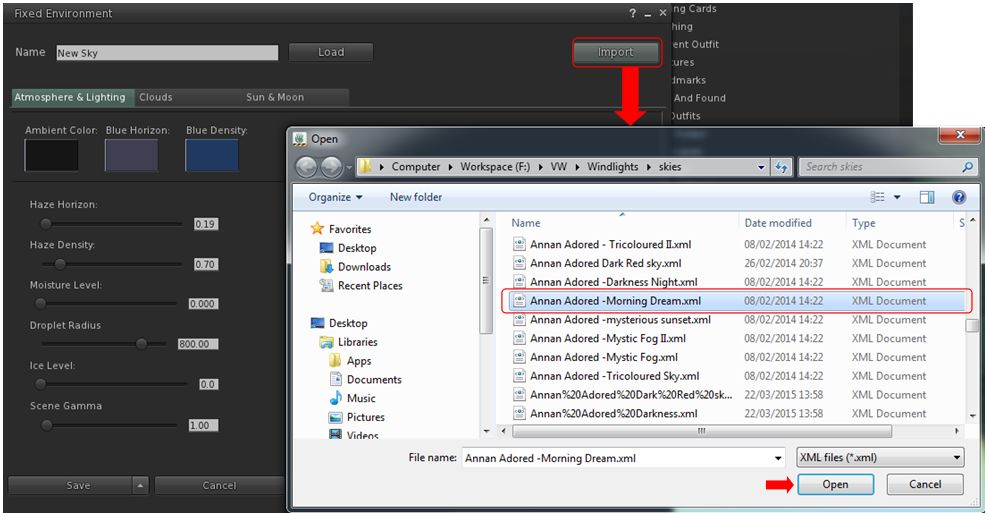
  • Windlight settings can be imported into EEP however.
Use the Import button in the edit floater to open a file picker and select the windlight to be imported

Will There Be More Rendering / Graphics Improvements for SL?

  • Rendering enhancement are on-going (e.g. via the Love Me Render project, which periodically releases RC viewers with rendering updates and fixes).
  • Id there is something specific you would like to see, please raise a feature request for consideration.

WILL SL Ever Have A New Rendering Engine?

  • Second Life cannot really adopt a commercial rendering engine, as the platform is too highly adopted to the user-generated content in-world.
  • However, as noted, it is actively being worked on for improvements, and this includes removing legacy code where it is no longer required.
    • An example of this is the EEP viewer code removes the ability to turn off the basic shaders in the viewer.
  • There are certain imperatives that are driving some system changes related to the rendering engine – such as Apple discontinuing support for OpenGL.
  • Trying to re-engineer SL to use a commercial engine also simply doesn’t make sense, as it would mean “throwing away” all that has been developed so far and practically re-engineering SL from the ground up.


Lab Gab 20 summary: Second Life cloud uplift & more

via Linden Lab

The 20th edition of Lab Gab live streamed on Friday, April 3rd, featuring Oz Linden, the Lab’s Vice President of Engineering and a member of the company’s management team, and April Linden, the Lab’s Systems Engineering Manager. They were appearing to primarily discuss the work in transitioning Second Life to commercial cloud environments. Ekim Linden had also been scheduled to appear, but was unable to do so.

The official video of the segment is available via You Tube, and is embedded at the end of this article. The following is a summary of the key topics discussed and responses to questions asked. Note that the first half of the video is related to the cloud uplift, and the second half to broader engineering-related questions.

April Linden has some 20 years of experience in systems engineering, and is genuinely passionate about Second Life. She first became involved in the platform in 2006 as a resident (and is still extremely active as a resident). She joined the Lab in 2013. She worked within the systems engineering team, and was promoted to her current position of Systems Engineering Manager, Operations, some 18 months ago. For her, the great attraction of the platform has been, and remains, the empowerment it gives people to express themselves positively.

Oz Linden joined the company in 2010 specifically to take on the role of managing the open-source aspects of the Second Life viewer and managing the relationship with third-party viewers, a role that fully engaged him during the first two years of his time at the Lab. His role then started expanding to encompass more and more of the engineering side of Second Life, leading to his currently senior position within the company.

Both are genuinely passionate and enthusiastic about Second Life and its users.

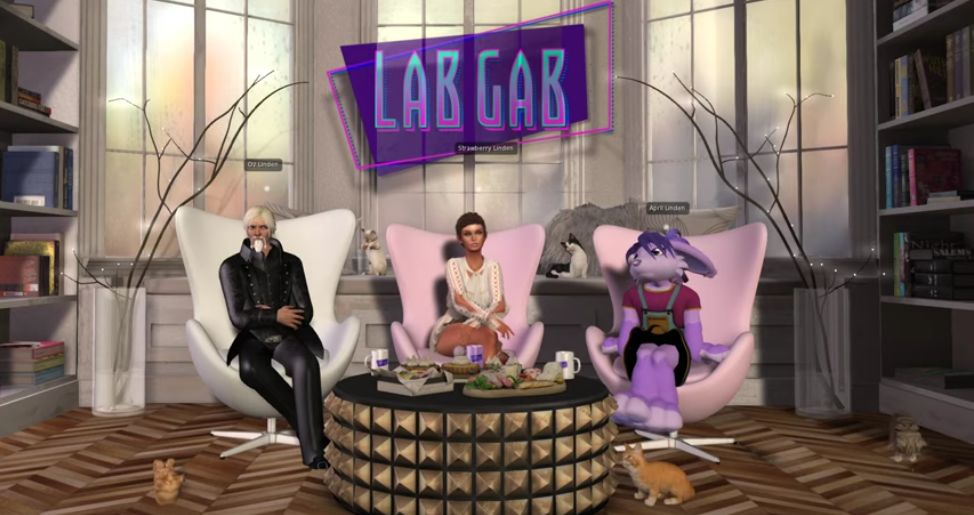
The bunny and the wizard who bring us Second Life: April Linden (Systems Engineering Manager, Operations) and Oz Linden (Vice President, Second Life Engineering)

The Cloud Uplift

What is It?

[5:40-9:45]

  • Cloud Uplift is the term Linden Lab use for transitioning all of Second Life’s server-based operations and services from their own proprietary systems and services housed within a single co-location data centre in Tucson, Arizona, to  commercial cloud services provided by Amazon Web Services (AWS) and Google.
  • The process of moving individual services to the cloud is called “lift and shift” – take each element of software, making the required adjustments so it can run within a cloud computing environment, then relocate it to cloud infrastructure and hardware in a manner that allows it to keep running and avoids disruptions that may impact users, and continues to run exactly as it did prior to the transfer.
  • The current plan is to have all of this work – up to an including moving all of the SL region simulators – to cloud services by the end of 2020.
  • Numerous services have been transitioned to date.
    • The Lab generally prefers not to discussion which specific services have been moved, to prevent users seeing the move as a placebo reason for issues they may be encountering, thus biasing their bug reports.
    • However, one service that is known to have moved is the inventory (asset) database, so that all users’ inventories are obtained via the cloud, and not from a dedicated asset cluster within the Lab’s co-lo facility.
  • With the services that have moved, the Lab has seen noticeable improvements in performance, partially as a result of cloud services using more recently / more powerful hardware configurations than the Lab can run without making a major new capital expenditure in equipment (which the uplift is intended to avoid).
  • A practical advantage of cloud operations is the ability for LL to scale services to meet demand.  The recent increase in users logging-in to SL, for example, placed a strain on the services that feed the CDNs that in turn deliver the majority of asset data to users (mesh data, textures, sounds, gestures, clothing, etc.). These services we then able to dynamically scale to an increased number of nodes to handle the load, something LL would not have been able to do without first sourcing, installing ans configuring the required hardware.
Oz and April with Strawberry Linden (c)

What Improvements Might Users See from the Uplift?

[9:48-14:42]

  • Between now and the end of 2020, no appreciable different should be observable to users.
  • The move is initially being made to a single AWS centre, so things like ping times to regions (once they are moved) shouldn’t change.
  • In terms of reducing simulator-side lag, the answer is unclear, as simulators have yet to be tested – this is due to start with simulators internal to the Lab Soon™. This will enable the Lab to begin to get real numbers in terms of simulator performance.
    • It is believed that simply moving simulators to the more recent, more powerful hardware used by cloud services should on its own result in a modest improvement in simulator performance.
    • That said, the outcome of performance adjustments in distributed environments is “really, really hard to predict”.
  • Longer-term, as the Lab is able to start exploiting the advantages of being in the cloud, there is confidence performance will improved in various areas.
    • For example, if simulators can be distributed in accordance with the geographical locations of their primary audiences (e.g. simulators that tend to get the majority of their audience from South America being located in South America), then this could reduce network time in connecting to them for those audiences, and so help boost performance as seen by those users.
    • While this is a longer-term goal for the cloud migration (it’s not going to be there from “day 1”), it is a part of the motivation to make the transition.

How will the Lab Handle Costs?

[14:45-18:40]

Sidebar note: cloud services typically bill based on demand and usage. This has given rise in some quarters to concerns / beliefs that LL could find themselves facing unexpected large bills for hosting.

  • Two answers: the first is nothing is ever certain.
  • The second is, the Lab, with April and Ekim in particular leading the effort, put a lot of work into modelling their likely operations and costs when using cloud services and infrastructure.
    • This work involved a lot of assumptions on how LL anticipated their costs would look based on how the planned to operate SL in a the cloud.
    • This model was then put to both AWS and to an independent, outside consultancy with expertise in advising clients on the use of cloud-base service provisioning, both of who gave positive feedback on the approach the Lab would be taking and the likely costs involved.
  • Further, the fact that SL isn’t a service that dynamically expands under use. All of its services are operating 24/7, so the costs can be readily calculated and pretty much consistent, therefore, the dynamic surges that can lead to high service bills don’t actually apply.
  • While there are some back-end services that can leverage dynamic hardware use in times of heavy load, these are in the minority (all of SL’s back-end services account for only 15% of its server fleet), so again, dynamic increases in hardware use for those services that can leverage it, are not going to be massively excessive.
  • As such, and allowing for answer (1), the Lab isn’t overly concerned about costs spiralling.

Will There Be Cost Saving that Can Be Passed to Users?

[18:41-19:54]

  • Unfortunately, the engineering teams are not responsible for determining fees charged to users.
  • More practically, it is not going to be possible to make any informed judgements on costs to users until the Lab has had the opportunity to see how actual operating costs compare with their predicted costs model.
  • Further, it is not anticipated that any cost savings will be made in the first 1-2 years of cloud uplift, so any decisions on if and where to reduce costs to users won’t be made for a a while to come, and those involved in making such decisions are not in the engineering teams.

Lab Gab 19 summary: Ebbe & Brett; LL, SL, Sansar & more

via Linden Lab

The 19th edition of Lab Gab was live streamed on Friday, March 27th, featuring Brett Linden, the Lab’s Senior Director of Marketing, and linden Lab CEO Ebbe Altberg, who were invited to discuss the Lab’s response to the SARS coronavirus 2 (SARS-CoV-2) pandemic and talk about Second life in general.

The official video of the segment is available via You Tube, and is embedded at the end of this article. The following is a summary of the key topics discussed and responses to questions. Note that the last 15 minutes of the video is something of an advert for the Linden Lab sponsored Mankind Tracer concert being held on Sunday, March 29th, which is not a part of this summary.

Sansar Summary

[0:40-3:00]

  • The decision to sell Sansar came, at least in part, from the recognition that as a platform, Sansar is at a very different stage of its evolution compared to Second Life, requiring different investment and resourcing.
  • Some 30 of the original team have received offers to join the new entity running Sansar (Wookey Project Corp), and “a bunch of them” are already back at work.
  • It appears that the focus for the platform will potentially remain on it being a platform for large scale virtual events in the music / entertainment sectors, utilising the platform’s ability to instance events for “many thousands” of attendees. Also, desktop and VR support will both likely be maintained.
    • However, the overall strategy and focus for developing Sansar is now obviously up to the new owners.
  • Linden Lab will remain a “partner”, inasmuch as Tilia will continue to be used for Sansar Dollar transactions and fiat money payouts, with Tilia also due to gain more customers in the near future..

Coronavirus Related

Dealing with the Virus

[3:00-7:48] plus as timestamped below.

  • On a set of personal notes,Ebbe, Brett and Lab Gab’s host, Strawberry Linden have thus far avoided infection (like the rest of the Lab’s staff they are working from home), but obviously, they do have concerns about the virus and its potential to impact family and friends.
  • Linden Lab is fortunate that it is exceptionally well geared towards remote working (many staff worked from home as a matter of course well before the current pandemic, and that’s been the way since the company’s formation).
  • It is not anticipated that Second Life should experience significant service interruptions due to the current health situation.
  • A comment that has been used among LL staff during calls and virtual meetings has been, “stay safe, stay virtual”.
  • [14:53-17:04] Users can help ease unnecessary stress on SL / LL staff by avoiding squabbles and upsets that can result in unnecessary abuse reports, etc., and by providing help to one another to lighten calls to support staff, as well showing support / friendliness to new users.
  • [27:55-29:33] All LL offices are closed. The co-lo data centre is open for access, if required, but all co-lo work is actually outsourced.

Usage and Concurrency

[7:48-11:09]

  • The last several weeks has seen a resurgence in the number of returning users (those who have not logged-in to SL for some time) as well as a rise in new users accessing the service.
  • New registrations are up by some 60%, with a rise in concurrency of around 10% overall.
  • These rises particularly correspond with cities, regions and countries where a lock-down is ordered.
  • Established users are encouraged to be kind and support incoming new and returning users, given they are likely trying to deal with the anxieties of the current situation.

Absolutely. We’re seeing quite [an] interesting resurgence of returning users, as well as new users coming in to explore Second Life. We see registrations up over 60% and concurrency’s up north of 10%, and we’re just a week or so into people being locked up. We can actually see countries and states that imposed strict stay-home policies, we see a corresponding jump in people in those markets jumping into Second Life.

– Ebbe Altberg, Lab Gab, March 27th

  • LL is not focusing any new features / activities specifically for those coming into SL as an alternative to watching television, playing games, etc. They are constantly working to increase registrations and user retention outside of any crisis.
  • The company is heavily committed to the the cloud uplift to AWS  / Google through until the end of the year, so there is not a lot of available resource to take on major new initiatives. This work will likely take the majority of the Lab’s technical resources through until the end of the year (see below as well).

Region Owners Impacted by the Virus & Assistance from the Lab

[17:10-18:54]

  • Contact support – see also: Region owners impacted by the Covid-19 pandemic encouraged to contact LL.
  • LL has no wish to see regions go under because holders are experiencing hardship as a result of result income at this time. however, the company also cannot afford to just give across-the-board reductions in tier.
  • Where cases can be explained  / discussed / explored, Linden Lab will try to do what they can and is taking a “human, compassionate” approach to people’s needs”.

Supporting Businesses and Education

[18:59-27:50]

  • Linden Lab has been “inundated” with requests from educators, businesses, etc., on whether Second Life can provide support for them.
  • The volume has been such that LL has had to re-assign resources to help deal with the incoming requests. There has also bee a certain amount of media attention on what Second Life can offer – the UK’s Daily Telegraph ran a paywalled article on SL and remote working on March 26th, for example)
  • It takes time to bring organisations in: understanding their requirements, getting them into SL, ensuring they have the required in-world facilities, etc.
  • In addition, LL have been carefully crafting a media campaign to raise awareness of SL as a place for socialisation and discovery. These have been garnering high rates of click-through that may be contributing to the upswing in registrations.
  • For the business side  – remote working, conferences, meetings, etc.,  – the Lab launched a micro-website and an accompanying updated FAQ promoting Second life as a working environment (see also: Second Life: support for remote working & reduced education / non-profit fees – updated, March 16th). This provides access to a series of seven turnkey region solutions for business use, comprising single and multi-region settings, capable of handling up to 350 avatars, with individual regions intentionally optimised such that they can comfortably and consistently handle 75 avatars apiece without becoming stressed.

The seven new turnkey business/ meeting environments provided by Linden Lab.

  • Education is still very much a factor in Second Life as well, with the platform again seeing an uptick in interest from educational organisations.
    • Various schools and universities can be found in the Destination Guide, and some have been active in SL for over a decade.
    • More are not publicly visible as they operate gated access for staff and students only.
  • Organisations such as CNDG are using Second Life for teaching / simulations in what is referred to as an “ambitious long-lasting run in SL”, with up to 10,000 students involved with Second Life experiential teaching modules.
  • Training also forms a part of learning in SL. For example, many nurses and medial staff have received simulation training within Second Life.
  • LL is committed to continuing to support educational use cases and make it easier for educational organisations and students to take advantage of what SL can offer.
  • Second life is also the focal point for the annual Virtual Worlds Best Practices in Education (VWBPE) conference.

Other Topics

Book Club and Showcase Streams

[11:10-14:43]

  • Despite the cloud uplift work, Linden Lab did announce two new two new initiatives on the marketing side:
    • The Second Life Book Club will launch on April 8th and a monthly event. A spin-off from the Draxtor Book Club hosted on Sansar, the Second Life Book Club will feature Draxtor Despres in conversation with authors from around the world, with the first instalment featuring Matt Ruff, Ken Liu, SL Huang, CB Lee, and a possible additional guest.
    • Showcase Streams will be a series of spontaneous “drop in” video streams that will aim to spotlight the many music, art and cultural events in Second Life.
  • Outside of the current pandemic, a reason for implementing initiatives like these is that the Lab has seen an uptick in interest in second Life as a result of the their social media engagement and the success of formats like Lab Gab in capturing non-SL users’ interest.

Name Changes

[29:41-30:52]

  • Most recently subjected to an internal pile-on test (stress test with mass use of a capability, in this case by LL staff) to uncover any previously missed bugs or issues.
  • Could now be just “a very few weeks” away from launching.

iOS Mobile Companion

[30:58-33:11]

  • Lots of activity.
  • Must be understood this will primarily be a communications tool (e.g. IMs, group messaging, etc., but not local chat or in-world presence / 3D view initially).
  • Now very close to Alpha status, which may only be for internal testing, and the path from that to initial release isn’t currently clear (iOS apps are subject to Apple strictures, among other things).
  • Work has now started on the Android version of this companion app as well, and the hope is this will quickly catch-up with the iOS version.

Future Plans / Updates

[36:10-39:27]

  • For 2020, the cloud uplift. This is occurring on a service-by-service basis on the back end (e.g. log-in service, web services, group services, etc.).
  • Transitioning the simulators will be a huge undertaking.
  • Some services have seen significant performance improvements following their transition, just because services a moving to more up-to-date hardware and newer infrastructure.
  • Because of this, 2020 will not be a major SL feature release year beyond what is already stated as being in the works (e.g. EEP, Name Changes, Premium Plus, mobile companion). Anything else will be subject to resources being available.
  • Note that more on SL tech and the uplift will be featured in the April 3rd Lab Gab which will feature Oz Linden, VP of engineering and members of his teams.

VWBPE 2020: Above the Book with Ebbe and Patch – summary

via vwbpe.org

The following is a summary of the VWBPE Above the Book session held on Thursday, March 26th. The session featured as guests, Ebbe Altberg, CEO of Linden Lab and Patch Linden, Vice President, Product Operations and a member of the Lab’s management team.

The video of the session is available on You Tube and is embedded at the end of this article, while the following is a summary of the discussion’s key points, with time stamps to the relevant points in the video for reference.

Notes:

  • Ebbe Altberg had a significant viewer issue that precluded his participation in the first half of the discussion, as such the majority of the summary points below are based on Patch Linden’s responses to questions etc. Where they are based on a reply or comment made by Ebbe, they are preceded by “[EA]”.
  • Time stamps commence at the 18-minute mark because there is a significant blank lead-in to the video.

Educational Discount and Work Opportunities in SL

Educational Discount

[18:48-19:45]

  • On March 13th, 2020 linden Lab introduced a limited time offer for education and non-profit organisations to to obtain full regions in Second Life / reduce their current full region tier to US $99.00 per month.
  • Once granted the fee reduction will remain applicable “as long as their [the organisation’s  / individual’s] invoicing is current.”
  • The reduction is something that had been under consideration by the Lab prior to the SARS-Cov-2 / Covid-19 situation, but it seemed that given the situation with learning centres around the globe being closed around the world, now was the time to introduce the offer in order to help organisations find a place where they can continue to offer lessons / services alongside of other options they might be exploring.

Business / Work Opportunities

[20:14-24:17]

  • Alongside of the educational / non-profit discount, Linden Lab also created a micro-website and an accompanying updated FAQ promoting Second life as a working environment.
  • This is designed to appeal / apply to to broad range of potential use-cases: educational, business, etc.
  • It is being actively used by LL to coordinate responses to the needs of those making enquiries and correspond with applicants / interested parties.
  • Connected to this work, the Lab has offered a set of seven turn-key solutions for interested parties.
    • Comprising single and multi-region facilities, which see a clever re-purposing of existing designs (e.g, the Horizons hub area, the Bellisseria Campwich lodge, the SL16B auditorium, part of the Paleoquest regions), as well as the 4-region Linden Town Hall facilities.
  • The single region facilities have been intentionally optimised such that they can comfortably and consistently handle 75 avatars apiece without becoming stressed.

This slideshow requires JavaScript.

The seven new pre-fabricated business/ meeting environments provided by Linden Lab.

  • There has also been some marketing work alongside of this to help raise awareness of SL’s continued presence as a platform (the UK’s Daily Telegraph ran a paywalled article on SL and remote working on March 26th, for example).

SL and Technology Related Questions

  • [24:24-25:33] Cloud Uplift: will sharding / instancing of regions be possible?
    • Potentially, but much further down the road.
    • The focus at the moment is on transitioning the SL infrastructure and getting it to a point where regions can be operated via the cloud.
    • Opportunities for product offerings, etc, will be considered some time after the uplift has been completed and costs, etc., better known.
  • [32:07-34:34] Despite all the talk of VR headsets and immersivity being ” the future”, the fact is virtual worlds already provide a 3D, immersive experience, even if viewed via a 2D screen. Given high frame-rate VR systems are still outside of most people’s pockets / interest, don’t you think worlds like SL are due a renaissance?
    • VR is a fully immersive experience that cannot be matched for its sense of presence.
    • SL has some significant challenges when it comes to that kind of immersive experience it will need to rise to [FPS, optimised content / content management], and / or the VR hardware requirements will need to come down to make VR is SL acceptable. They will likely draw together in time, but that’s not something for SL’s current roadmap.
  • [40:17-42:25] Has the more widespread availability of bandwidth and higher speed connectivity made it easier for people to connect to Second Life?
    • Yes. The ability for ISPs to provide faster connectivity, particularly now with fibre, has helped with SL’s global reach and accessibility.
    • 16-17 years ago, cable DSL was just coming in, and people without it, particularly if far away from the SL data centres, could experience issues with connecting. Over the last decade, the reported incidence of these kinds of issues has decreased to a point where they seem to be rarely heard.
  • [1:10:55-1:11:41] Given the current pandemic and the situation with the Second Norway / Sailors Cove East estates (see Second Norway & Sailor’s Cove East: rumours & statements), is LL considering providing region holder who are facing financial issues / lack of income due to SARS-Cov-2 some form of relief?
    • Region owners facing such issues are encouraged to approach the Second Life support team.
    • As it is, LL is working specific with Ey Ren, the estate owner for Second Norway / Sailor’s Cove East to try to resolve that situation.

Second Life and the Future

  • [1:02.07-1:07:38] As LL is again a single-product company, what is the vision, looking forward?
    • As already mentioned, the cloud uplift to AWS and Google is a major focus, and will take up most of the Lab’s time and effort throughout 2020, with the goal of completing the work in 2020.
    • It is hoped that the basic transitioning to the cloud will produce meaningful performance improvements.
    • There will not be a significant number of features coming on top of this work outside of those committed to (e.g. EEP, Name Changes, Premium Plus).
    • However, the uplift should position LL / SL for a long-term future, and should be seen as a commitment on LL’s part to the continuance of SL – the investment required in the shift would not have been made if there was a lack of confidence about the platform’s future.
    • LL itself is in a very comfortable position and profitable.
    • Further, the company’s organisational set-up means that it has not been overly impacted by the current pandemic crisis.
    • Second Life is seeing rising engagement and concurrency at present.
    • Overall the company has a very positive view of the future for SL, and very pleased with where they are in terms of the SL product offering.
    • Those interested in learning more about the technical side of SL can tune-in to the April 3rd edition of Lab Gab, which will feature Oz Linden, VP of Engineering and members of his teams.
    • Ebbe himself is now “100% devoted” to Second Life and Tilia.

Education Related Questions

  • [25:45-26:47] Will SL be able to connect to Canvas LMS? A lot of this can be supported through the in-viewer browser and via the viewer’s implementation of Chrome Embedded Framework (CEF).
    • Improvements to media  / web handling in the viewer are being made (notably media and CEF), and there should hopefully be more news on this Soon™.
  • [27:39-28:29] Can more be done to allow people to bring in their “traditional” and familiar 2D means of presentation (e.g. PowerPoint, etc), into SL beyond having to use use things like Media On A Prim (MOAP), etc?
    • The coming updates to media / web handling might have a lot to do with this, particularly in displaying 2D information formats. Essentially, if it is web-based, then you should be able to display it in-world.
    • [EA – 52:49-54:29] SL is perfect for iterative, interactive classroom activities and allowing students to contribute content to the classroom and in experiential education (field trips, learning through directed activities / simulation / training). However, more could be done to make the more traditional teaching tools – blackboards, whiteboards, video presentation, etc., – available / easier to utilise with Second Life.
  • [37:57-38:55] What about screen sharing / desktop sharing with SL?
    • Would be challenging to provide through Second Life, but obviously there are applications that will allow Second Life itself to be shared between screens / desktops.
    • It’s unclear as to what form any path to providing screen / desktop sharing within SL / the viewer might take.
  • [55:25-57:40] Can teaching environments be locked down to only allow students and staff access, and to prevent students teleporting away?
    • Regions do allow levels of privacy (access by group, access list, region / estate-level access blocking, etc.). It is also possible to bring users directly into a specific region / estate, and created accounts can be locked to a specific region / estate.
    • The siloing capability is available in Second Life, and it is made available to educators to use, and are available as a part of the educational / non-profit region fee.
    • [EA – 59:10-1:01:55]:
      • While it is not being considered by the Lab at present, it might be possible, post cloud uplift, to enable separate Second Life grids to be spun-up with completely different user name / account spaces associated with them.
      • If there are specific use cases for access control that aren’t provided by the Lab, or ways in which LL might provision specific market silo support, educators / physical world business users are encouraged to contact Patch and his team to discuss them or send ideas to business-at-lindenlab.com.
  • [1:07:53-1:10:54] Could a controlled space be provided where educators could collaborate to produce material in-world for students?
    • Can already be done.
    • A portal style space showing what is available for education in SL might be possible. One used to be provided, and LL might be interested in partnering with educationals to again provide one. Ideas can again be passed via business-at-lindenlab.com.

Sansar Related Discussion

  • [43:05-49:54] Second Life (and OpenSim) has always offered the ability for real-time content creation, which has been seen as one of the major attractions for it, and it was something lacking in Sansar that may have contributed to its lack of appeal. Do you think there is a long future for Second Life with its ease-of-creation?
    •  Yes.
    • [EA] Nowadays original content creation within SL is rare; most users are more customisers that original asset creators; they purchase items and then lay them out. Clearly, content creation & collaborative design are required in a virtual space, but do they need to be in the run-time environment?
    • [EA] Sansar took the route of separating the design process from the run-time environment to allow the latter to be a more performant environment, allowing everything placed in the design environment to be properly optimised [“baked”] to provide a good run-time experience.
    • [EA] Sadly, LL never got to the point of implementing collaborative design in the editor, or in really giving power to users to design their space without having to have a lot of expertise.
  • [49:55-51:47] On the sale of Sansar  [EA]:
    • Decision was made to sell Sansar and give the team that had been working on it to go and raise funds to try to go it alone with Sansar.
    • Was felt that it was easier for them to raise money as a separate entity from LL, given that Second Life is an established brand and Sansar was effectively a start-up brans within the environment responsible for Second Life.
    • As it is all of the staff who worked on Sansar are getting employment offers from Wookey project Corp., the new owners.
    • Linden Lab remain something of a partner to Sansar, as the platform will continue to use Tilia Inc, the Lab’s micro-payments  / virtual world tokens subsidiary to manage Sansar Dollar payments and payouts. Tilia itself will be growing its customer base with more clients lined-up to join it.