In July 2019, Tilia Incorporated, a wholly owned subsidiary of Linden Lab, officially took over the management of activities such as processing credit out of second Life (that is, withdrawing funds as US dollar balances the platform), and and US dollar balances held by Second Life users (see: Tilia has officially launched operations with Second Life*, August 2019).
Now, in an expansion of Tilia’s role with Second Life, Linden Lab has announced that as from Monday, May 26th, Tilia Inc, via its Tilia Pay service, will be managing all US dollar transactions related to Second Life, including those involving conversion of funds to other currencies.
This means that, as from Monday, May 26th, anyone:
Making a payment through one of their indicated payment methods – credit card, debit card, PayPal, or Skrill (as indicated on their Second Life account), such as purchasing Linden dollars.
Adding a new payment method to their Second Life account.
The change is being driven to both comply with regulatory requirements across a number of U.S. states and to leverage he enhanced fraud and money laundering safeguards that Tilia Pay provides.
The important things to note here are:
All Second Life users should be familiar with the Tilia Terms of Service (and Not just those who have either a US dollar balance associated with their account and / or cash-out money from SL).
Users will not be explicitly asked to confirm their agreement with the Tilia ToS / Privacy Policy. Rather, when paying with a payment method (e.g. credit card) or adding a new payment method to an account, a users will see text stating that by proceeding with the transaction, they are agreeing to both the ToS and Privacy Policy.
This move does not:
Introduce any new fees.
Require users to submit any additional information to Tilia Incorporated or Linden Lab.
Change how L$ transactions are conducted in the Viewer or in the Marketplace.
Readers are asked to read the Lab’s official blog post on the change for further information relating to it. In addition, questions or concerns should be directed to the forum thread on the matter – questions cannot be officially answered through this blog.
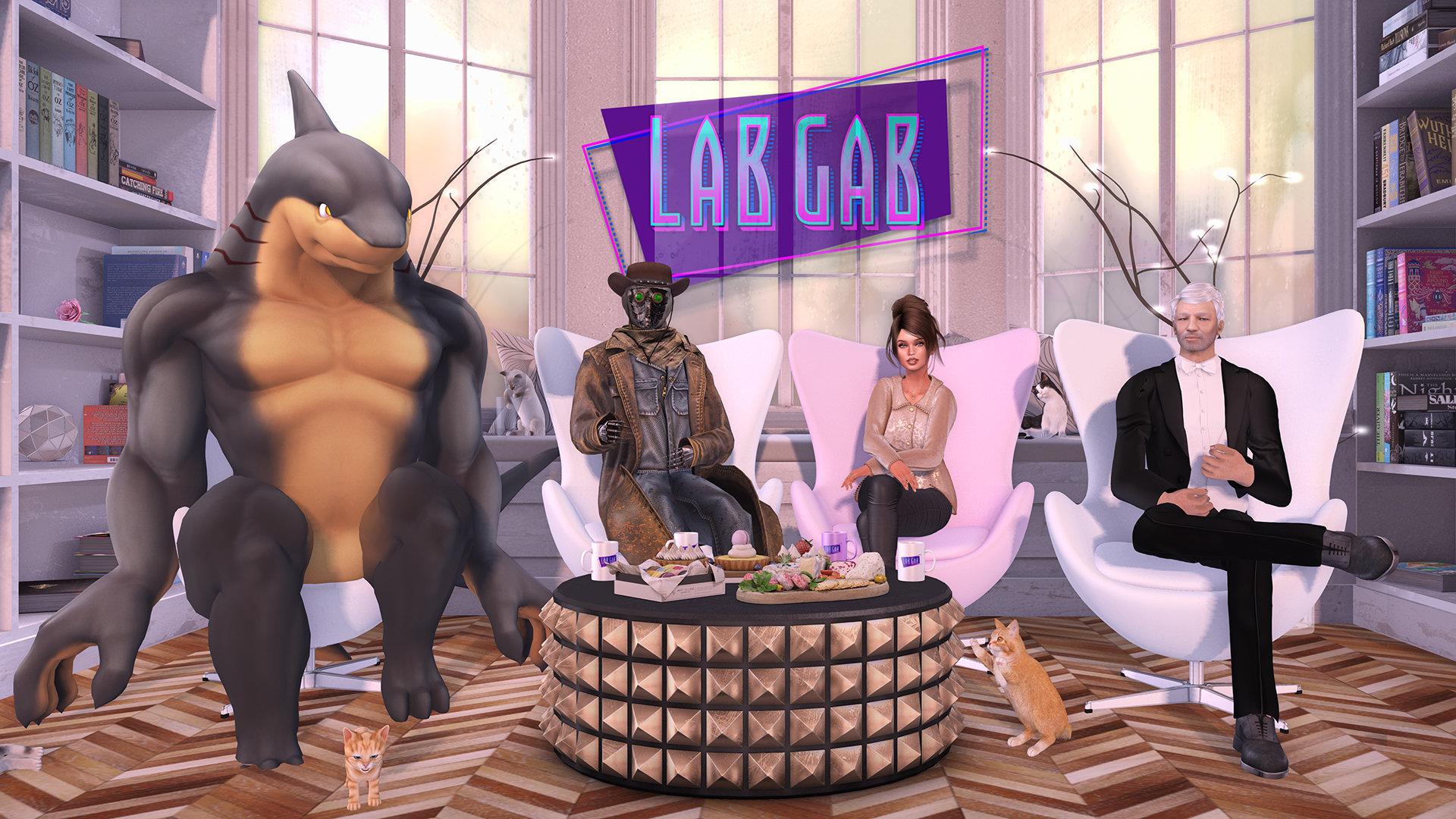
The 23rd edition of Lab Gab live streamed on Friday, April 24, featuring Rider Linden, Ptolemy Linden and Euclid Linden, who between them form the core team behind the Environment Enhancement Project (EEP), officially released by Linden Lab on Monday, April 20th.
The official video of the segment is available via You Tube, and is embedded at the end of this article. The following is a summary of the key topics discussed and responses to questions asked.
Rider Linden is a Senior Software Engineer who has been with Linden Lab for just over five years – although his familiarity with Second Life goes back beyond that, as he is one of the many personnel LL have recruited from the ranks of Second Life users. He was responsible for initially defining the EEP project. He then went on to develop the viewer controls for EEP, taking considerable feedback from users along the way, as well as working with the rendering team during the project’s development. More recently, he has transitioned over the the simulator team, working on that side of the SL and routinely attending the Simulator User Group meetings.
Ptolemy Linden and Euclid Linden are more recent hires at the Lab, both are working on the rendering side of Second Life. Both have been Lindens for around 6-7 months, and have really cut their teeth as Lindens whilst working on EEP. Neither was a resident prior to joining the Lab, and both are now looking forward to tackling more graphics-related work within the viewer.
Euclid, Rider and Ptolemy Linden will be joined Strawberry Linden to discuss EEP
What Is EEP?
EEP is a set of environmental enhancements for Second Life that supersede th use of Windlight XML files. The primary aim of the project was to make lighting / atmospheric / water environments easier to create and use within Second Life and extend the ability to customise them to the parcel level. In brief EEP:
Uses environment objects that you can keep in your inventory and / or share with others – including selling (subject to the SL permissions system) via in-world stores and on the Marketplace.
Provides parcel-level control of environments.
Allows up to four different, independently controlled sky layers.
Allows custom textures for the Sun, Moon and clouds.
Provides an extended day cycle of up to 168 hours (thus allowing a 7-day, 24-hour day / night cycle to be defined, for example).
Means that as environments settings are simulator-side, and so by default are automatically seen by anyone using any EEP enabled viewer on entering the region / estate / parcel.
Still allows the use of “personal” settings seen only be the use applying them, for the purposes of photography, machinima, etc.
Provides additional LSL controls for environments.
EEP Q&A
Unresolved Issues
EEP was promoted to release status with 75 issues on the viewer listed as “unresolved” (viewer version 6.4.0.540188). Will LL continue to work to resolve these?
LL was focused on clearing what were considered to be major / severe issues with the system before releasing.
Remaining issues are viewed as annoyance / edge cases rather than things that prevent EEP from being used. These will be cleared up as time allows, but not within what might be considered a dedicated EEP project at this point in time.
The exception to this will be any issue which proves to be a continuing problem for users in trying to use EEP, and which becomes a source of widespread forum complaint and / or the subject of bug reports.
Can the EEP UI Elements be Reduced in Size?
Several of the EEP UI elements take up a lot of screen real estate. Can these be reduced in size in future viewers / altered so that they can be resized by users?
There is a wider project at the Lab to revisit a lot of the viewer UI.
The EEP UI elements will like fall under this work.
Can EEP Settings be Applied via a Drop-down List, Rather than Attached?
No, as they are contained in inventory assets.
However, there is another broader than EEP project to look at inventory in general, and providing the means for users to preview EEP items which may, as it matures, help.
Does EEP Affect Teleports / Region Crossings?
(Asked as a result of the April 21st issues, which were not EEP related, but part of wider Internet issues within the United States).
Not at all.
The simulators have been supporting EEP for over a year thus far.
The additional data carried through TP / region crossing due to an applied EEP asset is minimal.
Transitions in EEP are handle very fast, and shouldn’t interfere with physical region crossings in vehicles [it has been noted at Simulator User Group meeting that if you are travelling fast enough to pass from region to region to region before EEP can fully transition from the first the the second environment, it will skip the second and go directly to rendering the third].
Will In-World Objects Need Updating to Look Right Under EEP?
A lot of time has been spent by the Lab trying to ensure that EEP renders objects as closely as possible to how they look under Windlight.
It’s note entirely one-to-one in all situations, and there may be some subtle differences. However, the hope is that for the majority of objects, EEP shouldn’t present a significantly different look.
If there are significant breakages in how some object look, the request is for creators to raise a bug report JIRA on them (and provide a sample to the Lab, if possible / requested).
How Can EEP Settings / Object be Created? Can they be Sold?
EEP settings / assets can be created in inventory with EEP-enabled viewers and experimented with.
For EEP viewer, the Library includes a group of settings (Library → Environments) that can be copied to Inventory and then edited and experimented with / used.
Creating a new EEP asset via the + button (1) or via right-clicking on the Settings folder and the selecting the required asset type from the create menu > My Settings option (2)
For more information on creating and using the EEP editors see:
Yes, absolutely, you can sell your own EEP assets if you wish, both through in-world stores and via the Marketplace.
Can I Use My Old Windlights with EEP?
Windlight settings cannot be used directly with EEP. Windlight used XML files external to the viewer; EEP uses settings contained with SL inventory assets.
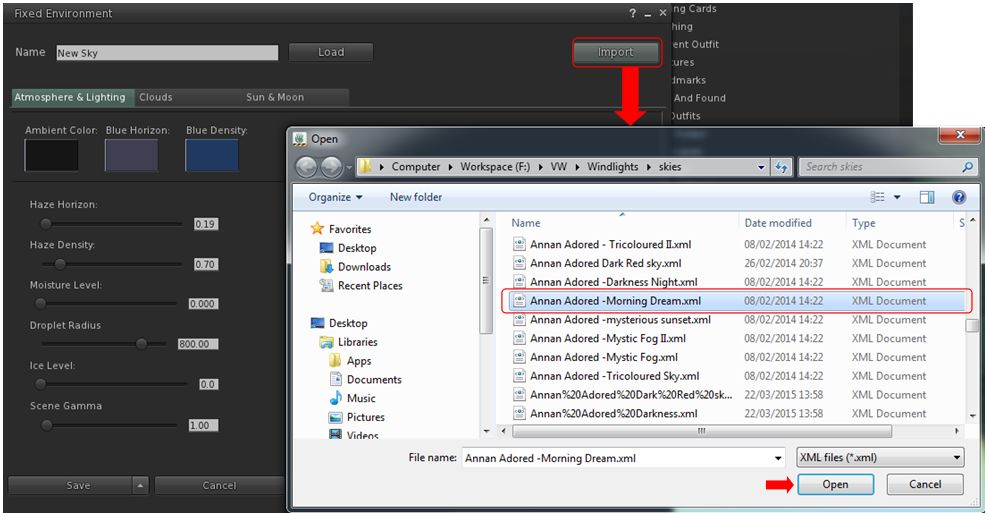
Windlight settings can be imported into EEP however.
Use the Import button in the edit floater to open a file picker and select the windlight to be imported
Will There Be More Rendering / Graphics Improvements for SL?
Rendering enhancement are on-going (e.g. via the Love Me Render project, which periodically releases RC viewers with rendering updates and fixes).
Id there is something specific you would like to see, please raise a feature request for consideration.
WILL SL Ever Have A New Rendering Engine?
Second Life cannot really adopt a commercial rendering engine, as the platform is too highly adopted to the user-generated content in-world.
However, as noted, it is actively being worked on for improvements, and this includes removing legacy code where it is no longer required.
An example of this is the EEP viewer code removes the ability to turn off the basic shaders in the viewer.
There are certain imperatives that are driving some system changes related to the rendering engine – such as Apple discontinuing support for OpenGL.
Trying to re-engineer SL to use a commercial engine also simply doesn’t make sense, as it would mean “throwing away” all that has been developed so far and practically re-engineering SL from the ground up.
The 20th edition of Lab Gab live streamed on Friday, April 3rd, featuring Oz Linden, the Lab’s Vice President of Engineering and a member of the company’s management team, and April Linden, the Lab’s Systems Engineering Manager. They were appearing to primarily discuss the work in transitioning Second Life to commercial cloud environments. Ekim Linden had also been scheduled to appear, but was unable to do so.
The official video of the segment is available via You Tube, and is embedded at the end of this article. The following is a summary of the key topics discussed and responses to questions asked. Note that the first half of the video is related to the cloud uplift, and the second half to broader engineering-related questions.
April Linden has some 20 years of experience in systems engineering, and is genuinely passionate about Second Life. She first became involved in the platform in 2006 as a resident (and is still extremely active as a resident). She joined the Lab in 2013. She worked within the systems engineering team, and was promoted to her current position of Systems Engineering Manager, Operations, some 18 months ago. For her, the great attraction of the platform has been, and remains, the empowerment it gives people to express themselves positively.
Oz Linden joined the company in 2010 specifically to take on the role of managing the open-source aspects of the Second Life viewer and managing the relationship with third-party viewers, a role that fully engaged him during the first two years of his time at the Lab. His role then started expanding to encompass more and more of the engineering side of Second Life, leading to his currently senior position within the company.
Both are genuinely passionate and enthusiastic about Second Life and its users.
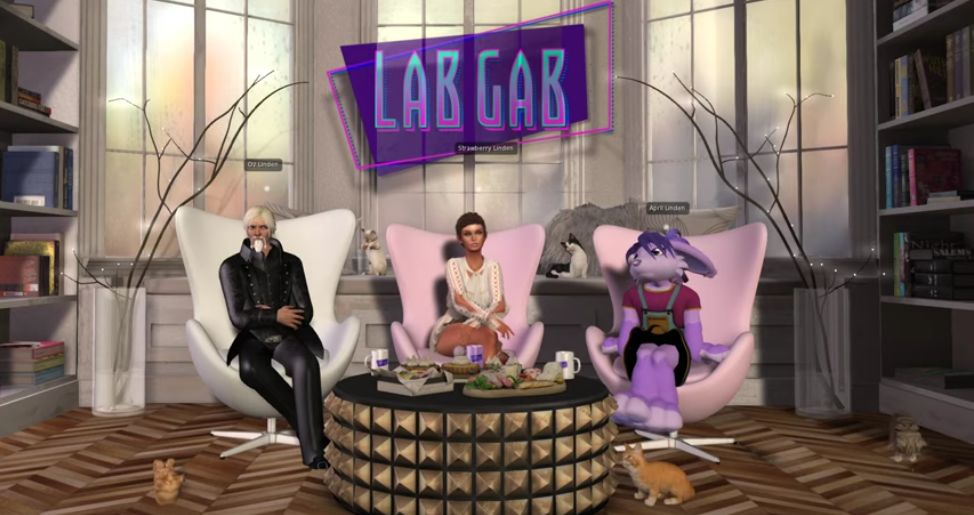
The bunny and the wizard who bring us Second Life: April Linden (Systems Engineering Manager, Operations) and Oz Linden (Vice President, Second Life Engineering)
Cloud Uplift is the term Linden Lab use for transitioning all of Second Life’s server-based operations and services from their own proprietary systems and services housed within a single co-location data centre in Tucson, Arizona, to commercial cloud services provided by Amazon Web Services (AWS) and Google.
The process of moving individual services to the cloud is called “lift and shift” – take each element of software, making the required adjustments so it can run within a cloud computing environment, then relocate it to cloud infrastructure and hardware in a manner that allows it to keep running and avoids disruptions that may impact users, and continues to run exactly as it did prior to the transfer.
The current plan is to have all of this work – up to an including moving all of the SL region simulators – to cloud services by the end of 2020.
Numerous services have been transitioned to date.
The Lab generally prefers not to discussion which specific services have been moved, to prevent users seeing the move as a placebo reason for issues they may be encountering, thus biasing their bug reports.
However, one service that is known to have moved is the inventory (asset) database, so that all users’ inventories are obtained via the cloud, and not from a dedicated asset cluster within the Lab’s co-lo facility.
With the services that have moved, the Lab has seen noticeable improvements in performance, partially as a result of cloud services using more recently / more powerful hardware configurations than the Lab can run without making a major new capital expenditure in equipment (which the uplift is intended to avoid).
A practical advantage of cloud operations is the ability for LL to scale services to meet demand. The recent increase in users logging-in to SL, for example, placed a strain on the services that feed the CDNs that in turn deliver the majority of asset data to users (mesh data, textures, sounds, gestures, clothing, etc.). These services we then able to dynamically scale to an increased number of nodes to handle the load, something LL would not have been able to do without first sourcing, installing ans configuring the required hardware.
Oz and April with Strawberry Linden (c)
What Improvements Might Users See from the Uplift?
Between now and the end of 2020, no appreciable different should be observable to users.
The move is initially being made to a single AWS centre, so things like ping times to regions (once they are moved) shouldn’t change.
In terms of reducing simulator-side lag, the answer is unclear, as simulators have yet to be tested – this is due to start with simulators internal to the Lab Soon™. This will enable the Lab to begin to get real numbers in terms of simulator performance.
It is believed that simply moving simulators to the more recent, more powerful hardware used by cloud services should on its own result in a modest improvement in simulator performance.
That said, the outcome of performance adjustments in distributed environments is “really, really hard to predict”.
Longer-term, as the Lab is able to start exploiting the advantages of being in the cloud, there is confidence performance will improved in various areas.
For example, if simulators can be distributed in accordance with the geographical locations of their primary audiences (e.g. simulators that tend to get the majority of their audience from South America being located in South America), then this could reduce network time in connecting to them for those audiences, and so help boost performance as seen by those users.
While this is a longer-term goal for the cloud migration (it’s not going to be there from “day 1”), it is a part of the motivation to make the transition.
Sidebar note: cloud services typically bill based on demand and usage. This has given rise in some quarters to concerns / beliefs that LL could find themselves facing unexpected large bills for hosting.
Two answers: the first is nothing is ever certain.
The second is, the Lab, with April and Ekim in particular leading the effort, put a lot of work into modelling their likely operations and costs when using cloud services and infrastructure.
This work involved a lot of assumptions on how LL anticipated their costs would look based on how the planned to operate SL in a the cloud.
This model was then put to both AWS and to an independent, outside consultancy with expertise in advising clients on the use of cloud-base service provisioning, both of who gave positive feedback on the approach the Lab would be taking and the likely costs involved.
Further, the fact that SL isn’t a service that dynamically expands under use. All of its services are operating 24/7, so the costs can be readily calculated and pretty much consistent, therefore, the dynamic surges that can lead to high service bills don’t actually apply.
While there are some back-end services that can leverage dynamic hardware use in times of heavy load, these are in the minority (all of SL’s back-end services account for only 15% of its server fleet), so again, dynamic increases in hardware use for those services that can leverage it, are not going to be massively excessive.
As such, and allowing for answer (1), the Lab isn’t overly concerned about costs spiralling.
Will There Be Cost Saving that Can Be Passed to Users?
Unfortunately, the engineering teams are not responsible for determining fees charged to users.
More practically, it is not going to be possible to make any informed judgements on costs to users until the Lab has had the opportunity to see how actual operating costs compare with their predicted costs model.
Further, it is not anticipated that any cost savings will be made in the first 1-2 years of cloud uplift, so any decisions on if and where to reduce costs to users won’t be made for a a while to come, and those involved in making such decisions are not in the engineering teams.
Speaking at the Above the Book session at the 2020 Virtual Worlds Brest Practices in Education conference on March 26th, and again during the Lab Gab episode 19 segment that aired on Friday, March 27th, Linden Lab CEO Ebbe Altberg revealed more about the about the sale of Sansar and the future of that platform. Also during the VWBPE session, he revealed something of the future path for Tilia Inc, the Lab’s subsidiary company.
The following is an amalgam of his comments during both sessions, complete with a quotes, audio extracts from the VWBPE Above the Book session, references to source material and supporting links.
Sansar’s Sale
Summary
The decision to sell Sansar came, at least in part, from the recognition that as a platform, it lay at a very different stage of its evolution compared to Second Life, requiring different investment and resourcing¹.
With the decision made, the Sansar team were apparently given the freedom to attempt to raise money / seek interested parties in order to keep the platform going (hence, perhaps, Ebbe Altberg’s February 12th comment that the former Sansar team were involved in discussions concerning the platform’s future – see the quote in Sansar: lay-offs, rumours, and confusion, February 12th, 2020)².
As it is, with the sale of Sansar, some 30 members of the team have (so far?) received offers to join Wookey Project Corp, and as of the March 27th Lab Gab session, “a bunch of them” are back to work¹. In support of this, I noted in a recent blog post that Sansar’s Community Manager, Galileo, appears to already be part of the Wookey Sansar team, having posted the Sansar blog post referenced below. Further, both Sheri Bryant and Julia Munck, formerly Sansar’s General Manager and Sansar’s VP of Product respectively at Linden Lab, have departed the company – presumably to join Wookey Project Corp.
It appears that the focus for the platform will potentially remain on it being a platform for large scale virtual events in the music / entertainment sectors, and that both desktop and VR support will be continued – although obviously, strategy and direction are now the remit of Sansar’s new owners.
Linden Lab will remain a “partner”, inasmuch as Tilia will continue to be used for Sanasr Dollar transactions and fiat money payouts (see more on Tilia below)¹ ².
Ebbe’s Comments – VWBPE Above the Book
To make the long story short about Sansar, we at Linden Lab decided to sell it and to give the team the chance to go raise funds and go it alone. I think it’s easier for them to go raise money as a separate stand-alone company rather than as a part of Linden Lab. Second Life is a very established, profitable, product and we kind-of had a start-up inside of an established, profitable company. And it was actually easier for them, I think, to raise money as a standalone, rather than as a part of Linden Lab.
So … the staff that worked on Sansar are all getting offers by the new entity to come back and start working on Sansar again, and I think they’ve started this week, so I’m super happy that the product and the technology and the team all get a chance to continue … and it makes it easier for Linden Lab and Sansar to both succeed, I think, going forward. I’m happy for the way things ended up in the end.
We are all likely familiar with Tilia Inc., Linden Lab’s subsidiary that handles all micro-transactions and payments /payouts related to Linden Dollars and Sansar Dollars, and which manages the Lab’s compliance with regulations relating to its role as a Money Transmitter / Money Services Business (MSB).
Tilia officially launched on Thursday August 1st, 2019, having been formally introduced to SL users in July 2019 – although as I noted at the time, SL and Sansar users may have had some awareness of its existence as the Tilia Inc., logo had been on both the SL and Sansar web pages related to L$ and S$ account purchases and Sansar account management for some time. For my part, I’d been speculating about the company since November 2015, and did so again in July 2019, when I noted that Tilia appeared to be geared towards providing its services to other companies.
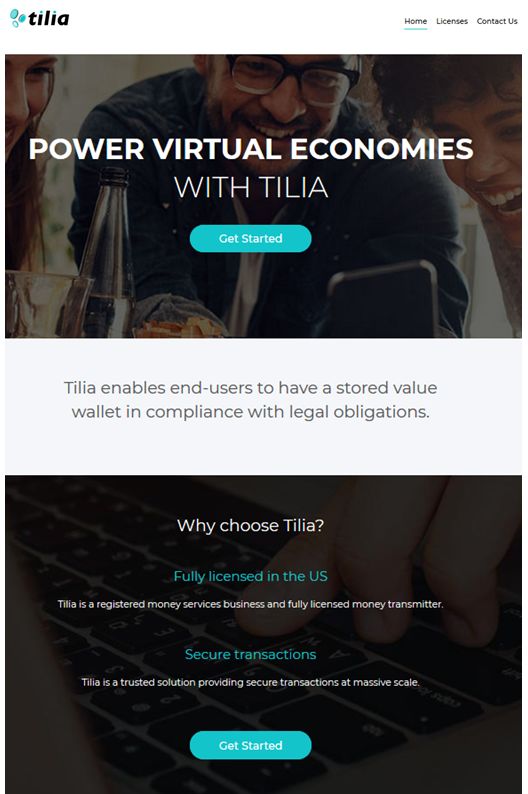
I first ruminated on Tilia being a means for Linden Lab to offer virtual economy solutions in July 2019, as a result of the (fairly obvious!) clue on the Tilia home page
Whilst speaking at the VWBPE Above the Book event, Ebbe indicated that with the sale of Sansar, Wookey Project Corp is effectively Linden Lab’s first customer for Tilia’s services, as the latter will continue to provide payment / payout capabilities for those using Sansar and the Sansar Dollar.
In addition, he also indicated more customers for Tilia are on the way:
We’re partners with them [Wookey Project Corp] because they’re using Tilia for payments / payouts just like Second Life is doing, and Tilia will have more and more customers over time. We have several of them lined-up to be integrated to get those payment services.
No specific details on which companies are planning to use Tilia, I’ll hopefully have more as they are announced.
The 19th edition of Lab Gab was live streamed on Friday, March 27th, featuring Brett Linden, the Lab’s Senior Director of Marketing, and linden Lab CEO Ebbe Altberg, who were invited to discuss the Lab’s response to the SARS coronavirus 2 (SARS-CoV-2) pandemic and talk about Second life in general.
The official video of the segment is available via You Tube, and is embedded at the end of this article. The following is a summary of the key topics discussed and responses to questions. Note that the last 15 minutes of the video is something of an advert for the Linden Lab sponsored Mankind Tracer concert being held on Sunday, March 29th, which is not a part of this summary.
The decision to sell Sansar came, at least in part, from the recognition that as a platform, Sansar is at a very different stage of its evolution compared to Second Life, requiring different investment and resourcing.
Some 30 of the original team have received offers to join the new entity running Sansar (Wookey Project Corp), and “a bunch of them” are already back at work.
It appears that the focus for the platform will potentially remain on it being a platform for large scale virtual events in the music / entertainment sectors, utilising the platform’s ability to instance events for “many thousands” of attendees. Also, desktop and VR support will both likely be maintained.
However, the overall strategy and focus for developing Sansar is now obviously up to the new owners.
Linden Lab will remain a “partner”, inasmuch as Tilia will continue to be used for Sansar Dollar transactions and fiat money payouts, with Tilia also due to gain more customers in the near future..
On a set of personal notes,Ebbe, Brett and Lab Gab’s host, Strawberry Linden have thus far avoided infection (like the rest of the Lab’s staff they are working from home), but obviously, they do have concerns about the virus and its potential to impact family and friends.
Linden Lab is fortunate that it is exceptionally well geared towards remote working (many staff worked from home as a matter of course well before the current pandemic, and that’s been the way since the company’s formation).
It is not anticipated that Second Life should experience significant service interruptions due to the current health situation.
A comment that has been used among LL staff during calls and virtual meetings has been, “stay safe, stay virtual”.
[14:53-17:04] Users can help ease unnecessary stress on SL / LL staff by avoiding squabbles and upsets that can result in unnecessary abuse reports, etc., and by providing help to one another to lighten calls to support staff, as well showing support / friendliness to new users.
[27:55-29:33] All LL offices are closed. The co-lo data centre is open for access, if required, but all co-lo work is actually outsourced.
The last several weeks has seen a resurgence in the number of returning users (those who have not logged-in to SL for some time) as well as a rise in new users accessing the service.
New registrations are up by some 60%, with a rise in concurrency of around 10% overall.
These rises particularly correspond with cities, regions and countries where a lock-down is ordered.
Established users are encouraged to be kind and support incoming new and returning users, given they are likely trying to deal with the anxieties of the current situation.
Absolutely. We’re seeing quite [an] interesting resurgence of returning users, as well as new users coming in to explore Second Life. We see registrations up over 60% and concurrency’s up north of 10%, and we’re just a week or so into people being locked up. We can actually see countries and states that imposed strict stay-home policies, we see a corresponding jump in people in those markets jumping into Second Life.
– Ebbe Altberg, Lab Gab, March 27th
LL is not focusing any new features / activities specifically for those coming into SL as an alternative to watching television, playing games, etc. They are constantly working to increase registrations and user retention outside of any crisis.
The company is heavily committed to the the cloud uplift to AWS / Google through until the end of the year, so there is not a lot of available resource to take on major new initiatives. This work will likely take the majority of the Lab’s technical resources through until the end of the year (see below as well).
Region Owners Impacted by the Virus & Assistance from the Lab
LL has no wish to see regions go under because holders are experiencing hardship as a result of result income at this time. however, the company also cannot afford to just give across-the-board reductions in tier.
Where cases can be explained / discussed / explored, Linden Lab will try to do what they can and is taking a “human, compassionate” approach to people’s needs”.
Linden Lab has been “inundated” with requests from educators, businesses, etc., on whether Second Life can provide support for them.
The volume has been such that LL has had to re-assign resources to help deal with the incoming requests. There has also bee a certain amount of media attention on what Second Life can offer – the UK’s Daily Telegraph ran a paywalled article on SL and remote working on March 26th, for example)
It takes time to bring organisations in: understanding their requirements, getting them into SL, ensuring they have the required in-world facilities, etc.
In addition, LL have been carefully crafting a media campaign to raise awareness of SL as a place for socialisation and discovery. These have been garnering high rates of click-through that may be contributing to the upswing in registrations.
For the business side – remote working, conferences, meetings, etc., – the Lab launched a micro-website and an accompanying updated FAQ promoting Second life as a working environment (see also: Second Life: support for remote working & reduced education / non-profit fees – updated, March 16th). This provides access to a series of seven turnkey region solutions for business use, comprising single and multi-region settings, capable of handling up to 350 avatars, with individual regions intentionally optimised such that they can comfortably and consistently handle 75 avatars apiece without becoming stressed.
4- region Town Hall
The Lodge
Horizons Community Centre
Futuristic
The Dino
Conference Room
Auditorium
The seven new turnkey business/ meeting environments provided by Linden Lab.
Education is still very much a factor in Second Life as well, with the platform again seeing an uptick in interest from educational organisations.
Various schools and universities can be found in the Destination Guide, and some have been active in SL for over a decade.
More are not publicly visible as they operate gated access for staff and students only.
Organisations such as CNDG are using Second Life for teaching / simulations in what is referred to as an “ambitious long-lasting run in SL”, with up to 10,000 students involved with Second Life experiential teaching modules.
Training also forms a part of learning in SL. For example, many nurses and medial staff have received simulation training within Second Life.
LL is committed to continuing to support educational use cases and make it easier for educational organisations and students to take advantage of what SL can offer.
Despite the cloud uplift work, Linden Lab did announce two new two new initiatives on the marketing side:
The Second Life Book Club will launch on April 8th and a monthly event. A spin-off from the Draxtor Book Club hosted on Sansar, the Second Life Book Club will feature Draxtor Despres in conversation with authors from around the world, with the first instalment featuring Matt Ruff, Ken Liu, SL Huang, CB Lee, and a possible additional guest.
Showcase Streams will be a series of spontaneous “drop in” video streams that will aim to spotlight the many music, art and cultural events in Second Life.
Outside of the current pandemic, a reason for implementing initiatives like these is that the Lab has seen an uptick in interest in second Life as a result of the their social media engagement and the success of formats like Lab Gab in capturing non-SL users’ interest.
Most recently subjected to an internal pile-on test (stress test with mass use of a capability, in this case by LL staff) to uncover any previously missed bugs or issues.
Could now be just “a very few weeks” away from launching.
Must be understood this will primarily be a communications tool (e.g. IMs, group messaging, etc., but not local chat or in-world presence / 3D view initially).
Now very close to Alpha status, which may only be for internal testing, and the path from that to initial release isn’t currently clear (iOS apps are subject to Apple strictures, among other things).
Work has now started on the Android version of this companion app as well, and the hope is this will quickly catch-up with the iOS version.
For 2020, the cloud uplift. This is occurring on a service-by-service basis on the back end (e.g. log-in service, web services, group services, etc.).
Transitioning the simulators will be a huge undertaking.
Some services have seen significant performance improvements following their transition, just because services a moving to more up-to-date hardware and newer infrastructure.
Because of this, 2020 will not be a major SL feature release year beyond what is already stated as being in the works (e.g. EEP, Name Changes, Premium Plus, mobile companion). Anything else will be subject to resources being available.
Note that more on SL tech and the uplift will be featured in the April 3rd Lab Gab which will feature Oz Linden, VP of engineering and members of his teams.
The following is a summary of the VWBPE Above the Book session held on Thursday, March 26th. The session featured as guests, Ebbe Altberg, CEO of Linden Lab and Patch Linden, Vice President, Product Operations and a member of the Lab’s management team.
The video of the session is available on You Tube and is embedded at the end of this article, while the following is a summary of the discussion’s key points, with time stamps to the relevant points in the video for reference.
Notes:
Ebbe Altberg had a significant viewer issue that precluded his participation in the first half of the discussion, as such the majority of the summary points below are based on Patch Linden’s responses to questions etc. Where they are based on a reply or comment made by Ebbe, they are preceded by “[EA]”.
Time stamps commence at the 18-minute mark because there is a significant blank lead-in to the video.
On March 13th, 2020 linden Lab introduced a limited time offer for education and non-profit organisations to to obtain full regions in Second Life / reduce their current full region tier to US $99.00 per month.
Once granted the fee reduction will remain applicable “as long as their [the organisation’s / individual’s] invoicing is current.”
The reduction is something that had been under consideration by the Lab prior to the SARS-Cov-2 / Covid-19 situation, but it seemed that given the situation with learning centres around the globe being closed around the world, now was the time to introduce the offer in order to help organisations find a place where they can continue to offer lessons / services alongside of other options they might be exploring.
Alongside of the educational / non-profit discount, Linden Lab also created a micro-website and an accompanying updated FAQ promoting Second life as a working environment.
This is designed to appeal / apply to to broad range of potential use-cases: educational, business, etc.
It is being actively used by LL to coordinate responses to the needs of those making enquiries and correspond with applicants / interested parties.
Connected to this work, the Lab has offered a set of seven turn-key solutions for interested parties.
Comprising single and multi-region facilities, which see a clever re-purposing of existing designs (e.g, the Horizons hub area, the Bellisseria Campwich lodge, the SL16B auditorium, part of the Paleoquest regions), as well as the 4-region Linden Town Hall facilities.
The single region facilities have been intentionally optimised such that they can comfortably and consistently handle 75 avatars apiece without becoming stressed.
This slideshow requires JavaScript.
The seven new pre-fabricated business/ meeting environments provided by Linden Lab.
There has also been some marketing work alongside of this to help raise awareness of SL’s continued presence as a platform (the UK’s Daily Telegraph ran a paywalled article on SL and remote working on March 26th, for example).
SL and Technology Related Questions
[24:24-25:33] Cloud Uplift: will sharding / instancing of regions be possible?
Potentially, but much further down the road.
The focus at the moment is on transitioning the SL infrastructure and getting it to a point where regions can be operated via the cloud.
Opportunities for product offerings, etc, will be considered some time after the uplift has been completed and costs, etc., better known.
[32:07-34:34] Despite all the talk of VR headsets and immersivity being ” the future”, the fact is virtual worlds already provide a 3D, immersive experience, even if viewed via a 2D screen. Given high frame-rate VR systems are still outside of most people’s pockets / interest, don’t you think worlds like SL are due a renaissance?
VR is a fully immersive experience that cannot be matched for its sense of presence.
SL has some significant challenges when it comes to that kind of immersive experience it will need to rise to [FPS, optimised content / content management], and / or the VR hardware requirements will need to come down to make VR is SL acceptable. They will likely draw together in time, but that’s not something for SL’s current roadmap.
[40:17-42:25] Has the more widespread availability of bandwidth and higher speed connectivity made it easier for people to connect to Second Life?
Yes. The ability for ISPs to provide faster connectivity, particularly now with fibre, has helped with SL’s global reach and accessibility.
16-17 years ago, cable DSL was just coming in, and people without it, particularly if far away from the SL data centres, could experience issues with connecting. Over the last decade, the reported incidence of these kinds of issues has decreased to a point where they seem to be rarely heard.
[1:10:55-1:11:41] Given the current pandemic and the situation with the Second Norway / Sailors Cove East estates (see Second Norway & Sailor’s Cove East: rumours & statements), is LL considering providing region holder who are facing financial issues / lack of income due to SARS-Cov-2 some form of relief?
Region owners facing such issues are encouraged to approach the Second Life support team.
As it is, LL is working specific with Ey Ren, the estate owner for Second Norway / Sailor’s Cove East to try to resolve that situation.
Second Life and the Future
[1:02.07-1:07:38] As LL is again a single-product company, what is the vision, looking forward?
As already mentioned, the cloud uplift to AWS and Google is a major focus, and will take up most of the Lab’s time and effort throughout 2020, with the goal of completing the work in 2020.
It is hoped that the basic transitioning to the cloud will produce meaningful performance improvements.
There will not be a significant number of features coming on top of this work outside of those committed to (e.g. EEP, Name Changes, Premium Plus).
However, the uplift should position LL / SL for a long-term future, and should be seen as a commitment on LL’s part to the continuance of SL – the investment required in the shift would not have been made if there was a lack of confidence about the platform’s future.
LL itself is in a very comfortable position and profitable.
Further, the company’s organisational set-up means that it has not been overly impacted by the current pandemic crisis.
Second Life is seeing rising engagement and concurrency at present.
Overall the company has a very positive view of the future for SL, and very pleased with where they are in terms of the SL product offering.
Those interested in learning more about the technical side of SL can tune-in to the April 3rd edition of Lab Gab, which will feature Oz Linden, VP of Engineering and members of his teams.
Ebbe himself is now “100% devoted” to Second Life and Tilia.
Education Related Questions
[25:45-26:47] Will SL be able to connect to Canvas LMS? A lot of this can be supported through the in-viewer browser and via the viewer’s implementation of Chrome Embedded Framework (CEF).
Improvements to media / web handling in the viewer are being made (notably media and CEF), and there should hopefully be more news on this Soon™.
[27:39-28:29] Can more be done to allow people to bring in their “traditional” and familiar 2D means of presentation (e.g. PowerPoint, etc), into SL beyond having to use use things like Media On A Prim (MOAP), etc?
The coming updates to media / web handling might have a lot to do with this, particularly in displaying 2D information formats. Essentially, if it is web-based, then you should be able to display it in-world.
[EA – 52:49-54:29] SL is perfect for iterative, interactive classroom activities and allowing students to contribute content to the classroom and in experiential education (field trips, learning through directed activities / simulation / training). However, more could be done to make the more traditional teaching tools – blackboards, whiteboards, video presentation, etc., – available / easier to utilise with Second Life.
[37:57-38:55] What about screen sharing / desktop sharing with SL?
Would be challenging to provide through Second Life, but obviously there are applications that will allow Second Life itself to be shared between screens / desktops.
It’s unclear as to what form any path to providing screen / desktop sharing within SL / the viewer might take.
[55:25-57:40] Can teaching environments be locked down to only allow students and staff access, and to prevent students teleporting away?
Regions do allow levels of privacy (access by group, access list, region / estate-level access blocking, etc.). It is also possible to bring users directly into a specific region / estate, and created accounts can be locked to a specific region / estate.
The siloing capability is available in Second Life, and it is made available to educators to use, and are available as a part of the educational / non-profit region fee.
While it is not being considered by the Lab at present, it might be possible, post cloud uplift, to enable separate Second Life grids to be spun-up with completely different user name / account spaces associated with them.
If there are specific use cases for access control that aren’t provided by the Lab, or ways in which LL might provision specific market silo support, educators / physical world business users are encouraged to contact Patch and his team to discuss them or send ideas to business-at-lindenlab.com.
[1:07:53-1:10:54] Could a controlled space be provided where educators could collaborate to produce material in-world for students?
Can already be done.
A portal style space showing what is available for education in SL might be possible. One used to be provided, and LL might be interested in partnering with educationals to again provide one. Ideas can again be passed via business-at-lindenlab.com.
Sansar Related Discussion
[43:05-49:54] Second Life (and OpenSim) has always offered the ability for real-time content creation, which has been seen as one of the major attractions for it, and it was something lacking in Sansar that may have contributed to its lack of appeal. Do you think there is a long future for Second Life with its ease-of-creation?
Yes.
[EA] Nowadays original content creation within SL is rare; most users are more customisers that original asset creators; they purchase items and then lay them out. Clearly, content creation & collaborative design are required in a virtual space, but do they need to be in the run-time environment?
[EA] Sansar took the route of separating the design process from the run-time environment to allow the latter to be a more performant environment, allowing everything placed in the design environment to be properly optimised [“baked”] to provide a good run-time experience.
[EA] Sadly, LL never got to the point of implementing collaborative design in the editor, or in really giving power to users to design their space without having to have a lot of expertise.
Decision was made to sell Sansar and give the team that had been working on it to go and raise funds to try to go it alone with Sansar.
Was felt that it was easier for them to raise money as a separate entity from LL, given that Second Life is an established brand and Sansar was effectively a start-up brans within the environment responsible for Second Life.
As it is all of the staff who worked on Sansar are getting employment offers from Wookey project Corp., the new owners.
Linden Lab remain something of a partner to Sansar, as the platform will continue to use Tilia Inc, the Lab’s micro-payments / virtual world tokens subsidiary to manage Sansar Dollar payments and payouts. Tilia itself will be growing its customer base with more clients lined-up to join it.





 Inara Pey: Living in a Modemworld