Sansar and VRJAM: of Lost Horizon and music festivals

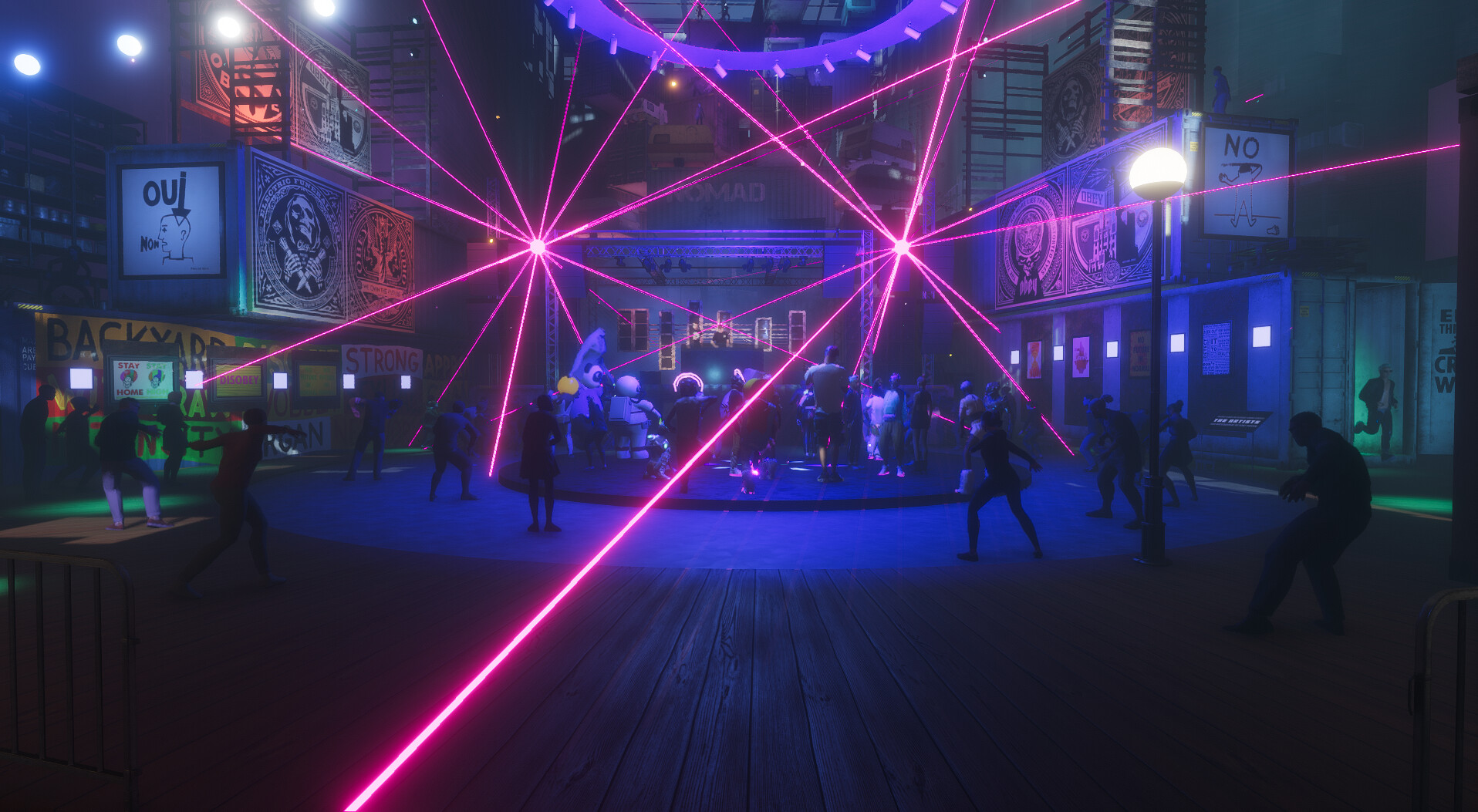
Lost Horizon: Nomad Stage, Saturday, July 4th, 2020

Friday July 3rd and Saturday July 4th, 2020 marked the Glastonbury Shangri-La music festival in Sansar, my observations of which appear in Glastonbury in Sansar: post event observations. Others have also written about the event, but what most of us appeared to miss in the run-up to it, is that just a few days ahead of the event a press release was made by Wookey Technologies and UK-based VRJAM that revealed the event’s title, Lost Horizon, is intended to be a “wrapper” for a long-term partnership between the two companies, aimed at making the Lost Horizon name (brand?) “the world’s first turnkey VR festival venue.”

In particular, the press release, which I caught via Businesswire over the weekend, noted:

Lost Horizon, which kicks off July 3 and 4 with the largest arts and music festival in virtual reality, will continue to host live events and festivals this year – allowing countless artists the opportunity to monetize their performances through ticketing, tipping, and the sale of virtual merchandise.

– via Businesswire, June 29th, 2020

It’s not clear at this point in time what other events will be held under the Lost Horizon banner, but speaking to EDMIdentity, Robin Collings, founding director of Glastonbury Shangri-La, and one of the driving forces behind Lost Horizon itself, intimated that as well as purely digital / virtual events, Lost Horizon could in the future (presumably post-pandemic) add physical events in the mix:

We’d really like to tour a project next year and mix Virtual and Physical events in real-time… and we have some more really exciting events in the Lost Horizon world lined up! Watch this space! 

– Robin Collings, talking to EDM Identity

Wookey Technology Products website lists Sansar as a “subsidiary”, rather than a “product”, which potentially raises some interesting questions for future consideration

How such a mixing pans out remains to be seen. In the meantime, the press release also helps to understand just how broad in scope developing and executing Lost Horizon Shangri-La actually was:

For the inaugural show, VRJAM has utilised a team of 80+ people in 12 countries to deliver performances by over 70 music artists and a virtual reality music experience of unparalleled beauty and detail. The effort marks the first time a VR event will engage multiple A-list music artists simultaneously.

– via Businesswire, June 29th, 2020

The Sansar mobile app lets users view events from cameras positioned around the stage(s).

Another point of interest within the press release, relates to the the Sansar app (iOS and Android, and released just ahead of the Shangri-La event) and the direction planned for it – and potentially how central it may become to audience attraction.

Built using the Agora real-time engagement platform, the app is currently geared towards streaming events from Sansar to consumers. However, over time it will evolve to allow deeper levels of interaction, including chatting with other event attendees (watchers?), and (eventually) avatar creation – and thus, presumably, direct access into events from mobile devices.

This latter point clearly interesting: what capabilities will they have? How will they be managed? Sansar already requires some hefty computing capabilities; it’s hard to see mobile devices handling that kind of ompf directly – so might it be that Sansar may offer some form of back-end streaming capability, a-la SL Go (to offer a Second Life parallel)? If so, might this in turn open other opportunities for Sansar.

But even outside of such future considerations, offering direct, camera-based streaming out of Sansar venues (as seen with the Shangri-La event) could do much to leverage audience viewing of events, perhaps tied to some nominal fee for doing so, to help monetise things.

As mentioned above, there do not appear to be any further VRJAM related events in the Sansar calendar right now (or at least, none bearing the VRJAM logo); which is not to say there are no further “live” music events planned.  A glance at the Codex/Atlas page reveals a mix of music events in with the rest, including Monstercat’s on-going Call of the Wild sessions (which seem to be registering less in the way of advanced interest in the past, but I’ve no idea of actual attendance, not having been to one since last October(ish).

According to the Sansar app, some of these events will be offered for streaming – such as the July 17th/18th (or 18th/19th for those in time zones equating to AEST) “@ the Inaverse!” event. This will feature Dutch-Australian trace DJ Marlo Hoogstraten in what is being described as a “new virtual world”, suggesting these “@ the Inaverse” events will be a new regular Sansar feature.

In the meantime, those wishing to get a journalist’s view on the Lost Horizon Shangri-La event should check out Kyle Melnick’s write-up for VR Scout, or watch his video, below.

My thanks to Loki Eliot for the pointer to the EDM Identity interview with Robin Collings.

A musical Pony Box in Second Life

Pony Box, July 2020 – click any image for full size

Pony Box is a half Homestead region designed on Dandy Warhlol (Terry Fortherington) on behalf of the Pony Box group as a location for them to offer DJ and live performer music to group members.

We are a community of Music Lovers. Where music speaks to the soul. Underground electronic sounds is what we are about.

– The Pony Box About Land description

The setting is that of a stretch of coastline backed by cliffs from which dual waterfalls tumble, the water from them cutting a path through the lowland grasses and shingles to reach the sea, while sandy beaches lie to the south and north sit as book-ends to the land.

Pony Box, July 2020

The land between the northern beach and the stream is home to Pony Box’s main structure: a warehouse converted into a pub. It sits in the middle of broad wooden decking, one arm of which stretches out over the beach on legs that dip toes into the blue waters at the deck’s far end. This decking is home to two of the setting’s DJ music venues; one at the end of the pier-like stretch, the other nestled alongside the warehouse-pub.

Steps descend from the stream side of the deck, providing a way to reach the shingle bank, home to a set of white bleachers. These face a live music stage sitting on the humped back of crooked finger of shingle that reaches into the stream, partially blocking it.

Pony Box, July 2020

Two bridges span the lower extent of the stream, providing the best route to reach the southern extent of the land. This is a low, rugged landscape marked by the tall fingers of fir trees and the rounded, squatter spread of crab apple, oak and walnut trees that shade the island’s second major building. Empty at the time of our visits, this suggested it might be intended to become a club house or perhaps an indoor venue for music.

We aren’t open all the time for music. We currently have a DJ who spins tunes every Friday at 1:00 pm SLT. We also do parties advertised through our land group, which I organise. The best way to find out about events is through the group.

– Mr Frosty (JackFrosstt), Pony Box co-owner

Pony Box, July 2020

The highlands to the est of the land aren’t direct accessible, although there are also signs of old habitation on them to give a further sense of depth to the vista as the land rises to form a natural barrier between Pony Box and the rest of the region.

There are one or two rough spots in the landscaping – some of the lowland rocks have been stretched so that their physics shapes no longer match and so you can end up wading through them rather than walking on them, but on the whole, the setting offers good scope for photography and he beaches offer places to sit and relax, as does the pub in the old warehouse.

Pony Box, July 2020

So, if you’re looking for a place to visit or a new place to find music, why not keep an eye on the pony Box in-world group, and hop over to the island and take a look?

SLurl Details

2020 viewer release summaries week #27

Logos representative only and should not be seen as an endorsement / preference / recommendation

Updates for the week ending Sunday, July 5th

This summary is generally published every Monday, and is a list of SL viewer / client releases (official and TPV) made during the previous week. When reading it, please note:

  • It is based on my Current Viewer Releases Page, a list of all Second Life viewers and clients that are in popular use (and of which I am aware), and which are recognised as adhering to the TPV Policy. This page includes comprehensive links to download pages, blog notes, release notes, etc., as well as links to any / all reviews of specific viewers / clients made within this blog.
  • By its nature, this summary presented here will always be in arrears, please refer to the Current Viewer Release Page for more up-to-date information.
  • Note that for purposes of length, TPV test viewers, preview / beta viewers / nightly builds are generally not recorded in these summaries.

Official LL Viewers

  • Current Release viewer version 6.4.3.543157, dated June 11th, promoted June 23rd, formerly the CEF RC viewer – No change.
  • Release channel cohorts:
    • Love Me Render RC viewer updated to version 6.4.5.544028 on June 30th.
  • Project viewers:
    • Custom Key Mappings project viewer, version 6.4.5.544079, issued on June 30th.

LL Viewer Resources

Third-party Viewers

V6-style

V1-style

Mobile / Other Clients

Additional TPV Resources

Related Links

Contemplating artificiality and the eternal feminine

Nitroglobus Roof Gallery: Caly Applewhyte – Ex Machina

Officially opening on Monday, July 6th at noon SLT at Dido Haas’ Nitroglobus Roof Gallery is an evocative, provocative and challenging exhibition entitled Ex Machina, created by Caly Applewhyte.

While her work embraces Second Life landscape images, Caly is perhaps primarily an artist focused on avatar studies, producing pieces that offer stories, and that can be both produced out of an underlying theme and / or nuanced in their content and message. It is in this latter area that the pieces presented within Ex Machina fall.

Nitroglobus Roof Gallery: Caly Applewhyte – Ex Machina

As individual images, each of the twelve large format pieces stands on its own in terms of narrative. While each has an obvious transhumanist / robotic element to it (the artificial enhancement of the body in the case of the former, the outright replacement of the body in the case of the latter), this is not necessarily the focus for the individual narrative; rather, this comes from the overall framing: the very human tilt of the head, the position of the hand (human or artificial), the cast of a look, etc., all of which serves to offer a story in and of itself.

However, when taken as a whole, it is evident that the transhumanist / robotic element evident in each piece does have a significant role to play in the exhibition’s core meaning. They reside alongside and reflect deeper themes of identity (and/or loss thereof), subjugation, and the psychological / philosophical / religious archetype of the eternal feminine, particularly as it relates to the idea (or myth, as Caly rightly references it) of the idealised female form, something that in turn encapsulates a touch Freud – and perhaps a darker warning.

Nitroglobus Roof Gallery: Caly Applewhyte – Ex Machina

The first of these ideals  – artificiality, transhumanism, robotics – are evident from the outset, as noted. Within them, we might choose to see questions as to humanity’s future; are we really simply the sum of our frequently all-too-frail parts? Or might our growing ability to manipulate technology, replicate our capabilities robotically and our evolving ability to create artificial intelligence one day lead to us completely transferring the human condition from that of flesh and bone to something we might see as more perfect, in whole or in part?

Such questions inevitably lead to the core focus of Ex Machina: questions of identity, subjugation and the idealised woman and what they may mean in a coming age.

For how better could the archetype of female beauty, grace, purity, and compliancy be expressed than through the creation of the flawless, artificial woman? And much easier might it be to relate to the potential widespread use of AI units than be giving them the idealised female face and form? After all, it is the female who is literally the mother of life, and the female ideal most often used to present the good and the positive.

Nitroglobus Roof Gallery: Caly Applewhyte – Ex Machina

But – and here’s the rub that Caly expressly raises – the entire idea of the eternal feminine whether rooted in the philosophical, psychological religious, is a male construct, one that has – intentionally or otherwise – constrained women. As humans, we are by nature flawed, just as all men are flawed in one way or another – though looks, abilities, disabilities, etc. However, for women, these flaws so often leave us wanting in the eyes of the (male) beholder, as Caly notes:

This paradigmatic myth, which generates high expectations that will always be disappointing, and moreover tries to trap women in an impossible ideal image, denying their individuality. Real women are thus always perceived as burdens, unfinished business.

Thus, in embodying the feminine in the perfection of the artificial, is there not a risk of further constraining / denying female individuality and value? To put it another way: in giving machines a female appearance, we may well establish a sense of connection to them in their role as servitors and assistants; but might not this also risk a further degradation of the place women have in society – perhaps even increasing things like the Madonna-whore complex (again, it is no coincidence the pieces in Ex Machina have a certain erotic edge to them)?

Nitroglobus Roof Gallery: Caly Applewhyte – Ex Machina

Complex, nuanced and challenging, Ex Machina is an exhibition intended to get the grey matter working, and it is well worth allowing it to do so, and in taking the time to to peel aside its layered meaning.

SLurl Details

Space Sunday: helicopters, craters and a sunny ISS

A perspective view of Korolev Crater, Mars. Measuring 82 kilometres across and located in the northern lowlands, this image of the crater was digitally created from pictures taken by the European Space Agency’s Mars Express orbiter. Story below. Credit: ESA / DLR / FU Berlin

Later this month an Atlas V launch vehicle should depart Canaveral Air Force Station at the start of what will be a 6+ month cruise to Mars for its payload, the Mars 2020 rover Perseverance. A twin to the Mars Science Laboratory (MSL) rover Curiosity that has been operating on the red planet since 2012, the Mars 2020 vehicle carries a range of updated systems and a science package designed, among other things, to investigate the possibility of past life on Mars, and the potential for preservation of biosignatures within accessible geological materials.

I’ll have a lot more to say about the rover – already nicknamed “Percy” in some circles – but here I’d like to focus on the rover’s travelling companion, Ingenuity, the perfectly named Mars helicopter.

Weighing just 1.8 kilogrammes, Ingenuity will make the trip to Mars mounted on the underside of Perseverance, where it will sit until such time in the rover’s surface mission – probably around the 60-day mark – will hopefully be in a position to deploy the helicopter ready to undertake up to five flights under its own power.

Mars Helicopter Ingenuity. Credit: NASA/JPL

The helicopter is very much a proof-of-concept vehicle, but if it proves successful, it will pave the way for future helicopter drones to assist in Mars surface missions. Such drones could, for example, be used to provide better terrain images and mapping when planning routes for future rovers to take, scout locations that may be suitable for more detailed study by rovers, and even undertake the recovery of samples obtained by other missions and left for collection, and return them to the craft that will carry them back to Earth for analysis.

Such future helicopter systems would likely be larger and heavier than Ingenuity, and capable of carrying their own science packages for use for studying things like the atmosphere around them. Further, their use is neither restricted to automated missions or to Mars. There is no reason why, if successful, Ingenuity shouldn’t pave the way for helicopter drones that could be used in conjunction with human missions on Mars, or in automated missions to Titan.

First, however, Ingenuity has to safely get to the surface of Mars – and that means experiencing the same “seven minutes of terror” of the entry, decent and landing (EDL) phase of the rover’s. mission. After that, it has to survive 60 days slung under the rover’s belly, with just 13 centimetres clearance between its protective shield and whatever is under the rover before it is liable to be a a location where it can be deployed. And then the fun begins.

Ingenuity stowed under Perseverance. The blue arrow shows the rotor mechanism, the red the helicopter’s body, as it sits on its side under the rover. Credit: NASA/JPL

Ingenuity has to be placed on ground that is relatively flat and free from significant obstacles – an area roughly 10 metres on a side. The shield protecting the helicopter will then be dropped by the rover at the edge of the location, and checks will be made to confirm the shield has fallen clear of both helicopter and rover and that the helicopter’s systems are in working order, a process that will take several days. After this, the rover will be commanded to roll forward several metres in readiness for actual helicopter deployment.

After this, the actual deployment process can commence. Due to its shape, the helicopter is stowed on its side under the rover, relative to the ground. This means the locking system that holds it in place must be released to allow the helicopter to drop through 90º, bringing two of its landing legs parallel to the ground. The remaining two legs will then be released to drop and lock into position, a the helicopter itself released from its restraining clips and literally drops down to the ground, and the rover drives clear, leaving Ingenuity to go through final checks head of its first flight.

The reason the helicopter is carried horizontally under the rover is because its rotor system makes it taller than it is wide, and the engineering team didn’t want to complicate the design by making it such that rotors would have to be unpacked / unfolded / deployed; they are instead ready for use once the helicopter is upright.

Ingenuity has two contra-rotating main rotors, one above the other. These not only provide lift and motion; the fact that they are contra-rotating means they each cancel the torque they would each induce in the helicopter’s body, something that would otherwise require a tail rotor to prevent it from also spinning when flying.

Once ready to go, Ingenuity is expected to fly up to five times, as noted, reaching heights of between 3 and 10 metres and potentially covering 300 metres per flight. Data from each flight will be shared from the helicopter and the rover using the Zigbee wi-fi low-power communications protocol, with Perseverance acting as the helicopter’s communications relay with Earth. Cameras on the helicopter should also provide the first ever bird’s eye view of low-level flying above Mars.

An artist’s impression of Ingenuity flying free of Perseverance, seen in the background. Credit: NASA/JPL

Continue reading “Space Sunday: helicopters, craters and a sunny ISS”

Supercomputers, mysteries , intrigue and music in Second Life

Seanchai Library

It’s time to highlight another week of storytelling in Voice by the staff and volunteers at the Seanchai Library. As always, all times SLT, and events are held at the Library’s home, unless otherwise indicated. Note that the schedule below may be subject to change during the week, please refer to the Seanchai Library website for the latest information through the week.

Sunday, July 5th: 13:30: Tea-Time with Miss Marple

Anyone who murdered Colonel Protheroe,’ declared the parson, brandishing a carving knife above a joint of roast beef, ‘would be doing the world at large a favour!’ It was a careless remark for a man of the cloth. And one which was to come back and haunt the clergyman just a few hours later – when the colonel was found shot dead in the clergyman’s study. But as Miss Marple soon discovers, the whole village seems to have had a motive to kill Colonel Protheroe.

Tea-Time with Miss Marple

Seanchai Library continues a 6-week run featuring Agatha Christie’s Miss Jane Marple, with The Murder at the Vicarage, the novel marking her first appearance in print.

Monday, July 6th, 19:00: Colossus

Gyro Muggins reads the 1966 future cold war novel by Dennis Feltham (DF) Jones.

Charles Forbin has dedicated ten years of his life to the construction of the supercomputer, Colossus, rejecting romantic and social endeavours in order to create the United States of North America’s (UNSA, a nation encompassing both America and Canada) first artificially intelligent defence system.

Colossus is capable of taking and analysing data rapidly, allowing it to make real-time decisions about the nation’s defence needs far fast than humans can process. But the system soon exceeds even Forbin’s calculated expectations; it is able to take far more information and process it far, far faster than he and his team at the Colossus Programming Office believed would ever be possible.

Such is the system’s apparent abilities, the President hands off full control of the UNSA’s ballistic missile capability, together with other defence protocols, to Colossus and makes the announcement to the world that he has ensured peace.

But then the USSR announces that it has a defence supercomputer of its own – Guardian – with capabilities similar to that of Colossus. Then the two computers demand they be allowed to communicate directly – and proceed to do so at a rate that is well beyond the understanding of their respective development teams. 

And neither system takes it kindly Forbin and his Russian opposite number, Academician Kupri, both disable their ability to communicate directly and then seek to remove them from control of UNSA and USSR nuclear missiles…

Tuesday, July 7th: 12:00 Noon: Russell Eponym, Live in the Glen

Music, poetry, and stories in a popular weekly session at Ceiluradh Glen.

Wednesday, July 8th, 19:00: The Phryne Fisher Mysteries

Corwyn Allen brings us stories about Kerry Greenwood’s Australian heroine of the 1920s, possibly made popular to a globe audience through the Australian Broadcasting Corporation’s series, Miss Fisher’s Murder Mysteries.

Phryne Fisher is rich, aristocratic and far too intelligent to be content as a flapper in the Jazz Age. She collects men, fast cars and designer dresses. she flies, dances, shoots and has a strong bohemian outlook on life. But no matter how delicious the distractions, Phryne never takes her eyes off her main goal in life: bringing down villains.

Thursday, July 9th, 19:00: What We Wanted to Do

Caledonia reads short stories at at Ceiluradh Glen.