Linden Lab announces it is to be acquired

© and ®Linden Lab

On Tuesday, July 9th, 2020, linden Lab announced it is to be acquired by “an investment group led by Randy Waterfield and Brad Oberwager”.

The acquisition is currently pending approval by financial regulators in the U.S., due to the Lab’s subsidiary, Tilia Inc., which forms part and parcel of the acquisition.

The full statement on the matter, which can be read on the Lab’s corporate website, includes a statement from Linden Lab CEO, Ebbe Altberg:

We’re excited for this new chapter to begin. We see this as an opportunity to continue growth and expansion for Second Life and our money services business Tilia. We’re grateful for the ongoing support from our community, business partners and investors. Now more than ever, there is increased recognition of the value and utility of virtual worlds to bring people together for safe, shared, and social on-line experiences.

Once the acquisition is finalised, both Mr. Waterfield  and Mr. Oberwager will join the Lab’s Board of directors.

Bradford Oberwager has founded and/or run five tech/CPG companies—Jyve, Bare Snacks (acquired by PepsiCo), True & Good! Snacks, Acumins/more.com (acquired by HealthCentral), and Blue Tiger/Open Webs (acquired by CarParts).

J. Randall Waterfield is Chairman of The Board & Chief Executive Officer of Waterfield Group, one of the largest private financial organisations in the United State, and occupies board positions on a number of other companies and organisations.

J. Randall Waterfield (l) and Bradford Oberwager (via Waterfield.com and LinkedIn)

Also commenting on the acquisition, Brad Oberwager states:

Both the company and its virtual world community have a unique culture and creative energy that remain important to the long-term success of Second Life. There’s a bright future for both Second Life and Tilia and we’re excited to help fuel these growth opportunities.

With the news breaking on Twitter, Altberg responded to questions on what it means for Second Life with a simple “Continued Greatness!”

I reached out to linden Lab on finding out the news, but was informed the company has no further comment on the acquisition beyond the press release.

However, given that the acquisition will see Mr. Waterfield and Mr. Oberwager joining the board, I would anticipate that – given the nature of acquisitions – it is unlikely there will be any immediate visible changes to Linden Lab, Second Life or Tilia Inc., and, and the company will likely to continue to operate in a “business as usual” mode with regards to both Second Life operations and the community for the immediate future. That said, there will likely be a lot of speculation as to the future of SL, together with concerns / fears as to what the longer-term future might be.

While it is purely speculative on my part, I would hazard a guess that the acquisition will take into consideration the increased interest Second life has witnessed over the last year(ish), and particularly as a result of the SARS-CoV-2 pandemic, and will see in inflow of cash for the company that will allow it to (hopefully) meet its immediate goals with both Second Life and Tilia Inc., and allow both platforms to continue to be developed.

This is certainly the belief held by Linden Lab’s co-founder, Philip Rosedale, who now heads-up High Fidelity Inc. Also quoted in the press release, he states:

Since its inception 17 years ago, Second Life has been a pioneer in the concepts of virtual societies, land and economies. I’ve known Brad [Oberwager] for 14 years personally and professionally, and I’m confident he will bring his passion and proven strategies to help Linden Lab achieve new heights in distribution, scale, and quality while remaining true to the original vision, creativity, and community that makes Second Life unique and special.

Source:  Linden Research, Inc. to Be Acquired, Thursday, July 9th, 2020.

With thanks to Whirly Fizzle for the pointer.

Journeying through mineral fractals in Second Life

Gem Preiz: Journey to the Centre of the Fractal Earth

Gem Preiz, the master of the fractal image, is once again back with a new exhibition of pieces that opened on July 7th.

For those familiar with his work, Journey to the Centre of a Fractal Earth sees him return to familiar territory after his trip into the world of scale city design with Skyscrapers (see: Gem’s Skyscrapers in Second Life) as he presents some 16 fractal images linked by the theme of mineralogy, whilst also touching on some broader themes common to his art.

The core of the exhibit is an exploration of mineral formations, carried out through a hypothetical journey to the centre of the Earth, that we might see them in their natural environs.

Gem Preiz: Journey to the Centre of the Fractal Earth
Our Universe, whose laws of thermodynamics teach us that its disorder is constantly increasing, nevertheless conceals in some places such extreme conditions that matter is organised in a perfectly ordered way. At the scale of our vision, the optimal arrangement of the atoms produces crystals with flawless geometry and colours entirely determined by the composition and structure of the mineral.
There are a few hundred mineral species on Earth (a few thousand if we include those that the microscope only can reveal), born of the fantastic pressures suffered by the rock in the Earth’s crust, the sudden cooling of volcanic material, or the accumulation of sediments crushed by their own weight. While tectonic movements and volcanoes lava have brought to Man many of these natural treasures (quartz, gypsum, sulphur, obsidian …), many of them were discovered in the depths of the planet only through industrial research or scientific exploration. 

– Gem Preiz, introducing Journey to the Centre of a Fractal Earth

Gem Preiz: Journey to the Centre of the Fractal Earth

This journey is carried out through the visit of sixteen large rooms, one after the previous, topped and tailed by tunnel-like walks from and to the “surface”. Within each room is displayed one of Gem’s marvellous, multi-panel, high-resolution fractal images generated in the form of a mineral, or rock laced with mineral striate. In an of themselves, they are stunning pieces, their form echoed in the walls and floors of each room, which may also utilise particle effects  an Delain Canucci.

Whilst intended to be representative of mineral deposits ” at the bottom of the most obscure caves and in the most secret veins,” some of these pieces equally have an other-worldly feel to them that brings to mind objects that might be found in deep space. for example, a gold-and-grey comet that catches the light of a star, the outgassing of volatiles forming a bright halo around it. Others suggest not so much crystalline minerals lying deep underground, but fabulous coral formations sitting on the deep ocean floor. Thus, Journey weaves into itself, intentionally or otherwise, those mentioned broader themes that captivate Gem’s thinking, and so often influence his art.

Gem Preiz: Journey to the Centre of the Fractal Earth

My only slight reservation is with Journey’s general presentation. On the one hand, I could see how travelling through the rooms is intended to reflects on the idea of the great depths and pressures at which minerals can be found / are formed (and of course gives a physical link to the title of Jules Verne’s famous novel used in the installation’s title). But on the other, in travelling through so many rooms of near identical presentation, I couldn’t help but wonder if an alternative, more compact means of delivery couldn’t achieve the same result?

That niggle aside however, for those drawn to fractal art Journey is well worth a visit simply because the framed images are genuinely captivating and elegantly beautiful.

SLurl Details

Second Life & COVID-19: a Digital Cultures study – call for participants

Tom Boellstorff and his digital alter ego, Tom Bukowski (image: Steve Zylius / UCI): launching a new study in Second Life

Tom Boellstorff (Tom Bukowski in Second Life) is a name that frequently pops-up in these pages. A Professor of anthropology at the University of California, Irvine (UCI), Tom has a long association Second Life as a part of his research – which has in the past produced two books – Coming of Age in Second Life: An Anthropologist Explores the Virtually Human, (Princeton University Press, 2008), and Ethnography and Virtual Worlds: A Handbook of Method (Princeton University Press, 2012). Most recently, I covered the transfer of his classes at UCI from the physical classroom to Second Life (see Tom Boellstorff: teaching digital culture in Second Life) and the result of that effort (see: Studying digital cultures in Second Life).

On Thursday, July 9th, 2020, Tom will be initiating a new round of weekly discussions on the subject of digital interactions and the impact of the SARS-CoV-2  / Covid-19 pandemic – and he is seeking the input of Second Life residents.

These discussion sessions form the core of a new study Tom is running, supported by the National Science Foundation, and which he explains thus:

The title of the study is The Role of Emerging Virtual Cultures in the Prevention of COVID-19 Transmission, and it is intended to examine the role of virtual cultures in the prevention of COVID-19 transmission.

As we know, this pandemic has been reshaping on-line interaction; as many have noted, what we call “social distancing” is really physical distancing, and because of it, an unprecedented number of people have been socialising on-line, in new ways and for new purposes. A better understanding of these new digital cultures will have consequences for COVID prevention: successful physical distancing will rely on new forms of social closeness on-line. It will also have consequences for everything from work and education to climate change.

– Professor Tom Boellstorff

Anteater Island: landing point

Central to the project is the examination of the implications of virtual worlds for new digital cultures, and a drive to answer questions such as how do such shared spaces using directed interactions through avatars transform things like intimacy, collaboration, the formation and extension of friendships, and help to expand cultural and social understanding / engagement.

Answers to questions like these might provide innovative strategies for preventing viral transmission, by forging new forms of social closeness in the context of physical distancing. It will also help us better respond to the transformed social lives we are all destined to encounter in the wake of COVID-19.

– Professor Tom Boellstorff

Sessions will be held every Thursday (unless otherwise stated) starting at 10:00am SLT at Anteater Commons, the central social area within Anteater Island. The series will open with a discussion on the subject of distance itself, with the session’s introductory notes stating:

One phrase we have learned since the beginning of the pandemic is “social distancing.” But as many have noted, this really means “physical distancing”; new social intimacies are forming on-line. How are they different from our on-line interactions before COVID-19?

And what does “distance” mean anyway? From its beginnings, the internet has been a technology to reduce distance. How is “distance” in Second Life different from “distance” on Facebook, Zoom, or email? How do we experience distance and closeness in Second Life, and how might this transform what we mean by “social distancing?”

Second life residents who would like to participate in the study are invited to join Tom and his research assistants on Anteater Island. Those attending should note:

  • Session are planned to last one hour, and will be held in Voice and local chat.
    • There is no requirement for attendees to use Voice if they do wish to, comments in local chat are acceptable.
    • However, attendee should have Voice enabled so they can hear all that is being said.
  • As this is part of a formal study, sessions will be recorded and text transcripts saved to help with the production of notes, etc., after each session. Screen shots may also be taken during sessions.
  • If any names, etc., of attendees are to be subsequently used in publication, permission to use names (avatar or personal name) will be sought. Those who are quoted will have the option of reviewing any statements they made  to ensure they are happy with their use.
  • The usual Second Life Community Standards / Terms of Service rules apply regarding use of language, avoidance of harassment, rudeness, etc.

I hope to be at least least some of the discussions, and may also be reporting on them and other aspects of the study through these pages.

Links to Tom Boellstorff in this Blog

SLurl Details

Eris Isle’s expansive beauty in Second Life

Eris Isle, July 2020 – click any image for full size

Eris Isle is a full region design by Pablo Nova and Karma Koppel that is currently gaining a lot of attention courtesy of a MadPea Hunt – although the fact is, the region deserves recognition in its own right, although a visit can come at a little cost.

A Full private island making use of the full region land capacity bonus, Eris Isle actually feels a lot bigger than a single region, thanks to a considered used of elevation. This breaks up the land to make some of the paths more circuitous at ground level whilst naturally concealing various locations, allowing them to come as a surprise to explorers (assuming people refraining from camming too much!). The raised elements of the landscape also provide additional space both on – and under – them.

Eris Isle, July 2020

It is on the central uplands that visitors arrive, an expansive table of rock that is home to a broad deck built partially over water. It is backed at one end by the cliffs of the island’s peak area, whilst the other falls away to waters that break up the land with a series of navigable channels. Grass tracks to the east and west offer starting points for explorations.

Take one of these, and you be taken down from the landing point and you can either pass over a rope bridge and continue on to a waterfront park area, or cross a second bridge and over a ridge line to where it descends to a farm  converted to house weddings within its large barn. Take the second grass track and it will lead down to where a covered bridge also provides access to the farm wedding venue.

Eris Isle, July 2020

It doesn’t matter which is taken, both offer a lot to see: a greenhouse and gardens, waterside paths running beneath ridges and cliffs and that lead to hidden places to sit; waterfalls that tumble from other high ridges and cliffs to arrive at rocky pools watched over by more seating areas and topped by lookout points, and so on.

Beyond these, more paths await discovery, some passing beyond the aforementioned gardens to reach northern headlands, bays and waterfront cabins (and a cottage) or wind their way up into rocky areas otherwise hidden from view, and / or reach the highest peaks and ridges of the island. The later include the lookout point mentioned, places to mediate and where Tai Chi can be practised.

Eris Isle, July 2020

It is finding all of the rocky routes that makes exploring the region particularly attractive. The care with with the region’s highlands have been built up means that these paths have a natural look and feel, so much so that in places they may not actually appear to be paths at first; even where they sit as steps, there is a natural cast to them entirely in keeping with the lay of the land as the lead the way to parts of the setting that might otherwise at first appear to be inaccessible, such as the west side camp site or the south-west horseshoe cove.

All of this still only scratches the surface of Eris Isle. There’s still the caverns to be found, either on foot or via the pedal boats off to the east side of the region. If boats aren’t to your liking, then a hot air balloon ride around the island might be. This can be found on the north side of the island (unless the balloon is in use) and is honestly hard to miss when moored.

Eris Isle, July 2020

Art also plays a major – and subtle role within the region, with sculptures to be found through the landscape (particularly around the garden area), and more can be reached via the gallery / ballroom teleport board at the landing point. Located in the sky over the region, at the time of our visits, the gallery was home to exhibitions by landscape photographers Charly Keeley-Keating, Pavel Stransky, Rawnie Lane and Shasta Laval.

Admittedly, all of the detail within the region does come at a cost, as mentioned at the top of this article. There is a lot of mesh and texturing that can hit viewer performance – particularly if there’s a large number of avatars present (numbers sat between 15-22 during our visits); with shadows enabled, I found my system running in single digit FPS. However, mitigating the potential hit by disabling shadows when walking / investigating, reducing the number of non-impostered avatars the viewer renders, etc., is worth the effort, as Eris Isle does have a lot worth seeing.

Eris Isle, July 2020

SLurl Details

2020 Simulator User Group week #28 summary

The Woods of Whimsy, May 2020 – blog post

The following notes were taken during the Simulator User Group meeting of Tuesday, July 7th, 2020.

Simulator Deployments

Please refer to the server deployment thread for news and updates:

  • There was not main channel deployment on Tuesday, July 7th, leaving the servers on server release 543526, comprising further infrastructure updates to support Group chat improvements / support of the cloud uplift work.
  • On Wednesday, July 8th, the RC channels should be updated with server release 544419, which should resolve issues with off-line inventory offers and group notice attachments
    • Note that this requires a viewer-side update, which should currently be in all the Viewer RC versions.

SL Viewer

  • The Arrack Maintenance RC viewer updated to version 6.4.5.544465 on July 6th.
  • The Tools Update RC viewer updated to version 6.4.5.544474 on July 7th.

The rest of the current range of official viewers remains as follows:

  • Current Release viewer version 6.4.3.543157, dated June 11, promoted June 23, formerly the CEF RC viewer – No Change.
  • Release channel cohorts (please see my notes on manually installing RC viewer versions if you wish to install any release candidate(s) yourself):
  • Project viewers:
    • Custom Key Mappings project viewer, version 6.4.5.544079, June 30.
    • Mesh uploader project viewer, version 6.4.4.543141, June 11.
    • Copy / Paste viewer, version 6.3.5.533365, December 9, 2019.
    • Project Muscadine (Animesh follow-on) project viewer, version 6.4.0.532999, November 22, 2019.
    • Legacy Profiles viewer, version 6.3.2.530836, September 17, 2019. Covers the re-integration of Viewer Profiles.
    • 360 Snapshot project viewer, version 6.2.4.529111, July 16, 2019.

Region Restarts and Region Crossings

The server deployment threads generally reference rolling restarts being performed if channels have been running for 10 days or longer, regardless as to whether there is an accompanying deployment (e.g. so at least once every 14 days).

However, during the Simulator User Group meeting, comments from the Lab suggest this is not an absolute. For example, if agents (avatar or scripted) are in a region, a restart may not occur. As it is, there is currently a fair number of mainland and private regions that have not seen a restart in 2-3 weeks.

This is causing some consternation among road vehicle users who see region restarts as (currently) the main panacea for their region crossing woes; there may well be fair mileage in this – no pun intended; but equally, there are reasons why restarts may not resolve issues, but as they are a non-trivial matter, could be disruptive to other users, requiring a balance to be struck.

The fact is the physical region crossings involving vehicles are a complicated issue. There is no single point of failure – and issues can be exacerbated by factors external to SL; it might even be argued that as script load plays a role in bad region crossings, loading vehicles up with scripts to monitor / log crossings could actually exacerbate the problems being encountered by those using said scripts. However, Given that rolling restarts are expected every 14 days, regardless of deployments, it might not be a bad idea to try to ensure this is a regimen that is more rigorously held to, in that restarts can be seen as calming region crossing issues.

Rock Your Rack 2020: blogger & entertainment registrations

via Rock Your Rack

Rock Your Rack, the annual fund-raiser organised by Models Giving Back (MGB) in aid of the National Breast Cancer Foundation (NBCF), will again take place between Saturday, October 3rd and Sunday, October 18th, 2020, inclusive.

Officially endorsed by the National Breast Cancer Foundation, Rock your Rack celebrates its eighth year of fund-raising in Second Life. Each year it brings together music, art and entertainment into a 14-day event that both raises for for, and awareness of the work carried out by, the National Breast Cancer Foundation. Activities at the event include designer booths, fashion shows, entertainment, an art show, and auctions and hunts.

I’ve previously covered applications for creators / designers (see: Rock Your Rack 2020: theme and designer registrations) – which I’ll just noted are open through the end of July 2020.

In the meantime, on Tuesday, July 7th, the organiser put out a call for bloggers interested in covering the event. However, those applying should take the time to read the blogging requirements ahead of any application, because as the organisers note:

Rock Your Rack is a little different event than your typical fashion event. Therefore, the expectations for bloggers is a little bit different than most events. We expect our bloggers to help get the word out for our musical events, press releases and other things which will not require you to style or set up a shot etc. So please understand this when you see the number of posts we are expecting. It may seems like a lot for a two week event, but some of the posts are given to you and all you have to do is post it as is. Be sure to read all of the information before you blog for our event. Those that are accepted and do not post the early press releases will be dropped before the blogger list is given to the designers to send items out.

Once read and understood, the application from can be found by clicking on the link at the top of the blogger requirements page.

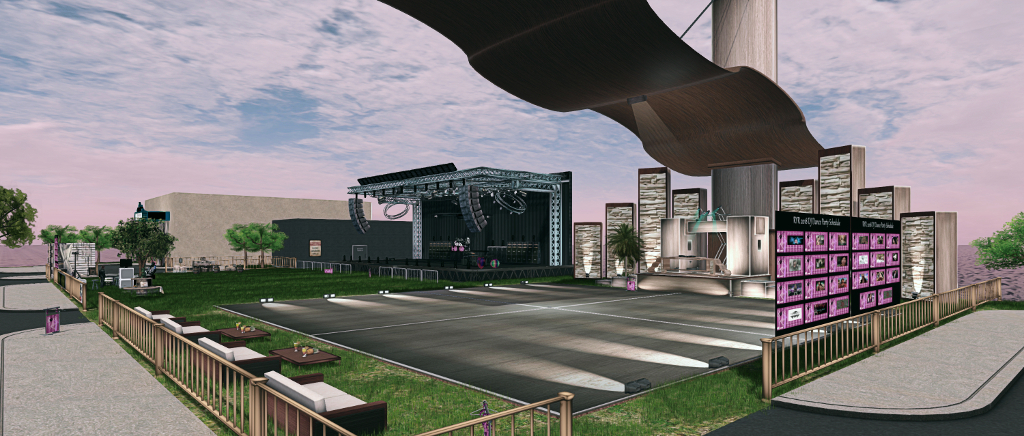
Rock Your Rack 2018

Entertainment Registrations

Registrations are also open for live entertainers and DJs wishing to participate in the Rock Your Rack 2020 entertainment activities.

Those interested in participating should follow the links below:

Note that applications for both also close at the end of July 2020 – so if you’re interested, be sure to hop over to the Rock Your Rack website sooner rather than later.

About Rock Your Rack and Models Giving Back

Rock Your Rack is the annual fund-raiser started in October of 2012 by Jamee Sandalwood and the team at Models Giving Back. MGB is the grid leader in trusted charity events. Jamee takes care of everything from Designers, to bloggers, to musicians, to models. This way any confusion is avoided and no one has to wait to check with anyone else before things are getting done. Rock Your Rack provides full transparency: all of the event’s documentation from screenshot totals, to Lindex transactions, to donation receipts account for every penny that was earned and donated all being posted to the Rock Your Rack website. The event has also, in previous years, obtained formal approval from the NBCF – see the 2018 approval letter for 2018 as an example.

Models Giving Back is the professional team of elite models in Second Life who have dedicated themselves to supporting the efforts of verified RL charities. This team of models gives tirelessly to the events we are involved with always giving of their time and talents to promote those designers involved in our events. For more information on Models Giving Back an how you can become a part of the team, visit the Models Giving Back Facebook Page for information about casting dates and times.

Related Links