Isolation’s Passengers in Second Life

Isolation’s Passengers – click any image for full size

Archetype11 Nova, aka Schmexysbuddy Resident, has been responsible for some of the most evocative / thought-provoking region builds in Second Life. I’ve covered a number of them in these pages – notably his Hotel California builds; his work embraces landscape design and artistic statement, often mixing ideas and sentiment, ideals and imaginings in an eclectic whole that captivates the eye and challenges us to look deeper, think a little harder and take a closer look at what is being offered.

With Isolation’s Passengers, Archetype11 offers what might be his most provocative  – and possibly his most personal – region design yet. It occupies a private full region that has the additional Full region LI bonus, although it does not currently make use of the extra land capacity. This additional space  – previous builds by Archetype11 / Schmexysbuddy have tended to be on Homestead regions – appears to offer plenty of opportunity for expansion or (perhaps) for multiple environments within the same location.

Isolation’s Passengers

The foundational aspect for this design is that of the SARS-COV-2 pandemic. This is not an uncommon theme within art and region design at present, but with Isolation’s Passengers, Archetype11 offers a different perspective on the pandemic, one which – as noted – touches on the personal for him, as he noted to me whilst I was visiting the region:

It’s intent is the onslaught of 2nd and 3rd order effects of isolation that aren’t readily visible…the invisible passengers of this pandemic. It was inspired by the death of a friend and brother of mine.

– Archetype11 Nova, describing Isolation’s Passengers

The story of that death can be found here, and should be read as a part of a visit to this region, as it helps to frame some of the motifs to be found within it.

Isolation’s Passengers

For those unfamiliar with the concepts of the 2nd and 3rd order effects of isolation, in the 1980s and as a part of studies into the long-term impact of isolation can have on the psyche among groups such as submariners, small teams on long-duration expeditions in the Antarctic and crews aboard the International Space Station. In particular, they noted three distinct reactions to being so isolated, linked to different points in  the isolation period.

The first order comes early on, encompassing the initial weeks / months of isolation.  It is marked by heightened anxiety, possibly mixed with periods of confusion and panic (think of the early stages of the the pandemic: anxiety over lock-downs, panic buying of toilet rolls, etc.). The second order (sometime referred to as the “sourdough order”) is marked by a sense of routine, possibly edged with a sense of newness / novelty (again, in terms of the pandemic: the novelty of working from home, the formation of a new routine based on self-motivation, etc). And then there is the third order. This is more negative: the dropping of routine as everything blurs into a never-ending whole where days are difficult to separate, and encompasses resentment towards our situation and towards those who are around us (not so much because of who they are but rather because they represent the fact we cannot interact with anyone else), and is a time that can be marked by emotional outbursts, aggressiveness, rowdy or anti-social behaviour.

Isolation’s Passengers

The 3rd order can often include a further emotional response that might appear as contrary to the others listed for it: that of anticipation – the sense that things will soon be over, and life can “get back to normal”, which in turn can lead to further frustration as “the end” doesn’t seem to get any closer, despite the passage of time.

Within Isolation’s Passenger’s we see many motifs representing elements of the second and third order effects of isolation – take the line of large masks with waterfalls falling from one eye: their repetition suggestive of routine; painted bodies suggestive of excitement that the freedom of expression isolation and working from home appears to initially present. Then there is the large clock sitting to one side of the region, representing the dragging passage of time and the resentment it can cause – the reminder of how long its been, and how long, potentially, we may still have to go before things “get back to normal”.

Isolation’s Passengers

But there is more here as well: the personal element of love and loss of a friend beautifully offered through these suggestions of life and death, love and loss through the use of angelic figurines (some partially dismembered), the shrouded busts with their crowns of thorns, the floating bodies under their own shrouds, the great church, the huddled skeletons, the shiny Morgan sports car with its “Just Married” sign and the promise of a bright future,  sitting amidst the wreck of several junker cars suggestive of age and decrepitude – and loss.

The layering of images and ideas within this build is compelling in their sheer diversity. Take the line of masks noted above; within them might also be seen the cracking of our daily façades – the faces we present to the the rest of the world that are becoming increasingly redundant in this age of isolation; also to be found within them is the sense of tears offered by the falling water. Between two of them sits  the carcass of an ageing ship, an orchestra playing even as pumps fail to keep the water at bay. This is rich in multiple motifs: there’s the idea of trying to carry on as normal in the rising tide of change; the echo of the Titanic and the idea we’re facing the sinking of all that can be normal in an increasingly  confusing, isolating world; the hint that despite the current disorder, perhaps normality can return; and then there’s the personal element again: music played in remembrance of a loved one.

Isolation’s Passengers

Poignant, beautifully presented, and watched over by the floating spores of a virus that hang in the sky – a reminder that as per that title of the build – we are all just passengers in the unfolding situation in the world today. Even the region’s core name – Solveig – seems to reflect the intertwined themes presented in the build – Sol and Veig being old Norse words meaning “house” or “hall” (the place where we most commonly have to isolate) and “strength” or “battle” (reflective of the strength we draw on from within in handling the battle we face in moving beyond the 3rd order of isolation).

SLurl Details

Announcing the Second Life Endowment for the Arts

via Linden Lab

In August 2019, and after an eight-year run (it’s first public exhibitions coming in 2011 after initially being announced in late 2010), the Linden Endowment for the Arts (LEA) closed, the organising committee having decided to step away from managing it (see: Linden Endowment for the Arts to officially close, LEA: more on the closure, and a move to save it and Linden Endowment for the Arts: update).

Following the announcement, there were numerous discussions on how the work of the LEA might be continued. In particular, artists Tansee Resident and Riannah Avora launched an in-world group specifically with the aim of gathering ideas and viewpoints on how the work of the LEA – and Linden Lab’s involvement in the body – might be continued.

At the time, a lot of discussions were held and a considerable number of ideas put forward (I was happy to play a small background role in advising both Tansee and Riannah in a number of areas, including potential discussions with Linden Lab). Ultimately, both went on to found groups operating on similar principals to LEA, with Tansee co-founding the Hannigton Endowment for the Arts (HEA) along with Hannington Xeltentat, and Riannah co-founding United Artists of SL.

However, the idea of a Lab-supported facility to help promote arts in Second Life never entirely went away, and Tansee continued to pursue ideas, refining a proposal originally created from the ideas gathered after the LEA had closed down. Then, in June 2020, a conversation with Lab CEO Ebbe Altberg at the SL17B event opened a door of opportunity. This in turn lead to a series of meetings with senior staff at the Lab, including Patch Linden, Vice President of Product Operations, and Brett Linden, the Lab’s senior Marketing Manager. After several such meetings, which included reviews of, and updates to, the proposal, Linden Lab indicated a willingness to support a new body similar to that of the LEA, but operating on a more modest and flexible footing.

Announced today, and starting an January 2021, the Second Life Endowment for the Arts (SLEA) will operate across seven regions supplied by Linden Lab, and managed by Tansee and Hannington supported by a Board of Advisers (the full list of whom is yet to be announced), and a team of volunteers to help in the day-to-day operations, once the new regions are open.

The seven SLEA regions

The seven regions, which are currently being set-up, will comprise the following:

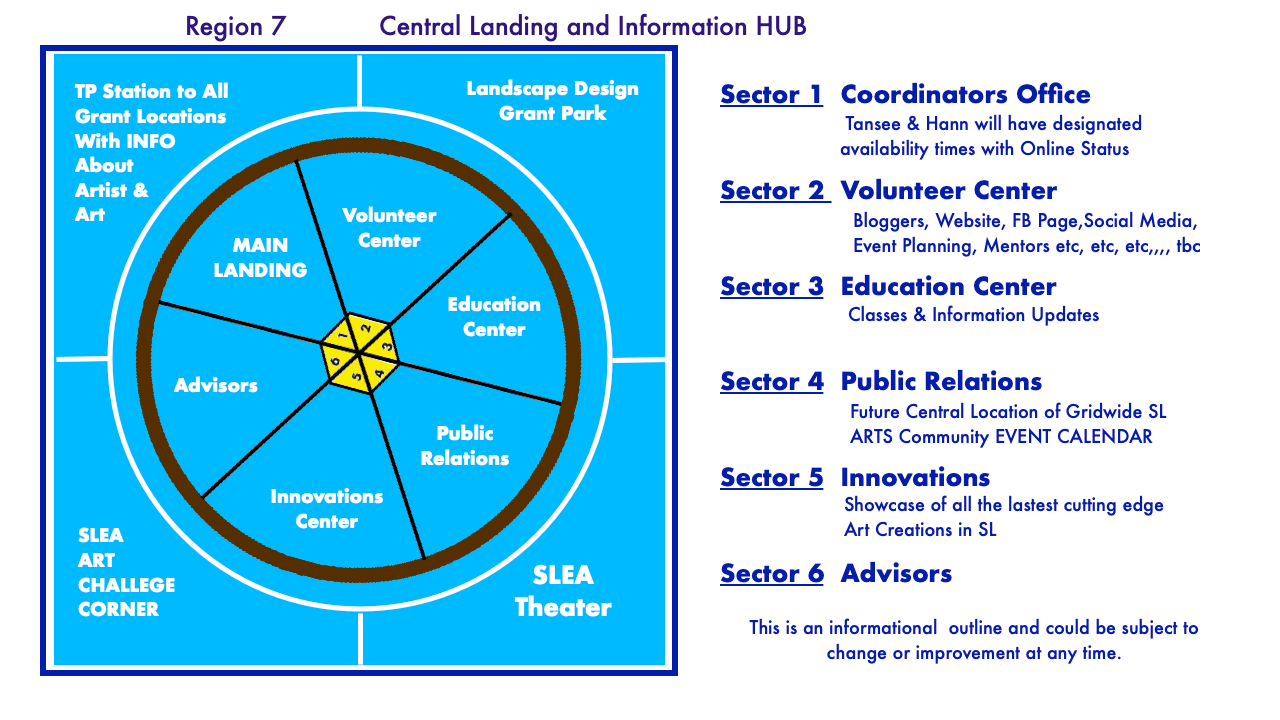
  • A  central hub (SLEA7). This will likely include:
    • A landing point.
    • Facilities for SLEA coordinators, advisers and volunteers.
    • An education centre.
    • A events centre to support arts activities and events across Second Life.
    • A teleport hub serving the SLEA grant regions and information on the artists currently exhibiting.
    • The SLEA Theatre for mounting art-related and special events.
    • An art Challenge corner.
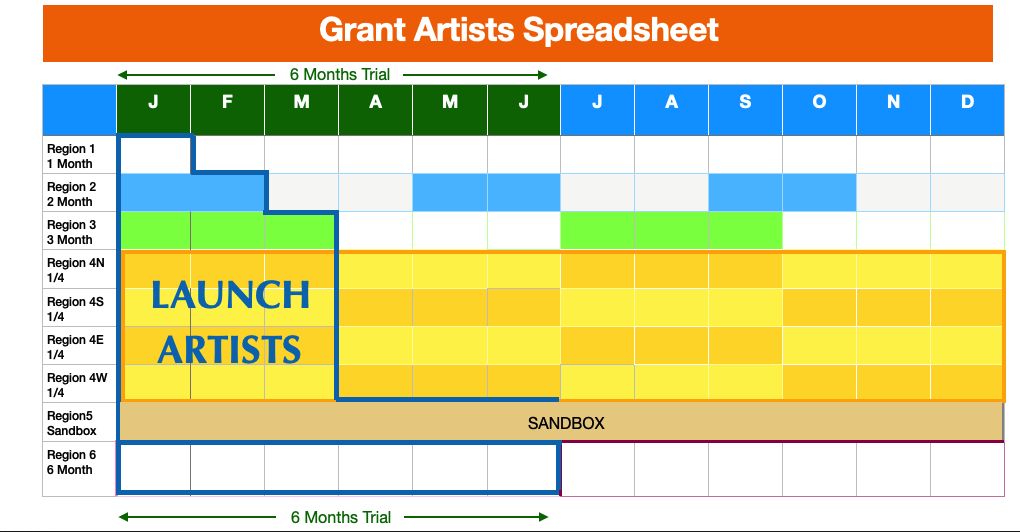
  • Four Full regions (SLEA1-3 and SLEA6) for region-wide art installations ranging from 1 to 6 months duration.
  • A single region (SLEA4) providing four quarter-region installation spaces.
  • A sandbox region. This will include an artist hangout and club for events and parties along with a new underwater building area.
The planned SLEA 7 hub region

As  noted above, SLEA will formally début in January 2021. Between now and then, the plan is to release information over a period of time, starting in October. These activities will include:

  • Providing information on:
    • How those interested to volunteer to help run SLEA, and on specific volunteer roles that are available.
    • How artists will be able to apply for grants, and requirements / guidelines for exhibiting through SLEA.
  • Updates on region design status.
  • Detailed information on the SLEA website, social media channels, etc.
  • The opening of the first round of applications for artists.

The reason for not having the website / social media presence in place alongside of this announcement was explained by SLEA co-ordinator Tansee Resident as follows:

We intentionally do not have a Website or a FB page or any of the essential networking tools. The reason for this is we truly want to include the artists in building this community from the ground up. In order to build a solid foundation it is imperative that we establish a Volunteer base and find people who are willing to share their area of expertise.

Tansee Resident, SLEA Co-ordinator

Proposed time line for SLEA development

So, in the interim period, those interested in SLEA as artists and / or as potential volunteers are asked to join the SLEA in-world group, which will be the primary channel of communications for the next few weeks. Also, to help promote SLEA, there will be a special Designing Worlds show featuring Brett and Patch Linden, together with Tansee and Hannington, which will be show at 14:00 SLT on Monday, September 14th via the Designing Worlds website and channels.

You can also read the official SLEA announcement from the Lab.

I’ll also continue to provide updates through these pages.

A Captain’s Retreat in Second Life

AustinLiam’s Captain’s Retreat boathouse / house on display with accessories at his in-world store.

While I like to build in SL – particularly my own homes – I’m always on the lookout for units made by others that might suit our needs or be up for a bit of kitbashing. One of those I’ve had my eyes on for  a fair while is AustinLiam’s Captain’s Retreat, and moving to a home literally just across the water from Austin’s in-world base of operations has tended to sharpen my interest in having a play with that design.

For those unfamiliar with Austin’s work, he produces a range of commercial and residential units and accessories ideal for those wishing to build a waterside setting or who live on / near the water. Most are of a wooden design, and so well suited to being used in a variety of settings.

AustinLiam’s Captain’s Retreat integrated into Isla Caitinara

The Captain’s Retreat is a split-level building well suited to a coastal locations or on the banks of broad rivers / the edge of lakes. It’s an over-the-water design, the lower level forming a boathouse suitable for small or modest sized powered boats, with the upper  level offering a large open-plan area providing some 20 square metres of accommodation space (including 2 balconies) that can easily and comfortably be split into two living areas,  and is well-lit thanks to large windows on three sides of the building, two sets of which incorporate sliding doors to access balconies that bracket the building.

At 84 LI, the building is supplied without a rezzer – you just unpack it and drag it out of the resultant  folder (which also contains a single armchair, a flag pole and a bearskin rug referred to as “bear … already dead” 🙂 ), then place it. This is handy for those who don’t like messing around with rezzers; however, for those who (like me) enjoy kitbashing / modding designs, thought has been given to making this a flexible design well suited to modding. The fireplace elements, for example, can be easily selected and relocated within the house. External lighting is supplied as a part of the build, the lights individually switchable, while the boathouse has a door that can be raised / lowered and has piers for easy access to any moored boat.

This slideshow requires JavaScript.

The interior living space can be comfortably split into smaller areas to suit needs. Borrowing from Austin’s approach, I used a room divider rather than full-height walls, and added slatted blinds from additional privacy between “day” room and sleeping area

In our case, the mood nature of the design allowed me to add external decking around two sides of the house, and then split the main living area into two areas – one a general living space,  with more than enough room for a sofa and armchairs, a dining  area and even a gallery kitchen. Taking a leaf from Austin’s in-world show home for the Captain’s Retreat, the remaining half of the room became a bedroom area,  overlooking the open waterway passing our Second Norway island.

The mod nature of the house allowed the fireplace to be relocated as noted above, whilst also allowing me to add greater depth to the two balconies and the glass awnings over the top of them. While it is not vital, I also modified the lighting supplied with the house, removing the supplied  scripts and replaced them with a system integrated with the room lighting I added to the house, with a script to activate all lights a SL sunset and turn them off at SL sunrise.

The living area of the house has balconies on either side, served by sliding window doors. The modular design of the build means that these balconies can be made deeper if required to provide more space, and the supporting beams of the house frame adjusted to match

At  L$1680, this isn’t a design that will break the bank – but it can provide a surprisingly comfortable living space. Thanks to Ydille’s Multi Scene Rezzer & Multi Scene Erazer Pro V5 I reviewed last month, the Captain’s Retreat house now forms a 4th option of house we can have at Isla Caitinara whenever we feel like a change – and for those looking for a house they can easily mod and / or create a cosy home on the water, I’d have no hesitation in recommending this design.

Links

The landscapes of Second Life

L’autre Oeil: Anouk LeFarve

Now open at L’autre Oeil (“The Other Eye) Gallery, owned and curated by Blaize Nightfire, is the gallery’s September 2020 exhibition entitled Landscapes. This is an ensemble exhibition featuring the work of Sandi Benelli, Charly Keating, Anouk Lefavre, Michael Lysios, Loegan Magic and Charlie Namiboo, who between them are some of Second life’s foremost landscape photographers / artists.

The gallery opened in June 2020, and was founded with a specific focus of promoting the work of artists to others in the Second Life arts community – although that doesn’t prevent admirers of the arts from visiting and appreciating the art on offer.

L’autre Oeil is a gallery for artists who love other artists. To be seen with the other eye, observers who appreciate a different perspective on the world around us.

– Blaize Nightfire, describing L’autre Oeil’s mission


For this exhibition –  my first visit to the gallery (and certainly not my last) – each artist is displaying three pieces of their work, some of which might easily be seen as story-telling triptych of images. Take Charlie Namiboo’s set, for example, the two outer images of plainslands neatly framing the black and white images of a river in what might be a tale of three parts, the two colour images supporting the centre image.

L’autre Oeil: Charlie Namiboo

Although the title of the exhibition is Landscapes, some of the artists have cast their net a little wider. Loegan Magic, for example, offers a richly evocative rooftop scene that is exquisitely composed, predominantly in black a white, but with a wall painting of John Lennon offered in colour, staring from the the lower part of the image in a haunting capture that carries echoes of Imagine in  Lennon’s eyes, and also a hint of F. Scott Fitzgerald’s Dr. T.J Ekleburg from the Great Gatsby. Similarly, Michael Lysios presents an oriental street scene, whilst Sandi Beneli uses SL landscapes and coastal scenes as a means to frame broader narratives on life and living – from flying a kite to the promise of a car trip. All of these images present additional depth to what is a captivating exhibition.

L’autre Oeil: Blaize Nightfire

Tucked away in the exhibition are three images by Blaize himself, who demonstrates he is no slouch with the camera, offering three images of his own that are as evocative as any of the others in these exhibition.

An attractive ensemble exhibition, well worth dropping by to see.

SLurl Details

Second Life to have a smashing time with Titmouse

logos © and ™ Linden Lab, Titmouse and Lightbox Expo

On Tuesday, September 8th, Linden lab announced their latest partnership event intended to offer fun for existing users and to encourage those why may not have tried the platform or who have been absence a while to have a go in a party-like environment.

For this latest event – which will take place on Saturday, September 12tth, the Lab has teamed up with animation studio Titmouse Inc., to host the virtual equivalent of the Titmouse Smash Party, to be held in conjunction with the 2020 Lightbox On-line Expo.

Titmouse, Inc., is a North American animation studio operating out of Los Angeles, New York, and Vancouver. Since 2000 they have been producing animated television programmes, feature films, music videos, title sequences, commercials, and short films for clients like Nickelodeon, The Cartoon Network, Disney, Netflix, Adult Swim and most recently, CBS Television for whom they have been working on the Star Trek: Lower Decks series others. However, for 20 years they also gained a reputation for hosting an annual Smash party.

The party allegedly started as an experiment in catharsis for Titmouse employees, after one of the founders of the company heard about a Japanese restaurant that offered clients an unusual service. To help diners get over the cost of their expensive meal, diners could, let off steamby going to a room in the restaurant and smashing a US $1,000 vase to pieces. True or apocryphal, I’ve no idea – but Titmouse reproduced the idea by setting up a basement room for staff where, if they were feeling stressed or suffering a creative block, they could go down to and smash the living daylights out of anything in the room (except other employees, obviously).

This basic idea took on a life of its own, evolving into an annual event for Titmouse staff, family and friends, with fun, music, noise and at its heart, The Cage, a place where attendees could – you guessed it – smash whatever was tossed / placed inside it to smithereens.

In the 21st century these types of activities are frowned upon. The Smash Party is a night where one can experience the visceral catharsis that our cave-person brain secretly desires without the stigma of our repressed society’s judgement.
Some companies do trust fall retreats. Some do bowling. Some do theme park trips. We, traditionally, have smashed.

– Titmouse owner Chris Prynoski, talking to WNW in 2019

Nothing is safe from The Cage – old toilets, broken (or even working TVs), furniture – anything that doesn’t constitute a serious risk or life or limb – and be placed inside and await its fate.

After 20 years, the real-life Titmouse parties were “retired”, Prynoski and his teams deciding they would rather end on a high and have people talking fondly about past parties, rather than responding to the news of the next party with, “What? Is that really still a thing?” or similar.

However, the company has found new ways of hosting the parties – through VR and now, thanks to Linden Lab, within Second Life.

Anything can (and probably will) happen at this virtual world gathering where participants are invited to smash, bash and crash one of the hottest parties of the year held by independent award-winning animation production company Titmouse.
Attendees of the Lightbox Expo and the Second Life community are invited to attend this year’s festivities, which include a combination of music, art and overall anarchy. At the centre of the event is an interactive smashing cage where attendees can smash objects with a variety of different weapons. You can also meet and take a photo with Titmouse mascot, Mr. Chirps.
Rumour has it that the region is filled with more than a few Easter eggs so don’t be surprised when you encounter everything that is weird and wonderful — all springing from the imagination of the Titmouse team.

– from the official Second Life blog post

Those interested in  finding out more can do so via the official blog post, which includes a link to a FAQ written specifically for those new to Second Life to help them get started and find their way to the event.

Be sure to save the date – Saturday, September 12th, and catch the promo video below as Patch Linden gets an early start on having a smashing time.


2020 Simulator User Group week #37 summary

Eris Isle, July 2020 – blog post

The following notes were taken from the September 8th Simulator User Group meeting.

Simulator Deployments

Please refer to the server deployment thread for news and updates. However, there are no planned deployments for week #37.

SL Viewer

On Tuesday, September 8th, 2020, the following viewers were updated:

  • The Bormotukha  Maintenance RC viewer updated to version 6.4.8.548394.
  • The Mesh Uploader RC viewer updated to version 6.4.8.548061.

The rest of the viewer pipelines currently remain unchanged from the end of week #36:

  • Current release viewer version 6.4.7.546539, dated August 11, promoted August 17, formerly the Arrack Maintenance RC viewer – No Change.
  • Release channel cohorts:
  • Project viewers:
    • Project Jelly project viewer (Jellydoll updates), version 6.4.8.547487, issued August 26.
    • Custom Key Mappings project viewer, version 6.4.5.544079, June 30.
    • Copy / Paste viewer, version 6.3.5.533365, December 9, 2019.
    • Project Muscadine (Animesh follow-on) project viewer, version 6.4.0.532999, November 22, 2019.
    • Legacy Profiles viewer, version 6.3.2.530836, September 17, 2019. Covers the re-integration of Viewer Profiles.
    • 360 Snapshot project viewer, version 6.2.4.529111, July 16, 2019.

Region Crossings

The recent updates to region crossings have generally improved things, but they’ve also led to a lot of “interesting” – to use Simon Linden’s term – side effects and some unpredictable behaviour.

  • Some are reporting a possible increase in avatar / vehicle collisions when crossing into regions with damage enabled.
  • Others are reporting issues of crossings “hanging” – the vehicle vanishes, the avatar is unable to move, communication, teleport, stand, etc., while the user is still able to cam around but is unable to to cleanly log-out.

This second issue apparently particularly noticeable when the region being entered is not visible at the time of the crossing (see BUG-229312), although this factor may be a separate issue to anything related to region crossings.

Group Chat

People continue to experience issues with group chat disconnecting / failing following a transition to a different region via vehicle or teleport (see BUG-229219).

There is a potential fix for this issue in the works, but whether or not it solves all of the issues currently being experienced or not is an unknown until it is actually deployed.

In the meantime, the group chat issue may be related to to issues being experienced with bots using group chat becoming unresponsive,sometimes after little more than an hour of running.

All of these issues appear to date from a period of back-end updates made in early August.

Cloud Uplift

Questions continue to be asked about changes that will / may be made to simulator services as a part of or immediately following the uplift work to get simulators transitioned to AWS services.

As has oft been stated by the Lab (and reported in these pages), the Lab’s focus is on successfully transitioning all of their services  – including simulators “as is”, without making substantive changes at this point in time. As  Oz Linden stated during the meeting:

Uplift is trying very hard not to make any changes we don’t _have_ to make … A big driver for getting simulators uplifted is that then we can start selling regions again … believe me, that’s pretty great motivation.  When and whether we’ll make other changes to optimize or exploit the cloud is later on.

–  Oz Linden, September 8th, 2020

aaa