Falling Tide, March 2026 – click any image for full size
I came across Falling Tide in the Destination Guide recently, where the description pricked my curiosity, so off I hopped to take a look.
Falling Tide is a weathered coastal town where old songs, faded lights and quiet stories linger in the salt air. Wander the docks, paths and streets, find hidden markers, listen, remember. Take your time, explore, let the place get under your skin.
– Falling Tide description
Falling Tide, March 2026
A part of the Winchester estate operated by Clara Winchester (clarabellwinters) and Daniel Winchester, Falling Tide occupies a Full region located between, but not connected to, two other of the estate’s regions. Several of the other regions in the estate also have their own public areas, although for this article I’m focussing solely on Falling Tide.
The Landing Point for the region as given by the Destination Guide, sits within the centre of the little town occupying half the setting. A second Landing Point (neither is strictly enforced) is located on the north-west coast of the region, atop a deck built out over the water. This appears to be favoured by the teleport HUD and boards.
Falling Tide, March 2026
The town Landing Point has a giver for the Winchester Group HUD, which can be used to access other public areas in the estate, whilst equally close to the Landing Point is a teleport board which does much the same. Both are Experience driven, so do be sure to accept it if prompted.
The coastal Landing Point, reached via the TP HUD or whilst exploring, has two notecard givers in the form of empty crates. One offers the opportunity to find stories about Falling Tide scattered around the region (six in all), the other offers visitors the chance to join The Lost Playlist Hunt, which comes with its own back-story.
Falling Tide, March 2026
The town is very much as its description states: somewhat rundown and past its prime but still marching forward and offering various attractions – notably the art gallery – with the old motel offering visitors opportunities to stay a while. At the southern end of the town and extending eastwards is a row of six modestly-size cabins available for rent, so please be aware of this when exploring so as to avoid trespass into rented units.
Water forms a good part of the setting, with a large bay separating it from the region to the east, and the land breaking into a couple of islands to the north-east, reached via a tarmac road surface. However, it appears these two islands have been recently formed as a result of tidal incursion, despite the setting’s name, which has washed away parts of the road in separating the islands from the rest of the land, leaving the locals to place a couple plank bridges to cross the new channels.
Falling Tide, March 2026
It is this outer landscape to the east and north of the town which really brings home the tired beauty of the setting. The buildings, from the lighthouse to the boat repair shop all carry a sense of age and of slipping gently into retirement. Where once tourists might have roamed, birds and waterfowl prevail, notwithstanding the presence of a tramp steamer sitting just off the northern coast.
This quiet sense of age, coupled with the dour grey sky actually makes Falling Tide very photogenic – although some tidying-up of footpath / road prims around the town is in order to remove overlaps and the resultant texture flickering. The outlying islands certain offer plenty of opportunities for photography, and more can be found in following the outlying roads and trails.
Falling Tide, March 2026
Serene in its gentle aging, quietly linked to the wider Winchester estate and even with opportunities for a bit of boating on the waters, Falling Tide makes for an unhurried visit.
Logos representative only and should not be seen as an endorsement / preference / recommendation
Updates from the week through to Sunday, March 8th, 2026
This summary is generally published every Monday, and is a list of SL viewer / client releases (official and TPV) made during the previous week. When reading it, please note:
It is based on my Current Viewer Releases Page, a list of all Second Life viewers and clients that are in popular use (and of which I am aware), and which are recognised as adhering to the TPV Policy.
This page includes comprehensive links to download pages, blog notes, release notes, etc., as well as links to any / all reviews of specific viewers / clients made within this blog.
By its nature, this summary presented here will always be in arrears, please refer to the Current Viewer Release Page for more up-to-date information.
Outside of the Official viewer, and as a rule, alpha / beta / nightly or release candidate viewer builds are not included; although on occasions, exceptions might be made.
Official LL Viewers
Default viewer 2025.08 – 7.2.3.19375695301 – maintenance update with bug fixes and quality of life improvements – December 2.
Notable addition: new VHACD-based convex decomposition library for mesh uploads.
Second Life Release Candidate viewer 2026.01 – 26.1.0.22641522367, March 5 – NEW
Legacy search; WebRTC improvements; QoL improvements.
The Vera C. Rubin Observatory is a facility I’ve covered numerous times in Space Sunday as it has been constructed and outfitted. Perched atop Cerro Pachón in Chile, at an altitude of 2.67 kilometres, the Vera C. Rubin promises – with a caveat – to totally alter the way we see the cosmos around us.
This is because the telescope is to carry out a 10-year survey to probe the deepest reaches of our universe to reveal its secrets. Called the Legacy Survey of Space and Time, or LSST (“legacy” here referring to the fact that the observations and images the telescope makes will be of interstellar objects as they appeared hundreds of thousands through hundreds of millions of years ago), the survey will be the most comprehensive of its kind to date, and involve astronomers from around the world.
The secret weapon the observatory uses in this survey is the largest telescope-camera system ever built. The primary lens of this behemoth is 8 metres across, with the entire camera weighing some 3 tonnes. Its construction took a decade, after which it had to be carefully packaged and shipped to Chile and up to the observatory, where it was installed into the facility as the core part of the Simonyi Survey Telescope (named for the private donors who sponsored the telescope, Charles and Lisa Simonyi).
A rendering of Vera C. Rubin’s Simonyi Survey Telescope with the camera system and lenes at its centre. Credit: Rubin Observatory project office.
Overall, the telescope is a 6.5m class optical telescope, with a 3.2 gigapixel charge coupled device (CCD) for imaging. Over the course of the LSST, the observatory is expected to reveal and catalogue a wide range of objects, including some 5 million Sun-orbiting asteroids (including around 100,000 near-Earth asteroids at least 300 metres across, some of which might present the risk of colliding with our planet at some point in the future); imaging around 20 billion galaxies, 17 billion stars and up to 6 million planetary systems orbiting other stars.
In addition, it is hoped the observatory will be able to catalogue “primitive” objects in the Kuiper belt (i.e. those thought to have existed at the time of the birth of our Sun), observe thousands of novae and supernovae to help astronomers to further understand the nature of the galaxy
The telescope had is “first light” – the first practical use of a telescope after it has been constructed, calibrated and commissioned – took place in June 2025. These took the form of “teaser” images as to what the telescope would be capable of, featuring the Trifid and Lagoon nebulae and extracts from a wide-field view of galaxies in the Virgo Cluster.
More recently, the images of the Virgo Cluster have been further cleaned-up and re-annotated, revealing the sheer power and depth of observations Vera C. Rubin can make. The image below covers a 3.5 degree diameter field-of view and reveals over 100 galaxies and numerous stars (particularly those within the constellation of Virgo) within our own galaxy, presenting a stunning insight into just how vast our universe is.
An annotated version of the Vrgo Cluster showing some of the 10 million galaxies captured in the observatory’s first light images. (Image credit: RubinObs/NOIRLab/SLAC/NSF/DOE/AURA) – click for full size & then zoom for detail
The telescope is designed to take multiple pictures during each observation period, the main camera taking a 30-decond exposure for each image, with an active optics system with wavefront sensors within the telescope keeping the mirrors precisely configured, aligned and focus for the clearest possible images.
However, whilst images from the telescope are stunning an informative, they also come with a problem, albeit not one of the observatory’s own making. That problem is satellite pollution. In short, megaconstellations like SpaceX Starlink and China’s Guowang are lobbing thousands of low-Earth orbiting satellites into the space around us. These satellites inevitably reflect the Sun’s light as they travel across the sky, and in time-lapse images, this reflected light appears as narrow streaks across an image – and not just one or two, but potentially dozens at a time. All of which has to be painstakingly cleaned-up in order for the full value of images to be obtained.
The issue here is that removing satellite steaks is not just a case of pulling up Photoshop and then editing – the very act of trying to clean up images to remove the streaks can introduce its own errors which might prove impossible to account for and which risk misinterpretations of what is being seen being made.
A time-lapse image of Comet C/2023 A3 (Tsuchinshan–ATLAS) taken from Italy on August 1st, 2024, demonstrating the issue of satellite pollution – the lines crossing the image are caused by the passage of satellites (predominantly Starlink) Credit: Rolando Ligustri)
Nor do the problems end there. A relatively new company, Reflect Orbital has grand designs of orbiting a 50,000-strong megaconstellation of satellites which can deploy large Sun-reflecting mirrors. The aim? To provide “responsive lighting after dark and to increase the effective hours of solar energy production”.
Currently, the company plans to launch a proof-of concept satellite called Eärendil-1 (which likely has Tolkien spinning in his grave) capable of deploying and 18m by 18m Mylar mirror utilising the same material as used to reflect sunlight off of space vehicles, sometime in 2026. This project has drawn such condemnation from astronomers and others (additional concerns about directing sunlight onto specific parts of the Earth and turning “night into day” are that it could have a serious negative impact on the circadian cycles of animals and humans), that Reflect Orbital has promised to work to minimise the broader impact of their idea. Time will tell on whether this offer is genuine or not.
Both the International Astronautical Union (IAU) and the US National Science Foundation have called on companies launching satellite constellations to be more aware of their negative impact and to reduce the reflectivity of their satellites – the IAU recommending that all satellites should appear no brighter than magnitude 7 objects.
Multiple companies have agrees to try to reach this goal, but thus far few have shown any real movements towards it. SpaceX, for example, gave assurances that it would work to reduce the reflectivity of its version 2 Starlink satellites compared to its version 1.x units. However, whilst effects were made, they fell far short of the level requested by the IAU, and efforts to further reduce reflectivity appear to have ceased. Others, such as Texas-based AST SpaceMobile raised a middle finger to the IAU’s recommendation by launching its Bluewalker 3 satellite with a reflectivity some 400 times greater than magnitude 7. Currently, that company plans to launch some 60 even larger and more reflective Bluebird Block 2 satellites into LEO during 2026/27.
The Vera C. Rubin Observatory imaged in 2022 during the final construction phase, seen against the backdrop of the Milky Way galaxy. time-lapse views of the night sky like this – and those captured by observatories like the Vera C. Rubin, are under increasing threat from low earth orbiting satellite clusters like Starlink and Guowang. Credit: Rubin Observatory/NSF/AURA/B. Quint
What is evident from this is that formalised regulation is required to try to minimise the impact the over-use of the low-to-medium Earth orbit regime, lest our ability to learn about our planet, solar system and the cosmos around us be otherwise degraded to an unconscionable level.
“Life Here Began Out There”
Battlestar Galactica fans will likely recognised this quote, being some of the opening words of the original series (as spoken by Patrick “John Steed” Macnee!), and a refrain which popped up in Ronald D. Moore’s largely excellent reimagining of the Galactica tale. It’s also a phrase which has taken on a certain nuance in recent times.
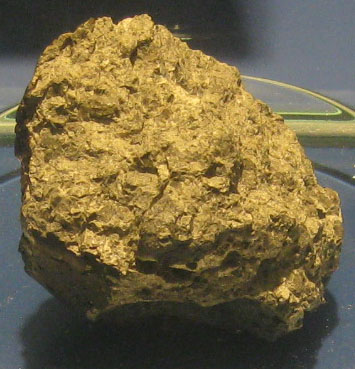
ALH84001 on display at the Smithsonian Museum of Natural History, Washington DC
It has long been known that – particularly in the very early history of the solar system – asteroid and other impacts on Mars could carry enough force to send chunks of Martian rock clean off the planet and into space, with some of them eventually coming under the influence of Earth’s gravity and falling down on our planet. One of the most famous pieces of evidence for this is the notorious Allen Hills fragment ALH84001. This was a fragment of rock shown to be consistent with the rocks of Mars discovered in the Allen Hills region of Antarctica in 1984,and which went on to cause a stir when it was announced the rock apparently contained evidence of fossilised Martian life (spoiler alert: it likely didn’t).
ALH84001 is not the sole example – Antarctica is actually a popular (but not the singular) place for asteroid fragment hunting, as the charred and discoloured can often be found close to the surface of the ice and snow fields, where they send out starkly to the human eye. Multiple expeditions have found lumps of asteroid and rocks which have later proven to have arrived here from the Moon or Mars.
Whilst the investigations around ALH84001 may have been flawed, they did help kick-start a debate as to whether life here on Earth might have originated elsewhere – such as on Mars – or might have been kick-started not by Earthly processes alone, but with the assistance of organics-bearing asteroid fragments plummeting through our atmosphere to arrive here. The idea even as a name: lithopanspermia.
Now, a new study suggests that, if not the actual case, either scenario is actually possible. Published in the journal PNAS Nexus, the study demonstrates how bacterium can survive the massive forces of an asteroid impact blasting the rock containing them into space, the extremes of interplanetary space and their fiery arrival on another world possibly altered, but otherwise largely unharmed.
In particular, the study shows that Deinococcus radiodurans, a particularly hardy bacterium known for its thick outer shell and an ability to repair its own DNA, as well as being tolerance of the kinds of radiation it might be exposed to in interplanetary space, could indeed survive all the trials and tribulations of being blown off of somewhere like Mars and landing here on Earth. In fact, so hardy is D. radiodurans that it has for some time had the nickname, “Conan the Bacterium”.
Most intriguingly, the bacterium has been found within rocks in the highlands of Chile and other regions were asteroid fragment hunting is popular.
To simulate the forces involved in an asteroid impact, the researchers sandwiched samples of D. radiodurans between two steel plates. Using a gas-powered gun, they fired a projectile at roughly480 km/h), subjecting the microbes to pressures between 1 and 3 gigapascals. That’s around 10 times greater than the maximum pressure which can be experienced here on Earth (and at the bottom of the Mariana Trench): 0.1 gigapascals.
At the low-to-mid-ranges of impact (1 to 2.4 gigapascals), D. radiodurans showed either no sign of damage or varying degrees of cell rupturing. At the higher pressure, damage was more extensive, but in both the mid-to-high level ranges, the team behind the study witnessed the bacterium’s self-repair mechanisms go into action, repairing damaged DNA and renewing damaged cell membranes.
Researchers exposed the bacterium Deinococcus radiodurans to the pressures experienced during an asteroid strike. The microbe survived, suggesting that impacts could spread life from planet to planet. Credit: Lisa Orye/Johns Hopkins University
We expected it to be dead at that first pressure. We started shooting it faster and faster. We kept trying to kill it, but it was really hard to kill.
– Lily Zhao, study lead, John Hopkins University
In fact, so hardy did the bacterium prove, the experiment was halted not because the team eventually killed it – but because the steel plates sandwiching the samples started giving out under the pressure of the gas gun impacts!
Of course, this doesn’t prove that life – or the ingredients of life – came to Earth from Mars or from asteroids. For one thing, we have yet to discover any solid evidence for Mars having once harboured basic life-forms, despite all the evidence it once have the conditions to do so, and they this formed in advance of Earth. There’s also currently no evidence for organics on asteroid having been able to form more complex structures.
However, and on a broad level, it does demonstrate that basic life forms such as bacteria are certainly hardly enough to travel from one place to another – and that if the conditions are just right in the place where they arrive, they might it turn go on to help kick-start more complex life there (assuming the place they arrive doesn’t already harbour some form of basic life which regards them as an invader to be wiped out).
Rockets and Satellites: Proof of Pollution
I’ve written about the growing problem of upper atmosphere pollution resulting from the increasing number of commercial launches around the world, and the potential impact it might be having or come to have on the stratosphere’s weather systems and in damaging things like the ozone layer (in particular, see: Space Sunday: space debris and atmospheric damage + some updates).
Now a team of researchers at the Leibniz Institute for Atmospheric Physics have published the first direct correlation between space vehicle debris re-entering the atmosphere and an increase in atmospheric pollutants – namely lithium.
In February 2025, Spaces launched a Falcon 9 to deliver 22 Starlink satellites to low Earth orbit (LEO). Whilst the upper stage of the rocket successfully delivered its payload to orbit, it suffered a malfunction during a planned de-orbit engine burn which should have lead to its controlled entry into the atmosphere and eventually destruction as it burned-up. As a result, the stage remained orbiting the Earth for 18 day before starting an uncontrolled re-entry some 100 km west of Ireland and proceeding over populated Europe to the point of kindly dropping debris on Poland.
During the event, atmospheric researchers at the Leibniz Institute, Germany, were surveying the upper atmosphere composition using a highly sensitive resonance fluorescence Lidar system when the noticed a sudden and rising spike in upper atmosphere lithium. Normally, lithium exists within the atmosphere to the tune of around 3 atoms per cubic centimetre, but the researchers at Leibniz saw levels climb to some 31 atoms per cubic centimetre at altitudes between 96.8 km and 94.5 km – the range in which Falcon 9 upper stages start to break-up and the risk of pollutant spillage is greatest.
The spike in upper atmosphere lithium (in red) as seen by the researchers at Leibniz Institute, showing its intensity and altitude – the latter of which matches the break-up of a Falcon 9 upper stage. Credit: Robin Wing et al
Intrigued, the atmospheric researchers continued to monitor the rising levels of lithium whilst also running some 8,000 simulations of backward wind paths from the Lidar station to the skies over Ireland. What they found, after eliminating any other potential causes for the spike they could think of, was that it commenced almost exactly at the time the Falcon 9 upper stage entered the Earth’s atmosphere west of Ireland and almost exactly tracked the stage’s passage over Ireland and the UK as it reached its point of initial break-up and fell through to around 94 km altitude, very much tying the plume to the stage’s demise – the upper stage of Falcon 9 rockets using lithium extensively in their components.
Whilst this is the first definitive time a significant increase in atmospheric pollutants has been directly tied to a re-entry event, but doesn’t supply all of the answers. For example, no-one actually knows how such concentrated dumps of lithium – which occur following every Falcon 9 launch and every re-entry of a Starlink satellite (which SpaceX have been disposing an accelerated rate in order to “get rid” of their version 1.x satellites in favour of the v2 unit) – will have on high-altitude weather systems or on other aspects of the atmosphere as they disperse and descend.
An images showing a backtracking of wind paths over Europe at the time of the Falcon 9 upper stage re-entry. Not how the initial track closely follows the track of the upper stage, including the period of maximal lithium dispersion as the vehicle breaks-up between 97 and 94 km altitude. Credit: Robin Wing et al
However, it is indicative that the commercial launch sector as a whole has a major question to answer in terms of what they should be doing to minimise the potential for damage to our atmosphere they are creating
Linden Lab Adult Hub, Second Life, March 2026 – click any image for full size
If memory serves, it was around 2 years ago (maybe slightly longer) when Linden lab first dropped hints about a new Adult Hub for Second Life. It appears that any “coming soon” associated with the Hub was of the Blizzard variety, given that here we are, some two(ish) years later, and the hub has finally arrived.
Or at least I assume it has only recently arrived; there’s been no announcement that I’ve seen, nor any chat about it (although, in fairness, I try to avoid the Forums, where it may have been announced). In fact, I was only alerted to its presence in-world by long-time friend, Miro Collas – so thank you, Miro!
Linden Lab Adult Hub, Second Life, March 2026
Called simply and appropriately the Adult Hub, the new facility is open to both existing and new residents – with mentors available to help the latter. In terms of setting, it has a strange semi sci-fi feel about it; not sure why – Adult activities are hardly constrained to that particular genre, but it does mark the hub as distinct from others the Lab has provided, with dark tones to the buildings, together with neon and LED-like lighting.
The Landing Point forms n open plaza with a heart motif, sitting in the centre of the major structures at the hub. The largest of these buildings is the Illusions Lounge – a club which, if I recall correctly, was featured in the early hints given about the Adult Hub back in 2024.
Linden Lab Adult Hub, Second Life, March 2026
On either side of the steps leading up to the lounge are teleport portals. The three to the left offer access to newcomer friendly locations, the middle to adult clubs and entertainment and the third to arts and culture. The single portal to the right of the stairs links to the main SL Welcome Hub. The three “destination” portals also have adverts for the SL Destination Guide between them. Each of these portals also has a sign above it naming the current destination were one to step through it.
To either side of the Landing Point are maps of the entire region, highlighting the various buildings and other facilities. These comprise the swimming pool, facing the lounge from across the Landing Point and overlooking the main beach (itself with a nude beach to one side); a beachside fire pit; a glamping space with three A-frame tents and couples mattresses; the imaginatively names Sexy Spa and Sexy Hotel; and The Fall, which form a part of the hub’s extensive gardens and outdoor spaces.
Linden Lab Adult Hub, Second Life, March 2026
Not directly annotated (but still shown) on the map are these saunas, the hub’s bar (which is linked via a terrace to the Sexy Hotel), and the walks through the gardens and outdoor spaces. These are all also pointed to via the hub’s plentiful signage.
The hotel is deserving of particular mention. The ground-level foyer presents five private sky-base rooms, each one with a photo and an indicator as to whether it is available for use. Clicking the Availability sign will display a dialogue asking you to confirm if you wish to use the room for up to 30 minutes.
Linden Lab Adult Hub, Second Life, March 2026
Responding “Yes” to this dialogue presents a further dialogue box explaining how to use the room on your own or with another guest or guests. When you have clicked your preferred choice (and entered the name of the other guest(s), if you are sharing), clicking the Available sign will teleport you to the room. As one might expect, the bed within each room includes adult animations. Each room also has an Exit door, which will return you to the Hotel foyer. Note that if you leave a room prior to your 30 minutes being up, you might not be able to select another room until your time has expired.
Similarly, most of the ground-level sitting positions – such as the glamping tents, the fire pit seats, the loungers at the pool and the various sitting spots secluded around the gardens all display a dialogue box when you first sit on them, allowing you to decide if you want to have sole control over their animation menu, or wish to share it with someone you are with. Very handy if you wish to avoid being disturbed by an unwanted guest. Also, like the hotel rooms, the Glamping tents are available for up to 30 minutes a session.
Linden Lab Adult Hub, Second Life, March 2026
The beaches are both surprisingly light on places to sit – the main beach appears to be more geared towards dancing and events. The gardens are one of the most pleasing aspects of the hub, offering both somewhat secluded spots in which to pass the time as well as much needed colour through the flowerbeds, some of which are neatly and symmetrically placed around the main Landing Point, making it feel more welcoming and relaxed.
In all, the Adult Hub is pretty well done, and as I explore I found the black / neon / colour scheme growing on me. The overall design is nicely low-key and relaxed, the signage and information boards will placed and informative.
Linden Lab Adult Hub, Second Life, March 2026
I did find one or two little glitches – the two maps at the Landing Point, for example, are supposed to be interactive (“Click locations for more information”), but this wasn’t working during my visit. That aside, I did like the neon 3D sculpture which, when views from the right angle forms the Second Life eye-in-hand logo, complete with a pair of horns and a devil’s tail.
It’ll be interesting to see how the Adult Hub fares and how new users are directed to it (criteria, etc.).
Hippotropolis Theatre: home of the OSD/TPVD meeting
The following notes were taken from:
Pantera’s video (embedded at the end of this article) and my chat log of the Open-Source Developer (OSD) meeting held on Friday, March 6th, 2026, together with my chat log of that meeting.
Please note that this is not a full transcript of the meeting but a summary of key topics.
The OSD meeting is a combining of the former Third Party Viewer Developer meeting and the Open Source Development meeting. It is open discussion of Second Life development, including but not limited to open source contributions, third-party viewer development and policy, and current open source programs.
This meeting is generally held twice a month on a Friday, at 13:00 SLT at the Hippotropolis Theatre and is generally text chat only.
Introduces the ability to moderate spatial voice chat in regions configured to use webRTC voice.
Second Life One Click Install viewer 26.1.0.21295806042, January 26, 2026 – one-click viewer installation.
Upcoming Viewers
Viewer 2026.01
Was lined up for promotion to release status, but LL has ben seeing some suspiciously low fault rates – less than 1%, rather than the more usual average fault rate accounting for freezes and crashes being closer to something like 5-7%.
As a result, the view is going to be left at RC status through until early in week #11.
Viewer 2026.1.1 – One Click Install
2026.1.1 is the new designation for the one-click install and velopack viewer (currently 26.1.0.21295806042).
This is unlikely to move to release status for at least a couple of weeks as it works through QA testing, particularly given this viewer represents a pretty big migration from the old updater to the new one.
Viewer 2026.02
This viewer is about to undergo an “Alpha” update, designed to gather feedback from users.
This is the viewer with the new “Flat” UI updates, font changes and WebRTC voice moderation capabilities, and might additionally receive some backported updates to texture streaming.
Example of the upcoming flat UI. Via: Geenz Linden / Github #4681/2
Viewer 2026.03 -“SL Visual Polish” (SLVP)
2026.03 is set to include:
The “long baking” SSR improvements that were started last year. This version of the viewer will likely have a long beta soak time to allow feedback on these changes to be gathered.
PBR specular for residents who are more familiar with the old Blinn-Phong workflow. This will:
Include another texture slot (tint of the specular reflection).
Work with metallics.
Follow the glTF specification, but will likely initially be without glTF overrides, as this requires server-side work.
This work is currently being wrapped-up.
HDR controls in EEP so residents can decide how bright or dark things should be. This work does require simulator-side updates. This will likely initially have server-side support on Aditi (the Beta grid).
It may additionally include:
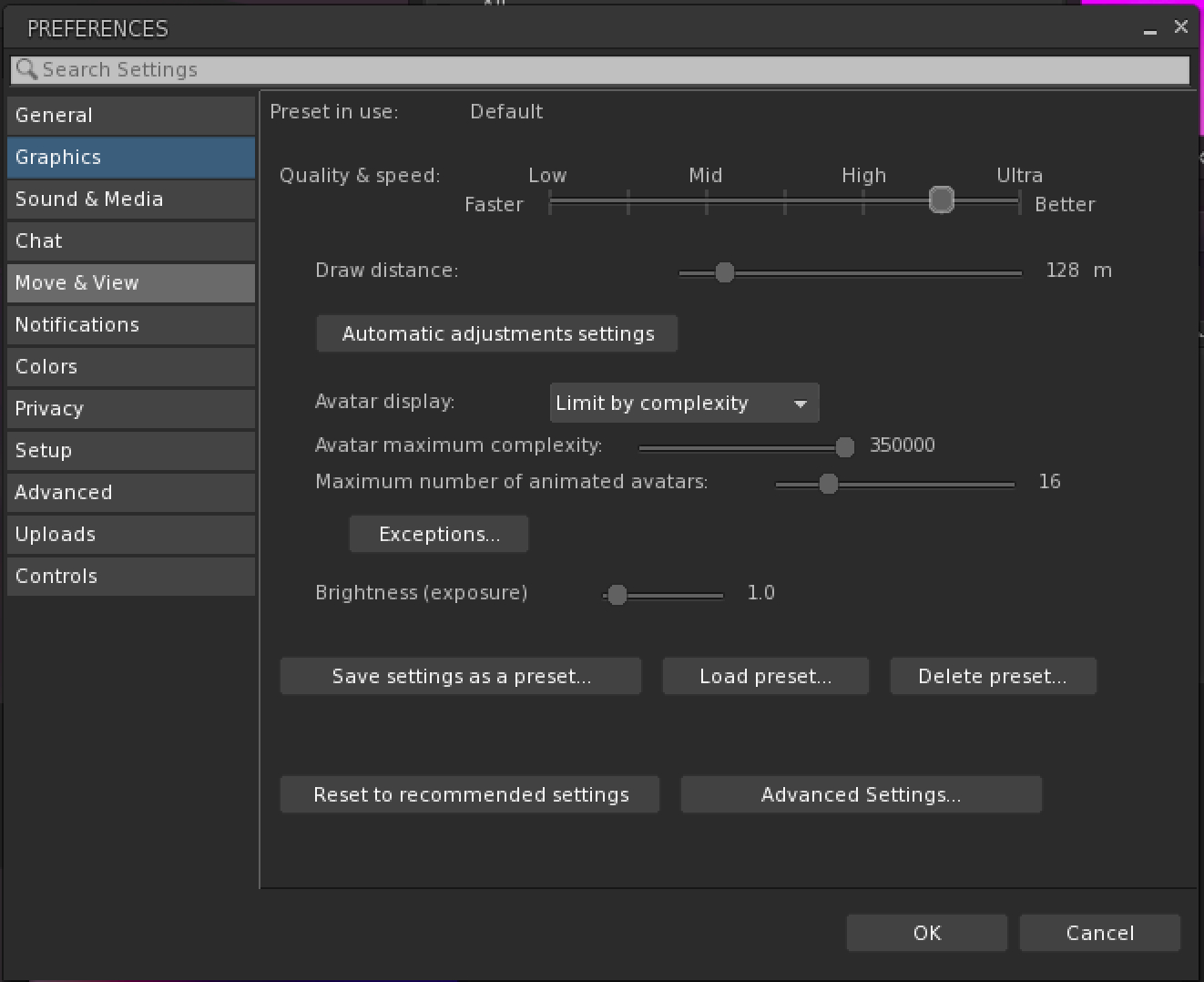
Further mirrors optimisations and a new “Ultra” quality setting that will enable a system mirror for water. A caveat on this work is that while this “water mirror” might up the quality of water reflections, it will do so at a performance hit; SSR for water will always be faster and less intensive.
Inclusion of an emissive strength setting for PBR.
Further performance optimisations.
The current repository for this viewer (valid March 6th, but may change) is available here.
This viewer may be in a head-to-head with the SLua viewer as to which gets promoted first when the time comes.
Grid-Wide WebRTC
A small deployment to the Preflight simulator Release Candidate channel was made on Thursday, March 5th, intended to address some server stability issues.
It is hoped that the deployment will quickly move to the BlueSteel RC.
There is still no Voice echo canyon for WebRTC for self-testing your own Voice system. However, one is still under consideration.
General Discussion
please refer to the video as well.
Geenz Linden has not had time to address the much-requested alpha-gamma fixes due to a focus on the SLVP viewer. It is also anticipated this work will require a decent bit of scoping, including understanding what needs to remove server-side to avoid a potential permissions hole.
Geenz has also has made further commits for the reimplementation of SSR after he found a good way to get hierarchical Z tracing working in the viewer.
He has also finally got the separable SSR pass working from another branch, which leads to a ton of optimisation potential for SLVP. For example, this now allows rendering of SSR at half or even quarter resolution, while the output for glossy SSR can be filtered, leading to less graininess on PBR surfaces and water.
There is also now a mirror for water reflections – which as was noted above, requires the Ultra quality setting and will impact viewer performance. but which is independent to SSR for water reflections.
The long-awaited Appearance fixes, as supplied by Kitty Barnett, are being targeted for the 2026.03 viewer.
There has been some musing on re-working the viewer graphic settings to make them easier to parse (such as making options drop-downs grouped by the Low to Ultra quality settings, with only the relevant options appearing for each. However, this work is only at the musing stage, not something being pursued.
A general discussion of texture handling – including the option to add blank texture detection and reduced these to 1×1 to help reduce the RAM load with textures.
A general discussion on a number of issues bugs (e.g. the AMD bug which sees the avatar textures broken on newer AMD GPU drivers – which is hopefully being addressed by AMD; MOAP input handling bugs on Linux & Apple, said to make playing some games in SL impossible, etc- see the last 15 minutes of the video for more).
The word ordinary tends to bring with it negative connotations, a suggestion that well, something might be OK, but really, something else could be far better., but until it comes along we’ll just have to make do. Even the dictionary defines the word in bland, downturned terms:
Ordinary /ôr′dn-ĕr″ē/ – adjective: Commonly encountered; usual; of no exceptional ability, degree, or quality; average; Not particularly good; not better than average.
But the fact is, ordinary can equally be positive in connotation: an ordinary route might sound like the same old, same old – but in fact it can give a rhythm to our daily lives, helping us get through the rush and rut more easily than having to panic thanks to unforeseen crises; the same is true for an “ordinary” day, when we can forget the pressures of work and the world and just be, simply sitting back, relaxing and let the minutes and hours pass at their own pace, allowing us time to breathe, to talk to the cat or the garden flowers or just be.
Cica Ghost, March 2026: Ordinary Day
For March, Cica Ghost reminds us of this through her installation Ordinary Day, which opened on March 6th, 2026. It presents a peaceful setting under a peaceful, if grey (or perhaps “ordinary” might be the right term!), where nothing happens unless we want it to. In the garden, a big cat innocently eyes a couple of Mouse cars (just sit on one if you wish and use the arrow keys to move / steer), and is happy to watch them at play,
Within this garden, flower-topped palms rise, casting their fronds wide to provide any shelter that might be required, whilst stone circles mark flowerbeds with more blue plants and tall grass. A stack of not exactly ordinary buildings rises towards the back of the setting, various stairways and a ramp climbing up into them.
Cica Ghost, March 2026: Ordinary DayMost of the latter lead to points of interest and curio – places to sit, including one where those so minded can maybe cheer up a sad-looking monster; a rooftop plaza where visitors might join some of Cica’s hand-drawn spiders as they dance a jig as an equally hand-drawn Cica plays her fiddle; or pay a visit to a snail sitting on a ledge. One of the sit points might be a little hard to reach, but does offer a view down over the garden the the cat.
Ordinary day doesn’t carry any deep message or meaning, it simply reminds us that really there is nothing wrong with “ordinary” day or with “ordinary” things or in being “ordinary”. The reality it, that we need time off and days which we can make our own, because those days might appear “ordinary” to the world, but for us they are opportunities for magic to happen – be it dancing a jig, sitting at a table, or racing a mouse car around a garden, or even contemplating our sorrows and finding a way past them.









 Inara Pey: Living in a Modemworld