Logos representative only and should not be seen as an endorsement / preference / recommendation
Updates from the week through to Sunday, March 5th, 2023
This summary is generally published every Monday, and is a list of SL viewer / client releases (official and TPV) made during the previous week. When reading it, please note:
It is based on my Current Viewer Releases Page, a list of all Second Life viewers and clients that are in popular use (and of which I am aware), and which are recognised as adhering to the TPV Policy. This page includes comprehensive links to download pages, blog notes, release notes, etc., as well as links to any / all reviews of specific viewers / clients made within this blog.
By its nature, this summary presented here will always be in arrears, please refer to the Current Viewer Release Page for more up-to-date information.
Note that for purposes of length, TPV test viewers, preview / beta viewers / nightly builds are generally not recorded in these summaries.
Official LL Viewers
Release viewer: Maintenance Q(uality) viewer, version 6.6.9.577968, promoted Thursday, February 2, 2023- no change.
glTF / PBR Materials viewer, version 7.0.0.578526, March 3, 2023 – This viewer will only function on the following Aditi (beta grid) regions: Materials1; Materials Adult and Rumpus Room 1 through 4.
I first encountered Yann Gyro’s (sempiternel) work during what was to become the last set of exhibition at La Maison d’Aneli in December 2022, when he presented an untitled but engaging 3D installation (see: Five at La Maison d’Aneli in Second Life). I was not the only one taken by that installation, as Dido Haas also saw it as well and asked Yann to consider exhibiting at her Nitroglobus Roof Gallery – and he accepted. So, officially opening on Monday, March 6th, 2023, we have Transcend Struggle, a combined 2D and 3D installation created by Yann.
This is a highly personal installation for Yann, focusing as it does on his mother’s diagnosis of metastatic breast cancer, and his love for her and his wish to support her through her diagnosis and subsequent treatment – and most of all to her memory and her strength.
For those who might not be familiar with the term, metastatic breast cancer is a stage VI cancer where the cancer cells have spread beyond the axillary lymph nodes to distant sites, including the bones, the brain, the liver and the pulmonary pleurae. it can occur several years after a primary breast cancer has been identified and treated (or at the same time the primary cancer is identified) and is the final stage of breast cancer; while treatment is possible, there is no cure. Treatments can take many forms, some of which can be as debilitating as the disease itself (e.g. radiation and chemotherapy).
Given the above, it should come as no surprise that the images and 3D elements of Transcend Struggle are powerful in message; metaphor is not required (although it is powerfully present in one sculpture and one of the images). Supported by a poem by Yann, the pictures and sculptures speak eloquently and fully to his love for his mother, her strength, and what is means to live within the twin shadows of a terminal cancer and its treatment regimes – shadows which fall across both the person afflicted and those around them.
As someone who has both lost her mother to cancer and has herself faced breast cancer (mine was fortunately a benign DCIS, and as of May 2023 I am 5 years “clear” of the disease following surgery and treatment), I found Transcend Struggle deeply moving. However, you do not have to have gone through diagnosis and treatment – or know someone who has – to appreciate the outflow of love found within the installation; it in clear both within Yann’s words and the beauty of his images, while his sculptures convey an equally strong message. As such, it is difficult to write about it; Transcend Struggle very genuinely needs to be visited, and Yann’s the images, sculptures, words experienced first-hand.
Cancer loves to hide in the darkness of fear and silence where it can prey on the mind as much as it does on the body, gnawing equally on those diagnosed with it and those around them; confronting it – be it through seeking a diagnosis, through treatment or just by talking about it – may not always lessen its threat, but it does shine a light on it and allow strength and love to be shared as it is faced. Transcend Struggle speaks eloquently to this fact.
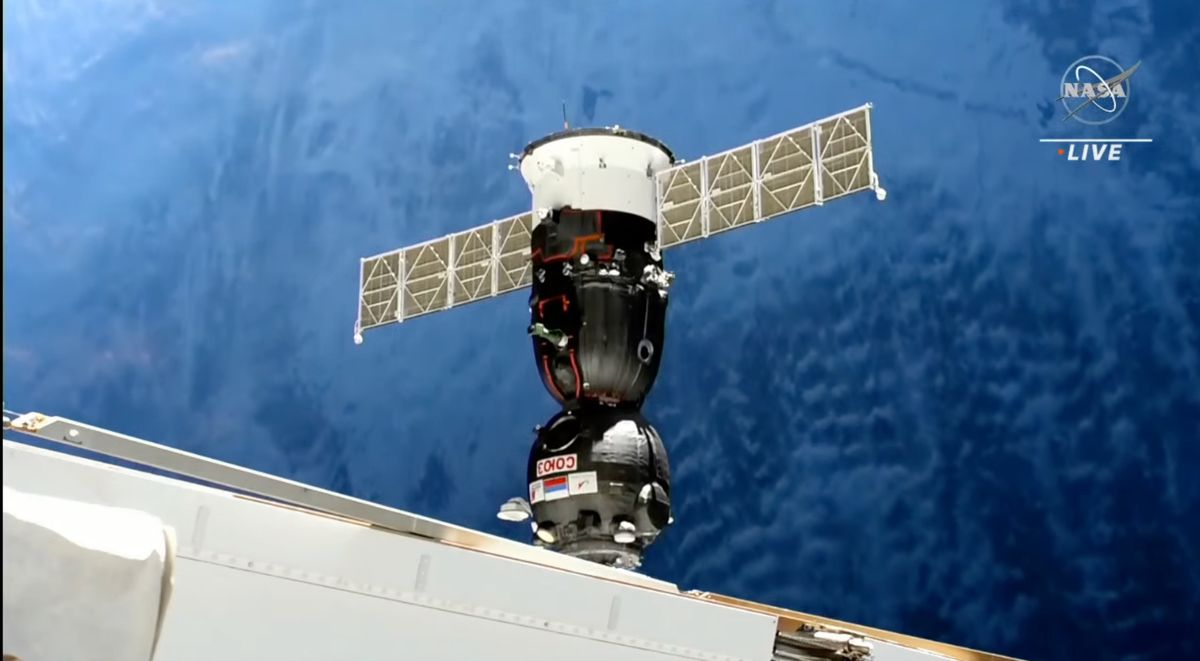
Russia’s uncrewed Soyuz MS-23 spacecraft approaches the International Space Station for docking on Feb. 25, 2023. The round forward section of the vehicle is the orbital crew module, discarded before re-entry; the bell-shaped centre element is the Earth return capsule, and the aft end with the solar arrays provides power and propulsion, but is discarded before re-entry. Credit: NASA TV
Russia’s uncrewed Soyuz MS-23 launched for the International space station on February 24th, 2023, on its way to replace the Soyuz MS-22 vehicle struck by a major coolant leak in December 2022, leaving it incapable of returning crew members Sergey Prokopyev, Dmitri Petelin and Frank Rubio to Earth as planned at the end of their 6-month rotation.
Due to the lack of any return capability, NASA and Roscosmos had worked on an emergency scenario whereby the Soyuz seat for Rubio had been transferred to Crew Dragon Endurance to allow his return with the 4-person members of NASA’s Crew 5 in the event of an emergency evacuation being called for ahead of MS-23’s arrival; the theory being that this would reduce the heat load in the Soyuz return capsule, allowing Prokopyev and Petelin to survive a return to Earth in that vehicle.
Having arrived at the ISS on February 25th, the crew started work in off-loading the ~430 kg of cargo MS-23 carried to the ISS and then moving the flight seats for the MS-22 crew into the newly-arrived Soyuz. It is not clear when MS-22 will be undocked from the ISS to attempt an automated return to Earth; however, its crew will now spend almost a year in space, as MS-23 will not make a return to Earth until September 2023, giving Roscosmos time to completely reshuffle crew rotations.
Crew Dragon Endeavour is lifted off of Pad 39-A at Kennedy Space Centre, Florida by a SpaceX Falcon 9 at the start of the Crew 6 mission, March 2nd, 2023. Credit: Jordan Sirokie
In the meantime, NASA’s Crew 6 mission launched from Kennedy Space Centre on March 2nd, aboard SpaceX Crew Dragon Endeavour delivering NASA astronauts Stephen Bowen and Warren Hoburg, cosmonaut Andrey Fedyaev and Emirati astronaut Sultan Alneyadi to the space station on March 3rd, after a one-hour delay in docking whilst a faulty sensor on the docking system was corrected.
Bowen is due to take over the role of ISS commander from Prokopyev, marking the start of NASA Crew Rotation 69. Following handover, the Crew 5 mission, comprising NASA astronauts Nicola Mann and Josh Cassada, together with JAXA astronaut Koichi Wakata and cosmonaut Anna Kikina (the first Russian to fly a US commercial crew programme flight, and the first Russian to fly on a US spacecraft since 2002) will depart the ISS aboard Endurance for Earth, possibly around March 8th.
The NASA Crew 6 / Expedition 69 crew (in the blue jumpsuits) of (l to r) Sultan Alneyadi, Stephen Bowen, Andrey Fedyaev and Warren Hoburg, join the current ISS crew of (l to r foreground) Josh Cassada, Koichi Wakata and Frank Rubio, together with (l to r in the rear), Dmitri Petelin, Sergey Prokopyev, Anna Kikina and Nicole Mann. Credit: NASA TV
Crew 6 almost marks the last flight of Crew Dragon under the initial contract between NASA and SpaceX which pegged launch fees at US $220 million / US$55 million per seat. From the August Crew 7 launch through until Crew 14 (~2028), SpaceX Crew Dragon flights will average US $288 million / US $72 million per seat.
Giving the Moon its Own Time Zone
A human return to the Moon and the potential for establishing a permanent presence there involves many things. Most of the time, efforts are focused on the technologies required: launch and landing systems, communications system, life support, etc. However, one thing people likely do not consider is the matter of how time will be kept.
Until now, missions to the Moon have operated on a time frame based on their country of origin, with their onboard chronometers synchronised with terrestrial time. However, this will not work going forward, when there will be multiple missions – crewed and robotic – operating on and around the Moon.
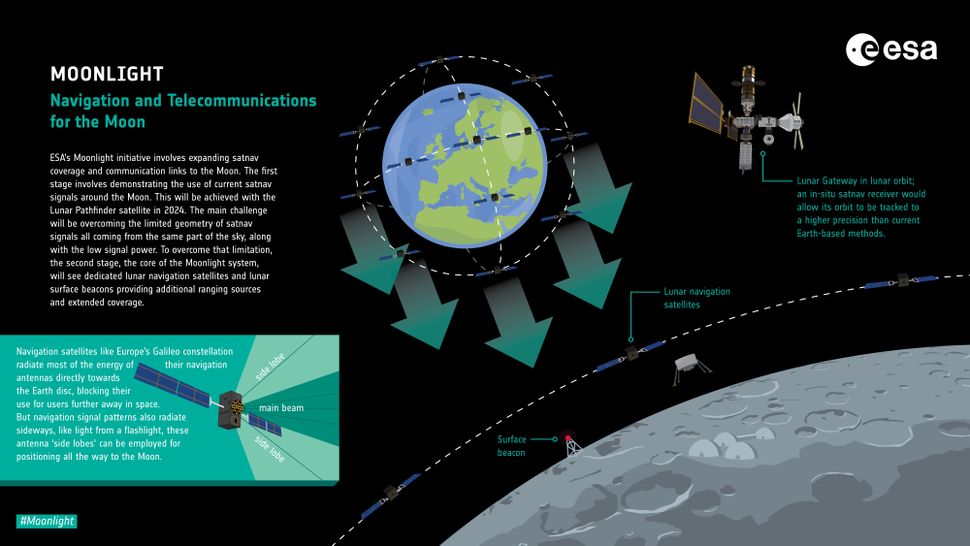
To facilitate these missions, NASA and the European Space Agency (ESA) are developing new orbital services such as the Lunar Communications Relay and Navigation System and Moonlight, both of which might be thought of a combination of communications as GPS data services such as the US GPS and European Galileo systems.
The latter have their own timing systems, but they possess offsets relative to one another of just a few billionths of a second, allowing them to operate on concert. In particular, they are fixed to the Universal Coordinated Time (UTC) global standard, which is also used by the internet and aviation, as well as scientific experiments that require highly precise time measurements. This allows both networks to remain fully in synch with one another and with ground-based units.
ESA’s Moonlight initiative plans to expand satellite-navigation coverage and communication links to the moon. Credit: ESA / K Oldenburg
Having a universal time standard for the Moon and cislunar space is important because clocks run slower on the Moon’s surface than on Earth by 56 millionths of a second per terrestrial day, whilst clocks placed in different orbits around the Moon will run at different rates to one another and those on the lunar surface. Over time, this can result in communications and data errors to be introduced, so having a singular reference point – time zone – unique to lunar operations is essential for such time-keeping and allowing for things like accurate navigation across the surface of the Moon and when in orbit around it.
To this end, and following meetings hosted by ESTEC, the European Space Research and Technology Centre, space organisations such as NASA, ESA and JAXA, have agreed to develop LunaNet. Based on the core concepts of GPS and Galileo, LunaNet is intended to provide a set of mutually agreed-upon standards, protocols and interface requirements for inter-operability between multiple space and surface units operating around on the Moon, all utilising the same time standard.
Exactly how this standard will be defined and will be responsible for maintaining it or what it should be called has yet to be determined. UTC, for example, is not maintained by any one nation, but by the intergovernmental International Bureau of Weights and Measures (IBWN) based in Paris, France. One suggested name for the new time zone is “selenocentric reference frame” (SRF), which doesn’t exactly roll off the tongue. It has also yet to be decided whether or not it should be synchronised with time zone on Earth. However, as a necessary requirement, developing and defining it could help with future deep-space missions.
UK Treated to Almost Nationwide Auroral Display
On February 24th and again of February 25th, the Sun gave off a pair of coronal mass ejections (CMEs) – massive eruptions of material throwing billions of tonnes of energetic material from the corona and free of the Sun’s gravity well. CMEs are a common event and can move in any direction relative to the Sun. As it so happened, this pair fired Earthward, travelling at around 3 million km/h, each arriving at a time when they were ideal viewing in the evening skies over the UK.
February 26th, 2023 auroral display seen from Hopeman Beach, Scotland. Credit: Alan Tough
After a journey of 150 million km, the material from the first CME slammed into the Earth’s magnetosphere over an UK just settling down for a quiet evening under clear skies on Sunday, February 26th. The result was a sizeable geomagnetic storm in which electrons in the magnetosphere were accelerated into the atmosphere by the blunt force of the CME material, sparking intense auroral displays which rapidly spread far further south than is usually the case, giving people across Britain with a glorious display.
Twenty-four hours later, the second CME struck, this time coinciding with lunchtime in the UK and largely overcast skies. However, such was the nature of the resultant geomagnetic disturbance, coming hard on the heels of the first, resulted in a second extensive auroral display which was still visible in the evening across many parts of the UK as the skies darkened – and the weather cleared again.
In A Galaxy… – March 2023, click any image for full size
Sci-Fi fans are liable to appreciate the latest 80 Days build by Camila Runo) supported by ZamiTio Resident, paying homage to a popular franchise – as is evident from its About Land description:
IN A GALAXY is a dangerous place where good meets evil, dark meets light. Travelers, pilots, space knights and droids can be found here as well as pirates, smugglers and assassins.
from In A Galaxy … About Land
In A Galaxy… – March 2023
From this, it is pretty easy to determine the setting is related to Star Wars – although I admire the way Camila overtly avoids using that term or others associated with the franchise. However, for those who don’t get the hint, the landing point – sitting within a skybox – further makes it clear, particularly via the sign above the teleport disk.
The latter takes visitors down to ground level and a certain desert planet usually overseen by two suns. However, rather than taking its main cue from the franchise’s big screen outings, this setting draws on the more recent outings for the franchise through Disney+, with a fair focus on elements seen within The Mandolorian and The Book of Boba Fett – although other touches are present as well; such as the freighter of a certain rogue of a smuggler (complete his his shaggy-haired partner) and touches from the animated series and also – in a way – the upcoming Ahsoka live-action series.
In A Galaxy… – March 2023
The teleport drops visitors in an walled landing / repair bay bearing a resemblance to Peli Motto’s place from The Mandolorian. There is even one of the armoured comanndoes-come-bounty hunters present – although who it is is up to you to decide; the vessel in the bay is not Din Djarin’s Razor Crest nor his Naboo N-1 fighter. Beyond the entrance to the bay is a short expanse of desert where the aforementioned freighter has landed, together with what might be a walled section of Mos Espa, Tatooine.
The latter can be accessed via a gate set diagonally across from the entrance to the repair bay, the sand leading to it well scuffed and unsettled by the passage of many feet. The streets of the town, are host to a number of indoor and outdoor spaces awaiting visitors. One of these is the local cantina, and while it might not be the one found in another Totooine space port, when you step inside you might find the music familiar; you might also get an answer as to whether or not the armoured character at the landing / repair bay is or isn’t Din Djarin
In A Galaxy… – March 2023
Further down the main street is another hint of Mos Espa. This comes in the form of a cantina / club reminiscent of Garsa Fwip’s Sanctuary. And while I didn’t come across either Boba Fett or Fennic Shand in walking the streets, I did come across Ahsoka Tano and Ezra Bridger engaging with Darth Maul in a lightsabre duel.
While Fett and Shand might not be directly present, hints to of their presence – or at least to characters from the franchise on the big screen – can be found in one corner of the city setting, providing you go indoors, notably in the form of a couple of cabonite-frozen figures hung as war décor in what may have once been the city-side residence of a member of the Hutt criminal enterprise race.
In A Galaxy… – March 2023
There are more characters who may be familiar with the Star Wars franchise waiting to be found scattered around, including a couple who may well raise a smile given who has the drop on who – or possibly a thought that “Han shot first!” in reference to one of them. However, I let you find them and the others for yourself.
No formalised role-play is active within the setting, but the creators welcome casual RP visitors might wish to set in motion – and there are opportunities both within the settings and in the surroundings (just watch out for the characters up on the cliff paths; they might have ideas about who’s for lunch…). Also when visiting, make sure you have local sounds enabled or you will miss a lot of the ambience, including the aforementioned music.
In A Galaxy… – March 2023
A delightful and engaging build, rich in character and fun sci-fi fans will likely appreciate, and one which neatly brings together touches of the old and the new within the Star Wars franchise.
Cloud Edge, January 2023 – blog post
The following notes were taken from my audio recording and chat log transcript of the Content Creation User Group (CCUG) meeting held on Thursday, March 2nd, 2023 at 13:00 SLT.
These meetings are for discussion of work related to content creation in Second Life, including current work, upcoming work, and requests or comments from the community, together with viewer development work. They are chaired by Vir Linden, and dates and times can be obtained from the SL Public Calendar.
Notes:
These meetings are conducted in mixed voice and text chat. Participants can use either to make comments / ask or respond to comments, but note that you will need Voice to be enabled to hear responses and comments from the Linden reps and other using it. If you have issues with hearing or following the voice discussions, please inform the Lindens at the meeting.
The following is a summary of the key topics discussed in the meeting, and is not intended to be a full transcript of all points raised.
Official Viewers Summary
The PBR Materials project viewer updated to version 7.0.0.578526, on March 3rd, 2023. Note that this viewer will only function on the following Aditi (beta grid) regions: Materials1; Materials Adult and Rumpus Room 1 through 4.
Available Viewers
Release viewer: Maintenance Q(uality) viewer, version 6.6.9.577968 Thursday, February 2, 2023.
Maintenance S RC viewer, version 6.6.10.578270, issued February 24 2023.
Performance Floater / Auto FPS RC viewer updated to version 6.6.10.578172, February 21, 2023.
Project viewers:
Puppetry project viewer, version 6.6.8.576972, December 8, 2022.
General Viewer Notes
The Maintenance R and the Performance Improvements / Auto-FPS RC viewers are both now apparently in line for promotion to de facto release status, although both may go through further RC updates prior to being promoted.
glTF Materials and Reflection Probes
Project Summary
To provide support for PBR materials using the core glTF 2.0 specification Section 3.9 and using mikkTSpace tangents, including the ability to have PBR Materials assets which can be applied to surfaces and also traded / sold.
To provide support for reflection probes and cubemap reflections.
The overall goal is to provide as much support for the glTF 2.0 specification as possible.
In the near-term, glTF materials assets are materials scenes that don’t have any nodes / geometry, they only have the materials array, and there is only one material in that array.
It is currently to early to state how this might change when glTF support is expanded to include entire objects.
The project viewer is available via the Alternate Viewers page, but will only work on the following regions on Aditi (the Beta grid): Materials1; Materials Adult and Rumpus Room 1 through 4.
Tone mapping: work is progressing on implementing the Krzysztof Narkowicz variant of ACES tone mapping, which should – depending on the monitor being used / viewer preferences set – produce better graphical results. As the result can vary by monitor / eye, this will include both an exposure slider and an option to disable the option.
Geenz Linden is working on the Mac side of the PBR work; Comic Linden is finalising UV treatment and Bed Linden is working on the one remaining server-side bug the team is aware of and Dave P (Runitai Linden) is working on atmospherics and issues with rendering them in linear space.
Linear space alpha blending: there are still issues with this, particularly at either end of the scale (high colours / high transparency and low colours / low transparency). This is being worked on, but may end up with a debug setting to disable linear space alpha blending by those who need to, with a warning that this is not how scenes are intended to be viewed.
A scene imported by Nagachief Darkstone and WindowsCE to demonstrate reflection probes (note the reflections on the knight’s armour – these are not generated by attached environment lights but by a reflection probe within the building structure. Image courtesy of Rye Cogtail
In Brief
It now looks as if the move away from the OpenGL API will be to Vulkan for Windows (/Linux?) and MoltenVK for Mac.
LL is interested in implementing something similar to the Firestorm Local Mesh capability by Beq Janus and Vaalith Jinn (see here and here for more), possibly as a result of a code contribution.
Land Impact:
Some creators are using the Animesh checkbox on upload to try to get around large mesh objects having heavy Land Impact values. LL gave notice at the meeting that this is regarded as an exploit, and it will be patched – so those doing so should really cease in order to avoid people facing unplanned object returns when their parcel start reporting they are over capacity.
In terms of Land Impact overall, it was acknowledged that while updated to allow for mesh, etc., the formula does still have some shortfalls; however, redressing this would require work which also involves bandwidth and server memory, and is not currently on the cards.
It is hoped that the move to support glTF mesh imports will offer a means to address LOD issues and Land Impact, as it will bring with it a fundamental shift in the data model
Cull distance volumes: one way to reduce the render load on a system is to have cull distance volumes. The PBR reflection probes are being seen by LL as a means to test data gathering which can eventually be used in cull distance volumes (e.g. so you can set-up a volume inside a room and have it so that the viewer does not start rendering anything within that room until a camera is within X metres of the room).
This could potentially make Land Impact more dynamic in terms of content streaming costs, based on the use of cull volumes / camera position.
It could also be used to assist in privacy matters (e.g. “don’t render what’s in this room unless people are in this room”).
At 09:00 SLT on Friday, March 10th, 2023, there will be pre-recorded Lab Gab session, featuring three of the Lab’s Second Life leadership team: Grumpity Linden, Mojo Linden and Patch Linden. They will be discussing all things SL-related and responding to questions submitted in advance of the event.
Grumpity Linden: heads up Second Life Product team, where she has overseen a shift to growth, a stronger, more balanced economy, movement towards better community cohesion, and an overall forward-looking approach. She originally started at LL whilst working for The Product Engine, and was involved in the development of Viewer 2 (as designed by 80/20 Studio), prior to joining LL full-time in 2014. As the Vice President of Product, she is responsible for coordinating the various teams involved in bringing features and updates to Second Life, liaising with legal, financial and compliance to ensure features and capabilities meet any specific requirements in those areas, and so on; work which can involve looking at specifics within various elements of the overall SL product, such as UI design and layout, etc.
Mojo Linden: joined the Lab in 2021 at the Vice President of Engineering, filling the shoes worn for so long by Oz Linden. A 20-year veteran of the gaming industry, he has been responsible for launching numerous games across multiple genres and platforms, and has a strong understanding of platforms, architectures, product development and technical capabilities. In his role at the Lab, he has shown enormous openness and candour in seeking to increase the platform’s functionality and performance, and in pushing to expand SL’s capabilities.
Patch Linden: originally a Second Life resident and business owner who joined the platform in 2004, and became a Linden in September 2007. He worked across a number of teams within the company – notably within the support and product spheres, and is responsible for developing the Land Operations team, and more recently setting-up the company’s support office in Atlanta, Georgia. Since 2019, he has been Vice President, Product Operations.
If you have a question you’d like Grumpity, Moho or Patch (or all three!) to answer, be sure to submit it via Lab Gab Google Form, and to do so before 09:00 SLT, on Thursday March 9th. The session will be shown of the Second Life You Tube channel, I hope to have a summary of the session available some time after it has streamed; in the meantime, the salient details are summarised below.
Viewing Details
Time and Date: 9:00 SLT on Friday, March 10th, 2023.







 Inara Pey: Living in a Modemworld