Logos representative only and should not be seen as an endorsement / preference / recommendation
Updates from the week through to Sunday, January 14th, 2024
This summary is generally published every Monday, and is a list of SL viewer / client releases (official and TPV) made during the previous week. When reading it, please note:
It is based on my Current Viewer Releases Page, a list of all Second Life viewers and clients that are in popular use (and of which I am aware), and which are recognised as adhering to the TPV Policy. This page includes comprehensive links to download pages, blog notes, release notes, etc., as well as links to any / all reviews of specific viewers / clients made within this blog.
By its nature, this summary presented here will always be in arrears, please refer to the Current Viewer Release Page for more up-to-date information.
Note that for purposes of length, TPV test viewers, preview / beta viewers / nightly builds are generally not recorded in these summaries.
Official LL Viewers
Release viewer: version 7.1.2.7215179142, formerly the glTF PBR Materials Maintenance RC, issued December 15, promoted January 8th, 2024 – numerous bug fixes and improvements – NEW.
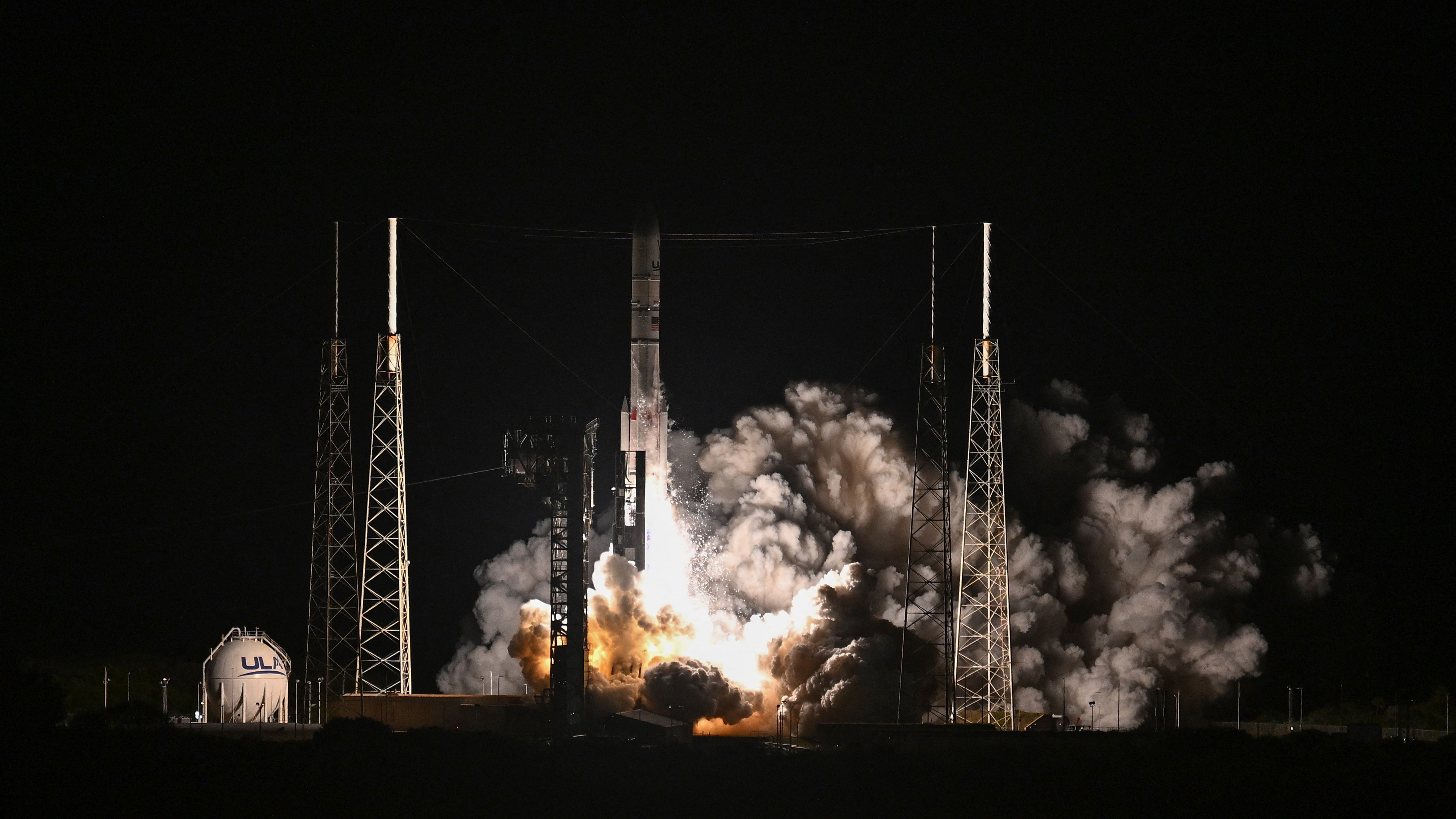
United Launch Alliance’s (ULA) Vulcan Centaur rocket lifts-off from Florida’s Cape Canaveral Space Force Station, Monday January 8th, 2024 at 07:18 UTC. Credit: CHANDAN KHANNA/AFP
On Monday January 8th, 2024 United Launch Alliance completed the maiden launch of their Vulcan Centaur rocket with complete success, silencing critics and demonstrating that the caution and most recent delays around the launch (outside of those coming from the payload side) were worth it.
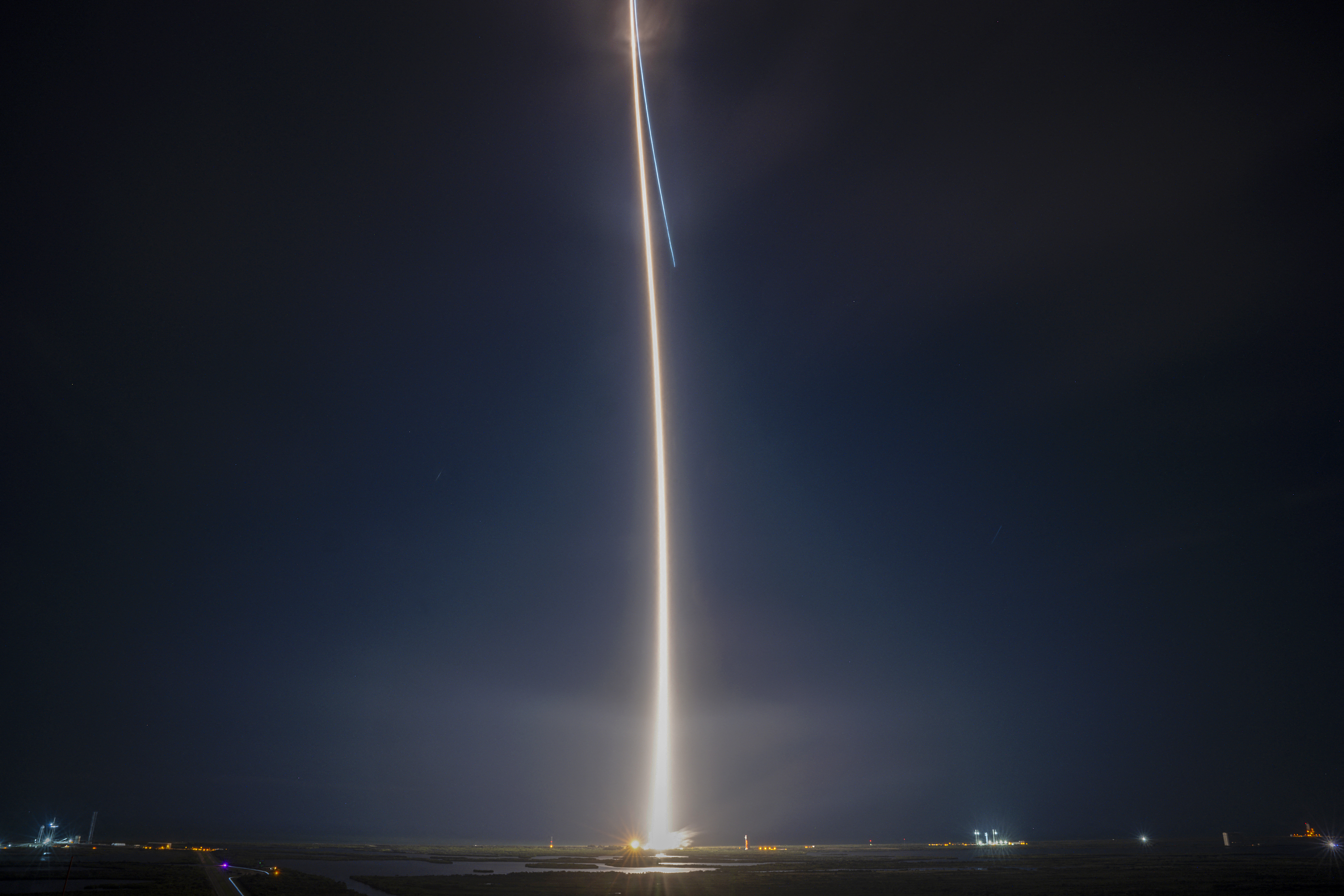
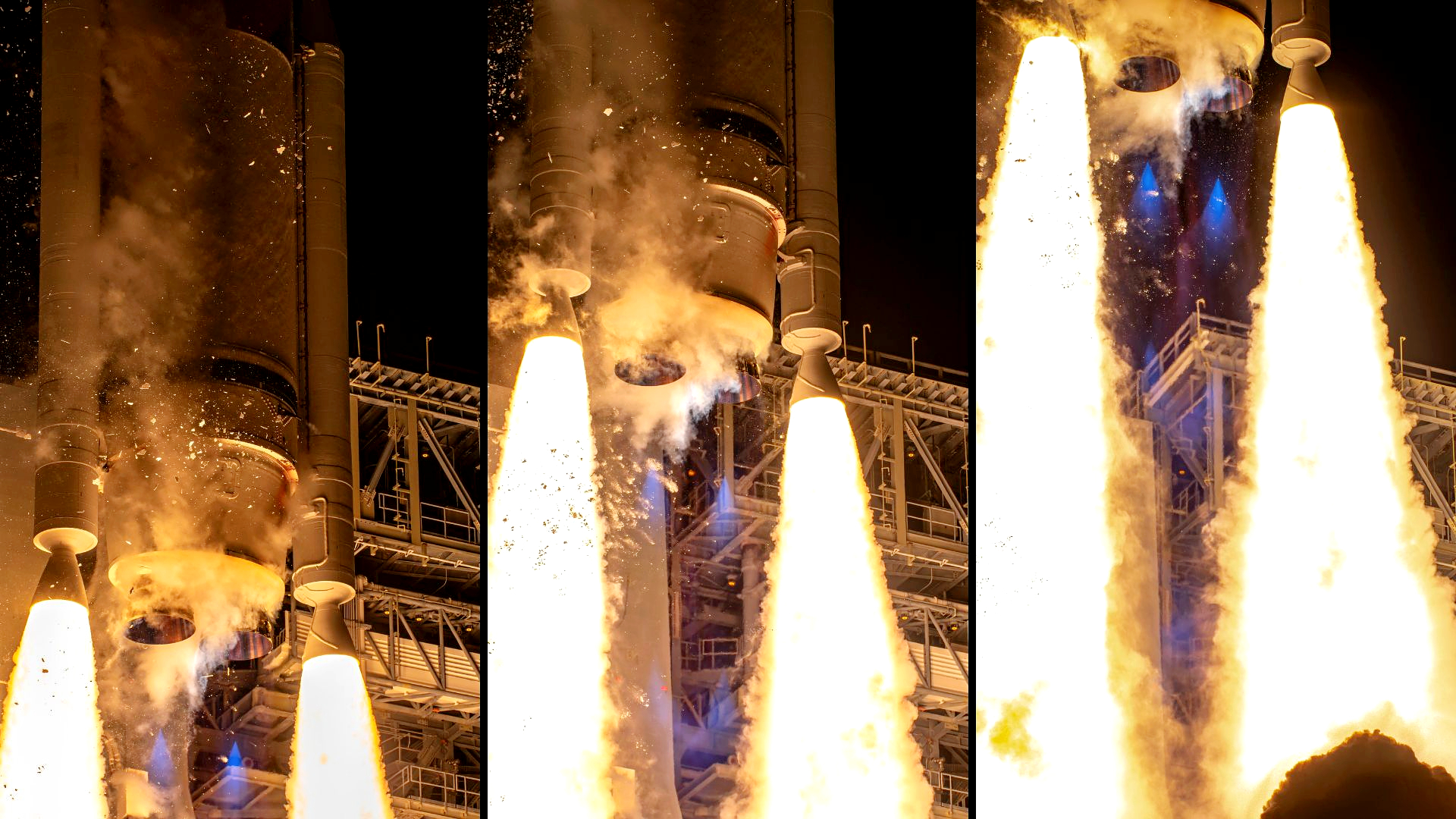
Lift-off came at 07:18 UTC as the two Blue Origin BE-4 motors of the 62-metre tall vehicle’s core stage ignited together with the two solid rocket boosters strapped on either side of it, lighting up the sky at Cape Canaveral Space Force station as the rocket climbed into a pitch-black sky. At 2 minutes into the flight, their job done, the solid rocket boosters shutdown and separated, leaving the rocket’s core to continue to power it upwards for a further three minutes before its liquid propellants were expended, and it separated to fall back into the Atlantic Ocean. The Centaur upper stage coasted for some 15 seconds before igniting it own pair of RL-10 motors in the first of three burns to place the vehicle and its payload into a trans-lunar injection (TLI) orbit and the first phase of what was hoped would be a looping trip to the lunar surface.
Lighting up the sky: a dramatic time-lapse image of the Vulcan Centaur rocket’s climb to orbit from Cape Canaveral Space Force Station. Credit: CHANDAN KHANNA/AFP
As I’ve previously noted, Vulcan Centaur is slated to replace ULA’s Atlas and Delta workhorses as a highly-capable, multi-mission mode payload launch vehicle in both the medium and heavy lift market places. Initially fully expendable, the vehicle may evolve into a semi-reusable form in the future, ULA having designed it such that the engine module of the core stage could in theory be recovered. It is also intended to become a human-rated launch vehicle. The Centaur upper stage is also designed with enhancement in mind, with ULA indicating that future variants might be capable of orbiting on an automated basis as space tugs or similar, once in orbit.
Whilst the vehicle carried a critical payload, the flight was actually regarded as a certification flight rather than an operational launch; one designed to gather critical performance and other data on the rocket which can be feed back into any improvements which might be required to make the vehicle even more efficient, etc.
A second certification flight is due to take place in April 2024, again with a critical payload – this one in the form of Sierra Space’s Dream Chaser cargo vehicle Tenacity, the first in a number of these fully reusable spacecraft which will help to keep the International Space Station (ISS) supplied with consumables and equipment, as well as helping in the removal of garbage from the station and the return of instruments and experiments to Earth.
Three incredible shots of the BE-4 engines and two strap-on boosters of ULA’s Vulcan Centaur, as the start to lift the vehicle away from the launch pad. Credit: Josh Dinner
While the launch of the Vulcan Centaur was a complete success – doing much too potentially boost ULA’s position as it seeks a buyer – the same cannot be said for its primary payload, which now looks set to make an unwanted return to Earth.
Peregrine Mission One (or simply Peregrine One), was to have been America’s first mission to land on the surface of the Moon since Apollo 17 in 1972. Financed in a large part via NASA’s Commercial Lunar Payload Services (CLPS) programme, this mission is nevertheless regarded as a private lunar mission, carrying some 20 experiments and instruments allowing it to operate in support of NASA’s broader lunar goals.
At first everything seemed to be going well with the mission. The lander rode the Vulcan Centaur to orbit before it powered-up its own flight systems and ‘phoned home to say it was in good shape. Then, some 50 minutes after launch, and the Centaur upper stage having completed its final burn to set the lander on its looping course to the Moon, Peregrine One separated from its carrier.
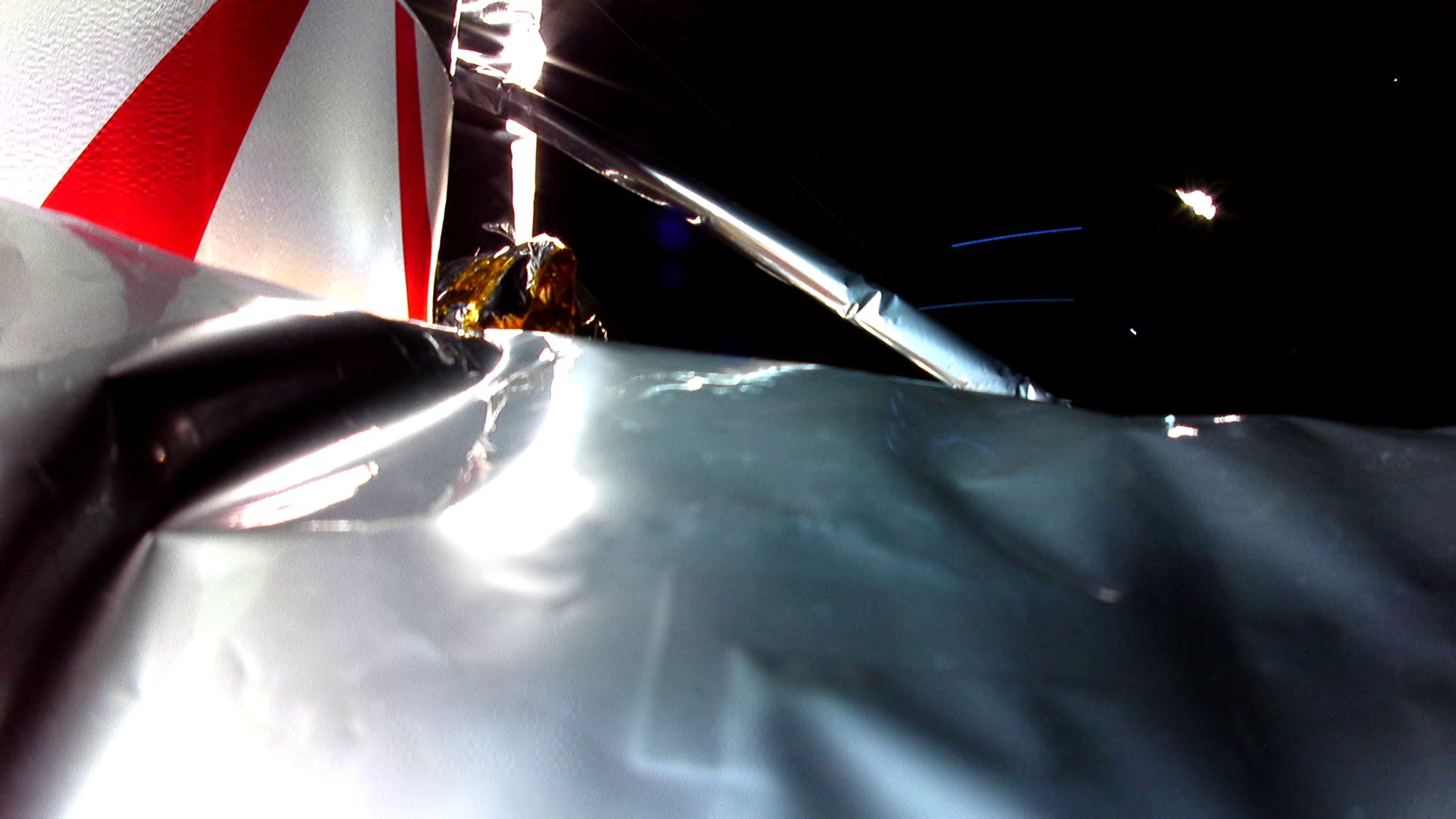
All appeared to go well in the hours immediately following separation, but following an attitude adjustment, telemetry started being received suggesting the craft was in difficulties and was unable to correctly orient itself. It was not initially clear what was wrong with the lander, and in an attempt to find out, Astrobotic – the company responsible for designing and building it – ordered camera mounted on the lander’s exterior to image its outer surfaces for signs of damage. The very first image returned showed an area of the craft’s insulation around the propulsion system – required to make the descent and soft-landing on the Moon – had suffered extensive damage, with propellants leaking into space from around it.
The first image returned from cameras on the Peregrine One lander revealed extensive damage to insulation material on the craft’s exterior and propellants venting into space. Credit: Astrobotic
This, coupled with the telemetry gathered from the lander caused Astrobotic to determine that one of the vehicle’s attitude control system (ACS) thrusters was still firing well beyond expected limits, most likely due to a failed / stuck valve, placing the vehicle in an uncontrollable tumble.
If the thrusters can continue to operate, we believe the spacecraft could continue in a stable sun-pointing state for approximately 40 hours, based on current fuel consumption. At this time, the goal is to get Peregrine as close to lunar distance as we can before it loses the ability to maintain its sun-pointing position and subsequently loses power.
– Astrobotic statement, Monday, January 8th
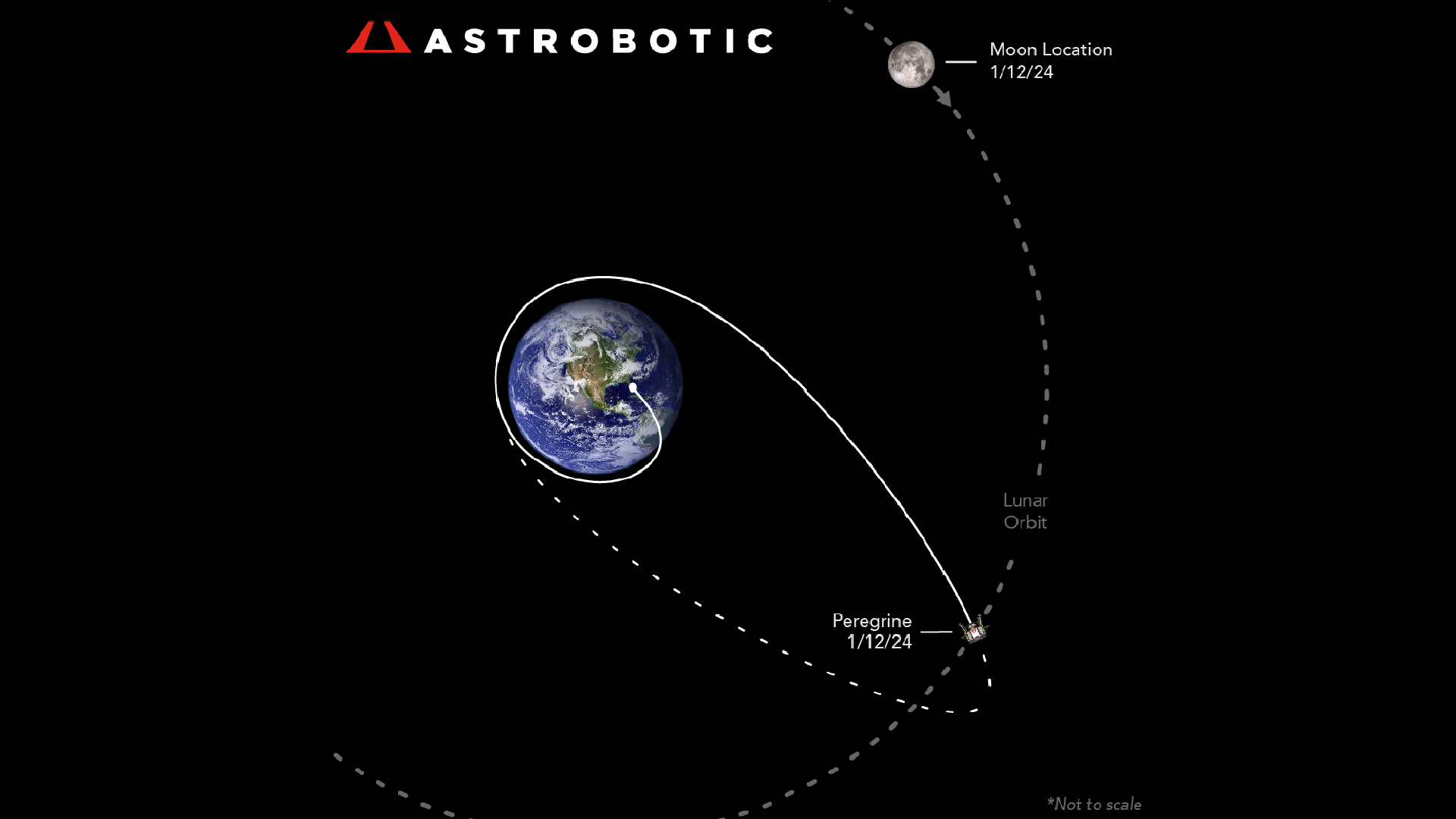
Initially, it had been hoped that the craft would still reach the Moon and make what is euphemistically called a “hard landing” (that is, crash into it) around the time of the planned landing date of February 23rd, engineers having calculated that by then, even if the rete of propellant loss slowed over several days and ceased, the craft would have insufficient reserves to make a controlled landing. However, by mid-week it was clear even this would not be the case; the leak had put Peregrine One on a much more direct path towards the Moon’s orbit than had been intended such that on January 12th, an status update from the company noted:
Peregrine remains operational about 238,000 miles from Earth, which means we have reached lunar distance! Unfortunately, the Moon is not where the spacecraft is now, as our original trajectory had us reaching this point 15 days after launch, when the Moon would have been at the same place.
– Astrobotic statement, Friday, January 12th
Peregrine One reached the distance of the Moon on Friday, January 12th, 2024 – much earlier than had been planned for the mission. As a result, the Moon was elsewhere in its orbit. Credit: Astrobotic
However, the one “good” piece of news through the week was that as time progressed, the propellant leak deceased, and some steps to help stabilise the vehicle – and maintain its orientation to the Sun such that its solar arrays could continue to received energy and power the vehicle’s systems – could be taken. These in turn allowed a number of the experiments on the lander to be powered-up. While they are not operating in their intended modes (or location), it is hoped that they will still be able to gather data on the radiation environment in interplanetary space around the Earth and the Moon.
The most recent projections from Astrobotic (January 14th) suggest that as the Lander has in sufficient velocity to complete escape Earth’s gravity well, it will likely start to “fall back” to Earth in the coming weeks, and orbital mechanics being what they area, most probably slam into the upper atmosphere and burn-up.
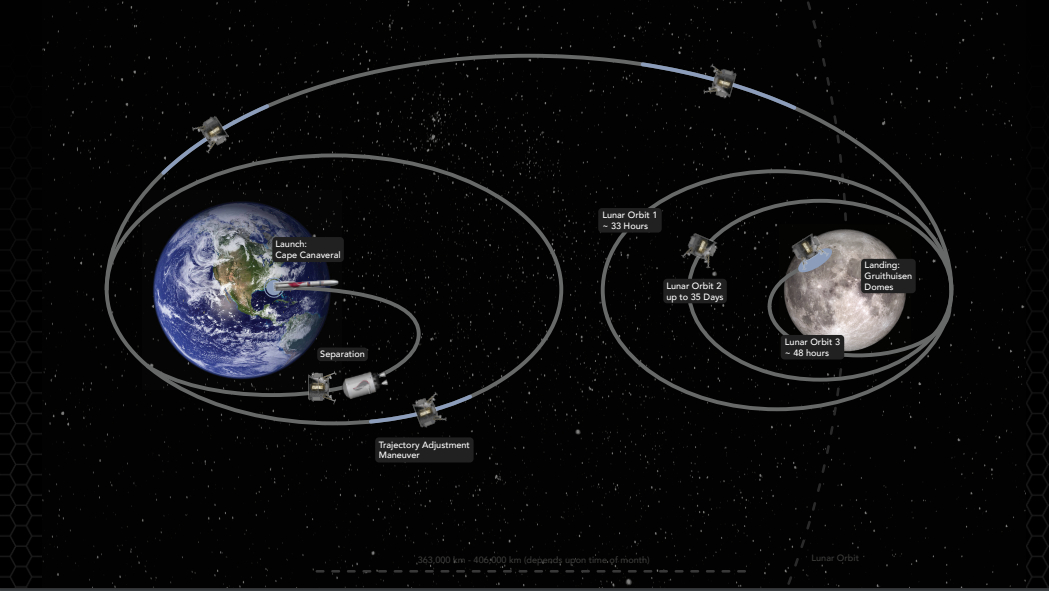
As it should have been: the intended flight place to get Peregrine One to the Moon. Credit: Astrobotic
Given Peregrine One’s involvement in the CLPS programme, NASA has been monitoring the Peregrine One situation closely, and on January 18th the agency and Astrobotic are due to convene a telecon in order to review Astrobotic’s efforts to recover the craft and what they have learned. In the meantime, agency officials have noted that the failure of Peregrine One to successfully achieve a lunar landing will not in any way impact CLPS.
Artemis 2 and 3 Slip
On January 9th, 2024, NASA announced America’s return to the Moon with crewed missions at the head of Project Artemis is to be further delayed.
In the announcement, made in part by NASA Administrator Bill Nelson, it was indicated that the upcoming Artemis 2 mission around the Moon and back, and intended to take place in November 2024, will now not take place before September 2025. Meanwhile, the first US crewed mission to the surface of the Moon will now occur no sooner than September 2026.
The reasons given for the delays relate most directly to Artemis 2. In particular, there are a number of new systems and capabilities in development as a part of the overall Artemis programme which are now far enough along that it makes sense to delay Artemis 2 to leverage them, as they offer increased safety at the pad and prior to launch – such as improved means for crew egress from the launch vehicle in an emergency, and faster propellant loading capabilities.
The overall plan for the Artemis 2 flight around the Moon, which will carry fours astronauts – three from the USA and one from Canada -, but which now not take place before September 2025. Credit: NASA
Another cause for the delay is on-going concerns about the performance of the ablative heat shield on the Orion Multi-Purpose Crew Vehicle (MCPV). Whiles the shield did its job and protected the unscrewed capsule of Artemis 1 during its passage back into the Earth’s atmosphere at the end of that mission in November 2022, it still showed signs that rather than charring in place, some of the material actually peeled away from the vehicle as it charred, which is not supposed to happen.
Finally, concerns have recently been raised about the electrical system managing the crew abort system rockets, designed to haul the Orion capsule and its crew clear of the SLS rocket if the latter suffers a serious failure during the initial ascent to orbit. As a result, further tests have been requested on that system.
I want to emphasize that safety is our number one priority. And as we prepare to send our friends and colleagues on this mission, we’re committed to launching as safely as possible. And we will launch, when we’re ready.
– Jim Free, NASA’s Associate Administrator
The announcement was, oddly, seen as a cause for vindication among some SpaceX fans – the private launch company has been cited as a potential reason for delaying the Artemis 3 programme, given they are still a long way from demonstrating they have the ability to supply NASA with an operational lunar landing vehicle and the means to get it to lunar orbit.
However, even the addition of a further 11 months to the Artemis schedule still leaves SpaceX with precious little time to achieve those goals in a manner which meets NASA’s safety requirements. As such, the concerns about SpaceX being able to meet current Artemis time faces, as highlighted (again) in 2023 by the US Government Accountability Office (which has an uncannily accurate eye for predicting programme slippages and their causes) still remain valid.
Kondor Art Square, January 2024: Mareea Farrasco – Obscured by Clouds
Obscured by Clouds is one of the more uncommon (and perhaps underrated) of Pink Floyd’s studio albums. Released in 1972, it features much shorter individual tracks than found on other albums – particularly Dark Side of the Moon, the recording of which was paused in order to make way for Obscured by Clouds – with the lyrics focused on life and love. It was written and produced as the soundtrack for the 1972 French film La Vallee (also known as Obscured by Clouds), the story of an accidental voyage of self-discovery embarked upon by a young woman.
I mention this because it might help illuminate why Mareea Farrasco selected the title Obscured by Clouds for her latest collection of art. This opened to visitors on January 11th, 2024 within the Art Square at the Kondor Art Centre, operated and curated by Hermes Kondor. Like the film, Mareea’s exhibition is something of a voyage of introspection, each image a short refrain – or perhaps stanza or verse might be a better description – on life in modern times.
Kondor Art Square, January 2024: Mareea Farrasco – Obscured by Clouds
As Mareea herself notes, we are living in a world of confusion; a place where the norms of social discourse are being torn asunder; where people’s right to think for themselves, to hold views of their own is disintegrating under the demands to conform in some manner – be it religious or a simple matter of skin colour, or something else; a place in which decency, humanity, caring and concern for social equality is more and more sneered upon and disparagingly labelled whilst coarseness, violence are lauded. It is a world of distorted realities, where it is all too easy to lose sight of simple truths – and even of oneself -, at a loss as to who we are and where we are trying to go.
All of this is hauntingly and beautifully reflected in Mareea’s images. Each one forms a single-frame statement on these confusions and distortions and our need to if not confront them, at least have the wherewithal to move through and beyond them and try to regain what has become obscured before we lose it entirely.
Kondor Art Square, January 2024: Mareea Farrasco – Obscured by Clouds
Collectively, the use of post-process clouding and misting effects adds a depth of feeling to them, evoking that idea of trying to pierce the confusion and find reality – and provocative in their message. These are each images which deserve not so much to be seen but to be contemplated; viewed both through the lens of the world today, and as a lens through which we might better see that same world and understand how we might both escape it and – more importantly – seek to rebalance it; to rediscover the really important things in life and discover who we are as individuals and – perhaps – as a race.
Saturday, January 13th will see the 2024 edition of Hippiestock take place in Second Life. A day-long music event, Hippiestock was established in 2011 by Hippie Bowman as a way to for him connect directly with friends he’d made through the Second Life forums.
Whilst intended as a “one-off”, such was the response to that first event in 2011, the Hippie agreed to consider making it an annual event -and 13 years later, we once again have the opportunity to come together with fun and music and to embrace the “hippie philosophy”, once described by Hippie himself as:
[A belief] in peace as the way to resolve differences among peoples, ideologies and religions. The way to peace is through love and tolerance. Loving means accepting others as they are, giving them freedom to express themselves and not judging them based on appearances. This is the core of the hippie philosophy.
– Hippie Bowman, January 2011
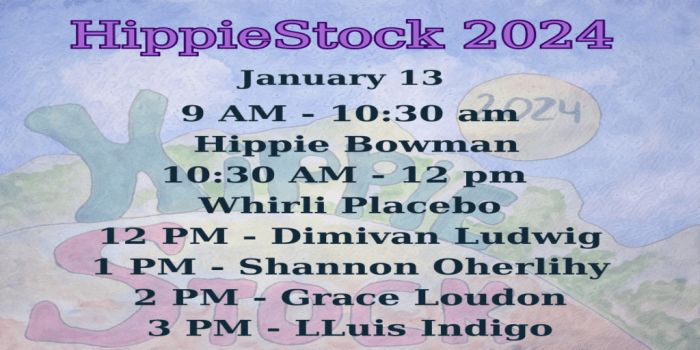
The event kicks-off at 09:00 SLT on Saturday January 13th, with the music line-up as follows:
The Hippiestock 2024 line-up
The venue has been designed to resemble the original Woodstock main stage, with a campground on the hills above it and a exhibition of art in keeping with the 1960s theme and presented by Ceakay Ballyhoo, who is also responsible for the overall build for the event.
So for some great music and the chance to peace out for the day, why not slip into something suitably flowing and emblematic of the period, put some flowers in your hair and join the fun?
Second Life History at the Primitive Museum campus
When it comes to the history of Second Life, there are many who may claim to hold some of the facts and figures and legends and tales. However, were the truth to be told, there is really only one person who has spent years carefully building what is perhaps the most complete history of Second Life’s long and growing history, and then synthesising it down in a manner that can be easily digested and appreciated: Sniper Siemens.
For the last decade (or more!) Sniper has been gathering, compiling and curating information representing as much of Second Life’s history as possible. Since 2014, this information has been displayed by Sniper in a series of installation at events and venues across the grid. I personally first encountered it that year, when it was hosted by the Linden Endowment for the Arts (LEA), and have also covered several iterations of the History since then over the years. So when Sniper IM’d me to tell me the History has a new (and hopefully permanent!) home, I knew I’d have to make sure it went to the top of my list of places to visit!
Second Life History, ground floor
This new home is on land graciously provided to Sniper by Xerses Goff , creator and curator of the Primitive Museum, of which the History now forms a part, sitting as it does within the campus alongside the Learning Lighthouse (itself part of SL’s history although currently being refurbished by Xerses) and just across the water from the original Primitive Museum (with the two connected by shuttle pod). In fact, the campus is an ideal location for the History, being located in Sansara’s historic Old World regions, and the hub of a developing educational project Xerses is bringing together.
For those unfamiliar with the Old World, it is the name given to what are many of SL’s earliest / original regions, including Da Boom. Also to be found within it are Rosedale, Kapor (for Mitch Kapor, the founding investor in Linden Lab), Omidyar with its eye-in-hand craved onto the seabed, and more besides. Similarly, a number of historic and important centres are also awaiting discovery / visit here – such as the Ivory Tower of Primitives, where many first learned (and continue to learn) the magical pleasure of shaping and trimming prims and then gluing them together.
Second Life History: the Beta Test monument
The History actually starts outside its main building, where a small garden acts as the landing point. Here can be found a number of artefacts, together with introductory boards easing visitors through the doors of the main building. It is flanked on one side by the dock where shuttles across the water can be obtained, and on the other by a large plaza presenting images, information and landmark givers for some of the historic locations around SL which remain available to this day for visits by the interested / curious.
Within the garden, Sniper offers a dip into a little of SL lore, providing the story behind the platform’s association with hippos. More lore (some of it perhaps known by many, perhaps new to others) can be found just inside the main building’s entrance, where boards provide short histories behind terms such as Land Baron, Prim Hogging and more, whilst revealing the history of Linden Bears and why those who have been in Second Life a very long time might still be awaiting receipt of their mule (does a pony really compensate?), the origins on Linden Bears and more.
Second Life History: the platform’s foray into streaming via OnLive’s SL Go
From the entrance, the history unfolds year-by-year as visitors travel around the building’s halls, with information imparted via written boards supported by images and interactive elements (be sure to mouse-over the different displays to see which might be clickable!). And in case you’re a veteran of past iterations of the History and so are tempted to hurry through the “early years” because you’ve seen it before – don’t! There are elements and information which are new to the History, and again the result of Sniper’s tireless investigations and research.
In all, the ground level of the History takes you from 1999 and The Rig, through LindenWorld to Second Life as it was in mid-2009. A teleport at the end of the level’s walk carry visitors up to the next floor, where 2009 continues before passing on to 2010 and the years through to 2021. Above this, 2022 and 2023 await, with the rest of the floor ready to be populated as 2024 unfolds.
Second Life History: the Burning Life / Burn 2 rooftop terrace
Throughout all of it, Sniper presents a rich and engaging mix of SL’s history, covering technical developments and innovations (server updates, viewer changes, capabilities from mesh to PBR, etc.,), through to many more of the legends and general history of the platform, together with looks at the (sometimes confrontational) relationship between residents and Lab; recalls some of those most notable for their impact on Second Life – Linden Lab personnel and residents alike; and remembers various notable communities and events. Each display area is carefully separated from its neighbours, allowing each to be focused upon without distraction, while the use of visual media is exceptionally well-considered and balanced throughout.
As well as the history of Second Life, the History building also presents a celebration of the Burning Life / Burn 2 celebrations held in-world in reflection of the annual Burning Man event held in the western United States – just take the teleport from the upper level of the History to the rooftop terrace to tour it. Plus, for those seeking more Second Life history, there is the Primitive Museum Teleport Trail, a trip through 25+ historical places across Second Life. Just look for the historic landmark sign to the front right of the History building, between it and the Learning Lighthouse.
Second Life History: marking the introduction of Senra in 2023
For history enthusiasts and / or those curious about the platform in which we spend so much of our time and how it got to be what it is, Second Life History is an invaluable visit / resource. Kudos to Sniper for the many years spent gathering and curating the information it contains, and thanks to Xerses for providing the land on which it can be hosted.
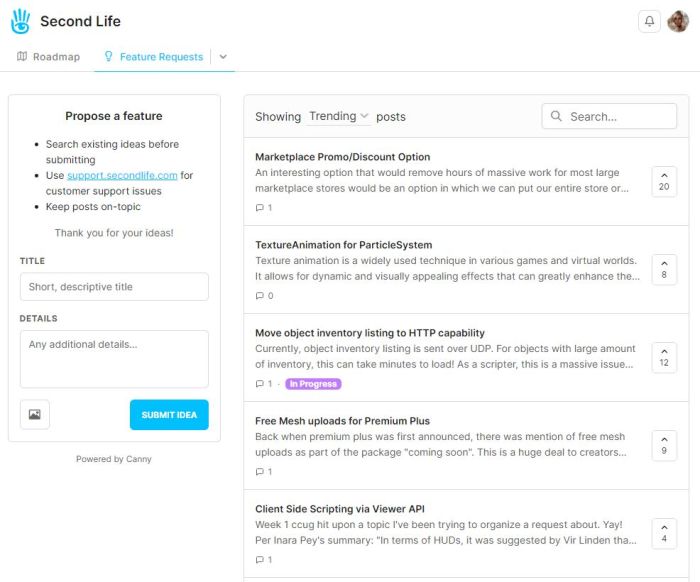
As I noted in my January 9th Simulator User Group notes, Linden Lab is in the process of moving Second Life away from using Atlassian’s Jira for bug reporting / tracking and filing feature requests, and on January 12th, this was confirmed in the first of a series of official blog posts on the transition.
The decision to move away from Jira is due to Atlassian changing their licensing model; traditionally, Linden Lab has been able to offer Jira on an unlimited basis to all SL users, leveraging the Atlassian Jira Server licence. That licence is being discontinued by Atlassian, making it fiscally impossible for Linden Lab to pay the licence fees associated with its many thousands of individual users who regularly access Jira. Therefore, a move to an alternate platform or platforms is required.
This being the case, going forward Jira will be replaced by what has been called a two-pronged approach to issue reporting and feature requests:
Github will form the new back-end for tracking and managing issues and requests (and is already being used for this purpose by LL), with all current Jira issues being migrated to it. In addition, technical users (such as TPV viewer developers, open-source contributors, etc.) who have accounts with Github, will be able to file ticket through it as well.
More generally, a new front-end feedback portal has been created for filing bug reports and feature requests by users at large.
Second Life Feedback Portal – current bug report form (l) and list of current bugs with search filters (top)
The latter is powered by Canny customer feedback software and tools. It was selected for a number of reasons, as the Lab note in their official blog post, not the least of which is the fact that Canny offers integration with Github, allowing requests and issues raised within it to be imported into the Github repositories (removing the need for cloning issues as is currently the case with Jira), combined with an improved set of triage tools. Other advantages with Canny are given as:
The ability to log-into the Canny tracking system via a user’s Second Life log-in credentials (as is the case with Jira now), thus maintaining its convenience of access / use.
Simpler forms for bug reports and feature requests, which may encourage more users to file issues / ideas.
Clearer navigation for non-technical users, making finding issues, etc., easier.
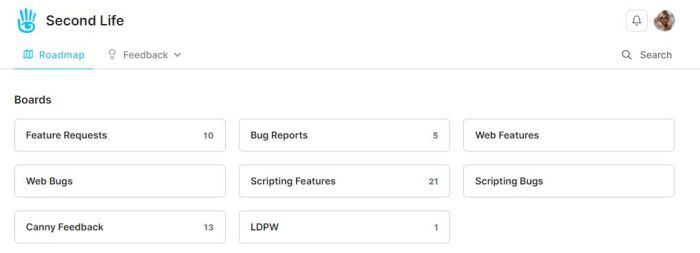
The use of multiple Boards to help categorise submissions and information.
Canny boards make navigation to specific subject areas – bug reports, feature requests, et. – easier
The ability to view a roadmap of activities and priorities.
Other advantages as noted by the Lab can be found in the official blog post.
The system has been undergoing testing, which has involved selected users, and feedback on it has been provided – although not all of it is particularly favourable. Some of the issued raised (such as the lack of file format options for attachments with only jpg, png, gif and webp supported) are understandable, particularly given these are unlikely to change in the near-future (if at all); others might simply be the result of a natural reluctance to enforced change. In this respect, the Lab is at pains to note that Canny is not a one-to-one replacement for Jira, and will require changes to established behaviours; how people adapt to this in practice is only something time will demonstrate.
Second Life Feedback Portal – current feature request form (l) and list of open requests with search filters (top)
The switch-over to Canny / Github will now be rapid (by SL standards). The new Jira licensing is due to come into force in March 2024, and so the Lab has published the following timeframe for the transition away from it:
December 2023: generate a full archive of Jira and maintain until shutdown.
December 2023 / January 2024: migrate Jira reports to Github repositories. Soft launch of Canny and accept tickets via both Canny and Jira.
February 2024: provide information on accessing the Jira archive; shutdown Jira access and complete switch to Canny / Github.
Finally, as noted in the official blog post – these changes do not impact general Support / personal issues. These should still be reported to support.secondlife.com.
For my part, I have previously – with the Lab’s help – provided tutorials on filing both bug reports and feature requests. The not As the Canny front-end for filing either is considerably more straight-froward to use (and / or may be further enhanced based on user feedback), I will a) be disabling access to the Jira tutorials on this blog from mid-February; b) may provide a tutorial on using Canny, if this is found to be worthwhile.