Space Sunday: launches and landings

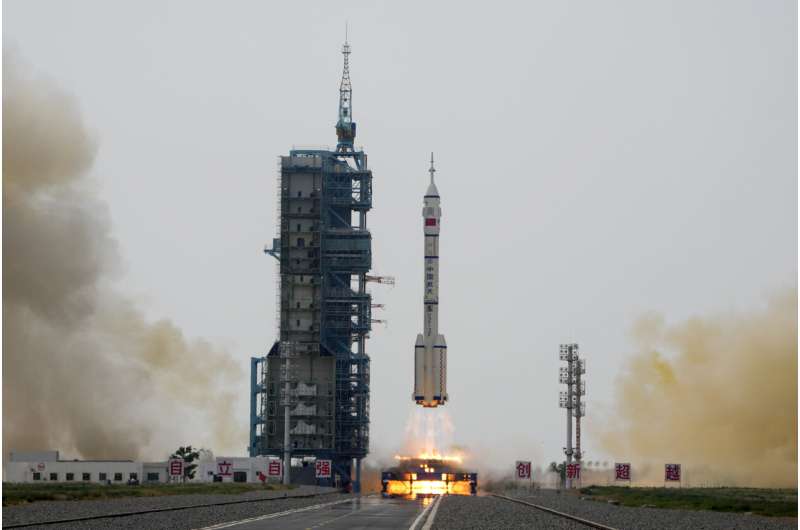
Shenzhou 16 lifts-off from the Jiuquan Satellite Launch Centre, May 30th, 2023. Credit: CGTN

Rotating crews to / from a space station is so routine here in the west that the comings and going of crews at the International Space Station (ISS) rarely gain much of a mention unless something extraordinary happens, or they happen to be entirely privately-funded, as with the Axiom Space Ax-2 mission (of which more below).

Not so for the Chinese, however, who are still adjusting to life with an orbital outpost that is meant to remain under permanent occupation and also provide a stepping stone towards the Moon. What’s more, they are gradually become more public about things as they continue to rake up successes.

Following the completion of “construction” of the major elements of the Tiangong space station with the docking of the second science module in November 2022, the Shenzhou 15 crew, comprising taikonauts Fei Junlong, Deng Qingming and Zhang Lu have been at work commissioning the module and carrying out further work in preparing the station for full-time operations, building on the work of the Shenzhou 14 crew, as well as performing a full science programme.
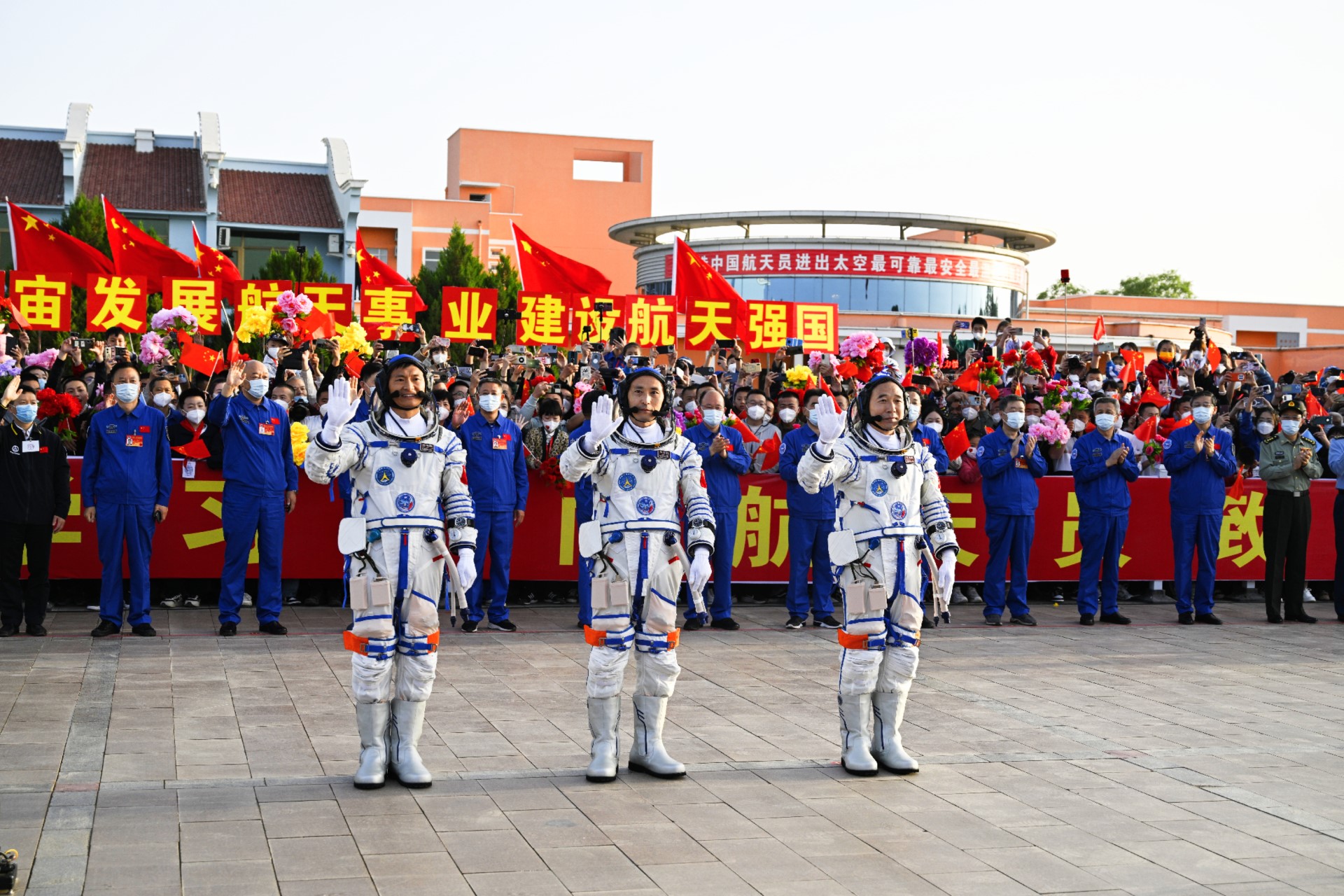
Chinese astronauts Gui Haichao (left), Zhu Yangzhu (center) and Jing Haipeng of the Shenzhou 16 space mission attend a see-off ceremony at the Jiuquan Satellite Launch Center on May 30, 2023 in Jiuquan, Gansu Province of China. Credit: VCG/VCG via Getty Images

On May 30th, they were joined by the crew of Shenzhou 16, who performed a “fast burn” flight to rendezvous and dock with Tiangong just seven hours after their launch from the Jiuquan Satellite Launch Centre in the Gobi Desert. This crew has garnered a lot of attention both nationally and internationally, as it includes China’s first non-military tiakonaut to fly in space: professor Gui Haichao, an aerospace researcher who has studied and taught in China and Canada.

The entire launch was covered live on Chinese national television, as was the rendezvous and docking, summarised for new broadcasts and viewing in the west in videos like the one below.

Gui is joined on the mission by commander Major General Jing Haipeng of the People’s Liberation Army Air Force (PLAAF), and rookie taikonaut Colonel Zhu Yangzhu of the People’s Liberation Army. Scheduled for a duration of 180 days, the mission will see Jing become China’s most experienced taikonaut, with four missions under his belt and clocking up over 225 days (cumulative) in orbit.

Following docking, the Shenzhou 16 crew remained with the three men of Shenzhou 15 Through until the weekend, when the Shenzhou 15 crew departed the space station late on Saturday, June 3rd (Beijing time), to commence a 9-hour return to Earth, where they touched down at the Dongfeng landing site within North China’s Inner Mongolia autonomous region at 06:33 on Sunday, June 4th (Beijing time – (22:33 UTC on June 3rd).

The landing was also covered in detail by the Chinese media, and as with the Russian approach to crew returning from long duration orbital flights, the three men were not allowed to spend time standing or moving under their own power; instead they were helped out of their craft and into waiting chairs, where they were interviewed by a China Central Television (CCTV) crew in a live broadcast. This focused on Senior Colonel Deng Qingming, quite possibly one of the longest-serving astronauts-in-waiting in the world prior to lifting-off on this mission, having been in the PLA taikonaut corps for 26 years! He is actually the last of China’s “first generation” intake of astronauts to fly into space, and his perseverance has made him an icon on the PLA space corps.

In between Shenzhou 16 lifting-off for Tiangong and Shenzhoou 15 returning, the crew of Axiom AX-2 also wrapped up their stay at the International Space Station and returned to Earth.

As the name indicates, this was that second Axiom Space crewed mission to the ISS, carried out as part of the company’s progress towards running its own space station, and delivered a crew of four astronauts to the ISS for a period of eight days. Aboard were former astronaut Peggy Whiston as mission commander, John Shoffner, an aviator and entrepreneur, Ali AlQarni, a captain in the Royal Saudi Air Force and Rayyanah Barnawi, and Saudi biomedial researcher and the first Saudi woman to fly in space.

The Axiom AX-2 crew (l-to-right): Peggy Whitson, John Shoffner, Ali AlQarni, and Rayyanah Barnawi

The mission lifted-off from Kennedy Space Centre atop a Falcon 9 rocket on May 21st, 2023, and the Crew Dragon Freedom docked with the Harmony module of the ISS a day later. During their time on the station, the crew performed public outreach activities along with scientific research, including studies into the effects of microgravity on stem cells and other biological experiments which had been agreed with the Saudi Space Commission as part of the deal to fly the two Saudi nationals on the mission.

For Whitson, it was a fourth opportunity to fly in space and add to an already impressive record: in her first mission, she spent an extended mission on the ISS, in her second she became the first woman to command the ISS (and later became the first women to complete two tours on the ISS as mission commander), she has completed the most EVAs (spacewalks) thus far for a woman, having spent a total of 60 hours and 21 minutes outside of the ISS performing various tasks; she has spent a total of 675 days in space during her career and remains the oldest woman to orbit the Earth. She was also the first woman to become NASA’s Chief Astronaut, the most senior position in the NASA Astronaut Corps.

For the rest of the crew, it was the opportunity to experience space for the first time, and for Axiom Space, a further opportunity to study managing orbital operations and research endeavours of the kind they hope to both manage and host on their own space station. The latter is due to start life as modules attached to the ISS (and referred to as the Axiom Orbital Segment) in the late 2020s, before becoming an independent orbital facility when the ISS is decommissioned at the start of the 2030s.

On May 30th, 2023, the crew re-boarded Freedom and departed the ISS, splashing down successfully in the Gulf of Mexico off the coast of Panama City, Florida in the early hours of May 31st, local time, where it was recovered by the SpaceX recovery ship Megan.

Spaceport Company Performs At-Sea Launches

Landing returning crewed spacecraft on the world’s seas – as with the AX-2 mission – has long been a thing for the United States. However, it has also been the dream of some to use the oceans as a means of launching vehicles into orbit – perhaps most famously (thanks to it being referenced in the Apple TV series For All Mankind), the simply gargantuan Sea Dragon. Planned in the 1960s but never built, this behemoth was designed to lift 550 tonnes of cargo to orbit – and to start its journey by floating in open waters off the US coast.

Obviously, Sea Dragon never came to be, but in 1999, a multi-national corporation – Sea Launch – commenced payload launches from the deck of a modified oil rig – the Odyssey, operating in the Pacific Ocean close to the equator – using a specialised version of the Russian Zenit-3SL. The company carried out a total of 36 such launches from 1999 through 2014, when Russia’s first military incursion into Ukraine (which ultimately brought an end to the company), suffering only four failures.

A sounding rocket is launched from a proof-of-concept “liftboat” developed by the Spaceport Company as part of their efforts to develop a US offshore launch platform capability. Credit: The Spaceport Company

Now a US company – the appropriately-named The Spaceport Company – has hosted four sounding rocket launches with the support of Evolution Space, from a platform in the Gulf of Mexico. The launches were the latest step of a proof-of-concept study the company is carrying out into the feasibility of conducting payload-to-orbit flights from mobile platforms operating off the US coast.

In particular, the company stated the operation – performed on May 22nd – was intended to exercise the procedures -including getting approvals from the Federal Aviation Administration and U.S. Coast Guard, clearing airspace and waters to allow for a safe launch  – before any actual rocket launch from the platform.

The company plans to plans to use the platforms – called liftboats – which can sail / be towed to a designated location before temporarily anchoring itself to the sea bed by means of four legs which can be extended down into the water to a depth of up to 50 metres, and also left the platform clear of the water. A second platform then acts as the launch control centre, freeing launches from the need of any land-based infrastructure, outside of a docking and servicing facility with the means to accept launch vehicles and move them onto the launch platform safely.

These platforms will be capable of being deployed almost anywhere of the US coast, although the company particularly hopes to leverage the increasing demand for launches out of both the Cape Canaveral Space Force Station and Kennedy Space Centre. presenting companies operating smaller rocket systems with a viable off-shore alternative.

Both The Spaceport company and Evolution Space (who providing the rocket systems for the May 22nd launches) kept quiet about the event itself, only releasing a post-launch briefing on the launches 24 hours after they had taken place.  Further test flights on the platform are expected over the course of the nest two years, and the company is targeting 2025 for its first full-scale, fully commercial payload launch.
Continue reading “Space Sunday: launches and landings”

The history of computing in Second Life

Museum of Computing History, June 2023

As a part of my on-going (and occasional) visits to museums in Second Life, I recently had the opportunity to drop in on the quite excellent Museum of Computing History, managed and curated by Brian Aviator, with the assistance of Timothy McGregor and Kevin Jackman.

Tucked neatly under Brian’s Blackslough Field Regional Airport and overlooking the inland seas and waterways of Sansara, this is one of two museums Brain operates / curates in Second Life, the other being the LGBTQ History Museum and Cultural Centre (also due to appear in these pages later this month, and which is – at the time of writing – featured as an Editor’s Pick in the Destination Guide in recognition of Pride Month).

Museum of Computing History, June 2023

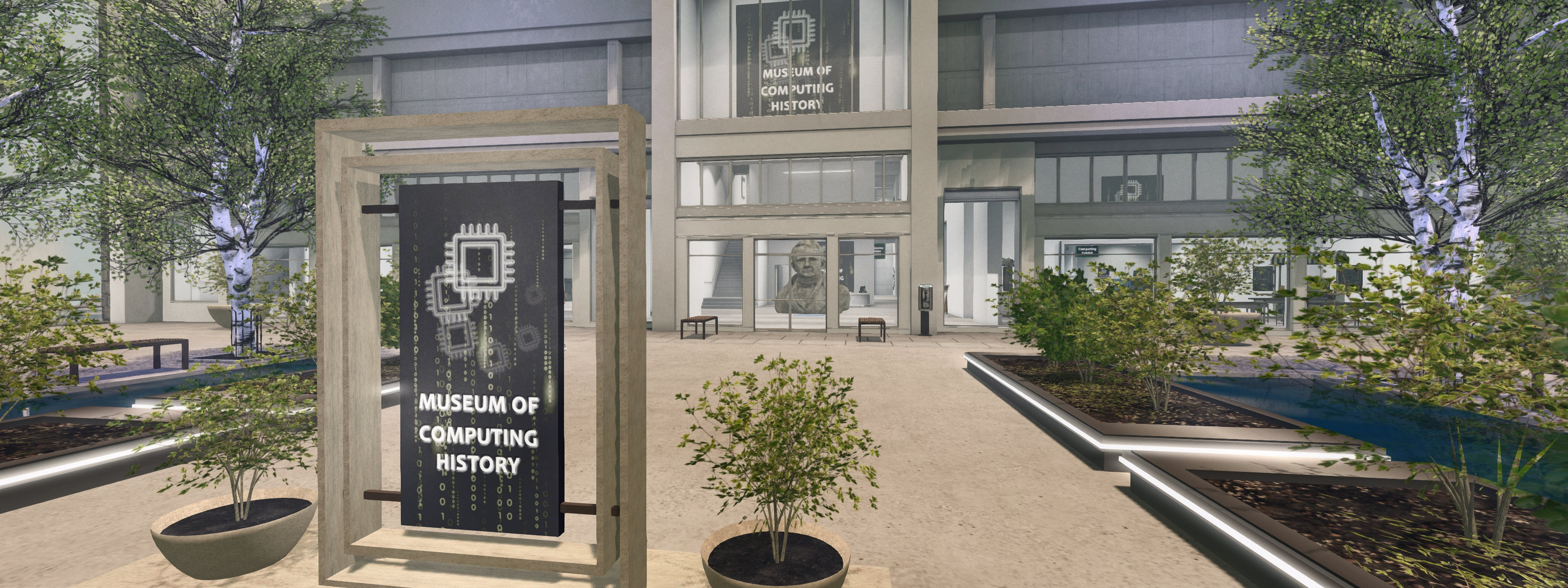
Extending over two floors, and with an ample, well-tended forecourt / terrace public space before it, the museum offers an impressively comprehensive dive in to the history of computing, from the abacus to the blade server and the rise of AI, featuring not just the technology and technological innovations, but many of the the individuals who have contributed to the development of computers, computational engineering and computer science down through the centuries and decades.

From the entrance foyer, dominated by a bust of Charles Babbage, the lower level of the museum comprises the Admiral Grace Hopper auditorium and four exhibition halls in which may be home to static exhibitions, and others have their displays rotated over time as new exhibits are developed (as is the case on the museum’s upper floor). At the time of my visit, the exhibits in these lower halls comprised:

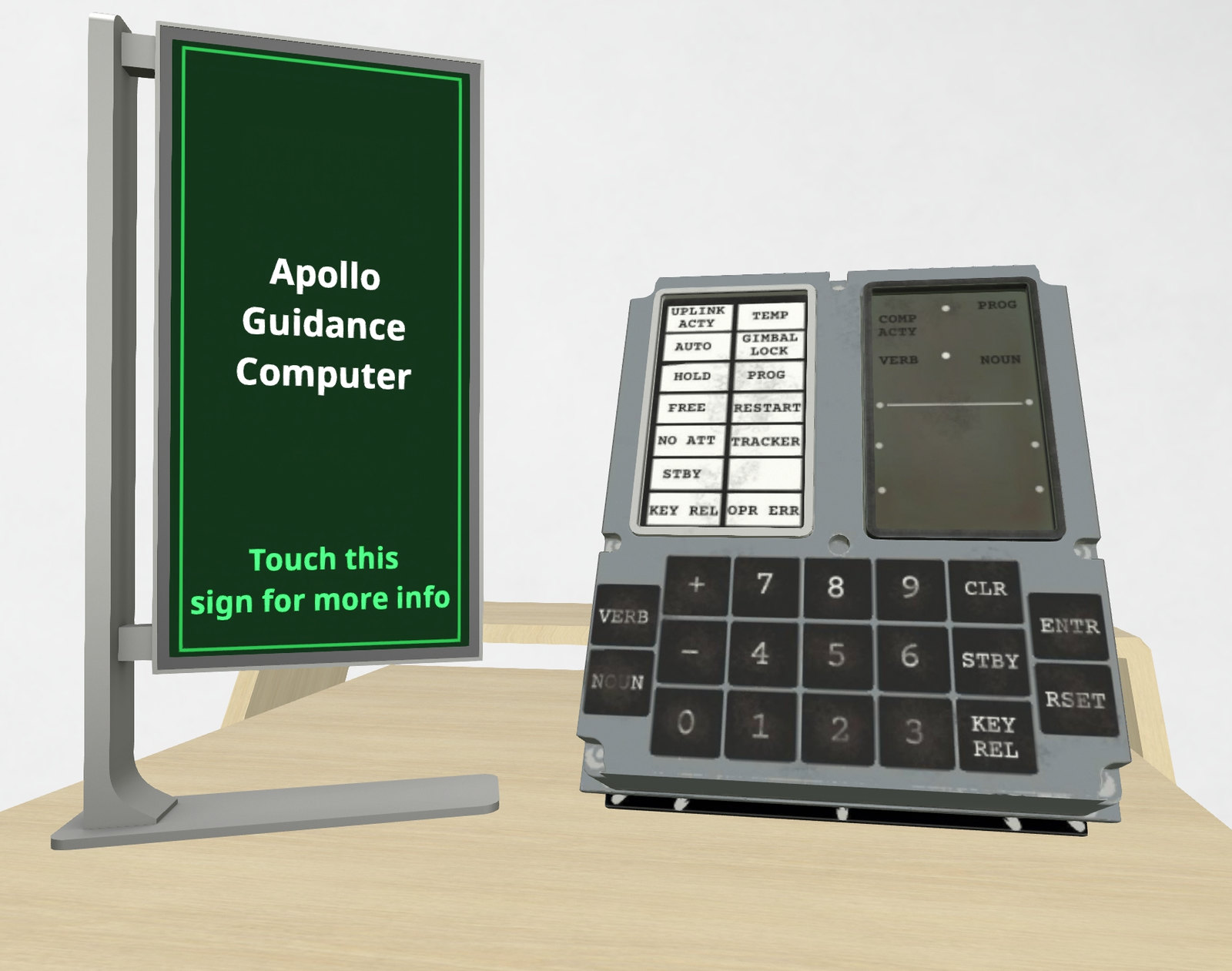
  • Museum of Computing History, June 2023. Made famous during the Apollo 11 landing mission, July 20th, 1969

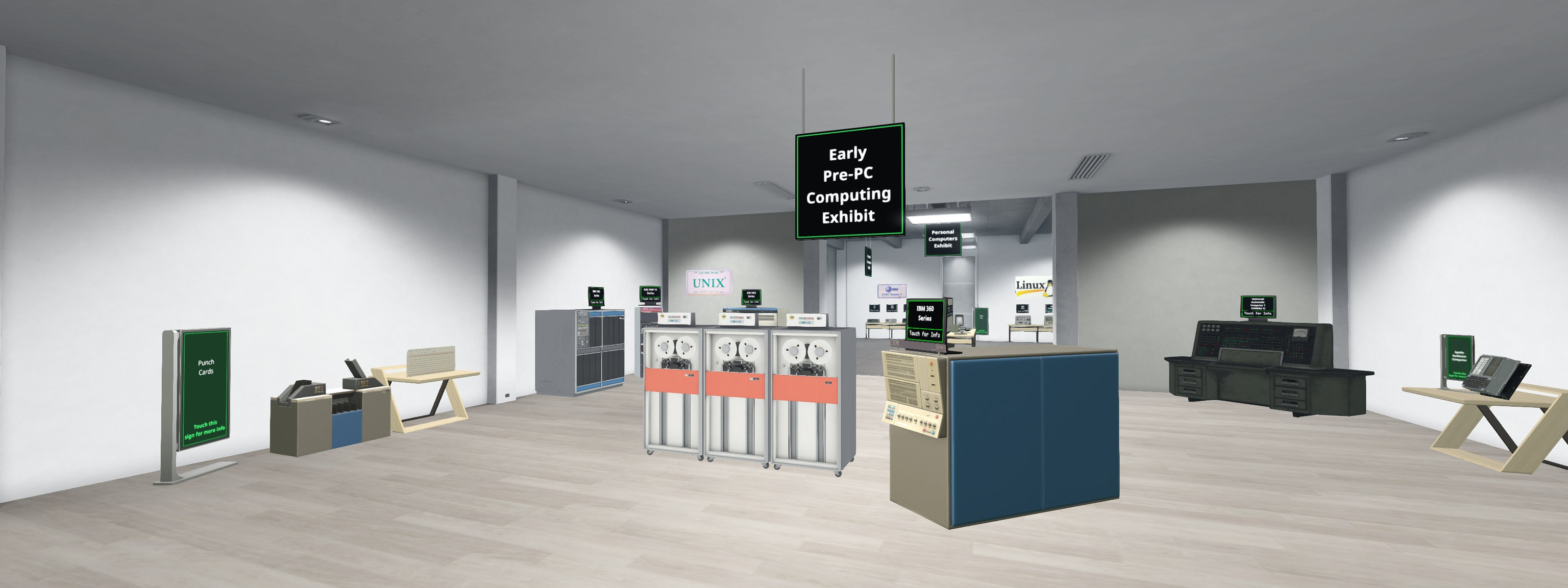
    Early Pre-PC Computing, which includes one of the earliest computational machines known to Man (the abacus), alongside models of Babbage’s Difference Engine; the electro-mechanical devices which played major roles in the European theatre of World War II – the German Enigma code setting machine and the Polish-British code breaking Bombe; the machines from the early decades of the modern computer era:  punch-card and tape-driven monsters, and even a look at one of the first computers to be used extensively “off-world”: the Apollo Guidance Computer (thanks to Hollywood and numerous dramatizations of the Apollo 11 lunar landing, perhaps now more widely known as the “1202 alarm computer”).

  • The Personal Computers Exhibit, which is liable to raise fond smiles for some, including as it does models of Commodore, Sinclair, Apple, Tandy, IBM and other machines as well as their associated operating systems upon which many enthusiasts cut their computing teeth. I personally found myself smiling at the presence of the BBC Model B and (for reasons that are both convoluted and irrelevant to address here, but include personal travels, Sir Arthur C. Clarke and film director Peter Hyams) the Kaypro II).
  • An Interactive Fiction Exhibit, with its reminder that there was a lot of brain-engaging fun to be had with computers long before the arrival of graphical games and shooting the bejesus out of others. This is also supported by a video presentation called Get Lamp: the Text Adventure Documentary, available through the Admiral Grace Hopper auditorium.
  • A look inside what might now be regarded as an “old school” data centre with huge boxlike machines (rather than huge boxlike racks of machines), and the odd super computer.

These hall all feature models of the various systems, boards, boxes and computers which in turn represent the work of multiple creators from across Second Life – such as (but most certainly not exclusively) Crash Lunar and (appropriately, given the museum’s subject matter) Ozzy Wozniak, both of whom provide a range of free models of computers, handhelds and consoles for those interested. Additional models have also been provided by Brain himself, imported (I believe I’m correct in saying) from 3D models developed by the Universidad de Castilla-La Mancha, Spain – for whom Brian gives acknowledgement. All are presented with display boards which, when touched, will provide a notecard of contextual information (and it should be noted that even the posters on the walls in some of the halls can also be touched for information of their own).

Museum of Computing History, June 2023

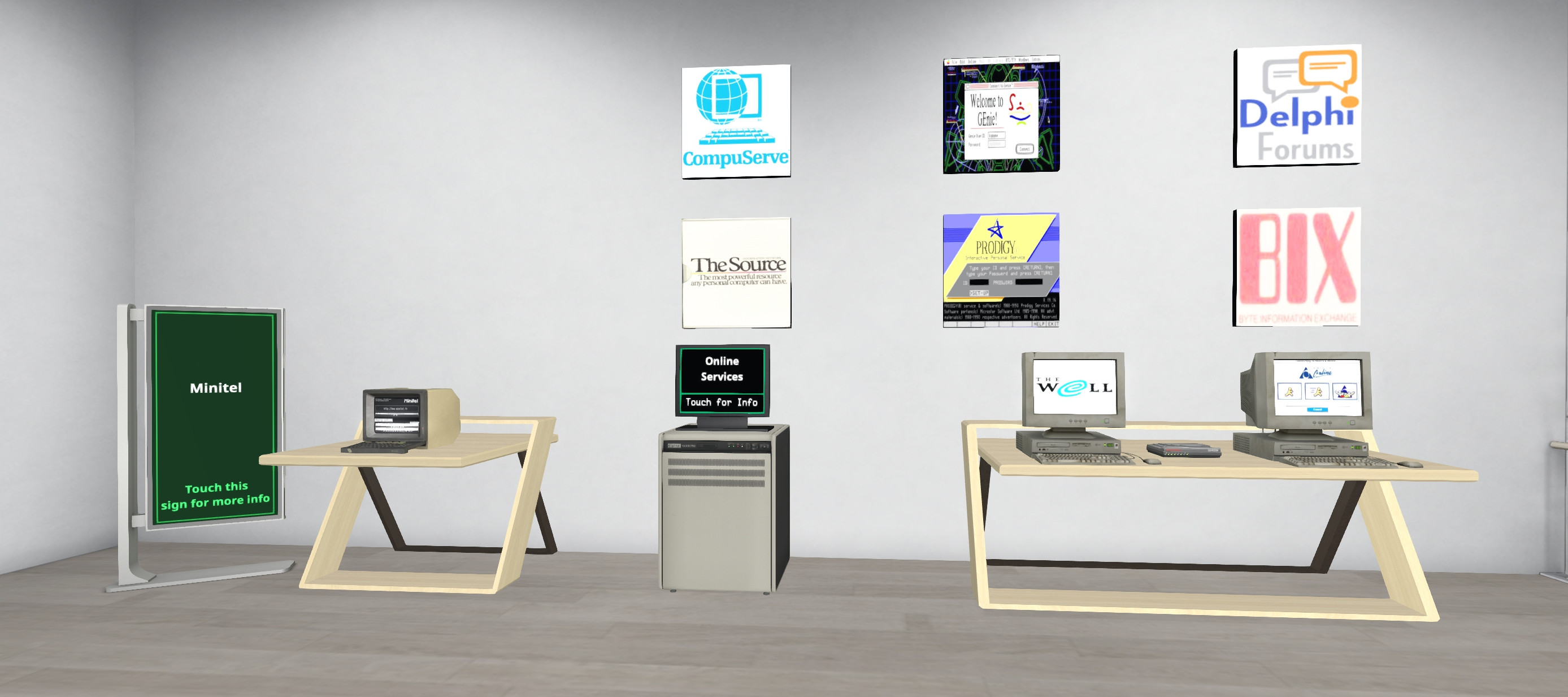
The upper floor if the museum comprises five exhibition halls, all following the same approach as the lower floor, with each focusing on a specific exhibit related to computing. At the time of my visit, these comprised: the relationship between computers and telecommunications and the rise of networking; video games and console systems; the development of artificial intelligence; the noble / ignoble art / act of hacking (which of these terms largely dependant on the who, what, where, when and how of the said hacking) , and biographies of some of the leading personalities and individuals who have played a role in the evolution of computers, mathematics, computer sciences, communications, and related subjects.

Comprising images of the individuals concerned which can be touched for a notecard-based biography, the latter covers people who – at least in name – are likely be  known to many: Augusta Ada King, Countess of Lovelace, Alan Turing, Steve Jobs, William Gates III, Steve Wozniak, Sir Tim Berners-Lee and Linus Torvalds, for example – and one Philip Rosedale; those who might be familiar (if not really known, such as Blaise Pascal; Seymour Cray; Vinton “Vint” Cerf (who has actually been in Second Life) and Robert Kahn; to those who really should have much wider recognition than they do, but whose achievements have perhaps been overshadowed by others – such as the aforementioned Grace Hopper, together with Margaret Hamilton and Dorothy Vaughan, who at times get pushed aside in the male-dominated history of computing, and Douglas Engelbart, whose work at times gets subsumed by the near-mythic achievements of Steve Jobs.

Museum of Computing History, June 2023

The latter’s work (with that of his team at the Stanford Research Institute – now SRI International) is the subject of a second video presentation within the museum, highlighting what would become retrospectively called The Mother of All Demos. The was a live event held in 1968, in which Engelbart interactively demonstrates his team’s oN-Line System (NLS), which is very much the precursor of just about everything we take for granted with computers today: the graphical interface with its cursor (or “bug” as they called it) and mouse; the ability to work collaboratively and share files dynamically; the use of hypertext and hypermedia – even teleconferencing. The video offered at the museum summarises Engelbart’s presentation, but for those interested, the entire demonstration – which lasted over 90 mins – is also available on You Tube.

I admit I did find myself a little conflicted over the use of notecards throughout the museum; not because it is a difficult format to understand, but rather because there are instances where the information is liable to change (such as with the biographies of some of those featured within the upper floor exhibitions, or on the subject of AI), which might lead to some information becoming out-of-date. As such, I wondered if offering a mix of web links as notecards, depending on the subject matter, might not be easier from a maintenance standpoint.

Museum of Computing History, June 2023
But, that is very minor quibble; there is no denying the Museum of Computing History has been extremely well put together, offering as it does something of interest for anyone with an interest in the subject – whether computer nerd or as someone simply interested in historical context and / or the influence of computing and computational machines have had down the centuries / decades. Information is easily accessible, and the range of topics cover and their associated depth means there is a lot of be absorbed without being overwhelming, and more than enough to encourage repeat visits.

 SLurl Details

Yes Her in Second Life: strength in the face of intolerance

Factory Arts Collective Gallery – Yes Her, June 2023

Intolerance of others, whether based on gender, ethnicity, religion, and /or sexuality has throughout human history been as much responsible for human suffering, depredation, subjugation and death as any of our multitudinous wars throughout the ages (with religion and ethnicity themselves being two of the most obvious causes of war / conquest).

In the modern age, to say, “you are less than me” purely on the basis of skin colour, gender, sexual preference and to whatever deity a person might opt to pray (or indeed, the manner and direction of said prayers), should, for most individuals capable of the basics of free and rational thinking be anathema. And yet, here we are, facing a rising tide of politically-motivated and damaging “otherism” which encompasses all of the above noted differentiators. Even women in what are regarded as “free” societies are finding their basic rights under threat / being rolled back.

It is a level of public intolerance that is concerning on multiple levels. There is obviously the increased risk those being marginalised face in terms of diminishing rights and growing potential for violence against them – and well as the encouragement it gives to others to engage in such violence. Then there is also the the positive reinforcement repressive regimes in other nations might see when they hear views similar in nature to their own being espoused by politicians from so-called “world leading” nations. Both of these should give pause to reconsider words about to be spoken by those considered to be in high office – but they don’t.

Factory Arts Collective Gallery – Yes Her, June 2023

Such intolerance is poisoning almost all walks of life; for those facing it, it can be – as intended – utterly debilitating, and thus either achieves the goal of subjugation, or generates an anger that can overtake thinking and outlook to a point where it is as damaging to the individual as any form of mental disenfranchisement in the face daily exposure to it. So what can be done? The answer to this simple-sounding question is both myriad and complex; but one part of it can be summed up as support one another and be who we are.

Yes Her is an exhibition of art curated by Scylla Rhiadra which seeks to do just that, with a specific focus on the matter of women’s rights, possibly spurred by the manner in which they are under open attack in the United States, but which embraces women the world over who face a daily challenge simply to exist as people rather than chattel. To use Scylla’s own words concerning the exhibition:

Women around the world are under a great deal of stress right now. And whether we live in Tehran, in Manchester, or in Forth Worth, Texas, we have good reason to be angry. Anger can be a powerful motivator to action. But swimming in constant anger is also a terribly toxic and ultimately self-destructive way to live your life. 
Yes Her is an exhibit that chooses instead to highlight positivity and optimism, and the immense point on which women can call, whether or not they are aware of it. … This exhibit argues that, while our anger can be justified, we need not always be reactive: we can make positive change happen without being prompted by assaults upon our rights. 
We can make a change by being who we are. 
This exhibit celebrates the positive strength and affirmation of what it means to be a woman.

– Scylla Rhiadra, from the introduction of Yes Her

Factory Arts Collective Gallery – Yes Her, June 2023

Having opened on Sunday, May 28th, at the Factory Arts Collective Gallery, Second Life Left Unity (if the SLurl delivers you to the ground-level unity station rather than the gallery, climb the steps into Nelson Mandela Park and follow the track to the left to the teleport kiosk), Yes Her sees Laurel Aurelia, Suki Blossom, Kira Fizzgig, Tatiana Demonix (Nikolay), Eva Knoller, Belinda Newell, Onceagain (Manoji Yachvili) and Saskia Rieko, join with Scylla in an exhibition celebrating womanhood. Each of the artists has contributed at least one image, which are displayed with several of Syclla’s own pieces – including the original Yes Her which help foment the idea for this exhibition.

These are images which are all narratively rich (and self-explanatory), offering a reminder to all of us that women are people, capable for expression the same emotions and desires as the male of the species – and, like it or not – the same autonomy of choice and right to a voice (both of which perfectly exemplified by Scylla through Yes Her (My Door) and Yes Her (Listen!). Within them are statement of power through simple companionship, fearlessness (and facing the future), strength, beauty and the essential humanity in being a woman – a humanity to which all of us should aspire, again regardless of religion, creed, gender, sexuality, age or ethnicity.

Factory Arts Collective Gallery – Yes Her, June 2023

Whilst a statement on the power of womanhood, as we enter Pride Month at a time when the LGBTQ+ communities are facing what is fast becoming an all-out assault on their rights (even, I’m ashamed to say by women of “status” who really should know better), Yes Her has a broader context in which to be seen.

Although the focus of the art is clearly on the power and beauty of womanhood and the right of women to make their own choices in life, Yes Her speaks out against all such intolerance and toxic behaviour and offers encouragement to any finding themselves marginalised by the bigotry of others. Simply substitute the word of your choice (gay, lesbian, pagan, refugee, person of colour, and so on) for the final “woman” in the quote from the exhibition’s introduction I’ve used earlier in this article, and you’ll see why. As such, it offers a message of strength extending well beyond its core focus, and offer s a reminder that no matter what those who would use intolerance as a message of hate and a means to ostracise and / or control, we are all people, with far more that unities us than separates us.

SLurl Details

May 31st 2023: Reminder: Second Life Marketplace Upgrade

A quick reminder that the Second Life Marketplace will be undergoing infrastructure upgrades for an estimated period of one hour, commencing at 10:00 SLT on Wednesday, May 31st, 2023.
This work will involve, among other things, a reset of the shopping cart functionality, and any items users may have placed in their shopping carts for future  purchase will not be saved.

To to avoid any upset in having shopping carts emptied, Linden Lab recommends shoppers take one or both of the following steps:

  • Finalise all purchases ahead of the maintenance period, and complete pending transactions to clear your shopping cart.
  • For those items you are not in a position to purchase ahead of the maintenance period, or do not wish to purchase at this time but would like to keep recorded for future reference, list them either in your favourites or your wishlist.

During the maintenance period, the Marketplace will be unavailable for either shoppers or merchants to access. For complete details, please refer to this official blog post, and to the SL Grid Status pages for updates.

2023 SL SUG meetings week #22 summary (and a LSL XML-RPC reminder)

Photo Café, April 2023 – blog post

The following notes were taken from the Tuesday, May 30th Simulator User Group (SUG) meeting. They form a summary of the items discussed and is not intended to be a full transcript. A video of the entire meeting is embedded at the end of the article for those wishing to review the meeting in full – my thanks to Pantera for recording it.

Meeting Overview

  • The Simulator User Group (also referred to by its older name of Server User Group) exists to provide an opportunity for discussion about simulator technology, bugs, and feature ideas.
  • These meetings are conducted (as a rule):
  • They are open to anyone with a concern / interest in the above topics, and form one of a series of regular / semi-regular User Group meetings conducted by Linden Lab.
  • Dates and times of all current meetings can be found on the Second Life Public Calendar, and descriptions of meetings are defined on the SL wiki.

Server Deployments

  • On Tuesday, May 30th, the SLS Main channel servers were restarted without any user-facing changes.
  • On Wednesday, May 31st, a new RC update, providing back-end support for the new inventory thumbnails viewer capability soon to be forthcoming. See my recent TPVD meeting summaries for more on this capability.

Viewer Updates

  • The Emoji Project Viewer (😊😒🥱😬🤪🫣😲🐱🦄 – depending on your personal point of view!), version, 6.6.13.580279, was issued issued on May 30th.
    • This viewer enables the use of emojis in local chat and IM conversations, encoded as their corresponding unicode characters as well as via the use of the Windows (Win+. or Win+;) and MacOS (Ctrl-Cmd-space) emoji pickers (note any animated gifs displayed in these pickers are obviously not supported).
    • This capability comes as a code contribution from Kitty Barnett, who first implemented it within the Catznip viewer. As such other TPVs may already present their own support of the capability in some flavour (such as supporting / recognising input via an emoji picker).

The remaining list of available official viewers is as follows:

LSL XML-RPC Reminder

A reminder that, as per my March 23rd relaying of the news that LSL XML-RPC functionality will be permanently ended on Thursday, June 1st, when incoming LSL XML-RPC traffic on the remaining small channel of regions on Agni (the main grid) will be blocked. The reason for this is that  LSL XML-RPC has been deprecated since the introduction of HTTP-In back in 2009, and by the time the March announcement was made, had dwindled to just a few dozen per hour across the entire grid, making maintenance and support of the capability no longer beneficial to LL in term of time and resources, which could be put to better use in improving SL.

In Brief

  • The glTF PBR materials project is still awaiting a small RC simulator release to allow for broader testing on the main grid.
  • BUG-227303 “collisions makes a script stop running and revert its mono status” is on LL’s “backlog” of issues to be resolved, down to the fact it has been proving difficult to reproduce consistently.
    • It was suggested at the meeting that looping around the regions forming the Jeogeot Gulf does consistently repo the issue (particularly when using vehicles with a lot of content / scripts), and this could be used for testing.
    • A discussion on region crossing flowed throughout the meeting, please refer to the video below.
  • BUG-232037 “Avatar Online / Offline Status Not Correctly Updating” – further work is in progress to try to address this issue, and will be targeted for an upcoming simulator release Soon™.
    • A temporary workaround LL is suggesting whilst this work in is progress is for people noting their Friends list is not display the correct status for their contacts to try teleporting to a an unoccupied region / region with relatively few avatars and then re-log from there.
  • Feature Request BUG-231702 “Allow scripts with PERMISSION_TRACK_CAMERA to detect FoV” was commented on, leading to a general discussion on the potential for greater LSL control of the viewer’s camera. Please refer to to the video below for details.
  • Blocking  / Muting:  it was pointed out that some people are using a new vector to harass people who have otherwise blocked them, by making a minimal L$1 payment to them through the viewer. It is not clear how widespread this is, and whilst a governance / viewer issue, requests were made during the meeting for LL to look into making blocking / muting more robust to prevent such edge-cases.

† The header images included in these summaries are not intended to represent anything discussed at the meetings; they are simply here to avoid a repeated image of a rooftop of people every week. They are taken from my list of region visits, with a link to the post for those interested.

Chang’an with a twist in Second Life

Chang’an, May 2023 – click any image for full size

It’s pretty well established in these pages that I tend to be drawn to things with an Oriental theme running through them in much the same way as a moth is drawn to a source of illumination. Part of this is doubtless the result of having spent some of my childhood years in Hong Kong (and some of my early adult years traveeling to places on that side of the world). However, it’s also likely born of the rich history of the Far East, a history which I’ve always found to be more engaging than the histories of western nations.

Which is a roundabout way of saying that when I copped the Destination Guide entry for Chang’an, I knew it would be skating up my list of places to visit; if nothing else, the DG description was enough to raise my eyebrow as curiosity was piqued.

Explore the virtual Chang’an, the capital of the Tang Dynasty (AD618-907) in China. You can see ancient Chinese (East Asian) cultural factors, including palaces, Buddhism temples, and gardens. Here you can dance, sing, entertain, and shop.
Chang’an, May 2023

This is an introduction which immediately gives a first hint of this Full private region’s over-arching theme: that of a fusion of Oriental / East Asian elements with a particular (but not exclusive) emphasis on China and Chinese history. Not that the setting is intended to be purely historical in context; in much the same way as it offer a fusion of influences, so too does it present a combining of periods, ancient and modern.

Designed and built by 大鱼 (Deo Rain), the region’s DG and About Land descriptions tell only a small part of Chang’an’s long history. The name belongs to what is now regarded as Xi’an, the capital of Shaanxi Province, and the third most populous city in north-western China. Over the last 40-ish years, and keeping pace with China’s overall modern economic development, Xi’an has re-emerged as an industrial, political and educational centre and, particularly, a cultural centre of note.

Chang’an, May 2023

As a centre of import, Xi’an’s roots go back to Neolithic times when it was a centre for the Yangshao culture, and areas within the city and its surroundings were used by several Chinese dynasties as their capital. These included the first half of the Zhou Dynasty, with centres at Feng Jing and Haojing, the Qin Dynasty, thanks  to China’s first emperor Qin Shi Huang (he of the Terracotta Army fame and responsible for starting construction of the Great Wall), moved the Qin capital to Xianyang in what is now the northern part of Xi’an. From here, it became central to the majority of the major dynasties through to the Ming and Qing Dynasties (the latter being the last imperial dynasty of China prior to the country becoming a republic in 1911).

The city of Chang’an is generally regarded as coming into being in 200 BC, when Emperor Liu Bang of the Han Dynasty ordered the construction of Weiyang Palace and, six years later, that of the first of the Chang’an city walls. However, it is under the Sui and – as noted by Deo in his descriptions for the region – the Tang Dynasties (which consecutively spanned a period from 581 CE through 907 CE) that Chang’an came to full prominence. This was kicked-off during the Sui Dynasty, when a new city was built south and east of the Weiyang palace, when it was initially called Daxing before being renamed Chang’an (meaning Perpetual Peace or Eternal Peace) during the Tang Dynasty.

Chang’an, May 2023

During this period, and prior to its destruction in 904 CE, Chang’an grew to enclose an area of some 84 km2 within its walls, split into three major districts: the civilian city, the imperial city and the palace itself.  During this period it was the third largest city in the world, boasting centres of commerce, learning, religion and culture, with paved roads and avenues of impressive proportions (Zhuque Avenue, the city’s grand street, was an impressive 155 metres across!).

As well as the palace, the city featured the Giant Wild Goose Pagoda, which together with the Small Wild Goose Pagoda survived the destruction of Chang’an (although it did suffer extensive earthquake damage in 1556 CE). It was built as the repository for sutras and figurines of Gautama Buddha that were brought back to China from India by Xuanzang, who also brought over 600 Sanskrit scriptures to Chang’an, where he established a centre for their translation, work which contributed enormously to the growth of both Chinese and East Asian Buddhism.

Chang’an, May 2023

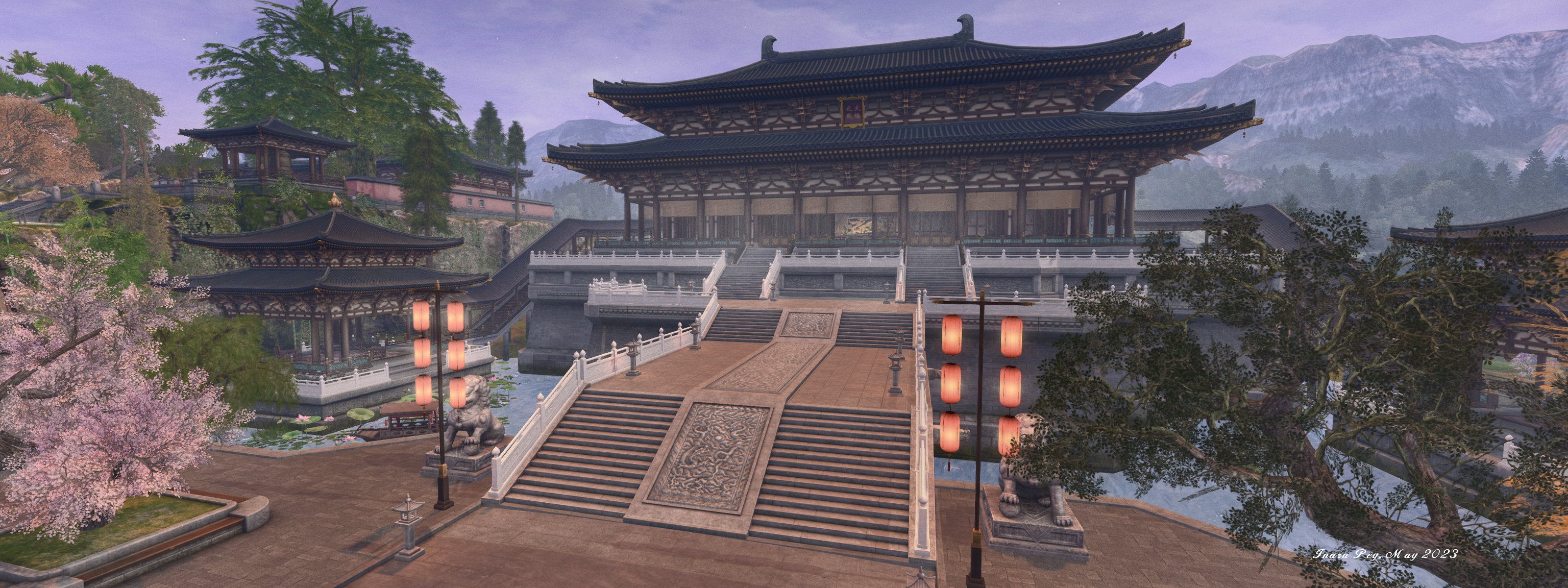
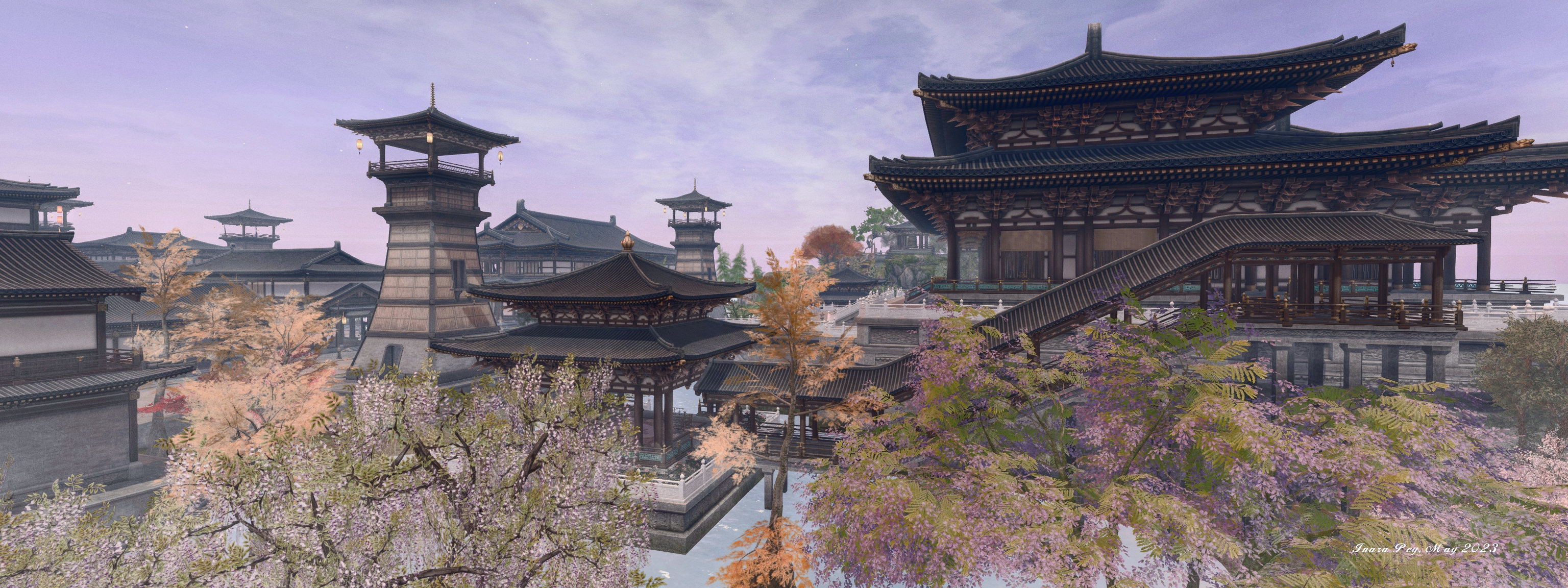
Much of this is celebrated in Deo’s build. Like its namesake, the later can be broadly split into three areas: the commercial centre (with stores available for rent), a cuisine district, and the palace-like Taiji Hall, sitting elevated at one end of the region, a broad paved footway running to it in the manner of Zhuque Avenue from the citadel gates, neatly separating the commercial and cuisine districts from one another in the process. The hall sits apart from most of the rest of the citadel as befitting its status as a near-palatial building, thanks to a broad body of water almost completely slicing through the northern part of the region.

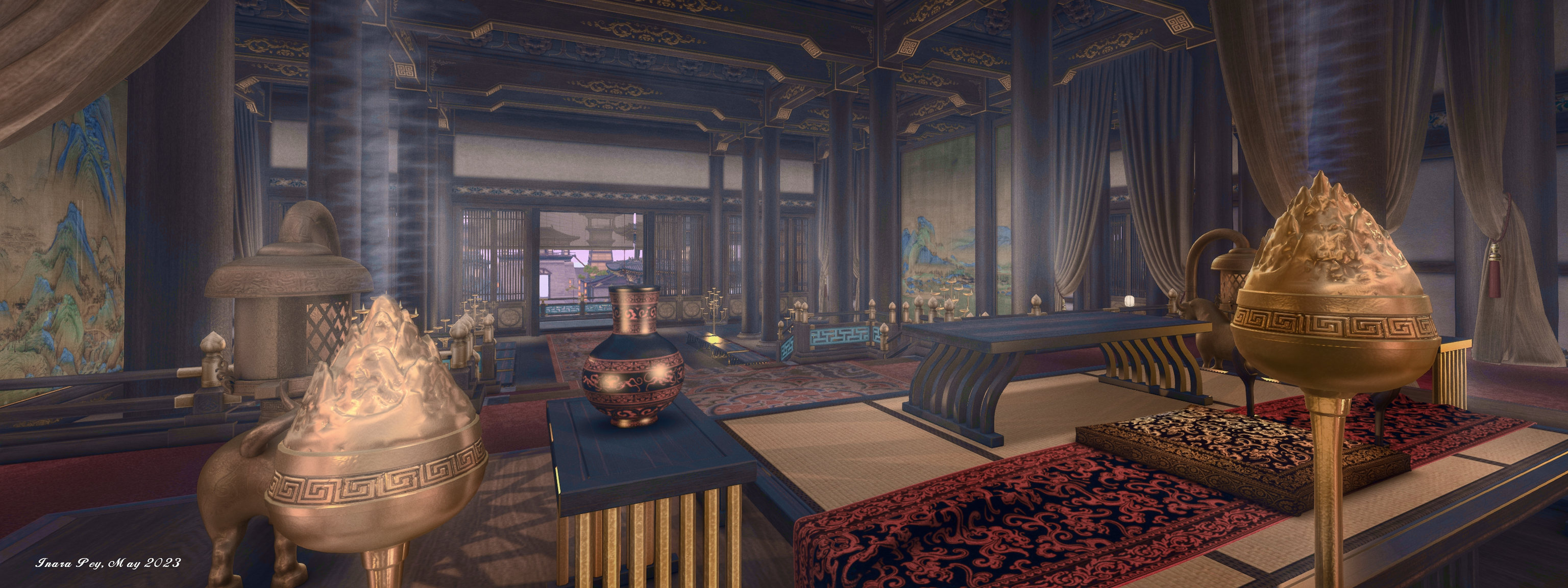
Two tall watchtowers stand guard on either side of the broad stepped bridge spanning the water to reach the main hall, and while these may not be particularly pagoda-like, but it is hard not to imagine them standing in for the Wild Goose pagodas of Chang’an. Taiji Hall itself is huge and of genuine beauty and craftsmanship (although apparently still under construction in places from what I saw whilst taking a sneaky cam around it!), which speaks to Deo’s skills as a designer: like the rest of the buildings within the region, it is entirely his own design.

Chang’an, May 2023

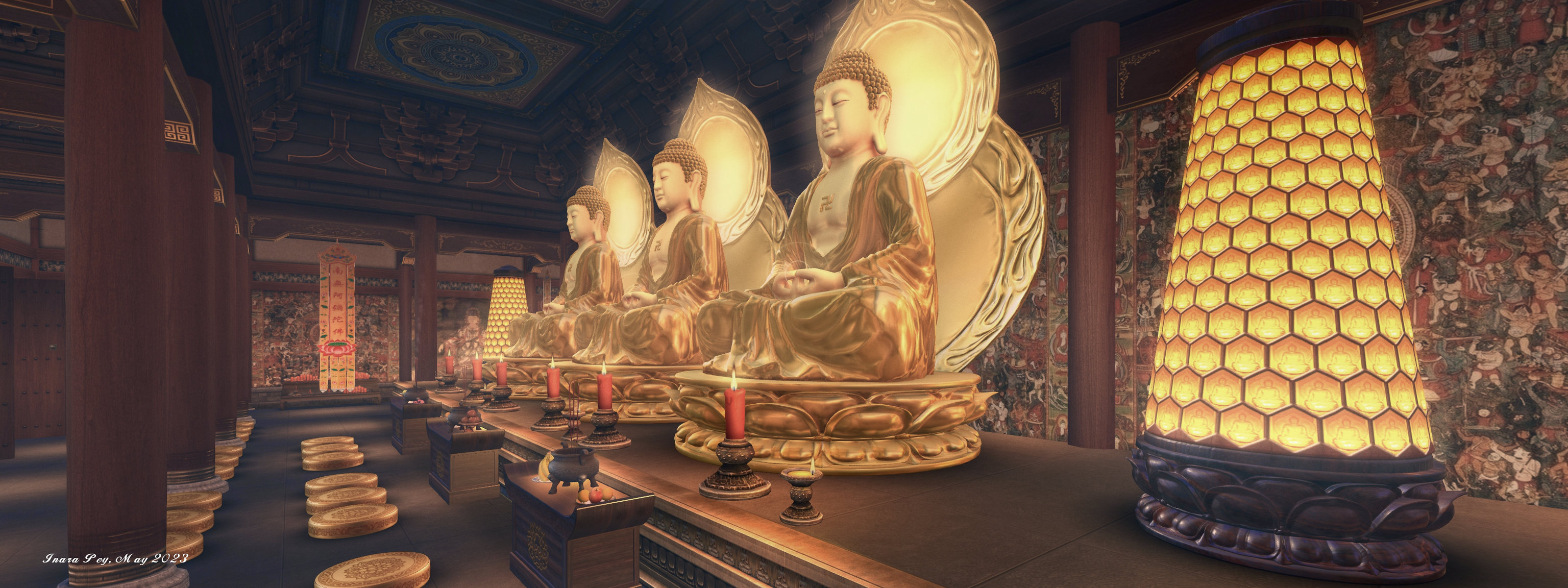
The most prominent elevated element of region sits to the north-west as a high plateau. It is topped by a temple which appears to offer a nod towards the Republic of China, carrying as it does the name of Anping. Built around a main courtyard, the temple has two primary buildings, the larger of the two dominated by three large figures of Buddha, and the smaller by a gold-covered figure of Guanyin, the East Asian representation of Avalokiteśvara. Thus, this retreat would seem to be an acknowledgement of Xuanzang and his seat of translation / study founded at Chang’an. But – how does one reach it? From the terraces of the palace and the paved streets below it, there does not seem to be an obvious route.

The answer lay close to the southern gateway where, between the eatery and the club-come-bathhouse which help fuse past and present within the build, a covered walkway might be found. Not only does this provide access to the engaging south-west section of the build (which hides its own pavilion and butterfly garden), and thence north to where a paved footpath meanders back towards the palace. As it does so, the paved path passes the start of a second, loosely-laid path winding into a gorge as it cuts into the base of the plateau. The far end of this path marks the start of a winding climb upwards. It’s a route of exploration I highly recommend, as it offers a sense of pilgrimage it is meandering route, as means to see parts of the region which might otherwise be missed, and a superb way to look out over the citadel as the path is climbed to reach a promontory just below the temple proper.

Chang’an, May 2023

When visiting Chang’an, I would recommend taking time out to study the map provided close to the landing point, as it will help point out the locations within the region – including those I’ve not mentioned or really described in this article. I would highly recommend a visit, as the region does offer an interesting fusion of ideas, and – quite frankly – Deo’s architecture is gorgeous.

 SLurl Details