Logos representative only and should not be seen as an endorsement / preference / recommendation
Updates from the week through to Sunday, November 16th, 2025
This summary is generally published every Monday, and is a list of SL viewer / client releases (official and TPV) made during the previous week. When reading it, please note:
It is based on my Current Viewer Releases Page, a list of all Second Life viewers and clients that are in popular use (and of which I am aware), and which are recognised as adhering to the TPV Policy.
This page includes comprehensive links to download pages, blog notes, release notes, etc., as well as links to any / all reviews of specific viewers / clients made within this blog.
By its nature, this summary presented here will always be in arrears, please refer to the Current Viewer Release Page for more up-to-date information.
Outside of the Official viewer, and as a rule, alpha / beta / nightly or release candidate viewer builds are not included; although on occasions, exceptions might be made.
Lift-off! With a massive plume of steam and water from the deluge system forced away from the launch pad by the 7 BE-4 engines, Blue Origin’s New Glenn mission 2 featuring the reusable first stage Never Tell Me the Odds, rises from Launch Complex 36 at Cape Canaveral Space Force Station, Florida, November 13th, 2025. Credit: Blue Origin
Thursday, November 13th, 2025 witnessed the second launch of New Glenn, the heavy lift launch vehicle from Blue Origin, marking the system as 2 for 2 in terms of successful launches, with this one having the added bonus of achieving an at-sea recovery for the rocket’s first stage, in the process demonstrating some of New Glenn’s unique capabilities.
In all, the mission had four goals:
Launch NASA’s much-delayed ESCAPADE (ESCApe and Plasma Acceleration and Dynamics Explorers) mission on its seemingly indirect (but with good reason) way to Mars.
Carry out a demonstration test of a new commercial communications system developed by private company Viasat.
Successfully recover the first stage of the rocket – which is designed to be re-used over 25 flights – with an at-sea landing aboard a self-propelled ocean-going landing platform.
Of these four goals, the recovery of the first stage booster was regarded more of an added bonus, were it to occur, rather than an overall criteria of mission success. This was reflected in the name given to that first stage: Never Tell Me the Odds (which sci-fi fans may recognise as a quote from the Star Wars franchise – bonus points if you can name the film, scene and speaker! 😀 ).
The first attempt to launch the rocket – officially designated GS1-SN002 with informal reference of NG-2 – was actually made on Sunday, November 9th, 2025. However, this was scrubbed shortly before launch due to poor weather along the planned ascent path for the vehicle. A second attempt was to have been made on November 12th, but this was called off at NASA’s request because – and slightly ironically, given the aim of the ESCAPADE mission – space weather (a recent solar outburst) posing a potential risk to the electronics on the two ESCAPADE satellites during what would have been their critical power-up period had the launch gone ahead.
Thus, lift-off finally occurred at 20:45 UTC on November 13th, with the 98-metre tall rocket rising into a clear sky from Launch Complex 36 at Cape Canaveral Space Force Station, Florida in what was to be a flawless flight throughout. As with New Glenn’s maiden flight, the vehicle appeared to rise somewhat ponderously into the sky, particularly when compared to the likes of Falcon 9 and Falcon Heavy.
The reason for this is simple: New Glenn is a very big vehicle, closer in size to NASA’s Saturn V than Falcon 9, and carrying over double the propellant load of the latter. So, whilst they are individually far more powerful than Falcon 9’s nine Merlin engines, the seven BE-4 engines powering New Glenn off the pad have a lot more inertia to overcome, hence the “slow” rise. Falcon Heavy, meanwhile has the advantage in that while it can carry a heavier payload (with a caveat I’ll come back to), it also has an additional 18 Merlin engines to get it going.
New Glenn approaching one minute into its flight on November 13th, 2025. Credit: Blue OriginAnyway, once clear of the tower, the launch proceeded rapidly for the initial 14 minutes of powered ascent, with the highlights being:
At 3 minutes 9 seconds after launch, having powered the rocket to an altitude of 77 kilometres, the first stage motors shut down and a few second later the upper stage separated, pushed clear of the first stage by a series of spring-loaded rods, allowing it to ignite its two BE-3U motors without damaging the first stage.
Immediately following this, two significant steps in the flight occurred completely autonomously.
In the first, the flight control systems on the rocket’s upper stage recognised that the first part of the vehicles ascent had been optimised for first stage recovery, rather than achieving orbit. They therefore commanded a “pitch up” manoeuvre, significantly increasing the upper stage’s angle of ascent, allowing it to reach its intended initial orbit.
In the second, the first stage used its reaction control systems (RCS) to enter a “coast” phase, essentially a controlled free-fall back towards Earth, re-orienting itself ready to perform a propulsive breaking manoeuvre.
After 50 seconds of continued ascent following separation, the upper stage of the rocket successfully jettisoned its payload fairings, exposing the two small ESCAPADE satellites, to space.
Circled in red: the payload fairing protecting the ESCAPADE and Viasat payload are jettisoned by New Glenn’s upper stage. Credit: Blue Origin / NASA
Dropping in free-fall for some four minutes, the rocket’s first stage re-lit three of its BE-4 motors at an altitude of around 66 km, slowing its re-entry into the denser atmosphere.
Following the re-entry burn, the motors shut down and the stage used the aerodynamic “strafes” close to its engine exhausts together with the upper guidance fins, to take over “flying” itself down towards the waiting landing vessel.
At 8 minutes 33 seconds after launch, the three centre Be-4 motors re-lit again at an altitude of just under 2 km, slowing the stage and bringing it to an upright position in preparation for landing.
It was at this point that New Glenn demonstrated the first of its unique characteristics: it brought itself to a near-hover abeam of the landing vessel prior to deploying its six landing legs. It then gently crabbed sideways until it was over the landing ship before gently lowering itself to a perfect touch-down right in the middle of the landing ring painted on the deck.
Captured from on the the range safety vessels near the Landing Platform Vessel Jacklyn, 600 km off the Florida coast, these three shot show Never Tell Me the Odds apparently overshooting the landing ship, then coming to a hover and translating back over the vessel’s deck to touch-down safely. Credit: Blue Origin
Immediately on touch-down, special pyrotechnic “disks” under the booster’s landing legs fired, effectively welding the stage to the deck of the ship to eliminate any risk of the booster toppling over during the return to port.
Called “energetic welding”, this capability has been developed by Blue Origin specifically for New Glenn landings at sea, but is seen as having potential uses elsewhere when “instant bonding” of this kind is required. Once the booster has been returned to port, the bonding disks can be separated from both ship and booster with no damage to the latter and a minor need to replace some of the deck plating on the former.
Two images captured from a video camera on the Landing Platform Vessel Jacklyn showing two of the “energetic welding” disks under the feet of the New Glenn booster firing to fix the rocket to the deck of the ship. Credit: Blue Origin
New Glenn’s ability to hover is also worth addressing. Some have claimed that this capability detracts from New Glenn as a launch vehicle as it reduces the amount of payload it might otherwise lift to orbit. Such claims are misplaced: not only is the amount of propellant used during a hover quite minimal overall, it clearly allows New Glenn to make much more of a controlled landing than can be achieved by the likes of SpaceX Falcon 9 stages, thus increasingly the booster’ survivability. Also, as experience is gained with further stage recoveries, there is no reason to suppose the ability to hover / translate / land cannot be further refined to use less propellant than may have been the case here.
And this point brings me back to comparative payload capabilities. It is oft pointed out that whilst big, New Glenn is a “less capable” launch vehicle than SpaceX Falcon Heavy on the grounds the latter is able to lift 63 tonnes to low Earth orbit (LEO) and 27.6 tonne to Geostationary Transfer Orbit (GTO), compared to New Glenn “only” being able to manage 45 and 13.6 tonnes respectively.
However, these comparisons miss out an important point: Falcon Heavy can only achieve its numbers when used as a fully expendable launch system, whereas New Glenn’s capabilities are based on the first stage always being recovered. If the same criteria is applied to Falcon Heavy and all three core stages are recovered, its capacity to LEO is reduced to 50 tonnes – just 5 more than New Glenn, whilst its ability to launch to the more lucrative (in terms of launch fees) GTO comes down to 8 tonnes; 5.6 tonnes less than New Glenn (if only the outer two boosters on a Falcon Heavy are recovered, then it can lift some 16 tonnes to GTO; 2.4 tonnes more than New Glenn). Given that reusability is supposedly the name of the game for both SpaceX and Blue Origin, the two launch systems are actually very closely matched.
But to return to the NG-2 flight. While the first stage of the rocket made its way down to a successful landing, the upper stage continued to run its two motors for a further ten minutes before they shut down as the vehicle approached the western coast of the African continent. Still gaining altitude and approaching initial orbital velocity, the upper stage of the rocket “coasted” for 12 minutes as it passed over Africa before the BE-3U motors ignited once again, and the vehicle swung itself onto a trajectory for the Sun-Earth lagrange L2 position, the two ESCAPADE satellites separating from it some 33 minutes after launch.
ESCAPADE: the Long Way to Mars
That New Glenn launched the ESCAPADE mission to the Sun-Earth L2 position rather than on its way to Mars has also been a source for some confusion in various circles. In particular, a common question has been why, if New Glenn is so powerful, could it not lob what is a comparatively small payload – the two ESCAPADE satellites having a combined mass of just over one tonne – directly to Mars.
The answer to this is relatively simple – because that’s what NASA wanted. However, it is also a little more nuanced when explaining why this was the case.
The twin ESCAPADE spacecraft, Blue and Gold (with the mission at that time referred to as EscaPADE) in a clean room at Rocket Lab, the company responsible for building them on behalf of NASA, prior to being shipped to Kennedy Space Centre. Credit: Rocket Lab
Interplanetary mission are generally limited in terms of when they can be optimally launched in order to be at their most efficient in terms of required propellant mass and capability. In the case of missions to Mars, for example, the most efficient launch opportunities for missions occur once every 24-26 months. However, waiting for such launch windows to roll around might not always be for the best; there are times when it might be preferable to launch a mission head of its best transfer time and simply “park” it somewhere to wait until the time is right to send it on its way.
During its development, ESCAPADE – as a low-cost mission intended to be developed and flown for less than US $55 million – had originally been intended to piggyback a ride to Mars aboard NASA’s much bigger Psyche mission. This mission would be heading to asteroid 16 Psyche, but in order to reach that destination, it would have to perform a fly-by gravity assist around Mars. Thus, it became the ideal vehicle on which ESCAPADE could hitch a ride, separating from the Psyche spacecraft as the latter approached Mars in May 2026.
However, Psyche’s launch was pushed back several times, such that by the time it eventually launched in October 2023, the additional delta-vee it required in order to still make its required fly-by of Mars was so great, there was no way the two ESCAPADE satellites could carry enough propellants to slow themselves into orbit around Mars after Psyche dropped them off. Thus, the mission was removed Psyche’s launch manifest.
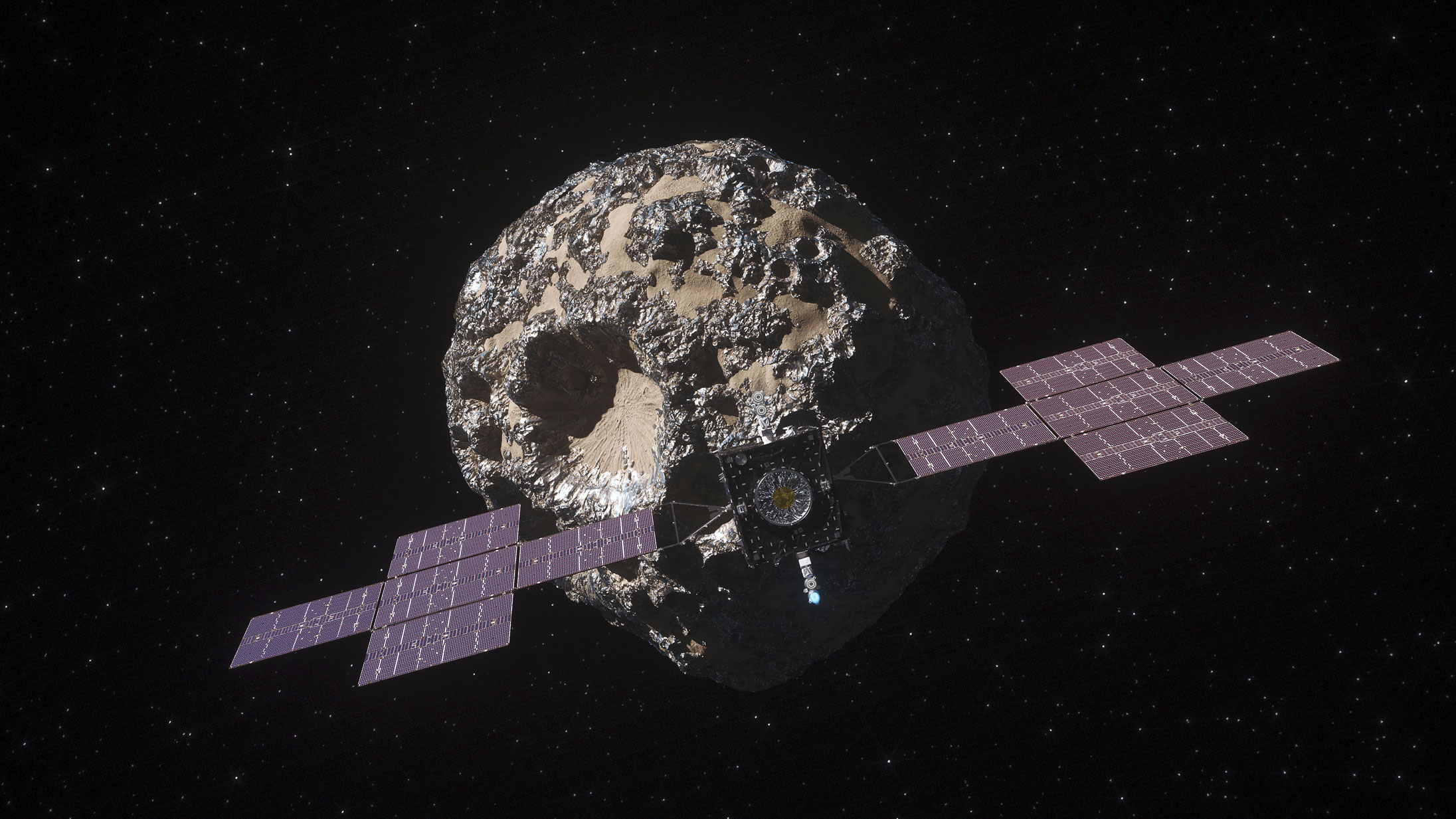
Originally, ESCAPADE would have hitched a ride to Mars on NASA’s Psyche mission spacecraft, seen in this artist’s rendering approaching it intended target for study, the asteroid 16 Psyche. However, delays in launching the Psyche mission meant ESCAPADE had to be removed from the mission. Credit: NASA
Instead, NASA sought an alternative means to get the mission to Mars, eventually tapping Blue Origin, who said they could launch ESCAPADE on the maiden flight of their New Glenn vehicle at a cost of US $20 million to NASA, and do so during the 2024 Mars launch window opportunity.
Unfortunately, that maiden flight of New Glenn was in turn pushed back outside of the Mars 2024 launch window (eventually taking place in January 2025), leaving it unable to both launch ESCAPADE towards Mars and achieve its other mission objective of remaining in a medium-Earth orbit to demonstrate a prototype Blue Ring orbital vehicle. And so NASA opted to remove ESCAPADE from that launch and instead opt to test out the theory of using parking orbits for interplanetary missions, rather than leaving them on the ground where they might eventually face cancellation – as was the case with Janus, another mission which was originally to have flown with the Psyche mission, but was also pulled from that launch due to its repeated delays.
Using ESCAPADE to test the theory of parking orbits also made sense because of the mission’s function: studying the Martian magnetosphere and its interaction with the Solar wind. Whilst the Sun-Earth L2 position doesn’t have a magnetosphere, it is subject to the influence of the solar wind. Given just how valuable a piece of space real estate its is proving to be with several mission operating in orbits around it, understanding more about the role the solar wind and plasma plays in the overall stability of the region makes a lot of sense – and ESCAPADE’s science capabilities mean its two satellites can carry out this work whilst they loiter there through 2026.
Currently, both satellites are performing well, having unfolded their solar arrays and charged themselves up. As noted, they will make a fly-by of Earth in late 2026 to slingshot themselves on to Mars, which they will reach in 2027. On their arrival, they will initially share a highly elliptical orbit varying between 8,400 km and 170 km above the surface of the planet, operating in tandem for six months. After this, they will manoeuvre into different orbits with different periods and extremes, allowing them to both operate independently to one another in their observations and to also carry out comparative studies of the same regions of the Martian magnetosphere from different points in space.
What’s Next for New Glenn?
As of the time of writing, Never Tell Me the Odds remains at sea aboard the landing platform vessel Jacklyn. Following its successful landing, the booster went through an extensive “safing” procedure managed by an automated vehicle, during which propellants and hazardous gasses were removed, and its systems purged with inert helium. Assuming it is in a condition allowing it to be refurbished and reused as planned following its return to dry land, the stage will most likely re-fly in early 2026 as part of an even more ambitious mission.
Never Tell Me the Odds re-lights three of its BE-4 motors, creating an atmosphere shockwave (to the right of the booster) as it drops back into the denser atmosphere ahead of landing. If all goes according to current plans, this stage will be refurbished and used to power New Glenn’s next launch, currently targeting early 2026 with a lunar mission. Credit: Blue Origin via a NASA observation aircraft
GS1-SN002-2, provisionally aiming for a January 2026 launch, is intended to fly the Blue Moon Pathfinder mission to the Moon, where it will attempt a soft landing as part of a demonstration of capabilities required for NASA’s Project Artemis. Blue Moon is the name given to Blue Origin’s family of in-development lunar landing craft, with Blue Moon Mark 1 being a cargo vehicle capable of remote operations and delivering around 3 tonnes of materiel to the surface of the Moon per flight, and Blue Moon Mark 2 being a larger crewed vehicle capable of delivering up to 4 people at a time to the Moon for extended periods.
Both of these craft use common elements: avionics, propulsion systems (the BE-7 cryogenic engine), navigation and precision landing systems, data and communications systems, etc. Blue Moon Pathfinder is intended to demonstrate all of these systems and capabilities, landing the vehicle on the Moon within 100 metres of a designated landing point. If successful on all counts, GS1-SN002-2 will not only demonstrate / confirm the reusability of the New Glenn first stage, it will provide a very clear and practical demonstration of Blue Origin’s emerging lunar mission capabilities, something which may well justify claims that the company is somewhat ahead of SpaceX in having a lunar landing capability that could meet the 2027/28 launch time frame for Artemis 3, the first crewed mission of the programme intended to land on the Moon.
Cerulean Township, November 2025 – click any image for full size
I first visited the Cerulean estate in Septembers 2024. A collaborative involving Emm (Emm Evergarden) of The Nature Collective fame (among other things) and Teagan Cerulean. I enjoyed my visit at the time, as noted within Coffee and a Salty C in Second Life, and actually tried to make a return visit in May 2025. However, at that time, and while the regions of the estate had been completely revised, I found things a little heavy-going viewer performance-wise, and the hoped-for article never materialised as a result.
More recently, I was again contacted by Teagan with an invitation to try a further visit with the note that both she and Emm have made some adjustments to the setting which might – together with the Lab’s tweaking of the core viewer code to encourage better performance for users – make a return visit somewhat easier. As I have always appreciated the work of Teagan, Emm and other members of the extended Cerulean family in SL, I was happy to accept the invitation and hop along to have a further look.
Cerulean Township, November 2025
The first hints of Autumn are in the air. Wander quiet trails, sip coffee by the water, or soak in the beauty of this tranquil PNW retreat. Cerulean is more than a place—it’s a feeling. Welcome home.
– Cerulean Township About Land Description
Occupying a Full private region leveraging the Lab’s Land Capacity bonus and with a Homestead adjoining it to the north, Cerulean township presents an engaging mix of public spaces and private residential rentals (the latter primarily located on the Full region, and all clearly marked as such to reduce the risk of accidental trespass by visitors).
Cerulean Township, November 2025
Whilst not enforced, the main Landing Point for the setting lies on the western side of the Full region, mid-way between a cluster of private residences lying to the north-west of the region and what might be seen as its commercial district to the south. Taking the form of a little railroad station alongside aged tracks, the Landing Point is subject to repeated audio notifications that the next scheduled train has been indefinitely delayed, and so visitors are encouraged to enjoy the local attractions.
Some of the latter are to be found by heading south from the landing point and along Old Mill Road past the aging motel to where Sonder Books and Vinyl Vines are the first of a number of local establishments to offer visitors a warm welcome, together with the Rusty Spoon diner. A walk east along Stumptown Avenue will also bring visitors to the local open-air market and, sitting alongside one of the setting’s large areas of water, the Les Beans Café which has been pleasingly carried over from my original visit to the setting (if completely redesigned!), and is still the venue for assorted local events.
Cerulean Township, November 2025
Across the bridge from the market and café lies the local glamping centre, complete with its own outdoor venue, the Bar/66. From here it is possible to take a chairlift up the eastern highlands overlooking Lost Lake and passing over tumbling falls as they cascade over the rocky cliffs. It’s also possible to follow a couple of trails up to the top of the highlands, but do note that these also pass close to some more of the setting’s private residences, so do keep an eye out for the signs warning you of such.
A trail skirts the foot of the highlands to head north towards Cerulean Lake, the largest body of water in the setting (comprising a little over half of the estate’s Homestead region. It is here that a long tongue of land extends north, passing between the main huddle of private residences to the west and a couple more to the east, between forming a low-lying and picturesque walk up to the lake’s harbour area with its waterside eateries, stores and line of (private, I think) houseboats and the land arcs around to the west, passing another campsite and the little wharf area marking the northernmost extent of the setting.
Cerulean Township, November 2025
The latter forms one of the two termini for the local ferry that plies the waters of Cerulean Lake, the other being at the southern end of the lake’s waters, not too far from the path mentioned above. The ferry is not the only means of getting out on the water either. Little motor boats are available from a couple of the decks along the wharf, whilst back at Lost Lake to the south, kayaks might be rezzed and paddled along the waterways.
For those who prefer not to take to the water for rides and don’t want to explore entirely on foot, other means of exploration await, be it on bicycle, horseback or via hot air balloon. These all add to the attractiveness of the setting in addition to its natural design and beauty.
Cerulean Township, November 2025
I will admit that I still had some issues with load times on arrival, but once I’d allowed things to fully load, the overall impact was minimal in terms of frame rates whilst wandering around (allowing for the fact I do have a reasonable GPU!), and certainly did not stop me from leaving shadows enabled whilst exploring. As such, I still consider Cerulean Township well worth visiting.
On Tuesday, November 11th 2025 (SLT), Firestorm released version 7.2.2.79439 of their viewer.
The primary aim of this release is to achieve parity with the Lab’s most recent releases and to add further updates to features added to the June 2025 Firestorm 7.1.13 release.
Note that the following is not a complete review of the 7.2.2 release and all the changes made therein; it focuses on the more visible and user-facing updates. Those requiring a list of all changes and updates, including all bug fixes, etc, should refer to the Firestorm 7.2.2 release changelog, which also provides all proper credits for the work.
Only download Firestorm from the Firestorm website. Do not utilise and other third-party site purporting to offer the Firestorm viewer, and remember Firestorm will never ask for log-in credentials in order to download a release version of their viewer.
There is no need to perform a clean install with this release if you do not wish to.
Do, however, make sure you back-up all your settings safely so you can restore them after installing 7.1.11.
Linden Lab Updates
This release brings Firestorm to full parity with the following recent official viewer releases from Linden Lab:
Chat Mentions: support for chat mentions allowing for better communication and awareness in local chat.
Type @ in any chat then pick a name from those listed, add your message and Say. Your text chat will be preceded by the selected avatar’s name displayed as a clickable link visible to everyone in local chat range, and which will open that person’s Profile.
Firestorm options:
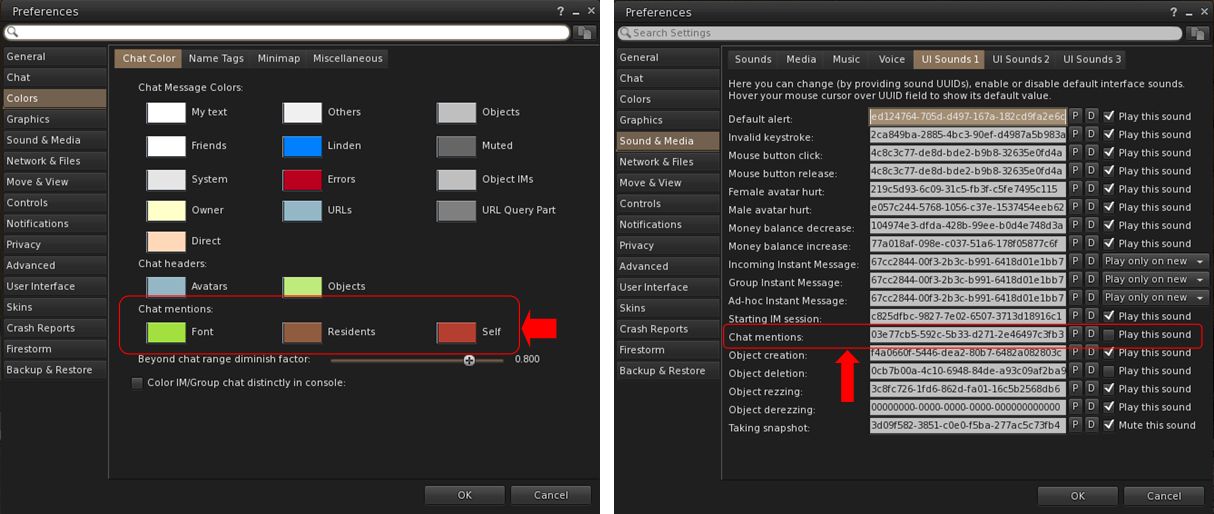
Set chat mention colours for Font, Residents and Self: Preferences → Colors → Chat Color → Chat Mentions.
Set audible tone for chat mentions using your name: Preferences → Sound & Media → UI Sounds 1 → Chat Mentions.
Chat Mention options available in Firestorm. Left: setting the colours in which chat mention links will appear; right: setting a sound to be associated with your chat mentions
Outfit Subfolders: the Outfit system folder now officially supports the use of subfolders.
Hover Height now supports new +/- 3 metre minimum/maximum values.
Build improvements:
Texture scale boundaries have been increased to match Firestorm Viewer – Canny Bug, GitHub Issue.
Physics Material Type now updates when selecting linked objects – Canny Bug, GitHub Issue.
Resolved texture “repeats per meter” value being incorrect for non-uniform sized objects – GitHub Issue.
Refer to the official release notes for all major updates and fixes.
Support for glTF mesh imports, together with enhanced frame time metrics.
Allows content creators to import models in .gltf and .glb formats in a process to COLLADA uploads, with a few key differences.
A unified material upload for the .glb format is not yet supported (due in a future viewer update). To upload .glb models containing material, upload the model without any textures, then upload the materials separately via Upload Build → Upload → Material and then rez the model in-world and apply the materials.
Refer to the official release notes for all major updates and fixes .
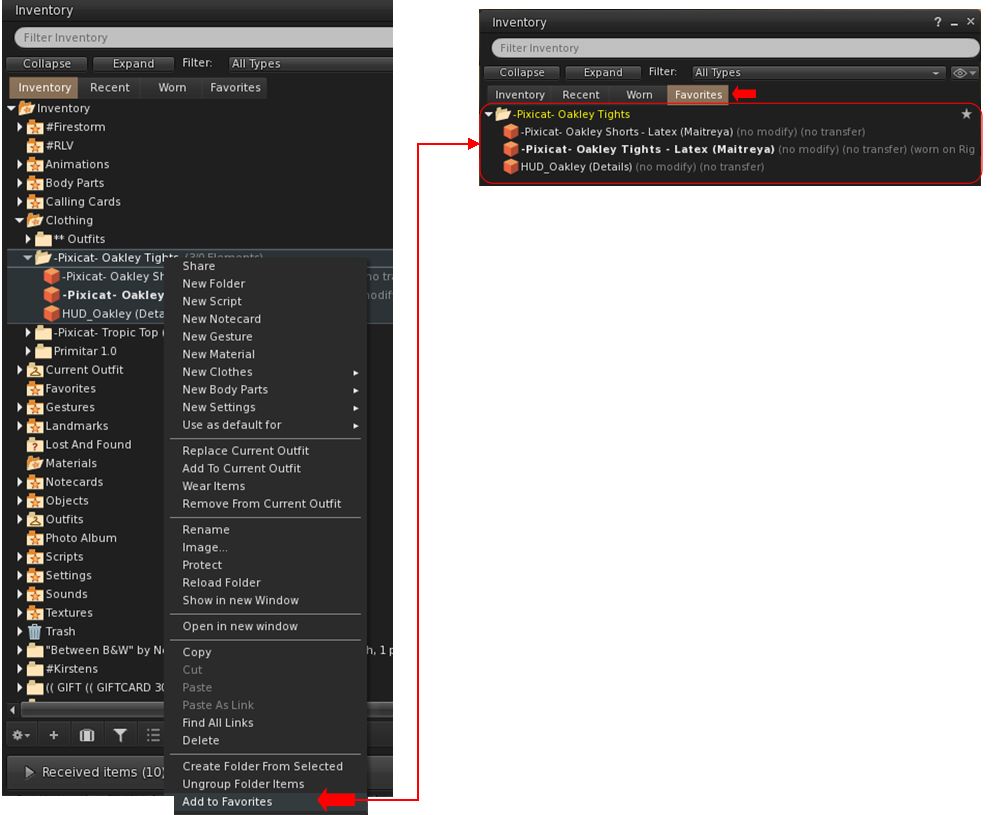
Supports the addition of individual items or folders in Inventory to the Favourites tab in the floater.
To add an item / folder to the Favourites tab:
Right click on the item or folder.
Select Add to Favourites in the context / Pie menu.
Inventory Favourites has been included from the official viewer, but doe not replace Firestorm’s own Favourite Wearables functionality
To remove an item / folder from the Favourites tab:
Locate the item / folder in Favourites or the original in the main Inventory tab.
Right-click on it and select Remove From Favourites in the context / Pie menu.
Note, this functionality is entirely separate to Firestorm’s Favourite Wearables feature, which remains in place in Firestorm, complete with its own toolbar button option.
Additional updates and improvements:
Assorted Avatar System fixes.
Camera and movement improvements.
Chat and Voice chat improvements.
UI Fixes.
Content Creation and Commerce improvements.
Environment improvements and fixes.
Mesh Uploader updates.
Refer to the official release notes for all the above updates and fixes .
Cherry-Picked Upstream Fixes from the Official Viewer
The Voice and WebRTC Reliability changes included in the official 2025,07 – 7.2.2.18475198968 viewer release have been added to Firestorm 7.2.2 at the request of Linden lab.
These changes comprise:
Improved device detection and recovery when unplugging/replugging microphones.
Fixes for several rare WebRTC crash scenarios, together with improved Voice clean-up and logging.
In world Voice indicator now properly reappears after tuning.
Fixed voice clean-up and device update crash on reinitialization.
All remaining updates and changes found within the 2025.07 official viewer release will be included in the next Firestorm release.
Firestorm Updates
New Features for 7.2.2
Disable Connecting to Neighbouring Regions (Navigation and Teleporting)
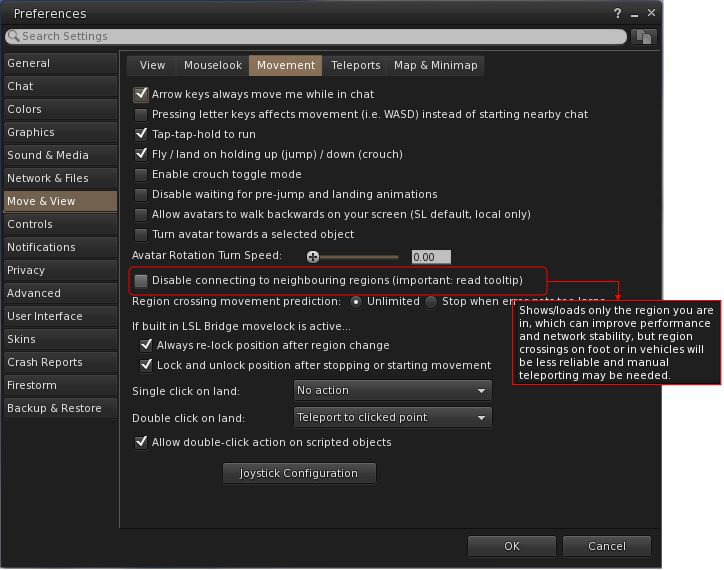
Preferences → Move & View → Movement → Disable connecting to neighbouring regions.
Prevents the viewer from connecting to neighbouring regions (which are ignored by the viewer), and only the current region (login/teleport destination) is connected, effectively isolating it.
This may improve performance for users with weaker computers or slower connections, assist multi-region event setups by lowering client overhead and reduce unintended neighbour interactions.
The new Preferences option to disabling the viewer from connecting to neighbouring regions, complete with the tooltip, which should be read to understand the implications
Limitations:
Region crossings will not function normally, as neighbouring regions are not visible or connected to the viewer.
Only direct teleports and logins to regions will work reliably.
The sense of world scale and continuity is reduced, and travellers or explorers may find it limiting.
New Imposter / Avatar Imposter Exclusions (Inventory / Avatar Appearance)
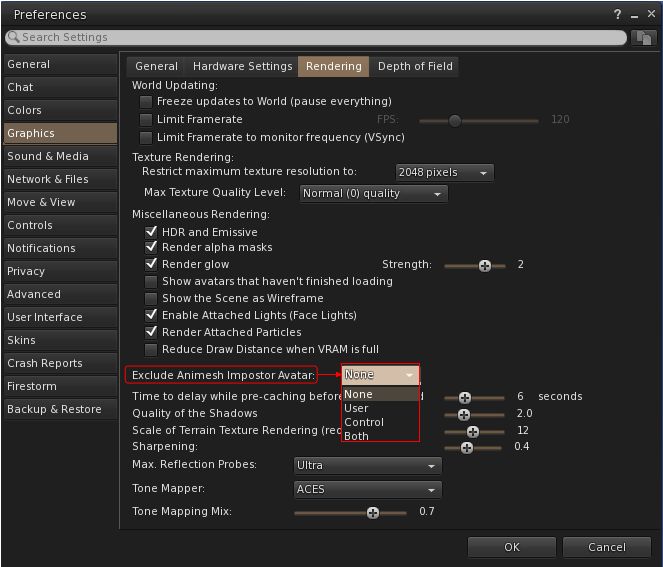
When selected, allows a user to keep using the imposter system, but protect Animesh avatars from not animating or from having rendering issues (e.g. missing attachments).
The new Impostors option for protecting Animesh avatars from not animating or from having rendering issues
Comprises four options:
None: Default, don’t exclude any avatars.
User: Exclude only user avatars which have Animesh attached to them.
Control: Exclude only control avatars.
Both: Exclude both User Animesh avatars and control avatars.
New Snapshot Framing Guides and Settings (Photography / Snapshot Floater)
The snapshot frame overlay and composition guides were added to the Snapshot floater with Firestorm 7.1.13.
They allow the user to:
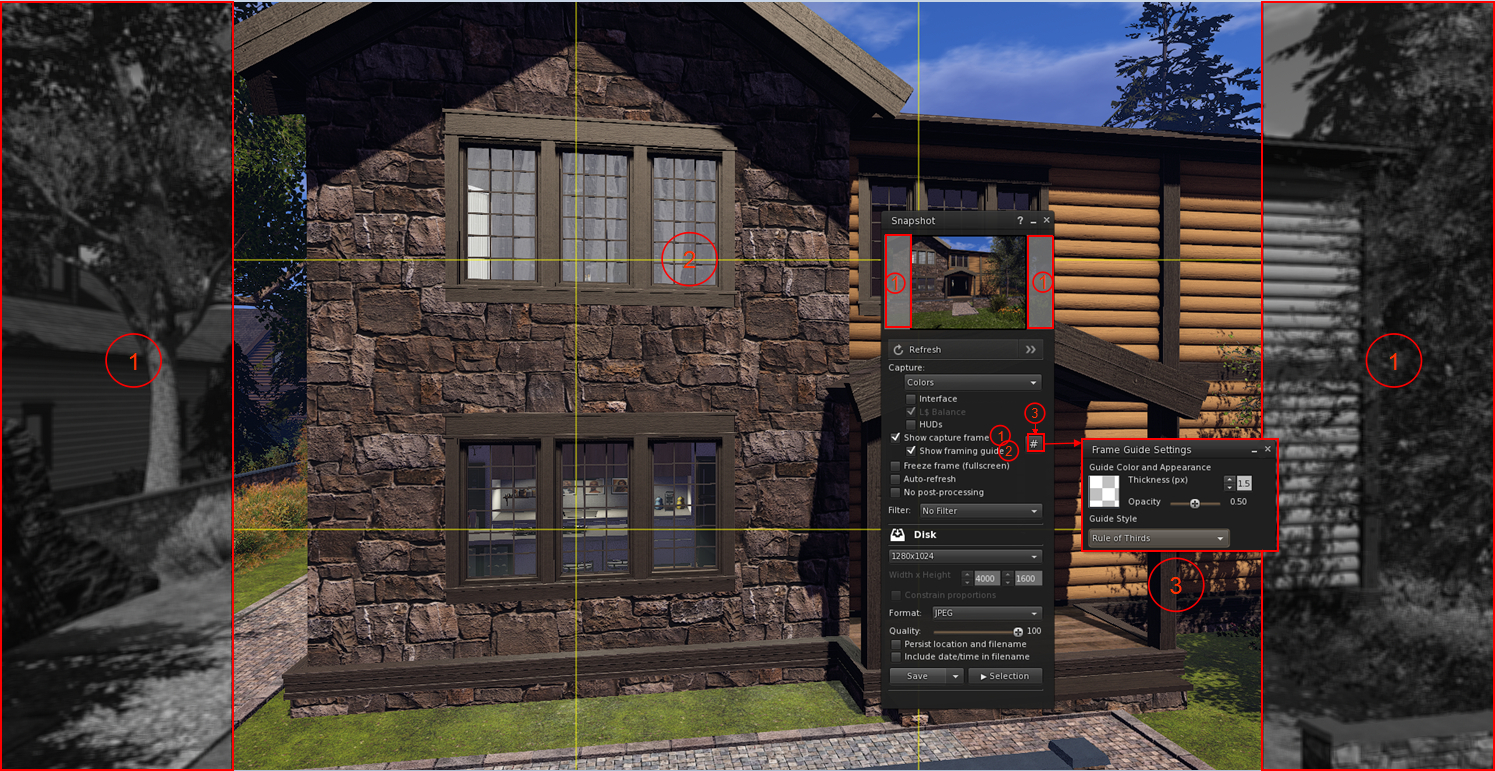
Overlay their in-world view with a frame mirroring the selected image size selected from the relevant image size drop-down, with the parts of the in-world view outside of the image capture size rendering in monochrome (Show Capture Frame)
Optionally display a composition guide overlay as a set of yellow lines within the image frame on their world-view.
Use a series of Debug settings to customise the snapshot frame.
Firestorm 7.2.2 enhances these frame overlays and guides with additional options, access via a new # button.
When clicked, this button allows the user to:
Adjust the thickness and opacity of the frame guides displayed in-world by the viewer without having to use the Debug Settings.
Select from an expanded down-down of guide styles:
Rule of Thirds.
Golden Ratio: – one of Top Left, Top Right, Bottom Left or Bottom Right .
The Snapshot floater showing the frame overlay option (1) and the yellow composition guide (2) using the Rule of Thirds, added to the floater as a part of the Firestorm 7.1.13 release. Also shown is the new Firestorm 7.2.2 # button (3) which opens the Frame Guide Settings floater, allowing the user to customise the frame guides and select from the composition guide drop-down (defined in the text above)- click for full size, if required
Firestorm Avatar and Animesh Poser
The Firestorm avatar and Animesh poser system was introduced with the release of Firestorm 7.1.13 as a re-write of the Avatar poser system developed by NiranV Dean (and found on the Black Dragon viewer). For assorted reasons, that release of Firestorm did not have any associated overview in this blog, therefore for detailed information on it, please refer to the following links:
Firestorm 7.2.2 introduces a large number of improvements and updates to the Avatar and Animesh Poser, all of which are summarised in the viewer changelog, to which those interested are referred to for details.
Other Notable Improvements / Updates
Note: for bug fixes, etc., please refer to the viewer changelog
Inventory, Appearance & Avatar
New option to automatically reset skeleton upon standing up, which is also automatically broadcast to surrounding avatars as well: Preferences → Firestorm → Extras → Reset avatar skeleton after standing up.
New Stop button on the link replacement floater (Right click inventory item → Replace Links (FIRE-29394).
‘Delete from outfit’ context menu entry when right clicking on an item in an outfit, in the Appearance window, Outfits tab.
This is useful for when you mistakenly added some HUD or anything else you didn’t want in your outfit, and is simpler than going inside the inventory and deleting the links from the outfit folder.
Note that only links are deleted, not actual inventory items.
Accessed via: Appearance → Outfits tab → Right click item → Delete from outfit.
Visual warning about too many saved outfits:
If a user has a large number of saved outfits, this can cause the viewer to freeze for a short time when opening the Appearance panel or when searching for saved outfits on slower hardware.
Therefore, when the user has over 200 saved outfits, they will now see this warning notification:
A large number of outfits were detected: [AMOUNT]. This may cause viewer hangs or disconnects. Consider reducing the number of outfits for better performance
Radar, Navigation and Teleporting
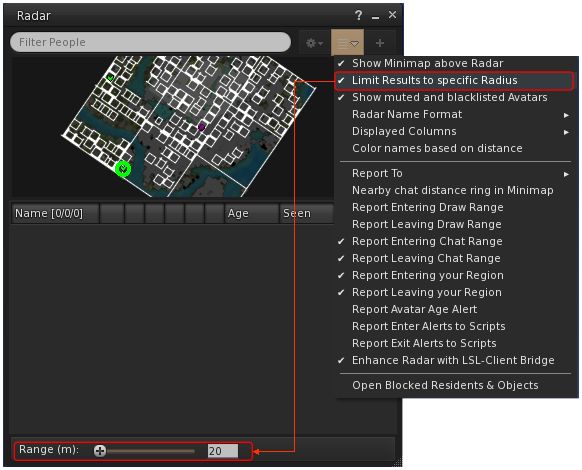
New Radar option to set the maximum range for results to be obtained (FIRE-35815):
World Menu → Radar (or Radar Toolbar button)→ Radar Options drop-down → Limit Results to specific Radius → open range panel at the foot of the floater.
Use the slider to set the desired radius, or manually enter the radius.
Firestorm 7.2.2 radar range option and slider / entry field
An option to View Chat Transcripts’ added to the Nearby People and Radar right-click context menu.
Option to show yellow beacons at region corners to help avoid region boundary disconnects, especially when driving or flying: Top menu → World → Show More → Beacons → Show → Region Corners (FIRE-33085).
The maximum zoom on the World Map has been increased to match the official viewer (FIRE-35934).
Communication + Sound and Media
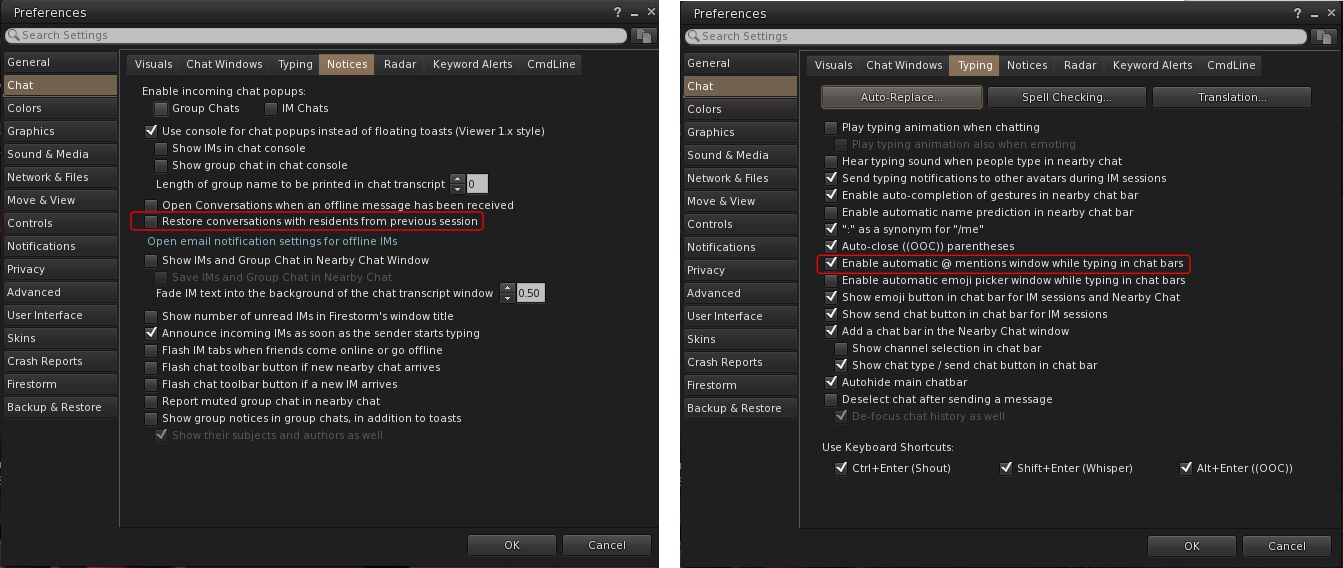
Functionality to save and restore open resident-to-resident IMs from the previous session (Group chat sessions are not always ready in time during start-up, making their restoration unreliable): Preferences → Chat → Notices → Restore conversations with residents from previous session.
Option to enable / disable auto-completion when typing @ mentions in chat: Preferences → Chat → Typing → Enable automatic @ mentions window while typing in chat bars.
New Chat Preferences to restore resident-to-resident IMs (left) and to enable / disable auto-completion when typing @ mentions (right)
Separate conversations opacity options, together with new checkbox to allow the conversation floater to abide by the active opacity when it is focused, so that way it can have its own inactive transparency separate to everything else – FIRE-35804.
Preferences → Colours → Miscellaneous → Floating Window Opacity → Use Active Opacity value when the conversations window is focused.
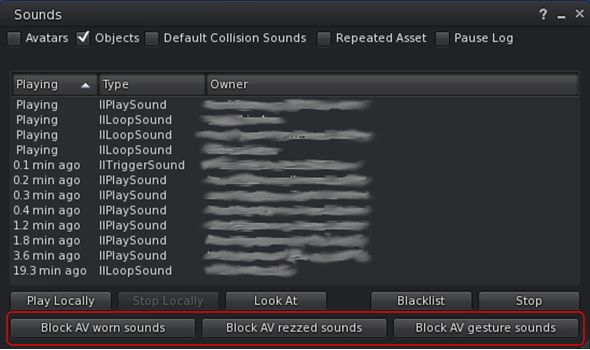
Sound Explorer: new buttons in Sound Explorer to mute all attached, rezzed or gesture sounds for a specific avatar
Muted sounds are re-enabled via the Asset Blacklist.
New Sound Explorer checkbox for muting specific sounds from an avatar
Asset Blacklist: new Flags column to the Asset Blacklist to denote if the muted sound is one of Avatar Worn Object Sounds, Avatar Rezzed Objects Sounds or Avatar Gesture Sounds.
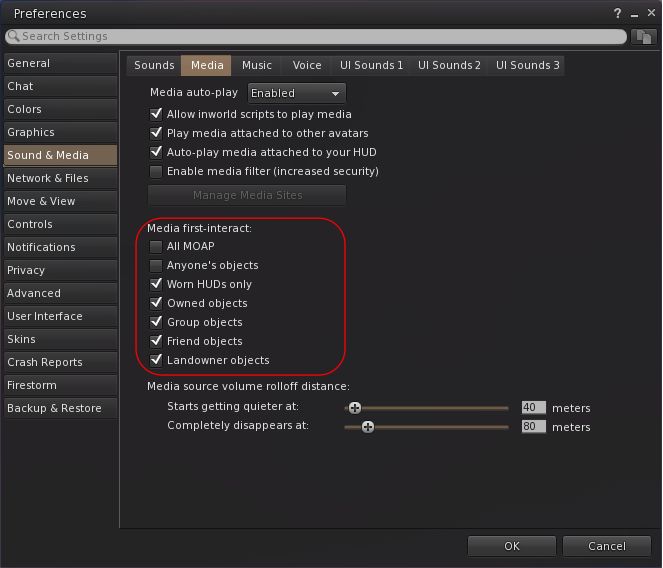
Media on a prim (MOAP) interaction option can now be set individually (when set, does not require a first click to focus before interaction can begin): Preferences → Sound & Media → Media → Media first-interact.
Firestorm 7.2.2 MOAP first interaction options
Miscellaneous Updates
Show On-Screen Console shortcut revised to ALT+SHIFT+`.
Area Search improvements:
Added functionality to save Area Search flags and options as defaults when the floater is opened:
Top Menu → World → Area Search → Filter Tab → Save as Default.
Improvements to more reliably send all objects and not just objects in front of the camera.
Camera:
Added an option to disable the reset buttons in the camera floaters (prevents the centre bullseye of the orbit and move camera controls from resetting the camera): Preferences → User Interface → Interface Windows → Disable camera controls reset buttons
Added a TPP preset button to the added to the right of the front, side & rear buttons on both the small and regular camera floaters – FIRE-32595.
Added Default buttons for Preference → Move & View → View sliders for ease of resetting to default values – FIRE-32710.
Height of Preferences floater increased for improved readability.
Graphics: Draw Distance VRAM Optimization changed to be optional:
Preferences → Graphics → Rendering → Reduce Draw Distance when VRAM is full or
Top Menu → Developer → Rendering → Reduce Draw Distance when VRAM is full.
Feedback
Sorry, no real feedback from me on 7.2.2, my personal situation has been such that I only managed to try the 79438 beta and the 78439 release less then 24 hours before the release of 79439.
The following notes were taken from the Tuesday, November 11th, 2025 Simulator User Group (SUG) meeting. These notes form a summary of the items discussed, and are not intended to be a full transcript. They were taken from the video recording by Pantera, embedded at the end of this summary – my thanks to Pantera for providing it.
Meeting Overview
The Simulator User Group (also referred to by its older name of Server User Group) exists to provide an opportunity for discussion about simulator technology, bugs, and feature ideas is held every other Tuesday at 12:00 noon, SLT (holidays, etc., allowing), per the Second Life Public Calendar.
The “SUG Leviathan Hour” meetings are held on the Tuesdays which do not have a formal SUG meeting, and are chaired by Leviathan Linden. They are more brainstorming / general discussion sessions.
Meetings are held in text in-world, at this location.
Simulator Deployments
On Tuesday, November 11th, the SLS Main channel was restarted without any deployment.
On Wednesday, November 12th:
All RC channels other than BlueSteel and Preflight should be updated with a new simulator update (Imbu). This “has a couple of performance memory fixes in the simulator. It fixes an issue with region names that contain a ‘.”
The BlueSteel and Preflight RC channels will be restarted without any update.
SLua Work
Rider Linden has been refactoring some of the official native VS Code plugin for LSL and SLua, and is planning on opening it up and making the repository public on Friday, November 14th.
There was a SLua update on the beta grid during week #45:
Since then, Harold has been cleaning up the bugs found with that release, with the aim of getting a limited deploy to a few simulators on Agni (the Main grid) later in November. This will be to simulators hosting Lab-managed regions; “volunteer” regions from region holders will be accepted further down the deployment road.
Viewer-side support for SLua is also defined as “iffy” – an update to the viewer has been anticipated, but work on it is pending Harold competing the work fixing the bugs in the simulator deployment.
A question was asked as to why vectors and quaternions are immutable in SLua. In reply, Harold stated:
Vectors are immutable because that’s just how it is in Luau, they’re not garbage-collected, they’re a value type. Storing a vector is exactly as cheap as storing a number. Quaternions _are_ garbage collected but they’re immutable for symmetry with how vectors work, and honestly people don’t tend to create a bajillion of them per frame so IDK if making them mutable is worth it. GC overhead isn’t something you have to worry about so much since we abstract away most of the GC details.
They’re not reference types so mutability probably wouldn’t work the way anyone would expect without special language support that would be hard. In reality, they were never mutable in LSL either, it just sort of pretended they were by hiding the fact that it was actually making a whole new vector.
Harold also noted that he settled on the canonical name “quaternion” in SLua because it’s easier to google what to do with them compared to “rotation”(which could mean anything), but he is open to ideas on this. The term appeared to find acceptance among those at the meeting, with the conversion flowing through the middle third of the meeting.
It was asked if it would be possible to add more functions to SL standard SLua libraries – e.g. someone writes really commonly used functions that might then – be included in common/native libraries?
The reply was yes, it is possible, but currently LL are being conservative because while it is relatively easy to add things, it is harder to removed them later if they turn out to be a bad abstraction or similar.
This led to a broader discussion on SLua scripting, etc.
In Brief
Leviathan Linden has been carrying out Voice related work, but is now “almost done” with that. He is currently focusing back on simulator crash and performance issues.
Leviathan also provided some feedback on a question from his “office hours” meeting on November 4th:
[I was asked] last week about some bugs in llBase64ToString() method. Apparently it was designed to replace C0 control codes (chars with numerical values < 32) with “?”, and fails to replace a C0 character if it is at the end of the string. I looked at the code and as far as I can tell that really is a bug… we skip the last character of the string for an “off by one” error. It has been around since before 2007. The question is: can we fix it?
It was suggested that either LL should make a new llBase64ToStringFixed() LSL function so as to preserve compatibility with old scripts implementing their own workaround; or a fix similar to that for XorBase64* is implemented.
Monty Linden is “looking into weird bugs and doing a project related to mobile.”
Pepper Linden has been carrying out more Conductor work to help with region packing. Pepper has also been engaged in the work on outfits support for the next SL Mobile update.
A question was asked on the status of long-discussed possible updates / improvements to in-world Land Impact calculations (such as removing Scale as a factor, as had been most “recently” discussed in SUG meetings). In short: no real progress at this time, due to the issue being somewhat complicated.
This led to a conversation on Land Impact, LODs (and LOd decimation) allowing larger megaprims, etc.
Also flowing through themeeting was a conversation relating to region sizes, region crossings, water planes, etc.
Date of Next Meetings
Leviathan Linden: Tuesday, November 18th, 2025.
Formal SUG meeting: Tuesday, November 25th, 2025.
† The header images included in these summaries are not intended to represent anything discussed at the meetings; they are simply here to avoid a repeated image of a rooftop of people every week. They are taken from my list of region visits, with a link to the post for those interested.
Logos representative only and should not be seen as an endorsement / preference / recommendation
Updates from the week through to Sunday, November 9th, 2025
This summary is generally published every Monday, and is a list of SL viewer / client releases (official and TPV) made during the previous week. When reading it, please note:
It is based on my Current Viewer Releases Page, a list of all Second Life viewers and clients that are in popular use (and of which I am aware), and which are recognised as adhering to the TPV Policy.
This page includes comprehensive links to download pages, blog notes, release notes, etc., as well as links to any / all reviews of specific viewers / clients made within this blog.
By its nature, this summary presented here will always be in arrears, please refer to the Current Viewer Release Page for more up-to-date information.
Outside of the Official viewer, and as a rule, alpha / beta / nightly or release candidate viewer builds are not included; although on occasions, exceptions might be made.





 On Tuesday, November 11th 2025 (SLT), Firestorm released version 7.2.2.79439 of their viewer.

 Inara Pey: Living in a Modemworld