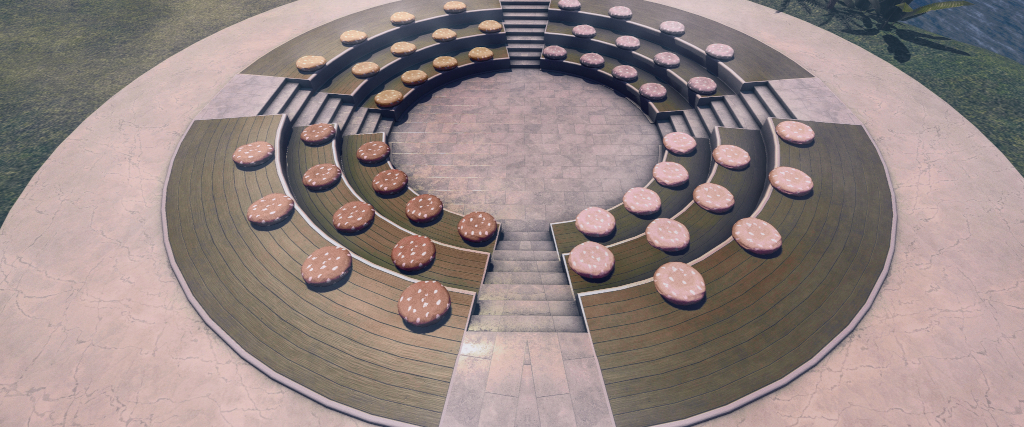
The PALM, August 2026 – click any image for full size
The start of the week saw an invitation arrive from Nomore (Manoji Yachvili) to visit her homestead region and latest art exhibition, Cellophane.
Whilst I was unable to make the opening due to pressures elsewhere, I was extremely pleased and surprised to receive it; earlier in 2026 Nomore had closed her Homestead region to public access, and had also offered what looked like being a final exhibition of her art, hosted by Dido Haas at Nitroglobus Roof Gallery (see: Of Inventory, art and the artist in Second Life). I was therefore keen to hop along and see both the region and the exhibition.
The PALM, August 2026
I’ve covered past iterations of Fading Shadows numerous times in this blog, and have always enjoyed how Nomore has blended natural setting, architecture and art to create a flowing sense of space and environment.
This is very much in evidence with this iteration for mid- 2026. Entitled The PALM, it presents a minimalist, windswept coastal area of sand and dunes into which the rolling tide has sculpted inlets and bays, and the slopes of the dunes and hills have been smoothed and rounded by the passage of the wind.
The PALM, August 2026
There is a sense of age to the setting, both in the way the sands have been so shaped, and in the fact that that an old stone watchtower guards one corner of the setting, the wreck of sailing ship caught on the shoals below it, guarded by an orca.
Across the region, to the north-east, the land becomes rockier, the sands rising to cleave to a table of rock on which sits Nomore’s private home, and the only part of the region off-limits to visitors.
The PALM, August 2026
These are not the only structures present within the region; Nomore has a captivating means of incorporating various architectural styles into her region designs which both perfectly fit the aesthetic and which can serve as a home to her art exhibitions. The PALM is no exception.
Scattered across the landscape are four modern building designs, each home to a themed exhibition of Nomore’s Second Life and physical world art. As with many of her past region designs, these have been blended into the setting through the use of texturing and materials – something perhaps most apparent here within the cliff house gallery on the north side of the setting.
The PALM, August 2026
Cellophane, Nomore’s latest exhibition is housed with Cory Edo’s Jura Cottage, a building I’ve oft considered playing with myself (still might!), which here again Nomore has superbly blended into the setting through careful retexturing of the base and some of the outer walls
The exhibition is – like many for Nomore – something of a reflection of personal feelings and outlook and accessible commentary designed to prod us into thinking about life and the planet around us. For me, this always makes Nomore’s exhibitions especially attractive; they are both visually and mentally engaging and multi-layered.
The PALM, August 2026
Cellophane offers food for thought on modern society and its outlook on a range of matters from global warming through to questioning the purpose of art, whilst gently reminding us that we are all stewards of this planet, and we all have a responsibility for actively caring for it.
In this the use of cellophane / plastic particularly layered; its convenience makes it both ideal for simple preservation, whilst at the same time it is one of the most ecologically damaging materials we can use and which we often so carelessly dispose. It is also a perfect metaphor for our willingness to be inactive participants (if you will) in expressing concern for the directions the world around us seems to be taking.
The PALM, August 2026
These thoughts and ideas have helped shape The PALM as a whole; reading the artist’s reflection on the exhibition sheds light on the nature of the region’s form and the idea of slow erosion. Thus landscape and art further come together.
In this, there is perhaps a wider contrast hidden without the quiet beauty of the region; particularly in the contrast between the flotsam and jetsam of human vacationing scattered over the sands and the quiet reminders of the beauty of life in all its forms in our oceans, and which can be glimpsed as we explore the landscape.
The PALM, August 2026
Which is not to say the PALM is all about Deep Thinking. Its minimalist beauty is captivating and photogenic; there are multiple places to sit and simply chat or enjoy the passing time; there are opportunities for padding out on the waters via little boats or have a little fun on a springboard.
Nor is the art within the region confined to the gallery spaces or even the ground. Elements of art have been carefully folded into the setting in the form of sculptures, whilst an active Experience operating within the region can be used to hop between the ground-level galleries and those up in the air over the region, which house Nomore’s personal collections of art.
The PALM, August 2026
In short, there are multiple reasons for visiting The PALM – and I very much hope that after reading this, you will hop over and see for yourself. My thanks to Nomore for the invitation, and apologies for no making the opening event!
The Simulator User Group meeting place at Longfellow
The following notes were taken from the Tuesday, August 11, 2026 Simulator User Group (SUG) off-week meeting (the “Leviathan Office Hour”). These notes form a summary of the items discussed, and are not intended to be a full transcript. They were taken from my chat log of the meeting. No video this week, as Pantera is on vacation.
Meeting Overview
The Simulator User Group (also referred to by its older name of Server User Group) exists to provide an opportunity for discussion about simulator technology, bugs, and feature ideas is held every other Tuesday at 12:00 noon, SLT (holidays, etc., allowing), per the Second Life Public Calendar.
The “Leviathan Office Hour” meetings are held on the Tuesdays which do not have a formal SUG meeting, and are chaired by Leviathan Linden. They are more brainstorming / general discussion sessions.
Meetings are held in text in-world, at this location.
Simulator News
As noted in my week #32 Simulator User Group meeting notes, the hot fix for some regions failing to grant capabilities correctly to the viewer (and thus crashing it) resulted in issues of its own, and so was rolled-back in week #32.
This means that while the more recent issues have been reverted, the original capabilities failure issue is again active, and people may find themselves being disconnected from regions and the viewer crashing.
Until a new fix for this issue can be deployed, if you are impacted by the viewer crash / disconnect issue and wish to log back into the same region, the advice is to wait a minute or two before attempting a log-in, as this may help.
Game_Control
There is unlikely to be much new for game_control during week #33, as Leviathan is the simulator on-call engineer, so dealing with general issues are his focus.
Leviathan noted that whilst game_control does allow an avatar to walk / run, depending on how much the control stick is tilted, however, it doesn’t (yet) have analogue directional input.
As has been previously noted, PromptFont is being used for the game_control preferences UI.
However, as Leviathan has modified a number of the PromptFont glyphs, the work falls outside the license for use under the name “PromptFont”. As a result, LL will need to provide an attribution (and payment) to PromptFont, as will need a name for the viewer implementation.
“PunctualFont” was suggested to reflect the improvements Leviathan’s improvements; but this (or something else, and several other suggestions then followed) has yet to be officially agreed upon.
In the meantime there is potentially more font work to be done with game_control.
Region Crossings
Pepper Linden is continuing to work on region crossings using Aditi (the Beta grid), apparently with a focus on double region crossings (stated by a user at the meeting, as Pepper was not actually available).
Leviathan noted that Pepper is working to make incremental improvements to region crossing, but their work is not, as yet, ready for merging into upcoming Main grid simulator code.
Lua Update
A surprising crash which appeared to be related to Lua and the Interest List was identified, but investigation revealed the issue probably the result of data corruption from a recently fixed Lua bug (the binary that crashed predated the Lua fix).
As a result of this, the Lua team are checking through Lua crashes to see if there are other issues lurking as a result of recent fixes.
Due to being on-call, Leviathan hasn’t had time to look at the llGetMapRegionTile(), face-count-mismatch bug, as he had hoped he would be able to.
However, as the on-call engineer, he has been directly involved in fixing potential exploits and griefing vectors, one of which is related to the use of a crasher within the Blake Sea regions and around some sandboxes.
There was a discussion about the UDP message template in the viewer potentially missing some messages sent by the simulator resulting in problems. This came as a surprise to Leviathan, and the issues has yet to b confirmed.
Shamone Beach, August 2026 – click any image for full size
I recently received an invitation from Robin Lobo to visit Shamone Beach and Shamone Surf, two regions within the estate operated by Sharon (Sharon Twist) under the Veteran’s Network banner.
Designed by Robin, the two regions – Shamone Beach being a full Private region leverage the available Land Capacity bonus and the Shamone Surf a Homestead – present a tropical archipelago neatly melding with off-region islands and the remaining regions in the estate (which fall outside of this article, although the SLurl to the main regions is supplied at the end; I’m uncertain if the islands in the remaining regions are public or private) to give a sense of wide open waters as might be found in a South Pacific cluster of islands.
Shamone Beach, August 2026
The largest island in the group takes up most of the north-west of Shamone Beach, presenting a rocky setting crowned by a private residence (clearly marked), with the rest of the island open to public exploration, complete with signs to help guide the way and avoid trespass.
To the east of the main island is a second island split between a rocky, tree-crowned hill and a humpbacked beach of golden sands. This neatly straddles the boundary between Shamone Beach and Shamone Surf, and provides access to the main physical attraction within the archipelago: surfing.
Shamone Beach, August 2026
Completing the group are three more islands marching across the southern extent of Shamone Beach, one of which is a sandy events and social space, able to keep its head above any tides long enough to grow a crown of stubby, grassy hair into which acacia trees have been able to transplant themselves.
The second of these three islands is dominated by the tall cone of a volcano. It is separated from the main This may have once been a part of the main island given the closeness and similarity of the rock formations, but if so, the sea has long since cut a channel between them. However, there’s no danger of the volcano upsetting the beauty of the setting with a rude eruption as it appears long extinct and its crater flooded. Between it and the events island a little round hump of sand pokes its head above the open waters as an island-beach retreat.
Shamone Beach, August 2026
The waters between the islands are relatively shallow – doubtless the reason why surfing can be enjoyed here as the waves coming in from deeper waters shoal and raise themselves up. However, the waters are far from deserted: orca, shark and stingrays are to be found swimming around and through them (so those opting to take a swim themselves might want to take a little care!), and alligators seem to be looking for a snack on the low hump of the events sand bar!
Passage between the three largest islands in the group is facilitated by a rope slide and footbridge for those who prefer not getting their feet wet, whilst bubble rezzers are to be found here and there for those wishing to drift around on the winds when passing between them – or when trying to reach the smaller isles.
Shamone Beach, August 2026
This is a place where relaxation and having fun are carefully stirred together to meet the needs of anyone seeking to just relax and share time under a warm Sun or who might wish to have some fun with various activities – surfing, riding a jet ski, swimming, dancing…
Places to sit and chill are to be found right across all of the islands; some are obvious (particularly along the beaches) others might take a little finding. Some spots might come as a surprise (I had no idea Hobbits enjoyed tropical holidays! 😀 ), and some might challenge those prone to vertigo! Those seeking the jet skis will find them moored in a little cover on the main island (keep inside the marker buoys when departing), or alongside the tiki house on the volcano island – the dock there also gives with opportunity to go swimming with a dolphin!
Shamone Beach, August 2026
I’m not really one for beaches and the like – not for holidays in the physical world, at least; I prefer to get out and about and explore 🙂 . This perhaps leaves me with an unfair bias against beachside resorts and the like in Second Life (whilst also perhaps explaining why I do spend a fair amount of time in-world exploring!).
However, when it comes to Shamone Beach and its surroundings, I really did enjoy wandering, poking, photographing and generally having fun. Robin has put a lot of care and attention into making the islands both relaxing and fun – and to ensure visitors can do both without ever feeling like they might be intruding on the privacy of the house on the top of the main island.
Shamone Beach, August 2026
The is genuinely a place offering something to see at pretty much every turn, be it a little place to sit and pass the time somewhere or the surprise of coming across a cosy hobbit hole or suddenly realising the shadow passing by you whilst swimming belongs to a gentle stingray, happy to leave you in peace if you do the same.
Do, however, mind the coconuts when wandering some of the beaches, as some of them can be very energetic. Some don’t so much fall from from their tree as they do launch themelves from it with gusto – as I found out whilst paddling in the shallows! 😀
Shamone Beach, August 2026
My thanks again to Robin for the invite – and for the delay in getting this piece written up; and also to Sharon for a brief chat during my more recent visit and before the Tuesday Restart Monster chased us both off of the islands!
Logos representative only and should not be seen as an endorsement / preference / recommendation
Updates from the week through to Sunday, August 9, 2026
This summary is generally published every Monday, and is a list of SL viewer / client releases (official and TPV) made during the previous week. When reading it, please note:
It is based on my Current Viewer Releases Page, a list of all Second Life viewers and clients that are in popular use (and of which I am aware), and which are recognised as adhering to the TPV Policy.
This page includes comprehensive links to download pages, blog notes, release notes, etc., as well as links to any / all reviews of specific viewers / clients made within this blog.
By its nature, this summary presented here will always be in arrears, please refer to the Current Viewer Release Page for more up-to-date information.
Outside of the Official viewer, and as a rule, alpha / beta / nightly or release candidate viewer builds are not included; although on occasions, exceptions might be made.
Official LL Viewers
Default viewer – 26.2.0.25386466510, May 19 -“flat” UI and font updates.
Release Candidate 26.3.0.30006559438, July 27 – quality of life improvements; performance improvements; bug fixes.
Kio Zen Garden, August 2026 – click any image for full size
Kio Zen Garden occupies roughly a quarter of a Full private region boosted by the Land Capacity bonus from LL. The work of Truebow Magic, it is a remarkable garden-temple-venue setting melding ancient Japanese architectural styling and modern aesthetics into a genuinely unique location.
This is a place very much a place of two halves: the ground-level areas, and the upper gardens. The latter sit on massive slabs of rock just above the former, extending out across the parcel from the cliffs which curtain off Kio Zen Garden from the rest of the region on two sides, supported by huge columns of rock like giant table legs.
Kio Zen Garden, August 2026
This is a design approach which can often come across as unnatural, giving rise as it does to large cavern-like spaces which are simply too regular to have any sense of having been naturally formed. However, that’s not the case here; such is Truebow’s design – including her choice of rock materials – that it is possible to travel through the entire setting without being aware of any sense of artificiality in its design.
Before going any further, I will note that Kio Zen uses a dedicated Shared Environment, and this really should be used when visiting, as it really brings out the depth of care which has been taken to blend materials, colour and form into the design. Given the nature of the region as a whole, I’d also suggest that a high draw distance is not required (particularly given Kio Zen is nicely screened from the rest of the region), nor is the use of shadows particularly required in order to see the setting at its best.
Kio Zen Garden, August 2026
The upper level, reached via two sets of wooden stairs, is split into three distinct areas. The largest of thee is a broad, flat Zen garden focused around a shallow body of water and given a sense of peace by a mix of surrounding high rocky cliffs, wooden curtain walls and the strategic use of bamboo.
Paths circle the outer reaches of this garden, with stone walkways providing the means to cross the central body of water, connecting several areas in which visitors might sit and pass the time. Wind chimes hang from frames and a mix of pagoda and paper lanterns illuminate paths and dapple the waters with light.
Kio Zen Garden, August 2026
The second elevated area is reached via a wooden walkway stretching across the northern side of the parcel close to the high cliff wall. Here the Zen garden theme continues, although the focus is very much on the temple occupying this space.
Crossing the walkway from garden to temple does reveal part of the lower elements of the setting and might give a hint of the unnaturalness of the base elements of both garden and temple if one is given to seeking them out – but the reality is, such is the work Truebow has put it blending rock with treetops, gardens (upper and lower), waterfalls and wooden walkways, everything does flow together naturally.
Kio Zen Garden, August 2026
The lower garden space between these two raised platforms forms one of four areas occupying the ground level of the parcel, with the focus within them being a mix of social spaces and the celebration of music. It is also where, for me, the magic of the setting is revealed.
These four areas can be broadly split into the aforementioned garden space, running north from the beach Landing Point, the Landing Point itself (where a teleport board might also be found), a second open garden space with the third upper section of the setting occupying its south-west corner, and a quite magnificent series of venue spaces and walks underneath and extended to either side of the rock table supporting the Zen garden.
Kio Zen Garden, August 2026
It is here that the sense of ancient-meets-modern permeates Kio Zen to great effect. Whilst home to spaces intended for music events, the structures under the rock are built in the shinden-zukuri style from Japanese classical history. This design emphasised open-sided geometric spaces linked by similarly open-sided walkways, the use of natural materials such a cedar wood for roof tiles rather than ceramics, and a minimalist approach to furnishings.
All of this is very much in evidence through these main structures, the high, sloping ceiling of which do much to hide the overhead rock (also helped by the clever use of large drapes over the overwise open-to-the sky roof ribs in places which both give the impression of being inside a building whilst further disguising the flat rock face above).
Kio Zen Garden, August 2026
Painted cloth and wooden side panels are also used, working with waterfalls and well-placed trees and plants to prevent the rock walls and columns from heavily intruding into the spaces and gardens spaced around the main sturctures.
Open to the sea at one end, and with side paths and walks stepping own off of the wooden halls and rooms, this area is genuinely stunning in its blending of styles, forms, architecture, nature, lighting, water and ancient and modern – but I’ll leave you to find “secret” lounge space tucked away within it!
Kio Zen Garden, August 2026The remaining lower garden space can be reached directly from the Landing Point. It offers an outdoor event area in the form of a cannabis garden (whether grown for recreational use or in reflection of the plant’s use in fibre production and Shinto rituals, I’ll leave you to decide!) and a further cavern topped by a garden space.
The cavern forms a further music space and hangout complete with outdoor deck seating at one end, just beyond a small jazz lounge which appears to be awaiting the arrival of the musicians. Above this, the flat garden space is crowned by an eye-catching ring of arched bridges spanning the tall columns of rock supporting the roof of the hangout. These are open to circumnavigation as well as connecting this corner of the setting with the paths leading to the Zen garden.
Kio Zen Garden, August 2026
There is much more that might be said about Kio Zen Garden, but the truth is it should be seen for itself. Every aspect of its design has been carefully considered, and it comes together as a physical work of art.
As the August 12, 2026 partial eclipse might be seen from the coast of Cornwall in the UK.
August 12, 2026 will see a total solar eclipse sweep across the Atlantic Ocean, the path of totality – in which the disk of the Moon completely covers that of the Sun as seen from Earth – extending down from the Arctic Ocean, across eastern Greenland and western Iceland before traversing the Atlantic to pass over northern Spain, the Balearics and parts of the Mediterranean before coming to an end as the Sun and Moon seem to part company once more.
The path of totality is not wide – just 393 kilometres across; but you don’t have to be completely within it in order to witness the eclipse. Countries to both the east and west will be witness to a partial eclipse, with much of western Europe – Scandinavia, the British Isles, France, the low countries, Germany and Italy in particular – will be treated to an evening partial eclipse to varying degrees, complete with a darkening of the skies as the disk of the Moon obscures a fair portion of the Sun, as if taking a bite out of it. For those in Europe who – weather permitting – would like to witness the event, here’s a quick outline of when and where to look and what to expect:
Start of eclipse time:
British Isles: 17:10 to 17:16 UTC (18:10-18:16 BST); maximum period of eclipse: 18:05-18:15 UTC (19:05-19:15 BST) – times varying according to latitude.
Europe: one hour later for either (UTC or daylight / summer time).
Direction of eclipse: west / north-west (depending on latitude).
Duration of maximum partial eclipse and percentage of Sun covered: 2-2.5 minutes, between 75% and 95% of the Sun’s disk covered.
Best coastal locations for observation: western coastal areas with uninterrupted sea views (e.g. west coasts of Ireland, Northern Ireland and Prembrokshire, together with the Scilly Isles and north coasts of Cornwall and Devon for the British Isles).
Best inland locations: elevated areas to avoid horizon obstructions.
Locations subject to total eclipse in Europe: the Spanish mainland cities of Bilbao, Santander, Valladolid, Burgos, Zaragoza and Valencia and their immediate surroundings, plus Palma, Mallorca.
If you do decide to watch the eclipse it is essential you follow safety guidelines, including:
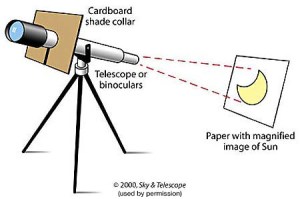
Projecting the image of a eclipse using a telescope. Credit: Sky & Telescope
NEVER look directly at the Sun with the naked eye OR when wearing sunglasses. The latter will not provide the levels of protection required, and looking at the Sun in either of these ways can result in serious eye damage.
If you plan to use solar eclipse glasses, make sure they are certified to ISO 12312-2. Also, if they are the kind with cardboard frames be sure to HOLD them in place; lightweight solar glasses can easily be dislodged by a breeze or by being bumped, potentially resulting in eye damage.
NEVER, EVER look at the Sun via a telescope or with binoculars without using a fully certified Sun filter system designed specifically for your equipment. If you do not have either, then use projection – position the telescope / binoculars so that the image of the Sun is being cast on a suitable flat surface (such a smooth pavement or piece of cardboard – be careful over over-heating the latter!) and observing the eclipse by watching the image, not by looking through the lens – see the image to the right as a guide.
NEVER look directly at the Sun with the naked eye or when using sunglasses, and certainly not via binoculars or a telescope or camera viewfinder / screen. ALWAYS use properly-certified solar glasses and solar filters suitable for the equipment you are using. Image credit: Getty library stock
Given European weather can be a pain at times (let’s face it, we may be in a heatwave, but that doesn’t stop Mother Nature from being awkward on the day and cluttering the sky with clouds!), and given the limited opportunities for really good viewing, the best way to witness the eclipse could be on-line. NASA live, for example will be showing the entire eclipse. and in mentioning NASA I should note that those in Eastern Canada and the United States will also be able to see a partial eclipse, but the coverage of the Sun by the Moon will be much less than will be seen from Europe.
A number of space-related and astronomy sites will also be either livestreaming or blogging the event with photographic updates, so Google is your friend for finding these.
nor is that all; August 12 marks what eclipse hunters are calling a “golden age” of total solar eclipses visible from more accessible locations around the world over the next decade. Some of these will be:
August 2, 2027: Spain, Gibraltar, Morocco, Algeria, Tunisia, Libya, Egypt, Sudan, Saudi Arabia, Yemen, Somalia, British Indian Ocean Territory.
June 22, 2028: Christmas Island, Cocos Islands, Australia, New Zealand.
November 25, 2030: Namibia, Botswana, South Africa, Lesotho and Australia.
March 20, 2034: Benin, Nigeria, Cameroon, Chad, Sudan, Egypt, Saudi Arabia, Kuwait, Iran, Afghanistan, Pakistan, India and China.
September 2, 2035: China, North Korea, Japan.
For the poor old British Isles, the next total eclipse to be directly visible across the countries will occur on September 23 – 2090!
Humans to Mars: The Risks of Deadly Dust
At some point in the (hopefully not-too-distant) future, humans will set foot on Mars. However for any nation or group of nations attempting this goal there are a number of challenges to be addressed, particularly in the areas of human psychology and welfare. One of those most frequently mentioned is that of radiation, both solar and galactic; however, whilst a major factor in planning for any human missions to Mars, the focus on radiation does tend to overshadow another equally hazardous issue: Martian dust.
Like the Moon, Mars is an extremely dusty environment. During Apollo, lunar dust caused numerous issues, from spacesuit erosion and compromising suit seals and joints, through getting into electrical and air circulation systems and causing overheating issues to most particularly getting into eyes, sinuses and ears to cause irritation, and into pulmonary systems where it could cause respiratory issues if not treated. Fortunately, the Apollo missions weren’t of a length where the health implications reached a point of any serious debilitation. On Mars, humans will face similar challenges, but to a much greater degree, both because of the nature of the dust and because of the duration of any mission.
Gene Cernan, the commander of the Apollo 17 lunar mission, photographed by crewmate Harrison Schmitt aboard the lunar module Challenger following their first surface EVA, December 11, 1972. Note the dust accumulation on his space suit. Credit: NASA / Schmitt.
While Martian dust – sometimes call “fines” on account of its extremely tiny nature and shape – carries similar and harmful silicates to those contained within lunar dust, it also carries perchlorates and metals like chromium, beryllium, arsenic, and cadmium, all of which are extremely toxic to humans and living cells. Given the duration of a typical humans-to-Mars mission (36-40 months), a crew continuously exposed to dust inhalation without proper precautions being taken, face potentially very serious health risks.
The concern is that future crews will be living and working in a closed habitat, repeatedly going outside, bringing dust back in on suits and equipment, in a low-humidity environment. That’s a condition in which small particles are more prone to becoming airborne and potentially inhaled, with crew members being exposed to fine respirable particles over many days, leading to a real possibility of developing cardiovascular and pulmonary illnesses – even cancers – within the lifespan of a mission.
– Shaunna Morrison, Associate Professor, Earth and Planetary Sciences, Rutgers University
Some of this can potentially countered through technology options such as the use of suitports and the use of high-filtration HVAC systems incorporating advanced and magnetic filters (Mars dust having high concentrations of metals, as noted). However, the Martian Dust Limiting Working Group – a cross-disciplinary group of scientists, doctors and engineers looking at the issue of Martian dust exposure – conclude that a lot of the risk mitigation is going to be via continuous regime of medication from daily intakes of vitamins through to things like iodine doses and supplements, together with the use of cough medicines and bronchodilators to manage inevitable periods of short-term inhalation.
One of the major takeaways from the Mars Dust Working Group is that Martian dust is a real crew-health and engineering issue, but it is also a tractable one if it is treated as a design requirement from the beginning. The best strategy is prevention first. Keep as much dust as possible outside the habitat, remove it quickly when it gets in, monitor airborne particles, and incorporate medical countermeasures into daily routine so crews are not purely relying on them as purely as a possibly limited after-exposure treatment.
– Shaunna Morrison
Layers of dust accumulated on the deck of the Mars 2020 rover Perseverance after 5 years of operations on Mars, July 2026.
This, coupled with the need for daily routines of exercise and training – particularly during the transit periods to / from Mars – is why those embarking on the initial missions to Mars and engaged in establishing a possible permanent human presence there will need to be highly trained and highly disciplined. They will be facing a range of potential health hazards and and psychological challenges which make the idea that anyone other than those who have undergone a broad range of physical and mental training and have the capacity to face the ardours of a 36-40 period of continuous living within a deadly environment can participate in such an undertaking a complete fiction.
Updates
Blue Origin Reveal NG-4 Explosion Cause
On May 28, 2026 during a pre-flight engine test while on the launch pad, the New Glenn rocket that was set to undertake the vehicle’s fourth flight exploded, destroying itself and the entire launch pad, and causing significant damage to the supporting infrastructure.
The moment of total destruction: the complete New Glenn rocket “stack” is destroyed on May 28, 2026 as 1,200 tonnes of propellants in the first stage tanks explode, sending a mushroom fire cloud into the sky over the Florida Space Coast. Via: AP News
Since that time, Blue Origin has been working to recover and rebuild the New Glenn launch facility at Cape Canaveral Space Force Station (CCSFS), and also carry out an investigation into what caused the explosion, said to have been in the one kiloton TNT range.
with regards to the latter, on Wednesday August 5, 2026, Blue Origin CEO Dave Limp reported via social media that the cause of the explosion has now been identified and is being addressed:
The anomaly originated at the main oxygen valve on one of the BE-4 engines, which was later confirmed by hardware recovery and inspections. Extensive component-level and engine hotfire tests have been conducted to understand the failure mode better and inform mitigations.
– David Limp, Blue Origin CEO
Work at Launch Complex 36, Cape Canaveral Space Force Station, Florida, destroyed in the NG-4 explosion, is proceeding apace. The current focus is on carefully dismantling the lightning conductor tower (centre), so that its damaged lower extremes can be replaced / repaired, prior to the tower being being rebuilt a a vehicle launch tower for future New Glenn 7×2 and 9×4 launches. Credit: Blue Origin
As a result of these tests and the forensic examination of vehicle wreckage, Blue Origin has made a series of modifications to the valve in question which will be incorporated in the production of future BE-4 motors and can be installed into the existing engines awaiting flight / reflight opportunities. This does not mean the FAA Mishap investigation into the explosion has been closed – additional fault tree analysis is continuing to determine if other factors may have been in play. However, Limp indicates that this is most like the key cause of the vehicle loss; as such, it would seem likely that the investigation will be formally closed in the next few months.
In the meantime, work on getting the launch facilities at CCSFS are now well in-hand, and Blue Origin remains of the opinion that the facilities and New Glenn could be ready to resume operations by the end of 2026.
Voyager 2: Instrument Shutdown Reprieve
Diagram of the Voyager spacecraft. Credit: NASA
It’s incredible to think that NASA’s twin Voyager spacecraft will, in a year’s time, mark the 50th anniversary of their respective launches (September and August 1977). The two craft are now so far from Earth (and travelling in interstellar space beyond the boundary of the solar system) it takes over a day for signals sent to or from them to be received.
Sadly, both vehicles are also dying – at least in terms of their available electrical power – as the reserves of plutonium within their radioisotope thermoelectric generators (RTGs) reach a point where the heat created through its nuclear decay becomes increasingly less able to generate the electricity required to power each vehicle’s science and other systems. As a result, NASA has been slowly turning off various instruments on each vehicle in the hopes of eking out power to keep the most useful (in interstellar space terms) functioning. In April 2026, for example, the Low-energy Charged Particles (LECP) experiment on Voyager 1 was shut down, leaving that craft with just 2 of its original 10 science systems functioning.
It had been expected that a similar move would have to be made with Voyager 2 in the second half 2026, to also leave it with only two functioning science instruments. However, in their latest piece of deep space engineering wizardry worthy of Montgomery Scott of the USS Enterprise, NASA engineers have worked out a means to re-route power through some of the spacecraft’s non-science systems at much lower levels than had previously been required, thus allowing power to be maintain to all three of the surviving science instruments.
Referred to by the mission’s engineering team as the “Big Bang” power change because of the risk it could figuratively blow up in their faces, this re-routing means that Voyager 2 now has enough electrical power capacity to run all three of its remaining instruments for up to a year before thought will have to again be given to shutting one down.
Voyager 2 is now being monitored to ensure there are no unwanted side-effects resulting from the change. Providing none are found, it is likely a similar operation will be performed across the 25.5 billion kilometres separating Earth from Voyager 1 so that it might continue to have sufficient electrical power to run its two surviving instruments for longer than had been anticipated.