Space Sunday: mini mission updates

An artist’s impression of the Psyche spacecraft en route to 16 Psyche. Credit: NASA

Due to launch in just under 2 months, on or shortly after October 5th, 2023, NASA’s Pysche mission is intended to explore the origin of planetary cores by studying the metallic asteroid of the same name.

The 14th mission in NASA’s Discovery programme, the spacecraft is currently going through the last of its pre-launch preparations, the latest being the installation and folding of its massive solar arrays.

With a total span of almost 25 metres and covering a total area of 75 square metres, these are among the largest arrays used on a NASA deep-space mission. They will be capable of generating 20 kilowatts of power during the early phases of the mission as the spacecraft departs Earth, where they will be primarily used for the purposes of vehicle thrust. However, Psyche is so far from the Sun that by the time the craft arrives, they will only be able to generate around 2 kilowatts – enough to boil two kettles side-by-side.
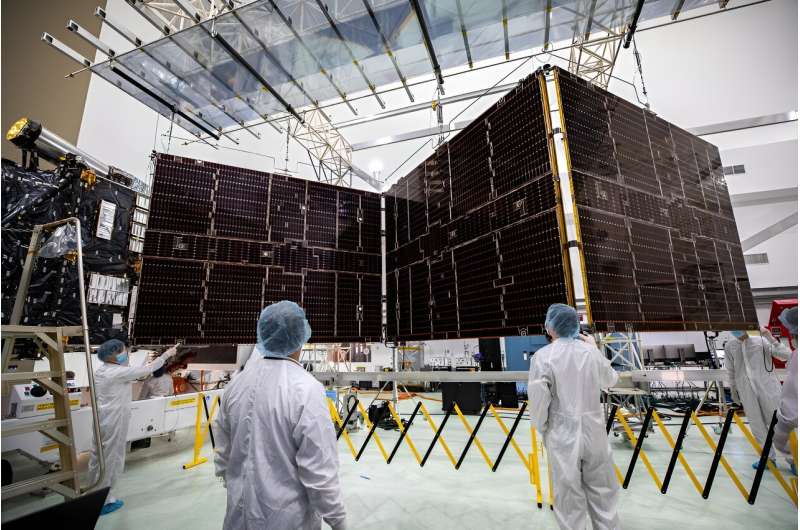
Technicians begin to retract one of the two solar arrays following its installation on NASA’s Psyche spacecraft. Credit: NASA/Kim Shiflett

For propulsion, the spacecraft will use four Hall-effect thrusters (HETs). Based on the discovery by Edwin Hall after whom they are named, these are a form of ion propulsion in which the propellant – most often  xenon or  krypton gas – is accelerated by an electric field. They provide an efficient thrust-to-propellant load ratio, allowing the spacecraft utilise a minimum propellant load – around a tonne – for the 5 year 10 months transit to asteroid 16 Psyche and the 21-month primary science mission.

The overall thrust produced by the HETs is equivalent to holding a single AA battery in the hand. However, as they can run for extended periods, they will be able to gently accelerate the spacecraft to 200,000 km/h during the 4 billion kilometre cruise out to the asteroid belt. They will also provide sufficient thrust to allow the spacecraft to slow itself and enter orbit around the asteroid in readiness to start its science mission.

16 Psyche is the heaviest known M-type asteroid – those with higher concentrations of metal phases (e.g. iron-nickel) than other asteroids – in the solar system. It was in 1852 by Italian astronomer Annibale de Gasparis, who named it for the Greek goddess Psyche, with the “16” prefix indicating it was the sixteenth minor planet to be discovered.
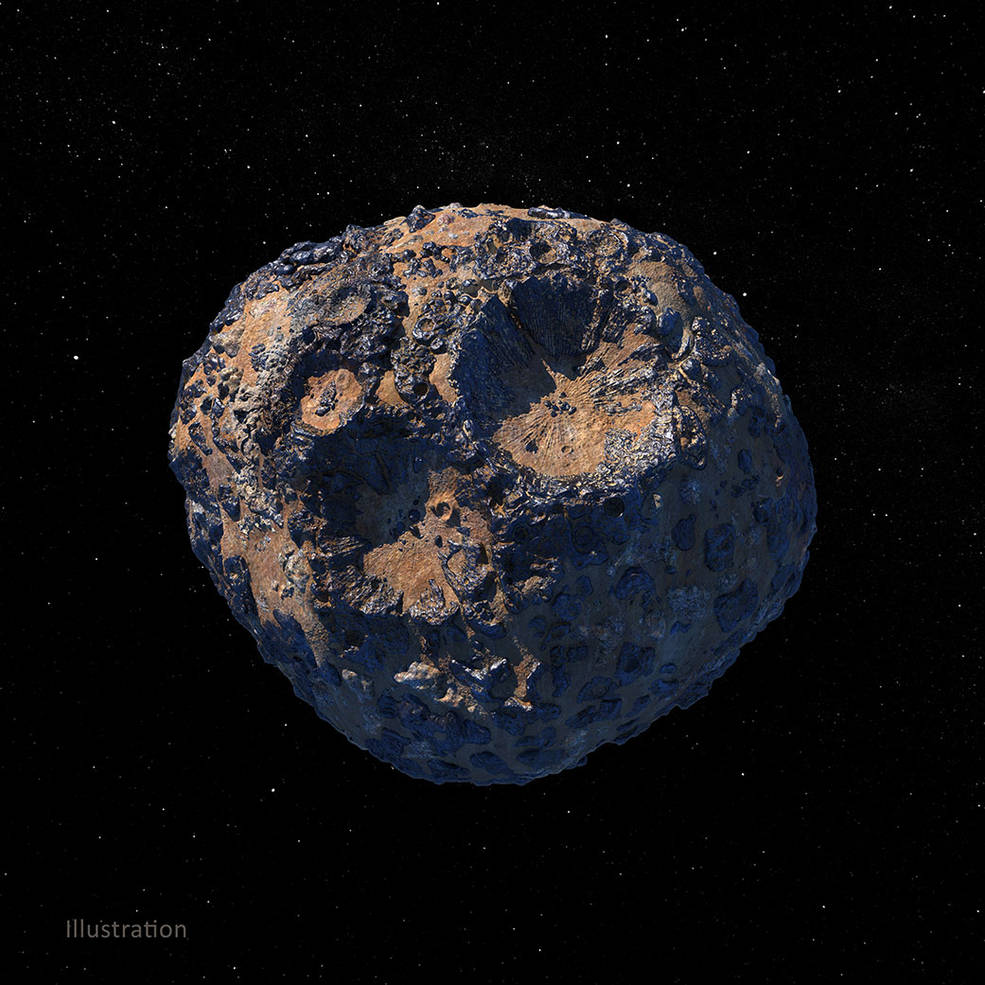
An artist’s rendering of 16 Psyche based on radar studies of the asteroid and albedo-based features witnessed through imaging. Credit: Peter Rubin/NASA

Initially, it was thought that asteroid was the exposed iron core of a protoplanet, exposed after a violent collision with another object that stripped off its mantle and crust. However, more recent studies lean heavily towards ruling this out – but it still might be a fragment of a planetesimal smashed part in the very earliest days of the solar system’s creation. As such, studying the asteroid might answer questions about planetary cores and the formation of our own planet.With the solar arrays installed and stowed, the next significant milestone for the mission will be the loading of the xenon propellant, which will occur over a two-week period starting in mid-August. This will be followed by the spacecraft being mated with its payload mount and then integrated into the upper stage of the SpaceX Falcon Heavy which will launch the mission from Kennedy Space Centre’s Pad 39B.

Euclid Arrives at L2 and Starts Commissioning Tests

The European Space Agency’s (ESA’s) Euclid space telescope has arrived in orbit around the Earth-Sun L2 Lagrange point, and commissioning of its science instruments has commenced.

As I noted in Space Sunday: a “dark” mission, recycling water and a round-up, Euclid is a mission intended to aid understanding of both dark matter and dark energy – neither of which should be confused with the other. Euclid will do this by creating a “3D” map of the cosmos around us, plotting the position of some two billion galaxies in terms of their position relative to the telescope and the redshift evident in their motion.

Animation of Euclid (purple) in a halo orbit around the the Earth-Sun L2 position (light blue), as seen from “above” and following launch from Earth (dark blue). Credit: Phoenix777 utilising data from ESA / NASA

From this, astronomers will be able to study the clustering effects of dark matter, the cosmic expansion of dark energy, and how cosmic structure has changed over time. It will be the largest and most detailed survey of the deep and dark cosmos ever done.

Following a 30-day transit from Earth, Euclid entered into orbit around the Earth-Sun L2 Lagrange point, 1.5 million km from Earth, at the end of July, and commissioning of its instruments – which had undergone power tests whilst en-route – commenced almost at once, with early result being released.

Over the next 6 years, Euclid will observe the extragalactic sky (the sky facing away from the bulk of our own galaxy) in what is called a “step and stare” method: identifying a section of sky and training both of its camera systems, one of which images in visible wavelengths and the other in infrared, before moving on to the next, generating “strips” on imaged squares.

The grid-like “step and stare” observation method Euclid will use to survey the extragalactic sky. Credit: NASA

In doing so, Euclid will capture light from galaxies that has taken up to 10 billion of the universe’s estimated 13.8 billion-year lifespan to reach us. In doing so, it will measure their shape and the degree of red shift evident, whilst also using the effects of gravitational lensing on some to reveal more data about them.

The data gathered is intended to help astrophysicists construct a model to explain how the universe is expanding which might both explain the nature and force of dark energy and potentially offer clues as to the actual nature of dark matter – the mass of which must be having some impact on dark energy as it pushes a the galaxies.

Commissioning images for Euclid’s near-infrared camera. Credit: ESA

In all, it is anticipated that Euclid will produce more than 170 petabytes of raw images and data during its primary 6-year mission, representing billions of stars within the galaxies observed. This data will form a huge database that will be made available globally to astronomers and researchers to help increase our understanding of the cosmos and in support for current and future missions studying the universe.

Curiosity Celebrates 11 Years on Mars by Completing Tough Challenge

Since arriving on Mars in February 2021, the Mars 2020 mission with Perseverance and Ingenuity has tended to overshadow NASA’s other operational rover mission on Mars, that of the Mars Science Laboratory Curiosity, which arrived within Gale Crater on August 6th, 2011.

In that time, the mission has scored success after success, doing much to reveal the water-rich history of the crafter – and the history of Mars as a whole. For the last several years the rover has been slowly climbing “Mount Sharp” – the 5 km tall mound at the centre of the crater – and officially called Aeolis Mons – revealing how it is the result of the crater being the home of several lakes during Mars’ ancient history.

With lower slopes at the top and upper sloped at the bottom, this image of Aeolis Mons (from NASA’s Mars Reconnaissance Orbiter) charts Curiosity’s climb to the ridge which caused it so much trouble (white lines, the dots showing individual Sols), with the multiple attempts to drive over it (the collection of dots in the middle of the image) and the eventually diversion around it which allowed the rover to enter the “Jau” crater field. Credit: NASA/JPL

Most recently, the rover has faced its toughest challenge yet: attempting to ascend a ridgeline setting between it and an area of geological interest dubbed “Jau”. From orbit, the ridge appeared to be difficult, but not impossible for the rover. However, it combined three obstacles which proved troublesome: a steep slope averaging 23o and which comprises a mix of sand dunes and boulders large enough to pose a threat to the rover’s already battered wheels.

Initial attempts to get over this ridge in April and June resulted in the rover hitting “faults”:  stoppages triggered automatically as the wheels start slipping, either as a result of the ground beneath them being too soft to offer traction meeting a resistance such as a too-large boulder they could not overcome. These forced the mission team to take a chance on a 300 metre diversion to try a point on the ridge which appeared to be less challenging.

The diversion proved worthwhile; despite taking several weeks to plan and execute, Curiosity managed to reach “Jau” – an area of multiple impact craters in close proximity to one another – in early July, and has been studying it at length.

Overcoming the ridge is a significant achievement for the rover, and clearly it means Curiosity should have something of a smoother passage to its next destination.

Continue reading “Space Sunday: mini mission updates”

2023 week #31: SL CCUG + TPVD meetings summary

Strandhavet Viking Museum, May 2023 – blog post

The following notes were taken from my audio recording and chat log transcript of the Content Creation User Group (CCUG) meeting held on Thursday, August 3rd, and the Third Party Viewer Developer (TPVD) meeting held on Friday, August 4th, 2023. 

Meetings Overview

  • The CCUG meeting is for discussion of work related to content creation in Second Life, including current work, upcoming work, and requests or comments from the community, together with viewer development work.
  • The TPV Developer meeting provides an opportunity for discussion about the development of, and features for, the Second Life viewer, and for Linden Lab viewer developers and third-party viewer (TPV) / open-source code contributors developers to discuss general viewer development.
  • As a rule, both meetings are:
    • Held in-world and chaired by Vir Linden.
    • Conducted in a mix of voice and text.
    • Held at 13:00 SLT on their respective days.
    • Are subject to the schedule set within the SL Public Calendar, which includes locations for both meetings (also included at the end of these reports).
    • Open to all with an interest in content creation / viewer development.
  • As these meetings occasionally fall “back-to-back” on certain weeks, and often cover some of the same ground, their summaries are sometime combined into a single report (as is the case here). They are drawn from a mix of my own audio recordings of the meeting + chat log (CCUG), and from the video of the TPVD meeting produced by Pantera Północy (which is embedded at the end of the summaries for reference) + chat log. Not that they are summaries, and not intended to be transcripts of everything said during either meeting.

Viewer News

No changes through the week, leaving the current official viewer in the pipeline as:

Note that the alternate viewer page also lists “Win32+MacOS<10.13 – 6.6.12.579987” as an RC viewer. However, the Win 32 + pre-Mac OS 10.13 was promoted to release status on July 5th, and viewer version 6.6.12.579987 points to the Maintenance S viewer, promoted to release status on May 16th.

General Viewer Notes:

  • The Inventory Extensions viewer has a couple of bugs which are preventing it progressing but are being worked on. There are also some simulator-side issues (inventory thumbnail images being dropped) which are also being addressed. However, this remains the next potential viewer for promotion to de facto release, alongside of the Maintenance U RC viewer.
  • The Maintenance U RC includes an extension to actions available when clicking on in-world objects. CLICK_ACTION_INVISIBLE effectively makes an object “invisible” to mouse clicks, allowing it to be clecked through to whatever might be lying behind it.  This functionality will be supported within the next simulator deployment, due in week #32.
  • The Emoji project viewer may see some font changes prior to progressing further (which may additionally require UI work in general) & is still adding further UI additions.

glTF Materials and Reflection Probes

Project Summary

  • To provide support for PBR materials using the core glTF 2.0 specification Section 3.9 and using mikkTSpace tangents, including the ability to have PBR Materials assets which can be applied to surfaces and also traded / sold.
  • The overall goal is to provide as much support for the glTF 2.0 specification as possible.
  • Up to four texture maps are supported for PBR Materials: the base colour (which includes the alpha); normal; metallic / roughness; and emissive, each with independent scaling.
  • In the near-term, glTF materials assets are materials scenes that don’t have any nodes / geometry, they only have the materials array, and there is only one material in that array.
  • As a part of this work, PBR Materials will see the introduction of reflection probes which can be used to generate reflections (via cubemaps) on in-world surfaces. These will be a mix of automatically-place and manually place probes (with the ability to move either).
  • The viewer is available via the Alternate Viewers page.

Further Resources

Status

  • LL is seeking feedback on how best to handle sky rendering. In short, ambient lighting is handled differently within “non-PBR” viewers and “PBR viewers” (notably, the latter uses HDR + tone mapping where the former does not).
  • As the majority of ambient environments have been designed using the “non-PBR” viewer rendering system, they undergo an auto-adjustment process within the PBR viewer so that that match the glTF specification requirements. Unfortunately, this can leave some skies / ambient lighting looking far too dark – and potentially lead to complaints from users on the PBR viewer (at least until more “PBR compliant” EEP assets make themselves available).
  • To compensate for this, LL included the option to disable the HDR / tone mapping processes in the viewer by setting Probe Ambience to 0 with Graphics preferences. However, doing this makes content specifically designed for PBR environments look muted and much poorer than they should. This brings with it the concern that to try to make their content look good in both “PBR” and “non-PBR” environments, creators will start to go “off-piste” (so to speak) from the glTF specification when making new content, thus defaulting the entire objective in trying to move SL to match recognise content creation standards.
  • There have been two main schools of thought within LL as to how to best handle both situations, these being:
    • Continue to iterate on the auto-adjustment system so it can handle a broader range of sky settings that are in popular use without them going overly dark within the PBR viewer.
    • Initially make HDR / tone mapping opt-in, rather than opt-out (so probe ambience is set to 0 by default, but can be set above zero by users as required) until such time as all viewers are running with PBR, then switch to making it opt-out (so HDR / tone mapping must be manually disabled).
  • General feedback at the meeting was for LL to continue to try to iterate and improve the the automatic adjustment to HDR / tone mapping for skies, so as to avoid the need for content creators to have to start producing “PBR” and “non PBR” versions of their content.
  • Outside of this, it has also been reported that multiple script-driven glTF materials updates (such has those that might be seen with the changing pattens on a disco floor, for example) actually cause multiple network connections, impacting network bandwidth to the viewer, which is hardly ideal.  This is currently being addressed, but until fixed on the simulator side, it will see a pause in glTF simulator updates being released.
  • The work on “hero” reflection probes for planar mirrors is continuing to progress.

Senra Discussions – CCUG and TPVD

Via the Content Creation Meeting:

  • A lengthy discussion on the Senra SDK and the requirement for Avastar with Blender – seen as a paywall block for creators who may not have previously entered the clothing market, but who want to in order to support Senra. Unfortunately, no-one directly involved in the Senra body development was at the meeting to handle questions.
    • Avastar is generally required with Blender as  the latter uses “none-standard” axes orientation compared to other tools, resulting in issues such as armature rotations being incorrect, plus its Collada export doesn’t (I gather, subject to correction here) support volume bones.
    • However, it was noted that other mesh bodies available within SL provide SDKs where these uses are fixed for Blender without the need to reference Avastar – so the questions were raised as to why LL haven’t done the same (or at least looked at those solutions).
    • The discussion broadened into issues with the avatar blend file itself which have long required fixing, with the promise that all comments on the SDK, Blender, and the avatar Blend file will be passed back to the relevant parties at the Lab.
      Those at the meeting from LL noted their hope that  – down the road – the switch from Collada to glTF-compatible formats will help to eliminate many issues related to avatar content creation, and if nothing else, will look to address specific issues . this, and that if nothing else, they will mark the need to fix the armature rotation issue with that work (“glTF Phase 2”) if it is not addressed beforehand.

Via the TPVD Meeting:

  • It was noted that there currently isn’t a formal venue for discussion Senra outside of the current forum threads or the Discord channel (for those able to access it.
  • The suggestion is currently to have a special purpose meeting – possibly under the CCUG banner – where those who developed Senra could respond to questions / concerns. This suggestion is being passed to Patch Linden who is better placed to arrange a meeting, given the Senra project largely falls within his remit.
  • There is a lot of concern / confusion over the SDK licensing (again, please refer to the forum thread on this for details).
  •  It was indicated that the Senra content will soon have inventory thumbnails included, ready for when the Inventory Extension viewer is promoted to release status.
  • Concerns about new users getting confused by wearing Senra items directly from the Library a) do not appear to be highlighted to indicate they have been added to the avatar (this is actually because the process of “wearing” the item has actually generated a copy within the user’s inventory, which *is* highlighted as added / worn); b) individual items added to an avatar in this manner go to the matching object class type system folder, *not* to a dedicated Senra folder (e.g. mesh clothing is copied to the Objects folder; skins go to the Body folder, etc.).

In Brief

Via the TPVD meeting

  • General discussions on:
    • Scalable fonts (as implemented by Genesis viewer).
    • How TPVs block older versions (for releases, the viewer requests a list of blocked versions from the TPV server in question (say, Firestorm, for the sake of argument), and if it finds itself on the list, it terminates trying to log-in to SL).
    • The move to de-dupe some asset types (textures, notecards, scripts  & (possibly) gestures by giving multiple CDN versions the same UUID number, including clarification on the difference between the original asset, the UUIDs for multiple versions and also inventory IDs (which handle permissions, etc.).
    • An extensive discussion on chat bubbles and toasts in the official viewer.
  • Please refer to the TPVD meeting video below for further details on the above discussions.

Next Meetings

† The header images included in these summaries are not intended to represent anything discussed at the meetings; they are simply here to avoid a repeated image of a gathering of people every week. They are taken from my list of region visits, with a link to the post for those interested.

Dropping into Sonder in Second Life

Sonder, August 2023 – click any image for full size

Located within the lake district of Heterocera, and folded into the Lake District Association, Sonder is a community-focused location mixing public spaces and private residences within a beautifully natural environment designed by Emm Vintner (Emm Evergarden of The Nature Collective fame) and Teagan Lefevre (of Le’eaf & Co fame), who have together with Teagan’s SL partner Cayleigh, taken over the management of the Lake District Association (LDA).

The LDA is a widespread community, encompassing multiple locations across Heterocera, with Sonder being the latest addition / development, as an information card available from a kiosk located close to the landing point explains:

The Lake District Association was originally founded by Lorenzo (wizardoznerol) and Kathena Mavendorf. Its members are owners and patrons of the lakes and waterways of Southwest Heterocera (or Atoll Continent). We are interested in the natural beauty and preservation of this unique area in Second Life. The Lake District area spans from Tethea and Or to the northwest, through Sesia, Andraca, Pruni, Enyo, Laothoe, Hector and Notata in the East and Gunda – which is our newest location.

– from the introduction to Lake District Association

Sonder, August 2023

Set back from the Atoll Road, Sonder’s Landing point delivers visitors within the paved square of a small town or village, a place split between elevations and presenting a mixture of shops, homes and buildings of mixed styles and materials which speak to a good degree of age and growth. At the lowest extent sits a large body of water marked by a fish market (I hate to use the term “seafood”, despite the sign, given the fact the water is landlocked, so fresh goods are liable to be well, freshwater in nature unless trucked in 🙂 ), a boat repair boat and the opportunity for fishing.

Above the lake, the main square offers the aforementioned kiosk for information on the LDA together with an experience-based teleport system providing access to points of interest and a bicycle rezzer for those who fancy a wheeled ride around the setting. Chief among the teleport destinations is the local micro brewery, located on the upper level of the village, a rentals board located just outside its sign-lit entrance.

Sonder, August 2023
The Lake District is home to communities, cafes, retreat centres, parks, trailer parks, swimming and boating areas, a launch into Linden ocean, dance club, soon to have church, and a bowling alley. So much is happening and constantly being added. The Lake District is a bustling place with a real heartbeat for SL living and play

– from the introduction to Lake District Association

One of the rental properties is also located on the upper terrace of the village, taking the form of an apartment block, so be sure to note the Private Residence sign to avoid trespass – similar signs mark the rental cottages in the open land beyond the village as well. This can be reached via dirt track passing an arch, stone steps running down to a path and trail running alongside the stream that passes through the landscape from the townside lake.

Sonder, August 2023

The track runs past a barn when a horse can be obtained by those wishing to ride around the setting – and beyond, if they so wish – stay mounted and us the map and it is possible to reach over nearby LDA locations.

Running westward, the trail runs past the local windmill-tuned-pub – with its cafés, pub and brewery, Sonder offers a richness of choice for those seeking a beverage or two! –  leading the way past the rental cottages to a communal barbecue terrace and game area. When following it, do keep an eye out for the beehives.

Sonder, August 2023
We are a relatively new group, founded at the beginning of April 2023. We want to see this area become a destination and a wonderful place to live, work and play. We appreciate and celebrate the unique beauty of the landscape of our area and are working to preserve and better the regions we live in.

– from the introduction to Lake District Association

Needless to say, given the partnership of Teagan and Emm, Sonder is a highly photogenic destination, one offer numerous things to do or see, and with room enough for those who wish to simply pass the time.

Sonder, August 2023

SLurl Details

  • Sonder (Gunda, rated Moderate)

August 2023 SL Web User Group (WUG) meeting summary

The Web User Group meeting venue, Denby

The following notes cover the key points from the Web User Group (WUG) meeting, held on Wednesday August 2nd, 2023. They form a summary of the items discussed and is not intended to be a full transcript. A video of the entire meeting is embedded at the end of the article for those wishing to review the meeting in full – my thanks to Pantera for recording it.

Meeting Overview

  • The Web User Group exists to provide an opportunity for discussion on Second Life web properties and their related functionalities / features. This includes, but is not limited to: the Marketplace, pages surfaced through the secondlife.com dashboard; the available portals (land, support, etc), the forums.
  • As a rule, these meetings are conducted:
    • On the first Wednesday of the month and 14:00 SLT.
    • In both Voice and text.
    • At this location.
  • They are open to anyone with a concern / interest in the above topics, and form one of a series of regular / semi-regular User Group meetings conducted by Linden Lab.
  • Dates and times of all current meetings can be found on the Second Life Public Calendar, and descriptions of meetings are defined on the SL wiki.

Marketplace

Re-Indexing for Listings Issue

  • An issue was discovered with MP product listings not showing up in search results or for store owners using their Manage Listing pages (although the product listing could be reached directly by entering its name).
  • This was traced to the items failing to be indexed correctly by the Marketplace service.
  • As a result, LL initiated a complete re-indexing of the MP at the start of week #31, and while it took time to complete, the issue should now be resolved and all product listing should be showing correctly via search, etc.
  • Those still encountering issues with their products should raise a Jira.

General

  • Best selling items ordering: when used within a specific MP store, this will in the near future order items according to how well they have been selling in comparison to the rest of the items in the store over the past 30 days, to better reflect current sales.
  • “Do Not Show Limited Quantities” in Search:
    • There have been requests to either have this option (shown in product search results at the foot of the left-side column along with Demos) enabled by default or limited quantity items should not be shown in Search results.
    • This has been requested primarily due to the issue of (new) users buying ex-gacha items without realising that are not buying from the original creator.
    • Given there are legitimate reasons for Limited Quantity items to be listed on the MP, excluding them from Search would be potentially  discriminatory.
    • Preferable solutions suggested were:
      • Retain the option and either reverse it – so it has to be enabled to include limited quantity items OR have whichever way the toggle is set stored within the user’s MP cookies, rather than the check box having to be be set against every search.
      • Add a further checkbox to specifically eliminate (or include, depending on the default setting) Gacha items from / with Search results.
      • LL implement a new product category – Limited Quantity – specifically for such products / items – although how well this would work is open to question, given there is a Gacha category which does not prevent those types of limited quantity items pitching up in Search results.
  • The above spread to a broader discussion on creators using unicode characters and punctuation symbols in their store names which actually makes it harder for them to show up in search results under the Merchants / Stores tab, unless a precise full or partial copy of their brand name is entered.
  • Listing Enhancement metrics: a request was made for those paying for Listing Enhancements to receive metrics (e.g. no. of times displayed, number of click-throughs generated, number of sales from click-throughs).
  • Product reviews:
    • A suggestion that LL should allow reviewers to just leave star ratings against items listed on the MP, as used to be the case with SL Exchange and is the case with Amazon.
    • A request for the MP to be open to reviews by those who have purchased a product in-world (and who may have used the MP as a form of catalogue to seek out items they then purchase in-world).
    • The ability to view an individual’s review history on the MP – allowing their fairness / bias to be better judged.
    • See also feature requests BUG-233138 “Social/Creator Focused Marketplace Feed” and BUG-233139 “A user-run first-line Moderation Tool”.
  • General discussions on:
    • The use of Favourites List and Wishlist options (e.g. Favourites List – as a means of quickly pulling up preferred brands and checking for new releases, requests for multiple Wishlists, etc., making lists more easily shareable other than by direct URL, etc.).
    • Preferred general Search results ordering (e.g. newest first or best selling).

Next Meeting

  • Wednesday, September 6th, 2023.

Looking at the Second Life Senra avatars

via Linden Lab

On Tuesday, August 1st, 2023, Linden Lab officially announced the release of the first of the Senra brand of starter avatars for Second Life. The announcement came perhaps a little later than had been planned – at SL20B, Patch Linden indicated the hope was to launch them in July – and more than a year since they were initially previewed at the SL19B event in June 2022.

Of course, the release of new “starter” avatars for Second Life is nothing new; there have been several such releases over the years – some of which have been covered in these pages. However, particular excitement  / interest has surrounded the Senra project, because it is the first time LL has developed a start avatar making full use of “modern” capabilities within Second Life, including the use of mesh bodies and heads, the rigging and animation capabilities presented by the extended “Bento” skeleton and capabilities such as Bakes on Mesh.

More particularly, the Senra avatars are coupled with a new approach to introducing new users to their avatars and to customising them, using a web-based process integrated into the overall New User eXperience (NUX), which commences with the sign-up process and continues through to bringing new users into Second Life via Welcome Hubs and Community Gateways.

The Senra folders in the System Library

Sadly, I’ve been unable to test this customisation process myself, so for that, I’ll have to direct you to the Second Life University video released alongside the formal announcement (and embedded at the end of this article). What I will say about it is that it is very mindful of that used with Sansar. Whether this is a result of taking lessons learned and replying them or purely coincidental, I’ve no idea; but if it is a case of the former, then I say good on LL for doing so, as the Sansar system always came across as easy-to-use.

For those who wish to try the new avatars directly, then as the official blog post notes, they can be obtained via the System Library. However, and if you have not yet done so (and while it may well be obvious to most) – do be sure to copy the folders from the Library into your inventory.

While it is possible to Add / Wear items directly from the Library, this will result in them being copied to your inventory anyway – but rather than remaining together, they’ll simply be placed in the system folder corresponding to their item type (eyes, shape, object, skin, tattoo layer…) thus scattering them throughout your inventory, rather than keeping them all nearly together.

This initial release for Senra – emphasis here because again, it is important to note that work on further avatars in the range, including anthro, are in development, as per Patch Linden’s comments at SL20B – is referenced as “Beta”; in other words, while it is officially released, feedback and lessoned learned from it will be applied to the new versions of Senra avatars as they are released.

In the meantime, this “beta” comprises two avatars: Jamie (female) and Blake (male).

In keeping with most avatar bodies and heads, they are supplied Copy / No Transfer + No Modify, and each, as supplied with this release, comprises:

  • A separate body and head. Both use the standard SL avatar UV Map using the universal channels and are fully BoM. Thus, they are reasonably compatible with most skin, tattoo and clothing layers.
  • A total of six shapes, skins (from bleached to really dark) and nail layers, eight eye colours and nine hair styles (a mix of hair objects and tattoo hairbases).
  • An identical range of clothing (tops, bottoms, skirts, etc.) for each avatar, sized to suit their basic shapes & with alpha layers for the fuller body forms.
    • Note that free additional colours of some clothing can be found at the kiosks within the SL Welcome Hubs (at the Avatar area inside the Second Life Academy).
  • A basic, HUD-style animation system with single-click stop / start capability.
The Blake and Jamie starter avatars

I don’t want to go overboard in discussing these avatars in detail; we’ll all form our own opinions on them over time – and there are others far better qualified to dig down into them than I. As such what I have to say here is somewhat subjective and intentionally limited.

The splitting of the avatars between head and body – given they were originally described as “all-in-one” back around the time of SL19B – is a good move. It allows those transitioning from these avatars to third-party options to split the expense (and learning curve) in doing so over an extended period (e.g. purchase a body first, get used to using it + its HUD, then later decide on a head), rather than having to do everything at once.

Whilst six shapes are provided, these actually split between three body sizes (which for ease of reference, I’ll call “thin”, “medium” and “broad”), and two facial feature shapes (again for ease of reference: “thinner” and “fuller”) to provide two broad sets of appearances: the “thinner” face with each of the three body sizes (shapes 1 through 3), and the “fuller” face with the three body sizes (shapes 4 through 6).

What a difference a skin makes. Left: Jamie with her default shape 4 and skin 4 (l) and the same shape with the skin supplied with the Monique starter avatar (r)

Some have critiqued the avatars  – notably the female – for not supporting heeled shoes. While Patch has indicated this may be added as an option in the future, not doing so actually makes sense in the context of new starters: have to reference a HUD system and find the option to angle the foot for a specific hell height isn’t entirely intuitive when the aim is to keep things as simple as possible.

For me, the weakness visual part of these avatars les with the skins, which lack a degree of depth and  – for Jamie at least – could have been much improved by the simple application of decent makeup in the texture, as demonstrated in the image above, which uses one of the older starter avatar skins suppled by LL (“Monique”).

Again, I can understand LL wanting to minimise items they provide so as to keep the door as open as possible for third-party content creators to join the Senra ecosystem; but surely something a little more attractive could have been provided for new users when it comes to Jamie;  something which lets them feel there avatar is at least reasonably attractive when compared to others. As it is, the blandness of the Jamie skins could leave those using it like they must immediately start spend, spend, spending to “get up to par” with others – or (as bad) feel their avatar is inadequate.

Additional Senra avatar items can also be found at the SL Welcome Hubs

My other niggle is with the animation system; I cannot fathom why LL felt a need to change a term that has been in use for almost as long as SL has been around (Animation Override). True, “Animation Controller is a more accurate term, but it still runs contrary to accepted terminology and could led to some confusion for new users – which Senra is supposed to minimise. Also, could not the animations be a little smoother or more natural?

With regards to third-party creators entering the Senra eco-system, applications for the Senra SDK, intended to allow them to obtain the SDK and do so opened a little ahead of the formal release of the avatars via a forum thread announcement.

This has prompted a lot of feedback related to the design and construction of these avatars which I’m far from technically competent to comment on. However, my own rough-and-ready comparisons using the Improve Graphics Speed floater – whilst not totally ideal in making such comparisons – suggest that overall, these avatars are not that bad when compared to other systems in terms of their overall load, even if they are perhaps not the most efficiently made.

The Jamie head (top) compared with the Lelutka Simone head (bottom, minus its separate eyes and teeth). Note the comparative faces / vertices  / VRAM counts which allow for a number of calculations by which to compare the two heads

The thread on the license agreement has also led to a degree of discussion on the extent of the requirement laid out in the agreement and its associated documents. I don’t want to drag this article out further by diving into things here, but I would say that some of the concerns raised (e.g. LL not allowing content for other head / body ecosystems) is born of a misunderstanding of Senra’s function (the system is for those new to SL and intended to offer a simplified road into avatar customisation – and providing multiple items for multiple bodies or heads could confuse new users), and a degree of over-wrought mistrust of LL born of a misapprehension around legal terms. However, for details, I’ll leave it you to to follow the thread and draw your own conclusions.

Conclusion

As with all avatar systems, Senra has its positives and negatives. What these are seen as will largely be a matter of personal experience and subjective analysis by most – as is the case with some of my comments here. As such, I’ll just close with a handful more of personal observations:

  • Are the Senra avatars an improvement on the “classic” ranges of starter avatars – absolutely.
  • Could the possibly be better? Well, most likely, yes. The devil is in the details, and I do feel this skimp on the most important detail – the skins.
  • Would I personally use one? No. But that’s because I have two bodies and four heads to play with on my main account and two heads and a body on my alt account, and they are more than enough.
  • Would I suggest friends still firmly glued to the the system avatar give Senra a go and see what they can make of them, mix and matching with items already in their inventory? Absolutely.


2023 SL SUG meetings week #31 summary

NordShore, May 2023 – blog post

The following notes were taken from the Tuesday,  August 1st Simulator User Group (SUG) meeting. They form a summary of the items discussed and is not intended to be a full transcript. A video of the entire meeting is embedded at the end of the article for those wishing to review the meeting in full – my thanks to Pantera for recording it.

Meeting Overview

  • The Simulator User Group (also referred to by its older name of Server User Group) exists to provide an opportunity for discussion about simulator technology, bugs, and feature ideas.
  • These meetings are conducted (as a rule):
  • They are open to anyone with a concern / interest in the above topics, and form one of a series of regular / semi-regular User Group meetings conducted by Linden Lab.
  • Dates and times of all current meetings can be found on the Second Life Public Calendar, and descriptions of meetings are defined on the SL wiki.

Server Deployments

  • On Tuesday, August 1st, all simhosts on the the SLS Main channel received the “Summer Blues” simulator update, comprising:
    • llGetPrimitiveParams will be able to identify animesh.
    •  The estate ban limit gets raised to 750, and the number of estate managers to 20, Not that the viewer-side changes to access these updates can be found in the Maintenance U(pbeat) RC viewer, listed in the Viewers section, below.
    • Two new LSL functions for LSD llLinksetDataDeleteFound and llLinksetDataCountFound.
    • Changes to UUID generation on certain items per my week 26 SUG meeting summary (e.g. textures, notecards, materials (particularly the upcoming PBR Materials)) to reduce the amount of duplication. These changes will not impact  UUIDs for objects rezzed in-world or made by the viewer.
    • Further work to correct some of the friends issues (as seen with BUG-232037 “Avatar Online / Offline Status Not Correctly Updating”). However, how effective these updates might be will not be fully understood until the update has been more widely tested through general use on Agni.
    • The update also included a certificate update for the simulators.
  • On Wednesday, August 2nd, the RC channels should all be restarted without any deployment.

Upcoming Simulator Releases

Simulator release now appear to be getting informal names (hence “Summer Blues”, above). The next up will be:

  • Dog Days – likely to include the unbinding of the Experience KVP database read / write functions from land (users will still require an Experience to access the KVP database), and set to be the next release to be deployed.
  • Bugsmash – currently with QA, and as the name suggests, contains a range of simulator-side bug fixes. It will also see the welcome return of visible RC channel names (now, if only we could see the return of server release notes ahead of the actual deployments).  Some of the fixes in this update comprise:
    • A fix in llRetunObjectsByOwner so that it won’t hit a throttle on large returns, and a fix to estate manage object return.
    • A change to the stack that gets displayed in the case of some script faults, intended to make it a easier to read.
    • A fix for the GroupMemberData cap giving out intermittently incorrect (but still well-formed) responses.
    • A minor fix about abandoned group land not showing correct previous owner.

Viewer Updates

No updates at the start of the week, leaving the current official viewers in the pipeline as:

Note: the alternate viewer page also lists “Win32+MacOS<10.13 – 6.6.12.579987” as an RC viewer. However, the Win 32 + pre-Mac OS 10.13 was promoted to release status on July 5th, and viewer version 6.6.12.579987 points to the Maintenance S viewer, promoted to release status on May 16th.

General Discussion

Please refer to the video for details on the following:

  • There is a general discussion on an exploit of llMapDestination().
  • BUG-234197 – “[PBR] Many duplicate material override messages for same object” – a potential need to throttle / omit scripted materials changes.
  • A further request was made for BUG-225228 “llStopAnimation is stopping all animations on detach instead of only the one specified” to receive LL TLC, together with requests for a series of other bugs and feature requests (such as the ability to click-through objects.
  • A question from Leviathan Linden on whether object inventory names – i.e. the names of items contained in an object – should be opened to allow leading / trailing whitespace. Short answer: “no”; suggestion, if whitespace alone is used in an object name, have the system replace it with the object type (e.g. object, notecard, texture, etc., possibly with a numerical indicator.


Note: there will be NO Simulator User Group meeting on Tuesday, August 8th, as the simulator team will be engaged in an internal meeting at the Lab.

† The header images included in these summaries are not intended to represent anything discussed at the meetings; they are simply here to avoid a repeated image of a rooftop of people every week. They are taken from my list of region visits, with a link to the post for those interested.