Currently open at The Glinka Gallery, operated and curated by Wolfgang Glinka, is an exhibition of original paintings by Serbian painter and digital artist, Lash VV. Entitled Animal Instinct, it marks his fourth show at the gallery, and focuses on one of his core interests as an artist: the natural world.
Located within one of the gallery’s halls, Animal Instinct is a collection of some 25 paintings of animals in the wild. It’s a selection that offers insight into Lash’s range as an artist, the pieces representing original works produced in oil, acrylics, watercolours, charcoal and ink drawings, drypoint, his skills with digital post-processing techniques and more.
The Ginka Gallery: Lash VV – Animal Instinct
These are pieces also representing their subjects in a similarly broad range of genres – still-life, impressionist, minimalist, abstracted – with each approach clearly balanced to best reflect the motion of its subject or captures the manner in which we tend to picture them in the mind’s eye. This gives each picture a depth and sense of life that can so easily capture the eyes – and also offer a hint of a story.
Take Dance of Love, for example. It captures two Japanese cranes in courtship, but more than this, though the the style, the minimalist use of colour, the piece offers a broader suggestion of the country itself. close by, Antelopes similarly captures the alertness of their subject while the light hatching of lines beyond them as all we need to see in order to be transported to the Serengeti.
The Ginka Gallery: Lash VV – Animal Instinct
Standing just inside the hall on the right is Fight, a beautifully raw piece, accompanied by a poem by Wolfgang entitled Rutting that equally captures the rawness of animal life in the wild.
Watched over by a 3D salamander also created by Lash, this is a wonderfully evocative selection of art guaranteed to capture the hearts of wildlife lowers.
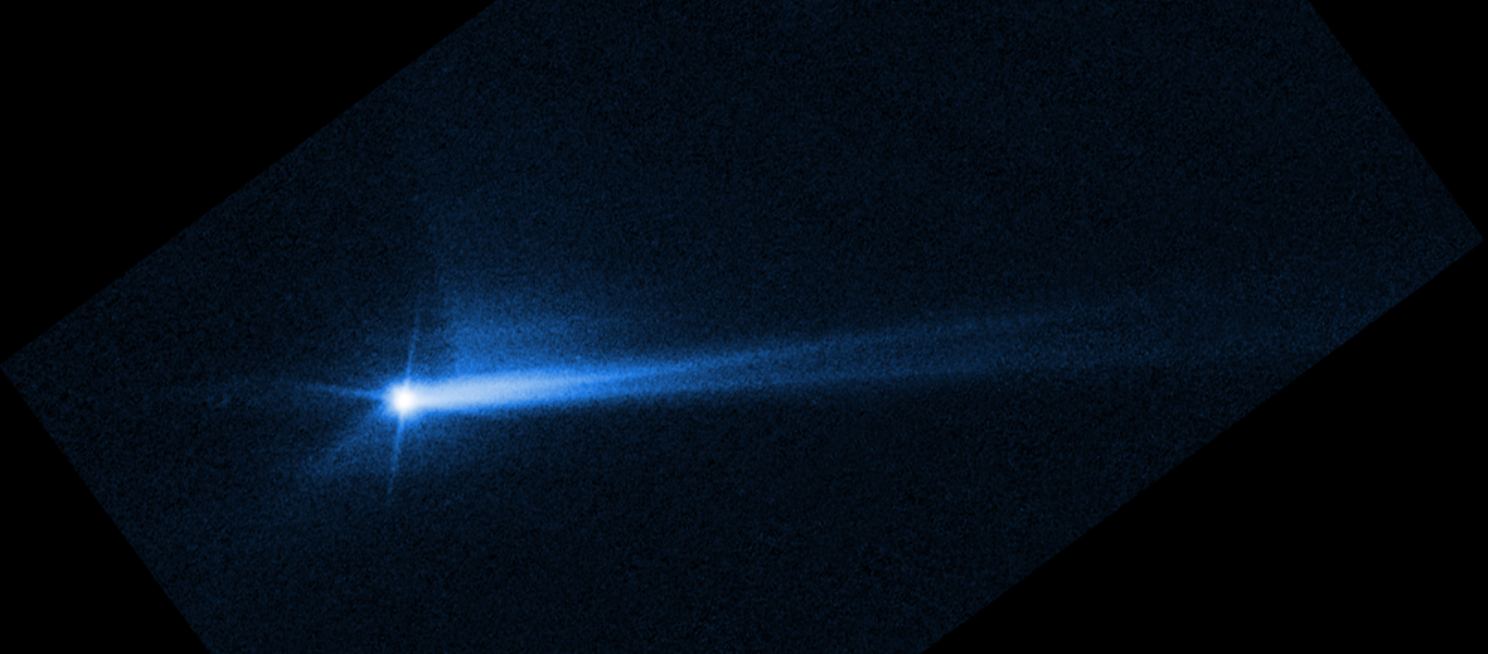
A Hubble Space Telescope image from Oct. 8 shows the debris blasted from the surface of an asteroid called Dimorphos 12 days after it was struck by NASA’s DART spacecraft. Credit: NASA / ESA / STScI / Hubble
The results are now in – to a degree – on the success of NASA’s Double Asteroid Redirect Test (DART) mission which has been the focus of my two previous Space Sunday updates.
An attempt to test the theory that a vehicle launched from Earth could successful divert the orbit of a near-Earth obit (NEO) threatening this planet with a collision simply through the kinetic force imparted through crashing into it, DART struck Dimorphos, a 160-m asteroid orbiting the much larger Didymos as both orbit the Sun every 2.11 years crossing and re-crossing Earth’s orbit.
As I’ve previously noted, Dimorphos was selected as a target as scientist know a lot about its orbits – it shares a stable solar orbit with Didymos, it had a near-circular equatorial orbit around Didymos once every 11.9 hours, allowing DART to strike it pretty much head-on, thus transferring all of its 22,530 km/h velocity into a force to counter Dimorphos’ own velocity and 5 million tonnes of mass.
Prior to the impact, the DART team indicated any change in Dimorphos’ orbit of Didymos of 73 seconds or more would be considered a success – although it would likely take a couple of weeks after the impact before the exact change in the asteroid’s orbit would be known, as detailed Earth-based observations would be required.
It turns out that DART didn’t affect the orbit of Dimorphos by seconds – by a whopping 32 minutes, altering it from 11 hours and 55 minutes to 11 hours and 23 minutes and also reducing the average distance between Dimorphos and Didymos. This strongly suggests such a mission, undertaken a the right time, could be an effective means of diverting an Earth-threatening asteroid. However, the team note further observations are required.
This result is one important step toward understanding the full effect of DART’s impact with its target asteroid. As new data come in each day, astronomers will be able to better assess whether, and how, a mission like DART could be used in the future to help protect Earth from a collision with an asteroid if we ever discover one headed our way.
– Lori Glaze, director of NASA’s Planetary Science Division.
One of the reasons DART may have had a much greater impact (no pun intended) on Dimorphos and give pause for further consideration is that while much was known about its orbit around Didymos, little was known about its composition. Post-impact, the images captured by the Hubble and James Webb space telescopes and Earth-based observatories suggest Dimorphos is essentially a ball of loosely packed gravel, dust and ice. Thus, DART’s impact was amplified by the jet of ejecta throw off of the asteroid. As such, it is unclear as to whether the impact would have had the same effect against a more closely-bound asteroid, such as those which are iron-rich.
A mosaic of enhanced imagery shows the material that was ejected from the asteroid Dimorphos as a result of the DART collision. The nested “windows” in the picture reflect how the exposure was adjusted to compensate for the brightness of the material. Credit; NASA
Given this, getting an early a warning as possible of a potential impact so that the threatening asteroid or comet could be struck at a point in its orbit where it is far enough from Earth, it only requires a slight alteration to its orbit in order to be deflected.
An upcoming mission that could achieve this is the Near-Earth Object (NEO) Surveyor. Due for launch in 2026, this Earth-orbiting observatory is specifically designed to seek out NEOs of 140 m diameter or larger which regularly cross Earth’s orbit around the Sun and come within 30 million kilometres of our planet while doing so.
An artist’s impression of the Near-Earth Object (NEO) Surveyor, due for launch in 2026. Credit: NASA
By using two heat-sensitive infrared imaging channels, the observatory will be able to make accurate measurements of NEO sizes and gain valuable information about their composition, shapes, rotational states, and orbits, allowing scientists and engineers to determine the best means to divert any that may come to present a real impact threat.
Gamma Ray Burst “The Most Powerful Flash of Light Ever Seen”
Astronomers just detected what may be the most powerful flash of light ever witnessed.
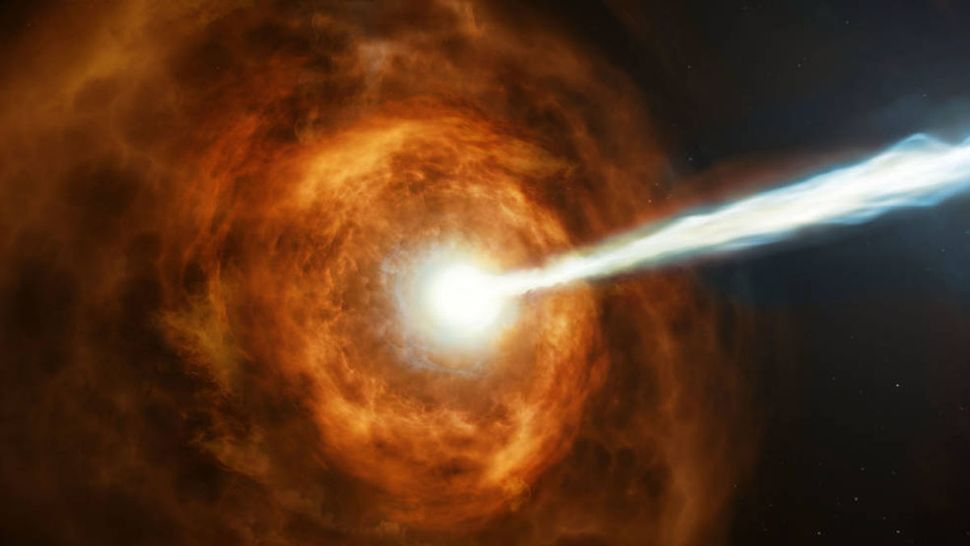
Gamma ray busts are the most energetic type of electromagnetic explosion known to exist in the universe. They are believed to come in two forms: short bursts, lasting around 2 seconds and believed to be caused by ultra-dense neutron stars colliding; and long bursts, lasting several minutes, believed to be caused by so-called “hypernovas”, – the death explosion of really super-massive stars prior to them collapsing into black holes.
Gamma-ray bursts are the most energetic flashes of light known to exist in the universe. Credit: NASA, ESA and M. Kornmesser
Up to 100 times brighter than supernovas, and therefore also referred to as super luminous supernovae, these latter blasts can give off as much energy in a minute or so as the Sun will generate throughout its 10 billion year lifespan.
The blast detected on Sunday, October 9th by NASA’s orbiting Neil Gehrels Swift Observatory, appears to have released 18 teraelectron-volts (TeV; one trillion electron volts) – almost double the energy of any such other burst thus far detected. In fact it was so powerful, it confused astronomers. Initially, it was believed the burst came from somewhere relatively close to the solar system and that it was an X-ray burst. It took additional analysis to confirm the flash was in fact a gamma-ray burst, and that it originated some 2.4 billion light-years away – which still makes it the closest such burst ever seen.
An artist’s impression of the explosion of SN 2006gy, a superluminous supernova. Credit: NASA
Officially designated GRB221009A, the burst was far enough away to cause excitement among astronomers rather than concern. However, should such a blast occur anywhere close to our stellar neighbourhood, it could very realistically end all life on this planet. In fact, it is believed that one of the biggest mass-extinction events in Earth’s history – the Late Ordovician mass extinction (LOME) event, which occurred 450 million years ago and eliminated up 60% of marine genera and nearly 85% of marine species in the second-largest mass extinction event of Earth’s history – may well have been triggered by such a blast.
Exactly which star caused GRB221009A isn’t known at this point, but it is so bright across all spectrums – X-ray, optical, radio and gamma – it is easy for observatories on Earth to monitor, allowing an extensive catalogue of data about it to be gathered.
When you are dealing with cosmic explosions that blast out stellar remains at near the speed of light, leaving a black hole behind, you are watching physics occurring in the most extreme environments that are impossible to recreate on Earth. We still don’t fully understand this process. Such a nearby explosion means we can collect very high quality data to study and understand how such explosions occur.
– Astronomer Gemma Anderson, Curtin University in Australia
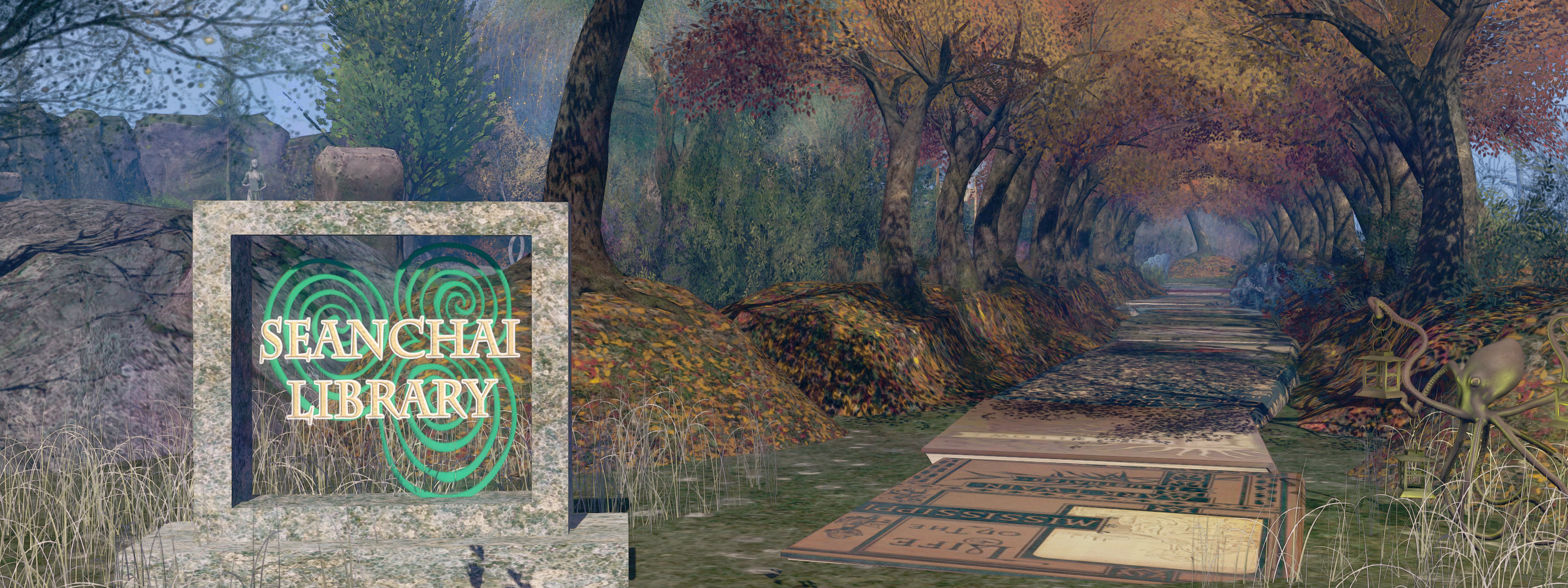
It’s time to highlight another week of storytelling in Voice by the staff and volunteers at the Seanchai Library – and this week previews the launch of a very special event.
As always, all times SLT, and events are held at the Library’s home in Nowhereville, unless otherwise indicated. Note that the schedule below may be subject to change during the week, please refer to the Seanchai Library website for the latest information through the week.
Sunday. October 16th, 13:30: The Halloween Tree, Part 1
On All Hallows Eve, young Pipkin is due to meet his eight friends outside a haunted house on the edge of town. But as he runs through the gathering gloom, Something sweep him away.
Arriving at the house in expectation of meeting Pipkin, his eight friends instead encounter the mystical Carapace Clavicle Moundshroud, who informs them that Pipkin has been taken on a journey that could determine if he lives or dies.
Aided by Moundshroud and using the tail of a kite, the eight friends pursue Pipkin through time and space, passing through the past civilisations – Egypt, Greece, Rome, the Celts – witnessing all that has given rise to the day they know as “Halloween”, and the role things like ghosts and the dead play in it.
Then, at length they come to the Halloween Tree itself, laden with jack-o’-lanterns, its branches representing the confluence of all these traditions, legends and tales, drawing them together into itself.
Two New York Police Department detectives investigate a series of suspicious deaths across New York City. These are revealed to be the work of a race of intelligent beings descended from canids, called the Wolfen.
The novel is told from the point of view of the human characters as well from the Wolfen themselves. The savage killing of two New York City policemen leads two detectives, a man and a woman bound together by a strange, tough passion, to hunt down the wolfen – once called werewolves.
Sophie has the great misfortune of being the eldest of three daughters, destined to fail miserably should she ever leave home to seek her fate. But when she unwittingly attracts the ire of the Witch of the Waste, Sophie finds herself under a horrid spell that transforms her into an old lady. Her only chance at breaking it lies in the ever-moving castle in the hills: the Wizard Howl’s castle.
To untangle the enchantment, Sophie must handle the heartless Howl, strike a bargain with a fire demon, and meet the Witch of the Waste head-on. Along the way, she discovers that there’s far more to Howl—and herself—than first meets the eye.
Caledonia Skytower reads Diana Wynne Jones novel.
Wednesday, October 19th, 19:00: Seanchai Flicks – Spooky Edition
Kondor Art Centre: Hermes Kondor – In The Edge Of The Dream
Now open at the Kondor Art Centre is the most engaging and fascinating series of digital art, presented by the Centre’s owner / curator (and exceptionally talented photographer artist in his own right), Hermes Kondor.
Located within the Centre’s Art Square, In The Edge Of The Dream is a collection of 20 images that combine themes of fantasy, flights of the imagination, the free thinking of childhood, and the freedom all of them can give us. Each and every one of these pieces carries an artistic and narrative richness that is completely stunning and captivating. More than paintings, these 16 works are portals to worlds of wonder, places of mystery and magic, halls of wonder and the marvels of the imagination unlocked when the mind – both in childhood and adulthood – is given the fullest freedom of thought and expression.
Kondor Art Centre: Hermes Kondor – In The Edge Of The Dream
The introduction to the exhibition can be found within a 17th image in the square in words from Hermes himself which are perfectly written and frame the exhibition beautifully. As such, rather than ramble on myself, I’m simply going to quote them here in the hope that in doing so, I can also help visitors frame their mindset in readiness for a visit.
Live the dream, transform yourself into it and discover the Reality of Fantasy.
The Magic is right there, living by your side and inside you. Let yourself be carried away by the Dream of Existing. Be enchanted, play with what you think is real and try to transform Life into Magic.
– Hermes Kondor
Kondor Art Centre: Hermes Kondor – In The Edge Of The Dream
Delight yourself with the Fantasy that dwells inside the Dream. Discover yourself, finding the other side of the Real. Complete yourself with your inner side and find the supreme Happiness that is right there with you, in the deepest dimension of Life.
Transform the Dream into Art and join me in the search for who we deeply are.
– Hermes Kondor
In addition to being presented in large format images, the painting in this collection are also available gathered into an in-world coffee table book – perfect for keeping the entire collection at home and being able to enjoy it even if you don’t have sufficient wall space for copies of the individual paintings. The book can be obtained from a table just a short walk from the exhibition’s introduction board – which I’m also using the landing point SLurl for the exhibition in this piece.
Kondor Art Centre: Hermes Kondor – In The Edge Of The Dream
A beautiful exhibition of digital art that really should not be missed.
The 2022 Second Life Sci-Fi Expo launched on Friday, October 14th, 2022, and will remain in orbit through until Sunday, October 23rd, in aid of The American Cancer Society and the Making Strides Against Breast Cancer (MSABC) campaign.
Active across four regions located alongside the American Cancer Society Island, this year’s even carries the theme of Voyage Through the Stars. These four regions are arranged as a single structure representing The Nexus, a massive space vessel and “crowning jewel of the United Earth Council fleet as it explores the vast reaches of interstellar space.”
The core of the build appears to be the vessel’s propulsion system, around which the almost spherical ship is constructed. Level with the mid-point in this vertical core is a broad deck ring running around the the circumference of the ship, which serves as the shopping precinct and home to the main event locations.
2022 RFL Sci-Fi Expo
The latter form a set of four smaller domes, comprising the the main landing point and information centre; the Raffle and Silent Auction, the ACS information hub and Memory Crystal garden, and the entertainment dome. All of the domes are connected via the shopping precinct, while the landing point dome has a set of teleport portals that can deliver visitors directly to any of the other three domes or to the main ACS island.
As with previous years, the expo presents a broad range of science-fiction related merchandise and daily entertainment and activities. The website sees a change in approach this year, with some information coming in the form of re-directs to Facebook pages, however, for ease of reference, here are the core links:
The website is perhaps a little light on specifics in places – a list of SLurls on the home page would be nice, as would actual details on the Quest – I can tell you it is called The Captain, the Governor and the Greslock, but little else other than you can join this in-world via the Quest vendors and point you to the list of prizes on Facebook, per above. Similarly, while events in the calendar can be clicked on for more details, a SLurl to the entertainment dome is sadly absent. But that said, the best way to appreciate the Expo is to pay it a visit, and I encourage all sci-fi fans do so!
About Making Strides Against Breast Cancer
Making Strides Against Breast Cancer is the American Cancer Society’s premier event to raise awareness and funds to fight breast cancer. But it’s more than just the name of a walk – it describes the amazing progress we’re making together to defeat this disease. Since 1993, four million walkers have raised more than US $280 million through Making Strides. Learn More.
Puppetry demonstration via Linden Lab – see below. Demos video with the LL comment “We have some basic things working with a webcam and Second Life but there’s more to do before it’s as animated as we want.”
The following notes have been taken from chat logs and audio recording of the Thursday, October 13th Puppetry Project meetings held at the Castelet Puppetry Theatre on Aditi. These meetings are generally held on alternate weeks to the Content Creation User Group (CCUG), on same day / time (Thursdays at 13:00 SLT).
Notes in these summaries are not intended to be a full transcript of every meeting, but to highlight project progress / major topics of discussion.
Project Summary
Previously referred to as “avatar expressiveness”, Puppetry is intended to provide a means by which avatars can mimic physical world actions by their owners (e.g. head, hand, arm movements) through tools such as a webcam and using technologies like inverse kinematics (IK) and the LLSD Event API Plug-in (LEAP) system.
Note that facial expressions and finger movements are not currently enabled.
Most movement is in the 2D plain (e.g., hand movements from side-to-side but not forward / back), due to limitations with things like depth of field tracking through a webcam, which has yet to be addressed.
The back-end support for the capability is only available on Aditi (the Beta grid) and within the following regions: Bunraku, Marionette, and Castelet.
Puppetry requires the use of a dedicated viewer, the Project Puppetry viewer, available through the official Second Life Alternate Viewers page.
No other special needs beyond the project viewer are required to “see” Puppetry animations. However, to use the capability to animate your own avatar and broadcast the results, requires additional work – refer to the links below.
There is now a Puppetry Discord channel – those wishing to join it should contact members of LL’s puppetry team, e.g. Aura Linden, Simon Linden, Rider Linden, Leviathan Linden (not a full list of names at this time – my apologies to those involved whom I have missed).
Bugs, Feature Requests and Code Submissions
For those experimenting with Puppetry, Jiras (bug reports / fixes or feature requests) should be filed with “[Puppetry]” at the start of the Jira title.
New Viewer Version – 6.6.3.575529 Dated October 12th
This viewer uses a different, more efficient data format sending updates up to the region, and from the region to viewers.
The new and old formats and viewers are not compatible; someone on the new project viewer will be unable to see puppetry rendered for someone using the older viewer version, and vice-versa.
It is hoped that severe breakages between viewer versions like this will be avoided going forward, but this change was deemed necessary
This viewer also a crash (deadlock) fix, and puppetry animations should fade in/out when starting or explicitly stopping (animations may stop abruptly should the LEAP plugin crash, or the data stream is lost, etc.).
Those self-compiling viewers with the puppetry code should ensure they are pulling the updated code from the 6.6.3.575529 (or later as new versions appear) repositories.
Protocol Overhaul
Leviathan Linden Linden noted the project team is going to overhaul the Puppetry/LEAP protocol.
The intent is to replace all the current LEAP commands (“move”, “set_this”, “set_that”, etc.), and replace with just two commands: “set” and “get”.
On the “set” side:
It will be possible set avatar joint transforms, or specify IK targets, and also set various configuration settings as necessary.
These set commands will be “incremental” in nature (so that changes can be made to reach the final state), and once set, they stay at the defined value until modified, cleared, or the plug-in “goes away”.
On the “get” side:
get_skeleton and any other get_foo commands (if used) will be replaced with {get: [skeleton, foo, …]}.
A message will be generated and set back to the viewer making the Get request, but the form of the message is still TBD.
Meanwhile, the viewer will only do IK for your own avatar, and will transmit the full parent-relative joint transforms of all puppeted joints through the server to other viewers, and LL will make it possible for a plug-in to just supply full parent-relative joint transforms if desired (e.g. no IK, just play the data)
This overhaul will also provide:
A way to move the Pelvis. This will include both a pre-IK transform (which is just setting the Pelvis transform) and also a post-IK transform, in case the avatar is to be moved after setting all the joints.
A “terse” format for the LEAP/Puppetry protocol to simplify some “set” commands to reduce data going over the LEAP data channel. It will be possible to mix these “terse” command with long-form explicit commands.
Leviathan plans to break all of this work down into a set of Jira issues and place them on the kanban board for ease of viewing.
The overall aim of this overhaul is to make the protocol more easily extendible in the future.
To the above, Simon Linden added:
The data stream is radically different than what we started with. Essentially your viewer will do the work for your avatar: send[ing] all data needed for your puppetry animations [so] the people seeing you just have to use those positions – no IK or significant processing. That should help out in the long run with crowds
Example Script
Simon Linden has produced a simple example script that is pushed to the Leap repository:
It reads a JSON file and sends that puppetry data to the viewer.
Using it, is is possible to edit some values, save the JSON text file, and see bones move as an example of doing so.
In Brief
BUG-232764 “[PUPPETRY] [LEAP] Puppetry should be able to ‘Get’ and ‘Set’ avatar camera angle” has been raised to go with the protocol overhaul, and while it has yet to be formally accepted, has been viewed as a good idea by the Puppetry team.
Puppetry does not support physics feedback or collisions as yet, and work for it to do so is not on the short list of “things to do next”
There is currently an issue of “near-clipping” within a a first-person (e.g. Mouselook) view and using puppetry (so, for example, holding a hand up in front of your avatar’s face in Mouselook results in the hand being clipped and now fully rendering). This is believed to by an artefact of the viewer still rendering the head (even though unseen when in first-person view), and this interfering with rendering near-point objects like hands. The solution for this is still TBD.





 On All Hallows Eve, young Pipkin is due to meet his eight friends outside a haunted house on the edge of town. But as he runs through the gathering gloom, Something sweep him away.
 Sophie has the great misfortune of being the eldest of three daughters, destined to fail miserably should she ever leave home to seek her fate. But when she unwittingly attracts the ire of the Witch of the Waste, Sophie finds herself under a horrid spell that transforms her into an old lady. Her only chance at breaking it lies in the ever-moving castle in the hills: the Wizard Howl’s castle.


 Inara Pey: Living in a Modemworld