Logos representative only and should not be seen as an endorsement / preference / recommendation
Updates from the week ending Sunday, February 20th, 2022
This summary is generally published every Monday, and is a list of SL viewer / client releases (official and TPV) made during the previous week. When reading it, please note:
It is based on my Current Viewer Releases Page, a list of all Second Life viewers and clients that are in popular use (and of which I am aware), and which are recognised as adhering to the TPV Policy. This page includes comprehensive links to download pages, blog notes, release notes, etc., as well as links to any / all reviews of specific viewers / clients made within this blog.
By its nature, this summary presented here will always be in arrears, please refer to the Current Viewer Release Page for more up-to-date information.
Note that for purposes of length, TPV test viewers, preview / beta viewers / nightly builds are generally not recorded in these summaries.
Official LL Viewers
Release viewer: Mac Voice hotfix viewer 6.5.2.567427, dated January 13 – no change.
Gem Preiz: Exoplanet: One Step Further, February 2022
Wednesday February 22nd, 2022 saw the opening of the first half of a 2-phase art installation by Gem Preiz. Presented under the over-arching title Exoplanet, the installation carries the sub-title One Step Further, and is located on a sky platform within the region of Akikaze, held and curated by Akiko Kinoshi (Akiko Kiyori) as a part of her “Akipelago” group of regions.
This is another exhibition by Gem that combines a prim-base build with his always fascinating fractal images; as such it follows in the tradition of past installation such as Arcadia, Skyscrapers, Elusive Reality, Sapiens, and The Anthropic Principle, allowing the visitor to consider an architectural theme and / or enter an immersive environment in which his fractal art offers an extension to the environment. At the same time, it is also something of a harkening back to installations such as No Frontiers, his two-part series Heritage: Vestiges and Heritage: Wrecks and Rhapsody in Blue Fractals, in which the fractal images are the nucleus of a tale – a journey, if you will, of the imagination to futures and places within the cosmos that await our discovery.
Gem Preiz: Exoplanet: One Step Further, February 2022
In terms of the the build, this takes the form of a human outpost on another world. Where this may be is anyone’s guess; the environment outside suggests Mars, but that belies the main title for the exhibition – Exoplanet – so I prefer to think of it as somewhere beyond our solar system. It’s a curious place, sitting within a geodesic dome (which for me carried echoes of a much smaller dome sitting within Gem’s Skyscrapers city), powered by solar arrays which sit alongside a communications array beyond its curving walls.
In all, 14 different locations can be explored within the dome, either on foot or via the teleport HUD that is offered to visitors on arrival (and which contains a 15th destination – a point just outside one of the dome’s access points). These range from a control centres through to crew habitation units, although not all of the buildings are necessarily accessible. Within the base are also a number of vehicles: shuttles, hover cars and tracked rovers, which can be sat upon and driven, adding a dimension of fun, while the base is staffed by static NPCs that have a slight Star Trek edge to their uniforms.
Gem Preiz: Exoplanet: One Step Further, February 2022
A point to note here is that the base isn’t supposed to be in any way “accurate” in its representation of a stellar outpost, as Gem explains in the installation’s introductory notes:
Exoplanet does not intend to look realistic or even consistent from a scientific point of view. Rather, it aims to create an immersive 3D environment which evokes space exploration. It deliberately uses, as with all my builds, prims with their SL attributes (bumpiness, shininess, alpha etc.), and does not rely on meshes or textures to reproduce reality — except for crew avatars.
– Gem Preiz
Gem Preiz: Exoplanet: One Step Further, February 2022
Turning to the art, a total of 18 pieces are offered within the installation and can be seen in one of two ways: via a large screen that hangs to one side of the dome, the 18 images displayed on it as a slide show, or by visiting the needle-like Tower that faces the screen from across the dome, where the images are displayed across several floors connected one to the next by wall-mounted teleports (note also that this tower also incorporates the Observation and Headquarters destinations on the teleport HUD).
While they may not necessarily all be new, these are pieces that all tell a story that is literally cosmic in its theme, carrying us to strange, new worlds orbited by vast space station-like structures, or upon which a civilisations has created massive cities and structures, and out into deep space where more structures are huddled – but whether they under construction or damaged and broken by events unknown and their age or finished articles built to some strange design ethos, is left entirely to our imaginations.
Gem Preiz: Exoplanet: One Step Further, February 2022
With the facilities under the dome suggesting a human base sitting beyond our solar system but still on the very edge of the rest of the galaxy, the images present suggestions of both humanity’s journey to reach this point in history (BZ Fractal SF9, BZ Fractal SF18, BZ Fractal SF1 and BZ Fractal SF13), and of the far older alien civilisation whose remnants have both drawn humans to the remote location in the inky blackness of space, and which even now is the reason the people of this base are preparing to venture still further from their homeworld.
There is another aspect here as well, as again noted by Gem in his introductory notes:
The purpose of the combined mixture of fractals and 3D interactive build, is to make them resonate : the space base offers an immersive 3D experience, even if it is in a simplistic environment, while the fractal images show a complexity impossible to reproduce in 3D.
– Gem Preiz
Gem Preiz: Exoplanet: OneStep Further, February 2022
All of which makes for an engaging exploration. When visiting Exoplanet: One Step Further, be sure to not the recommended environment setting displayed at the landing point. And for those interested, Gem has produced another of his soundtrack videos on You Tube, which offers a mixes of pieces that contain within them echoes, perhaps of M83 and Hans Zimmer.
On February 18th, 2021, NASA’s Mars 2020 mission arrived in Jezero Crater, Mars to commence operations.
In the year since then, the 1 tonne Perseverance rover and its tiny companion, the 1.8 Kg helicopter drone Ingenuity, have achieved a tremendous amount, with Ingenuity far exceeding expectations and the rover really still in the earliest phase of its mission (it’s “sister” rover, Curiosity has now been exploring Gale Crater on Mars for over nine years).
Currently, Perseverance is close to wrapping up its first science campaign, studying the basin of the 45 km wide Jezero Crater, a place believed to have once been the home of a lake billions of years ago, and which features some of the oldest rocks scientists have been able to study up close via a rover.
Nor is the rover studying those rocks purely in situ. As I’ve reported in these pages, the rover has been gathering samples in seal containers which – much later in the mission – be deposited in at least one cache on the surface of Mars to await collection by a hoped-for future sample return mission.
So far, six samples have been gathered, and while Martian pebbles got caught in a part of the sample transfer mechanism in January (see: Space Sunday: pebbles, ALH84001 and a supernova) suspending further coring operations, these were finally cleared at the end of the month, leaving the way clear for the rover to collect two more samples in the next couple of weeks.
A raw (unprocessed for Earth lighting conditions) image taken via the forward Hazard Avoidance Cameras (Hazcams) on NASA’s Mars 2020 rover Perseverance as it uses its robot arms to examine an area of exposed rock dubbed “Rimplas” during the rover’s return trip to its landing point. This image was captured on February 8th, 2022 (Sol 345 for the mission). Credit: NASA/JPL
These will come from a type of dark, rubbly rocks seen across much of the crater floor and which have been dubbed Ch’ał (the Navajo term for “frog”). It is hoped that if returned to Earth, samples of these rocks could provide an age range for Jezero’s formation and the lake that once resided there.
The samples Perseverance has been collecting will provide a key chronology for the formation of Jezero Crater. Each one is carefully considered for its scientific value.
– Thomas Zurbuchen, associate administrator of NASA’s Science Mission Directorate
As well as gathering and assessing samples, Perseverance has used the MOXIE (Mars Oxygen In-Situ Resource Utilisation Experiment) to produce oxygen from the Martian atmosphere – such capabilities will be vital for future Mars missions, not only for producing oxygen, but also methane fuel.
The rover also recently broke the record for the most distance driven by a Mars rover in a single day, travelling 320 metres on February 14th, 2022. This was achieved using the AutoNav software that allows Perseverance to find its own path around rocks and other obstacles.
Having spent the first year of operations studying the crater floor, Perseverance recently started heading towards one of the major features within the crater, a large river delta that once helped feed water into the crater.
On Earth, river deltas are great at preserving carbon-containing organic compounds – the building blocks of life as we know it. As such, much of the rover’s second year on Mars will be spent exploring and study the Jerero river delta.
We are incredibly excited to finally get to the delta [it is] the reason we chose the landing site, and we hope to get to it later this spring. Once we’re there, we’ll be able to look at the bottom of the ancient lake that once filled Jezero to search for signs of ancient microbial life, and we plan to spend the whole next year travelling through the ancient lake deposits and ancient river deposits that are within the delta.
– Briony Horgan, associate professor of planetary science at Purdue University
In order to reach the delta, Perseverance has been backtracking from a rugged part of the crater floor called “South Séítah”, which it has been exploring for the last several months, and will return to its landing site – now called Octavia E. Butler Landing – in the next two week or so. From there, it will drive west to reach the delta region.
While this might sound a long-winded way of doing things, the fact is that the route back from “South Séítah” is known and therefore “safe”, and the landing site provides direct access to the river delta. Whereas going “cross country” from “South Séítah” to the delta would take the rover across a dune field, with the risk of it becoming stuck.
Exactly where the rover will start its studies in the delta has still to be determined, as there are several points of interest that have already been spotted by the science team. One of these is a hilly feature dubbed “Kodiak Hill”, which the rover imaged from the landing point just after it arrived on Mars, and which could provide a good vantage point from which to properly survey the delta as a whole.
It’s likely a final determination of where to go to first with the delta may be made with the assistance of Ingenuity.
Having completed its regime of five test flights early in the mission, during which Perseverance was relegated to the role of passive observer, the little drone has completed a total of 19 flights and doesn’t show any sign of stopping. While there had been some concern that a recent dust storm might impact its ability to obtain sufficient sunlight to keep its batteries charged, Ingenuity came through in good condition and, once its batteries had been fully charged, proved itself to be able to take to the air once more.
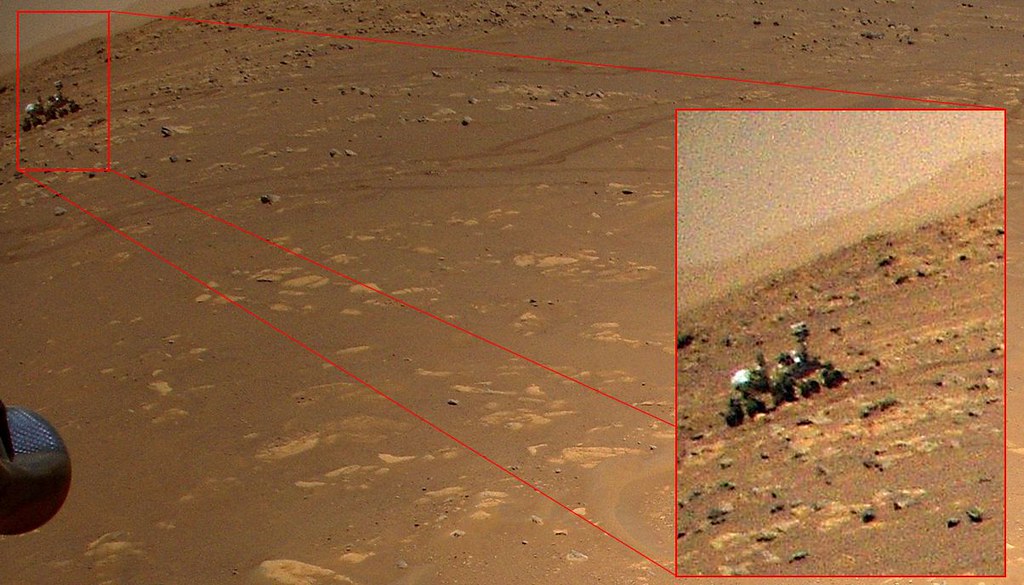
Ingenuity manages to catch Preservice in one of the images it captured which manoeuvring during a test flight in April 2021. Credit: NASA/JPL
For the majority of its flights, Ingenuity had acted as an aerial scout for Perseverance, imaging its surroundings in order to help mission planners determine potential route the rover could follow and / or identify potential points of interest the rover could be directed to study. As such, it has proven itself an invaluable part of the overall mission and more than proven the benefit of having UAVs operating in support of surface missions.
I’ll continue to report on the mission’s progress – and that of Curiosity, as and when NASA provides updates.
Isaacman’s Polaris Programme
Jared Isaacman, the billionaire who paid for and commanded the first non-professional astronaut flight into space, Inspiration4 in September 2021 aboard a SpaceX Crew Dragon vehicle (see: Space Sunday: Inspiration4 and Chinese Flights), is now planning a series of similar space flights – potentially culminating in the first crewed flight of the Starship vehicle.
On February 14th, 2022 Isaacman announced the establishment of the Polaris Programme, which will run in cooperation with SpaceX.
Polaris is a series of pioneering Dragon space missions that will aim to rapidly advance capabilities for human exploration. This programme has been purposefully designed to advance long-duration human spaceflight capabilities and guiding us toward the ultimate goal of facilitating Mars exploration.
– Jared Isaacman, February 14th
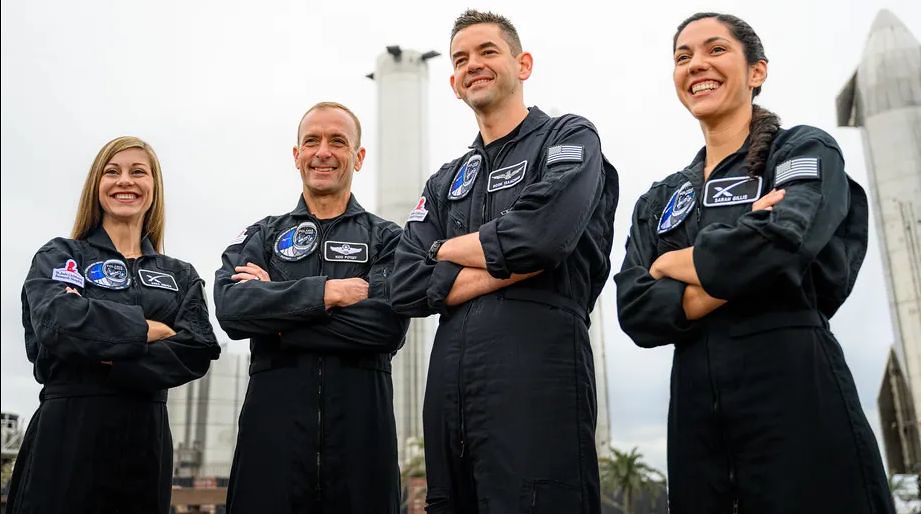
Thus far, only the first mission in the programme has any specifics associated with it – and these are sketchy in places, at least for the moment. Called Polaris Dawn, it appears to be jointly funded by Isaacman and SpaceX. It will take place no sooner than the last quarter of 2022 and will comprise Isaacman as commander, Scott “Kidd” Poteet, a retired Air Force pilot who was one of the ground directors for the Inspiration Inspiration4, as pilot and mission specialists Sarah Gillis and Anna Menon, both SpaceX employees – Menon is married to Anil Menon, a former SpaceX flight surgeon who left the company to join NASA at the end of 2021 as part of its latest astronaut intake.
The other details revealed for the mission are:
It will aim to break the record for the highest Earth-orbiting crewed space flight That record was set in 1966, when Charles “Pete” Conrad Jr and Richard F. Gordon Jr piloted Gemini 11, the ninth crewed flight of that series in an extended elliptical orbit with a perigee of just 268 km and an apogee of 1,368 km.
This high altitude will allow the crew to study the radiation environment at the edge of interplanetary space – which is vastly different to that experienced by the majority of people who have flown into space – human missions rarely exceed 450 km above the Earth.
The Polaris Dawn crew (from L to R): Anna Menon, Scott Poteet, Jared Isaacman, and Sarah Gillis. Credit: Polaris Programme/John Kraus
The programme will aim to “raise funds and awareness” for St. Jude Children’s Research Hospital (the Inspiration4 mission raised a total of US $240 million for the hospital) as a part of “a global health initiative” that will involve SpaceX, their Starlink satellite broadband network. But again, precise details as to what this will mean / entail were no elaborated.
The flight will include the first EVA (extravehicular activity) spacewalk by a commercial crewed mission.
This last aspect has drawn the most attention, as it will entail the entire crew utilising a modified version of the suits currently worn by crews using Dragon to fly to / from the International Space Station. It will also be a further hark-back to the Gemini (and Apollo) missions. Like the vehicles used in those programmes, Crew Dragon does not carry an airlock, so the entire vehicle will have to be depressurised the the EVA – something that shouldn’t be a problem, as the vehicle has from the start been designed to be able to vent down to vacuum. However, the exact purpose of the EVA – together with the overall science objectives for the mission – has yet to be detailed.
How many Polaris missions will take place after Dawn is unclear; in terms of Crew Dragon, Isaacman appears to suggest the number of missions will be dependent on how quickly Starship moves from development through operational status as a cargo vehicle to being capable for flying with crews.
This is not something that we can expect in the next few years; SpaceX have a lot to do just to prove Starship and Super Heavy form a viable cargo launch vehicle, after which the vehicle will have to go through an assessment and rating to clear it for flying crews and passengers. This is itself not a simple process – for example, it is expected that crewed launch vehicle have so form of abort / escape system, something Elon Musk has thus far only “supposed” this could be possible for Starship.
However, for all the gaps in what has thus far been presented, the Polaris Project would appear to be an interesting new venture – one the goals that again reach beyond mere space tourism.
Sometimes also referred to as motor neurone disease (MND) or by the synonyms Lou Gehrig’s disease and Charcot disease, ALS is a specific disorder that involves the death of neurons that control voluntary muscles. For about 90-95% of all diagnosed cases, the precise cause of the disease is unknown; for the remaining 5-10% of diagnosed cases, it is inherited from the sufferer’s parents. There is no known cure, and symptoms generally first become apparent around the age of 60 (or 50 in inherited cases). The average survival from onset to death is three to four years. In Europe and the United States, the disease affects about 2 people per 100,000 per year.
Harvey Memorial Ensemble ALS Awareness Week 2022
The Ensemble officially kicks-off at 14:00 SLT on Sunday, February 20th, 2022, with a live set by singer Soso, and will conclude with a final music set commencing 16:00 SLT on Sunday, February 27th. Between these two times, the event will offer daily mixes of live performer and DJ sets, commencing at 07:00 SLT and running through until 18:00 SLT daily, giving plenty of opportunities for Second Life Residents from around the globe to drop in.
Whilst visiting, people are encouraged to make donations to AISLA in any one of a number of ways:
By clicking the donations kiosks in front of the event stage.
By clicking on the AISLA information boards to go directly to AISLA’s donations web page, where credit / debit cards or a PayPal accounts can be used to make a direct donation.
By purchasing a Paola Mills tee-shirt design from the vendors on the west side of the arena, between the 2D and 3D art displays.
By purchasing one of the special Harvey Memorial Rabbit paintings by Terrygold (L$200 each) – these can be found on the west side of the events schedule board.
By entering the Ensemble Week prize draw to win a MotoDesign Chopper motorcycle – the draw is a limited entry event (90 numbers), and located on the east side of the events schedule board – thewinning draw will be made in Sunday, February 27th, 2022.
By participating in the Art Auction.
100% of L$ donations and payments, with all winning bid payments from the Silent Art Auction, will be forwarded to AISLA a the conclusion of the event.
Harvey Memorial Ensemble ALS Awareness Week 2022: 2D Artists
The Art Auction has been expanded this year to feature a total of 16 2D and 3D artists. It runs from the opening of the event through until closure on Sunday, February 27th, when the winning bids will be ascertained.
The 2D artists participating are: GlitterPrincess Destiny, Nur Moo, Blip Mumfuzz, LeMelonRouge Onyett, Terrygold, Tarozaemon Rossini, Maddina Tremor, and Karma Weyman. Each has donated three pieces of art that are being auction as unique, single lots (so people are bidding on all three pieces by an artist rather than the individual pieces).
The 3D artists have donated a single piece each, and comprise: Giovanna Cerise, Mistero Hifeng, Livio Korobase, Bryn Oh, Barry Richez, Eupalinos Ugajin, Ciottolina Xue and Moki Yuitza.
Harvey Memorial Ensemble ALS Awareness Week 2022: 3D Artists
The Harvey Memorial Ensemble ALS Awareness Week in Second Life is always an engaging and fun festival, with even more added to the mix this year yo make hopping along and participating even more worthwhile – so why not take the time during the week to do so?
Metaverse Fashion Week SL: the Jonathan Simkhai collection by Blueberry, February 2022
As I noted in In Vogue (+ Elsewhere): Second Life and Designer Fashion(and courtesy of the likes of Vogue and UK Glamour), Second Life has been making headlines in the world of fashion of late, coinciding with the “Big Four” fashion cities – New York, London, Madrid and Paris – host their semi-annual Fashion Weeks.
The reason for all the media interest – with still more to come! – is because amidst all the on-going hype around many fashion designers diving into the waters of NFTs and the like, New York fashion designer Jonathan Simkhai decided to go a step further and team-up with Blueberryxx and her Blueberry team to offer a special preview of a selection of pieces from his Autumn / Winter 2022 (AW22) at a special show in Second Life ahead of the items being unveiled at his New York Fashion Week show – with the added element that some of the collection would later be made available for sale within Second Life.
Metaverse Fashion Week SL: the Jonathan Simkhai collection by Blueberry, February 2022
In all, 11 of Simkhai’s AW22 collection were given a Second Life “makeover” by the Blueberry team (with one being given that special SL zing, converting from a shimmer gown to a leotard whilst worn). These were initially presented to a special gathering of VIPs from the physical world – models, influencers, celebrities, and journalists from the fashion, technology and lifestyle industries – at a previewing show held in-world on Tuesday, February 15th, 2022 – itself an interesting challenge, one worth of exploration – and Blueberryxx was willing to take the time to do so with me.
As people frequently point out, for those unfamiliar with Second Life, getting to grips with the platform is no easy matter; just getting comfortable with the viewer and figuring out the basics controls can be difficult enough, leave alone anything else. And when you have a group of dignitaries coming into the platform to see a show, you need to be able to make everything as seamless as possible, and add a little fun to the process.
To achieve this, the Blueberry team did a number of things. Ahead of the event, they prepared bespoke avatars for each of the VIPs, modelled around a photograph of each guest’s face. Each guest was also able to select an item from the SL “Simkhai collection” in which their avatar could be dressed.
On the day of the event itself, the VIPs were able to log into SL and there avatars at the venue, where the real magic began, as Blueberryxx explained:
We wanted to make sure the outside press would have an easy time therefore and so shine a more positive light on SL. We knew that if they had to learn how to cam during the show they were going to have a hard time. And while we would have loved to have models controlled by humans, the mainstream press hasn’t always been kind to Second Life, and we didn’t want to risk distractions and negativity in having a model crash or fall off the runway or anything like that; we wanted guests focused on the show and the outfits
So we made it almost like watching a short movie: we scripted a Second Life Experience which could take the VIP avatars, seat them at the main runway, and then control their camera for them as the models moved. Then we used Corrade to control the models, allowing us to move them smoothly and have pre-loaded animations ready to play on them.
– Blueberryxx
For those unfamiliar with Corrade, it is an open metaverse scripted agent (bot) library that has a lot of extensibility. For the Second Life Metaverse Fashion Show, it meant that the 11 models (plus the Jonathan Simkhai avatar) could be placed on a “base vehicle” pre-loaded with animations (a basic walk and a series of modelling poses), which could then follow a scripted path along the catwalk runways (each base turning transparent just before the model appear on the catwalk), giving the illusion each model was “walking”, with keyframes being used to halt each base and trigger the poses.
All of the movements of the bots on their “vehicles” was coordinated by a central script system, resulting in a smooth, professional show easily equal to any physical world catwalk show, perfectly timed and executed and with none of the pitfalls of using “regular” avatars. Meanwhile, the venue’s Experience ensure the VIPs received smooth views of the passing models and their outfits, unencumbered with having to worry about the complexities of using the viewer.
Six of the bots backstage “walking” on the animation stands that (when transparent), moved them along the catwalks to give the illusion they are “walking”. The gaps between them would be filled as the remaining five return to their “rest” points
Following the VIP show, Blueberry hosted a total of 8 “public” shows across Thursday, February 17th and Friday, February 18th 2022 for Second Life users. For these events, members of the Blueberry bloggers group were able to witness the show just as the physical world VIPs had, joining the Experience and then letting that take over seating them, etc. Non-group members could then view the shows from adjoining regions, with the 11 models completing walks around runways that extend out and around the venue from the end of the main catwalk.
This split between “VIP” and “non-VIP” apparently caused some grumbling at some of the shows, as it hadn’t been fully communicated ahead of the event. But on the whole, everything worked well: the extended catwalks around the main venue region meant those on the adjoining regions still had plenty of opportunities to appreciate the designs as model parade along them.
Metaverse Fashion Week SL: the Jonathan Simkhai collection by Blueberry, February 2022
Despite the grumbles that were voiced, the majority of the “non-VIPs” at the public shows (myself included) were content to sit at the edge of the main venue region and cam over to watch things (which also gave me the opportunity to sneak some backstage looks to see how things were being run!). And the Blueberry team is certainly keen to make improvements in the future.
The feedback has been overwhelmingly positive (I was prepared for the worst!), and we’re grateful for the understanding shown with the parts we messed up; we promise to do better in the future – more interactive features for watchers, more seating and even swag bags!
– Blueberryxx
One of the attractions of the public shows was that Vogue had indicated the Simkhai / Blueberry outfits seen in the show would be offered for sale in-world. As there were no vendors at the venue (which would have perhaps been an ideal place to commence sales to SL users), Blueberryxx was happy to explain what was happening:
We will be offering a sub-set of those in the show, with the actual styles still subject to selection by Jonathan. We’re also discussing future opportunities for styles to be produced and sold in Second Life. However, they will all be charged at Blueberry prices; there is no premium to be charged.
– Blueberryxx
The scripted agent representing Jonathan Simkhai and his models on the main catwalk
In this, it is important to note that the garments produced by the Blueberry team for Second Life are not the same as the six NFT items being produced and sold by Everyrealm, and which were also referenced in several of the articles published after the VIP show.
Those NFTs (which Everyrealm are calling a “Metaverse Fashion Week Wearables Collection“), are being produced for use via the Ready Player Me platform, theoretically allowing them to be use across multiple games / platforms – although they do come at a premium: prices range from US S250 to – wait for it – US $2600 for the “one-off”.
Metaverse Fashion Week SL: the Jonathan Simkhai collection by Blueberry, February 2022
All of which perhaps underlines a further value of Second Life; a major issue with NFTs is that despite the claims of “democratisation” of art, etc., they largely lean in the other direction – exclusivity through scarcity.
However, within Second Life, everyone has the opportunity to be included in the experience of appreciating / wearing luxury fashions at prices that aren’t going to hurt the bank balance. And this is something that an exploratory partnership between a top New York fashion designer and a top Second Life fashion label can only expand – and hopefully it will if Blueberryxx has a say in things, as she noted to me as we ended our conversation.
My brand is all about approachable and comfortable and a easy to enter community, something Jonathan understands, so we are in discussions about a possible future permanent collection collaboration.
– Blueberryxx
In the meantime, I’m looking forward to setting some of the initial Blueberry versions of Simkhai’s designs becoming generally available in SL, and – hopefully to seeing the discussions of around further collaborations bearing fruit in the future.
My thanks to Blueberryxx for her time and assistance in writing this piece, and to Sophia Harlow for putting us in direct contact outside of SL.
My audio recording and chat log of the Content Creation User Group (CCUG) meeting held on Thursday, February 17th 2022 at 13:00 SLT. These meetings are chaired by Vir Linden, and meeting dates can be obtained from the SL Public Calendar.
My audio recording and the Video recording by Pantera (embedded at the end of this piece) from the Third-Party Viewer Developer (TPVD) meeting on Friday, February 18th, 2022 at 12:00 noon SLT.
It is a summary of the key topics discussed, and in the case of the TPVD meeting, timestamps to the relevant point of the video are included.
This list reflects the currently available official Second Life viewers.
Release viewer: version version 6.5.2.567427 – Mac Voice hotfix viewer, January 13 – no change.
Release channel cohorts:
Maintenance J&K RC viewer, version 6.5.3.567451, issued on January 20th.
The Tracy Integration RC viewer version 6.4.23.563771 (dated Friday, November 5) issued Tuesday, November 9.
Project viewers:
Performance Improvements project viewer version 6.6.0.567604, dated January 24.
Mesh Optimizer project viewer, version 6.5.2.566858, dated January 5, issued after January 10.
Performance Floater project viewer, version 6.4.23.562625, issued September 2.
Legacy Profiles viewer, version 6.4.11.550519, dated October 26, 2020.
Copy / Paste viewer, version 6.3.5.533365, dated December 9, 2019.
General Viewer Notes
The Maintenance J&K RC viewer is still the next in line for promotion to de facto release status.
Progress of this viewer had been delayed due to the viewer updater needing to be updated from Python 2 to Python 3.
This change has now been made, and the viewer is ready to be issued as an updated RC viewer.
Work continues on the Performance Improvements project viewer to lift that to RC status.
It was found that bump (normal) maps were being processed on the main viewer thread, causing the viewer to exceed 60 fps with Vsync enabled (which should hold it to 60fps), causing frame jitter. Bump map processing has therefore been moved to a separate thread.
There has been a pass to improve hardware compatibility with AMD GPUs.
An issue with rigged meshes failing to render in the thumbnail panels when editing an avatar’s shape has been addressed,
This could be the first in a series of viewers produced under the Performance Improvements banner, with the Lab already discussing additional improvements that could be made in future versions.
The Performance Floater viewer is being updated with further options to manually adjust viewer settings to help maintain frame rates.
As noted in the week #5 summary, multi-factor authentication (MFA) is coming to the viewer.
The viewer-side code is complete, and had been awaiting the implementation of server-side support.
The latter has now been deployed to the Main grid, so it is anticipated that an RC version of the official viewer will be available in the very near future.
It is recognised that TPVs will need time to integrate the necessary viewer-side code into their offerings, therefore:
As MFA is implemented in the official viewer, there will be a “grace” period to allow TPV adopt the viewer code.
During this period, users will be able to access SL on TPVs as they currently do now, regardless of whether or not they have opted-in to MFA.
After this “grace” period, all users who have opted in to MFA will be required to authenticate themselves when using the viewer to log-in to Second Life (with the use 30-day period of valid authentication, as per secondlife.com MFA).
Please refer to my week #5 summary for the full list of notes on MFA in the viewer.
In Brief
Content Creation Meeting
Honouring joint rotation at mesh upload:
There are a number of long-standing bugs and requests concerning support (or lack that of) for maintaining mesh joint rotations at upload – currently, overrides are only provided for position and scaling.
The Collada .DAE file format does allow for rotation to be maintained through a number of ways, but currently SL doesn’t support all of them – hence when joint rotations tend to be ignored.
The general discussion leaned towards having the ability to override join rotation at upload would be a nice to have, with the view from LL that if done, it would be a check box at upload, so it would only apply to new content being uploaded, and not affect existing content.
Preference over the above was expressed for the ability to scale bones via animations.
This could allow for things like animals to increase in size as they grow from kitten / cub / pup, etc., to adulthood; possible improvements to clothing; enabling more complex avatar animations etc.
One potential issue with this is that scaling by animation might / will conflict with the skeletal sliders.
Providing animation scaling adds a further point of complexity, presenting 3 points at which scale is being impacted: within the mesh (from values at upload), trough the application of animations and via the shape sliders. Ergo, some form of ordering hierarchy is potentially required to avoid conflicts between the three.
No conclusions were drawn on this in terms of possible implementation or further investigation of options.
Sparked an extended conversation on physics shapes and LI – not all of which, I confess, I could not entirely follow in listening back through the audio, as some of it depended on some in-world testing – and I was absent from my screen through the majority of the meeting, so did not get to see the in-world examples being manipulated.
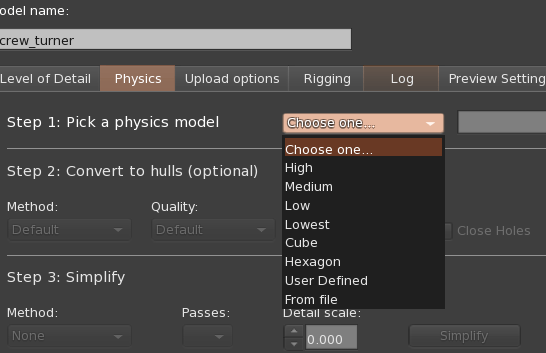
Essentially, the feature request calls for the provision of simpler physics shapes to be available for use when uploading a mesh than are currently available – the simplest being a “cube” mesh physics asset. This is something Firestorm already provides:
Physics models offer through the Firestorm mesh uploader – the shapes being continued within the viewer for application. Credit: Beq Janus
The conversation also folded into it requests to have direct access to Havok (the physics engine) primitive physics shapes (sphere, cube, cylinder, etc., and the ability to upload them.
For now, a contribution of the code used by Firestorm has been offered / requested.
This is turn lead to a discussion on, if implemented by LL, whether the default upload physics shape (Convex Hull) should be changed to “Cube” – with the preference being to leave it as is, although it was noted that with PBR set for future implementation, the upload mesh form may at some point need to be changed.
Given the confusion evident within the discussion, this also perhaps points to the need for the uploader to have a link to relevant and maintained documentation on best practices for mesh uploads, physics, etc.
The end of the meeting featured a further request for materials support for Bakes on Mesh (BoM)
This is something which, as noted in the past, would require a not insignificant extension to how bakes are handled, together with and expansion of the Bake Service itself – particularly if it was expected that individual layers would have an associated normal and specular channel associated with them.
A suggested alternative would be to have a single normal and single specular channel then is applied to the entire bake. While this might work for specularity, it’s not clear how this would work with a normal maps and be effective when trying to define different fabrics through the use of normals.
Currently, LL have no direct plans to implement materials for BoM.
TPV Developer Meeting
BUG-225696 “All offline inventory offers from scripted objects are lost” is to be the subject of a simulator-side project that is now “gearing up” to fix it “once and for all”, which is “coming for a near value of ‘Soon™’.
There are a lot of “new initiatives” in the pipeline with LL beyond those outlined in things like the 2021 year-end review, but nothing that has reached a point where it can be discussed in detail at TPVD (or other) meetings.





 Inara Pey: Living in a Modemworld