A trip to France in Second Life

Bordeaux, France, January 2022 – click any image for full size
On this grid I actualize the worlds I imagine, conjure my wildest daydreams, and walk a path unknown. I am here to create a fantasy for others to enjoy. Landscaping is my medium, my love language, and my story.

– TONAL (Avalyn Aviator)

I recently had cause to visit two adjoining Full regions design by TONAL which offer a rich mix of environments combined by what is clearly a love of France: its architecture, its history and its sweeping countryside and landscape.

Bordeaux, France, January 2022

Within Bordeaux, France, TONAL offers visitors a cityscape worthy of historic Paris. Here stand buildings one might easily encounter in a walk down the Avenue des Champs-Élysée and the streets running back from it and to either side of its long arm. Like that broad avenue, the buildings here present shops (some spaces available for rent) and apartments above (some of which are available for rent and cleverly hidden with in the façades of the various buildings, reached via the region’s experience teleport option (if available for rent).

The streets may not be as broad as the likes of the Champs-Élysée, but they are perfectly navigable on foot and offer the opportunity to explore this city-like setting and discover its secrets and places of interest, such as the neighbourhood supermarket, the little children’s playground or the more ostentatious Jardin et Salon de Thé.

Bordeaux, France, January 2022

As with Paris, this is a cosmopolitan centre marked by open spaces and terraces looking down towards a body of water albeit is a lake rather than a river!), and fountains and statures add grace and a timeless sense of history to the setting. Unlike Paris, however, this is a cityscape market by tall medieval-like towers topped by conical roofs of a kind more commonly seen gracing many chateaux across France rather than in the heart of a metropolis. Even so, they add a sense of place here.

Placed at various points around the city are maps (some of which can be found inside public spaces and resemble oversized iPads). These provide a map of the city and the adjoining countryside (of which more below), and include click-to-teleport markers for those wishing to quickly hop around the setting’s major points of interest, such as the aforementioned Jardin et Salon de Thé or the rooftop restaurant or the grand stables, to name but three. Oddly, a map isn’t placed at, or close to, the landing point – but a wander around the streets will quickly reveal it.

Bordeaux, France, January 2022

With a westward perspective, the city looks out towards the countryside of Village des Chasseurs de la Valle de Londyn, the second Full region comprising this location.  Between countryside and city sits a large lake around which sits a part of the town far older than that around the landing point, the buildings clearly harking back to medieval times. Guarded to one side by an old (and unfurnished) fortified chateau, the majority of these aged building are façades designed to give a further sense of depth and place to the setting – which they do so admirably – although a walk around them will bring visitors to a cosy tavern.

Across the lake and reached via bridge or by following the cobbled ways either side of the water, the land opens out into hilly woodlands. Here, as the region’s name suggests, there is the opportunity for hunting, with part of the region only accessible on the purchase of the “hunting pass” (L$200 for 24 hours). I confess I didn’t give this a try, so am unsure of what to expect, but I did take the public track up and around the wooded hills, passing some of the cottages and country houses that are also available for rent here.

Village des Chasseurs de la Valle de Londyn, January 2022

At the time of my visit, it appeared some remodelling was underway – I caught sight of a couple of exposed plywood boards and at least one building within Village des Chasseurs de la Valle de Londyn was still set to track any movement of its rezzing box. However, none of this detracts from the appeal of either region or the opportunities for photography to be found throughout. That said, within Bordeaux, France, there is a lot for the viewer to rez and render, so those on more moderate system may need to adjust settings / reduce Draw Distance to a more comfortable level to assist in their explorations.

Warning aside, I enjoyed wandering through both Bordeaux, France, and Village des Chasseurs de la Valle de Londyn, so why not hop along and have a wander yourself?

Bordeaux, France, January 2022

SLurl Details

Space Sunday: JWST, Artemis and rockets delivering cargo to Earth

JWST art. Credit stsci.edu

The James Webb Space Telescope (JWST) is due to enter its initial halo orbit around the Earth-Sun L2 position, 1.6 million kilometres beyond Earth’s orbit around the Sun, on Monday, January 24th, 2022.

With the deployment of its major external elements completed, the observatory has been engaged in the first phase of a sensitive operation to correctly align the 18 hexagonal segments of its primary mirror so it perfectly reflects light into the boom-mounted secondary mirror and thence back into the telescope’s interior for delivery to its space science payload.

This first part of what is an extensive operation saw all 18 segments gently eased 12.5 mm away from the mirror’s backing structure, each segment being propelled forward by six tiny motors, referred to actuators. This allowed each mirror segment to be gently moved away from the restraints that held it in place during launch, and provides enough space behind each segment so it can be gently adjusted to align with its companions as the alignment process continues, all of them coming together to form a single, focused parabola.

When it starts, the latter part of the work will involve the actuators moving in the micron and nanometre ranges of movement, and once started, is expected to continue for around 40 days.

However, before that process begins, at 19:00 UTC on Monday, January 24th, JWST will fire its thrusters to ease itself into its initial halo orbit around the Earth-Sun L2 position, marking its arrival in the area of space where it will operate.

Thanks to the sheer accuracy of the Ariane 5 launch vehicle and the “mid-course” correction thruster burns JWST has made en route to this point, it has been calculated the observatory currently has sufficient propellant reserves for at least 10 years of operations. If the insertion burn proves to be as accurate, mitigating any need for it to be further refined, then JWST may have its overall mission length extended a little more.

JWST is due to enter its Earth-Sun L2 Halo orbit on Monday, January 24th, 2022. Credit: NASA

Once safety inserted around the L2 point, the telescope will go through an additional period of cooling adjustment to bring its instruments down to their operational temperatures. This process, which will actually use heaters to ensure heat dissipation is properly controlled, will take a number of weeks to complete, after which the primary mirror alignment process will resume, allowing scientific instrument calibration to commence.

Artemis: No Immediate Second Lunar Landing

After landing astronauts on the Moon in the mid-2020s for the first time in more than a half-century, NASA will wait at least two further years before making a second crewed lunar landing as part of the Artemis program.

Artemis 3 is due to deliver a crew of 2 to the lunar surface in around 2025. However, the next mission slated for Artemis will not follow it to the lunar Surface. Instead, and as indicated at a two-day meeting of the NASA Advisory Council’s Human Exploration and Operations Committee on January 18th/19th, it was indicated that the Artemis 4 mission will target the assembly of the Lunar Gateway.

This is the space station that will be placed in cislunar orbit and used as a transfer station for crews arriving from Earth aboard NASA’s Orion capsule and the Human landing System (HLS) vehicles that will carry them to the surface of the Moon and back. The first elements of the Gateway, the Power and Propulsion Element and Habitation and Logistics Outpost, will be launched together via a SpaceX Falcon Heavy in late 2024. They will then spend a year spiralling around the Moon and settling into their halo orbit.

Artemis 4, which will feature the Block 1B Space Launch System rocket using the powerful Exploration Upper Stage (EUS), intended for heavy cargo launches and deep space missions will carry the International Habitat Module (I-Hab) for the gateway, along with a crewed Orion vehicle that will oversee attaching I-Hab to the Gateway modules already in lunar orbit.

Whilst conceptual in terms of what the Lunar Gateway might eventually become, this image indicates the core NASA NASA elements  – the Power and Propulsion Element and the Habitation and Logistics Output module (which will actually be docked one to the other) to be launched in 2024, and the JAXA / ESA I-Hab module, to be launched in 2025 as part of the Artemis 4 mission. The Orion capsule + service module are also shown. Credit:  NASA

Even with the more powerful EUS replacing the Interim Cryogenic Propulsion Stage that will fly on Artemis 1-3, the Gateway flight of Artemis 4 will be a challenge for the SLS. The Block 1B vehicle will be capable of delivering around 38 tonnes to lunar orbit – and some 27 tonnes of that capability will be taken up by the Orion crew capsule and its service module. That means the European and Japanese space agencies, responsible for providing I-Hab for Artemis, must ensure the module masses no more than 10 tonnes. By comparison, similar modules on the ISS average around 12-12.5 tonnes.

A further reason for focusing Artemis 4 on Lunar Gateway activities is that NASA will not actually have any HLS vehicle(s) at its disposal for lunar landings for a period of time after Artemis 3. In awarding the initial HLS contract to SpaceX to develop a lunar landing variant of its Starship vehicle, NASA did so on the basis of using only a single lunar landing. Once it returns to orbit, the SpaceX HLS will require refuelling in order to make a second trip – and currently, NASA has indicated that it would rather await a “sustainable” HLS system  – to be developed under a new, yet-to-be awarded contract called Lunar Exploration Transportation Services (LETS).

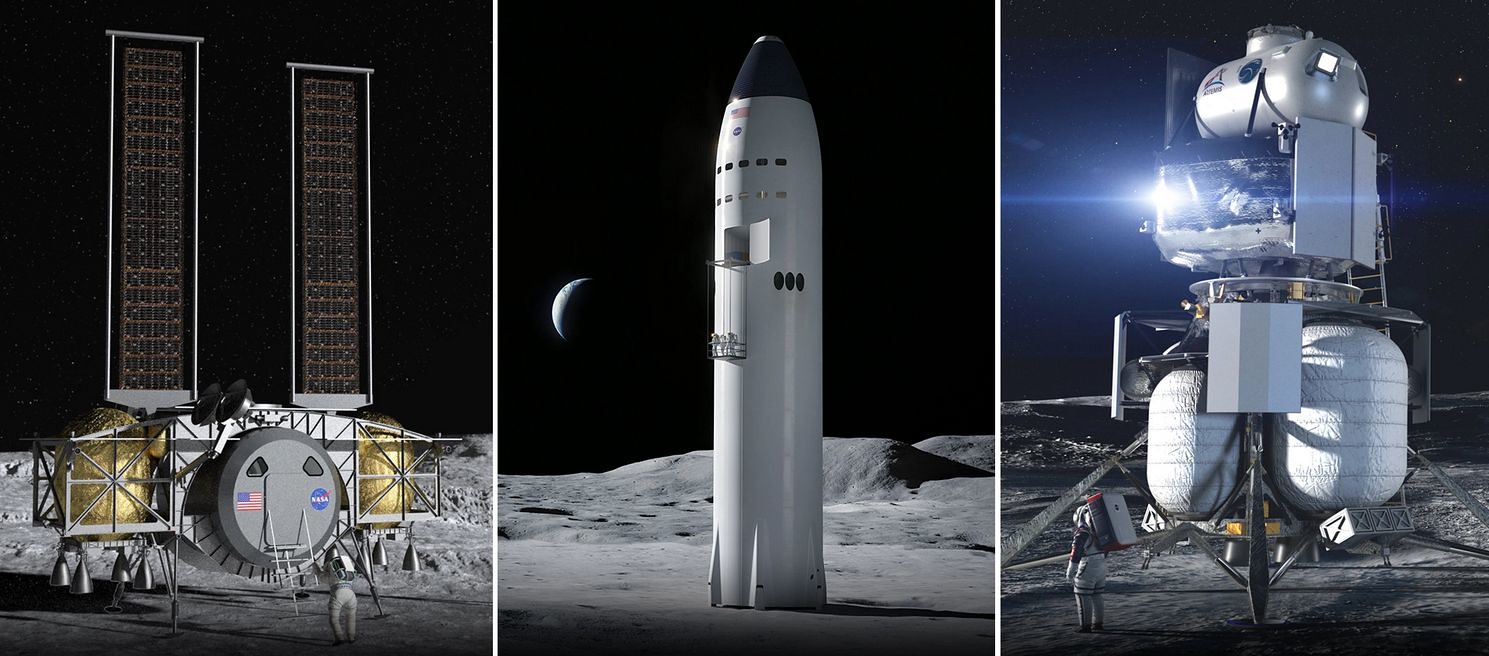
NASA HLS; the current contract with SpaceX is only for a single HLS vehicle (centre). After Artemis 3, the first lunar landing, NASA will be relying on a “sustainable” HLS design – yet to be contracted – which might be Dynetic’s versatile design (l), or the Blue-Origin led design (r), both of which originally competed against SpaceX for the initial HLS contract, or might be provided by another supplier. Credit: Dynetics / SpaceX / Blue Origin

Exactly what is so happen to the SpaceX HLS after Artemis 3 is unclear. That mission will not use the Lunar Gateway, but will see an Orion dock with the SpaceX vehicle in lunar orbit for the 2-person crew transfer. As such, it is entirely possible the SpaceX HLS might simply be “parked” in lunar orbit and left.

However, given any LETS contract has yet to be granted a further crewed landing on the Moon under the Artemis banner is unlikely to occur before late 2027 or (more likely) 2028 / 29.

Continue reading “Space Sunday: JWST, Artemis and rockets delivering cargo to Earth”

Lori Bailey and Lam Erin at Kondor Art Garden in Second Life

Kondor Art Garden, January 2022

Now open at the Kondor Art Garden, located within the Kondor Art Centre operated by Hermes Kondor, is double-header exhibition featuring the landscape art of Lori Bailey (Ishtara1) and Lam Erin.

The Garden has been a regular exhibition space at Kondor since the centre opened, but it has been recently given a completely new look by Naru Darkwatch on behalf of Hermes to present a striking new exhibition space. Gone is the central event space surrounded by a path and a space for images to be places, with a stage at one end and an additional open display space at the other. Instead, the gardens present a central events space, bounded by two pools of water around which gravel paths loop. Predominantly constructed using Alex Bader’s Zen Garden building kit, it is a space I immediately felt at home within, both because Alex’s kit is a personal favourite of mine and because the design reminded me of the open-air area display spaces I built using it and on behalf of the Phoenix Artists Collaboration.

Kondor Art Garden: Lori Bailey (Ishtara1)

This much larger design means that the garden can now easily feature two exhibitions of art, each centred on one of its two halves, or potentially a single large exhibition by an artist, their being plenty of room on the outside of each path as it loops around its respective water feature to display both 2D or 3D art as the need arises. Given both Lori and Lam specialise in landscape works, the garden is especially well suited to this joint exhibition.

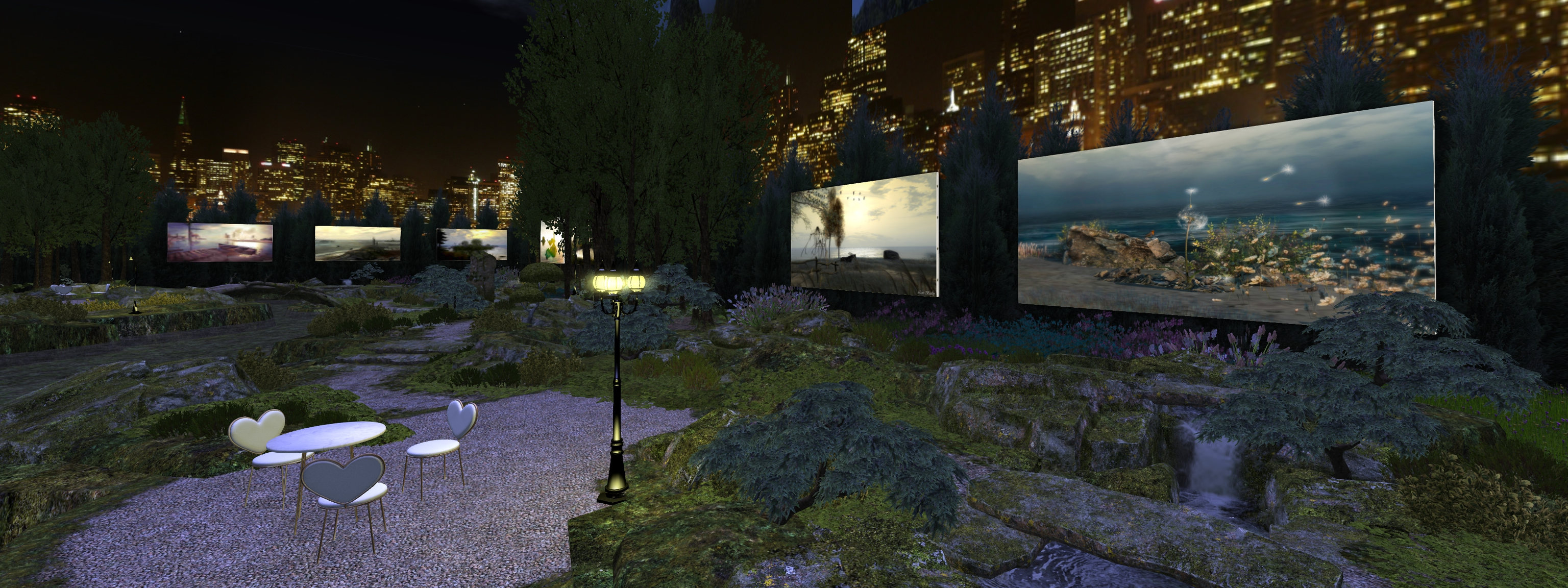
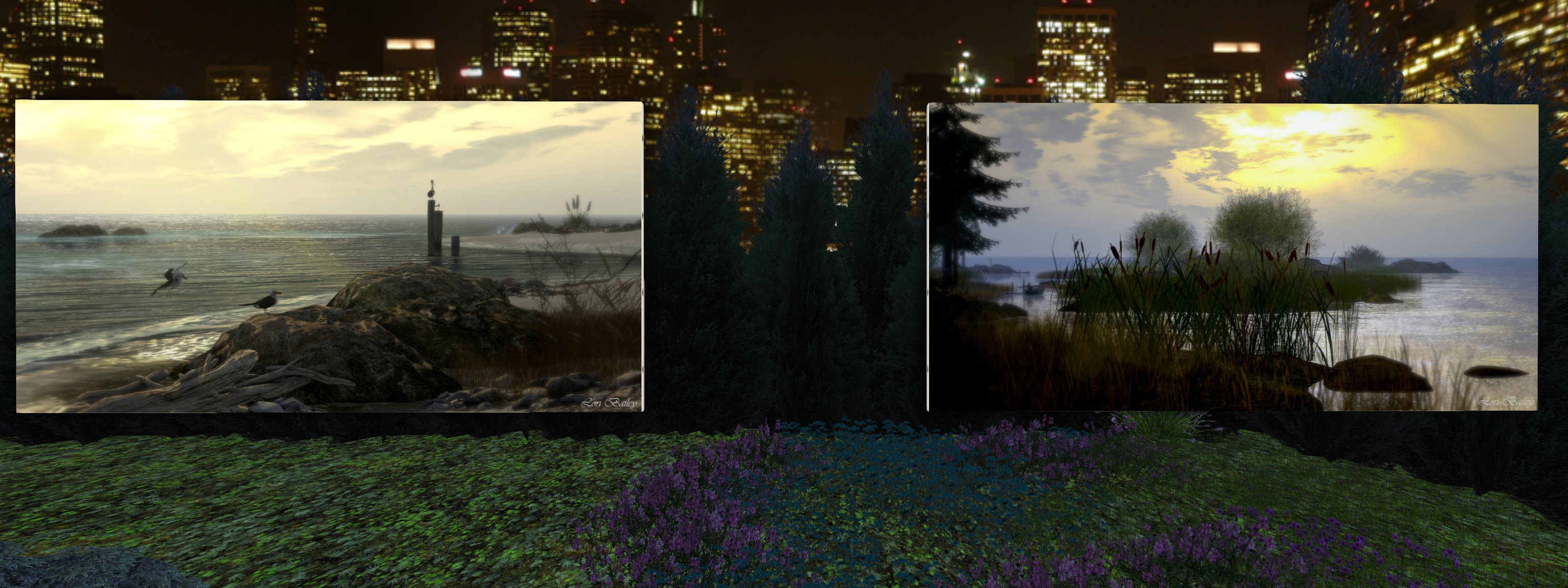
I believe this is the first exhibition I’ve been to in which Lori’s art is very much centre stage. Occupying the northern end of the gardens, it presents some 15 pieces, all with a focus on water, and most taken during the later part of the day when the Sun is low on the horizon. However, what makes all of them particularly engaging is the manner in which Lori has used light, shadows and reflections, together with a very considered hand in post-processing to give us images that, while shot within the digital realm of Second Life, could so easily have been captured in the wilds of Canada or the United States or perhaps Scandinavia or northern Europe – and in one case, somewhere in the far south Atlantic.

Kondor Art Garden: Lori Bailey (Ishtara1)

These are pieces which, in terms of tone, balance and colour, capture a natural beauty that is far from the world of pixels and rendering engines. In looking at Dawn for example, it is hard not to think we are looking at a picture taken from aboard a survey vessel cruising along the coast of Antarctica (or maybe somewhere like South Georgia).

Sitting further along the same side, Remoteness, Duo and Transparency bring forth thoughts of a long walk along the banks of one of Canada’s wilderness rivers and what might be encountered along the way. Each image offers a scene so beautifully composed, it is hard not to get lost within it, whilst within others, narrative stir and entice us – perhaps the most evocative laying curled within Childhood Memories of Winter and Golden Hour.

Kondor Art Garden: Lam Erin

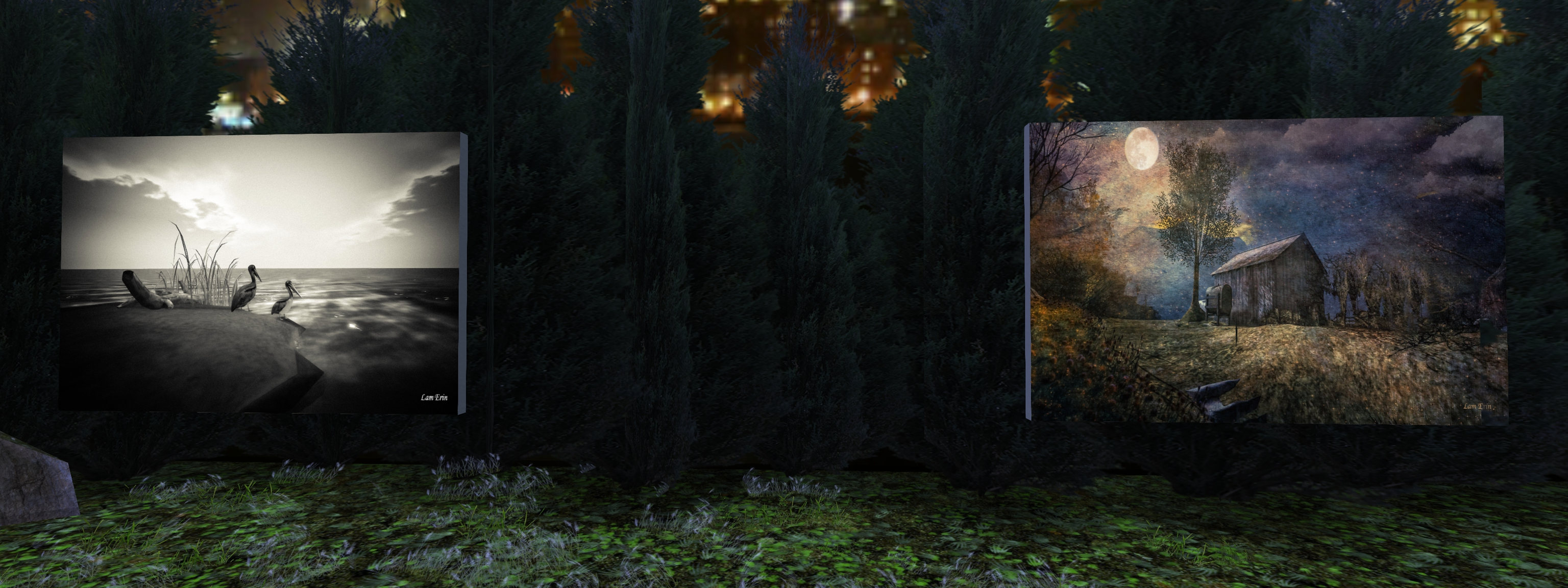
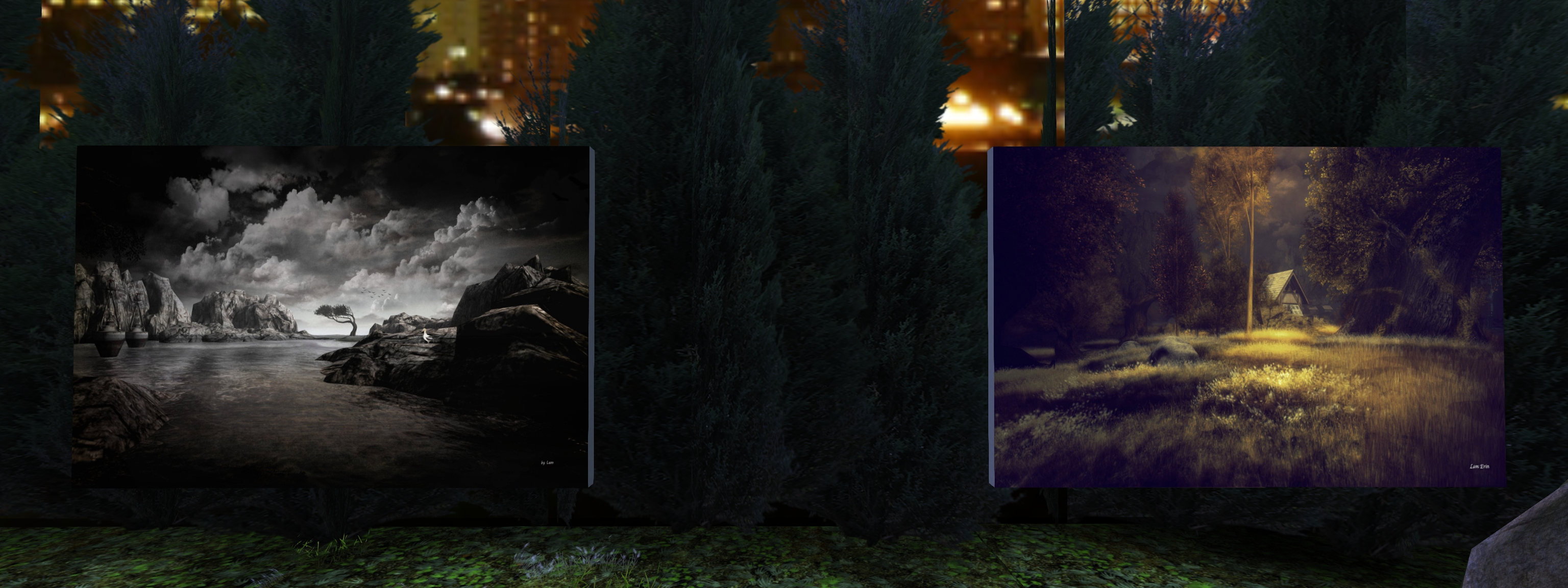
Lam Erin is an individual whose work I have covered numerous times in this blog, both as the holder / creator of his Cherishville region designs and as a master of Second Life landscape photography. His work is almost always immediately recognisable due to the richness of colour he tends to present – a deliberate over-saturation of the colours of the Sun – and the processing of the clouds within his images to give them an often brooding sense of presence, so often stirring thoughts of Nature’s power and her sometimes capricious nature.

This is very much evident within the majority of the 11 pieces Lam offers here, images perfectly composed to convey a mood within their setting, the cloudscapes most clearly hinting at the narrative each picture contains. And even in those where the colour has been removed, leaving us with a monochromatic view of Lam’s world, the clouds continue to speak out and frame the image and its story.

Kondor Art Garden: Lam Erin

Were I to critique this joint exhibition at all, it would be in the size of the individual images. They are pieces whose beauty deserves to be writ large, but within the expanse of this garden, there is a risk that, without close examination, they might be overwhelmed. However, this does not detract from both halves of this exhibition from being thoroughly engaging and well worth the time taken to visit them.

SLurl Details

Lana’s whimsy in Second Life

LANA, January 2022 – click any image for full size

In September 2021 I visited LANA, the rich and in places quirky Homestead region designed by Valarie (Zalindah) – see Lana’s seasons in Second Life. Since then, the changing of the year has brought with it a changing in the region’s looks, although much of the core theme  – that of letting go, freeing oneself to experience anew – remains very much prevalent, as does the balance between land and water, together with some of the individual motifs visitors might have encountered with that previous iteration.

However, where back in September LANA offer a setting perhaps rooted more within natural elements- countryside, water, a small town, etc., in its new form the region embraces something far more whimsical in nature, offering multiple vignettes that will catch the eye as one explores, set within a landscape that is very different in styling although it does retain a combination of two seasonal styles.

LANA, January 2022

The first of these seasonal elements is encountered at the landing point, tucked into the south-east corner of the region. Taking the form of a single-roomed building with hard, concrete walls, and with and enclosed garden where visitors arrive, the landing point sits caught in the depths of winter and blanketed in deep snow. The single room of the building is comfortably furnished, two of its walls adorned by what I assume to be images of past iterations of LANA / previous builds by Valerie, while a fire blazes in the hearth, encouraging people to step inside and escape the snow.

At first glance, there doesn’t appear to be a way out of the walled garden or the house to get to the rest of the region. Snow is piled to dither of the structure, and in hanging around the landing point, I did notice several people seemingly confused, wandering in and out of the house, and finally resorting to climbing up the snow drift to one side of it to reach the roof (with one then promptly falling into the winter scene at the far end of the building that is open to the sky but glassed-off from the rest of the room!).

LANA, January 2022

However, the route to the rest of the region isn’t that hard to spot – there is, after all a large white arrow pointing to it from the garden, together with a hopscotch game. It runs over the snow partially piled between the left side of the house and the wall that encloses the garden to reach a road set between bare, arched trees which march away westward through the snow-covered landscape, a large frozen pond beyond one of their arches ranks and cold, open waters to the other.

It is on this pond and along road that the region’s sense of fantasy starts to be revealed: two huge snow wolves – or perhaps dire wolves? – guard both the ice and – a little more aggressively – the far end of the road. Beyond this second wolf and over a hump of snow-dusted ground sits a second pond where a tall Torii gate – watched over by a third wolf – offers the way forward for explorers. Here the path splits, one arm curling back east, to where more Torri gates climb a slope to reach above the snows and a headland that runs north on the shoulders of rocky slopes that rise from the waters on either side, home to ancient ruins and more for those who take that route.

LANA, January 2022

The second arm of the path, however, continues west over lowlands that gradually open out, the snow on them slowly giving way more and more to the scrubby grasses that refuse to remain under its blanket. Eventually turning north, these lowlands are home to trees on which frost still clings although the general sense is of a place in the throes of late autumn. From a distance this low-lying land appears is if it might be marshy in nature – and indeed, a sliver of water does split it’s northern end into a sliver of an island – but the ground is in fact dry.

Closer to where the snow gives way to the grass of these lowlands, the land also points north to where a second rocky upland sits, a large bay to one side of it, a narrower inlet to the other. The way to it is hard to miss, marked as it is by a combination of the remnants  of what must once have been a huge tree and the chinthe-like dragon hovering over it on lazy wing flaps.

LANA, January 2022

Dragons are another presence here that links this LANA with that of the past. Here they come in numerous forms – the chinthe, a water dragon, oriental dragons, and I was particularly enamoured of the peacock dragon curling down to a touch of afternoon tea.

The latter is also one of the elements of whimsy waiting to be found across the region; others include cloud beds floating over a little block of apartments, the oversized plushies scattered throughout the setting. Also to be found throughout the setting are vignettes focused on wildlife and animals – rabbits being a favourite within it – that offer plenty of opportunities for photography.

LANA, January 2022

Retaining much of its oriental lean throughout – notably on the top of the headland running up the east side of the region – whilst offering a setting that is entirely different from its prior incarnation sitting beneath a fitting EEP sky, LANA continues to offer a richness of design and content that makes it a ideal destination for the seasoned Second life traveller ad those looks for places to appreciate.

With thanks to Shawn for the suggestion for a re-visit.

SLurl Details

  • LANA (rated Moderate)

2022 TPV Developer meeting summary, week #3

Lost Dreams, January 2022 – blog post

The following notes are taken from the TPV Developer meeting held on Friday, January 21st, 2022.

These meetings are generally held every other week.  They are recorded by Pantera Północy, and her video of the meeting is embedded at the end of this report – my thanks to her for allowing me to do so – and it is used with the chat log from the meeting and my own audio recording to produce this summary, which focuses on the core topics discussed.

SL Viewer

[Video: 0:10-7:37]

  • The two Maintenance RC viewers Jenever and Koaliang, have been combined into a single Maintenance RC viewer, version 6.5.3.567451, issued on January 20th.

Important note: the above viewer version has a significant issue that may prevent users on this cohort from logging in. See this report for details. The recommendation is for those wishing to avoid the issue is to download and install the current release viewer (or if experiencing issues, to contact Support and request and inventory fix). 

The rest of the current list of official viewers remains as:

  • Release viewer: version version 6.5.2.567427 – Mac Voice hotfix viewer, January 13.
  • Release channel cohorts (please see my notes on manually installing RC viewer versions if you wish to install any release candidate(s) yourself).
    • The Tracy Integration RC viewer version 6.4.23.563771 (dated Friday, November 5) issued Tuesday, November 9.
  • Project viewers:
    • Mesh Optimizer project viewer, version 6.5.2.566858, dated January 5, issued after January 10.
    • Performance Improvements project viewer version 6.5.2.566967, dated December 17.
    • Performance Floater project viewer, version 6.4.23.562625, issued September 2.
    • Legacy Profiles viewer, version 6.4.11.550519, dated October 26, 2020.
    • Copy / Paste viewer, version 6.3.5.533365, dated December 9, 2019.

General Viewer Notes

  • The combined Maintenance RC viewer is likely the next viewer in line for promotion.
  • The Graphics improvements viewer still has some bug to be fixed prior to moving to RC status. In particular, Euclid Linden is working on fixing the frame stall issue resulting from a media texture update. Essentially, if vsync is enabled, then command buffer resources aren’t as unbounded as they are with vsync disabled, resulting in textures copied to it a call to update media textures exhausts all available resources, effectively blocking it until it is flushed, rather than the buffer simply being discarded as is with case with vsync disabled.

Upcoming Feature Work

[Video: 1:30-1:51]

  • Vir re-iterated that 2022 should see the viewer progress with new graphics features.
  • Further performance improvements beyond those currently within the Performance Improvements viewer are in the planning stages.
  • However, nothing is available for open discussion by LL at this point in time.

Animation Override Discussion

[Video: 11:07-52:00]

  • A discussion on improving avatar animations through the use of a cap / reliable messaging between the viewer and the server to directly replace the default server-side avatar animations (walk, run, sit, swim, fly, etc), with custom animations  – as per a scripted Animation Override – but avoiding the need  to use llSetAnimationOverride and scripted HUDs (as is currently the case).
  • See also  BUG-230100.
  • No work is currently planned for this, but interest was expressed in how it might work.
  • Firestorm has such a capability (adopted by some other TPVs), but the implementation isn’t widely favoured.
  • Another suggested option would be to make animations assets that define an animation set (e.g. a “Stand” asset that can be a container for a set of animation stands + the timing for running them + defining if they should be randomly or sequentially played).
  • A further advantage is that as well as removing the need for scripted attachments, it would allow everything to be drive via a viewer UI element, offloading work from the server to the Viewer (and potentially into an off-thread).
  • A problem in using a cap is that the viewer could hit it fairly readily, particularly if cycling through a large set of animated stands, for example.
  • There are also edge cases were scripts may still be required, but these are not inimical to the development of a client-side AO system able to work directly with the server-side animation graph.
  • The discussion lays out the benefits for more of a client-side AO control capability, and I refer you to it for the in-text comment – not that towards the end of the discussion, things turned towards some WIBNIs (as in, “Wouldn’t It Be Nice If the system could dynamically adjust walk speed to avatar size”), although elements like this would require a much more intensive overhaul of the animation system.
  • Please refer to the video for the full text of the discussion.

In Brief

  • [52:32-End] A short discussion on the benefits of LL defining an Area Search.
    • While Firestorm has an Area Search, it tends tow spam an entire region with requests for each individual prim hover properties (and is subject to draw distance and interest list).
    • ObjectNavMeshProperties, however (with changes and a throttle), could provide an alternative and potentially more preferable solution.
    • The core of this discussion is in text, with little input from LL – please refer to the video.
  • It has been reported via the forums that there is Mac OS Monterey performance issue associated with the viewer. At the time of writing, it is not clear how widespread this is or if a bug report has been raised, although the issue appears to be with a Monterrey OS capability, rather than the viewer – please read the forum post for more.

Philip Rosedale: musing on Second Life and the metaverse

Philip Rosedale (2006) via Esther Dyson on Flickr

Note: the articles linked to in this article will display a log-in form on opening. Simply click the X to close this and view the article.

Whilst coming a week late to the party, but Protocol, the on-line tech publication, presented a brief but punchy interview with Philip Rosedale on his return to Linden Lab, a piece that makes for worthwhile reading.

I admit that a small part of my attraction to Second Life’s founder doesn’t believe in VR, by Janko Roettgers and Nick Statt, lay in the fact a couple of Rosedale’s comments on the state of VR as it is today, pretty much echo what I was saying a good few years ago (that the current generation of VR headsets are inherently anti-social in the way that cut the user off from those immediately around them). However, that’s not the reason for me to point to the article; there is far more of relevance within it.

What makes this article a particularly pleasant read is the direct approach taken by this authors, with key points neatly broken down into sub-sets of bullet points. These start with a refreshing  – and, I would state – fair summation of the state of consumer-facing VR before moving to to some of the challenges faced by “the metaverse” is trying to reach a significant global audience, and what’s on the horizon for Second Life in the future.

Janko Roettgers

This third sub-set of items has already been covered to some degree and includes the topics we’ve already heard about / surmised:

  • The use of tracking technology for avatar expressiveness.
  • A renewed move towards mobile support for Second Life (again, related to the “decentralised environment patents” transferred to LL?).
  • Improved communications capabilities.

No specifics are offered, admittedly – but what is recognised and – allowing for the fact that Rosedale is only (currently?) a part-time advisor to the Lab – a recognition that Second Life is long in the tooth with a heavy reliance on legacy technology  / approaches – and that at some point it is entirely possible that at some point building a new platform alongside of, and eventually replacing, Second Life as we know it, may well become a necessity.

And before anyone says, “but they did that with Sansar, and look at what happened!”, it is worth pointing out that a) Sansar was never developed as some kind of “SL 2.0”; it was made clear from the outset that the Lab was looking to address two different environments: Second Life and what was believed to be the coming wave for VR users, with agendas / needs that were very different to the majority of Second Life users. As such, there is no reason why, if LL did embark on an actual “SL 2.0”, it would likely be far more in respect of retaining the current user base and growing it, rather than seeking other horizons, as was the case with Sansar, whilst also allowing the platform to pivot more readily to newer technologies.

I actually find this point-of-view – which again, is a personal perspective from Rosedale, and not at this point anything we know to be part of the Lab’s plans for the foreseeable future – to be refreshing. Linden Lab has perhaps been too afraid of the spectre of “content breakage” and Second Life users a little too attached to inventory that they (probably) haven’t used in years, that it’s about time someone voice the reality that in order to move forward, there may well come a time when a break from at least some of the past is required.

For me, a particular point of interest within the article is what Rosedale states about the challenges facing “the metaverse”, and specifically the need to get to a point where avatar-centric communications can be “as effective as a simple Zoom call” together the  need for Second Life to provide “a better communication experience to take on Zoom calls.”

Nick Statt

I find this of a point of interest because it both underlines the coming of “avatar expressiveness in SL, and what the Lab hope to achieve with it, and also a continuing disconnect that is still evident in thinking around what “the metaverse” “must” do.

Within SL (and for the metaverse as a whole), there is no doubting that there are a range of use cases that can only benefit from avatar expressiveness. Picture, for example, a teacher within a virtual classroom being able to recognise a student who is experiencing difficulty or confusion during a lesson just by witnessing their facial expressions, and thus provide assistance.

However, the idea that “the metaverse” can gain traction among users just by emulating tools already at our disposal – Zoom, Skype, Duo, Viber, etc., – is potentially misguided. Such tools are already too ingrained into our psyche of ease-of-access and use to by easily replaced by carrying out the same task in virtual spaces. If “the metaverse” is to gain a mass appeal that isn’t centred on one particular environment / limited demographic – again, note Rosedale’s comments about Fortnite, Roblox and VR Chat – then it has to have a broad-based and compelling set of attractions rather than risking being seen as “just an alternative” to what can already be done using this, that or the other app or programme, etc. that is already at our disposal.

But in this I’ve said more than enough –  or al least the article from which it is drawn, so I’ll close here and leave Roettgers, and  Statt’s piece for you to read directly. And in doing so, I’d also recommend taking a look at what amounts to a follow-up piece by the same authors. With In the metaverse, everyone can sound like Morgan Freeman, Roettgers and Statt talk to Philip Rosedale about spatial audio and the company he currently runs: High Fidelity; it’s another informative read.