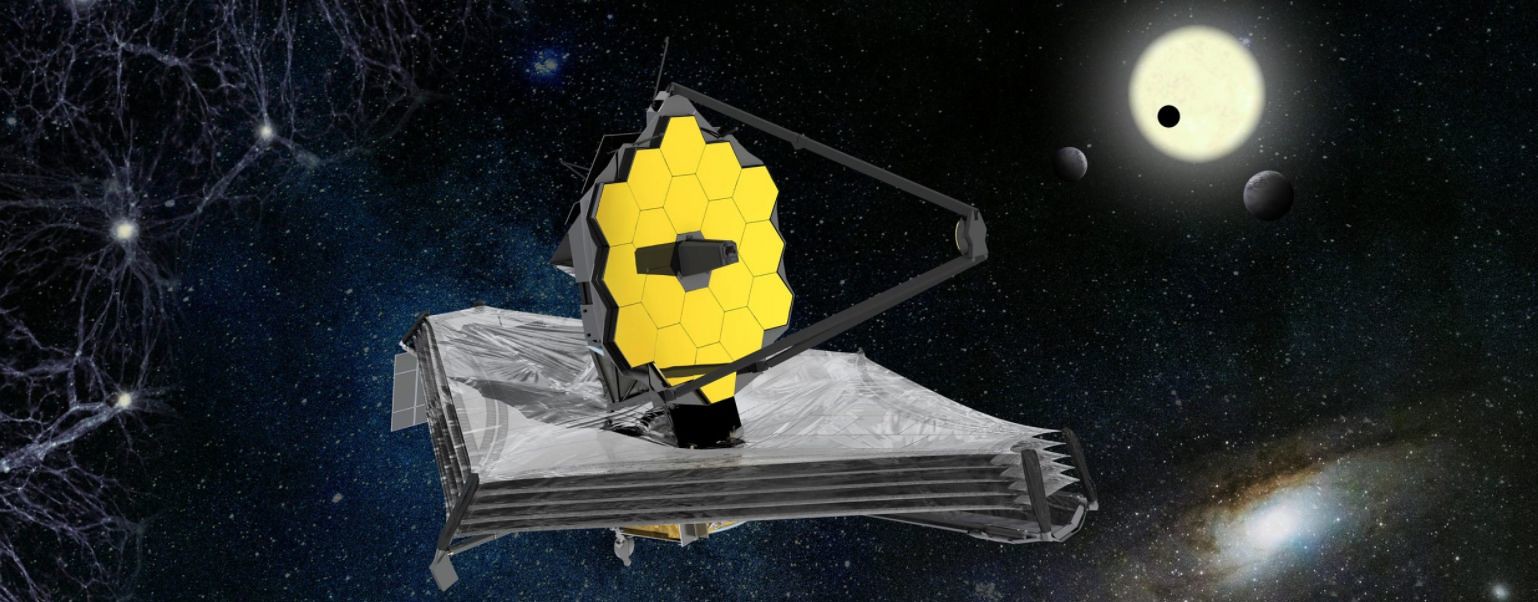
Here’s a brief summary of what has happened thus far with deployments.
In the early houses of Wednesday, December 29th (UTC), Earth, JWST unfolded the forward sunshield pallet, lowering it away from its stowed position in front of the central deployable tower supporting the (still folded) primary and secondary mirror assemblies and the telescope’s massive radiator, and containing JWST’s vital electronics and science instruments.

The lowering process took 20 minutes to complete, and was followed by the aft sunshield pallet being unfolded from behind the mirror tower in an 18-minute operation. After this, JWST went through several hours of additional operations, including ensuring the pallets were correctly in place and their sub-systems operational, and orienting the observatory with respect to the Sun to provide optimal shielding when the sunshield is deployed and tensioned. Once all this was completed, the command was given for the pallets to lock themselves in their deployed condition.
Later on the 29th, the deployable tower was raised some 1.2 metres from its “stowed” state over a 6-hour period. This moved it away from JWST’s thrusters and provided the room needed for the sunshields to be deployed and tensioned.

Thursday, December 30th saw the deployment of the sunshield commence. A three-part process, and one vital to the observatory’s operations, this started with the drawing back of the membranes that have protected the delicate sunshield.
On December 31st, the booms that extend the five layers of the sunshield were extended. Operations began at 18:30 UTC, with the five segments of the portside boom extending outwards from the mid-point between the two sunshield pallets. The procedure took just over three hours to complete, and was followed by the extension of the starboard boom, which took a similar amount of time, also drawing out the membranes of the sunshield on that side of the telescope.

Overall, the deployment of both booms took longer than anticipated, but was successfully completed, with operations then being halted for New Years Day. On January 2nd, operations resumed on the tensioning of the membranes. A 2-day operation, this involves separating each of the 5 membranes from the others and then tensioning it using the side booms and four fore-and-aft boom mechanisms. Once this has been completed, the focus will switch to deploying the telescope’s “eyes” – its secondary and primary mirrors.
The other news on the programme is that such was the accuracy with which the Ariane 5 placed JWST onto its transfer orbit, coupled with the smoothness of the first “mid-course” thruster burns, far less propellants that had been estimated. This now means that the observatory has sufficient reserves to complete at least a 10-year mission (although NASA remains focused on the 5-year primary mission).
Space Highlights for 2022
I generally try to look ahead to key space events at the start of the year, and while this may not be as comprehensive as previous years, but the following is offered as a broad summary of high points.
Launches
Several new launch vehicles will undergo initial launch tests / flight in 2022, including:
- Block 1 NASA Space Launch System (USA): maiden flight, February 2022 carrying the Artemis 1 mission hardware and cubesats for ten missions in the CubeSat Launch Initiative (CSLI), and three missions in the Cube Quest Challenge. The payloads will be sent on a trans-lunar injection trajectory.



 Inara Pey: Living in a Modemworld