Space Sunday: ISS – 20 years of living in space

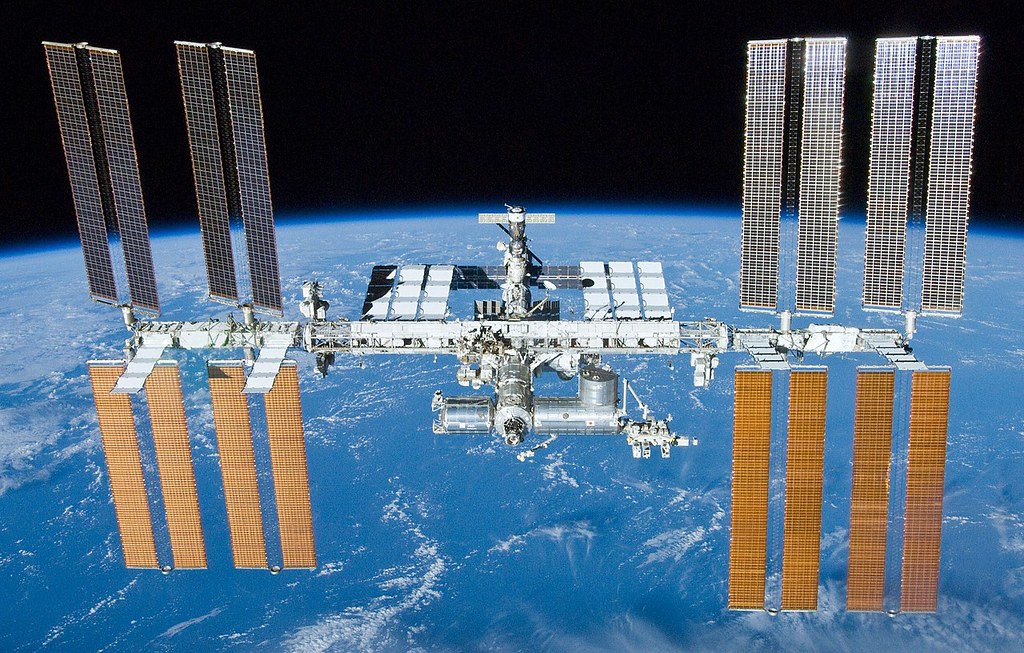
The International Space Station seen from the space shuttle Atlantis, May 23rd, 2010. The vertical gold / maroon panels are the solar panels for generating power; the white horizontal panels are the radiators for removing excess heat from the station. Credit: NASA

On October 21st, 2000, a Soyuz vehicle lifted-off from the Baikonur Cosmodrome in Kazakhstan en route for the fledgling International Space Station ISS, carrying two cosmonauts and an American astronaut. Sergei Krikalev, Yuri Gidzenko and William Shepherd were not the first people to visit the ISS, but when Soyuz TM-31docked with the station on November 2nd, they became the first official crew to live and work aboard it, and their arrival marked the start of 20 years of continuous occupation of the station.

At the time of the arrival of the Expedition 1 crew, the ISS was a small affair, the Russian-built Zarya propulsion, attitude control, communications and electrical power distribution module, launched in 1998; the American Unity module, intended to link future US and international modules on the station with the Russian units, delivered by the shuttle Endeavour in 1998; and the Russian Zvezda, which rendezvoused and docked with the station in July 2000.

The primary role of the Expedition 1 crew was to commission the ISS and its systems and to oversee the initial expansion of the station, with the assistance of two space shuttle flights. The first of these delivered the additional solar arrays to power the station, elements of the “keel” of the station (the Integrated Truss Structure), and the second the US Destiny research module. However, the work wasn’t all construction related: the three men also started the station’s long-running science programme that continues through to today. They also caused a slight controversy as they started work.

The ISS at the time of Expedition-1 crew. On the left is the Soyuz TM-31 vehicle the crew flew to the station aboard, docked against the Russian Zvezda module. In the middle is the Zarya module, the first module launched, and the US Destiny module to the right. This image was captured by the crew of STS-97 aboard the shuttle Endeavour, December 2000. Credit: NASA

The idea of a US space station has started to come together in the 1980s under the project title Space Station Freedom. This was later revised to Space Station Alpha before finally becoming the International Space Station following the signing of a US / Russian agreement to build a joint orbital facility. However, the “Alpha” name stuck with many at NASA, including Expedition 1 commander Shepherd, who insisted on using it – much to the consternation of Russian officials, who felt they had had the first space station in Salyut and Mir, so the new station was at best “Beta” (or better yet in their eyes, Mir -2).

Once aboard the station, and with the agreement of Krikalev and Gidzenko, Shepherd insisted on using “Alpha” as the station’s radio call sign, stating it was easier to say than “International Space Station” or “ISS”. Despite the annoyance on the part of Russia, “Alpha” continued to be used by the Expedition 1 crew, resulting in it being adopted as the station’s official radio call-sign.

As well as playing hosts to three space shuttle missions – the third of which delivered the Expedition-2 crew -, Shepherd Krikalev and Gidzenko also oversaw the start of re-supply missions using the Russian Progress vehicles (essentially fully automated Soyuz vehicles) capable of delivering around 2.4 tonnes of supplies and fuel to the ISS.

Following Expedition-1, the initial crews visiting the ISS were exclusively made up of Russian cosmonauts and American astronauts, with each crew spending, on average, 5-6 months on the station. It was not until June 2006 that the first international crew member boarded the ISS in the form of German astronaut Thomas Reiter. He was followed in 2008 by Frenchman Léopold Eyharts and Japan’s Koichi Wakata in 2009 (Wakata actually served a total of 5 Expedition crew rotations: 18, 19, 20 (all back-to-back and continuous) and 38 and 39 (again back-to-back). After this, crews routinely included one or more non-American / Russian astronaut.

The men who started it all: Sergei Krikalev, William Shepherd (centre) and Yuri Gidzenko: the Expedition-1 crew. Credit: Roscosmos

In the 20 years since Expedition-1, 240 individuals have made 395 flights to the ISS (including 7 “space tourists”) – a number that represents 43%of all human flights into space. In that time, the space station has grown from those initial three units to a total of 16 permanent pressurised modules, numerous unpressurised pallets and work stations, and one commercial unit, the Bigelow Expandable Activity Module (BEAM), an inflatable unit, currently configured as a storage space.

Outside of the Zarya, Zvezda, Unity and Destiny modules, the ISS comprises the following pressurised modules:

  • For science: the Columbus European module (added February 2008); the Japanese Kibō module (which, with its unpressurised work platform is the largest crewed elements of the ISS, added between 2008 and 2009); the Russian Rassvet module (now primarily used for storage, added May 2010).
  • Airlock / docking: the US Quest Joint Airlock, supporting EVAs using either US or Russian space suits (added July 2001); the Russian Pirs and Poisk airlock / docking modules (added September 2001 and November 2009, respectively, and connected to the Zvezda module); the US International Docking Adapters 2 and 3 (IDA-1 was lost in a Falcon 9 launch failure), delivered in 2016 and 2019 respectively.
  • Other modules: the US Harmony “hub node” connecting the European and Japanese science modules to the US Destiny module (added 2007); the European Tranquillity life-support and environmental module (added November 2009); the Leonardo European multi-purpose module (added February 2011) and the European Copula module, with its seven large windows (added in 2010).

Together, the pressurised modules of the ISS offer a volume of living / working space equitable to that of a 747 airliner. The overall mass of the ISS, including the Truss, and all unpressurised / external elements is approximately 425 tonnes.

Nor is this all: four more Russian modules are awaiting launch to the ISS: the Nauka Multipurpose Laboratory Module (MLM). Delayed since 2007, it is currently slated for a 2021 launch, but this may yet be cancelled as the warranties on several of the module’s system expire in later 2021; the Prichal “docking bell”, primarily intended to provide docking for two further power modules (SPM-1 and SPM-2) and for Soyuz  / Progress docking. Prichal is slated for launch in late 2021, and the two SPM units in 2024.

Further commercial elements are also due to be added  in the form of the Bishop Airlock Module, designed for the launch of cubesats from the station (and awaiting launch before the end of 2020), and the Axiom commercial node, due to be added in 2024.

The 2 decades of ISS operations has seen the amount of equipment deployed in the station increase. This is the console for operating one of the station’s 2 robot arms (located in the US Destiny module) which has become surrounded by a plethora of laptops and monitors that help monitor EVA operations. Credit: NASA

The living spaces on the ISS can support up to 6 crew at a time, although the standard crew complement outside of rotation periods, when two crews are operating side-by-side, has tended to be 3 (even when the shuttle was still operational). With the arrival of the SpaceX Crew Dragon and the Boeing Starliner, crews can now increase to 4-6, depending on requirements.

However, we’re not talking glitzy, hi-tech living. Despite its volume, the ISS is cramped; personal space is limited to a couple of cubic metres (mostly used to hang an astronaut’s sleeping bag), and “free” space has become increasingly overcrowded with the passing years as more and more equipment has been packed into the various modules.

The first Japanese astronaut to work aboard the ISS, Koichi Wakata, attempts to get some sleep during his fifth Expedition crew rotation (Expedition-39), which saw him take command of the ISS in 2014. Credit: NASA / JAXA

The lack of gravity means that almost any surface can be used as a floor, ceiling or wall, depending on a person’s orientation. However, to try to keep a general sense of orientation within the Russian modules, surfaces facing towards Earth are considered “down” and are coloured olive green; surfaces pointing away from Earth are considered “up”, and are painted beige. Perpendicular surfaces between them flow from the one colour to the other as you look “up” or “down”.

Doe to the lack of personal space, almost any “free” space on the structural walls / ceilings / floors of the various modules tend to become the home of personal and other mementos. One area of the Zvezda module, for example, has been turned into a corner for expressions of the Russian orthodox faith, and another a shrine to Russian heroes of space flight and discovery from Tsiolkovsky to Gagarin.

The two most popular areas of the station are the Harmony module, with its communal dining area, which is also used to celebrate birthdays, anniversaries, holidays, etc., and the European Copula, due to its unparalleled views out of its windows. Overall, however, life on the ISS is described as, “noisy, smelly [if your sinuses clear, as they are usually blocked due to the lack of gravity], dirty and awash with everything from human skin and floating globs of sweat [crew are expected to undertake around 2 hours of physical exercise a day] to the pencil you misplaced yesterday and which is now floating around in the air currents between modules,” with the noise being noted as the biggest issue.

The scientific range of the ISS has been, and remains, extensive. Human and life sciences space research includes the effects of long-term space exposure on the human body, testing medical systems and procedures specifically aimed towards supporting long-duration space missions (e.g. to Mars and back), zero-ego production of pharmaceuticals to help with ailments on Earth (the lack of gravity allows compounds to be mixed that would otherwise naturally separate). The broader aspects of life sciences have included the growth of unique protein crystals, and the evolution, development, growth and internal processes of plants and animals.

A second major area of research has been materials science.  This has included the production of unique materials (again made possible due to the lack or gravity) or materials with a greater purity than can be achieved on Earth; energy production and clean energy alternatives. Astronomy and Earth sciences have formed a third leg of ISS science, with the former encompassing wide-ranging stellar and solar studies such as the impact of cosmic rays and the solar wind on out atmosphere, solar observations, research into dark matter, etc. Earth sciences have included climate change studies, monitoring ice melt, global pollution (including world-wide emissions of carbon gases and aerosols, etc.

The fourth aspect of ISS research is education and cultural outreach. This includes teaching and lecturing from orbit, working with Earth-based students by carrying out their experiments, etc. An amateur radio programme gives students from around the world the opportunity to contact the ISS and talk about science, technology, mathematics and engineering with the crew.

Research is split between the various science modules on the station, with some providing unique environments / facilities for specific research fields, others sharing larger research projects. The science programme can additionally be extended or supplemented through equipment and experiments carried up to the ISS via crewed and uncrewed vehicles.

The ISS in 2012: A – Zvezda; B – Zarya; C – Unity; D – Tranquillity; E – Quest; F – Destiny (under truss); G- Harmony; H – Kibō (with external experiments pallet); I – Columbus. Not visible: Rassvet and Leonardo. 1 – Soyuz vehicles; 2 – radiators; 3 – Integrated Truss; 4 – solar arrays. Credit: image – NASA / Roscosmos

Operating the ISS has not been easy.  It is subject to numerous international agreements, has required the involvement of some 17 nations over the years (although Brazil has officially withdrawn from the programme), with 15 nations being original signatories to the ISS Intergovernmental Agreement. A total of 25 individual space agencies and centres around the world have a hand in managing ISS operations from the ground, with Russia and America providing the primary mission control centres and staff. These two countries are also responsible for carrying all crew to / from the station, and for the core missions to keep the station supplied with consumables, fuel, equipment, etc., although Japan also provides re-supply missions as well (as did the Europeans until their Automated Transfer Vehicle (ATV) programme came to an end).

Given the number of nations involved, there have inevitably been tensions from time-to-time, with perhaps the most famous being in 2009, when a disagreement between America and Russia resulted in Russian mission managers banning US personnel from using the toilets in the Russian modules and forbidding their cosmonauts from using toilets in the US modules!

Outside of odd bouts of tension on the ground, the main challenges in operating the ISS tend to be space-based. Several parts of the station are now ageing (the Zvezda module, whilst launched in 2000, was actually built in the 1980s, for example), so maintenance of the station, inside and out, accounts for a significant about of operational time. Stress on the structure as a whole means that there are often minor pressure / atmosphere leaks – which can be exacerbated by impacts with dust and tiny particles of debris, some of which can grow to be quite serious (but not life-threatening).  There’s also the growing risk of collision with large pieces of orbital debris.

However, despite all this, the ISS today continues to be at the forefront of human space research, and can form an essential platform for research into crewed missions to Mars. It is estimated to cost US $7.5 million per crew member per day to operate the station – which, while expensive, is still less than half the anticipated cost set in 2000. Thanks to the US Senate and House finally giving approach, US funding for the station means it can now continue operating through to 2030.

Dipping into a Sugar Mine in Second Life

Sugar Mine, November 2020 – click any image for full size

Sugar Mine is a Homestead region I learned about from Annie Brightstar. For those who are not aware of Annie’s work, she curates information on places to visit – regions, art exhibitions, installations, and events – and provides information on them through her Scoop it! pages and via her Twitter feed, which I tend to drop into from time-to-time as it is an excellent reference for things I may have otherwise missed.

The region is the home to Tomster Starflare and his gardener Gioia Sautereau, with the majority of it open for people to explore – providing visitors only attempt to reach those areas accessible on foot from the landing point or via the the teleports. The latter come in two forms: teleport discs and also experience portals (be sure to accept the experience when offered) that take a number of forms: mirrors, doorways, floating portals, stairways, and so on. The “on foot” aspect of visits should be kept in mind, as there is an adjoining region that’s part of the same group, but not necessarily part of the same setting.

Sugar Mine, November 2020

As a region carrying an Adult rating, there are aspects of the setting that lean towards BDSM – but nothing particularly overt (in fact, it’s so subtle, you might actually miss it). It is also a place that’s a little hard to describe; carrying a strong industrial thread, alongside something of a deco / steampunk vibe in places, together with hints of dystopia and of futurism. All of which makes for an engaging mix.

Many of these elements are evident at the landing point: an industrial wharf watched over by a steampunk lighthouse, whilst a hover truck floats under the arch that marks the main road  away from the wharf – although there is a route for those on foot that goes via the nearby beach and stairs up the neighbouring headland.

Sugar Mine, November 2020

Both the footpath and the zig-zagging road lead the way up to a plaza built on top of tall, deco-style and high-rise buildings. On its way to the plaza, the road offers a view out over one of the more dystopian aspects of the region: a semi-collapsed Eiffel Tower (of which more anon). A hover barge floating off the shoulder of the hill facing it offers a futuristic counter-point.

The plaza itself has buildings on three sides, with the fourth largely open, presenting a view across the waters below to a island that matches the plaza in elevation. Water tumbles from a dam-like outflow to drop unimpeded to the waters below, passing the double lines of tram tracks that appear from a tunnel as it does so. This water drop and other elements at the top of the hill  continue the industrial theme, whilst the three buildings each offer a deco-esque look. One of these forms a cinema,  another a large saloon club, and the third appears to be purely decorative. A  steam-power motorcycle and British Moran Plus 4 add a further mix to the setting.

Sugar Mine, November 2020

The club offers a its own rich mix of themes: sci-fi, retro, and more. It is also the place where the fun may well begin, depending upon how you find your way around. In one corner is the image of a flight of stairs. Walk into it, and you’ll be teleported to a building some distance away that might otherwise be an annexe to the bar. This in turn offers two further teleport points – stairs (you’ll need to look for them) back to the main bar, and a doorway to the fallen Eiffel Tower.

The stairway in the main bar is not the only teleport portal to be found there, there is a second that leads to a further room below ground, which also has its own portal. There are more portals to be found elsewhere (notably on the old Eiffel Tower),  but I don’t want to give too much away about where they lead. Suffice it to say that some may be one-way, leading you from point to point (including across the water to that other tall island with its own water tumbling from multiple outlets on hight, and marked by the sliced hull of an old Soviet-era submarine).

Sugar Mine, November 2020

However, the portals are not the only means of finding more places to explore – at the landing point, the plaza and elsewhere are teleport discs that offer the means to hop around. most notably, these will also offer the means to reach the region’s caversn – just left-click to select your destination, then right-click and teleport.

For those who wish, dances are available at various points, while the high, flat top of the smaller island offers a semi-natural retreat with a large body of blue water and places to sit. This island also offers a way down to the ground-level buildings that support the high plaza. These have a curious Japanese aspect to their signage , adding a further twist to things, although most are just façades for the most part.

Sugar Mine, November 2020

Genuinely unique in its approach and design, Sugar Mine makes for an  engaging visit edged with a sense of being a magical mystery tour.

SLurl Details

Lab Gab November 6th: Cloud Uplift update

via Linden Lab

On Friday November 6th, 2020 Lab Gab, the live streamed chat show hosted by Strawberry Linden on all things Second Life returned to the the subject of the work to transition all Second Life services to Amazon Web Services (AWS) and away from running on the Labs’ proprietary hardware and infrastructure.

The session came some 7 months after the last Lab Gab to focus on this work in April 2020 with Oz Linden and April Linden (see Lab Gab 20 summary: Second Life cloud uplift & more), and this time, Oz Linden sat in the hot seat alongside Mazidox Linden.

The official video of the segment is available via You Tube, and is embedded at the end of this article. The following is a summary of the key topics discussed and responses to questions asked.

Mazidox Linden is a relative newcomer to the Linden Lab team, having joined the company in 2017 – although like many Lab staff, he’s been a Second Life resident for considerably longer, having first signed-up in 2005.

Table of Contents

He is the lead QA engineer for everything simulator related, which means his work not only encompasses the simulator and simhost code itself, but also touches on almost all of the back-end services the simulator software communicates with. For the last year he has been specifically focused on QA work related to transitioning the simulator code to AWS services. He  took his name from the Mazidox pesticide and combined it with the idea of a bug spray to create is avatar, to visualise the idea of QA work being about finding and removing bugs.

Oz Linden joined the company in 2010 specifically to take on the role of managing the open-source aspects of the Second Life viewer and managing the relationship with third-party viewers, a role that fully engaged him during the first two years of his time at the Lab. His role then started expanding to encompass more and more of the engineering side of Second Life, leading to his currently senior position within the company.

“The Bugspray” Mazidox Linden (l) and Oz Linden joined Strawberry Linden for the Friday, November 6th segment of Lab Gab to discuss the cloud migration work

What is the “Cloud Uplift”?

[3:25-5:55]

  • Cloud Uplift is the term Linden Lab use for transitioning all of Second Life’s server-based operations and services from their own proprietary systems and services housed within a single co-location data centre to  commercial cloud services.
  • The work involves not only the visible aspects of SL – the simulators and web pages, etc., but also all the many back-end services operated as a part of the overall Second Life product,  not all of which may be known to users.
  • The process of moving individual services to the cloud is called “lift and shift” – take each element of software, making the required adjustments so it can run within a cloud computing environment, then relocate it to AWS infrastructure and hardware in a manner that allows it to keep running exactly as it did prior to the transfer, while avoiding disruptions that may impact users.
  • The current plan is to have all of the transitional work completed before the end of 2020.
  • However, this doe not mean all the the work related to operating SL in the cloud will have been completed: there will be further work on things like optimising how the various services run on AWS, etc.,

Why is it Important?

[5:56-12:12]

  • It allows Second Life to run on hardware that is a lot more recent than the servers the Lab operates, and allows the Lab to evolve SL to run on newer and newer hardware as it becomes available a lot faster than is currently the case.
    • In particular, up until now, the route to upgrading hardware has involved the Lab reviewing, testing and selecting hardware options, then making a large capital expenditure to procure  the hardware, implement it, test it, then port their services over to the hardware and test, then implement – all of which could take up to 18 months to achieve.
    • By leveraging AWS services, all of the initial heavy lifting of reviewing, testing, selecting and implementing new server types is managed entirely by Amazon, leaving the Lab with just the software testing / implementation work.
  • A further benefit is that when SL was built, the capabilities to manage large-scale distributed systems at scale didn’t exist, so LL had to create their own. Today, such tools and services are a core part of product offerings alike AWS, allowing the Lab to leverage them and move away from having to run (and manage / update) dedicated software.
  • Two practical benefits of the move are:
    • Regions running on AWS can run more scripts / script events in the same amount of time than can be achieved on non-AWS regions.
    • The way in which simulators are now managed mean that LL can more directly obtain logs for a specific region, filter logs by criteria to find information, etc., and the entire process is far less manually intensive.

How Secure is SL User Data on AWS?

[12:20-15:43]

  • It has always been LL’s policy when dealing with third-party vendors (which is what AWS is) not to expose SL user data to those vendors, beyond what is absolutely necessary for the Lab to make use of the vendor’s service(s).
  • This means that while SL user data is stored on AWS machines,it it not stored in a manner Amazon could read, and is further safeguarded by strict contractual requirements that deny a company like Amazon the right to use any of the information, even if they were to be able to read it.
  • In fact, in most cases, user-sensitive data is effectively “hidden” from Amazon.
  • LL  is, and always has been, very sensitive to the need to protect user data,even from internal prying.
  • In terms of the simulators, a core part of testing by Mazidox’s team is to ensure that where user data is being handled (e.g. account / payment information, etc.), it cannot even be reached internally by the lab, as certainly not through things like scripted enquiries, malicious intent or prying on the part of third-party vendors.
  • [54:30-55:18] Taken as a whole, SL on AWS will be more secure, as Amazon provide additional protection against hacking, and these have been combined with significant changes LL have made to their services in the interest of security.

Why is Uplift Taking So Long?

[15:48-19:20]

  • The biggest challenge has been continuing to offer SL as a 24/7 service to users without taking it down, or at least with minimal impact on users.
    • This generally requires a lot of internal testing beforehand to reach a point of confidence to transition a service, then make the transition and then step back and wait to see if anything goes dramatically wrong, or users perceive a degraded service, etc.
    • An example of this is extensive study, testing, etc., allowed LL to switch over inventory management from their own systems to being provisioned via AWS relatively early on in the process, and with no announcement it had been done – and users never noticed the difference.
  • Another major challenge has been to investigate the AWS service offerings and determine how they might best be leveraged by SL services.
  • As many of the SL services are overlapping one another (e.g. simulators utilise the inventory service, the group services, the IM services, etc.), a further element has been determining a methodical manner in which services can be transitioned without impacts users or interrupting dependencies on them that may exist elsewhere.
  • The technology underpinning Second Life is a lot more advanced and recent within the AWS environment, and this means LL have a had to change how they go about certain aspects of managing SL. This has in turn required experimentation, perhaps the deployment of new tools and / or the update / replacement of code, etc..

Will Running on AWS Lower Operating Costs?

[19:33-23:00]

  • During the transitional period it has been “significantly” more expensive to operate SL, inasmuch as LL is paying to continue to operate its proprietary systems and services within their co-lo facility and pay for running services via AWS.
  • Even after the need to continue paying for operating the co-lo facility has ended, it is unlikely that the shift to AWS will start to immediately reduce costs.
  • However, the belief is that moving to AWS will,  in the longer term, reduce operating costs.
  • Whether reduced operating costs lead to reduced costs to users, or whether the savings will be re-invested in making further improvements to the service lay outside of this discussion.
  • Right now the focus is not on driving down costs or making service significantly better, but is solely the work of getting everything transitioned. Lowering costs, making more efficient use of the underpinning capabilities provided by AWS will come after the migration work has been completed.

What Happens to the Old Hardware / Facility, Post-Uplift?

[23:09-25:15]

  • Several years ago, LL consolidated all of their hardware and infrastructure into a single co-location data centre in Arizona.
  • Most of the hardware in that facility is now so old it has depreciated in value to a point where it is pretty much worthless.
  • A specialist company has therefore been contracted to clear-out the Lab’s cage(s) at the co-lo facility and dispose of the hardware.
    • As a demonstration of LL’s drive to protect user data, all drives on the servers will be removed under inspection and physically destroyed via grinding them up on-site.

Continue reading “Lab Gab November 6th: Cloud Uplift update”

Men in Motion 2020 at Men in Focus in Second Life

Men in Focus November exhibition: Pavel Stransky

Officially opening on Saturday November 7th, is the annual Movember art exhibition at the Men in Focus Gallery, curated by JMB Balogh. Sponsored by the Men in Motion dance troupe, the exhibition is in support of the Movember Foundation, and furthers the gallery’s aim to both promote and feature photography by male artists.

Once again, I was graciously granted the opportunity to preview the exhibition – thank you, Jo! – which sees 2D artists Darkyn Dover, Winter Jefferson, Pavel Stransky and Arnno Planer join several of the Men in Motion dance troupe in displaying their work, together with 3D artists Mistero Hifeng, Luc Lameth and Reycharles.

Men in Focus Movember exhibition: Darkyn Dover

Of the 2D artists, I’ve long been familiar with the work of both Darkyn Dover’s Pavel Stransky, and admire both for their ability to frame images as stories.  This is very much displayed with the selections they present in this exhibition, where Darkyn’s work can be found on the ground floor and Pavel on the third, with some more “traditional” posed avatar studies (lying on the beach and looking out to sea) and portraits (notably Pavel’s striking studio-like piece simply entitled Portrait) added to the mix.

For those images offering a narrative, within these two selections, I found myself particularly drawn to: Darkyn’s No Ideas, which offers both a story in its own right whilst offering a strong feeling of familiarity and understanding for those of us who have ever suffered from a bout of extended writer’s block. Meanwhile, Pavel’s Singing in the Rain, which not only brings to mind Gene Kelly’s entire magical dance routine from that film, but also tells a story of Kelly’s entire genius as a dancer and the heyday of the Hollywood musical; it’s a genuinely evocative piece, beautifully framed.

Men in Focus Movember exhibition: Arnno Planer

Sandwiching Pavel’s work are the selections are those by Winter Jefferson (2nd floor) and Arnno Planer (4th floor). Both offer more “traditional” avatar studies, mostly tightly focused on the avatar such that while costumes are used, the narrative that might be offered is a lot narrower in presentation. This is not a critique of either artist in any way at all; every artist in SL has a specific style and approach to their work, and both Arnno and Winter’s work is engaging and very much broaden the mix of art here.

Of the 3D artists, all are making a return to the gallery, and their pieces  – as enticing as ever – can be found on each of the guest artists levels, and the two levels devoted to the art of members of the Men in Motion dance troupe.

The Movember exhibit officially opens with a 2-hour event featuring the music of Ame Starostin Cheveyo, starting at 17:00 SLT on Saturday, November 7th.

Men in Focus Movember exhibition: Luc Lameth

About the Movember Foundation

The Movember Foundation is a multinational charity raising awareness of, and money for, men’s health and welfare, with a focus on cancer, mental health and suicide prevention. Its titular and widely known campaign is Movember, which encourages men to grow moustaches during the month of November. The foundation partners annually with the Distinguished Gentleman’s Ride to also raise money for men’s health.

Founded in 2003, in Melbourne, Australia by Adam Garone, Travis Garone, Luke Slattery, and Justin Coghlan, the organisation attained registered charity status in 2006, and has raised approximately US $700m in charitable donations. These funds have been used to fund more than 800 programmes focusing on prostate cancer, testicular cancer, poor mental health, men’s health awareness and healthy lifestyles. It is active in 21 countries and has a global workforce of 130 people. In addition, Movember coincides with International Men’s Day (November 19th), which among its aims, shares the goal of promoting the health and well-being of men and boys.

SLurl and URLs

2020 CCUG meeting week #45 summary

Where Our Journey Begins, September 2020 – blog post

The following notes were taken from my audio recording and chat log of the Content Creation User Group (CCUG) meeting held on Thursday, November 5th 2020 at 13:00 SLT. These meetings are chaired by Vir Linden, and agenda notes, meeting SLurl, etc, are are available on the Content Creation User Group wiki page.

SL Viewer

At the time of writing, the current selection of official viewers (release, RC and projects) was as follows:

  • Current release viewer version 6.4.10.549686, formerly the Mesh Uploader RC promoted on October 14 – No Change.
  • Release channel cohorts (please see my notes on manually installing RC viewer versions if you wish to install any release candidate(s) yourself):
    • Cachaça Maintenance RC viewer, version 6.4.11.551139, issued October 27.
  • Project viewers:
    • Project Jelly project viewer (Jellydoll updates), version 6.4.11.551213, November 2.
    • Custom Key Mappings project viewer, version 6.4.10.549685, November 2.
    • Legacy Profiles viewer, version 6.4.11.550519, October 26.
    • Copy / Paste viewer, version 6.3.5.533365, December 9, 2019.
    • Project Muscadine (Animesh follow-on) project viewer, version 6.4.0.532999, November 22, 2019.
    • 360 Snapshot project viewer, version 6.2.4.529111, July 16, 2019.

ARCTan / Jellydoll / Imposter Avatars

  • Bug fixes for Jellydolls include:
    • Fixing an issue where jellydolled avatars could suddenly vanish with viewed on Mac systems.
    • Ensuring Amimesh attachments on imposter avatars update in sync with the avatar.
    • Impostered avatars and their Animesh attachments are currently rendered entirely separately to one another, so the code might be looked at to unify their rendering.
    • A general clean-up on the imposter code, which has led to the discovery that while code was added to the viewer to check to see if impostered avatars had been updated, it has never been hooked up to updating the imposter avatar as rendered by the viewer, leaving them frozen. This is now being fixed.
  • Once the Mac issue is sorted, the play is to merge the Jellydoll updates back into the ARCTan project (from which they were split earlier in the year).
    • However, the current Jellydoll work will progress as is through the currently project viewer continued through to RC and, ultimately, release.
  • As a reminder:
    • The current ARCTan work is focused on the viewer-side updates to avatar complexity calculations.
    • Work on providing in-world object rendering costs (LOD models, etc.) which might affect Land Impact will be handled as a later tranche of project work, after the avatar work.

Graphics

  • No news on work for replacing OpenGL.
  • Ptolemy Linden from the Graphics team has been working on performance improvements, notably related to Linden Water rendering. This work is currently focused on providing a means for those on low-end systems to completely disable water reflection rendering entirely and / or to make water opaque, both to reduce the rendering load.
  • The entire water rendering issue is complicated for a range of reasons (e.g. the fact the water plane is still drawn at altitude even though its appearance is occluded by the sky sphere, the fact that any changes made for some users could impact the “shared experience” / expected behaviour for others, etc.).
  • Ptolemy also noted that the viewer collects a lot of static rendering information that could potentially be used to assist with better drawing / rendering of scenes, and this could be something that might be looked at in more detail once the Project Uplift work is completed.

Date of Next Meeting

  • Thursday, November 19th.

Don’t forget: Lab Gab, November 6th: cloud update

via Linden Lab

Lab Gab returns on Friday, November 6th, 2020, with a cloud migration update.

As most are aware, the work to transition Second Life to operating via Amazon Web Services (AWS) has now progressed to a point where regions on the main grid (called Agni) are starting to be transitioned. In fact, by the time the Lab Gab show live streams, approximately one-third of all Agni regions will be operating via AWS services.

At the same time, as as per my November 2020 Web User Group summary, the Web teams are hopeful that all web properties will be running via AWS by early December, placing the Lab on course to achieve its target of completing the migration (referred to as Project Uplift) by the end of 2020 (although there will likely be more work related to it to follow in early 2021).

This being the case, the Lab Gab segment will feature Oz Linden, the Lab’s Vice President of Engineering (and the man pretty much in overall charge of the engineering / technical aspect of the work) and Mazidox Linden, the Lab’s senior QA Engineer who has been particularly involved in the migration work, testing the simulator code in reference to the migration work, and who describes the project as “the largest change to the simulator [software] ever.”

“The Bugspray” Mazidox Linden (l) and Oz Linden will be joining Strawberry Linden on the Friday, November 6th segment of Lab Gab to discuss the cloud migration work

As usual, the programme will be streamed via YouTube, Facebook, or Periscope, at 10:00 SLT, and if all goes according to plan, I’ll have a summary of the video (and the video itself) available soon after the the broadcast, for those unable to watch live.

For those who may have questions on the migration work, there is still time to submit them via the Lab Gab Google form, in addition, and if there is time, questions may also be taken from the chat feeds associated with the live stream channels.