Let it Snow! 2020 in Second Life

Let It Snow!, November 2020

With winter on our doorstep, Milly Sharple has once again opened her annual Let It Snow! winter / Christmas themed region for Second Life residents to enjoy, and Caitlyn and I once again received an invitation – although I’m still playing a lot of catch-up on general blogging  due to the physical world occupying a lot of my time at the moment, so it has taken me a fair few days to get to the point of writing about it.

I’ve actually been covering Let It  Snow! on an annual basis since 2014, only stopping during the years Milly took a break from presenting the region, and have always enjoyed our little pilgrimages to see what seasonal delights Milly has served up – as an artist, she has an eye for framing photogenic series of vignettes across her chosen region, often with touches of whimsy design to bring smiles to the faces of those visiting.

Let It Snow!, November 2020

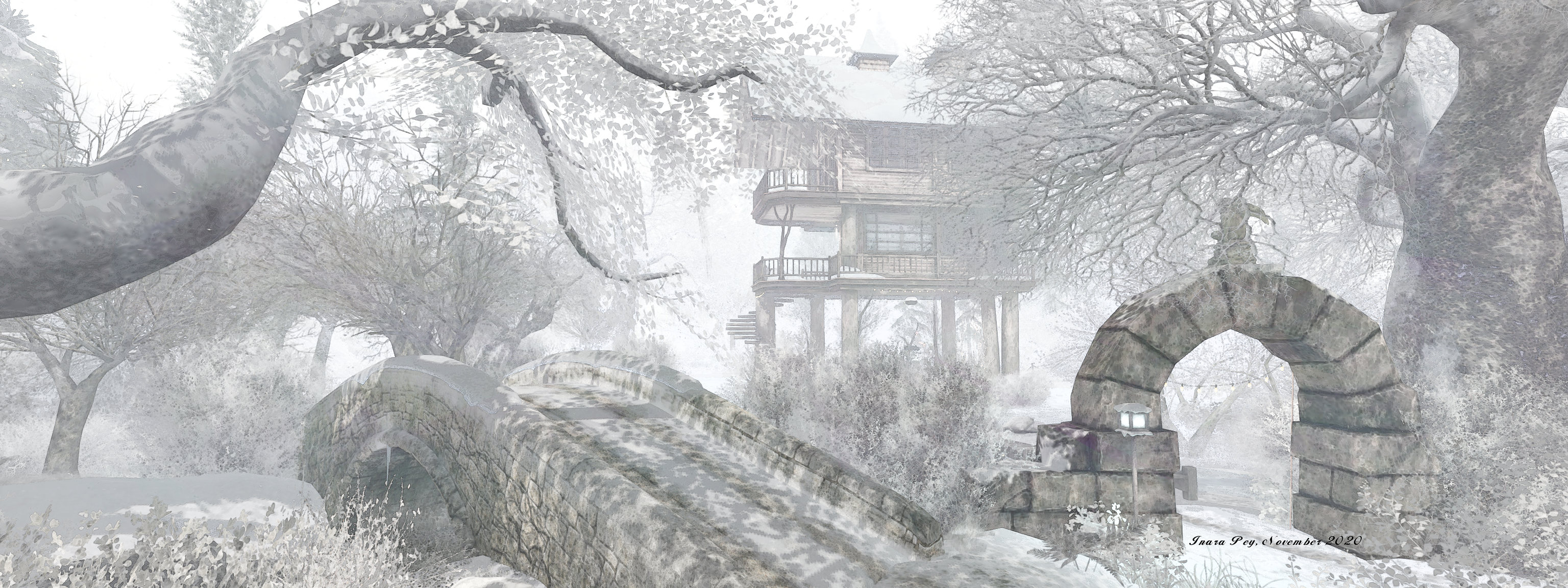
A  visit to the region starts on the north side, where a little village square awaits arrivals, a pavilion offering the warmth of an open fire, a gazebo a place for dancing and, for those seeking something a little warmer, a cosy cottage. Overlooked on one side by a large and warmly-furnished house atop a rocky table,the village is a short walk to a frozen pond ready for ice skaters.

Cut by channels of frozen water spanned by bridges, this year’s Let It Snow! follows Milly’s previous iterations of the region by presenting within its snow-covered landscape a series of interlinked vignettes and scenes, each of which stands on its own whilst also being linked to the rest of the region.

Let It Snow!, November 2020

To describe all of these settings here would be to spoil the opportunity for exploration and discovery, but there are various points within the region I found particularly attractive. Chief among these is the the manner in which Milly has combined The Chapel Ruins from The Looking Glass with pieces by Paco Pooley and Krystali Rabeni to create the site of a ruined chapel, complete with a stained glass window by Milly as a romantic setting with an ethereal edge to it.

Whimsy is added here and there, as with previous designs – such as the snowball-throwing snowman lurking under a tree, while seasonal touches come in the form of the decorations adorning the rooms of the large house, the lights hanging on the trees around the skating rink and so on.

Let It Snow!, November 2020

As well as ice skating, the region offers signs where sleds can be rezzed,  plenty of opportunities for dancing, and even the opportunity to play chess with a companion.

The best way to explore the region is to go where your feet will take you – there are no formal paths (just steps to get up to and down from he raised portions of the landscape). However, when visiting I do recommend you use the region’s environment settings to appreciate i to the fullest – and the sky dome Milly has placed over it – to the fullest.

Let It Snow!, November 2020

With plenty to see and do, and with lots of opportunities for photography, 2020’s let It Snow is as captivating to the eye as past iterations, and more than worth the time taken in a visit.

SLurl Details

Space Sunday: a Dragon, a telescope and a heavenly princess

Sunday, November 15th, 2020, 19:27 local the Crew-1 Falcon 9 booster lifts-off from Kennedy Space Centre’s Pad 39A.Credit: NASA

Sunday, November 15th saw the official start of a new era in low-Earth orbit space transportation with the launch of the NASA / SpaceX Crew-1 mission to the International Space.

Originally scheduled for launch on Saturday, November 14th, the Crew-1 mission was delayed due to weather causing concerns about the recovery of the Falcon 9 launch vehicle’s first stage. However, at 19:27 local time on Sunday (00:27 GMT on Monday, November 16th), the Falcon 9 topped by the Crew Dragon and its crew of four – NASA astronauts, Mike Hopkins, Victor Glover, Shannon Walker and Japanese astronaut Soichi Noguchi – lifted off from the SpaceX leased Pad 39A at Kennedy Space Centre, the first stage of the rocket making a successful return to Earth and landing aboard the autonomous drone ship Just Read The Instructions.

Resilience approaches the ISS on November 16th/17th 2020. Credit: NASA / SpaceX

Nine minutes after launch, the Crew Dragon capsule – named Resilience by the crew – achieved an initial orbit, and the crew followed a long tradition of space flight dating back to the first manned space mission, and revealed their “zero gee indicator”, a Baby Yoda plushy toy from the TV series, The Maldorian.

The use of toys and dolls as such indicators goes back to the flight of Yuri Gagarin and his flight aboard Vostok-1 in April 1961.  Gagarin carried a small doll into orbit out of curiosity, as he wanted to see what floating in the micro-gravity of space looked like. However, his practice was copied by other Soviet cosmonauts, and in turn by NASA missions, with crews on the Crew Dragon continuing the tradition – Doug Hurley and Bob Behnken carried a plushy planet Earth on their trip to the ISS earlier in  2020 during the Crew Dragon certification flight.

While not confirmed, it is believed the selection of Baby Yoda was due to back-up crew member Kjell Lindgren. A long-time Star Wars fan, Lindgren had used a model of R2D2 as a zero-gee indicator during a 2015 Soyuz flight to the ISS and while aboard the station, persuaded the rest of the crew to dress up as Jedi Knights for a special NASA promotional poster.

It’s been a tough year. And the fact that … SpaceX and NASA were able to get our spacecraft ready to go, the rocket ready to go, throughout this year, throughout the pandemic, and all of that — we were inspired by everybody’s effort to do that. So that’s why we named Resilience, and we hope that it puts a smile on people’s faces, it brings hope to them. Baby Yoda does the same thing. I think everybody, when you see him, it’s hard not to smile, and so it just seemed appropriate.

– Mission commander Mike Hopkins explaining the choice of name for the Dragon
capsule and the selection of Baby Yoda as the zero-gee indicator.

A NASA graphic showing the craft docked at the ISS at the time the Resilience docked. Credit: NASA

It  took some 27 hours for Resilience to catch up with the ISS, finally rendezvousing and docking with the station at 11:01 EST on Monday, November 16th (04:01 GMT, November 17th). Following a further 2 hours of post-flight checks and preparations both in the capsule and on the station, the forward hatch on Resilience was opened and the four crew were invited aboard the ISS. In doing so, they set a new record for the space station: the first time it has been occupied by full-time crew  totalling seven  people. This is actually one more person than the ISS is designed to accommodate, so Crew-1 commander Mike Hopkins is sleeping aboard the Resilience.

The Expedition 64  crew will remain on the ISS for a 6-month rotation period, Hopkins and his crew joining NASA astronaut Kate Rubins and Russian cosmonauts Sergey Ryzhikov and Sergey Kud-Sverchkov, who arrived at the ISS on October 14th, aboard the Soyuz MS-17 – a mission which was itself a record-setter, rendezvousing with the station just three hours after launch, utilising Russia’s “ultrafast” ISS launch and rendezvous flight plan for the first time.

Kate Robins, who arrived aboard ISS as a part of the Soyuz TM-17 crews, greets Victor Glover as he boards the ISS from Resilience, marking the first time an African-American astronauts has boarded the station as part of the full duration crew. Credit: NASA
Once aboard the station, the crew wasted little time in getting down to work. On November 18th, Ryzhikov – currently in overall command of the ISS – and Kud-Sverchkov made a 6-hour 48-minute spacewalk that inaugurated the operational use of the Poisk “mini research” module as an airlock.

As I noted in my previous Space Sunday update, Poisk has been delivered as an airlock / docking module in 2009. It is one of two such units attached to the Russian Zvezda module, the other being the Pirs airlock / dock, deployed to the ISS in 2001. Up until the Ryzhikov / Kud-Sverchkov EVA, Poisk had only been used as a docking module, spacewalks generally being conducted via the Pirs module.

 Sergey Ryzhikov (centre top with the red stripe on his backpack) and Sergey Kud-Sverchkov work outside of the Poisk (the vertical unit) and Zvezda modules of the ISS. Credit: Roscomos

However, Pirs is due to be removed from the ISS in 2021, so it can be de-orbited to burn up in the upper atmosphere using one of the Russian Progress resupply vehicles. It is due to be replaced by the Nauka Multipurpose Laboratory Module (MLM) – although there are some doubts about this module, as its launch has been delayed so much, several of its systems are at the end of their warranty period.

In  particular, the Poisk spacewalk was to start the process of decommissioning Pirs, by moving vital communication equipment and cabling from that module and connecting them to Poisk, allowing it to become the primary Russian EVA airlock.  As  well as this work, Ryzhikov and Kud-Sverchkov retrieved hardware used to measure space debris impacts, and repositioned an instrument used to measure the residue from thruster firings. The EVA marked the 47th Russian space walk in support of ISS operations, and the 232nd ISS spacewalk overall.

Continue reading “Space Sunday: a Dragon, a telescope and a heavenly princess”

A girl, weird women, spirits, and princes

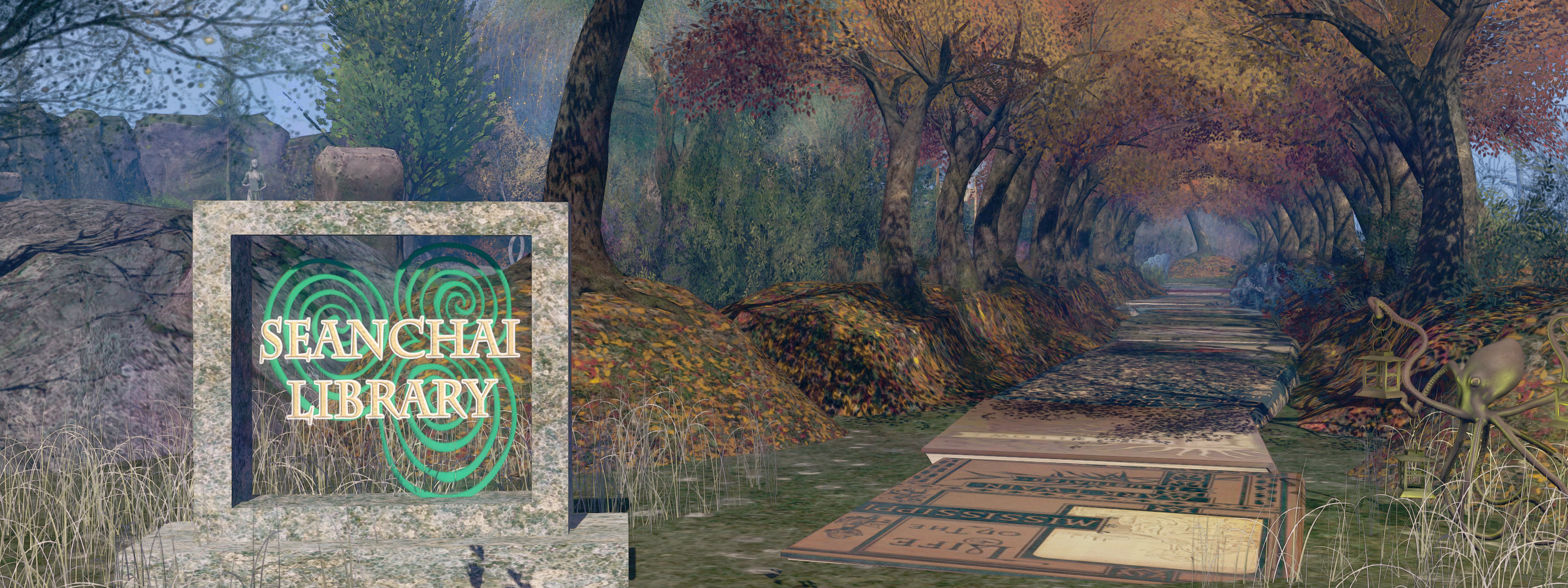
Seanchai Library

It’s time to highlight another week of storytelling in Voice by the staff and volunteers at the Seanchai Library. As always, all times SLT, and events are held at the Library’s home in Nowhereville, unless otherwise indicated. Note that the schedule below may be subject to change during the week, please refer to the Seanchai Library website for the latest information through the week.

Sunday, November 22nd, 14:00: The Curious World of Calpurnia Tate

As Calpurnia Virginia Tate, aka Callie Vee, turns 13 in 1900, she revels in studying science with her cantankerous grandfather, with whom she co-discovered a new plant species in The Evolution of Calpurnia Tate. But a life of science doesn’t seem to be in her future: although her family is rich and her six brothers can pursue their educations and follow their dreams, Callie can’t.

Destined from her unfortunate birth as a female for life as a Texas debutante and wealthy matron, she’s furious as she feels the doors of the gilded cage closing in on her in a world where the fact that she’s smarter and harder-working than her brothers doesn’t matter a bit.

As she tries to keep her tenderhearted brother Travis, who keeps bringing home strays. And Callie has her hands full keeping the wild animals – her brother included – away from her mother’s critical eye. Whether it’s wrangling a rogue armadillo or stray dog, a guileless younger brother or standoffish cousin, the trials and tribulations of Callie Vee will have readers laughing and crying and cheering for this most endearing heroine.

Join Caledonia Skytower at the Golden Horseshoe for another Magicland Story  Time.

Monday, November 23rd, 19:00: The Dark Bright Waters

Gyro Muggins reads Patricia Wrightson’s second novel charting the life of Wirrun of the Inlanders.

First encountered in The Ice Is Coming, when Wirrun set out on a quest to overcome the rise of the ancient enemy of Australia, the ice-bearded Ninya, the young janitor now has a reputation as a Hero among the Inlanders (Wrightson’s fantasy view of the Australian Aboriginals). It’s not a title he appreciates; he would much rather just get back to his janitorial work.

But the spirits of the land are restless: Yunggamurra, a river spirit is lost, so uses her siren-like powers of song to draw to herself those who might might take her home. Her singing come to Wirrun’s ears, and those of an elderly aboriginal emissary, and he realises he must journey to the very heartlands of Australia to better understand what he is feeling.

This he does, with the old emissary and his friend Ularra. Once there, he discovers that a storm is indeed rising within the domain of the spirits, and he is uniquely placed to both find Yunggamurra and prevent the coming storm. And so his new adventure begins.

Tuesday, November 24th

12:00 Noon: Russell Eponym, Live in the Glen

Music, poetry, and stories in a popular weekly session at Ceiluradh Glen.

19:00: Woman’s Weird: Strange Stories by Women, 1890-1940

With Willow Moonfire.

Wednesday, November 25th, 19:00: Nine Princes in Amber

Carl Corey wakes in a medical clinic, with little to no knowledge of who he is or how he got there. Fearing he is being over-medicated and kept against his wishes, he overpowers staff and discovers his stay is being paid for by his sister, one Evelyn Flaumel, whose address is on the hospital’s records.

Fleeing the clinic, he makes his way to his sister’s home. Here, with the aid of a pack of tarot cards and a confession from his sister, he learns that his name is actually Corwin (and she is Flora), and they are two of 14 siblings – nine male and five female.

One of those brothers, Random, arrives, pursued by strange, vicious creatures, that force Corwin to join him into fighting them to the death.  During the battle, Corwin makes another discovery – he has super-human strength.

After the fight, Random reveals more truths to Corwin – notably that he and his siblings are of royal descent from a planet called Amber, a parallel world to Earth from which he has been cast into exile.

Random reveals that their father, king Oberon, has vanished, and the throne is therefore open, and persuades Corwin in a quest to claim it. However, to do so, they must travel through the realms of Corwin’s brothers and sisters in order to reach Amber, and the journey reveals to Corwin his family’s ruthless and Machiavellian nature – a nature he shares -, and that the path to the throne is a route of force and betrayal.

Join Corwyn Allen as he reads the first volume in Roger Zelazny’s Chronicles of Amber series.

Thursday, November 26th: Library Closed

The library is closed for US Thanksgiving Day.

The snows of Yukina in Second Life

Yukina, November 2020

Occupying half of a Full region, Yukina is the home of Namanax & Stella (Stella Mahogany), who is largely responsible for its design. Currently sitting within a winter setting, we were directed to it by Shawn Shakespeare, our resident region discoverer :).

The parcel runs north-south,  with the eastern side open to the sea, and the west boundary marked by high cliffs separating it from the neighbouring parcel.

Yukina, November 2020

The southern end of the land is a actually the private home of Stella and Namanax, and while protected by ban lines to prevent trespass, leaving the garden open, it might be a good idea to avoid straying beyond the gabled gates leading up to the house (complete with stone lions guarding the path), in order to avoid the flick-knife armed squirrel  patrols (you’ll have to visit and take a peek into the grounds of the house yo understand this comment 🙂 ).

The main house isn’t the only property on the parcel, however; the public area of the parcel are home to a number of houses and cabins large and small, including one particularly impressive structure rising from the small  lake in the middle of the landscape. All of these appear to be open to the public and are furnished, giving each of them a cosy feel.

Yukina, November 2020

The landing point sits on the east side of the parcel on the dock alongside a boathouse. From here visitors have a choice of routes for exploration, most laid out in the form of snowy tracks that wind their way out and around the houses and cabins. The way around is also marked by by the local wildlife within the parcel, which ranges from the aforementioned squirrels (which are in fact more interested in playing than carrying weapons of any description!) through rabbits, cats, puppies, chipmunks and – most notably reindeer.

All of this makes for a lot to see, from the comfort and warmth of the houses to the scenes along the tracks to the decks that sit alongside a number of the houses (and which offer places for visitors to sit).

Yukina, November 2020

There are also some nice scenic touches waiting to be found – the Christmas tree shop operated by some nattily dressed gnomes being one of the more obvious, although I liked the little hump backed bridge over the still-flowing stream that feeds the (otherwise frozen) lake.  And for those who like a little a little activity during their visits, the lake offers ice shaking;  just look for the sign on one of the tracks that loops by it.

Overall, the setting is well presented and makes for an engaging visit. However, there is a lot packed into this half region, including falling mesh snow (that actually invites itself into one of the houses, drifting through the roof!), all of which can make for heavy going in places due to the volume of mesh, so some might want to tweak their viewer to get the most comfortable level of performance.

Yukina, November 2020

But that said, Yukina offers a rewarding wintertime visit.

SLurl Details

  • Yukina (Cosa Nostra, rated Moderate)

Second Life Endowment for the Arts: first grants

via Linden Lab

On Friday, November 2020, the Second Life Endowment for the Arts (SLEA) announced the first group of artists who have been awarded grants to use the new SLEA art facilities in the first six months of 2021.

As I reported in September this year, the SLEA is the successor to the former Linden Endowment for the Arts, which ran from 2009 through until 2019, when the user committee responsible for running it decided to close it down. At the time of the closure announcement, moves were initiated to try to keep the LEA afloat, which transitioned into discussions with Linden Lab to develop a successor – the Second Life Endowments for the Arts.

Operating on a smaller scale than the original LEA, offering an initial group of five regions for art installations: four for region-wide installations and one offering quarter-region art spaces, all of which are supported by a central hub and a sandbox. Grants for the use of the spaces run for between one to six months in duration.

The seven SLEA regions.  Image courtesy of SLEA / LL

The first set of artists selected for the opening round of installations are as per the table below, and include artists who will be also be presenting on the core SLEA region (“Region 7”) – presumably using the SLEA theatre or the Art Challenge space.

Commenting on the selection, Tansee Trillium stated:

Rather than filling out a specific form to apply for a grant, SLEA requested the artist respond in his or her own words the concept of the submission.
Upon the initial review it was realized that a grading system was not necessary as each essay was clear, concise and very detailed and equally befitting of a grant. As the process continued, it was noted that a very interesting pattern was evolving. Out of 19 applications no-one requested a one month grant which made that region flexible for a longer period. The majority of requests were made for 1/4 regions, 8 to be exact.
It was at this point as Coordinator of SLEA, I made what I believe to be a very balanced, mindful decision to fill the first 6 months from January 1, 2021 through June 30, 2021 giving each of the applicants the chance to show us their original creations to be on display for others to enjoy, appreciate, be inspired, learn from and most of all represent The Arts.

– Tansee Trillium, announcing the first SLEA grants

The first group of SLEA artists, the dates when they’ll be exhibiting and the regions in which they’ll be exhibiting. courtesy: SLEA

In  addition to the awarding of the first grants, Tansee has announced that the SLEA regions will officially open to the public on New Year’s Eve, December 31st, 2020, with a special “ribbon cutting” event that will include fireworks and particle display, held simultaneously across five regions together with live music, DJ’s, and dancing.

There will also be a special SLEA Grand Opening on Sunday, January 24th, 2021, featuring a special 24-hour Celebration of the Arts. Any artists wishing to participate in this event should contact Tansee or Hannington Xeltentat.

Congrats to all of the participating artists.

2020 CCUG meeting week #47 summary

Ruegen, October 2020 – blog post

The following notes were taken from my audio recording and chat log of the Content Creation User Group (CCUG) meeting held on Thursday, November 19th 2020 at 13:00 SLT. These meetings are chaired by Vir Linden, with dates available via the SL Public Calendar.

The venue for meetings is the Hippotropolis camp fire.

SL Viewer

At the time of writing, the current selection of official viewers (release, RC and projects) was as follows:

  • Current release viewer version 6.4.11.551711, formerly Cachaça Maintenance RC viewer promoted on November 12 – NEW.
  • Release channel cohorts:
    •  Custom Key Mappings project viewer, version 6.4.12.552100, November 12.
  • Project viewers:
    • Simple Cache project viewer, version 6.4.11.551403, issued on November 12.
    • Project Jelly project viewer (Jellydoll updates), version 6.4.11.551213, November 2.
    • Legacy Profiles viewer, version 6.4.11.550519, October 26.
    • Copy / Paste viewer, version 6.3.5.533365, December 9, 2019.
    • Project Muscadine (Animesh follow-on) project viewer, version 6.4.0.532999, November 22, 2019.
    • 360 Snapshot project viewer, version 6.2.4.529111, July 16, 2019.

General Viewer Notes

  • The Custom Key Mapping viewer is thought to be reaching a point where it can be promoted as the de facto release viewer.
  • A new Love Me Render (LMR) RC / project viewer is due to be issued. LMR-5 will include non-EEP bug fixes.
  • The Copy / Paste project viewer is on hold as a result of running into UI complications, and is currently awaiting further work by the viewer UI team, or possibly a decision to scrap the viewer entirely.

ARCTan / Jellydoll / Imposter Avatars

  • Vir has most recently looking at timers / frame rate variability.
  • As a reminder:
    • The current ARCTan work is focused on the viewer-side updates to avatar complexity calculations.
    • Work on providing in-world object rendering costs (LOD models, etc.) which might affect Land Impact will be handled as a later tranche of project work, after the avatar work.

Graphics

  • Work has commenced on separating out the rendering of viewer UI elements from scene rendering.
    • The reason for this is that the UI currently gets rendered on per frame basis, which is performance expensive on what is essentially a relatively static element of the viewer.
    • The aim is to revise the UI such that it is only re-drawn was needed, and it is hoped this will result in a performance gain in terms of viewer frame rates.
    • When this work is in a condition where it can be released, it will appear in its own project / RC viewer, and not as a part of the Love Me Render graphics-specific viewer pipeline.
  • No news on work for replacing OpenGL.

In Brief

  • There may be an issue with the viewer ignoring avatar custom joint positions if they do not have a weight associated with them. This appears true for .DAE files exports from Maya, and possibly with exports from Blender 1.7.9.a / 1.7.9.b (although Avastar may automatically compensate for unweighted custom joints by given them a default weighting). However, it is not clear if the issue lies with the modelling software or the mesh uploader, and its been requested that those experiencing these issues check the mesh upload data to see if anything is being pruned.

Date of Next Meeting

  • Thursday, December 3rd.