Kultivate 5th Anniversary Weekend – Vita Theas and Kapaan
Friday June 12th, 2020, marks the opening of the Kultivate’s Magazine 5th anniversary art show in Second Life, with the event running through until Sunday June 14th, inclusive, which art, music and entertainment for all who visit.
Kultivate Magazine is a publication about the cultural aspects of Second Life, its goal is to support art, culture, photography, music, and fashion. The brand includes the magazine, The Windlight Art Gallery, The Edge Gallery of Black & White Imagery, The Kultivate Loft Gallery, Signature Gallery, AIR Gallery and the Select Gallery. It addition, Kultivate Magazine is the media partner and primary sponsor of Team Diabetes of Second Life, an official and authorised fund-raising team for The American Diabetes Association.
Kultivate 5th Anniversary Weekend – 3D artists Ilyra Chardin, Cica Ghost and Venessa Jane
For the anniversary weekend, Kultivate presents a 2D and 3D art exhibition with some 31 artists participating, including: aht1981, Akiko.Tripsa, AlexAvion, Angel Heartsong, Anibrm Jung, Anouk Lefavre, archgothica, DrusillaGwind Resident, Elle Thorkveld, Francis Bagration, Hana Hoobinoo, ilyra chardin, Inara Pey, Jamee Sandalwood, Johannes Huntsman, Kapaan, Karma Weymann, KismaKSR Resident, Myra Wildmist, Reycharles Resident, Rissy Feiri, Sabine Mortenwold, Sheba Blitz, SkinTrader Greyskin, softandred, Syphera Inaka, talligurl resident, Tempest Rosca-Huntsman, Vanessajane66, Veruca Tammas, Vita theas, & wintergeist.
Obviously, with so many artists participating, the range of art on display is broad, with avatar studies, landscapes, colour images, monochrome, physical world paintings, mixed media, and more. All of the art is displayed in the open air, with the region’s default windlight providing a strong neutral background light to fully appreciate the pieces on display.
Kultivate 5th Anniversary Weekend – Jamee Sandalwood and John Huntsman
Entertainment for the weekend comprises (all times SLT):
Friday June 12th:
16:00-17:00: live performer Nina Setner + 10 slide show frames giveaway, 1 Templar Poses poseback giveaway, & L$1,000 Trompe L’Oeil Gift Card giveaway.
17:00-18:00: live performer Melenda Baptiste + 10 slide show frames giveaway, 1 Templar Poses posepack giveaway, & L$1,000 Trompe L’Oeil Gift Card giveaway.
Saturday, June 13th:
16:00-17:00: live performer Samuel James + 10 lucky winners of L$250 each & Templar Poses posepack giveaway.
17:00-18:00: live performer Aislen Sings +10 lucky winners of L$250 each & Templar Poses posepack giveaway.
Sunday, June 14th:
13:00-14:00: live performer Max Kleene + 1 Lumipro giveaway.
So be sure to hop along and join the celebrations and enjoy the art!
**[Dream]** Village, June 2020 – click any image for full sizeI received a couple of suggestions from MorganaCarter and Shawn Shakespeare that we should pay a visit to Dolceluna Myoo’s Homestead region **[Dream]** Village. So off we hopped to have a look around, and found it a thoroughly delightfully visit.
The first thing to note about the region is not to let the “Village” of the title fool you; whilst buildings are to be found here, this is not in any way a village style environment; rather it is a open rural space, the buildings scattered across it with plenty of space between them to suggest an untamed place, perhaps sitting on the edge of a more developed location.
**[Dream]** Village, May 2020The landing point sits to the south, close to a tram line that offers the suggestion that this is an end-of-the-line destination even if the region is surrounded by water. Across the tracks from the terminus is an outdoor events space alongside an old shack. From here, opportunities to explore run in multiple directions, or visitors can opt to hang out and dance on the deck.
**[Dream]** Village, May 2020Off to the east is the first of the island’s cabins, reached by passing some of the island’s wildlife – bears and deer with seagulls flapping overhead. This is a cosy, aged placed with a makeshift terrace, and a Bohemian interior that’s inviting enough to make one of the region’s cats feel like it is missing out on the comfort, although the geese enjoying the yard outside might disagree; to them the tub of water is far more interesting!
**[Dream]** Village, May 2020Two large bodies of water cut into the landscape from the east and west, such that the bulk of the low-lying land forms an uppercase “i” in shape. A further single-storey sits house to the north, a small summer cabin close by. Both are again furnished and offer plenty of opportunities for photography and / or sitting with friends. Horses graze close to the summer house, offering a further reason to tarry here.
More places to sit and pass the time can be found dotted around the setting: chairs and camp sites, swings strung from the boughs of trees, an offshore deck and around the vehicles scattered across the region, such as the old VW camper wagon. For those who fancy something a little different, a hot air balloon sits over the eastern bay.
**[Dream]** Village, May 2020There’s a richness of detail to the setting that further brings it to life. As well as wildlife and horses mentioned above, sheep can also be found grazing in places, whilst chickens share the island with the geese. Cats are also much in evidence, some of who form an appreciative audience for one of the poses offered in the region (those wishing to use their pose systems or props van join the local group for rezzing rights).
Ideally suited to a range of environmental settings and with a lot of subtle touches and plenty of details, **[Dream]** Village makes for a visually engaging and restful visit, rich in opportunities for photography and for simple appreciating the scene.
The revamped Sansar log-in screen shares the same image with the installer and updater, giving a more cohesive look to the product
It’s been a while since I poked my head into Sansar; I’ve been watching the events page to see what is going on and the COMETS – users engaged on the platform – have been doing a sterling job in trying to provide a nucleus of a community and running events among themselves. Product Meetings have been few – two since Wookey took over things, one of which I could attend, and one since then; hopefully more will come along as the Wookey Team settle in to remote working – something that was still being set-up at the meeting I did made.
However, a comment passed at the meeting I did make has come to pass: as of June, Monstercat, the Canadian electronic dance music (EDM) is back to running events in Sansar, with their Call of the Wild events now scheduled on a weekly basis. It’ll be interesting to see how these pick up again; prior to the hiatus, they were (on a, I believe, monthly basis) generating around 1,300-1,500 “interested” responses.
May and June have seen a couple of platform updates – release notes here and here. Both offer continuing support for events, with the most recent also featuring a revamped Nexus and updates to the user on-boarding process. Other updates among the recent pair of of releases include new events-oriented templates creators can use for their own events, ability for world owners to mute all voice users in their environments, additional shaders and bug fixes, but I’ll be focusing here on the Nexus and on-boarding.
The Nexus Reloaded
The Nexus has received a significant overhaul whilst also retaining much of its look and feel. Major changes lay in the removal of Agent Prime and any hint of Sansar Quests (although Agent Forma remains in club Forma (she’ll just politely tell you to bugger off when touched).
The Updated Nexus
The Prime Portal central area remains, again with a new look, while the portal itself is gone, as is the lounge area above it. Replacing the Prime Portal is a new event-focused portal that leads to the currently-promoted major event or, if the event is not currently live, provides the option for people to register their interest in attending and to have it added to their calendar. At the time of my visit, this was promoting the Lost Horizon event Sansar is hosting with Glastonbury Shangri-La (read more about this in Glastonbury comes to Sansar for 2020).
Searchlights swing back and forth from the central portal area to illuminate the four major portals around the outer walkway. These remain pretty much as before: Monstercat, Sanrio World (Hello Kitty) and a link to open the Popular Places section of the Codex (if you’re a Second Life user, Codex = Destination Guide with added functionality), with the forth offering a teaser for Bootshaus (which might be some kind of virtual tie-in with Bootshaus.tv?).
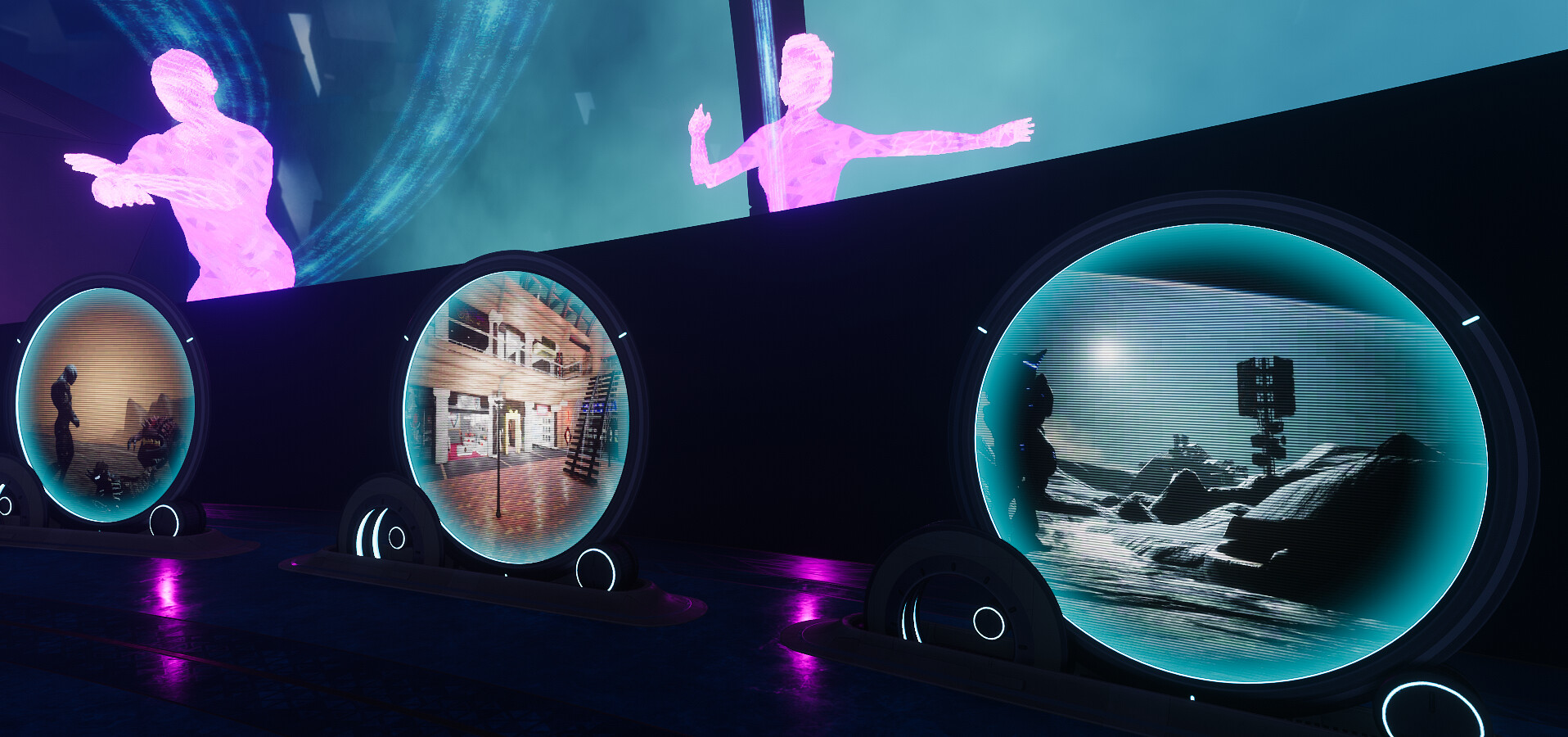
To further encourage general exploration, the Nexus now features an outer “portal wall”. This features a ring of portals leading to the more popular user-created Sansar Experiences. I’m unclear as to how worlds are selected for these portals – I assume there is a process in place – or how / when the destinations to which they point might be refreshed.
The revamped Nexus offers more portals to user-created worlds
On-Boarding Process
The revamped on-boarding process is stills 4-step affair: download the client, create and account and verify e-mail, select an avatar, get dropped into the Nexus. With a notable exception, the majority of the changes in the latest release appear to be cosmetic: the installer, updater and log-in screen all now share the same graphic that appears to have been largely inspired by the cinematic version of Ready Player One.
That exception is the avatar carousel, which sees a new set of seven avatars for new users. Unsurprisingly, the focus is on human avatars with three male and three female in casual / clubbing garb. They are rounded-out by one non-human (but humanoid) robot. I’ve no idea if these are purely Sansar Studios created avatars or if some have been selected from the work of creators (as has been the case in the past).
Four of the seven new starter avatars. Inall there are three male and three female avatars, plus the humanoid robot seen above
Additionally, it would appear that the “getting started” pop-ups have been overhauled to look a little brighter. These are again minimal; all I’ve encountered is how to move and how to emote (play animations) – which is fine for getting around and bopping on a dance floor – but what about things like text chat for those who don’t have a microphone (the latter is at least intuitive, having its own UI button)?
And how about at least giving new users a clear hint that they have a home space? If nothing else, a pointer to the latter might pique the curiosity of some coming into Sansar for an event and get them to come back and have a look at what it is, and so help kick-start them into wider exploration.
New User Experience – Digital University
While not an official undertaking by the Sansar team, when it comes to user on-boarding, the Sansar Training Grounds 101, created by experienced Sansar User ZeroCheese for the Digital University, does offer a more rounded opportunity for new users to more fully get to grips with the client.
Available through the Codex and (currently) featured at the Nexus, this experience offers a guided walk-through of core aspects of using Sansar – movement, manipulating objects, sitting, using emotes (animations) – which includes an introduction to the idea of using the Sansar Store, using voice and text chat, and using the UI. True, not absolutely everything is shown – but frankly, it doesn’t need to be; what is there is sufficient to allow a new user to get on in Sansar, with the rest open to being learned / discovered in time.
Sansar Training Grounds 101
This latter aspect of gaining familiarity with a platform over time is something that often gets overlooked in discussions about the “new user experience”. All too often it seems people get too caught-up in believing everything must be laid before the new user – regardless of the fact that it likely took them weeks or months to understand all that they now want to push onto the new user in a single serving. That it might actually make things harder for said user, and add to the belief that a platform has a “steep” initial learning curve, is often overlooked.
As it is, Training Ground does a pretty good job of covering the vital basics whilst also pointing the way for the user to poke at the client UI and discover / learn about it on their own. One or two aspects could perhaps be a little better: the initial walk training seems excessive, whilst the need to land fruit in the basket is required in order for the next lesson to be reached could be better emphasised. However, what is provided is more than enough to allow a novice user to be able to more fully enjoy Sansar. If only it were more front-and-centre at the Nexus to encourage interested new users to give it a go.
General Observations
The new look Nexus does what it says on the tin – and by offering more in the way of portals to experiences, it appears to have overcome something of the past critique that it was too much of a bottleneck that stopped incoming users filtering through to other locations on the platform. Certainly, during all of my most recent visits over the last few days, the number of avatars within the Nexus have been nowhere near as lose as they were in the back-end of 2019.
The new avatars are, I would suspect, bland when it comes to those familiar with platforms like Second Life. However, they do fulfil the need to offer events-oriented avatars to incoming attendees, and this should be borne in mind. Hopefully, more will be added to the mix; seven is a very small number, and were an event like Lost Horizon to generate a lot of interest and engagement from newcomers, then leaving the choice of avatar to just those seven could lead to such an event looking something like a clone fest.
Overall use of Sansar currently appears to remain somewhat below pre-sales levels with most activity being driven by the COMETS, as noted above. It’ll be interesting to see how much impact on peak levels of activity the renewed Monstercat events have, and what the upcoming Lost Horizon event does for Sansar’s visibility.
As I’ve noted a few times in these pages, Bellisseria, the Linden Home continent, provides space not only for people to live and form communities, but also to express themselves and the creativity present in-world and through people’s talents. One of the key ways this is done is though residents in the continent given their homes over for the display of art – their own, the pieces they’ve purchased and / or the works of others they invite to exhibit.
One of the Bellisseria galleries I’ve only recently become aware of – and my thanks to curator Fenella Allen for IMing me – is that of Limoncello Art Gallery.
While perhaps new to Bellisseria (given the continent itself is just over a year old!), this is a gallery with a long history. Originally founded by LastDitch Writer, the gallery existed in a 120-metre long airship hovering over the Mainland region of Nanga, and was home to his personal collection of art, both 2D and 3D.
Limoncello Art Gallery
The space available at Bellisseria is obviously a lot smaller that a 120 metre airship, but Lord Junibalya, who now looks after the collection, has provided a skybox for the art that forms a 2-storey gallery with a fair amount of room for pieces to be displayed – and there is a lot to see!
There is a lean towards art from the physical world – paintings, drawings, portraits, abstracts – but Second Life avatar studies are also well represented, while the upper level floor space lends itself to 3D pieces by Toysoldier Thor and Mistero Hifeng. Other artists represented in the collection whose names are likely to be recognised include Gitu Aura, Dido Haas, Carelyna, JMB Balogh, In Inaka, Audie Whimsy, Wyald Wooley and Asmita Duranjaya, to name a handful.
Limoncello Art Gallery
Given thes pieces are from a private collection, none are directly offered for sale. However it might be possible to purchase a copy of some pieces by contacting the artist directly (but please keep in mind that not all of the artists represented in the gallery may still be active in-world).
An impressive collection offering a lot to appreciate, the compact size of the parcel notwithstanding, Limoncello Art Gallery is well worth the visit for any patron of the arts in Second Life. My thanks again to Fenella for contacting me about it.
Earlier this month, I wrote about Professor Tom Boellstorff, and his move to teaching his course from the state-of-the-art Anteater Learning Pavilion at the University of California, Irvine (UCI) and into Second Life, as a result of the university’s desire to move classes on-line due to the SARS-CoV-2 pandemic (see: Tom Boellstorff: teaching digital culture in Second Life).
As noted in that article, Tom has been teaching a course entitled Digital Cultures (Anthropology 128C), utilising facilities he constructed at Anteater Island, where the students could study collectively and in working groups and also relax and socialise if they so wished.
Around 35 students participated in the course, and as a part of their work, they split into six research groups each one of which selected a specific aspect of digital culture they wished to study. Two of the groups focused on dating apps, one group studied ranking in League of Legends; one group studied the use of TikTok for education; one group studied fashion influencers on Instagram; and one group studied social interactions through virtual spaces an video games, using Animal Crossing as a reference point.
On Tuesday, June 9th, 2020, the six groups were at Anteater island, where they presented the results of their work. I was one of several Second Life users invited to attend the session (as well as it being generally open to all), and I hopped over in advance of the presentation to take a quiet look at the work and chat with Tom and the students.
Professor Tom Boellstorff (Tom Bukowski in SL) on the right, with student HannahUrban
Needless to say, it was an incredibly challenging quarter for everyone. Learning Second Life was a challenge for them (we also used Zoom), but of course the big thing was all of the difficulties due to the pandemic, from friends and family losing jobs, to working from their homes or apartments, to the isolation and dislocation. Then on top of that is now the George Floyd protests, in which many of the students have been taking a creative and active role.
So they are exhausted beyond belief, but also have done amazing work. We were originally going to have a room on campus where the groups could show off their research to anyone who wanted to come see. That can’t happen, so we’re doing it in Second Life instead!
– Tom Boellstorff (Tom Bukowski in Second Life) commenting on the course
and the move to using virtual / on-line tool sets
Student Michael Shaneman from “Group 5” studying socialisation via virtual spaces and video games, setting up his group’s presentation area.
The students I chatted all indicated they found the experience of using Second Life (none were already familiar with it) to be positive, if at times a little frustrating. Part of the latter was due to the need to look outside of the platform for some collaborative tools such as Google Docs, and part of it was down to UCI mandating the use of Zoom, which encouraged some students to step back from using SL, despite Zoom’s own lack of capabilities, such as break-out rooms.
The presentations themselves were conducted by the students in voice, using web media through a main board, with some of the groups also providing additional infographic boards in their presentation areas. Within each group, students took turns in introducing their project before walking through their methodologies – including direct interview with subject matter specialists, Q&A sessions with users and observational methodologies and then moving on to discuss their findings.
Some of the latter proved interesting. Those studying influencers, for example, noted that while followers tended to be aware they were being manipulated into potentially making a purchase, they nevertheless tended to more actively engage with an influencer and one another to form more of a community when the influencer would be more authentic in their views, outlook and appearance- and this has in turn started to alter how sponsors and brands respond to / use influencers.
Presenting findings in-world
Similarly, the group studying TikTok highlighted the fact that while it is a recent application intended for entertainment, it has taken root among “informal” educators – those wishing to pass on information / offer a means to impart information – due to its exceptional ease of use and its brevity of video length, the latter of which encourages a precise focus on a subject / message, whilst making the information easy to digest on the part of watchers. They also noted that the platform’s unique approach to interaction and feedback had also served to increase its popularity.
For me, the study looking at virtual spaces and video games as a means of social interaction was the most fascinating. Framed in terms of the pandemic, it really underlines the extent to which perceptions are being changed in terms of how video games with social aspects and virtual spaces can offer beneficial ways for direct, positive interaction between friends and between family members forced apart by the needs of physical distancing, helping to potentially open a new era of communication / interaction.
What was particularly impressive about this entire process is just how well it appears to have worked. From initial need to move to on-line teaching, through the creation of Anteater Island without overly disrupting the students work, through to enabling the study groups to function and bring together a set of engaging and informative presentations, the entire process itself is perhaps a case study in the making – and as I’ve noted, Tom has plans for just that, and I hope to be able to bring word on it in due course.
In the meantime, Anteater Island will remain open for visitors for the next several months, and the students have been invited to add more material if they wish. For those so interested in education in SL, it’s a worthwhile visit, as is following the links below.
My thanks to Tom for keeping me informed on things, and my congratulations to all the students involved in these studies.
The following notes were taken at the Simulator User Group meeting held on Tuesday, June 9th.
Simulator Deployments
At the time of writing there were no formal simulator release notes, however:
There was no deployment to the main SLS channel on Tuesday, June 9th.
On Wednesday, June 10th, the same RC deployment will be rolled to all of the simulator RC channels. This comprises:
A minor script constant fix (CLICK_ACTION_ZOOM and CLICK_ACTION_DISABLED were missing).
The chat range changes for channel 0.
Voice Carry Project
Voices Carry is the name given to the extended chat range project. Once available, it will allow region / estate owners / managers to set the open chat range on a region (see BUG-228333). When considering it, the following points should be kept in mind:
It only applies to local chat channel 0, and so it should not impact scripted objects using other chat channels.
The distance set within a region will determine which, if any, of any adjoining regions can her local chat with that region.
For example, if you are in a region with chat distance set to 50m and you’re more than 50m from any boundary with an adjoining region, then your chat will not be relayed beyond the region.
The distance chat is set to within a region will determine how far any chat from an adjoining region will be relayed within it.
For example: if a region has a chat range of 20m, and chat is relayed from a neighbouring region with a range of 100m, that chat will only be relayed 20m within the current region.
No matter how great the chat range is set within an region, it will never be relayed further than those immediately adjoining it.
For example: if a Mainland region has a chat range set to 1000m, chat from it will only be relayed to the (maximum of) 8 regions adjoining it.
SL Viewer
There have been no updates to the official viewers to mark the start of the week, leaving the current viewers as follows:
Current Release viewer version 6.4.3.542964,, dated May 29th, promoted June 2nd, formerly the FMOD Studio RC viewer – NEW.
Release channel cohorts:
Tools Update RC viewer, version 6.4.4.543148, June 5 – this viewer is built using VS 2017 / a recent version of Xcode, and Boost.Fiber. It contains no user-facing changes.
Love Me Render RC viewer, version 6.4.4.543142, June 3.
CEF RC viewer, version 6.4.3.542757, issued May 27.
Project viewers:
Mesh uploader project viewer, version 6.4.3.542535, June 3.
Copy / Paste viewer, version 6.3.5.533365, December 9, 2019.
Project Muscadine (Animesh follow-on) project viewer, version 6.4.0.532999, November 22, 2019.
Legacy Profiles viewer, version 6.3.2.530836, September 17, 2019. Covers the re-integration of Viewer Profiles.
360 Snapshot project viewer, version 6.2.4.529111, July 16, 2019.




 Inara Pey: Living in a Modemworld