
At 04:03 UTC on Monday, February 10th (23:03 EDT, USA), the European Space Agency’s Solar Orbiter is due to be launched atop a United Launch Alliance Atlas V from Cape Canaveral Air Force Station, Florida. Referred to as SolO, the mission is intended to perform detailed measurements of the inner heliosphere and nascent solar wind, and perform close observations of the polar regions of the Sun, which is difficult to do from Earth, in order to gain a much deeper understanding of the processes at work within and around the Sun that create the heliosphere and which give rise to space weather.
The launch will mark the start of a three 3-year journey that will use a fly-by of Earth and three of Venus to use their gravities to help shift the satellite into a polar orbit around the Sun. Once there, and at an average distance of some 41.6 million km, SolO will move at the same speed at which the Sun’s atmosphere rotates, allowing it to study specific regions of the solar atmosphere beyond the reach of NASA’s Parker Solar Probe and Earth observatories for long periods of time.

Our understanding of space weather, its origin on the Sun, and its progression and threat to Earth, comes with critical gaps; the hope is by studying the the polar regions of the Sun’s heliosphere, scientists hope they can fill in some of these gaps. The outflow of this plasma interacts with the Earth’s magnetic field and can have a range of potential effects, including overloading transformers and causing power cuts, disrupting communications and can potentially damage satellites. Further, the disruption of the Earth’s magnetic fields can affect the ability of whales and some species of bird to navigate.
We don’t fully understand how space weather originates on the sun. In fact, events on the sun are very hard to predict right now, though they are observable after the fact. We can’t predict them with the accuracy that we really need. We hope that the connections that we’ll be making with Solar Orbiter will lay more of the groundwork needed to build a system that is able to predict space weather accurately.
– Jim Raines, an associate research scientist in climate and
space sciences engineering
Specific questions scientists hope SolO will help answer include:
- How and where do the solar wind plasma and magnetic field originate in the corona?
- How do solar transients drive heliospheric variability?
- How do solar eruptions produce energetic particle radiation that fills the heliosphere?
- How does the solar dynamo work and drive connections between the Sun and the heliosphere?
To do this, the satellite is equipped with a suite of 10 instruments, some of which will be used to track active solar regions that might explode into a coronal mass ejections (CMEs), a major driver of space weather. When a CME occurs, SolO will be able to track it and use other instruments to be able to break down the composition of the energetic outflow (and that of the outflowing solar wind in general).
Knowing the composition of this outflow should help determine where energy is being deposited and fed into the solar wind from eruptions on the Sun, and how particles are accelerated in the heliosphere – the bubble of space where the Sun is the dominant influence, protecting us from galactic cosmic radiation.

Combined with the work of the Parker Solar Probe, launched in August 2018 (see: Space Sunday: to touch the face of the Sun) and which gathers data from within the Sun’s corona, and observations from Earth-based observatories such as the Daniel K. Inouye Solar Telescope (DKIST), Solar Orbiter’s data should dramatically increase our understanding of the processes at work within and around the Sun.
Like the Parker Solar Probe, SolO will operate so close to the Sun it requires special protection – in this case a solar shield that will face temperatures averaging 5,000º C on one side, while keeping the vehicle and its equipment a cool 50º C less than a metre away on the other side. This shield is a complex “sandwich” starting with a Sun-facing series of titanium foil layers designed to reflect as much heat away from the craft as possible. Closest to the vehicle is a aluminium “radiator” that is designed to regulate the heat generated by the craft and its instruments. Between the two is a 25-cm gap containing a series of titanium “stars” connecting them into a single whole. This gap creates a heat convection flow, with the heat absorbed by the titanium layers venting through it, drawing the heat from the radiator with it, allowing Solar Orbiter to both expect excess solar heating and present itself from overheating.
SolO’s primary mission is due to last 7 years, and those wishing to see the launch can watch it livestreamed across a number of platforms, including You Tube.
SLS Core Stage Raised for Engine Test
In mid-January, I wrote about the first core stage of NASA’s huge Space Launch System booster starting a journey that would carry it from its fabrication facility at NASA’s Michoud Assembly Facility, New Orleans to the Stennis Space Centre where it will be put through a series of tests later in 2020 (see: Space Sunday: stars, a rover, a planet and a round-up).

The 65 m long, 9 m diameter stage rolled out of its factory on January 8th, 2020 to take a 2 km road journey to where a special barge was waiting to carry to to Stennis by water. It arrived there in mid-January, the barge docking alongside the the historic B-1/B-2 test stand, originally built to test the first stage of NASA’s Saturn V rocket, and which will be used for testing the stage.
The test stand has had to be extensively modified for this. Modifications have included new hold-down supports to hold the stage upright and attached to the stand, 454 tonnes of new steel bracing to help support the stage when vertical, an extensive modification to the crane used to lift stages onto and off of the stand, and a complete upgrade of the water sound suppression system.
The latter is the system that delivers hundreds of thousands of gallons of water to a launch stand during the initial lift-off of a rocket – not to protect the pad from heat, but to absorb the sound energy from the rocket motors, rather than it pounding the launch pad and potentially causing it serious or catastrophic damage to either the pad or to the rocket as the sound is deflected by the pad back onto the vehicle as it lifts-off.
The 85-tonne core stage was lifted into position on January 21st / 22nd, and was immediately followed by the first of s series of “modal tests” that will take place over the next weeks / months. These will include confirming the mounting of the core stage on the test stand, inspecting the stage for any signs of damage during the installation process, powering-up of the rocket’s avionics and computers, configuring the main propulsion system for full engine testing, testing the hydraulic systems used to control the swivelling of the four RS-25 main engines to provide vectored thrust during ascent, and carrying out leak tests on the two huge fuel tanks inside the stage in preparation for a “green run” engine test.

This will involve fully fuelling the stage with 730,000 gallons of liquid hydrogen and liquid oxygen and then firing the RS-25 motors for 8 minutes – the length of time they will operate during a launch – and putting them through a range of gimballing and thrust tests that also mimic their operational envelope during orbital ascent.
Following the test, the stage will be inspected and repairs made to the orange insulation foam coating it which the overall structure of the stage is examined, and the four RS-25 motors – updated variants of the space shuttle’s main motors – will be stripped down, refurbished and prepared for their first – and only – flight. The stage will then be transferred to the Vehicle Assembly Building at NASA’s Kennedy Space Centre ready for mating with the rest of the vehicle that will form Artemis-1, an uncrewed mission to fly an Orion Multi-Purpose Crew Vehicle to cislunar space and around the Moon and back again.

No official date has been released for the green run test, but it is anticipated it will occur around mid-year. Its outcome will help determine whether or not Artemis 1 will take place at the end of the year or not.
At the same time as the SLS core stage was arriving at Stennis Space Centre, NASA teams at the Kennedy Space Centre took over one of the High Bays of the Vehicle Assembly Building to commence test assemblies of the massive solid rocket boosters (SRBs) that will help power the SLS to orbit.
The SRBs – essentially strap-on boosters – are uprated versions of those used by the space shuttle in order to reach orbit. Like thoedm, the SLS SRBs will be used in the first 2+ minutes of flight to “kick-start” the massive SLS “stack” off the pad and accelerate its massive bulk through the denser part of the atmosphere before they are jettisoned.
During preparation for an actual launch, the SRBs are fabricated in sections in Utah by Northrup Grumman. Completed sections, which include the “solid” propellant that gives the boosters their name, are then transferred to Kennedy Space Centre, where they are carefully checked out, vertically stacked atop one another and literally bolted together to form two complete boosters mounted on the mobile launch platform. After this, a Core Stage is then lowered onto the mobile launcher and mated to them.
Given their extra size and complexity, NASA personnel need to gain familiarity with the “stacking” procedure, and have started doing so using “pathfinder” sections of a SRB. These are individual sections built to the same specification as an actual SRB and which have the same mass, but are filled with inert ballast rather than fuel.

When in use, the five-segment, 17-story-tall twin boosters will provide 3.6 million pounds of thrust each at lift-of, each one doubling the amount of thrust provided by all four of the RS-25 motors of the core stage, and 25% more thrust than provided by the space shuttle SRBs. However, unlike shuttle SRBs, these will not be recovered for refurbishment and re-use after a launch, but will be discarded following launch, together with the SLS core stage.
Voyager 2: Fully Recovered
In my last Space Sunday, I noted that NASA’s Voyager 2 vehicle had a wobble at the end of January, switching itself to a fault protection mode, 18.5 billion kilometres from Earth. Due to the time involved in 2-way communications, it took several days to recover the vehicle – but at the time, normal transmissions of science data had not resumed.
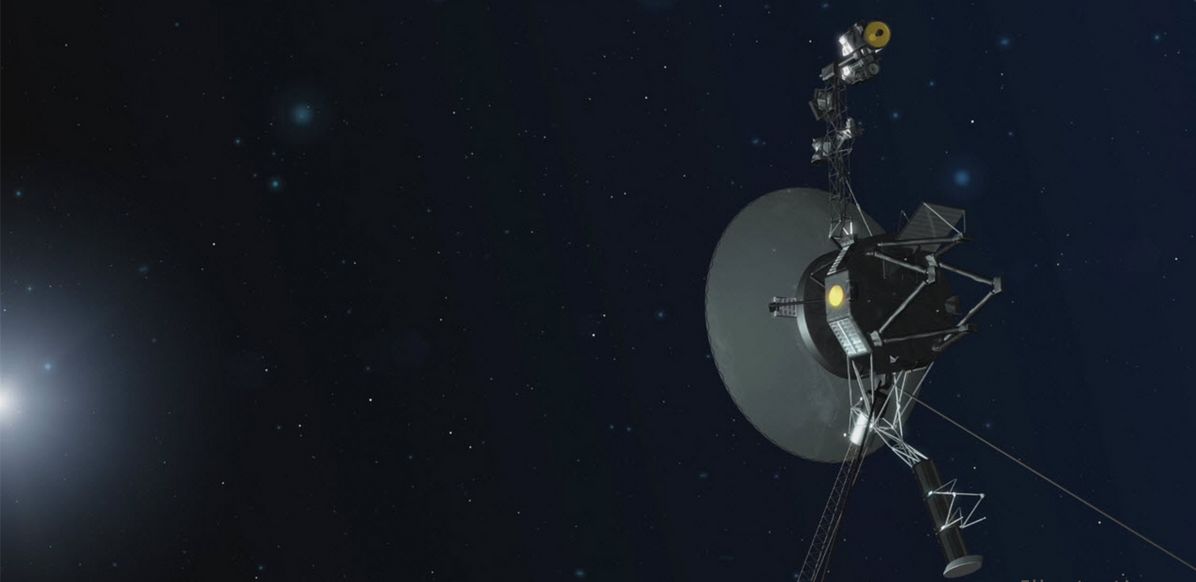
On Thursday, February 6th, NASA confirmed that Voyager 2, as well as being stable, has now resumed transmitting data from the remaining science instruments, and engineers at NASA’s Jet Propulsion Laboratory are evaluating the information received, and the overall health of the instruments.
As well as this, they are also checking the overall status of the vehicle’s electrical systems: as well as providing power to the instruments, Voyager’s electrical system is used to provide heat to critical systems – such as the fuel lines that deliver hydrazine gas from the craft’s tanks to its thrusters, allowing it to perform critical manoeuvres. Were these to freeze, there is a risk Voyager 2 would be unable to point its antenna at Earth and maintain communications.
The IAF On-Line Competition for Young Influencers
 Are you, or someone you know enthusiastic about space, technology, science fiction and everything in between, and who would like to meet astronauts and talk to experts from NASA, ESA and Roscosmos? Were they (or you) aged between 18 and 35 in January 2020? If so, you could see your wishes come true via the IAF On-Line Competition for Young Influencers in Space.
In partnership with Roscosmos, the Russian Space Agency, the International Astronautical Federation (IAF) will be holding the 2020 Global Space Exploration Conference (GLEX 2020) in St. Petersburg, Russia between the 9th and 11th of June. To help with the event, the IAF are looking for young influencers to help promote their vision of peace through space via on social media. Up to five of those doing so will be invited and fully sponsored by the IAF to attend the event.
There are some significant requirements for those wishing to participate, but the reward is not to be sneezed at – to find out more, check the competition page.

 Inara Pey: Living in a Modemworld