Sansar: why LL are building their own engine w/audio

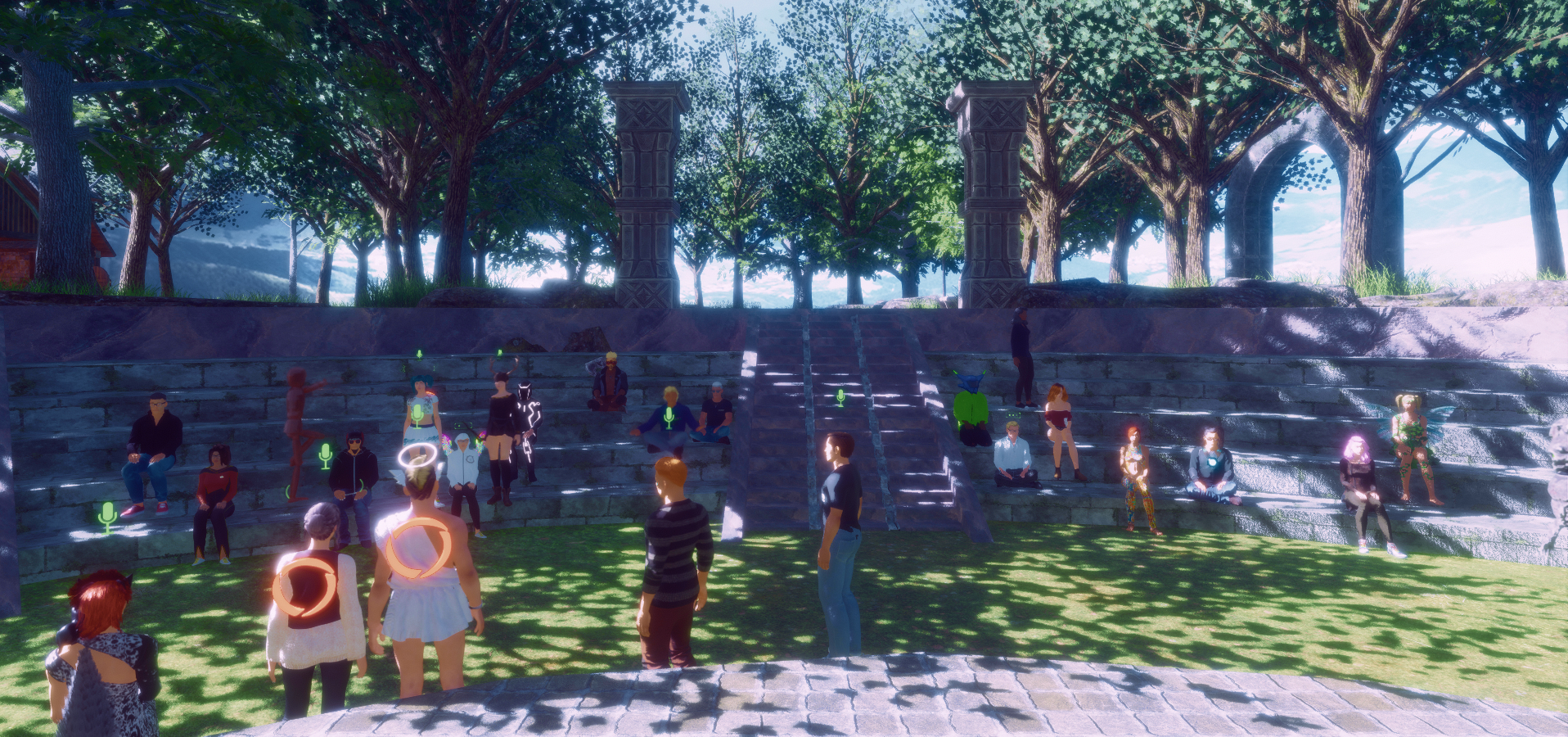
Gathering to hear about the choice to build Sansar’s own engine, March 7th, 2019 Product Meeting

A frequent Sansar question asked of the Lab is why did they opt to build their own platform engine, rather than choosing to use an off-the-shelf engine such as Unity or Unreal. To try to address these questions, as a part of the Sansar Product Meeting on Thursday, March 7th, 2019 Richard Linden (Sansar’s Chief Architect) and Jeff Petersen (aka Bagman Linden), Linden Lab’s Chief Technology Officer gave a 25 minute overview of the Lab’s thinking on the matter and what they see as the advantages / disadvantages in either building their own engine or using an existing product.

The following is a summary of their discussion, with audio extracts, the full version of which can be found in the official video of the product meeting. Note that in presenting them, I have attempted to group comments made by topic, as such the audio extracts below do not necessarily chronologically follow the meeting video. However, care has been taken to not lose the overall context of the comments made by either Jeff or Richard.

The presentation was followed by a more general Q&A session, which also involved Landon McDowell (Linden Lab’s chief Product Officer) and Nyx Linden. Some of the questions relevant to the core subject of the platform and engine and roadmap are also included. Please refer the video for all questions ask at the meeting.

Jeff Petersen – Introduction

  • Linden Lab CTO Jeff Petersen

    The decision to create an engine from the ground up was made some 5 years ago.

  • There is a degree of envy towards the likes of Unity and Unreal, particularly because of their maturity and cross-platform (operating system) support, plug-in support, etc.
  • However, the Lab’s aim is to build a platform that can compete with other platforms in the same arena, which includes both Unreal and Unity. Ergo, using one of those platforms as the foundation for something like Sansar made (and makes) little sense, simply because doing so would deny a product the kind of low-level control required to differentiate from those  platforms.
  • In addition, there are directions in which Linden Lab would like to take Sansar and user-generated content (UGC) which perhaps do not sit well with the use of an off-the-shelf engine.
  • Further, in opting to build their own engine for Sansar, LL has been able to make use of a number of third-party applications and tool sets (perhaps the most notable being Speech Graphics facial animation software and Marvelous Designer), which allow LL to leverage capabilities and integrate them into the platform to provide the necessary flexibility of approach / use.  This kind of approach isn’t so easy with platforms such as Unity and Unreal, which are seen as more “full stack” solutions: once you start using them, you are pretty much locked into the technology they support and the integration they want to provide.
  • A further point of note in the decision to build Sansar’s engine is that Linden Lab obviously has an enormous amount of experience with development systems designed to support and enable user-generated content and user creativity.
    • In this respect, Richard Linden, Sansar’s Chief Architect, is one of the longest-serving members of the Lab’s staff, having been with the company since before the development of Second Life, in which he played a significant role.

Richard Linden – Constraints

  • An important thing to remember with Sansar is it is not just a virtual world, it is a platform creation engine intended to allow users to design and implement compelling content they can use to attract an audience.
  • So again, Sansar is in competition with the Unitys and Unreals that are out there, and thus needs to be differentiated from those platforms. This is done through the constraints / requirements LL apply, their own unique experience in running Second Life and in handling UGC on a scale and of a type normal games do not have to deal with.
  • In terms of constraints, LL recognised a number of performance related constraints that informed their decision to develop their own engine:
    • Rendering: UGC comes in many flavours from the optimised to the unoptimised. From the managed poly count to the outrageous poly count. Sansar has to provide a rendering system that can handle all of this, and ensure that it can deliver experiences to uses that offer both a smooth experience in VR and do not cripple a user’s computer in doing so.
    • Physics: again, the physics engine must be robust enough to handle all kinds of UGC, optimised and unoptimised. In this, LL have 15 years in using the Havok physics engine in Second Life, so it made sense to leverage that experience in Sansar.
    • Scripting: experiences and (in time) avatars will be liable to have many, many scripts running in them / associated with them, scripts which (again) might not be optimised for streamlined execution, so the platform needs a scripting engine that can scale to the demands being placed upon it as experiences become more complex in their capabilities and avatars evolve (and appear in Sansar in (hopefully) greater numbers over time).
      • As noted by Bagman, this includes managing malicious (deliberately or otherwise) scripts whilst keeping the scripting environment open enough for creators to be able to do what they want with their scripts. This is something not easily achieved within a “full stack” engine architecture without requiring substantial changes to its scripting system.
    • Audio and UI capabilities: again providing the necessary flexibility for support of audio content from creators (FMod) and a UI tool (NoesisGUI) that is flexible enough to meet the needs of creators and of consumer users.

Richard and Jeff – Asset Management

  • A further constraint is the sheer volume of UGC assets.
    • Second Life has an estimated 24 billion UGC assets associated with it.
    • Linden Lab hope that in time, Sansar will be at least an order of magnitude bigger than this.
    • To avoid issues of having to reprocess data associated with assets, SL and Sansar are founded on the idea of the immutability of assets. Linden Lab promise that so far as is possible, updates to the platform will not break existing content.
  • The majority of games built on other engines don’t have to deal with any of this.
    • They have comparatively low number of assets they have to deal with.
    • When they update (or the engine they use updates) they can do one of two things:
      • Reprocess their assets, then burn and ship a new version of their game.
      • Remain on the current version of the engine and use the newer version for their next project.
  • Given the above, engines like Unreal and Unity aren’t geared towards dealing with massive amounts of asset data or in maintaining the immutability of assets, as that is not expected of them.
  • Using such engines for an environment like Sansar, where assets could be expected to be relevant for years (as is the case with Second Life now), and continue to work “as is”, without having to be reprocessed by the Lab each time the engine is updated, is therefore a non-starter.

Richard – Aims in Building an Engine

  • LL ultimately want to make Sansar an environment where anyone can create and share, whether or not they are “hard-core” content creators. This means Sansar needs to:
    • Support users who may not create original content, but can use that content (as provided by others) to express themselves and present environments they and their friends can enjoy.
    • That has the ability to take on a lot of the heavy lifting involved in content optimisation, etc., and which doesn’t necessarily require those creating environments to have in-depth / professional level knowledge on scene optimisation, content development, etc., that might be required in other platforms.
    • That can (in time) offer a collaborative content creation environment, so people can work together to design and build as well as visit experiences together.
    • Collaborative editing does not only mean being in a shared editing space, it means also having access to all of your chat and communications tools to be able to stay connected to friends who are in Sansar but not in your edit environment – again, these types of capabilities aren’t necessarily provided in other engines.
  • Not all engines have all of these types of capabilities built-in. And even where third-party plug-ins are available to achieve aspects of the functionality, they may not actually be as flexible to use or in meeting the constraints particular to Sansar as might initially seem to be the case.

Jeff  – IP Protection

  • IP protection has and remains a major consideration, and was looked upon as a show-stopper for using other engines.
  • Sansar is designed to provide a supply chain economy, with individual rights respected in the use of component elements (.e.g whether an item can be used just within a scene, how it can be used as a component in someone else’s model, how royalties are safeguards and paid in respect of the latter, etc.
  • The use of personal inventory and the Sansar Store is also viewed as potentially being seamless (e.g. scene creators can use items they upload to their inventory and / or items available on the store, up to and including the potential for “try before you buy” from the Store, with all rights again respected.
  • This kind of protection isn’t seen as being offered by engines like Unreal or Unity without a considerable amount of code re-writing which, as it is part of the overall engine “stack”, runs the risk of having to be re-implemented each time there is an update to an off-the-shelf engine each time that particular aspect of / tool within the engine gets updated by the provider.

Richard and Jeff – Broader Pros and Cons

A major disadvantage with using an off-the-shelf engine is seen as the back-end support.

  • There tends to be very little out-of-the-box support to meet the requirements a platform like Sansar has.
  • Trying to engineer around this using such a product can be difficult, particularly given the amount of information sharing that goes on between the Sansar client and the back-end.
  • Most likely, it would have meant working on the engine’s code, it would have effectively been a fork of the original Unity / Unreal / whatever code base, which itself opens up all sorts of headaches.
    • The code won’t really be supported by the engine provider
    • How is the code maintained; how are major updates to the engine handled and merged without potential breakage to the forked code, etc?
    • This is already a problem for LL with Havok.
  • As mentioned above, there is the issue of longevity. Game built using engines like Unity tend of have a finite requirement on the engine, when they are shipped, that’s largely it, and no need to necessarily maintain full backwards compatibility; the next version can be built on the latest version of the engine. Sansar doesn’t have that luxury, and most engine providers don’t see it as a need.
  • The case against a dedicated engine is that, obviously, it takes a lot longer to build out all of the necessary functionality that an off-the-shelf product might provide and that can be used.
  • LL is a small company with limit resources, ergo, building their own engine is a long-term task.
    • However, LL is uniquely positioned to be able to afford to take on the work, and has a fully supportive board who recognise the effort.

Continue reading “Sansar: why LL are building their own engine w/audio”

Exploring Puddlechurch in Second Life

Puddlechurch; Inara Pey, March 2019, on FlickrPuddlechurch – click any image for full size

Marty Triellis e-mailed me in late February with an invitation for us to visit Puddlechurch, the latest region design he and Cherish Demonge have developed. The invitation came almost exactly a year after we had visited one of their previous designs (see A NonStop visit in Second Life) and Shug Maitland also pinged me about the region via IM, we set off to have a look.

Described as a residential / photography region, Puddlechurch is beautifully conceived and executed. Some 14 rental properties of varying sizes are scattered through the landscape, but you’d hardly know this from a casual visit; such is the design and spread of the rentals – up on hill, down in dale, on the coast, over the water – that without a count at the rental office, you’re be pushed to tell the number was this high.

Puddlechurch; Inara Pey, March 2019, on FlickrPuddlechurch

The landing point sits close to the rental office, in a little village-like setting towards the north-east of the region. Largely deserted, the village is little more than bricked and boarded-up buildings, tumbled walls and a slightly forlorn little square, the rental office seemingly the last place of business still operating.

Three routes lead away from the square: east to a waterfront area (which I understand from Marty is still under construction). A similar path points west to the coast on that side of the region, while up a set of steps, a worn track points the way south, a tree-lined lane that passes the local chapel and graveyard.

Puddlechurch; Inara Pey, March 2019, on FlickrPuddlechurch

Which of these you take is up to you, but I confess, I found the westward path and the way it opens out to present the bay and buildings that reside there to be utterly captivating and beautifully natural. It is here that several of the rental properties are to be found, sitting close to the shingle beach or raised up on platforms build over the water and facing the mainland from the low-lying shingle bar that lies across most of the entrance to the bay, giving the impression this might once have been low-lying land that the sea has opted to lay claim to over time.

The houses out on the shingle bar are reached via wooden board walks. With a view out over the westward sea and the high peaks d the surrounding islands on one side, coupled with the view back inland on the other, these make for desirable properties for those looking for a home, their careworn looks adding a further layer of shabby chic to their attractiveness. Each sits within its own parcel, allowing parcel privacy to be used (each parcel additionally includes a security system) – a smart move given the close proximity of the public path running along the shingles betwixt houses and water.

Puddlechurch; Inara Pey, March 2019, on FlickrPuddlechurch

This approach has also been taken with the offshore units sitting on their wooden decks. Reached via their own board walks, these might be small, single room structures, but they also offer a little space for mooring boats (LI allowing!).

It is the breadth of housing style, as well as the landscaping that also makes Puddlechurch so appealing. If the small wooden cabins and houses on the west coast don’t appeal, follow the paths inland from beach or landing point (they all interconnect perfectly), and you’ll find a good mix of housing styles: a converted warehouse here, a town house there, a stone cottage in a corner; for those looking for an expansive property, there is even something of a manor house, and several of the properties have decks and / or planted gardens.

Puddlechurch; Inara Pey, March 2019, on FlickrPuddlechurch

Of course, what might be available for rent is liable to vary over time, so be sure to check the boards at the rental office, which will also furnish you with the rent and LI allowance for each property. These will also provide the estate’s rental guidelines, and I strongly recommend these are given a careful read through prior to renting.  When exploring, available properties are signified by a real estate (or if you are in America, a realtor) board outside, while memories of prices can be refreshed with the visit to the estate’s web page.

Cherish and Marty describe the setting as inspired by “British” countryside. By this I assume they mean a variety of influences from across the British Isles have informed the finished design. Certainly, there is no singular point of influence that appears to have gone into the design; rather, what is presented is singular and unique, carrying with it odd (and pleasing) little aspects of familiarity to anyone who has visited some of the more remote spots around the Irish and Scottish coastlines, or has visited some of England’s woodlands.

Puddlechurch; Inara Pey, March 2019, on FlickrPuddlechurch

Whether or not you are looking for a place to live, Puddlechurch offers a pleasing visit and includes multiple opportunities for photography. Our thanks to Marty for the invitation and to Shug for the tip.

SLurl Details

Farewell, Fran

Fran Swenson with her avatar (in the blue gown) Fran Seranade, and her daughter’s avatar, Barbi Alchemi (image courtesy of image courtesy of San Diego Union-Tribune / Bill Wechter

In 2013, I was able to write about the extraordinary Fran Swenson – Fran Seranade in Second Life – a Parkinson’s Disease sufferer who at the time had seen – and continued to see – something of an overall improvement in her condition, which she attributed to Second Life.

Fran’s story, which was reported in the likes of the San Diego Union-Tribune and Wired and came to be the focus of and one of the earliest editions of The Drax Files World Makers, was the trigger-point for her daughter, Barbara, establishing Creations for Parkinson’s in Second Life, designed to raise money for research into the disease and for a possible cure by supported the work of The Michael J. Fox Foundation for Parkinson’s Research and providing a meeting place for those stricken by the illness and those seeking a sense of community and support. Fran’s response to her condition and Second Life was also the subject of study by Donna Z. Davis (Tredi Felisimo in SL) and Tom Boellstorff  (Tom Bukowski in SL).

The avatar represents who I really feel inside. When I look at my avatar, I feel like I’m looking at myself … I’m dancing now and I can run, hop, jump and have fun. I’m not just in my apartment, I have the whole world now. It’s thrilling!

– Fran Swenson (Fran Seranade in SL) on the joy and
freedom Second Life gave her

I met Fran, and her daughter Barbara, on a number of occasions in Second Life in 2013 and 2014, although sadly, I allowed contact with them both to drift over the years since. Throughout those meetings, I was always stunned by Fran’s energy; she always exuded happiness and a sense of fun that was infectious. It is therefore with enormous regret – and following word sent by Draxtor Despres – that Fran sadly passed away at the age of 92 on March 3rd. With her passing, a genuine, warm and caring light has gone from Second Life and we have lost a true pioneer.

Fran was an earth angel whose extraordinary love touched all who met her. From her earliest days, it was her lifelong mission to help people wherever she saw a need. Mom always said, “Love is unlimited. The more you give, the more love there is to give.”

– Fran’s daughter, Barbara Richards (Barbi Alchemi in SL),
remembering her mother

An in-world  memorial for Fran is being planned, but will understandably take time to arrange – I hope to help spread the word for all who may wish to attend once the date and time have been confirmed. If you would like to make a physical world donation in Fran’s names to help further the work of The Michael J Fox Foundation for Parkinson’s Research, please use the link below, where you will also find a memorial to her.

To Barbara (Barbi Alchemi in Second Life) her brother (AlmostThere in SL) and their family, to all who knew Fran as a friend and an active members of the Creation’s community, I extended my condolences at this time – as I’m sure all who knew Fran and her story do as well.

Mathilde and Kayak at Raglan Shire

Raglan Tree Gallery: Mathilde Vhargon

Currently open through until the end of March 2019 at the Raglan Tree Gallery are two exhibitions by two physical world artists who have a very different focus for their art to one another.

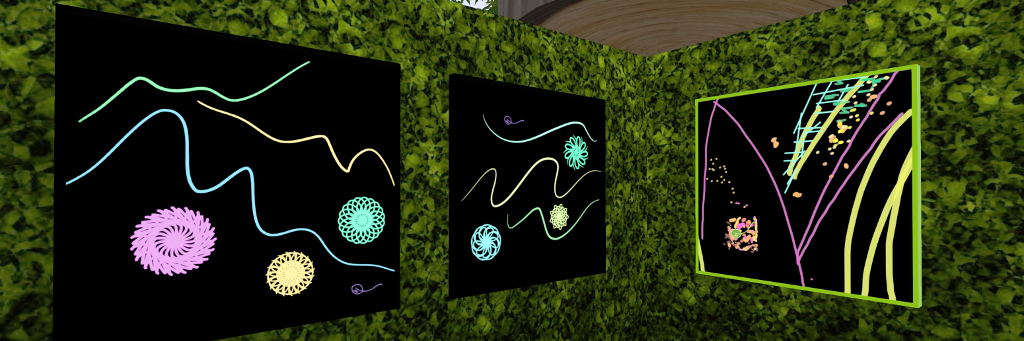
Mathilde Vhargon entered the world of the arts as a classical musician, but for the last 10 years she has seen digital art as her creative medium, having originally  presented 3D sculptures in Second Life before moving to 2D creativity using Gimp and ArtRage.

Raglan Tree Gallery: Mathilde Vhargon

My paintings suggest themselves to me a little at a time without conscious planning. I often use small sections of them as materials to develop into new paintings. I also like to create kaleidoscope and mandala versions of some of my original paintings.

I love strong colours and flowing abstract forms. You will often find ambiguous suggestions that lead the viewer to imagine various possibilities and interpretations. I am most happy when my art creates a chain of associations and questions about life and humanity.

– Mathilde Vhargon, discussing her art

Raglan Tree Gallery: Mathilde Vhargon

The richness of abstraction in Mathilde’s work is immediately evident on seeing the piece presented at Raglan Tree. These are bold pieces, rich a colour and depth, some encompassing natural shapes and elements – flower petals, leaves or the suggestion of a squirrel. Also on display are monochrome pieces, together with simple paintings that perfectly convey their sentiment, all rounded out by a collage-like piece Toward the Light and even one with a fractal-like suggestion to it, Memories of Grandma, that make this an eye-catching and rewarding selection to visit.

Sharing the gallery space with Mathilde is Kayak Kuu. Apparently taking his name from the fact he used to teach whitewater kayaking, his interests span the theatre and computers – he makes note of both his love of all things Macintosh / Apple and that a good deal of his time is spent immersed in community theatre activities. He is also an avid photographer, as his exhibition at Raglan Tree more than demonstrates.

Raglan Tree Gallery: Kayak Kuu

Photography has been a hobby of his most of his life since the black and white and early Polaroid instant film days … [he] travels extensively and that is where many of his photographs displayed here come from.

– from the notes accompanying Kayak’s exhibit at Raglan Tree

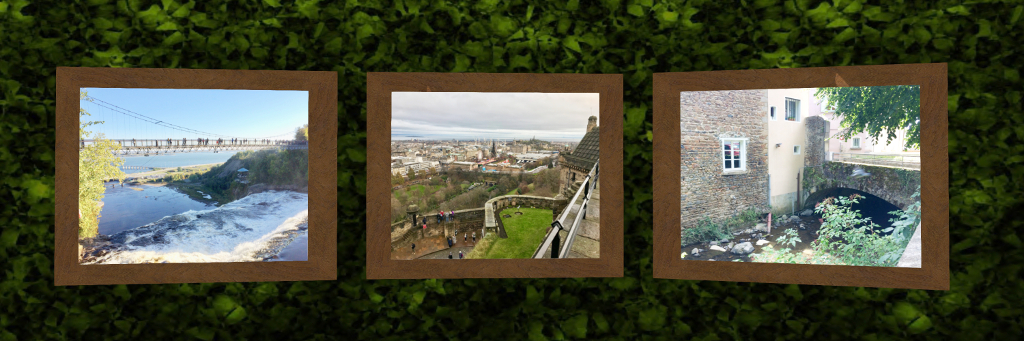
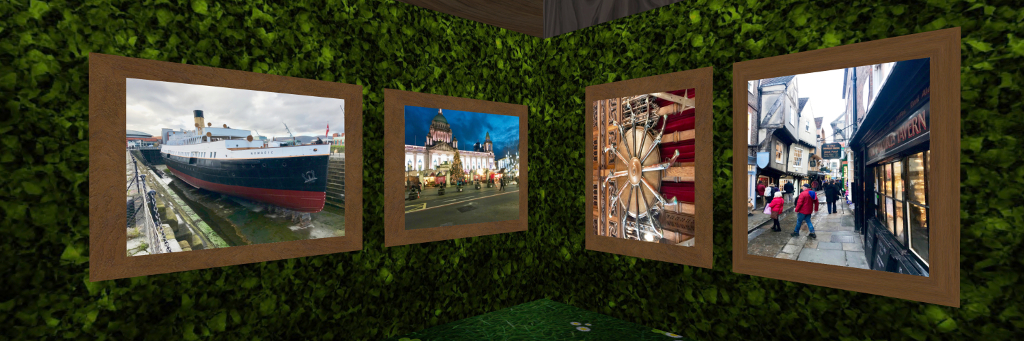
Just how extensive Kayak has been fortunate enough to travel is certainly laid witness to in this exhibition. Pictures from across the United States sit shoulder-to-shoulder with those from Canada, Europe, Ireland, the United Kingdom, Mexico, Roatan…

Raglan Tree Gallery: Kayak Kuu

Such is the diversity of locations on offer, I suspect that anyone who has travelled in the United States or France or the UK in particular are liable to recognise some of the locations Kayak has uniquely captured. I admit to smiling through each of his pictures of York, Belfast and Edinburgh, all of which have particularly happy memories for me, as did his image of the Smithsonian’s Air and Space Museum in Washington D.C).

Presented in the round in on one of Raglan Shire’s great tree platforms, these are selections of art that demonstrate (again) that physical world art can have a place in our pixel lives and – with Kayak’s work – allows us to witness small scenes from places in this world we might otherwise not get to see.

Raglan Tree Gallery: Kayak Kuu

SLurl Details

Lab launches Second Life video travelogue

The Pen – subject of Linden Lab’s new video travelogue series

On Wednesday, March 6th, 2019, Linden Lab launched another new video series: Second Life Destinations, highlighting locations across the grid that residents might like to visit. The series is intended to be issued on a weekly basis and the Lab notes:

In this series, we’ll highlight different places focusing in on the beauty and imaginative possibilities in no more than 60-90 seconds so that you can get a quick peek at the creations and communities inside each virtual space. At times we may even speak to creators of theses spaces so they can shed some light on what inspired them. Look for each new episode on our blog and social media channels, including Facebook, YouTube and Twitter.

For the first in the series, the Lab visit The Pen, Bay City’s beatnik hang-out operated by Marianne McCann, home to a range of activities include Marianne’s regular “Expresso Yourself” events, where the microphone is opened to visitors to express themselves in words (prose or poetry) or song on the first Tuesday of the month between 18:00 and 20:00 SLT.

The Pen was recently the venue for Marianne’s 13th rezday celebrations, and these are the focus of the video, which includes the voice of singer Grace MacDonnogh, a long-time friend who has a wonderfully mellow way with music and lyrics.

As a seasoned SL travel writer (and videographer when my PC decides to behave itself), I admit to finding myself caught between two conflicting feelings regarding this new series. On the one hand, there are a lot of people like me in the blogging community: we may not all focus on blogging destinations (although equally, some do), but  considerable effort goes into writing-up places and taking photos  / producing videos. Give all that, a series like this might be felt as coming a little close to treading on toes. On the other hand, the series is intended to be limited to 60-90 seconds, and as such it shouldn’t really impact on the work done by videographers and bloggers.

Nevertheless, it’ll be interesting to see how the series develops. In the meantime, I’ll leave you with the first, which demonstrates the potential innocuousness of the series.

2019 SL User Groups 10/1: Simulator User Group

The Four Villages; Inara Pey, February 2019, on FlickrThe Four Villagesblog post

Please refer to the server deployment thread for the latest news.

  • There are no planned deployments to the SLS (Main) channel or the three major RC channels, these sees all four remain as follows:
    • The SLS Main channel remains on server maintenance package 19#19.01.25.523656.
    • The BlueSteel and LeTigre RCs remain on EPP server maintenance package 19#19.02.27.524820.
    • The Magnum RC channel remains on server maintenance package 19#19.01.25.523656, comprising internal fixes.
  • The current small Cake RC on Agni that is being used to iron out some transient network issues with the newest server operating system update, should receive an updated on Wednesday, March 6th, 2019.
    • There are reports that teleporting out of regions on Cake can result in a viewer disconnect.

SL Viewer

The EAM RC viewer updated to version 6.2.0.524909 on Tuesday, March 5th, 2019.

The rest of the SL viewer pipeline remains as follows:

  • Current Release version 6.1.0.524670, formerly the BugSplat RC viewer February 13, promoted February 28 New.
  • Release channel cohorts (please see my notes on manually installing RC viewer versions if you wish to install any release candidate(s) yourself):
    • EEP RC viewer version 6.0.2.524683 released on February 27.
    • Love Me Render RC viewer, version 6.0.2.523177, January 16.
  • Project viewers:
  • Linux Spur viewer, version 5.0.9.329906, dated November 17, 2017 and promoted to release status 29 November – offered pending a Linux version of the Alex Ivy viewer code.
  • Obsolete platform viewer, version 3.7.28.300847, May 8, 2015 – provided for users on Windows XP and OS X versions below 10.7.

The Question of Script Load II

The subject of script and script run time returned. As notes in my previous SUG meeting summary, there are some reports that the percentage scripts run seems to be falling across Mainland, without a noticeable increase in script count, which if true, would indicate something is going wrong. Speaking at this week’s meeting, Oz Linden indicated that the Lab hasn’t done anything to their knowledge that should impact script performance. One theory is that child agents could be causing issues (see BUG-225729, BUG-226298).

As also noted in the previous meeting notes, there have been requests to make Top Scripts in a region visible to parcel holders, as well as estate owners / managers. It has been pointed out that this could result in privacy / drama issues and add to simulator processing loads. A compromise idea suggested this meeting would be for parcel owners  to see script time for in-world scripts be aggregated by parcel; this would allow people to have (hopefully friendly) words with neighbours if they see issues. A request has been made for this idea to be submitted as a feature request.

Oz Linden also indicated that allowing users see their own script usage through the viewer UI is on the roadmap.