Weddings, aliens and tales new and old

Seanchai Library

It’s time to highlight another week of storytelling in Voice by the staff and volunteers at the Seanchai Library. As always, all times SLT, and events are held at the Library’s home at Holly Kai Park, unless otherwise indicated.

Sunday, March 3rd, 13:30: Tea Time with Mary Russell and Sherlock Holmes

Following his retirement from active investigations, Sherlock Holmes moved to the Sussex Downs in order to keep bees. However, the gentility of his retirement takes a turn after an encounter with one Mary Russell, a 15-year-old orphan from the United States who moved to England to live with her Aunt.

Somewhat precocious, Mary Russell is also gifted with wit and intellect, and without anything being planned, the two form a new partnership, Holmes teaching Russell his trade craft and assisting her in solving crimes, their adventures charted by American writer, Laurie R. King.

For six years the two work together, until 1921, when they deal with the case of A Monstrous Regiment of Women. At the end of that adventure, Holmes and Mary are wed – but the matter was only given passing mention in the story.

With The Marriage of Mary Russell, here recounted in voice Savanah Blindside, Da5id Abbot, Kayden OConnell, and Caledonia Skytower, Laurie King revisits the nuptials between the two in a short story that also helps to fill some of the blanks around the relationship between Russell and Holmes.

A Tea Time Special Vote

In March and April, Seanchai Library will be presenting Sherlock Holmes Greatest Hits for the Sunday Tea Time at Baker Street sessions. BUT – which four stories should they present? A short list of 10 of the adventures completed by Holmes and Watson has been drawn up, but Seanchai fans and supporters have the power to select the final four. Just visit Sherlock’s Greatest Hits, read the synopses of the short listed ten stories and place your vote for your preferred stories in the list. The final four will be selected from those receiving the most votes.

Monday, March 4th 19:00: The World Of Ptavvs

Gyro Muggins returns to Larry Niven’s Known Universe to read the first novel Niven ever set within it  – given it was actually he first full-length novel. Within it, he lays many of the seeds, human and alien that would come to define that universe, its characteristics, traits and races.

A reflective statue is found at the bottom of one of Earth’s oceans, having lain there for 1.5 billion years. Humanity’s experiments with time manipulation lead to the conclusion the “statue” is actually an alien caught within a “time slowing” field.

Larry Greenberg, a telepath with highly developed and honed abilities is asked to participate in an attempt to make contact with the alien. This involves Greenberg and the “statue” being places within a single time slowing field, the effect of which is to nullify the one shrouding the alien.

The the new field in operation, Greenberg finds himself in the company of Kzanol, a member of a race called the Thrint. Powerfully telepathic, the Thrint once rules the galaxy pure through their mental powers and the ability to bend the minds of others to their own will. However, in the time that Kzanol has been trapped the result of a malfunction aboard his ship which forced him to abandon it and fall to Earth protected by the stasis field of his space suit, the Thrint were facing a revolt by all the races they had enslaved.

As a result of this, the Thrint had determined to wipe out every race in the galaxy using a thought amplifier. Now, his own mind mixed with that of Kzanol, Greenberg sets out with the alien with the aim of using the weapon to enslave every mind in the solar system…

Tuesday, March 5th 19:00: The Storyteller’s Path

An original story presented by Caledonia Skytower, together with poems by W.B. Yeats, time permitting.

Wednesday, March 6th 19:00: Selections from Wind on the Willows

With Faerie Maven-Pralou.

Thursday, March 7th

19:00: Beyond the Veil

A story from Ancient Ireland. With Shandon Loring. (Also in Kitely grid.kitely.com:8002:SEANCHAI).

21:00: Seanchai Late Night

Contemporary science fiction and fantasy with Finn Zeddmore.
A trip to Green Acres in Second Life

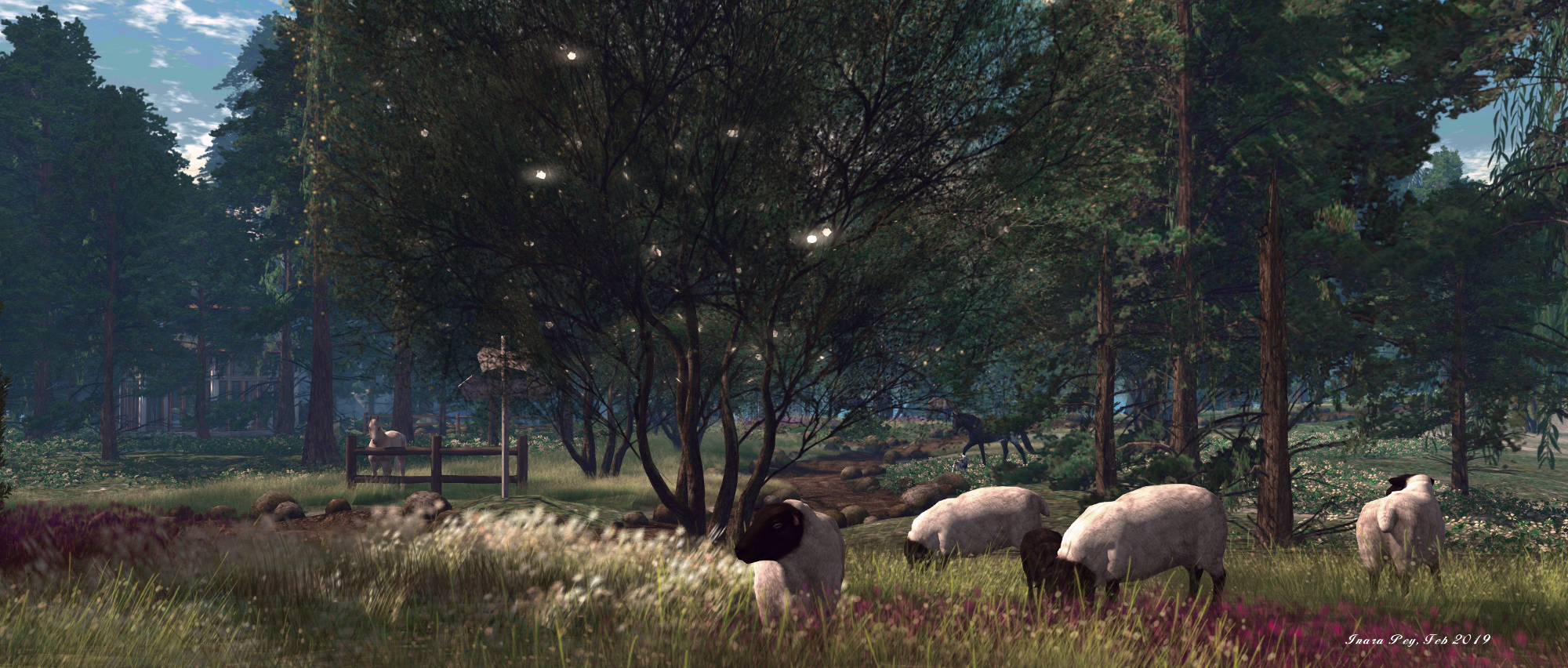
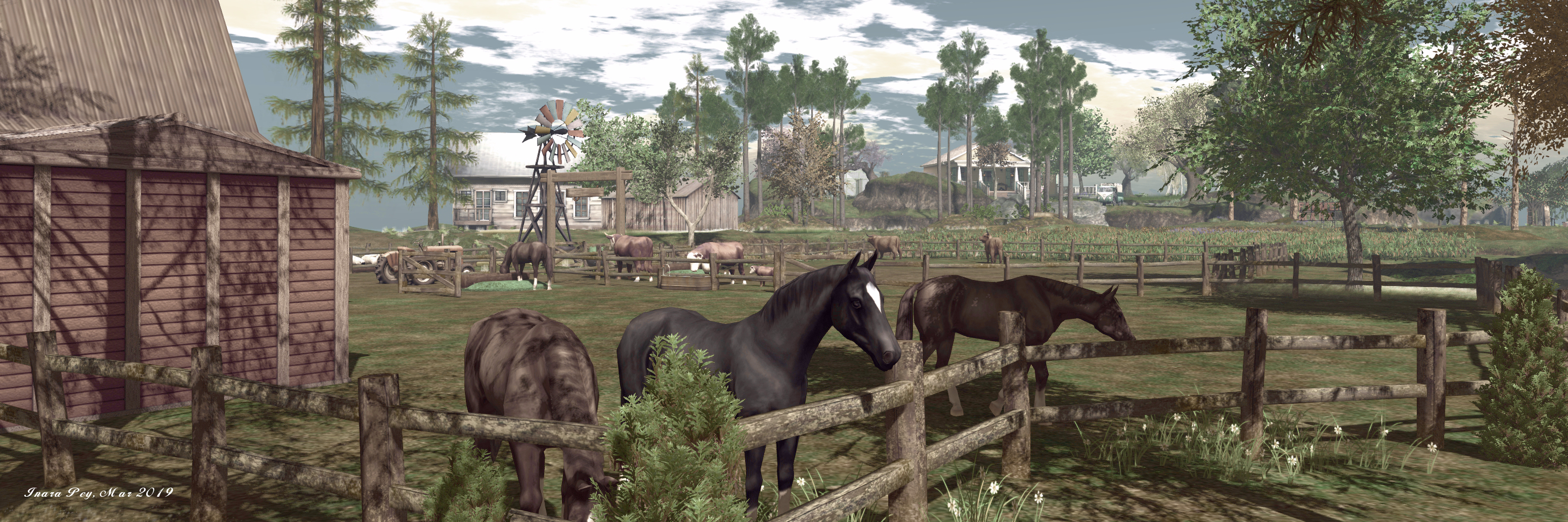
Green Acres; Inara Pey, March 2019, on FlickrGreen Acres – click and image for full size

Green Acres is the name given to a Homestead region designed by Alsatian Kidd with assistance from Iniquity Constantine that presents a slice of rural Americana in a very photogenic setting.

The region is roughly divided into two parts: rugged uplands running roughly diagonally across the land from the north-west to the south-east, that presents an arc of cliffs to the low-lying lands forming the rest of the setting.

Green Acres; Inara Pey, March 2019, on FlickrGreen Acres

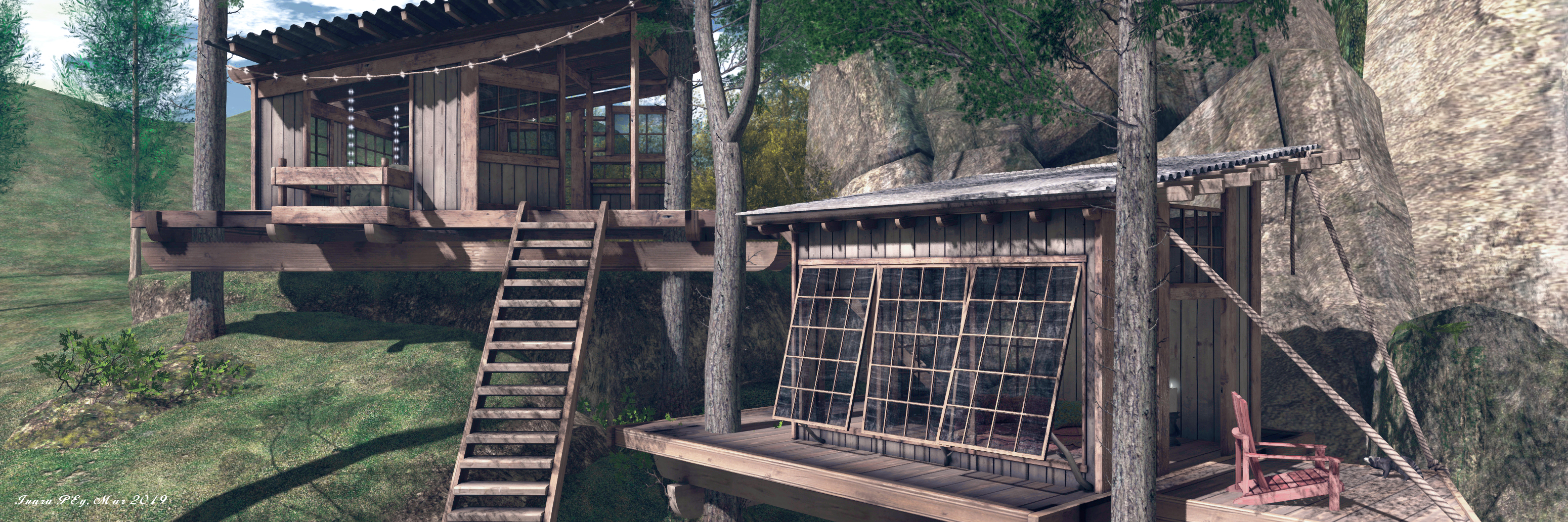
The landing point sits on a low-lying table of grass eastwards of the hill, close to Cory Edo’s Yara Treehouse design, which is imaginatively built back into the stepped face of the rocky hills, water dropping in a sheet to one side, feeding  a pool at its feet where ducks swim, the water tumbling over a further small drop to meander away around the foot of the hills and through a narrow grassy gap between them.

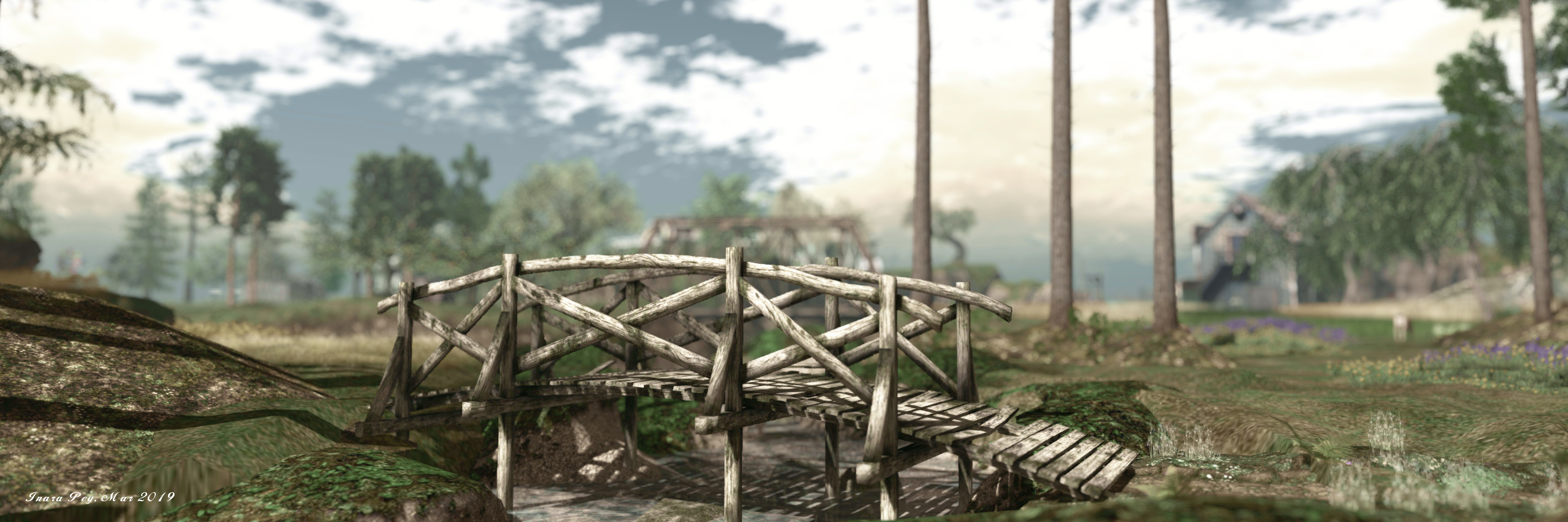
This gap is shared by a path that winds along the stream’s bank, inviting visitors to follow. Beyond the cleft, the two part company, the stream continuing to hug the foot of the hills before it joins with a small river. By contrast, path branches before this confluence is reached, one arm linked to a snuggle spot nestled in the arms of the hills, reached via a little wooden bridge, the other running northwards over grassland. This path will eventually lead visitors to a lighthouse standing on a low promontory of rock and bracketed between a small beach nestled into a cove on one side and the estuary of the river on the other.

Green Acres; Inara Pey, March 2019, on FlickrGreen Acres

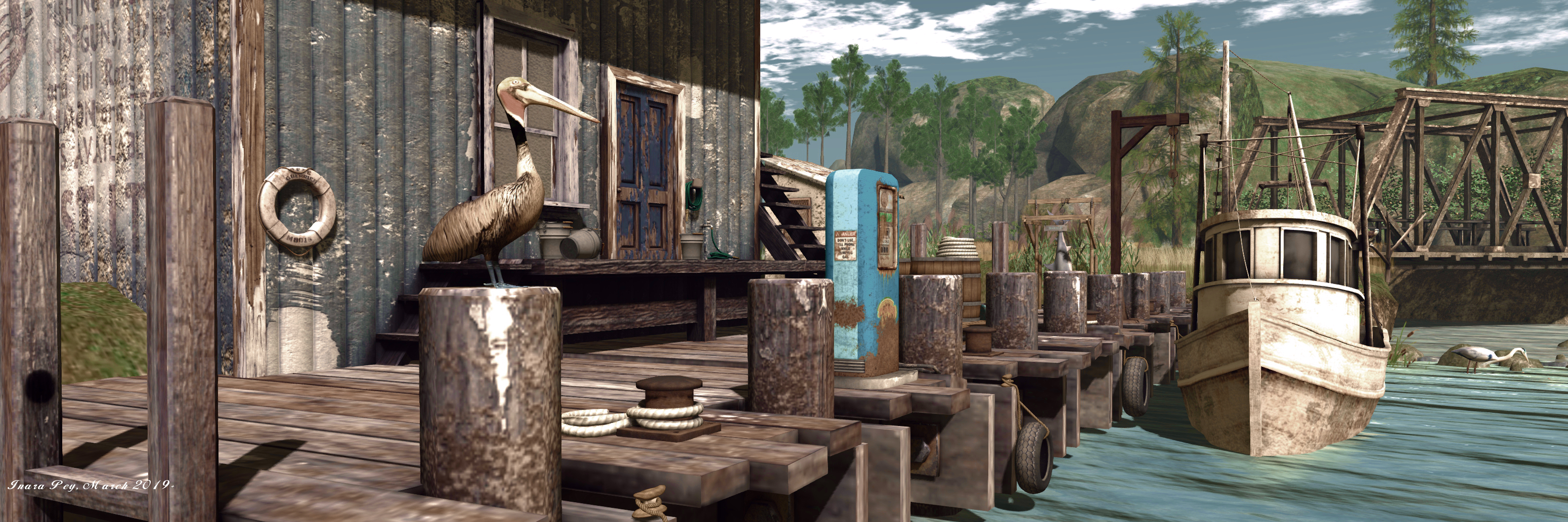
The estuary is home to a small fishing wharf, while the river is spanned by a broad girder bridge, providing the way to reach the ranch that occupies rest of the region. The lands here are open to exploration, but visitors are asked to respect the privacy of the owners and not stray into the ranch house itself.

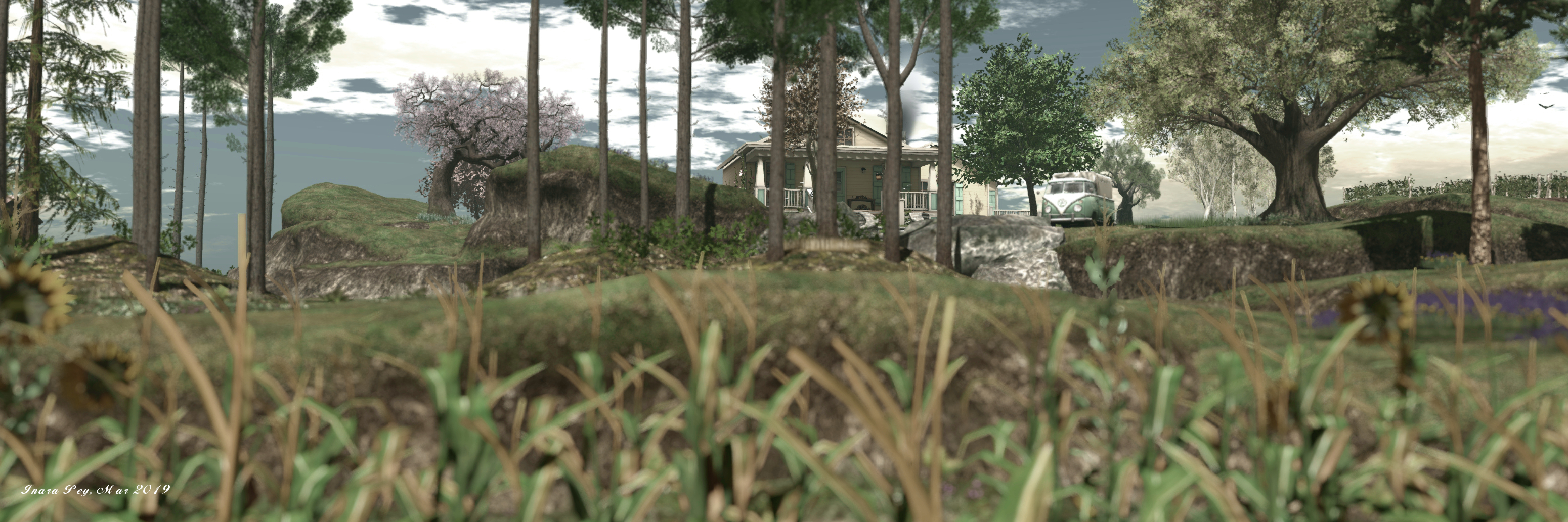
This house sits above the rest of the ranchlands on a low table of grass and rock that offers an excellent vantage point for keeping an eye on things, the house sharing the hill with grapes growing on the vine. Below them, the land presents fields and livestock grazing, with cattle, sheep and horses occupying the fields adjacent to a large barn. Close by, an orchard offers apple trees ripe for harvesting, while more rutted tracks offer a route around the ranch outbuildings.

Green Acres; Inara Pey, March 2019, on FlickrGreen Acres

Beyond the ranch, the land closes back towards the hills, a large pool of water both fed by another waterfall and feeding the little river offering room for geese to swim and visitors to relax in a waiting kayak.

One of the things I like about Green Acres is the lie of the land potentially – and subject to respect and care – is one of those places ideal for exploring on horseback if you have a wearable / rideable horse. The trails around the region are ideal to follow, and the open grasslands offer plenty of room for grazing while appreciating the landscape from the saddle. But even if you don’t have a horse, the region offer a pleasant walk with plenty of opportunities for photography and for sitting and relaxing scattered around. There’s the kayak mentioned above, for example, a cosy little place on the beach, a picnic blanket spread on the grass, and the tree house near the landing point, to name but a few.

Green Acres; Inara Pey, March 2019, on FlickrGreen Acres

With deer, bear, raccoons and foxes also to be found, birds overhead and a gentle sound scape to surround you while exploring, Green Acres is another  delight of a region to visit.

SLurl Details

2019 SL User Groups 9/3: TPV Developer Meeting

Provincial Life; Inara Pey, February 2019, on FlickrProvincial Lifeblog post

The following notes are taken from the TPV Developer meeting held on Friday, March 1st, 2019. A video of the meeting is embedded below, my thanks as always to North for recording and providing it. Time stamps are provided to the major topics of discussion, which will open the video in a new tab for ease of reference.

There was a lot of general text chat during the meeting, there these notes are purely a summary of the key discussion point likely to be of interest to most users.

SL Viewer

[0:44-4:48]

As noted in my CCUG Summary for the week:

  • The BugSplat RC viewer, version 6.1.0.524670, was promoted to de facto release status on Thursday, February 28th.
    • This has resulted in breakage for some open-source builds, and the Lab will be accepting patches to correct this, providing the patches do not interfere with the BugSplat changes.
    • There will likely be further fine tuning of the BugSplat code to assist with the reports generated.
  • The EEP viewer was promoted to RC status with the release of version 6.0.2.524683 on Wednesday, February 27th.

The remaining viewer in the pipelines remain as follows:

  • Release channel cohorts (please see my notes on manually installing RC viewer versions if you wish to install any release candidate(s) yourself):
    • Estate Access Management (EAM) RC viewer, version 6.1.0.524240, dated February 22nd.
    • Love Me Render RC viewer, version 6.0.2.523177, dated January 16th.
  • Project viewers:
  • Linux Spur viewer, version 5.0.9.329906, dated November 17th, 2017 and promoted to release status 29th November, 2017 – offered pending a Linux version of the Alex Ivy viewer code.
  • Obsolete platform viewer, version 3.7.28.300847, dated May 8th, 2015 – provided for users on Windows XP and OS X versions below 10.7.

The EAM viewer requires a further simulator update, and there will be further simulator updates / deployments for EEP (which is not yet grid-wide).

The new Maintenance RC viewer – code-named Teranino (after the Croatian liquer) – has been delayed while it is being merged up to the BugSplat release. Among other things, this RC will have numerous crash fixes in it.

Also as noted in my CCUG summary, the Bakes on Mesh viewer is awaiting a Bake Service update. Once that has been deployed, the viewer will likely be promoted to RC status.

Asset UDP Messaging Deprecation

[4:54-6:08] The simulator update to remove the remaining Asset UDP messaging was delayed as a result of the week #9 deployments having to be deployed. The initial deployment of the changes will, I believe, be made to the Magnum RC channel.

As these updates are deployed the current Obsolete Platform viewer and the Linux Spur viewers will be increasingly unable to receive asset data – including avatar shapes, meaning avatars used using them will appear as clouds. These viewers will not be updated to render avatars, and will not be updated to enable them to do so.

In Brief

  • [22:29-22:52] Texture memory caching: this work is stalled at present, but LL hope to resume the work soon.
  • [23:12-23:35] Visual Studio 2017 update: “Good progress” is being made on the shift to using VS 2017 in the viewer build process, and it is hoped tested on the updated build process can commence in a few weeks.
  • [28:38-28:48] Avatar attachment issues: the issue of attachments belonging to other avatars randomly appearing to be briefly attached to your screen when logging-in to / teleporting to busy regions is thought to be the result of a race condition, with the viewer receiving object data for attachments before it gets the necessary avatar / attachment point data. While the problem does correct on receipt of the latter, LL are continuing to investigate.
  • [7:06- 19:23 – mainly in text chat] NiranV Dean (Black Dragon viewer) believes he has noted two performance improvement areas:
    • A means to prevent fps collapse when edit-selecting rigged mesh. He has offered to set up a repository so his ideas on this can be examined.
    • A means to reduce the number of getChild calls generated when using tools such as the Edit window (some TPVs may have already implemented fixes to reduce these calls).
    • Using sliders to make changes to glow and transparency (and possibly to materials – e.g. shine and glossiness, although the workflow here would be more complicated) to reduce the number of callbacks being made.
    • There is a willingness at the Lab to look at his ideas, once they’ve been submitted  / made available.
  • [29:38-31:31 (and beyond in chat)] General discussion on avatars appearing to float above platforms floors at altitude. In short, this is nothing to do with further height offset issues, but likely the result of floating point precision options (the same issues that can lead to things like “prim drift” when building at altitude). Any attempt to redress this could be a major project, if not a fundamental change in how the simulator works.
  • A presence of the Singularity team at the meeting led to suggestions a release for that viewer might be somewhere on the horizon.

Chalkboards and photographs in Second Life

Lyric Art Gallery: SecondHandTutti

Officially opening at 10:30 SLT on Saturday, March 2nd, 2019 at the Lyric Art Gallery is the latest edition of the Visual Feast exhibitions, featuring the work of two artists: SecondHandTutti and the gallery’s co-curator, Michiel Bechir. Between them, they offer two very different – but equally captivating – exhibits.

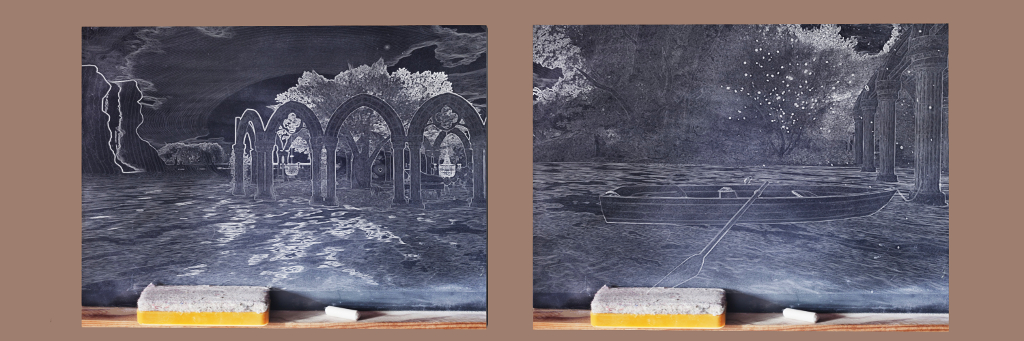
On the ground floor of the gallery is SecondHandTutti’s #26 Chalkboard Dolls, which – contrary to the title is actually 17 pieces of art comprising 14 wall mounted images and three 3D pieces. They are, however, all drawn together by the chalkboard theme.

Lyric Art Gallery: SecondHandTutti

The 14 images, all clearly taken in Second Life have been beautifully rendered to present a series of chalkboard drawings. Each is offered as if freshly drawn, the chalk resting on the board’s shelf alongside an easer. It’s a fascinating way by which to capture Second Life and the degree to which each image genuinely appears to have been hand-drawn on a board is mesmerizing. Granted, on one or two you have to get the camera in close to fully appreciate the detail, but the effort is more than worthwhile.

The three 3D pieces utilise chalkboards to display their names. They are uniquely abstracted studies of figures created with prims, rather than the more common mesh. This gives them a rawness of line that is as eye-catching as the images surrounding them, and  – in the case of Dancer perhaps offers an added sense of tribalism to the figure and the dance.

Lyric Art Gallery: Michiel Bechir

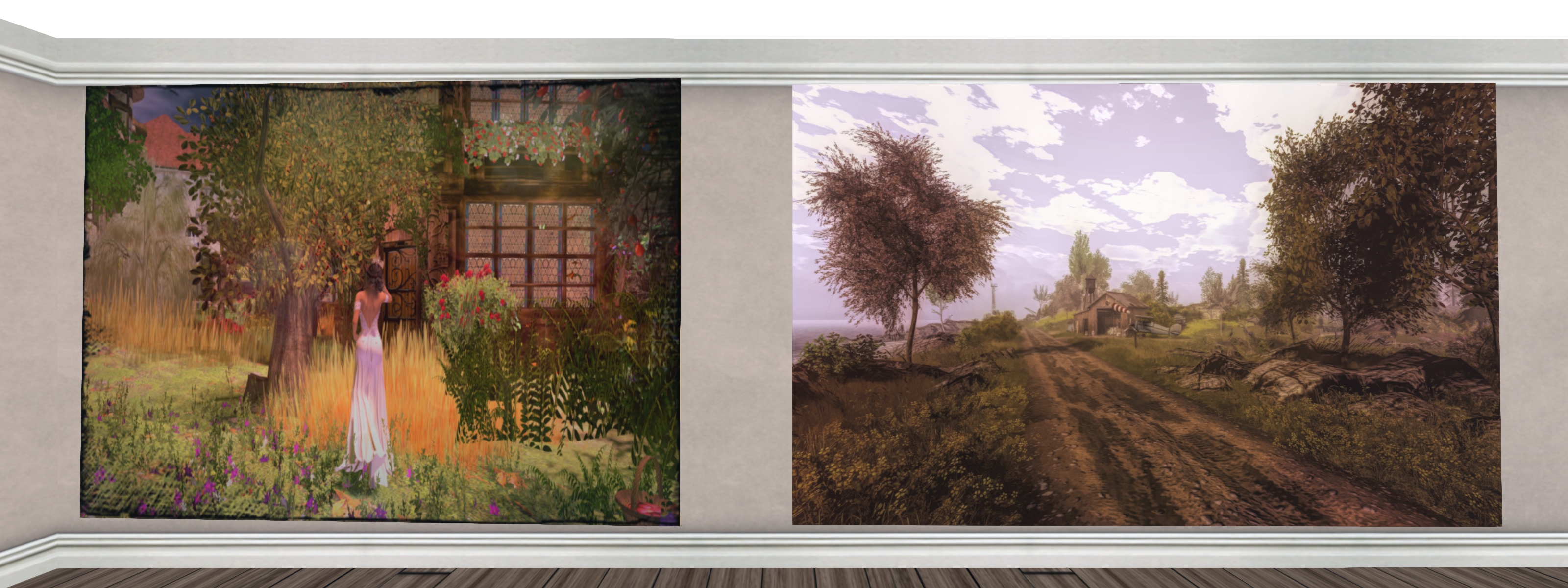
Located on the upper floor of the gallery, Michiel’s exhibit presents 17 of his photographs taken around second Life, either mounted on the walls or on easels. His work has always had a richness to it, whether presented as a gently post-processed photograph, or more broadly edited to give the feel of a painting, and the selection offered at the Lyric presents both approaches for visitor to admire.

As a seasoned SL traveller, one of the things I enjoy with landscape photography that has been captured in-world is trying to identify the locations without cheating by referencing the Edit floater or hovering the mouse over a picture in the hopes of seeing a name. Sometimes the images feature aspects of a region that are so iconic, it is relatively easy to do so: the airstrip at Wild Edge, for example, or the wind turbines at La Digue Du Braek, or the beauty of the Gulf of Lune – all of which can be found in this selection. But sometimes, the setting can be captured in a more subtle manner – and thus I was delighted to spot images taken and Scribbled Hearts and Kekeland, two destinations to which I have in the past made numerous visits.

Lyric Art Gallery: Michiel Bechir

Two excellent selections of art, and I recommend them as being well worth a visit.

SLurl Details

Sansar: February release and Product Meeting week #9 w/audio

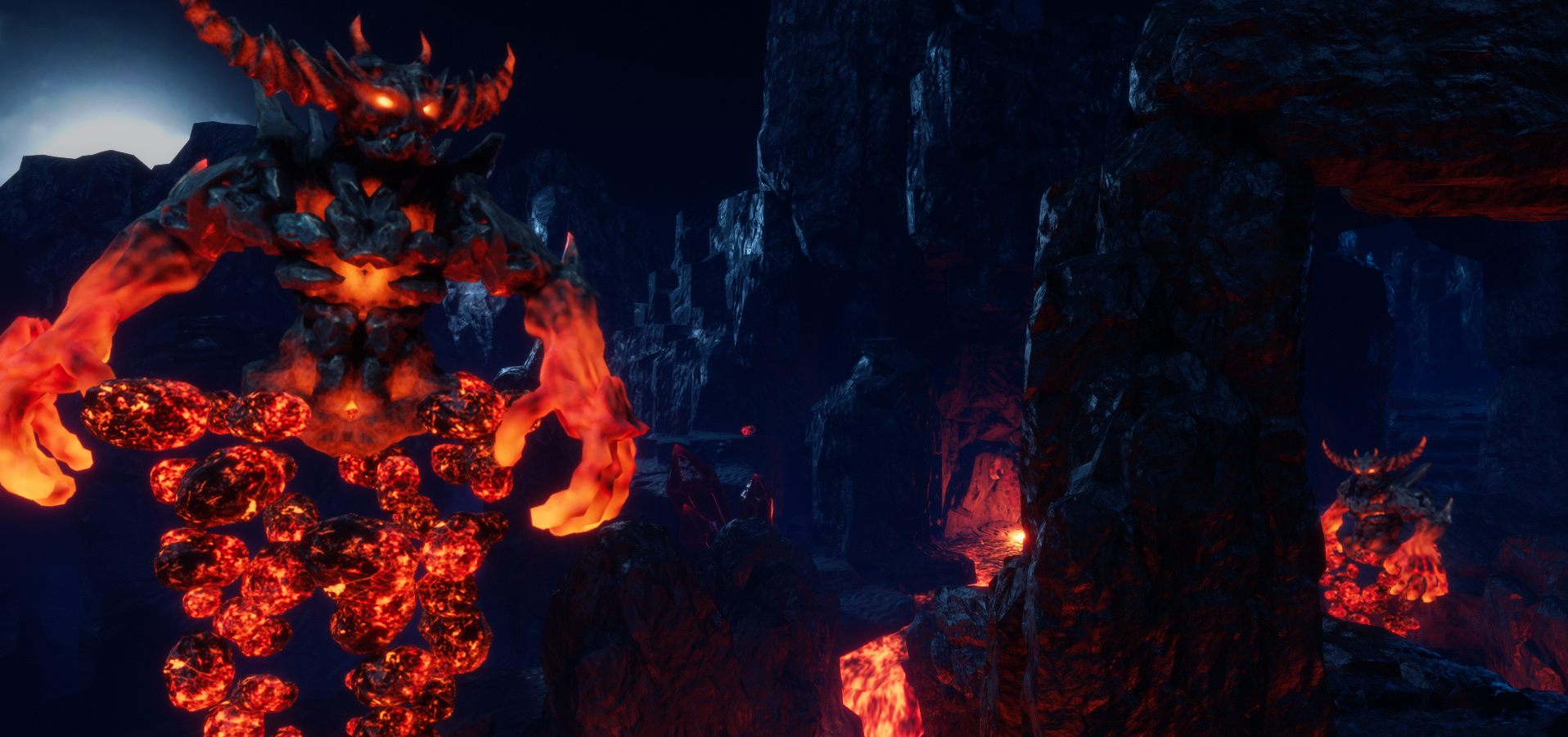
Schwefelstein Pass

On Thursday, February 28th, Linden Lab released the C’mon Get Happy release. This is rather a small update compared to previous releases. The full release notes are available, and highlights of the release key features might be summarised as:

  • Save and sell a collection: creators can now pull a group of objects from a scene and save it back in their inventories as a single object.
    • All script relationships and relative positioning for the objects will be stored in that single object, making it easy to drag and drop a collection of items in a scene or sell it in the store.
    • Note the objects will not be linked: when placed back into a scene, they will remain a group of individual objects. This will be coming in a future release.
  • Smoother gifting: there is a new notification to let receivers know that they received Sansar Dollars from another user.
  • Draw distance limit: creators can now define an object’s draw distance limit from the properties panel. The draw distance defines the distance at which an object starts to render in the scene.
    • For example, if an object’s draw distance limit is set to 10 metres, the object will no longer be visible when a user in an experience is beyond 10 metres from the object.
    • This is currently set to infinite by default, so creators are asked to implement it when building their scenes.
  • Extended limits on uploaded Avatar items: the proximity limits on clothing, accessories, and hair are expanded, with the Axis Aligned Bounding Box (AABB) area increased by .1m left/right and .3m front/back.
    • This means that the AABB area is now min(-0.9m, -0.9m, -0.05cm) max(0.9m, 0.9m, 2.2m).
    • This change does not affect emotes nor custom avatars.
  • New avatar reference files: the avatar reference files are now noted as being updated and can now be found here.
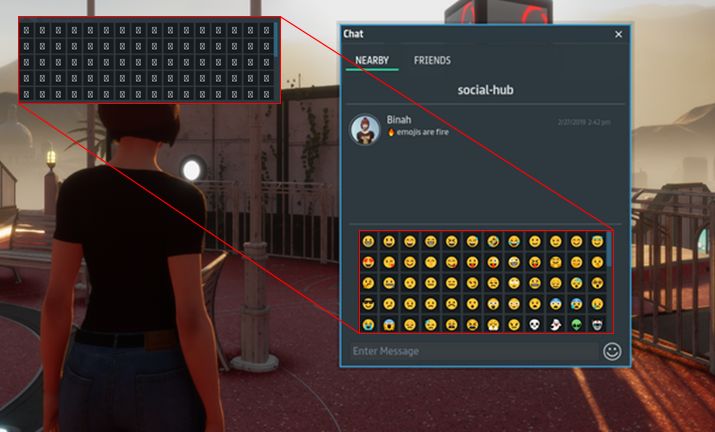
  • Emojis have been added to chat.
    • The font used is Segoe UI Emoji, which is not supported by Windows 7. Users on that operating system will see an X in a box whenever an emoji is used.
The Emojis panel can be pulled up using the smiley icon to the right of the text entry field. Users on Windows 7 will see this as a panel of “empty” boxes (as shown in the inset, top left)
  • Two key bug fixes for the release are:
    • Servers should spin-up faster when trying to access an experience which has no-one in it.
    • Chat should no longer scroll to the top when opening the chat panel.

Again, for the full list of updates, please refer to the release notes.

Product Meeting

Sansar as a World

This is something that has been mentioned in recent product meetings – the shifting to emphasise Sansar as a “World” rather than as a collection of discrete experiences. Commenting on this at the product meeting, Landon  McDowell, the Lab’s CPO, explained the reasoning behind this thus:

We asked ourselves what was really missing from Sansar and what we wanted to add to it, and one of the things that kept coming up consistently is … one of the magical things in Second Life is it feels like a world. It feels like place … and when we designed Sansar, we didn’t really implement that; it was a design decision. we wanted the individual worlds to stand alone, and be disconnected and independent … [Now] we feel that lack of place … is something that we’re personally missing and something we want to add into Sansar.

– Landon McDowell, Linden Lab CPO

Questing and Gameplay

The focus of the February 28th Product Meeting was on the updating Quest / rewards / achievements system that has been the subject of recent Product Meetings. This is seen as being both a means to help on-board new users to Sansar and – linked to the above – as a means of providing a capability that can allow grater gaming  and questing with common roots across experiences, thus helping to give a feeling of continuity between them.

Part of this is what the Lab is calling Directed Play, which is liable to start appearing over the next couple of releases (March / April), as outlined by Stanley, the Director of Product for Sansar and Aleks Altberg:

  • The first pass at a quest system. This will initially be a basic approach of complete a task / achieve an objective, and receive a reward.
  • This will initially feature quests formulated by the lab, so will be player focused, but over time will be opened out to allow creators to build using the tools.
  • For the initial release, as it will feature game play from the Lab, the rewards will be small Sansar dollar amounts, as these are the easiest thing for the Lab to offer.
    • The system will be broadened such that when Creators are able to use it, they will be able to offer items as rewards  – accessories, clothing, custom avatars, etc.
  • The ability for creators to use the system and offer rewards will hopefully be made available in the spring / late spring of 2019.
  • Longer-term, the Lab is also thinking about progression systems, e.g. experience points / levelling system or achievements.
    • These are again being considered in terms of both how the Lab might use them and how creators can incorporate them into their experiences.
    • This work might start to be surfaced in the summer of 2019.
  • The first quest that will be deployed in the March release is the previously mentioned “tutorial quest”, specifically aimed at new users. This will take them through the basics of walking, talking, running, interacting with objects, etc.
    • Ultimately, it will push new arrivals into the Social Hub, which will include a new area focused on quests, and tentatively referred to as the Quest Giver.
  • The Quest Giver will have a couple of further quest provided by the Lab:
    • A scavenger hunt spread over some of the experiences provided by Sansar Studios, where player have to locate various Easter Eggs and return them to the Quest Giver.
    • A guided tour approach to various Sansar Studio experiences, with landmarks participants must visit.
    • Both formats will include rewards on completion.
  • One thing the Lab does not want to get into, outside of some “premium” content they will produce, is building quest style content over and over. The focus is very much on producing a set of tools that can be leveraged by content creators whilst providing users with a consistency of use across different types of quest.

Q&A Session On The Quest System
  • Will creators be able to assign and store data against players (experience points (XP), etc)?:
    • The plan is to have a global XP system that works across all of Sansar, but this has not been fully defined. However, the idea is to allow content creators to contribute towards it.
    • This does not prevent creators using their own system if they so wished.
    • One issue is that anyone can be a creator and anyone can be a player, therefore the system has to be robust enough to avoid being gamed, and this is one of the reasons the Lab is approaching the XP system carefully.
  • Will creators be able to gift questors with rewards automatically?: Yes, but creators are asked not to think of it as “gifting”, and don’t want users to have the expectation of a reward dropping into their laps on completion of every task.  Rather the idea is to make these games an overall quest that results in a rewards being given (i.e. a product the creator might otherwise sell in their store).
    • More broadly, the gift capability will remain separate to the quest system and the concept of rewards.
  • Will it be possible to build experiences that only user reaching certain XP levels can enter? Possibly, but the Lab has not got to the point of considering this type of specific requirement as yet.
  • Will it be possible to assign animated characters (NPCs) as quest givers? Eventually, yes.
  • Will it be possible to branch quests (e.g. complete task A, then either go on to B or C, rather than having to complete B then C)?
    • Initially, where quests are related, there will be a linear progression: if you want to do quest B, you must complete quest A.
    • Longer term, branching might be possible, as the Lab is still putting ideas together (hence requesting feedback through this PM).
    • Where quests are not related, it is possible to participate in more than one (so if quests X, Y and Z stand independently to one another and have no requirements one to the next), a user can be involved in all three simultaneously.
  • Will creators be able to set-up and run multiple instances of popular quests they create and track usage, etc? Not initially; but if it becomes necessary, the Lab will consider it.
  • Will it be possible to have objects that can only be obtained / used by players reaching a certain level? Once the levelling system is introduced, mostly likely yes, but objects like that would require explicit scripting on the part of the creator.
  • Will players be able to pick up items and add them to a local inventory (“backpack” or similar) to carry around and use as required, rather than being limited to just carrying things by hand? Potentially, by means of scripted support.
  • Will there be a “quest list” or “log” for users to track what quests they participated in, and their current progress within quests? Yes, and this will be part of the initial release.
  • Will quests be limited to individual experiences or run across multiple experiences? Initially, the system will be focused on quests within individual experiences. However, it will be expanded to support quests across multiple experiences.
  • Why should creators build games outside of the quest system if the Lab is going to be building and promoting its own games?
    • The intent for the Lab (as noted in the audio above) is not for the Lab to be in the market of making content and games. Their involvement is more to test the tools (e.g. the native UI elements), ensure they work and can do what is expected of them before passing them over to creators to start using them.
    • The quests built by the Lab can also function as a means to introduce incoming users to the quest system and how it works, so they will be familiar with the basics before they enter quests built by creators.
  • Will the system allow creators to set a limit on the number of players in a quest, e.g. set their quest so only one or two or just a small group can participate at any one time? Not something currently on the roadmap, but as the idea has been a common request, something to allow this might be added in the future.
  • Can creators / users still do their own thing if they don’t want to use this system? Yes. It’s just another set of tools creators can use if they so wish.
    • Similarly, users do not have to participate automatically. All quests will be opt in.
    • Those opting-in to a quest will gain access to the native UI elements the lab is building for quest players (and which will be available to creators to use when the system is opened out).
  • Will the system include a heath system? Not in the initial releases.

Other Items

  • Why isn’t Sansar built on Unity? Because it was a conscious decision to build a dedicated engine the Lab could manage and extend without being dependent upon a third-party supplied engine that is geared towards trying to support multiple markets.
    • That said there is no reason why user-generated content cannot be used on either platform, and the Lab has been considering a Unity import mechanism (see my previous PM summary notes).
  • Will avatar locomotion include climbing as well as jumping and crouching? No plans for climbing, sliding or things like it at present. Jumping and crouching are the current focus for locomotion additions.
  • Can a slider be added for transparencies to allow opaqueness to be adjusted on objects? Not directly, but can be achieved by setting the materials and using an alpha on the object / face.
  • Will experience concurrency be increased? This is being worked upon, and the goal is to raise the ceiling on avatars in an individual instance of an experience to 100, hopefully be mid-2019.
  • Will Sansar have a particle system? A popular request, but currently on being worked on, although it is a goal for the future.
  • Will there be a “Universal” inventory system usable across all experiences? Again, a goal, but not for the immediate future.
  • Will Sansar allow adult content? There are currently no plans to allow adult content.
  • Custom animations for sit points: still at least a couple of releases away.
  • Private grouping (e.g. allowing private voice calls or text chat between 2 or more users): something the Lab wants to provide, but currently a question of resources and priorities.
  • Object parenting: might be out in the next release for the Edit mode, but this will not include run-time parenting of objects in run time.
  • Windows Mixed Reality support: still no plans to officially support WMR headsets.
  • Ticketing system: the ticketing system has been used for a number of LL organised Sansar events. A new, more robust ticketing system is currently being built, and it is hoped to make that available to experience creators so they can use it with their events.
  • Site-to-site teleporting:  the next release should include the ability to set-up teleports that deliver users to a specific point within an experience