On Saturday, January 26th, 2019, the Kokua viewer updated with the release of version 6.0.1.44611 (no RLV) and version 6.0.1.44619 (originally .44610).
The RLV version of the viewer initially brought the RLV version of Kokua to parity with RLV 2.9.25, released on January 25th. However, that release had a bug in it, forcing Marine Kelley to issue a hot fix release, version RLV 2.9.25.1 on January 26th, which was quickly adopted by the Kokua team into Kokua 6.0.1.44619. Outside of this fix, .44619 is functionally identical to .44610.
RLV Updates
The RLV updates can be summarised as:
Force a rebake whenever attachments and wearables are changed.
Prevent the avatar from going into T-Pose while editing an attachment that has been worn only for a few seconds.
When in Mouselook, don’t show rigged attachments that are worn on any head attach points.
Optimise the rendering of the vision restriction spheres.
Remove the artificial far touch restriction when vision is restricted, to allow objects to beyond an avatar’s visual range to be touched.
Kokua Updates
Both the .44611 and .44619 releases include the following updates from the Kokua team:
New Avatar right-click context menu option Reload My Outfit: this can be used to resolve clouded logins by manually forcing another attempt to wear the default outfit, effectively adding the current outfit onto itself.
Addition of Firestorm’s Wear Items option added to the inventory folder right-click menu. This causes the wearable items in the folder to be worn, replacing any items on the corresponding attachment points.
Reinstatement of the Help > Kokua Support Group option to obtain in-world help from other users (issues / bugs should still be filed via the Kokua Sourceforge support option).
The new right-click avatar content menu option Reload my Outfit (l); the right-click Inventory context menu option Wear Items (via Firestorm); and the reinstated Help menu > Kokua Support Group option (r)
Removal of the following menu options:
Disable Build Constraints (no longer supported by Second Life servers)
Texture Memory Stats (there was no code behind this menu entry, so it would always do nothing)
Toggle PG (again, there was no code behind this option)
Addition of various Firestorm improvements to login, inventory handling and outfit wearing.
Internal changes to make the performance statistics code more efficient.
A switch to using Linux GCC V7 from V5 for compilation.
Fixes for a number of errors in the XML configuration files for menus and floaters. These reduce the number of entries written to the log files and provides a small performance benefit.
I’ve not had time to drive this viewer following the release, so cannot comment on general performance, etc. However, as chance would have it I did get the chance to try the Reload My Outfit option, which seemed to work pretty well.
Update, January 31st: the next Comedy Gladitors line-up has now been confirmed as Steven Hofstetter (host), with Josh Wolf, Jamie Kennedy, Zainab Johnson, and Greg Fitzsimmons, as noted below. The event will take place on Monday, February 11th, 2019, commencing at 17:00 PST (03:00 GMT, Tuesday, February 12th, 2019). Tickets are available for the “early bird” rate of US $4.99 through until Wednesday, February 6th, 2019, thereafter most likely US $9.99 in keeping with the first Gladiators event.
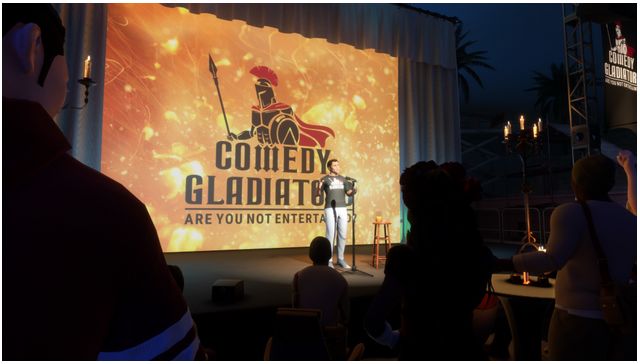
Sansar has recently hosted two comedy events – in fact the first two in a pair of series. The first, Comedy Gladiators, took place in December 2018, and featured Steven Hofstetter together with Ben Gleib, Maz Jobrani, Alonzo Bodden, and Mary Lynn Rajskub. I wasn’t able to attend the event given the US / UK time difference, but did provide some coverage of the event ahead of time.
Four more events in the series are currently planned, all specifically suited to US audiences, set to by held on the following Mondays at 17:00 PST:
February 11th, 2019.
February 25th, 2019.
March 11th, 2019.
March 25th, 2019.
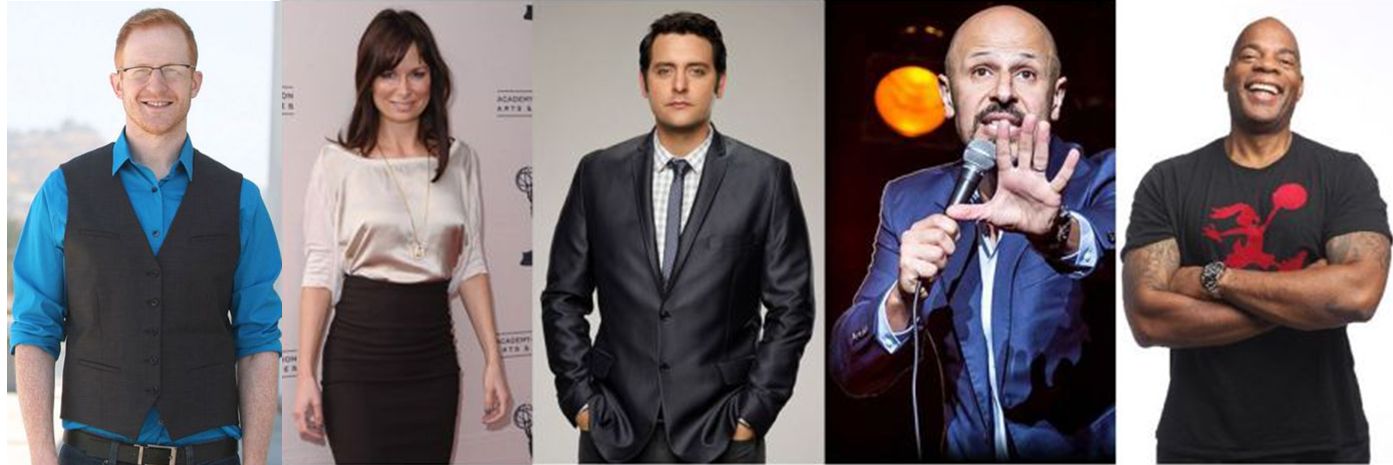
Steven Hofstetter (l) and the cast of the first Comedy Gladiators show: Mary Lynn Rajskub, Ben Gleib, Maz Jobrani and Alonzo Bodden
The second series of events launched on January 12th, in collaboration with the San Francisco Comedy Festival. This featured comedians David Cross (Mr. Show and Arrested Development fame) and Amy Schumer (MADTv, Insatiable, Shameless), together with openers Irene Tu and Chad Opitz). A further Sketchfest event will take place on Saturday, January 26th, featuring Michael Ian Black and Andy Kindler, supported by Emily Catalano.
All of the events are offered as ticketed activities – attendees pay via the Sansar Store in order to have access to an instance of an event. Starting with the January 26th event, Sansar users on Steam will also be able to pay for tickets via their Steam wallet. But what are these events actually like?
I cannot actually tell you first-hand, as I’ve yet to make one (as noted the Comedy Gladiator event was far too late for me, while 9:00pm UK time on a Saturday evening generally means I’m out-and-about in the physical world. However, Steven Hofstetter recently issues an extract the first Comedy Gladiators event, which helps to illustrate things.
This event saw a far amount of publicity ahead of it, with the Lab issuing a press release about the series launch, which was picked-up by a number of outlets. Steven Hofstetter also promoted it through his YouTube channel (although the promo video has since been removed, given the event has taken place).
From this clip, I got the impression the participants had at least had some experience of using VR ahead of the show, even if certain aspects of their avatar’s reactions to their own movements caught them by surprise.
At the time I wrote about the first of the SF Sketchfest event, I noted that:
Compared to the Comedy Gladiators event hosted in Sansar on December 10th, 2018 (read more here), the SF Sketchfest is receiving fairly low-key and what seems to be very short-notice advertising through social media.
The first SF Sketchfest event advertised David Cross and Amy Schumer, Irene Tu and Chad Opitz
As I couldn’t help but feel the event appeared to be somehow rushed – not that I had any evidence for feeling that way; it was just a gut feeling. However, reader Susan Wilson – who had been looking forward to the Comedy Gladiators event in December 2018, appeared to confirm this nagging doubt I had about the SF Sketchfest, when writing about the event:
Well, that was a waste of money. I heard the first comedy show in Sansar was great so I was looking forward to it but this was awful. Two famous people bumbling around a room, not even telling jokes. The openers were honestly better, at least they stood on the stage and did comedy. I was hoping for a comedy club experience in VR. This was more like watching “comedians” experience VR and not be very funny about it at all. It was nice to finally be able to sit down in Sansar though!
And I have to confess, a video of the session Baz DeSantis pointed me towards last week does tend to back this assessment up. Focusing on David Cross and Arden Myrin (who was not listed in the original line-up) while on stage (or rather, with the audience), it is fair to say that what is shown is less stand-up comedy and more a exploration of VR by a couple of people who have never previously tried it.
However, the flip side to this is that, while the session may not have been the kind of stand-up comedy presentation one might expect, there was also something of a level of interaction within it that one might not expect from a physical world venue of this kind; the hosts / focus of the show moving freely among the audience, chatting with them, exchanging hugs, etc.
The show also took an interesting left-turn a little over half-way through the recording, becoming something of a Q&A session. On the one hand this allowed a degree of insight into the comedians: why they become involved in comedy, but on the other, as it started it did feel forced and almost like a fall-back option should the session didn’t go in an intended direction.
Would I have come away from the event feeling happy? I’m not really sure; as a “stand up comedy event” the SF Sketchfest session to me falls very wide of the mark, and I’d like agree with Susan Wilson’s assessment. But as an opportunity to meet and chat with a couple of comedians in an informal, “unplanned” situation, it is an interesting experiment and I did find the latter half of the video somewhat engaging (I confess to previously being utterly unaware of either David Cross or Arden Myrin, so have no idea of their comedy styles).
But that said, if these kind of event are to succeed in drawing an audience, the SF Sketchfest does suggest that Linden Lab perhaps need to give more thought either into how the events are presented, or in preparing the participants in advance for what they are getting into if this type of event and Sansar are to be seen as a platform for stand-up comedy that can reach a very different audience.
I’ll leave you with the video of the Sketchfest event of January 11th (do note the language can be a little raw). Should any of you attend the January 26th event, I’d be interested in reading your feedback in the comments.
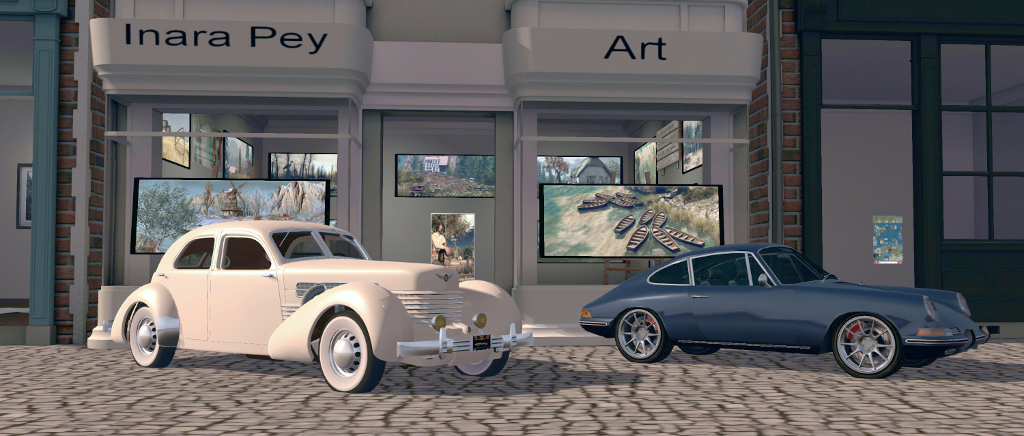
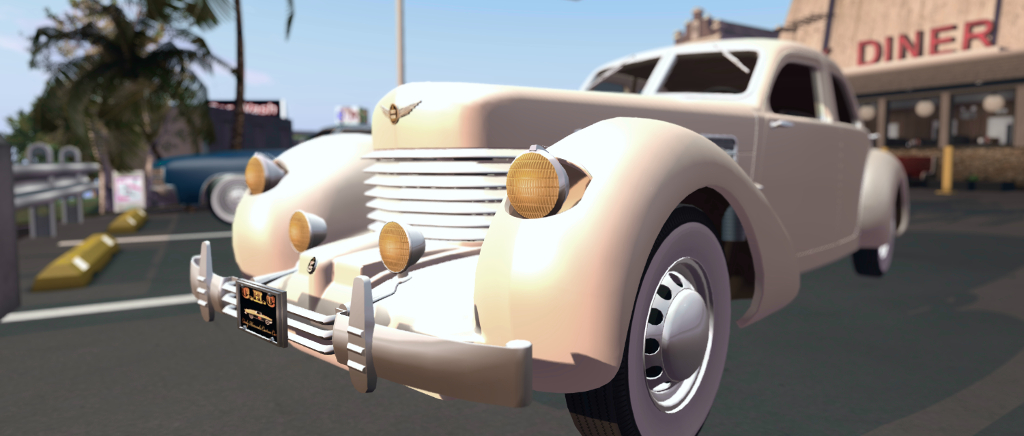
The CHC Beverly 812 (l) and [SURPLUS MOTORS] Carra outside my gallery at the GTFO World HQ, ready for their road testsFor a while now, and as part of my continuing explorations of the grid, I’ve had it in mind to run an occasional series on the highways and byways of the mainland. However, doing so requires having a suitable vehicle.
Back in 2015, I purchased the CHC Beverley 812, largely as a photographic prop, but which could also offer a ride while exploring the mainland. However, I also wanted a second car for a bit of variety – but not being much of an SL road driver, I wanted something of a modest price, given it would largely remain “garaged” in my inventory. Fortunately, the Marketplace furnished me with just such a vehicle: the fully featured [SURPLUS MOTORS] Carra, offered for just L$10 as a former group gift.
Now I confess to knowing absolutely nothing about the relative merits of different makes of cars in SL, so I’m approaching this from a novice standpoint, but I thought it might be worthwhile looking at the two cars as products before starting on any mainland journeys.
Both are very different in looks and finish – but under the hood (so to speak), both are surprisingly similar. The Beverley 812 (L$1,199) is based on the 1930s luxury salon car, the Cord 812. With stylish, Art Deco lines that still draw the eye today, the Cord was innovative for its time, and its looks are perfectly captured in the CHC model, which is 100% mesh. The Carra is modelled after an early model of the Porsche 911.
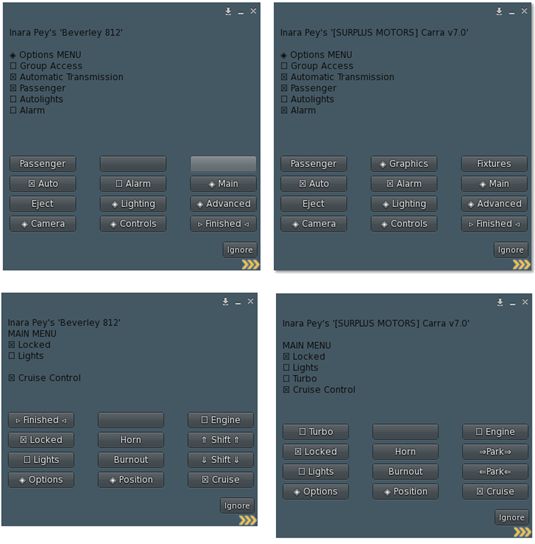
In terms of controls, both vehicles are driven by scripted menu systems which, if not from the same source, are remarkably similar in layout and options, as shown below. This is actually extremely comprehensive on both cars, and includes multiple options to adjust things like acceleration, braking, steering, skidding, etc., responsiveness, together with enabling automatic headlights / tail lights, etc.
Comparison of menus between the CHC Beverly 812 and [SURPLUS MOTORS] CarraThe basic drive controls are the usual: Arrow Left / Right and / or A / D for steering; Up Arrow / W for the accelerator; Down Arrow / S for brakes, and the Page keys to step up / down through the manual gears. In addition, the menus for both can be used for gear shifts, and both have options for an automatic transmission and cruise control.
On the road, and with either one or two aboard, both handle in a similar manner; I found both needed a similar level of adjustment to the steering responsiveness (down to around 0.80-1.00) to ensure a more realistic road handling for road driving, and both tended to pull to the right when on “straight” sections of road. Other than this, both were easy to drive, and they handled multiple region crossings (we took Route 8 from the GTFO HQ at Bruissac all the way to the end of the line at Bagheera and back), in much the same way – again, I assume because the use the same scripting. In short, while there were the inevitable attempts to take to the air, burrow into the ground to go a-slewing off across the countryside on reaching a crossing, providing either car wasn’t going at a silly speed, both recovered very close to the point of crossing to allow driving to resume.
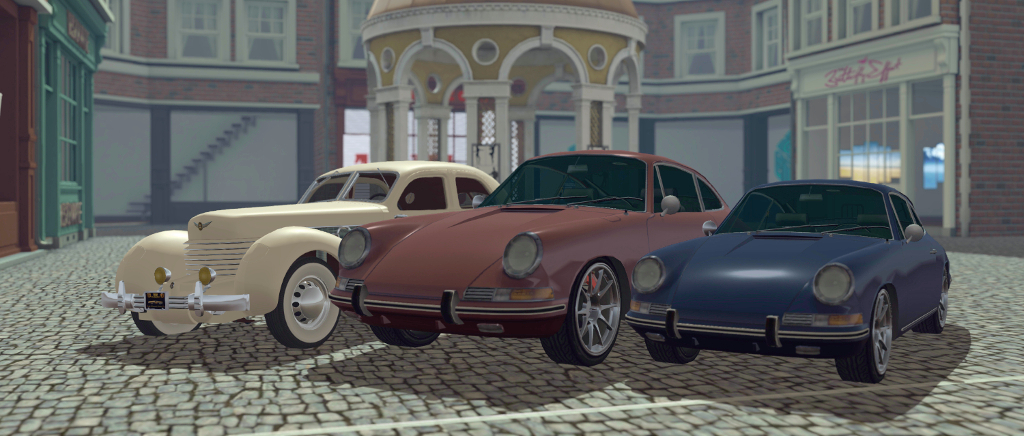
Comparison in size: the Beverley 812, the default Carra, and one resized to scale with the Beverley / my avatar
Turning to the individual models, the Beverley is supplied Modify, and individual mesh faces on the bodywork and interior can, to a degree, be selected for tinting. Sadly, no templates or maps are supplied, so detailing can be hit-and-miss. The build quality is very good, with few visual blemishes in the mesh, and the texturing is very much the superior, particular on the car’s interior.
The Carra is No Modify, but is supplied with additional script options to overcome some of the limitations this presents. These include a painting system with 6 colour presets and the option to provide your own tint using SL vectors. There’s also a scripted resizer – which is vital if you’re like Caitlyn and I, and have a reasonably “real” avatar height and body dimensions, as the car feels HUGE in its default size (see the above image). In terms of finish the mesh perhaps isn’t as polished as the Beverley’s, and texturing on the interior and body trim is noticeably poor.
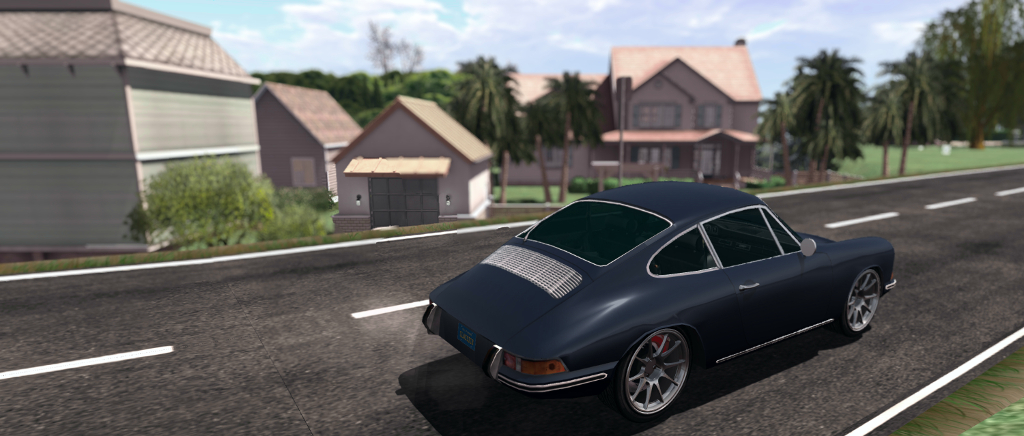
[SURPLUS MOTORS] CarraBoth cars have opening doors, bonnets and boots. The latter respectively reveal the engines, with the Beverley very much the superior. They both have customisable license plates (scripted again for the Carra). Both also have a tendency to float when being driven, and this can be far more noticeable with the Carra when resized smaller.
However, when taken as a whole, there really is little to chose between the two – and by extension, either brand, assuming the same script system is used across all their vehicle. For the keen SL motorist, the Beverly 812 is probably the more attractive of the two; it is a stylish model that completely captures the heart of the original, and has some nice touches and an overall better finish. However, for those looking to try driving in SL with a capable vehicle that will allow them to graduate to other models / makes, the Carra is undoubtedly a bargain – and would remain so at twenty times the L$10 paid, and issues with mesh blemishes and textures doesn’t negate this.
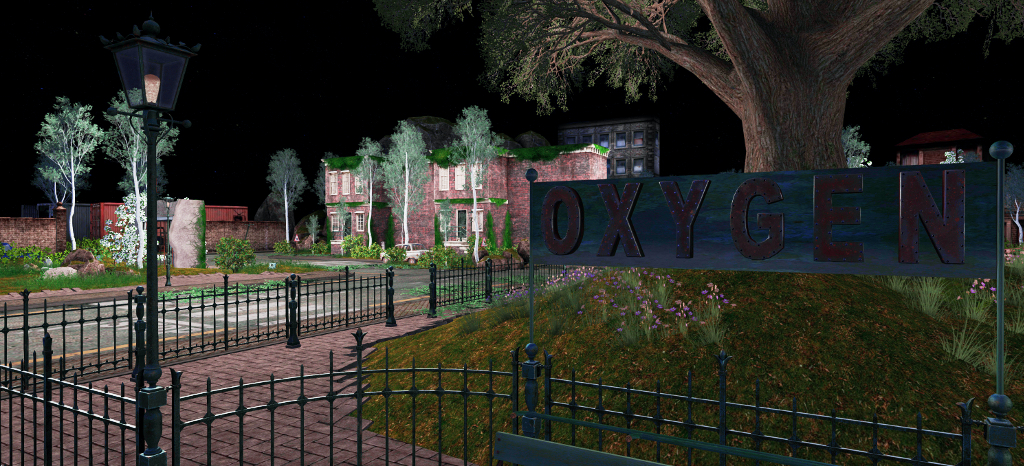
Oxygen, with the subtitle The Suffocated Planet, is the title of a new installation by Terrygold, which officially opens at 13:30 SLT on Friday, January 25th. As with The Rusted Farm (read here for more) before it, it offers art with an ecological theme.
As with The Rusted Farm, Oxygen focuses on the myriad ways in which humans are systematically poisoning our own planet. But where the former dealt with the ruining of the world’s oceans and lands, Oxygen focuses on the manner in which we are slowly destroying the very air we breathe.
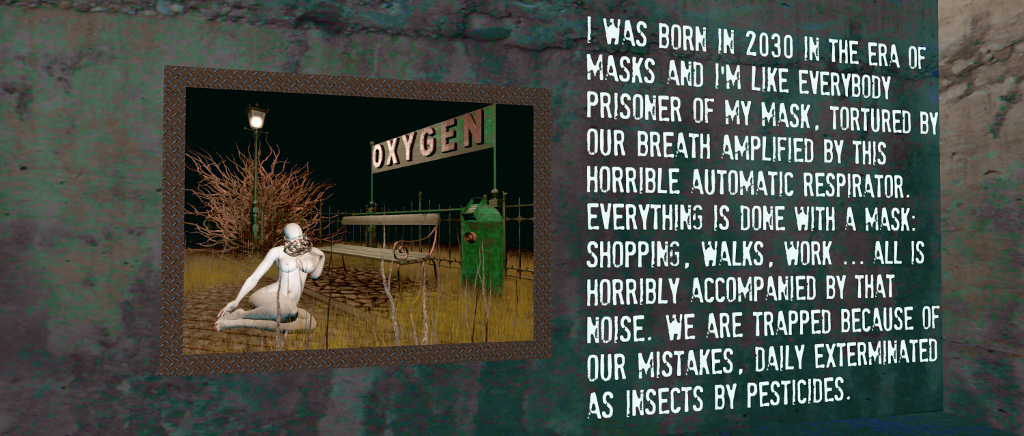
At its core, the installation provides a story, told it words and pictures, of a woman born in 2030, a time when the atmosphere has become so polluted people are unable to live outdoors without the aid of a respirator, which to her feels as suffocating as the deadly mix of gases in the unfiltered air. She longs to witness first had the world she has never known; a place where the sky was as blue as her eyes, and where plants and flower grow in abundance.
Her world appears to be that of underground habitation; a place of concrete walls, floors and ceilings, of passages and vast rows of tanks used to sustain our race. But even here the air is not fresh or clean, and the ever-present respirator imprisons her. There is only one place she can escape the cloying grasp of the mask, and then only briefly – and it brings forth all the longing she feels for the world that has passed, together with a renewed hated for the mask she’ll all-to-soon have to return to wearing.
My weekly hour in the municipal greenhouse is almost over; I’m already wearing my mask and in a little while I’ll be back into that fog. 59:55 … 56 … 57 … 58 … 59 it’s here. The Noise.
That “noise” is the sound of her own confined breathing, the beat of her own heart, reminders of her imprisonment.
Through the story, we follow her attempts to find peace, or rediscover all that humanity has lost. These attempts lead her to a truth: that nature is in fact stronger than we might think. While our own foolishness may bring about our own end, Nature herself will ultimately survive and recover, healing the wounds wrought by humanity in our foolishness.
Throughout the installation, the story is told through words seemingly painted on the walls of the drab halls of living spaces, and through self-portraits of Terrygold wearing the all-encompassing mask, a heavy, ugly affair. Through these images we witness her longing, her desires and ultimately, her discovery.
This tale is in many ways dark and sad; even the outcome is tinged with shadow as well as hope for the future or the natural world. However, the message is clear: should we not work with Nature, to cease our wilful destruction of environments, poisoning of water and polluting of the very air we breathe, in order to ensure the continuance all of this fragile ecosystem in which each and every one of us is born and depends upon? Or are we going to continue along a path in which, while it is true Nature through her hardiness will eventually survive and recover, will nevertheless leave humanity’s mark on the world akin to that of the dinosaurs, our passing marked only by the bones of our towns and cities?
The majority of the following notes are taken from the Content Creation User Group (CCUG) meeting, held on Thursday, January 24th, 2019 at 13:00 SLT. These meetings are chaired by Vir Linden, and agenda notes, meeting SLurl, etc, are usually available on the Content Creation User Group wiki page.
SL Viewer
On Wednesday, January 23rd, the following viewers were updated:
The Estate Access Management RC viewer, to version 6.1.0.523351.
A set of environmental enhancements allowing the environment (sky, sun, moon, clouds, water settings) to be set region or parcel level, with support for up to 7 days per cycle and sky environments set by altitude. It uses a new set of inventory assets (Sky, Water, Day), and which include the ability to use custom Sun, Moon and cloud textures. These can be stored in inventory and traded through the Marketplace / exchanged with others, and can additionally be used in experiences.
The project also includes a new set of render shaders to support atmospheric effects such as rainbows, crepuscular rays (“God rays”), better horizon haze and fogging (but will not include rain / snow).
The simulator code is now out on the BlueSteel RC channel, which has also absorbed the Snack RC.
A further project viewer update is expected for the EEP viewer. This is currently awaiting QA clearance, which should hopefully be followed by an RC viewer soonTM
The latest EEP viewer (version 6.0.2.523088 and dated January 16th, at the time of writing) includes sample EEP assets in the Library section of inventory, in the environments folder. These will also be included in all versions of the EEP viewer as it moved towards release status.
It is not clear on whether the final shader updates (e.g. crepuscular rays) will be ready by the time the viewer goes to RC status.
The focus now is not on adding features but ensuring there are no significant blockers to EEP progressing to release status.
Bakes On Mesh
Project Summary
Extending the current avatar baking service to allow wearable textures (skins, tattoos, clothing) to be applied directly to mesh bodies as well as system avatars. This involves viewer and server-side changes, including updating the baking service to support 1024×1024 textures, and may in time lead to a reduction in the complexity of mesh avatar bodies and heads.
This work does not include normal or specular map support, as these are not part of the existing Bake Service, nor are they recognised as system wearables. Adding materials support may be considered in the future.
This work is currently focused on fixing viewer bugs and moving the viewer forward.
Non-HTTP Asset Fetching / UDP Path Deprecation
A further reminder that UDP message paths for inventory asset fetching is being removed from the simulators.
When complete, this means anyone using really old viewers that use UDP messaging rather than HTTP / CDN will no longer be able to obtain responses to asset requests.
This work is running a little behind the planned completion date of January 9th.
In Brief
Texture caching: the updates to the viewer texture cache are part of Graham Linden’s work, and he is currently focused on EEP and shader work.
Mesh uploader: as reported in my previous TPVD meeting update, Beq Janus contributed her updates to the mesh uploader to LL. These are being worked on for incorporation in the official viewer. This is no largely working, but has some UI inconsistencies to be ironed out.
ARCTan: this is the work to revise the calculations for avatar / object complexities
It is still at the data gathering phase. This data can then be used to redefine the formulas used in calculating complexities, leading to the necessary adjustments to things like rendering cost, LI, and upload costs.
This work also involves updates to the respective back-end services so that they can acquire all the information needed for the calculations, rather than relying on viewer-side analysis.
Texture use should also be considered in the new calculations – although this may be in terms of the number of textures, rather than their size.
ARCTan may also look at instancing of meshes (e.g. more than one instance of a specific mesh in a scene, if this is not done already (as textures already are).
Animesh follow-up: still at the discussion stage internally at the Lab.
The 2019 Relay for Life Second Life fund-raising season is approaching, and with it comes some changes, some of which have been previously noted in these pages.
Chief among the changes are the move of a couple of key dates:
The kick-off weekend for the core 16 weeks of activities will launch at 10:00 SLT on Saturday, February 16th, 2019.
The Relay Weekend will take place on Saturday June 8th and Sunday June 9th, roughly a month earlier than has tended to previously be the case. This will once again feature a number of key activities, including:
The Opening Ceremony.
Survivor / Caregiver walk.
Luminaria Ceremony.
Closing Ceremony.
Team registrations for the season opened on Sunday, January 20th, at part of the ACS National Recruitment Challenge, which runs January 20th through February 3rd, 2019.
Place RFL kiosks and / or vendors in their shops / clubs.
Display RFL information in their businesses.
Donate ad board space.
Gift cards and / creations can be donated either to teams or for Relay auctions and raffles.
Live Singers and DJs can donate their services at Relay For Life events.
Group owners can notices about Relay For Life events.
People can sponsor RDL of SL events – contact Ariel Stormcrow or Dianna Wycliffe for more information.
Land holders can donate their land for an RFL of SL event.
American Cancer Society Information Day
Information Day
Want to learn more about the American Cancer Society, Relay for Life and / or RFL of SL? Then why not drop in to one of the Information Day sessions being held on Sunday, January 27th, 2019.
The day will see four meet and greet sessions take place:
06:00-08:00 SLT
10:00-12:00 SLT
14:00-16:00 SLT
18:00-20:00 SLT
Each of these sessions will include the opportunity to hear about Relay for Life, Making Strides Against Breast Cancer, Survivor Support Groups, Caregiver Support Groups, connecting Second Life to Real Life American Cancer Society.
The Information Day will take place on the American Cancer Society island, As well as these sessions, there will also be entertainment from:
Austin Moores 12:00 noon SLT.
Max Kleene 13:00 SLT.
Relay Rap 16:00 SLT.
Keeba and the Tiny Maniacs 17:00.
For a full schedule of the event, please contact Nuala Maracas or Trader1 Whiplash in-world.
 On Saturday, January 26th, 2019, the Kokua viewer updated with the release of version 6.0.1.44611 (no RLV) and version 6.0.1.44619 (originally .44610).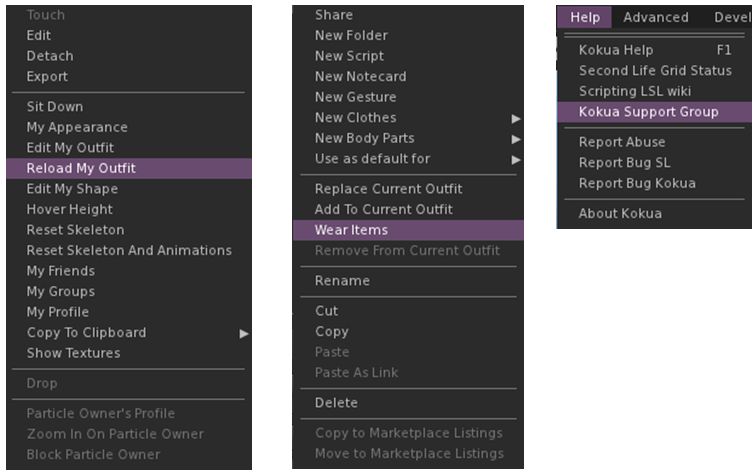






 Inara Pey: Living in a Modemworld