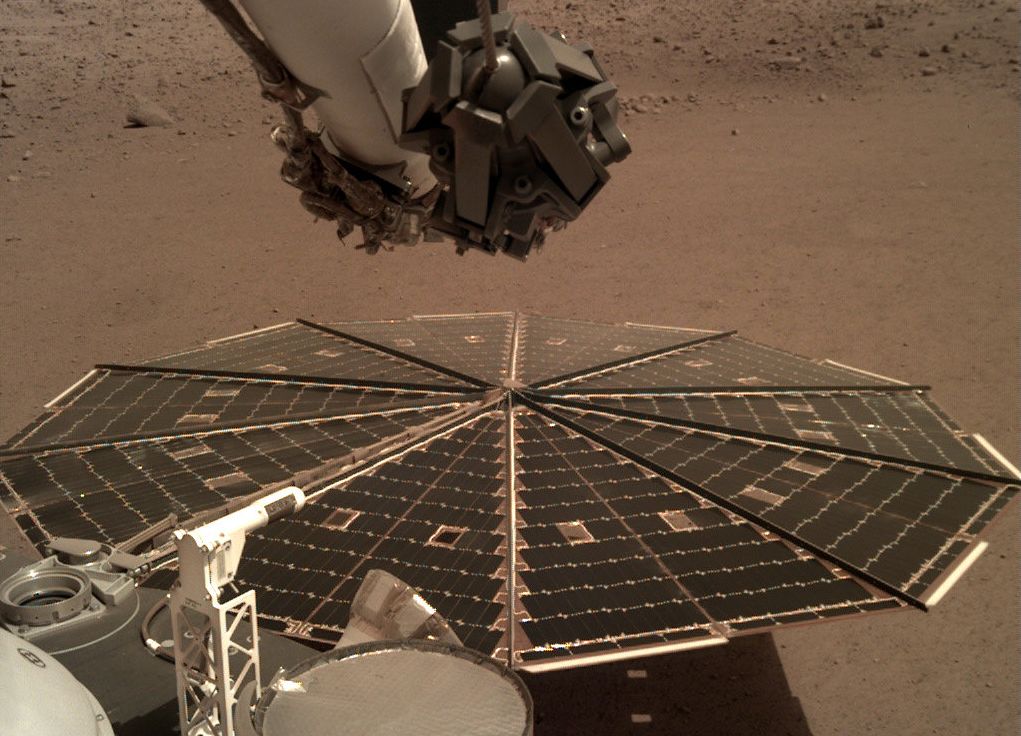
It’s always a remarkable time when a new mission arrives on or around another planet in our solar system, so forgive me if I once again kick-off a Space Sunday with NASA’s Interior Exploration using Seismic Investigations, Geodesy and Heat Transport (InSight) lander, which touched down on Mars just 10 days ago.
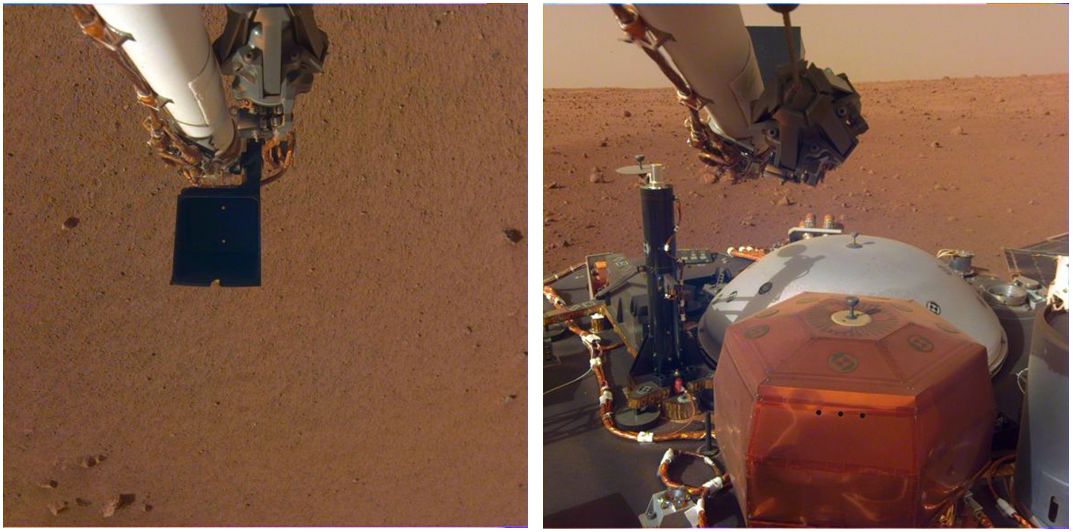
Over the course of the last several days, NASA has been putting the lander’s 1.8 metre (6 ft) long robot arm through its paces in readiness for operations to commence. The arm has multiple functions to perform, the most important of which is to place two major science experiments on the surface of Mars. The arm is also home to one of the two camera systems on the Lander.

Very similar to the Navcam systems used by both Opportunity and Curiosity, the camera is called the Instrument Deployment Camera (IDC). It is mounted above the arm’s “elbow” and has a 45-degree field of view. As well as offering a first-hand view of everything the robot arm is doing, IDC can provide colour, panoramic views of the terrain surrounding the landing site.
The arm hasn’t as yet been fully deployed, but in being put through its paces, it has allowed the IDC to obtain some tantalising views of both the lander and its surroundings.
Some powering-up of science systems has also occurred, notably Auxiliary Payload Sensor Systems (APSS) suite. The air pressure sensors immediately started recording changes in air pressure across the lander’s deck indicative of a wind passing over InSight at around 5 to 7 metres a second (10-15mph). However, the biggest surprise can from the seismometer designed to listen to the interior of Mars.
As this was tested, it started recording a low-frequency vibration in time with the wind recordings from APSS. These proved to be the wind blowing over the twin 2.2-metre circular solar panels, moving their segments slightly, causing the vibrations, which created a sound at the very edge of human hearing. NASA later issued recordings of the sounds, some of which were adjusted in frequency to allow humans to more naturally “hear” the Martian wind.
The InSight lander acts like a giant ear. The solar panels on the lander’s sides respond to pressure fluctuations of the wind. It’s like InSight is cupping its ears and hearing the Mars wind beating on it.
– Tom Pike, InSight science team member, Imperial College London
Once on the surface of Mars and beneath its protective dome, the seismometer will no longer be able to hear the wind – but it will hear the sound of whatever might be happening deep within Mars. So this is likely to be the first of many remarkable results from this mission.
To Touch an Asteroid
NASA’s OSIRIS-REx (standing for Origins, Spectral Interpretation, Resource Identification, Security – Regolith Explorer), launched in September 2016, has arrived at its science destination, the near-Earth asteroid Bennu, after a journey of two billion kilometres. It will soon start a detailed survey of the asteroid that will last around year.
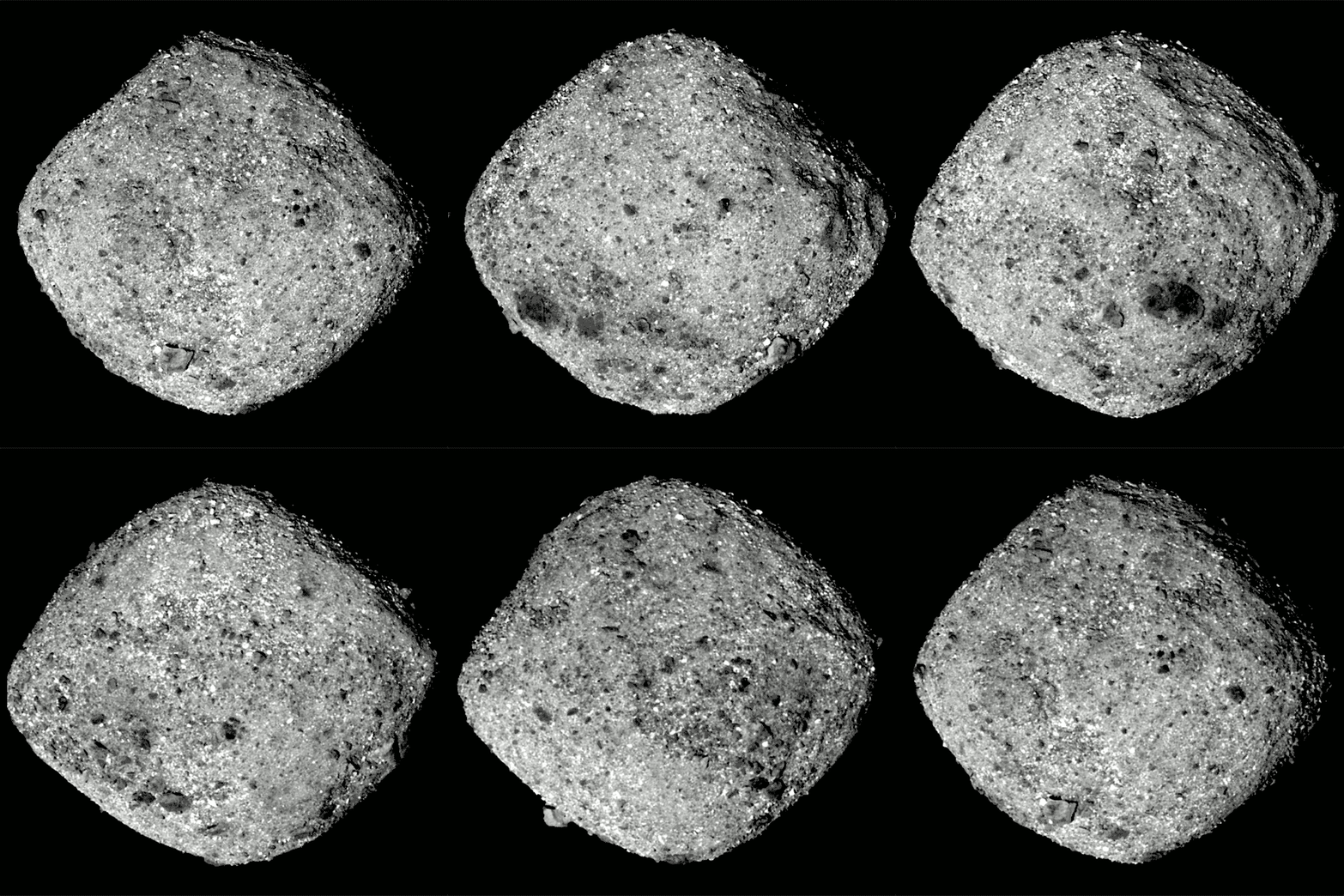
Bennu, which is approximately 492 m (1,614 ft) in diameter, is classified as a near-Earth object (NEO), meaning it occupies an orbit around the Sun that periodically crosses the orbit of Earth. Current orbital predictions suggest it might collide with Earth towards the end of the 22nd Century.
To this end, OSIRIS-REx will analyse the thermal absorption and emissions of the asteroid and how they affect its orbit. This data should help scientists to more accurately calculate where and when Bennu’s orbit will intersect Earth’s, and thus determine the likelihood of any collision. It could also be used to better predict the orbits of other near-Earth asteroids.
Bennu is primarily comprised of carbonaceous material, a key element in organic molecules necessary for life, as well as being representative of matter from before the formation of Earth. Organic molecules, such as amino acids, have previously been found in meteorite and comet samples, indicating that some ingredients necessary for life can be naturally synthesized in outer space. So, by gaining samples of Bennu for analysis, we could answer many questions on how life may have arisen in our solar system – and OSIRIS-REx will attempt to do just that.
Towards the end of the primary mission, OSIRIS-REx will be instructed to slowly close on a pre-selected location on the asteroid, allowing a “touch and go” sampling arm make contact with the surface for around 5 seconds. During that moment, a burst of nitrogen gas will be fired, hopefully dislodging dust and rock fragments, which can be caught by the sampling mechanism. Up to three such sample “hops” will be made in the hope that OSIRIS-REx will gather between 60 and 2000 grams (2–70 ounces) of material. Then, as its departure window opens in March 2021, OSIRIS-REx will attempt a 30-month voyage back to Earth to deliver the samples for study here.
Continue reading “Space Sunday: hearing Mars, looking at Bennu and roving the Moon”



 Inara Pey: Living in a Modemworld