2018 SL UG updates #24/3: TPVD meeting

Woods Club; Inara Pey, June 2018, on FlickrWoods Clubblog post

The majority of the following notes are taken from the TPV Developer meeting held on Friday, June 15th 2018. A video of the meeting is embedded below, my thanks as always to North for recording and providing it.

SL Viewer

  • The Pálinka  Maintenance RC updated to version 5.1.6.516459 on Friday, June 15th.
  • The Bakes on Mesh project viewer updated to version 5.1.6.516270 on Thursday, June 14th.

The rest of the current SL viewer pipelines remain as follows:

  • Current Release version 5.1.5.515811, dated May 31, promoted June 1 – formerly the Love Me Render Release Candidate – No Change.
  • Release channel cohorts (please see my notes on manually installing RC viewer versions if you wish to install any release candidate(s) yourself):
    • 32-bit Windows Unloop RC viewer, version 5.1.6.515965, dated June 5 – specifically for 32-bit Windows users caught in the 64-bit install loop (see here for more). Otherwise, the viewer is functionally identical to release version 5.1.5.515811.
  • Project viewers:
  • Linux Spur viewer, version 5.0.9.329906, dated November 17, 2017 and promoted to release status 29 November – offered pending a Linux version of the Alex Ivy viewer code.
  • Obsolete platform viewer, version 3.7.28.300847, May 8, 2015 – provided for users on Windows XP and OS X versions below 10.7.

[13:07-13:30] The 360 snapshot viewer has been stalled pending other work (such as support for uploading 360 images to Second life Place Pages) and for resources to work on it – but it has not been forgotten.

Upcoming Viewers

  • [4:15-4:36] Voice update: there should be a new Voice RC viewer arriving, hopefully in the next two weeks. This will contain a new SL voice updated from Vivox.
  • [5:56-6:26] Texture caching: a project viewer re-working texturing caching should be appearing soonTM. This viewer (and the work related to it) is currently on hold pending the Environment Enhancement Project (EEP). When it does appear, the Lab is confident it will make a noticeable improvement to viewer performance.

Animesh Mini-Update

Please refer to my CCUG meeting summary for more on the status of Animesh.

[0:24-2:46] The Lab is aiming to try to get Animesh deployed to a release candidate channel on Agni (the Man grid) during week #25 (week commencing Monday, June 18th, 2018). It is not 100% certain there will be a deployment but, according to Oz, if it does go ahead, it will likely be a part of the RC deployment to the BlueSteel channel. Region holders wishing to test Animesh can request their region be moved to the required RC via a support ticket.

Note that the viewer supporting Animesh will remain at project release status for the time being.

[38:28-42:40] discussion – voice and chat of the Animesh 90-degree rotation issue. Again, all see my CCUG meeting notes, linked to above.

Region Crossings

[4:42-5:50] Work on trying to improve region crossings on the simulator side of the equation is continuing. The messaging changes as a result of this work  are being ported to the SL viewer, and should appear in a future Maintenance branch of the viewer, although the messaging updates themselves are not expected to have any real effect on improving region crossings from a viewer perspective.

The simulator changes are being handled one at a time, and will be appearing in simulator RC updates over the course of the next few months.

In the meantime, and as reported in my Simulator User Group updates (see here for an example), user Joe Magarac (animats) has developed a viewer-side update to help correct some of the region crossing issues within the viewer, particularly in relation to “partial unsits”. His work is likely to be featured in the upcoming Firestorm release, and I’ll have more on that in my review of that release. It’s not clear if these changes have been contributed to the Lab (or if they would be accepted if they have).

Global Experiences

[14:58-17:45] There have been concerns that the roll-out of grid-wide experiences will mean automatic opt-in to such activities, rather than consented opt-in. This will not be the case: grid-wide will function the same as current region / parcel experiences – consent will need to be granted via a dialogue box. Only experiences developed by Linden Lab may have automatic opt-in, although none of the Lab’s experiences to date use this, and there are currently no plans to deploy any that do.

The only difference with grid-wide experiences and current experiences is that the land owner doesn’t have to explicitly allow grid-wide experiences (it will – I understand – instead be a case of land owners opting out of grid-wide experiences if they don’t want them on their land).

There has also been a request to make experience dialogues when requesting the ability to take control to be friendlier  / more informative on the grounds that people are scared of them.

[23:30-37:00] There is an extended discussion (mostly text) over unintended consequences of experiences when combined with tools such as avSitter (and / or RLV), and the potential for abuse. This includes a discussion on how to make it easier for users to discover what is acting on their avatar through the viewer UI (and the problems in trying to do so).

In Brief

  • [3:28-3:58] https move – work is progressing on moving all of the SL web services to https: – however, this work has been more of a background task of late while the web services team work on other projects. So, not time frames on when the various services still to be moved will do so.
  • [8:44-9:58] SL wiki edit rights / JIRA comments rights: because of issues with spam bots, etc., both the SL wiki and the SL JIRA has been locked from casual editing (wiki) / making comments on reports (JIRA).
    • If you have a valid need to edit SL wiki pages, submit a support ticket with a request for edit rights. All requests are reviewed and access granted on the outcome of said review.
    • If you have a valid reason to want to comment on SL JIRA reports, you should e-mail a request with your SL user name and why you are requesting access to letmein-at-lindenlab.com.
    • Note that the JIRA lock does not prevent people from raising JIRA bug reports and feature requests.
  • [22:48-23:28] The Read Off-Line Messages Capability: there have been a couple of issues in handling Friend and Group requests received while off-line. These are being addressed server-side, and it is hoped the code will be with QA in week #25 (commencing Monday, June 18th, 2018), and will hopefully be deployed shortly thereafter.


3D surrealism in Second Life

Classical and Surreal Sculpture

Quite by chance I stumbled across Classical and Surreal Sculpture, an open-air exhibition of works of surrealism taken from famous exponents of the genre and rendered as 3D models by MADD (maddomxc Umino). It’s a small place, and the setting a simple parcel field covering just 3072 square metres.

Within this space, MADD has reproduced surrealist works of art by some of the more famous exponents of the genre, including Constantin Brâncuși (1876-1957), Umberto Boccioni (1882-1916), Max Ernst (1891-1976), René Magritte (1898-1967), Walter Mac Mazzieri (1947-),  and Masaru Shichinohe (1959-), together with assorted reproductions of a number of sculptures,- most notably perhaps Prométhée (Prometheus) by Nicolas-Sébastien Adam (1705-1778).

Classical and Surreal Sculpture

Some of the more famous pieces by these artists are offered: Magritte’s The Lovers, for example, or Ernst’s L’Ange du Foyer (Angel of the Hearth) and Surrealism and Painting. Despite the small space, all of the pieces on display are set out such that the field doesn’t feel at all crowded, and a couple are presented with copies of the original 2D art on which they have been based. In the case of Surrealism and Painting, this has been done quite humorously – the sculpture is painting the image upon which it is based (rather than the piece the original is painting).

All of the pieces on display are offered for sale – a point that did admittedly leave me a little twitchy around issues of copyright, notably – but not exclusively – around the pieces based on Mazzieri and Shichicohe’s work.  However, and particularly in the case of the reproductions of the 2D art pieces, these are very well executed pieces, and while I’m not exactly a huge lover of surrealism (although I do admire Magritte’s work), this little corner of Second Life makes for an interesting visit.

Classical and Surreal Sculpture

SLurl Details

2018 SL UG updates #24/2: CCUG meeting summary w/audio

MindPillars, a Scottish themed Sim; Inara Pey, May 2018, on FlickrMindPillars, a Scottish themed Simblog post

Updated on June 15th: to include planned RC channel for Animesh deployment – see notes below. 

The following notes are taken from the Content Creation User Group (CCUG) meeting, held on  Thursday, June 14th, 2018 at 13:00 SLT.  These meetings are chaired by Vir Linden, and agenda notes, etc, are usually available on the Content Creation User Group wiki page.

Note that the audio presented here may not be in the exact order of discussion during the meeting; as subjects were at times returned to following their initial discussion, I have attempted to bring together key points of discussion by topic / subject matter. Also, please note that audio drop-out when Vir is speaking appears to be an ongoing problem at his end.

Animesh

Project Summary

The goal of this project is to provide a means of animating rigged mesh objects using the avatar skeleton, in whole or in part, to provide things like independently moveable pets / creatures, and animated scenery features via scripted animation. It involves both viewer and server-side changes.

Resources

Current Status

It now appears that Animesh could be arriving on the server-side release channels on the main (SLS) grid as early as week #25 (week commencing Monday, June 18th, 2018). There are caveats to this: the status of issues with the viewer being one of them – there are certain issues the Lab is focused on, which they would ideally like to have some fix / workaround in place for prior to deploying the Animesh simulator code to Agni.

Update: At the TPVD meeting on Friday, June 15th, Oz Linden indicated that if the Animesh simulator code is deployed to an RC in week #25, it will most likely go to BlueSteel.

Current Viewer Issues

Encroachment / Position / Offsets: this is to ensure that the visual position of an Animesh object is not too far offset from its position as calculated by the simulator (e.g. using things like animation offsets to alter the visual position of all or part of an object). The fix for this is to force the bounding boxes for all joints and the meshes attached to them to remain within a specified distance – most likely 3 metres, although this is still TBC – from the location where the simulator has calculated the object should be.

This update should be in the next update to the Animesh project viewer, and will also utilise new infrastructure on the back-end to allow smarter tracking of the bounding boxes for rigged meshes. This be being done by tracking bounding boxes on a per joint basis, and then transforming them. While it can take a “noticeable” mount of time to do this, Vir’s belief is that it doesn’t unduly impact performance, although if it does become an issue, it may be re-thought.

Concerns were expressed that this would limit the scaling of Animesh creations. Vir states this shouldn’t be the case – the restriction is not ties to scale, but to position. So, for example, a dragon could still be 60 metres in length / height,  but the encroachment fix would mean where it appears in people’s viewers cannot be offset more than 10 metres from where the simulator calculates its actual position to be as a static mesh.

Z-Offset Height Setting: until now the z-offset height setting that can be specified when uploading a mesh to Second Life has been ignored when using meshes with it set to Animesh objects (the offset only works when the mesh is attached to and avatar).

It is hoped an update to fix this will be in the next project viewer update, which should appear before the server-side Animesh code arrives on an Agni RC channel.

Rigged Mesh Level of Detail / Bounding Box Issues: (BUG-214736) – Essentially, attachments on avatars swap their LOD models as if they were scaled to the overall avatar bounding box.

This is a long-standing issue which Graham and Vir Linden are working on, but a fix is unlikely to be available prior to Animesh arriving on Agni.

Broken Rotations Issues:

  • In one (BUG-139251), when some static mesh objects are converted to Animesh, the visual mesh is rotated through 90 degrees when seen in the Animesh viewer, but the physics mesh isn’t, leaving it perpendicular to the model. This is possibly an orientation issue, with the viewer expecting the mesh to be aligned to +x=forward – which not all mesh modelling tools follow.
  • The second problem is that when linking a series of objects into a single Animesh, then are visually located where the avatar skeleton supporting them is located, but the physics shapes remain in the original location of the objects prior to linking / converting.

The recommendation here (for the time being) is that Animesh objects should have a non-mesh root object, and associate any physics representation to that non-mesh root object.  This should hopefully eliminate the current issues and help ensure that any mesh being propelled via scripts in the root object will move in a predictable manner (.i.e. moves forward when driven forward by a script).

Other Issues

Additional bugs: the above are not the only bugs being looked at, but they are the ones causing the most concern due to the risk of behavioural issues / changes they might cause, together with perceived content breakage, when Animesh starts being deployed to the Main grid. Other issues, which are not seen as having so direct an impact will continue to be looked at ad hopefully resolved as Animesh is tested on the Main grid, together with any other issues which may come to light.

GLOD: there is concern that the global LOD values set by the mesh uploader when creators don’t specify their own custom LODs incorrectly encourages poor optimisation, by rewarding those so decrease the calculated LOD values with lower LI post-upload. The feeling is that the reverse should be true. It’s anticipated that Project ARCTan should help to address this.

Bakes On Mesh

Project Summary

Extending the current avatar baking service to allow wearable textures (skins, tattoos, clothing) to be applied directly to mesh bodies as well as system avatars. This involves server-side changes, including updating the baking service to support 1024×1024 textures, and may in time lead to a reduction in the complexity of mesh avatar bodies and heads.

This work does not include normal or specular map support, as these are not part of the existing baking service.

Resources

Current Status

A new Bakes on Mesh project viewer arrived on Thursday, June 14th. Version 5.1.6.516270 includes the new “universal” wearable types corresponding to the 5 new bake channels. These are:

  • LEFT_ARM_TATTOO – bakes to the mesh left arm.
  • LEFT_LEG_TATTOO – bakes to the mesh left leg.
  • AUX1_TATTOO – creator definable layer / channel.
  • AUX2_TATTOO – creator definable layer / channel.
  • AUX3_TATTOO – – creator definable layer / channel.

Note that none of these additional wearables can be applied to the system avatar mesh; which continues to use the original six bake channels.

It’s also not clear if alpha layers can mask these new channels at present. If not, that Vir agrees it is something that should be looked at.

Other points of note:

  • There are no plans to extend Bake on Mesh to allow the use of wearable on non-wearable objects. This is because Bakes on Mesh uses the avatar bake service, which is not geared to apply wearables to in-world objects sans an avatar shape.
  • There is no time frame for Bakes on Mesh deployment at the moment; the project is still in the process of being developed, tested and refined with the help of content creators.
  • There is no updated on any form of scripted control for Bakes on Mesh. It hasn’t been ruled out, but no work is currently being done for scripted support.

In Brief

  • Mesh uploader cost formula / calculations: there have been requests to offer a clearer explanation of mesh cost calculations through something like a clarified wiki page. In terms of Animesh, providing guidelines on potential cost is difficult, as the actual conversion of a mesh to an Animesh takes place post upload.
    • One suggestion to help estimate Animesh costs is to add an Animesh model type to the drop-down list of object types in the mesh uploader.
  • Bento .BVH animation issue: the .BVH format allows for custom joint names for animations in addition to the default joint names. One such custom schema is to prefix joint name with “avatar_”. However, it has recently come to light that while the use of “avatar_” on pre-Bento joints works, trying to upload animations using any of the Bento bones prefixed with “avatar_” results in either an error message on upload (the SL viewer) or the animations uploading, but then being ignored on playback (tested with Firestorm). A JIRA bug report has been requested for this.

A visit to a mystical kingdom in Second Life

Eri-Ador; Inara Pey, June 2018, on FlickrEri-Ador – click any image for full size

In Middle Earth, Eriador lies between the Blue Mountains (Ered Luin – or Erid Lindon) to the west and the Misty Mountains (Ered Hithui or Hithaeglir) to the east. It is the land within which – among other places – the Grey Havens, The Shire and Rivendell (Imladris) might be found.

Within Second Life Eri-Ador lies with mountains to the west and to the east (and also, admittedly, to the north and south). While carrying certain echoes of Tolkien’s mythical realm of Middle Earth – within it you will find elven halls and tree houses, Ents and Orcs and even the Dark Tower itself, surmounted by the Eye – it is not intended to be a facsimile of the world made famous through the likes of The Hobbit, and The Lord of the Rings. Rather, it is a region that draws a degree of inspiration from Tolkien and from Second Life itself to present a place edged in mysticism and with a rich artistic vein.

Eri-Ador; Inara Pey, June 2018, on FlickrEri-Ador

The work of Tom Mcgregor (mastersinn) and his SL partner Misty Mcgregor (MistieDream),  Eri-Ador is difficult to really quantify; it is a place which has to be experienced, rather than described. There is so much to see and appreciate.

In the broadest terms, the region is split into two – the west side largely sitting on shallow water, the east a rugged, snow-dusted stretch of land. A visit beings on the western edge of the region, within a gazebo of distinctly elven design. From here, and lying under the guarding branches of arched trees, a grassy avenue sits on the water, pointing the way east to the rise of dry land.

Eri-Ador; Inara Pey, June 2018, on FlickrEri-Ador

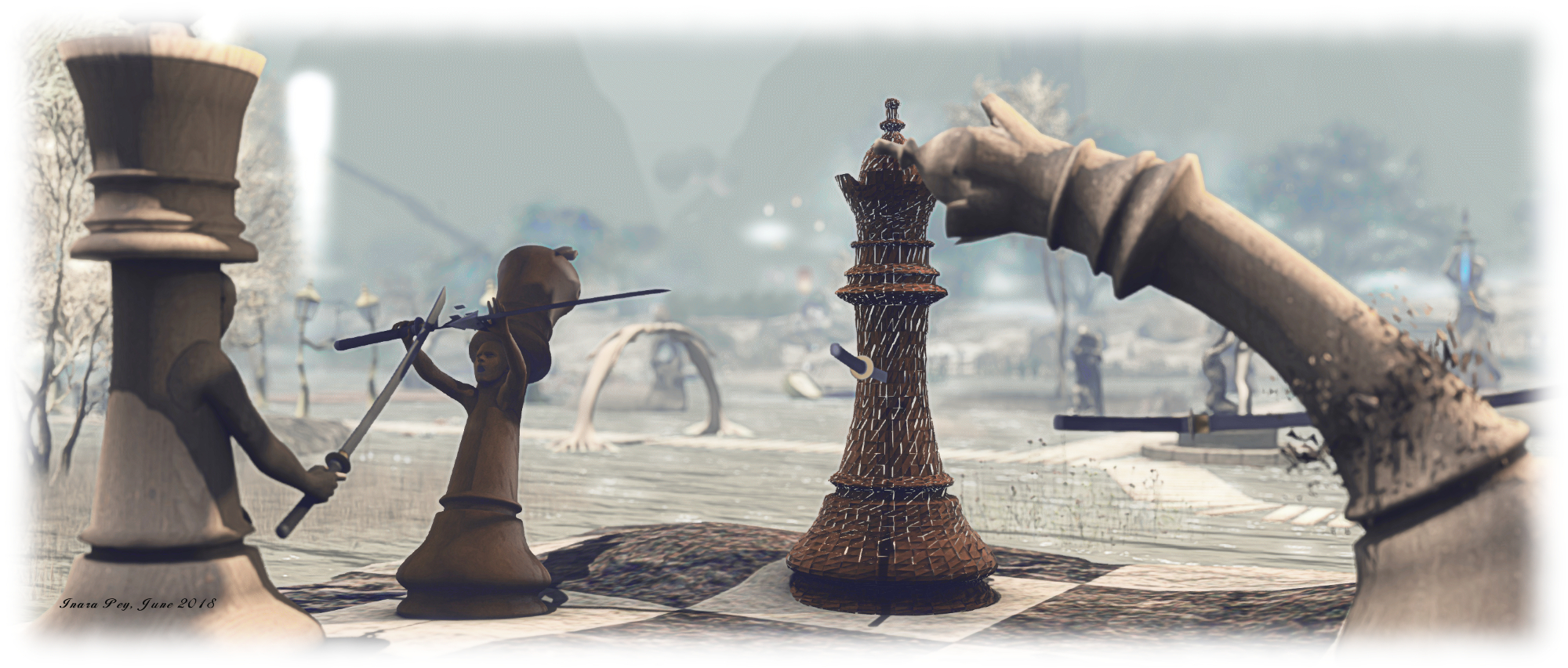
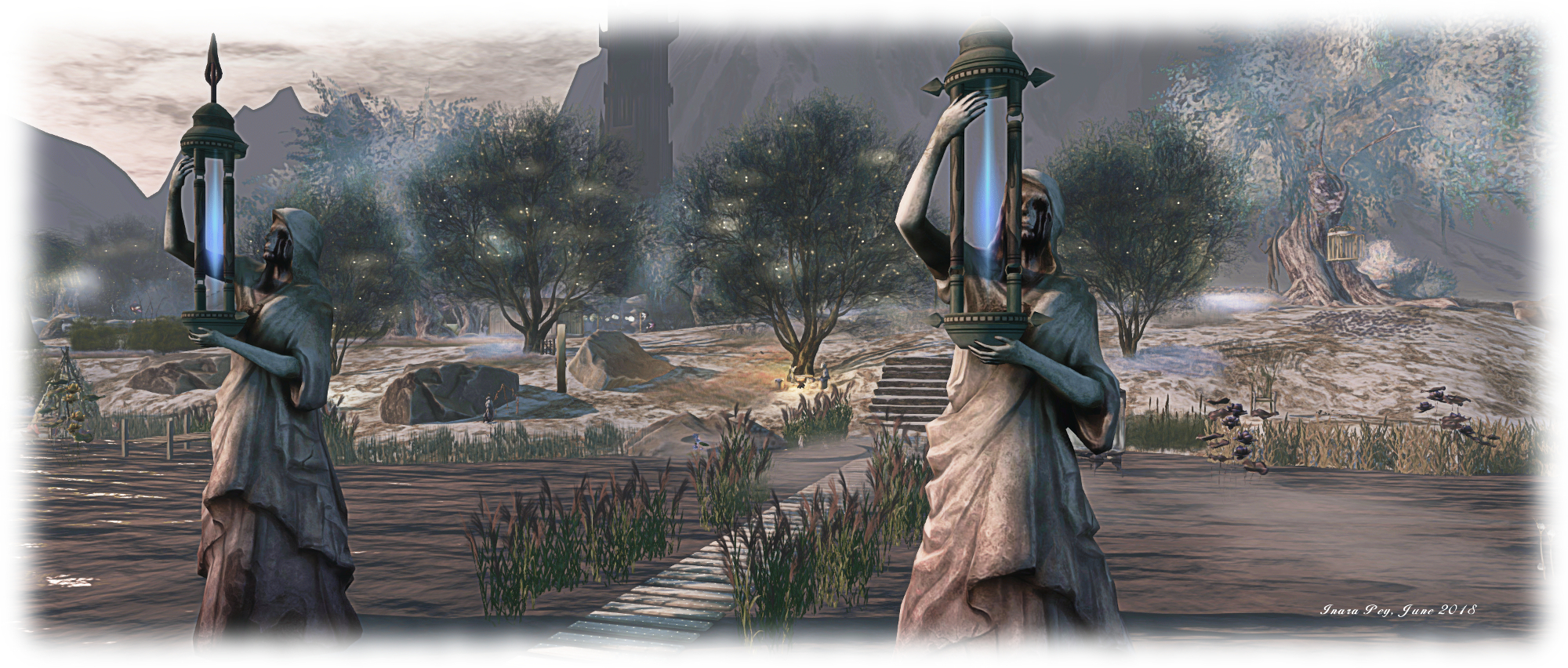
To the right and left of this avenue, the waters offer the setting for a garden of sculptures from the likes of Mistero Hifeng, Sharni Lubomir (Sharni Azalee), Groll (Groll Greggan), Kadaj Yoshikawa, Shepherd (BF2 Shepherd), Paco Pooley and CioTToLiNa Xue to name just some. These are displayed either side of the east-pointing avenue, those to the south caught beneath a torrential downpour, about which a line of street lamps guarding a south-pointing board walk can do little: the umbrellas that hold aloft little more than handles and spines…

Travel south through the rains and you’ll eventually come to the elven hall. Imladris it may not be, but it sits, Rivendell like within the shadows of mountains, echoing the Last Homely House and carrying inside it, its own sense of mystery and magic – or perhaps modern elven science …

Eri-Ador; Inara Pey, June 2018, on FlickrEri-Ador

The board walk also branches to the east before reaching the elven hall and, like the grass path under the arched trees pointing eastwards from the landing point, eventually makes landfall. Here, sitting atop a low snow-covered shoulder of rock sits Barad-dûr, a dark finger of a tower, its nail the burning all-seeing eye. Before the tower floats a gaunt wraith, hands cupping fireballs – one of the Nine, perhaps?

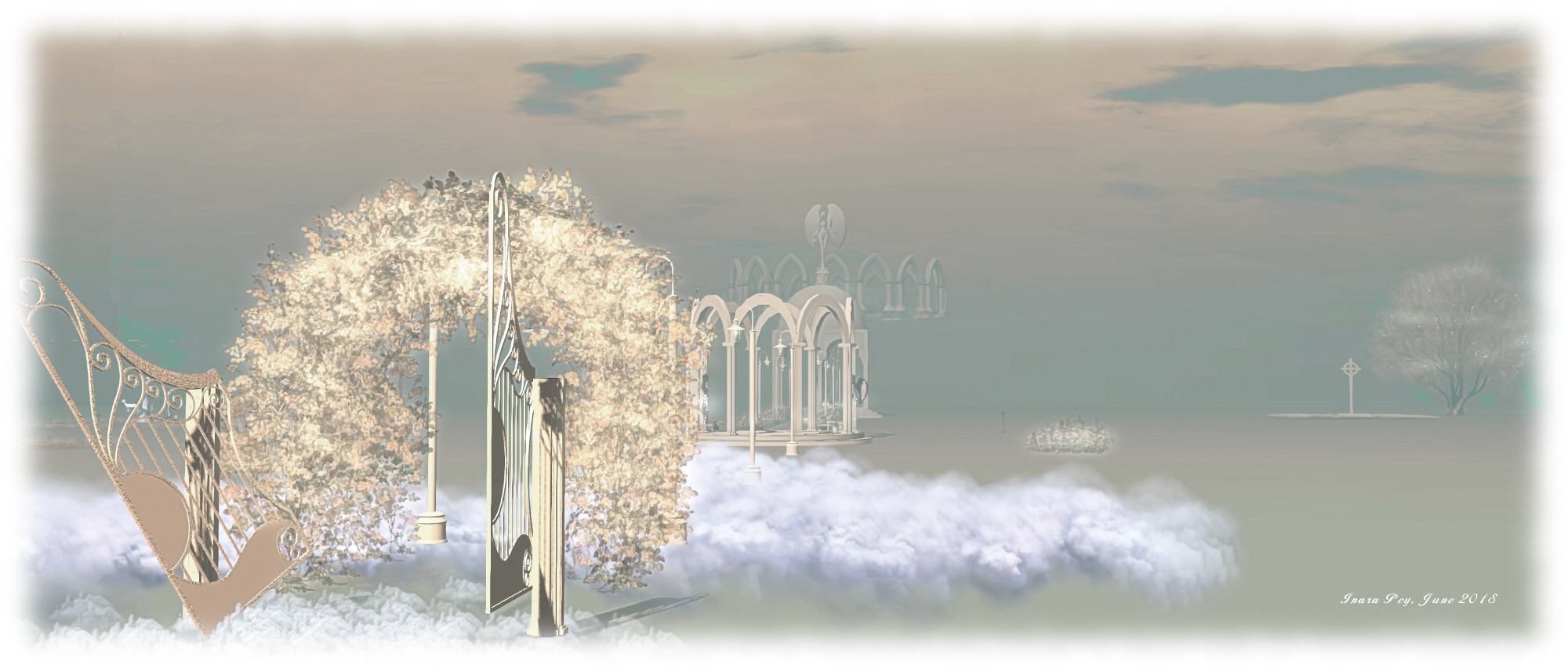
Like the watery half of the region, there is much to discover on the rocky landscape either side of the Dark Tower, making careful exploration a must. There is, for example, a harpsichord and harp to be found with a small music stage close by; while elsewhere a balloon-suspended bridge connects a pointed escarpment to a platform floating upon clouds, while a stone stairway climbs even higher into the heavens, its passage marked by more of Mistro’s figures.

Eri-Ador; Inara Pey, June 2018, on FlickrEri-Ador – “Heaven”

All this still only touches on the richness to be found within Eri Ador – from the aforementioned Ents in their confrontation with an Orc through touches of whimsy with bearded dwarves. For those wishing to sit and admire the art and the setting, their are numerous places to sit – and even to participate in the music of the setting. And al of that is without mentioning the two further points of exploration: Heaven and riding area.

The latter are both located overhead, and reached via the teleport disc at the landing point. The riding area in particular offers a very different environment than found at ground level, giving visitors a touch of the Old Western frontier.  This is also not without its sense of sitting outside of time: it’s not every day you travel through a frontier town with saloon, stagecoach and gun slinger to arrive at a farm with a pick-up truck and tractor … I will confess, neither Caitlyn or I were entirely clear on the “riding” aspect of this level; neither of us were successful in finding any kind of horse rezzer – which didn’t stop us from exploring!

Eri-Ador; Inara Pey, June 2018, on FlickrEri-Ador – “Riding Area”

All-in-all, Eri-Ador is a fascinating and unique region; very different from those of recent visits, and definitely a place to visit and explore. I would note that the use of mesh rain and similar effects can have an impact on viewer performance, so some tweaking of viewer preferences might be in order – but this shouldn’t be used as a reason not to make a visit.

SLurl Details

  • Eri Ador (Mystical Kingdom, rated: Moderate)

With thanks to Shakespeare for the LM ♥ .

A pause for a personal ad: landscaping and design

Our home: Isla Pey – click any circle to view image / enter slide show

One of the things I’ve always enjoyed doing in Second Life is landscaping. I’ve done so on both a parcel basis with the properties I’ve had and still have in Second Life and with for parcels held by friends. I’ve also designed assorted regions – most notably, Holly Kai Park, which is still open to public visits.

As a result of this, I’ve built up a good library of landscaping sets from various designers, and gained a good familiarity with designers work as well – so I’m pretty well placed to provide advice on what to buy, what to mix’n’match (so you have full control of the finished design).

Holly Kai Park – click any circle to view image / enter slide show

So, this being the case, I’ve decided to test the waters and offer my abilities to those who would like to have the regions or – most particularly, their home parcels – landscaped.

I don’t intend to make this a full-time thing, and may not be able to fulfil all requests, however, if you are interested, feel free to contact me in-world via note card (please, no requests via the comments section!) and we can discuss ideas and terms.

In the meantime, the embedded slide shows will, I hope, demonstrate some of my work. Simply click on any of the images in the circles to see a full version, and scroll through each set.

“Impression”, LEA 6, 2016 – click any circle to view image / enter slide show

And as the saying goes, “we now return you to our regular broadcasts” – or in this case, articles 🙂 .

2018 SL UG updates #24/1: Simulator User Group meeting

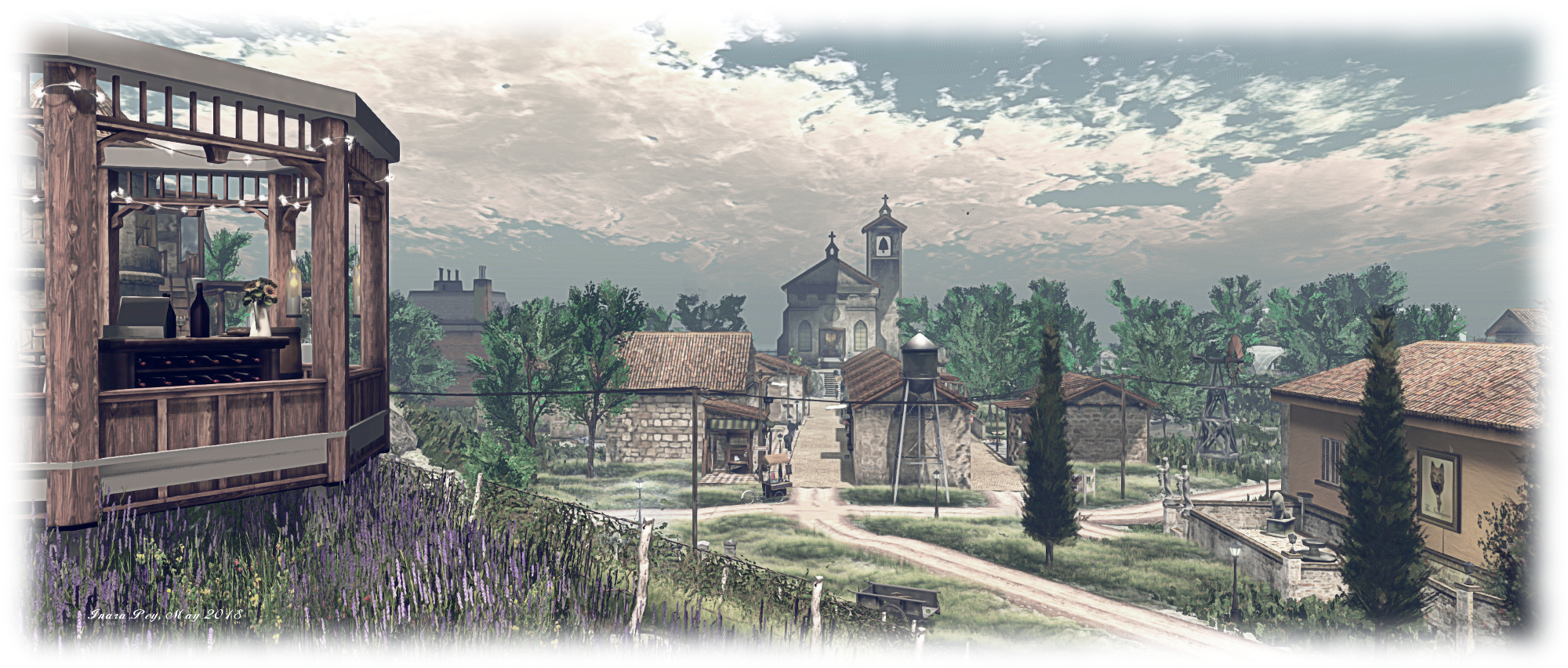
Italian Village of Ciampi, Italy; Inara Pey, May 2018, on FlickrItalian Village of Ciampi, Italyblog post

Server Deployments

As always, please refer to the server deployment thread for the latest information.

  • There was no deployment to the Main (SLS) channel on Tuesday, June 12th 2018, leaving the channel running server maintenance package 18#18.05.25.515749, containing internal fixes and server-side support for the upcoming new Estate Management ban list management changes.
  • On Wednesday, June 13th, the three main RC channels – LeTigre, BlueSteel and Magnum – should be updated with a new server maintenance package, 18#18.05.30.516064, comprising:
    • Additional work to support localised Abuse Report categories.
    • Improvements to object updates as part of ongoing performance improvements.
    • Removal of the logging of a trivial message.
    • Internal fixes.
    • Note that the majority of this updated is the same as 18#18.05.30.515812, initially deployed on Wednesday, June 6th, and subsequently rolled-back.

The reason for the RC channel roll-backs was described by Simon Linden at the Simulator User Group meeting on Tuesday, June 12th:

We had some excitement last week as we rolled a new version out to the RC channels, discovered a crasher bug we didn’t catch in testing, and had to revert back to the main version. That was fixed real quick and we’ll get the updated server again tomorrow … It was basically “go to a region with a crowd”; I’m not sure of the exact frequency, but the new code was in sending attachment updates … it probably happened one in a million times. Put that on a few thousand regions and it becomes noticeable.

SL Viewer

The Pálinka Maintenance RC updated to version 5.1.6.516121 on Tuesday, June 12th, 2018.

At the time of writing, the remainder of the SL viewer pipelines are as follows:

  • Current Release version 5.1.5.515811, dated May 31, promoted June 1 – formerly the Love Me Render Release Candidate.
  • Release channel cohorts:
    • 2-bit Windows Unloop RC viewer, version 5.1.6.515965, dated June 5 – specifically for 32-bit Windows users caught in the 64-bit install loop (see here for more). Otherwise, the viewer is functionally identical to release version 5.1.5.515811.
  • Project viewers:
  • Linux Spur viewer, version 5.0.9.329906, dated November 17, 2017 and promoted to release status 29 November – offered pending a Linux version of the Alex Ivy viewer code.
  • Obsolete platform viewer, version 3.7.28.300847, May 8, 2015 – provided for users on Windows XP and OS X versions below 10.7.

Other Items

Client-Side Scripting Discussion

During the Simulator User Group meeting, the discussion turned towards client-side scripting support. This is something the Lab looked at several years ago, with Babbage Linden working on a possible C# implementation. Tis could enable things like scriptable UI elements, eliminating the need for HUDs, etc.

There are practical benefit to such an approach – be it with C# or something like Python; but there are also risk with the potential for exploiting the capability, as Simon Linden pointed out:

There’s also a really ugly trust issue with viewer-side code … do you trust someone so you’ll install their code, with the potential they might look into your inventory and such … we could probably sandbox an interpreter, but yes that kind of thing would have to be locked down, or it is definitely scary if it can read/write files … also preventing a viewer interpreter from loading outside modules … which of course are very useful, but can do scary things.

Also during the meeting, Oz Linden didn’t rule out the possibility of looking at the project again at some point in the future. However, it is important to note that currently, there is nothing on the SL roadmap with regards to this kind of work – or anything like it – at this point in time.