The majority of the following notes come from the Simulator User Group meeting of Tuesday, June 19th, 2018.
Sever Deployments
As always, please refer to the server deployment thread for the latest information.
On Tuesday, June 26th, the Main (SLS) channel was updated with server maintenance package 18#18.06.14.516450, previously deployed to the LeTigre and Magnum RC channels, comprising internal fixes and logging improvements.
On Wednesday, June 27th, the release candidate channels should be updated with server maintenance package 18#18.06.22.516968, which includes Animesh on a first-time deployment for LeTigre and Magnum (having been deployed to BlueSteel in week #25), and “new Main Channel code”.
Some SLS channel regions reported double restarts on Tuesday, June 26th, and these are being investigated by the Lab.
Animesh Deployment
Follow the Wednesday, June 27th, Animesh will be live on all the major RC channels – however, as previously noted in this updates, it is still in development, and not product-ready.
The Animesh project viewer, necessary for working with Animesh and rendering it correctly, can be obtained from the Alternate Viewers wiki page.
Animesh Resources
You can find further information on Animesh via the following resources.
Linux Spur viewer, version 5.0.9.329906, dated November 17, 2017 and promoted to release status 29 November – offered pending a Linux version of the Alex Ivy viewer code.
Obsolete platform viewer, version 3.7.28.300847, May 8, 2015 – provided for users on Windows XP and OS X versions below 10.7.
Environment Enhancement Project (EEP)
The is still some confusion as to how EEP will work with different region / parcel windlight settings at altitude when compared to Firestorm’s parcel windlight capability. In short:
Firestorm allows the windlight within a parcel to be changed at any altitude using a command line construct in the About Land description floater.
However, this is purely a viewer-side change.
Anyone entering a region using a viewer that does not have the same windlight support will not automatically have the setting defined in About Land applied to their viewer.
EEP should ensure that windlight settings set by altitude will apply to everyone in a parcel, regardless of the viewer they are using.
However, windlight changes by altitude are limited to four heights: from ground level up wards; 1,000m and above; 2,000m and above; 3,000 and above.
Top Scripts and Region / Parcel Management
Some people are experiencing region performance issues – notably around scripts, etc. It’s been suggested that making Top Scripts and Colliders visible to parcel holders within a region so they can see what in their parcel might be impacting performance has been suggested.
This isn’t a fresh request (see JIRA SVC-835), but it is one that hasn’t been discussed recently.
The concern was raised that allowing Top Scripts to be more widely visible could lead to harassment between parcel holders in a region.
There is also some concern that over-use of the capability could itself impact region performance, because Top Scripts is an intensive query to run.
Even so, it is something being take back to the Lab for further discussion, and is seen as “reasonable”, providing the ability to start / stop scripts isn’t included (griefing vector).
The main festivities for the SL15B anniversary celebration are now over; the parties have all happened, the DJ and live performers have left the stages – but the regions remain open to visitors through until July 1st, 2018.
This being the case, and with the numbers packing some of the regions likely to decrease, now is an excellent opportunity to visit some of the resident built exhibits within the anniversary regions, so I thought I’d offer a short series of looks over the next few days at some of the ones that caught my eye.
Celebrating SL’s 15th and Bay City’s 10th
2018 is not only the year in which to celebrate Second Life’s 15th anniversary but also the 10th anniversary of one of the Mainland’s most established and vibrant communities: Bay City.
SL15B: Bay City – see some of the attractions within Bay City – and then pay them a visit!
Developed by Linden Lab and opened for residents in early 2008, Bay City offers an urban-style environment on the continent of Sansara. It is intended to reflect “the American urban experience, between 1940 and 1965, perhaps best typified by Chicago circa 1950 and marked by a distinct deco influence.” Today it is home to the The Bay City Alliance, a resident community founded by those moving into Bay City in 2008, and who promote the Bay City regions, and hold regular events there as well as helping newcomers (to both Second Life and to Bay City) who come to the regions.
Over the years, Bay City has become home to a number of famous landmarks – the Hotel Falmouth, the Channel Island Mental Hospital, Hairy Hippo Fun Land, Bay City Municipal Airport and the Bay City Fairgrounds,to name but a handful within the 40 or so regions of Bay City.
Visitors to the Bay City exhibition at SL15B can discover more about some of these landmarks in Bay City, as well as something of its history. Designed with an eye to detail and presented in the style of a tourist information centre, the exhibit is another fine example of the architecture to be found within Bay City as well as being (for me) exemplifying what makes an engaging SL15B build: it is not pretentious or overstated, it avoids the temptation to try to dwarf surrounding spaces, it avoids lots of glow and / or unsightly textures plastered all around it and it is informative, rather than looking like an advertising hoarding. You might argue that such a build risks being overlooked – I’d disagree, being personally drawn to the more understated and interesting designs.
SL15B: Bay City – if you’ve ever wondered what the main grid would like like if presented as a globe – make sure you drop in here!
Corn and Bears
The Cornfield is a place of myth and legend; a place where misbehaving avatars were once sent, back in the early days of Second Life. Sitting under a starry sky, it was inspired by the 1961 episode of The Twilight Zone entitled It’s A Good Life. Avatars deposited in the cornfield were cut off from communication with the rest of the grid, and had only one another and several televisions and tractors for company.
The original Cornfield still exists – to the north and west of Shermerville, but access is restricted. However, there are various duplicates which can appear in-world and are open to the public.
One such duplicate has been used in an experience led game. Another Another is located at the southern end of the SL15B regions. the latter Cornfield offers people a chance to experience (albeit with modern conveniences such as windlight and media on a prim) the life of a citizen confined to the sin bin. It’s also a region where the Lab’s more recent experience-based game, Tyrah and the Curse of the Magical Glytches can be played, for those who have a game HUD.
Alongside the Cornfield, and making a popular return to Second Life, is Bear Island.
It was Nicole Linden who started the Linden Bear tradition – having Lab staffers make an in-world bear which residents can request (or sometimes obtain by completing a challenge or receive as a gift). It’s a tradition that continues through to today. The Lab still runs courses for staff on bear making, and many of the available bears are based on Nicole’s original – although some Lindens don’t necessarily make a bear, preferring to have other animals such as a frog or something. Not all of the Linden Bears represent individual Linden staffers – there have been bears to celebrate Easter, Valentine’s Day, Halloween Bear, and so on – some of which may still pop-up in-world at the appropriate time.
SL15B: Bear Island – How many Linden Bears have you collected over the years?
Bear Island is a celebration of this tradition, offering visitors to see many of the bears made by Lindens past and present – and also recapture snippets of SL history (such as the arrival of Viewer 2.0). I confess that I’m not that much of a bear collector, but Bear Island is an interesting place to visit to experience one of the more eclectic aspects of Second Life culture and history.
The Parker Solar Probe
While we’ve not formally met, Diamond Merchant and I share an interest in space exploration and space science. She has in the past presented SLB events with models of famous space probes (such as Cassini, the probe from the mission of the same name which spent 13 of its nineteen-year mission exploring Saturn and its moons).
For SL15B, and on behalf of the Leeward Cruising Club, she presents the Parker Solar Probe mission, and overview of the upcoming NASA mission to the Sun scheduled for launch at the end of July / start of August 2018. Named for physicist Eugene Parker, the mission is billed as the first to “touch” the Sun, as it will come to within 8.86 solar radii (6.2 million km or 3.85 million mi) of the Sun’s photosphere (or “surface”).
I’ll be covering the mission in a Space Sunday report in July and ahead of the launch. For SL15B, Diamond presents another of her beautifully detailed prim models, positioned over the disc of the Sun, with boards around the outside of the exhibition space providing details on the mission, etc. Those wishing to experience the view from the probe and sit n one of several blue spheres placed at ground level around the exhibit. Make sure you have the audio stream on as well to help you drift away in space.
It’s another build that eschews fancy glow, towers and other assorted brashness and instead presents a path winding through a corner of story land, which visitors are invited to follow. Along the way are information boards containing assorted information – including one or two surprising tidbits of information (how about SL being the home of over 300,000 hours of music and entertainment?).
Update, August 27th: Aphantasia appears to have closed. SLurls have therefore been removed.
The rolling echo of distant thunder reverberates between high peaks, a bass backdrop to the much closer dusk-time voices of nature that rise from between the tall fingers of shadowy trees clustered across the tops of a little archipelago of grassy islands. The waters from which these rise are turned brown under a sky heavy with an evening haze through which a lowering Sun tries to reach and which those thunder reflecting peaks into shadowy guardians surrounding this little grouping of islands.
Such is the aural greeting awaiting visitors to Aphantasia, a wonderfully atmospheric Homestead region designed by Benny Green. The region’s name is taken from that suggested for a condition where one does not possess a functioning mind’s eye, and so cannot voluntarily visualise imagery – the face of a loved one, a favourite place, a shop down the road, and so on.
Aphantasia
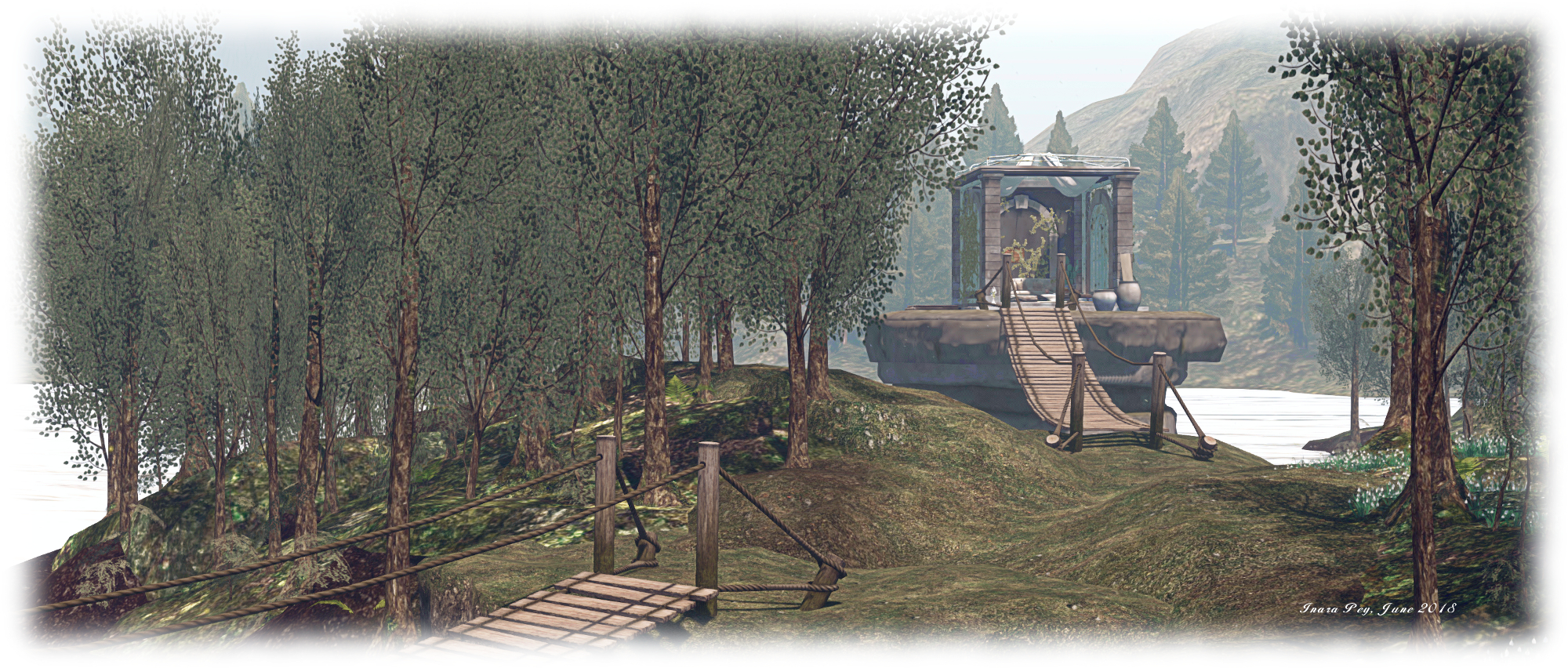
It’s an interesting choice for a place that is, in two words, visually stunning – although perhaps to be fully appreciated during an initial visit, it requires a slight tweak to you viewer’s windlight so the beauty of the region can be seen under daylight. The landing point, rich in those night-time sounds (themselves joined by the soft clucking of a chicken or two perhaps nervous at the approach of darkness), sits upon one of four islands in the region, a home for a circular cottage and a well. It is anchored to the largest of the islands by a rope bridge, one of two ways to explore the location (the other being the teleport trapdoors to be found at several locations in the region).
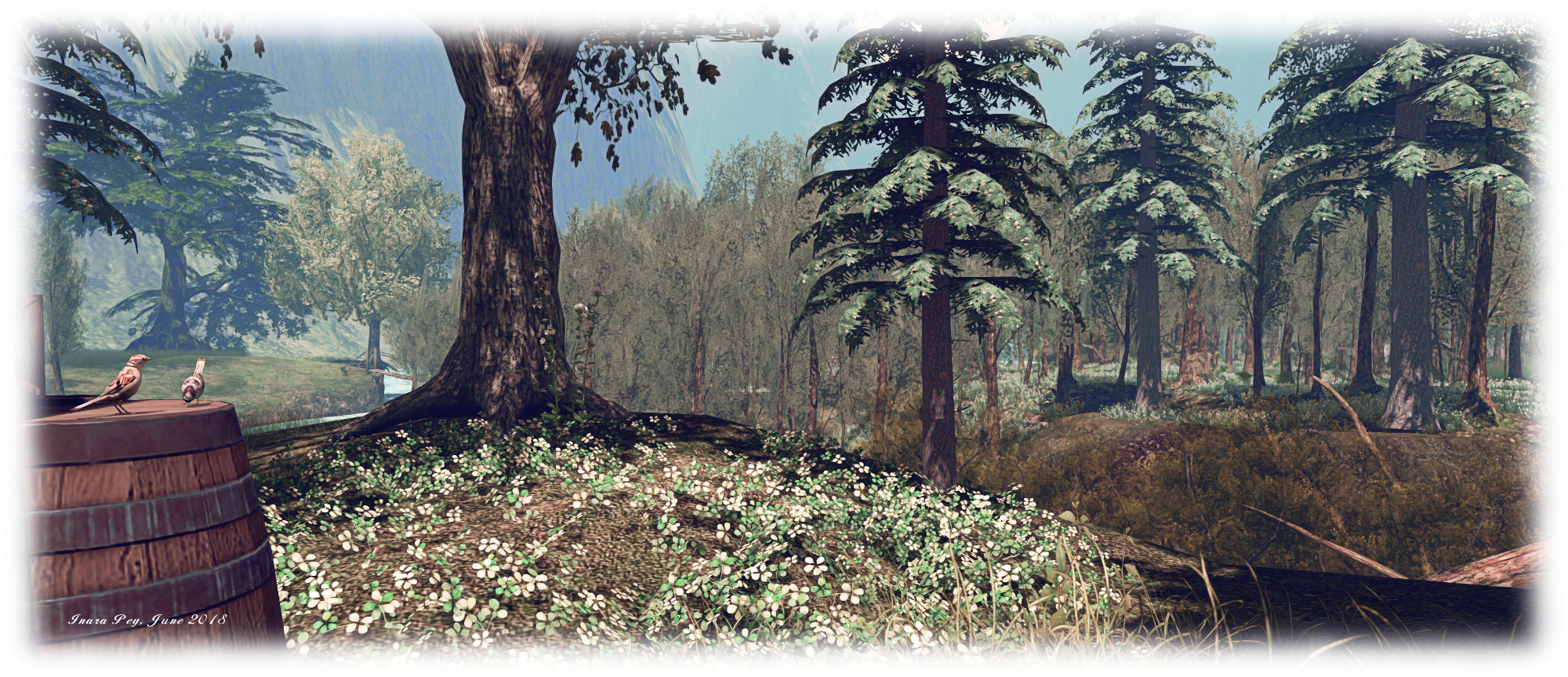
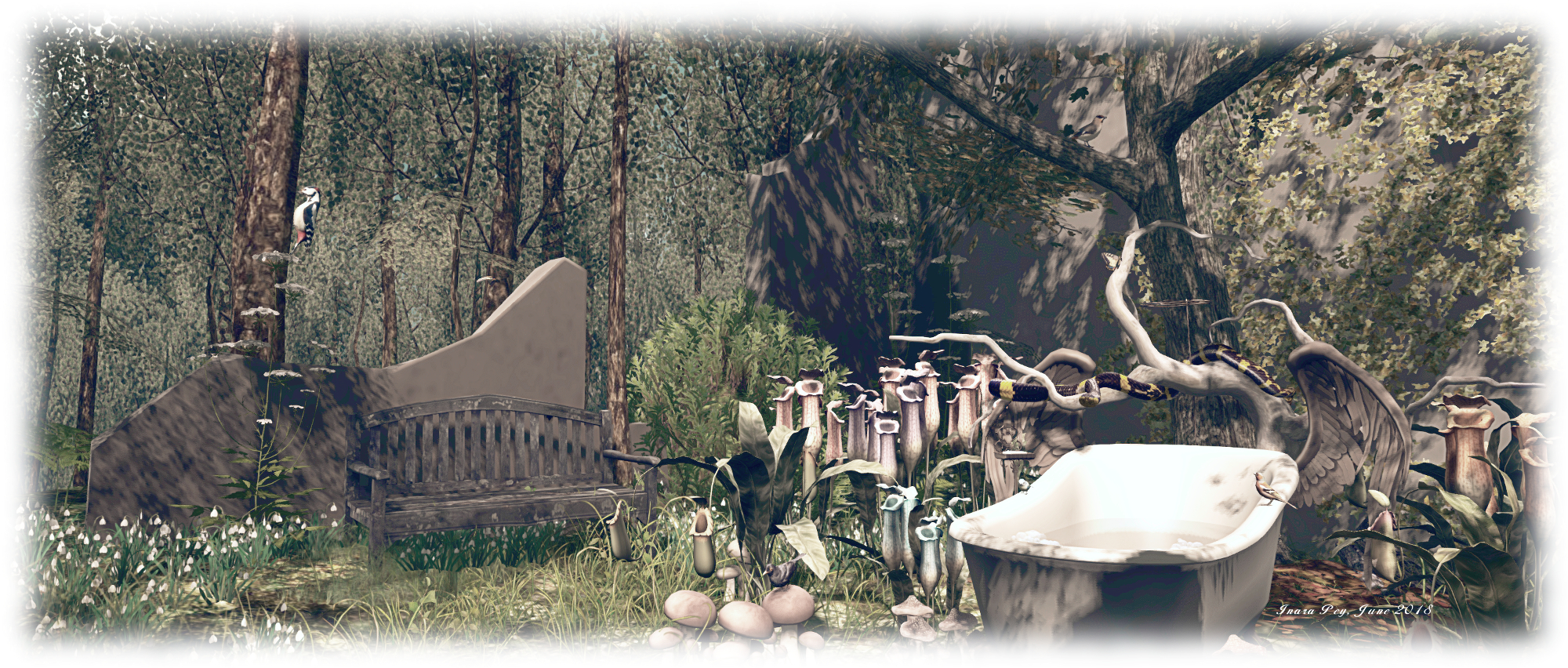
Across the bridge, the large island offers a richly wooded setting, paths winding under tall conifers and smaller trees, directing people with to two further bridges or to the ruins of an old house where a bathtub sits among tube plants, toadstools and flowers, watched over by a snake coiled lazily around an old tree branch.
Aphantasia
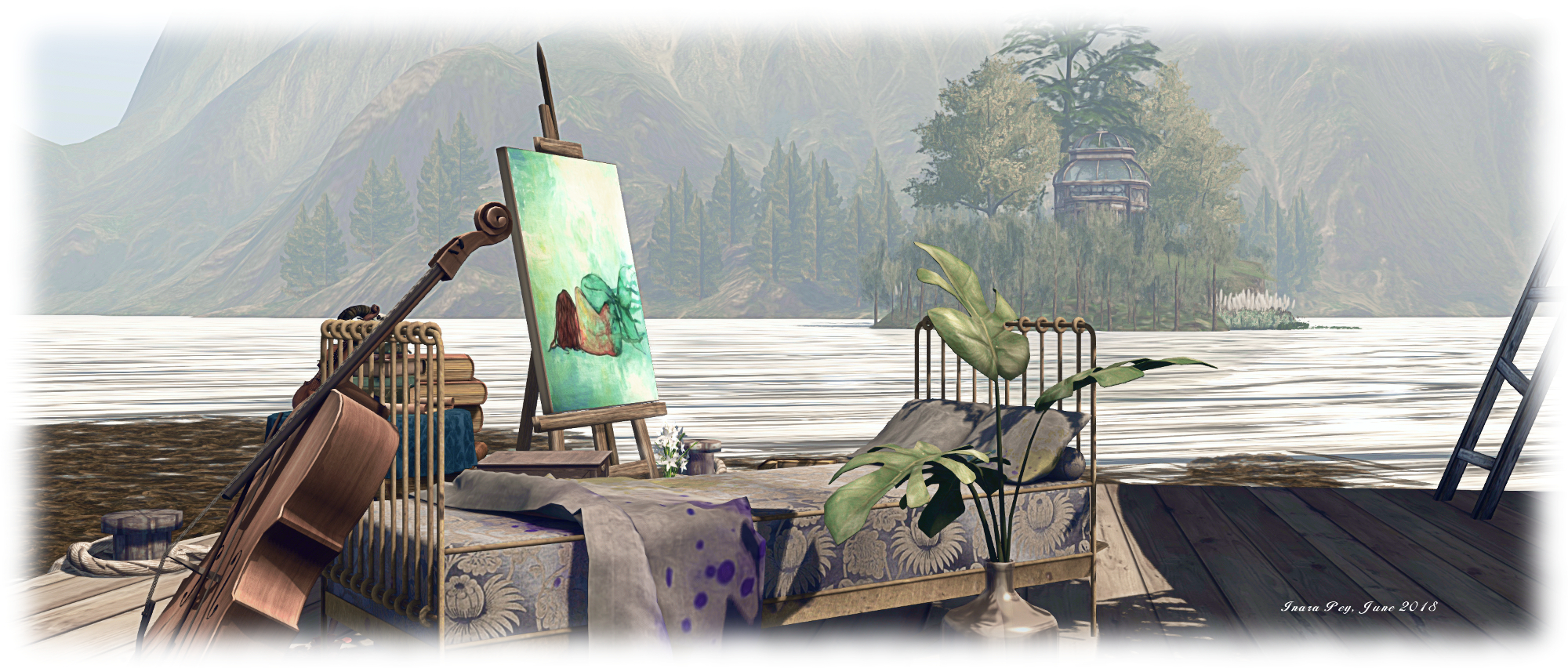
Travel through the conifer-crowned and rugged south-western finger of this island, and you can make your way to the haven of a houseboat moored in the lee of a high cliff. Here can be found signs of occupancy – possibly by an artist / musician, going by the paraphernalia on the rear deck.
Of the two bridges mentioned above, one offers the way to an island devoid of human clutter, but offering a grass pate on which to wander, watched over by the imposing bulk of a great oak tree. The second bridge provides the way to reach a round plug of rock rising from the water and just about big enough to accept the cosy stone folly sitting on its head. But this isn’t the fourth island in the group.
Aphantasia
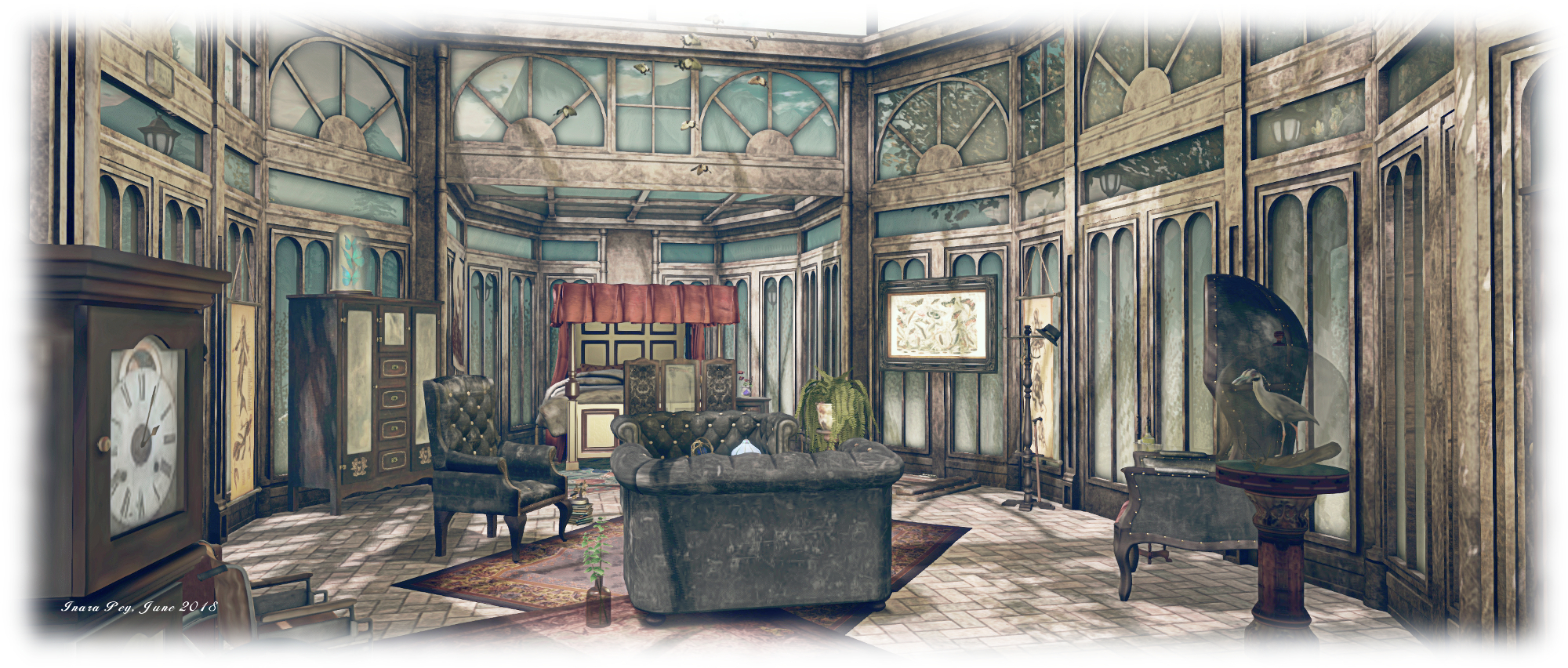
Set well aside from the others, the fourth island in the group lies to the north-west. No bridge connects it to the others, so reaching it requires the use of one of the teleport trapdoors at the landing point, the folly or the houseboat. It is home to a grand conservatory with some interesting furnishings within (mind you don’t find the wheelchair too head-turning an experience!).
Atmospheric and enchanting, Aphastasia is richly detailed, visually and aurally. There are numerous places to sit and relax or cuddle throughout the sitting. Do note the region’s description does state some mild adult activities might take place – although none were witnessed on our visits. There are also a couple of points on the largest island where some of the trees need converted to phantom as they can unexpectedly bump people sideways when encountered – although keeping to the tracks seems to avoid collisions.
Aphantasia
For those who take photos of the region, there is a Flickr group where they can be shared (and which interestingly show a hall / cavern of some description being present quite recently, although we found no sign of it on the ground, under the ground or in the air). Also, if you appreciate the region as much as we did, please consider making a donation towards its upkeep at the landing point.
SLurl Details
Aphantasia (Serena Nova Zembla, rated: Adult)
With thanks to Shakespeare and Maxie for the pointer.
The main festivities for the SL15B anniversary celebration are now over; the parties have all happened, the DJ and live performers have left the stages – but the regions remain open to visitors through until July 1st, 2018.
This being the case, and with the numbers packing some of the regions likely to decrease, now is an excellent opportunity to visit some of the resident built exhibits within the anniversary regions, so I thought I’d offer a short series of looks over the next few days at some of the ones that caught my eye, starting with some of the art exhibits.
Ciottolina Xue – Little Paradise in Second Life
Self-taught in 3D art, Ciottolina Xue is – in the interests of full disclosure – someone whose art I admire and who is a personal friend with Second Life. However, this isn’t why I’m including her in this article – I’m doing so because Little Paradise in Second Life is engaging and beautifully conceived.
Offering a sculpted garden environment, accessed through wrought iron gates, Little Paradise presents paths – some under open sky, others passing under the boughs of trees – that lead visitors around a series of rose-centric sculptures in which scenes of babies (and the occasional adult) are set.
It is, first and foremost, a very personal setting – many of the child sculptures represent Ciottolina’s Second Life persona, with some of them, together with the adult sculptures representing those with whom she has friends, and who have supported her throughout her time in Second Life.
Roses are my sensations; sensations that have taken over with time, passing by and emotions perceived by meeting new people who I esteem today. People who have become fond of me and without Second Life I never would have met. Some of them have become acquired mothers, aunts, uncles and other are precious friends. They support and encourage me in every step I take. People who are very capable in what they do.
But just as these little scenes are personal to Ciottolina, so too can they represent all of us: the roses offer us a chance to recapture memories of our times in Second Life and the scenes within them reflect our own friendships and relationships over the past however many years we’ve been active in SL. Similarly, the paths through and around the garden represent our own journey through Second Life.
Little Paradise is designed to be seen in a night setting (accept the parcel windlight on entering if you are using Firestorm or a viewer supporting parcel level windlight, otherwise try setting your viewer’s time of day to midnight); however, it also works under daylight settings as well – as I hope the images here demonstrate.
The Art of Viviena
Located alongside Little Paradise in Second Life is an enclosed art display by Viviena, marking her return to SL15B after illness prevented her being a part of SL14B – she was previously an official photographer at SL11B through SL13B.
Presented under a night-time sky, Vivena offers another garden environment, this one home to her Second Life photography, with individual easels set out along the winding path, each home to one of her images. These are all landscapes, taken from right across the main grid – just click on and image and use Edit to obtain the name of the region if it is not immediately familiar to you.
What is delightful about Viviena’s work is it shows no real sign of post-processing, but instead offers images of Second Life as we can expect to see it in-world. Each picture is perfectly composed, cropped and presented for our appreciation. This makes her work a must-see, whether exhibited in-world, or displayed on website such as the SL15B site, or through her Flickr stream.
As well a presenting their art, the gardens offered by Viviena and Ciottolina allow a perfect escape should exploring the rest of SL15B start having you feeling a little tired.
Djehuti-Anpu (Thoth Jantzen) is an artist whose work never fails to captivate me. Specialising in mixed media, Thoth’s work is always immersive, interactive and captivating. For SL15B, he presents Moments of Immertia, a multi-layered piece which includes some past work as well a new pieces.
A visit to Moments of Immertia does come with some prerequisites, and the instruction boards in the exhibit explain. In short:
Make sure you have Advanced Light Model (ALM) enabled via Preferences > Graphics – this is essential, but you do not need to have shadow rendering enabled as well.
If you can, raise you viewer’s rendering to High or Ultra (you can reduce draw distance down to about 100 metres to help compensate for the rendering load, if required).
Make sure your viewer is set to auto-play media, and disable your media filter (if your viewer has it and you use it) – you can reset both to your preference on leaving the exhibit.
Allow the parcel windlight settings, if your viewer supports them. If not, set your time to midnight.
To this I would add a small warning. if you are prone to motion sickness or are sensitive to flashing lights, note that parts of Moments of Immertia involve moving and rotating colours and moving optical surfaces which can fill the screen.
Finally, also note that due to the quirks of SL, parcel media textures may not always activate as expected. If you find yourself in what is clearly intended to be an immersive media space and media is not playing, simply toggle the parcel media (movie) button off and back on again.
Virtual environments are should be immersive, providing experiences difficult or impossible to replicate in reality. That’s the point of this exhibit – to provide a few moments of immersion in strange virtual environments – just to give you a “wtf?” moment or two. Some of the displays may even give you pause to reflect.
– Djehuti-Anpu (Thoth Jantzen)
On the ground level of this exhibit sits COVFEFE: The New World Disorder, a (rightfully, in my personal view) irreverent consideration of the mind of the 45th President of the United States, whose head resides within the wreckage of a chess board – symbolic, perhaps of the impact this POTUS has had on the world as a whole. Chess pieces are tumbling through the air, and visitors can become part of the chaos by sitting on any of them, while touching the head poking up through the woodwork will offer some pearls of, um, wisdom from Duh-Donald, which are either direct quotes or concatenations of quotes from the man himself.
I’m so smart, I’m highly educated! I know words … I know the BEST words! COVFEFE!
COVFEFE: The New World Disorder shares the ground space with two more elements: TJ’s Tetrapylon, where visitors might ask the oracle and where touching is again encouraged. Alongside of this is In Surreal Time: Evolutions of a Theme, TJ’s contribution to the First Biennale Digitale part of the Santorini International Biennale exhibition of art and architecture (which is now in its fourth edition).
Directly in front of the latter is the teleport to the remaining elements in the exhibit:
Vertigogo – a mirrored room and observation deck based on materials and projection.
OMFG! and WTF? – massively immersive multimedia environments.
K-Scope 1.0 – TJ’s first immersive media environment and introduced to the public in 2008.
These all require your viewer’s ALM and media options to be set per the notes above.
No amount of worlds can do this exhibit justice, it genuinely has to be experienced – and really shouldn’t be missed (again, remembering the above cautionary note on motion and light sensitivity).
Ginger Lorakeet – Inside Art
There can be few who are unfamiliar with Ginger Lorakeet’s images which allow avatars to become a part of an overall picture. She has presented her work at a number of past SLB events, and is once more present at SL15B with her Inside Art – and this time with a set of images that follow something of a fantasy theme.
Ginger’s images are always well presented, but the ones offered at SL15B are special. Using muted colours and tones well suited to the overall theme, they each offer an entire narrative, and these individual narratives can in places perhaps be woven into a complete story.
Whether or not you’ve seen Ginger’s work at part SLB events or elsewhere, these pieces are very definitely worth the time to visit and try.
Logos representative only and should not be seen as an endorsement / preference / recommendation
Updates for the week ending Sunday, June 24th
This summary is generally published on every Monday, and is a list of SL viewer / client releases (official and TPV) made during the previous week. When reading it, please note:
It is based on my Current Viewer Releases Page, a list of all Second Life viewers and clients that are in popular use (and of which I am aware), and which are recognised as adhering to the TPV Policy. This page includes comprehensive links to download pages, blog notes, release notes, etc., as well as links to any / all reviews of specific viewers / clients made within this blog.
By its nature, this summary presented here will always be in arrears, please refer to the Current Viewer Release Page for more up-to-date information.
Note that test viewers, preview / beta viewers / nightly builds are not recorded in these summaries.
Official LL Viewers
Current Release version 5.1.6.516459 and dated June 15th, promoted June 21st – formerly the Pálinka Maintenance Release Candidate – New
Tiangong-2, with one of the two docking ports visible. Credit: China News
China may be preparing to de-orbit its Tiangong-2 orbital laboratory, possibly to avoid a situation similar to that relating to the so-called “uncontrolled” re-entry of their Tiangong-1 facility, which re-entered the Earth’s atmosphere and broke-up / burnt-up in April 2018.
Orbital information published by the U.S. Strategic Command’s Joint Force Space Component Command, through the Joint Space Operations Centre, indicates that Tiangong-2 has moved from an altitude of around 380 by 386 km down to 292 by 297 km.
No official announcement regarding the status of the Tiangong-2 space lab has been made by the China Manned Space Engineering Office (CMSE), however, China has made no secret of its plans to establish a permanent orbital presence over the Earth in the 2020s – and that to do so, they would discontinue operations with both Tiangong-1 and Tiangong-2. and de-orbit both.
Measuring 10.4 metres in length and some 3.3 metres in maximum diameter, Tiangong-2 weighs 8.6 metric tonnes – making it the same overall size and weight as Tiangong-1, launched in 2011. The re-entry of that unit came after a series of alarmist headlines claiming it would “crash” to Earth after it was reported the Chinese only had partial control over it. Because of that tabloid farrago, some have speculated the alteration in Tiangong-2’s orbit is to allow China to retain full control over the facility, including when it re-enters the atmosphere.
Jing Haipeng (l) and Chen dong (r) aboard Tiangong-2. The only crew to visit the facility Credit: CCTV
Launched in September 2016, Tiangong-2 hosted a single crewed visit that same year, which lasted 30 days. In 2017 served as a test-bed for verifying on-orbit automated docking and refuelling capabilities – two aspects of operations vital to the Chinese ambitions of developing their large-scale space station – using the Tianzhou-1 cargo spacecraft.
Tiangong-2 carried a range of science payloads, including POLAR, a gamma-ray burst detector developed by an international collaboration including Swiss, Chinese and Polish institutes. According to principal investigator Nicolas Produit, this astro-particle experiment collected excellent data during six months of operations, with science results to be published shortly. It is the kind of international collaborative effort China would like to develop with its new station.
Artist’s impression of the planned Chinese space station complex. Credit: CCTV
China is aiming to launch the first module of the space station proper, named Tianhe, around 2020. This mission first requires the nominal return-to-flight of the heavy lift Long March 5 launch vehicle, which suffered a launch failure in July 2017. When completed, the space station will mass between 60 and 100 metric tonnes, including two experiment modules due for launch in 2022. It will be capable of hosting three astronauts in rotations of up to six months at a time. A further element of the station will be a free-flying Hubble-class space telescope capable of docking with the station to receive propellants and undergo maintenance and repairs.
More on Ceres and the Building Blocks of Life
In February 2017, I wrote about the discovery of the basic building blocks of life on Ceres, which has been the subject of the joint NASA / ESA Dawn mission since March 2015.
The discovery of aliphatic compounds on the surface of Ceres was made by an international team of scientists who had been reviewing data from the Visible and Infra-red Mapping Spectrometer (VIMS) aboard the spacecraft. Now, a new study conducted by a team of researchers from Brown University suggests that these patches contain more organic material than previously thought.
Dawn spacecraft data show a region around the Ernutet crater where organic concentrations have been discovered (labelled “a” through “f”). The colour coding shows the strength of the organics absorption band, with warmer colours indicating the highest concentrations. Credit: NASA/JPL / UCLA / ASI / INAF / MPS / DLR / IDA
Aliphatics are a type of compound where carbon atoms form open chains that are commonly bound with oxygen, nitrogen, sulphur and chlorine – all of which are necessary for the evolution of life. This doesn’t actually mean that Ceres supports life, because these molecules can also arise from non-biological processes. Nevertheless, the presence of these compounds does raise the questions.
The team behind original discovery of the aliphatics, found within a 1000 km² region around of the Ernutet crater, concluded that between 6 and 10% of the spectral signature detected on Ceres could be explained by organic matter. As hydrothermal activity had been detected on Ceres, the researchers hypothesised that the molecules were endogenous in origin – that is, they came from inside the protoplanet. Given that ammonia-bearing hydrated minerals, water ice, carbonates, and salts have also been detected on Ceres, there is the suggestion that it may have an interior environment that can support prebiotic chemistry.
Dawn mission (NASA / JPL) – click for full size
However, rather than relying on Earth rocks on which to base their work and findings, the team from Brown University used carbonaceous chondrite meteors, which have been shown to contain organic material that is slightly different from what we are familiar with here on Earth. As a result, they determined that the organics found on Ceres were distinct from their terrestrial counterparts – and the up to 40 to 50% of the spectral signal we see on Ceres is explained by organics – far more than originally estimated.
If this latter estimate is correct, it raises the question about where it came from – 40% is a lot for the compound to be entirely endogenous in origin. Rather, the high concentrations seem to be more consistent with being deposited by a comet impact.
Given that the asteroid belt is composed of material left over from the formation of the Solar System, determining where these organics came from could shed light on how organic molecules were distributed throughout the Solar System early in its history, and the role this distribution may have played in the development of life here in Earth.
If, however, the compound deposits are endogenous in origin, there is still the question of what mechanisms were / are in play to result in such high concentrations emerged in Ceres’ northern hemisphere, and then preserve them in these locations. This is a question unlikely to be answered without follow-up missions able to obtain and analyse samples gathered from the surface of the protoplanet.







 Inara Pey: Living in a Modemworld