Space Sunday: drills, neutrinos and a spaceplane

In May I wrote about an attempt to return the drill mechanism on the Mars Science Laboratory (MSL) rover Curiosity to operational status. As I noted in that report, use of the sample-gathering drill was suspended in December 2016, after problems were encountered with the drill feed mechanism – the motor used to extend the drill head leading to fears that continued use of the drill feed mechanism would see it fail completely, ending the use of the drill.

At the time of that report, a live test of the drill on Mars had just been carried out, but the results hadn’t been made public. However, on May 23rd, NASA issued an update confirming the test had been successful, and a sample of rock had been obtained.

The new drilling technique is called Feed Extended Drilling (FED). It keeps the drill head extended and uses the weight of the rover’s robot arm and turret to push the bit into a target rock. This is harder than it sounds, as it requires the weight of the rover’s arm to provide the necessary pressure to help push the drill bit into a rock – something it is not designed to do, and risks either breaking the drill bit or cause it to become stuck.

Engineers had spent more than a year developing the technique using Curiosity’s testbed “twin” on Earth before carrying out a preliminary test on Mars in February (see here), which was not intended to gather any sample. For the May 19th, 2018, test the mission team combined the FED approach to drilling with using the drill’s percussive mechanism with the intention of both testing the combined technique with an attempt to obtain a sample of rock.

The sample in question is of specific importance to the mission team, although it required a literal turnaround for the rover. For the last few months, Curiosity has been traversing “Vera Rubin Ridge” on “Mount Sharp”. In doing so, the rover passed a distinct rock formation mission scientists realised could fill a gap in their understanding about how “Mount Sharp” may have formed. However, at the time, there was no way to obtain a sample. Once it looked likely that drilling operations could be recovered, the decision was made in April to reverse the rover’s course and return to the rock formation, where the test was successfully carried out.

The team used tremendous ingenuity to devise a new drilling technique and implement it on another planet. Those are two vital inches of innovation from 60 million miles away. We’re thrilled that the result was so successful.

– Curiosity Deputy Project Manager Steve Lee.

The 5 cm (2-in) deep hole in a target called “Duluth”, captured by the rover’s Mastcam on May 20th, 2018 (Sol 2057) after a successful test allowed a rock sample to be gathered by the rover since October 2016. Credit: NASA/JPL / MSSS

The rover has since resumed its traverse towards an uphill area enriched in clay minerals that the science team is  also eager to explore. The next stage for the engineers it so figure out how to transfer the gathered sample ready for analysis by the rover’s on-board laboratory.

Previously, this would have involved passing the sample through another system on the rover’s “turret”, called CHIMRA (Collection and Handling for In-Situ Martian Rock Analysis). However, transfer into CHIMRA in part requires the use of the drill feed mechanism. As this can no longer be used in case it breaks. the idea – yet to be tested – is to try positioning the drill head over the hoppers feeding the science suite and then running the drill in reverse, allowing the sample  – held within the hollow drill bit – to trickle back out, and hopefully into the hoppers.

If It’s A Particle Jim, Then It’s Not As We Know Them

Neutrinos are elementary particles that interact only via the weak subatomic force and gravity. Their behaviour is explained by the Standard Model of particle physics.

In essence – and very broadly speaking – the Standard Model is a list of particles that go a long way toward explaining how matter and energy interact in the cosmos. Some of these particles – quarks and electrons, for example – are the building blocks of the atoms that make up everything we’ll ever touch with our hands. Others, like the three known neutrinos, are more abstract: high-energy particles which can be created naturally (within the core of stars or during supernova events, for example), or artificially (e.g. in nuclear reactors or nuclear explosions), and which stream through the universe, barely interacting with other matter. Billions upon billions of solar neutrinos pass through each of us every second without ever affecting us.

The LSND. Credit: Los Alamos National Laboratory

These neutrinos can be broken into three known “flavours”:  electron, muon and tau neutrinos. As waves of neutrinos stream through space, they periodically “oscillate,” jumping back and forth between one flavour of the three flavours and another – or that’s the theory.

In the 1990s, the Liquid Scintillator Neutrino Detector (LSND) at the Los Alamos National Laboratory, New Mexico, reported more neutrino detections than the Standard Model’s description of neutrino oscillation could explain, resulting in a new flavour of “heavy” neutrino being posited: the “sterile neutrino”.

At the time, the discovery met with excitement; physicists had long noticed a discrepancy between the predicted and actual number of anti-neutrinos, or the antimatter partners to neutrinos, produced in nuclear reactors. Sterile neutrinos could offer an explanation for the discrepancy. The only problem with the idea is that other than the LSND results, no-one has been able to find evidence for the existence of “sterile neutrinos”.

Until, possibly, now. A paper just published suggests that another neutrino detector – the MiniBooNE, operated Fermilab in Chicago – has also reported a similar result to LSND, resulting in the suggestion some neutrinos are oscillating into the “heavier” sterile neutrinos and then back into one of the recognised flavours. What’s more, combining the results of the MiniBooNE experiment with those of LSND suggests there is just a one-in-500 million chance of both results being a fluke.

Continue reading “Space Sunday: drills, neutrinos and a spaceplane”
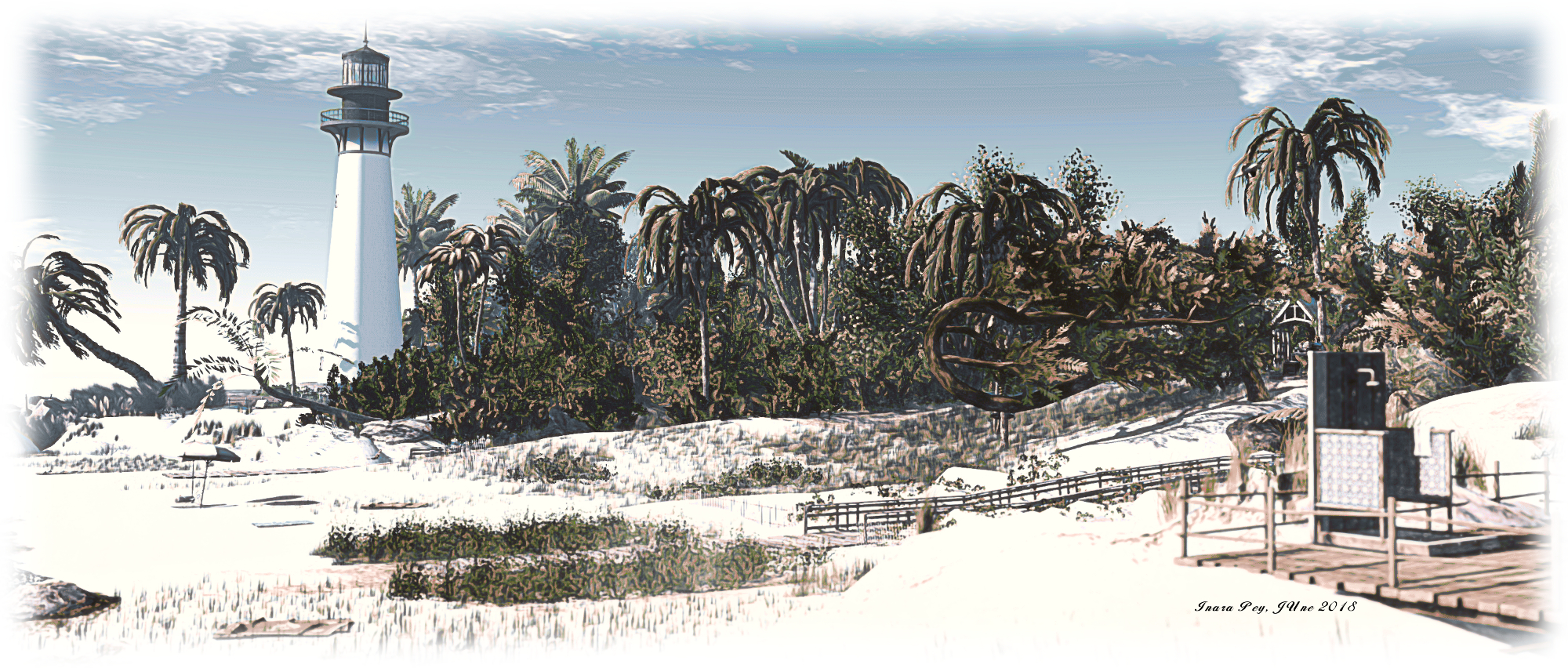
Relaxing in Cape Florida in Second Life

Cape Florida Lighthouse and Park; Inara Pey, June 2018, on FlickrCape Florida Lighthouse and Park – click any image for full size

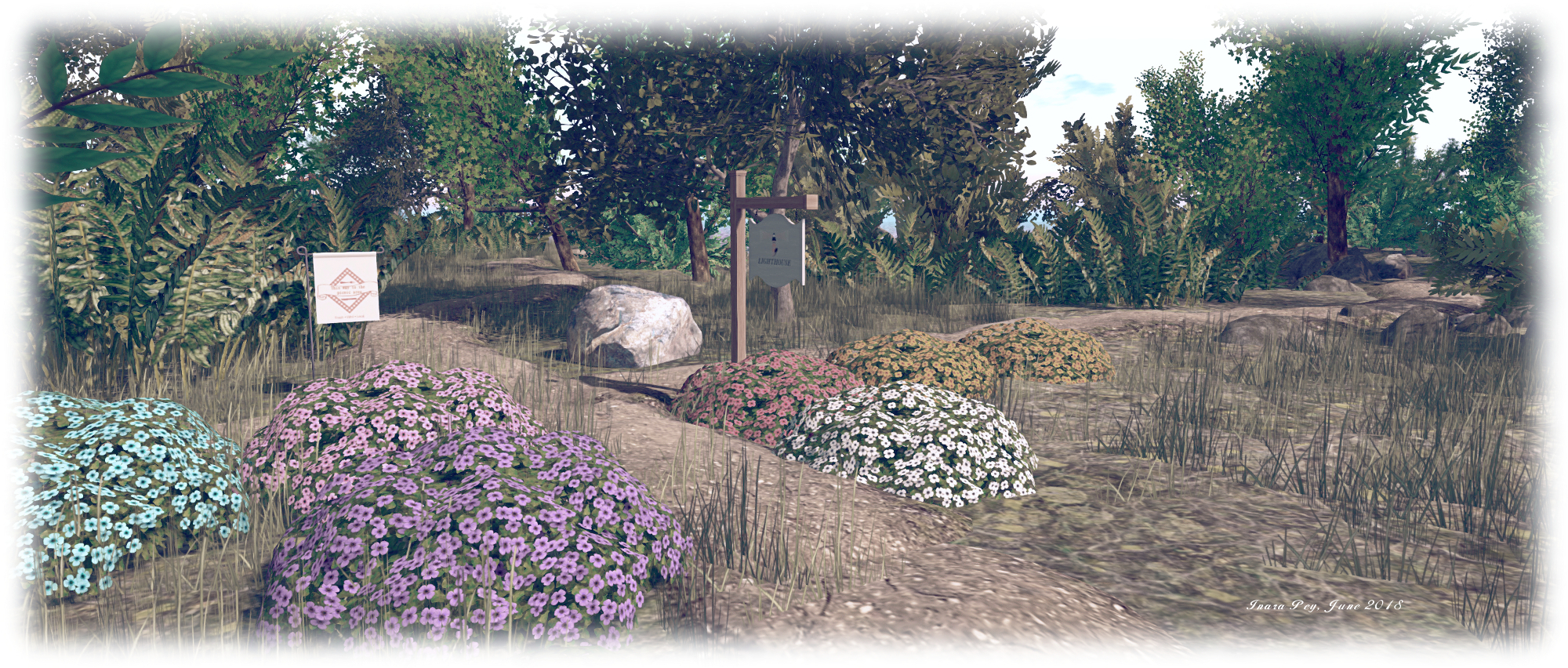
Cape Florida Lighthouse and Park is a homestead region designed by Shen Molinaro, specifically designed for people to visit, enjoy and to relax in. It offers plenty of walks, both along its sandy beaches and inland along paved paths, wooden board walks and over raised earthen trails that wind over grass and under bough. Also on the beaches and under the boughs of trees and palms, can be found places to sit or hang out along with opportunities to enjoy board games, take a bicycle ride or have a swim (look for the HUD givers as well as the rings out on the surf).

The region is somewhat modelled after the Cape Florida Light and the Bill Baggs Cape Florida State Park, at the southern end of Key Biscayne in Florida. The lighthouse has a long history, and is the oldest standing structure in Greater Miami. Today it is operated by the US Environmental Protection Agency.

Cape Florida Lighthouse and Park; Inara Pey, June 2018, on FlickrCape Florida Lighthouse and Park

I’ve no idea how well the region reflects the park, as I’ve never had the good fortune to visit the latter; but the lighthouse presents a fitting homage to its physical world namesake, and the beaches echo those from which popular photos of the lighthouse have been taken. However, accurate physical resemblance to Bill Baggs State Park isn’t important: the region stands on its own as a  place of natural SL beauty.

The beaches run along the west and north sides of the region, the northern beach becoming quite expansive before it reaches the white finger of the lighthouse topped by the black “nail” of its light. Grass grows on the undulating beaches, vying with trapped seaweed to break-up the whiteness of the sands. Rocky outcrops also break up the sands, several of which have snagged flotsam deposited by the sea during high tide; there are also numerous places to sit and watch the ebb and flow of the tide – be it on sun loungers, deck chairs or blankets.

Cape Florida Lighthouse and Park; Inara Pey, June 2018, on FlickrCape Florida Lighthouse and Park

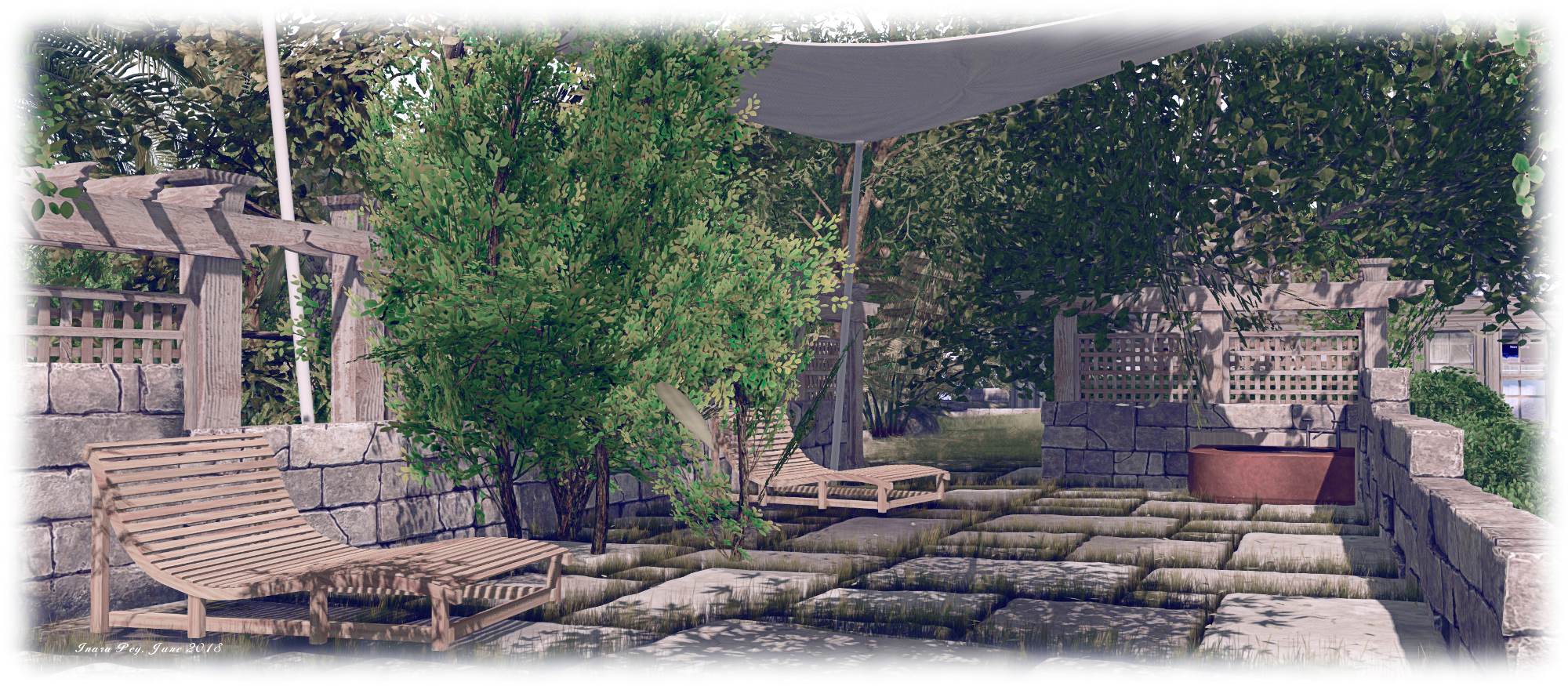
Behind the beaches, the land rises gently – not to any great height, but enough for the sand to give way to a more solid covering of grass spread beneath the boughs of tress and palms. It is here, among the trees that the majority of the board walks and paths can be found, offering multiple routes to different destinations. The latter includes the octagonal bulk of a great greenhouse overlooking the southern coastline, the glass long gone from its heavy wooden frame, a small cabin, a partially walled terrace, a paved terrace under a triangular awning, and more besides.

To the east of the park is a tiled roof gazebo offering shade, food and refreshments, one of several decks that hug the coastline sitting below it. On one of the latter, set above the south-western tip of a beach on a rocky overlook, offers a couple of spiKKo tables for those looking to play a game. Just above one of the beaches, tucked away near the old church gate marking the way to (or from!) the paved terrace and its awning, in a chess table. A little stall can be found here as well, offering a range of fresh fruit.

Cape Florida Lighthouse and Park; Inara Pey, June 2018, on FlickrCape Florida Lighthouse and Park

The paths and board walks, with their twisting and winding and frequent intersections, help to give a feeling that the park is larger than the region on which it sits. This is further helped by the use of trees, bushes and shrubs to hide views of the coastline.

Those wishing to rez props for photography can do so by joining the region’s group. It might also be worth playing with windlight settings – I confess to flicking my viewer over to a couple sky options provided by Stevie Davos as a part of his cloud and sky series (see here for more), as I found the default windlight left me feeling a little chilly whilst exploring the region. When wandering as well, make sure you have local sounds enabled; Shen has provided a rich sound scape to fit the region and breathe further life into it.

Cape Florida Lighthouse and Park; Inara Pey, June 2018, on FlickrCape Florida Lighthouse and Park

A beautifully conceived and executed region which invites people to tarry whilst visiting.

SLurl Details

Holmes, aliens, revenge, rescue and music in Second Life

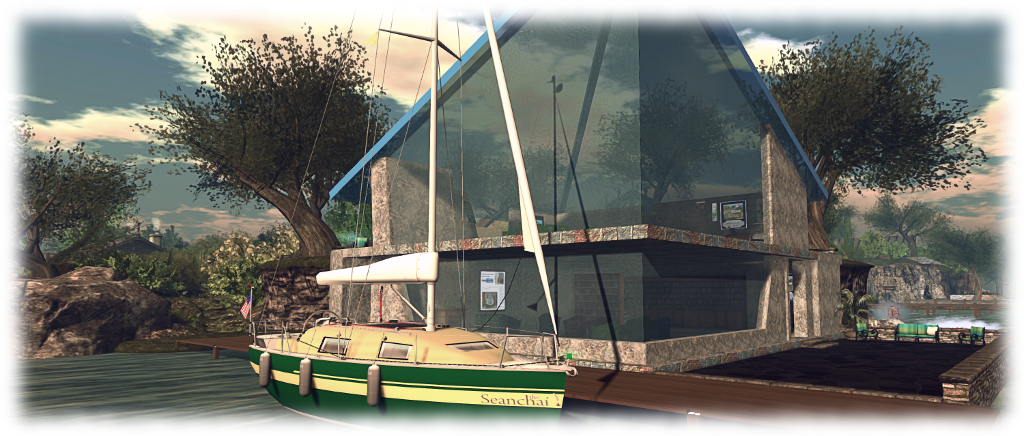
Seanchai Library

It’s time to highlight another week of storytelling in Voice by the staff and volunteers at the Seanchai Library. As always, all times SLT, and events are held at the Library’s home at Holly Kai Park, unless otherwise indicated.

Sunday, June 3rd

13:30: Tea-Time at Baker Street

Caledonia Skytower, Kayden OConnell and Corwyn Allen return with a Seanchai favourite: Tea-time at Baker Street. This time they are going right back to the roots of the legend, and the case which first introduced the world to Doctor John Watson and the renowned Consulting Detective, Mr. Sherlock Holmes.

study-in-scarletA Study in Scarlet was written in 1886 as a full-length novel by Sir Arthur Conan Doyle and published the following year. It is actually one of only four novel-length stories Conan Doyle penned about Holmes and Watson in the original canon (the remaining 56 tales of their adventures are all short stories). As it was the first time the two had appeared in print, part of the story was used to establish each of them, and how they met.

It is 1887, and Doctor John Watson, invalided out of the British Army after being wounded in the Battle of Maiwand during the Second Anglo-Afghan War (1878-1880), has returned to London where he is seeking accommodation. After bumping into an old friend, Watson finds himself being taken to St. Bart’s Hospital, where he is introduced to a stranger carrying out a laboratory experiment. On shaking Watson’s hand, Sherlock Holmes immediately perceives that he has recently returned from Afghanistan, and thus Watson first experiences Holmes’ remarkable deductive abilities – although quite how Holmes came to his conclusion remains a mystery. After a short conversation, he agrees to join Holmes in moving into a flat (apartment) at 221B Baker Street, where they’ll split the rent.

In the story, it is actually several weeks before Watson learns of Holmes’ rather unusual chosen profession. When told, he remains initially dubious until Holmes gives a practical demonstration of his powers of observation and deduction, using a messenger from Scotland Yard as his subject. The messenger has come with a request for Holmes’ assistance; Holmes is at first reluctant to heed the call,  but Watson urges him otherwise. So it is that they set out on their first adventure together, one involving poison, a double murder in London and a bitter tale of love, loss and revenge from America.

18:00 Magicland Storytime – Mrs Piggle-Wiggle

Mrs. Piggle-Wiggle lives in an upside-down house and smells like cookies. She was even married to a pirate once. Most of all, she knows everything about children. She can cure them of any ailment. Patsy hates baths. Hubert never puts anything away. Allen eats v-e-r-y slowly. Mrs Piggle-Wiggle has a treatment for all of them.

The incomparable Mrs. Piggle-Wiggle loves children good or bad and never scolds but has positive cures for Answer-Backers, Never-Want-to-Go-to-Bedders, and other boys and girls with strange habits.

Join Caledonia Skytower at the Golden Horseshoe in Magicland Park, as she reads from Betty MacDonald tales of Mrs. Piggle-Wiggle.

Monday, June 4th 19:00: The Nitrogen Fix

2000 years from now, the Earth has acid oceans, mutating exploding plants, silent, tentacled observers, doomed Hill cities, nomad Outcasts, vicious, power-mad rebels.

In this world, fully depleted of freely floating oxygen – it has all been trapped in the Nitrogen Fix –, humans are the last native animal species on the planet. What civilization is left is isolated and separated.

A doomsday scenario? perhaps. But Hal Clement has a knack for making this beleaguered, suffering version of Earth and the trials of those living on it far more enticing that might be first thought.

Join Gyro Muggins as he travels to Clement’s world and see what might be found there.

Tuesday, June 5th: The Cold Dish (Walt Longmire #1)

Two years ago, four boys were put on trial for raping a Cheyenne girl. Now one of them – Cody Pritchard – is dead, shot and dumped in with a local farmer’s sheep.

For Walt Longmire, it means his hope of finishing out his term as sheriff of Wyoming’s Absaroka county in peace and quiet is at an end; instead, he finds himself in the middle of a murder investigation.

Plenty of people had cause for wanting Cody Prichard dead but who had the guts to do the deed? And are his three compadres next on the hit list? For Longmire, it means facing one of the more volatile and challenging cases in his twenty-four years as sheriff. One in which he means to ensure that revenge, so often regarded as a dish best served cold, is never served at all.

Join Kayden OConnell as he reads the first volume of Craig Johnson’s tales of Sheriff Walt Longmire.

Wednesday, June 6th 19:00: Hello, Universe

In one day, four lives weave together in unexpected ways.

Virgil Salinas is shy and kind-hearted and feels out-of-place in his loud and boisterous family; Valencia Somerset, who is deaf, is smart, brave, and secretly lonely, and loves everything about nature; Kaori Tanaka is a self-proclaimed psychic, whose little sister Gen is always following her around; and Chet Bullens wishes the weird kids would just act normal so that he can concentrate on basketball.

None of them are friends; at least not until Chet pulls a prank that traps Virgil and his pet guinea pig at the bottom of a well.

This leads Kaori, Gen, and Valencia on an epic quest to find the missing Virgil. Through luck, smarts, bravery, and a little help from the universe, a rescue is performed, a bully is put in his place, and friendship blooms.

Join Caledonia Skytower as she reads Erin Entrada Kelly’s 2018 Newbery Medal Award-Winning tale.

Thursday, June 7th: RUSH 2112

  • 18:30-19:00 The Temple of Syrinx plays a major role in unlocking the Crystal Gate in Ready Player One. Shandon  Loring reads that part of Ernest Cline’s seminal VR story.
  • 19:00: RUSH 2112 Anthem – the story behind the music of the album.

Also presented in Kitely (hop://grid.kitely.com:8002/Seanchai/144/129/29).

19:00 Seanchai Late Night

Contemporary Sci-Fi with Finn Zeddmore.


Please check with the Seanchai Library’s blog for updates and for additions or changes to the week’s schedule.

The current charity is Project Children, growing peace in Northern Ireland one (or two) children at a time.

2018 SL UG updates #22/3: TPVD meeting

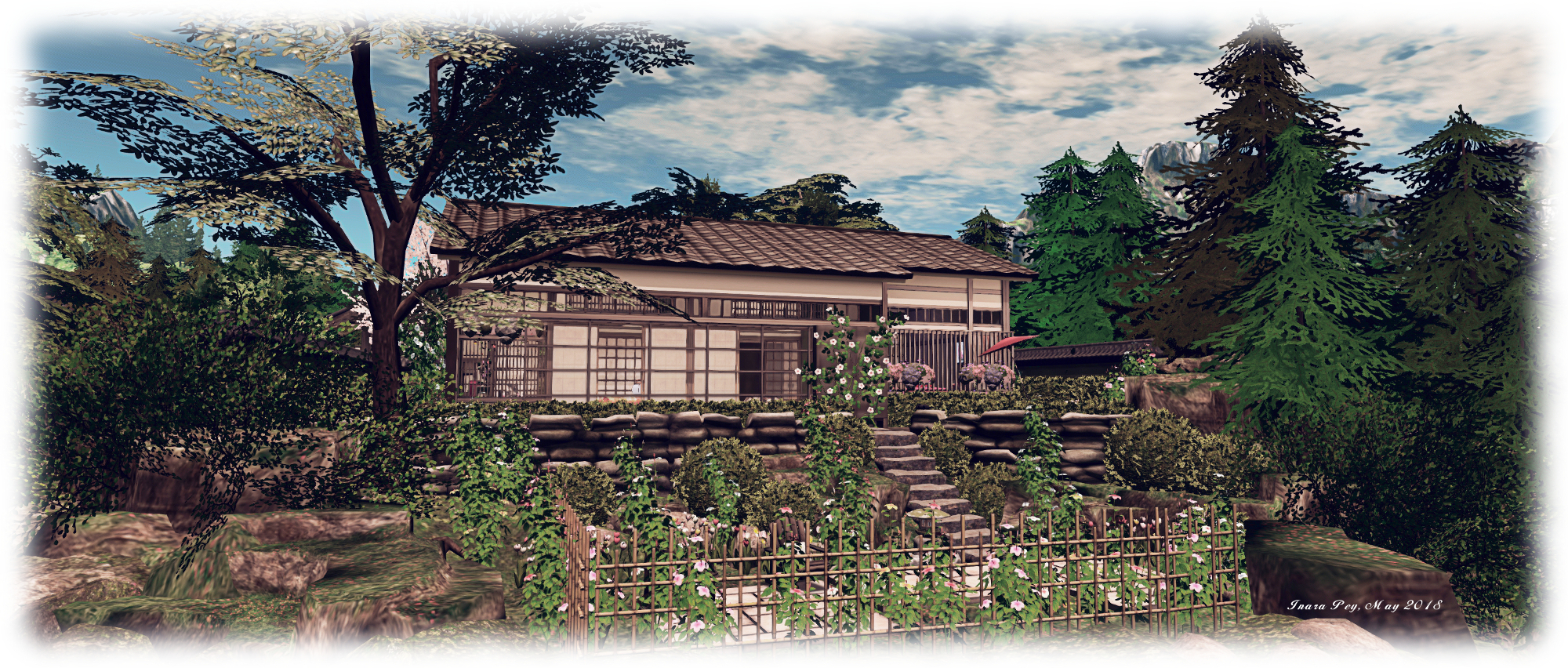
Village of Ahiru; Inara Pey, May 2018, on FlickrVillage of Ahirublog post

The majority of following notes are taken from the TPV Developer meeting held on Friday, June 1st 2018. A video of the meeting is embedded below, my thanks as always to North for recording and providing it.

This was another short meeting, with about half of that covering SL projects, which are noted below. The rest of the meeting was more general conversation, and I’ll leave it to the video to cover them. As always, time stamps in the text below will jump you to the relevant points in the video.

Server Deployments

On Wednesday. May 30th, all three primary RC channels were updated to a new server maintenance package, 18#18.05.25.515749, comprising and internal fix (presumably for the unspecified bug which prompted the roll-back of #18.05.14.515432) and the simulator-side support for the updated Estate Management tools.

SL Viewer

[0:52-2:33] The Love Me Render viewer was updated to version 5.1.5.515811 on May 31st, and promoted to de facto release status.

All other viewers in the various pipelines remain unchanged from the start of the week:

  • Release channel cohort:
    • Pálinka Maintenance RC viewer, 5.1.5.515527, dated May 21.
  • Project viewers:
  • Linux Spur viewer, version 5.0.9.329906, dated November 17, 2017 and promoted to release status 29 November – offered pending a Linux version of the Alex Ivy viewer code.
  • Obsolete platform viewer, version 3.7.28.300847, May 8, 2015 – provided for users on Windows XP and OS X versions below 10.7.

It is likely all of the above will be updated as they are merged with the Love Me Render release.

360 Snapshot Viewer

[27:48-28:32]  The 360 snapshot project viewer has been on hold in part due to two reasons: the prime resource (Callum Linden) was assigned to another project; work on the viewer has been awaiting the development of an interface to allow direct uploads to Second Life Place Pages. In the meantime, the viewer code base is being maintained in parity with release versions of the viewer.

[28:57-29:34] There are also some graphics challenges that need to be addressed is trying to support the necessary high resolutions 360-degree images require couple with the low-end graphics systems many SL users have.

Upcoming Project Viewers

[2:34-3:07] The new project viewer with the updated Estate Management tools (ban list management, etc.) is expected “pretty soon”. This will work with the simulator-side Estate Management updates currently on the RC channels.

[5:26-5:42 and 7:20-8:35] Another upcoming project viewer has re-vamped texture caching. It’s hoped this will help with viewer performance. With it, users will be able to define a much larger overall cache size on their computer if they so wish. It is also hoped this work will include improvements to VRAM handling – although a problem here is that some systems incorrectly report the amount of VRAM they have available. Further, providing a recommended setting and assuming users will adhere to that recommendation doesn’t always work.

(There is also a text discussion on caching among games, etc.).

Viewer Camera Presets

[5:53-6:34] This is a contributed project from Jonathan Yap (who was responsible for developing and coding the graphics presets options in the viewer). It will allow users to define their own placements for the SL camera around their avatar (e.g. an over-the-should view, a view from overhead, etc.), which can then be saved and selected / used as required – see STORM-2145.

The work has been stalled awaiting a couple of new controls for manipulating the camera position being implemented. However, it is a project the Lab isn’t going to lose sight of, and it remains on the active project list.

Crash Reporting Changes

[18:18-21:04] The Lab is about to start experimenting with viewer crash reporting, removing the existing Breakpad based crash reporting tools and replacing it with BugSplat, a commercial service. If this works on a trial / experimental basis, the Lab will probably switch to using  BugSplat as their crash reporting mechanism.

Should this happen, TPVs using the current crash reporting mechanism may not want to merge the associated changes to use BugSplat, and continue to use the Brakpad mechanism (or introduce an alternative bug reporting solution of their own – such as Crashpad, regarded as the successor to Breakpad). Those wishing to use the BugSplat code will need their own subscription to the service and update the viewer code accordingly when using it in their own viewers.

From the Lab’s perspective is that dealing with crashes requires the maintenance and use of a lot of historical data which needs to be routinely searched, analysed, updated, etc., and a third-party company that specialises in this kind of work can probably do so and provide the necessary tools a lot better than the Lab can do on its own.

Project ARCTan

[4:24-5:22] This is the code-name for the project to re-evaluate object and avatar rendering costs to make them more reflective of the actual impact of rendering both. As I’ve previously noted, the Lab is sensitive to the implications of doing this – particularly in the area of Land Impact, and will take steps to avoid disruption (e.g. through object returns) once the project reaches that point in time. (One area of potential impact is sculpties, which currently do not have their render cost accurately reflected in their land impact.)

The Lab has been gathering data as the first step in this work, and is “homing in” on better formulas, although Oz notes there is still a lot of work to be done and the project will be a “long, slow roll-out”. It’s likely that when a project viewer for this work appears (no time frame on this), it will include contributions for jelly dolling avatars with excessive texture use.

Land Auctions and Place Pages

[28:35-2855] The new auction system (users being able to auction their own land holdings will be run through the Second Life Place Pages. This has been a focus for recent work on Place Pages, which has delayed the development of the 360 snapshot viewer interface referenced above.

[30:27-31:47] The auction capability might even be made available (to some degree) in June 2018. This is likely to be just for Linden-owned land to start with, so the Lab can deal with issues without too much disruption / confusion, prior to the service being extended to users with land holdings.

The new user-to-user land auctions will be run through Second Life Place Pages, with Linden-run auctions starting the process off

As Ebbe Altberg has indicated, the plan will then likely to be to allow Mainland land holders auction their land directly to other Premium users, and then expand the ability from there.

The use of Place Pages for auctions means that those wishing to auction their land will need to create a place page for it.

Other Items In Brief

  • [11:32 and 13:30-13:40] Parcel Banning and Object Information: there appears to have been a recent change that means if an individual is banned from a region, they no longer receive information about objects on that parcel – see BUG-216294. This is regarded as expected behaviour. This includes a largely text-based conversation on options for de-rendering objects on other parcels, together with the idea about SL not being a place necessarily intended for isolated living, extending through to [18:10].
  • [22:23-22:47] “Social” tools in the viewer: it’s unlikely the Lab will make any changes to user profiles in the viewer any time soon; back-end work is being considered for group interfaces in the viewer, but this most likely won’t take place until after the cloud migration work has been completed.
  • Fun fact: Linden staff are subject to the same constraints in behaviour and activities when using ALT accounts as when using their official accounts. This means for example, a Linden staffer cannot participate in the upcoming user-to-user land auctions, and improper behaviour will be regarded in the same way as if they were using their official account.

Gallery Mirror Amsterdam in Second Life

Gallery Mirror Amsterdam – Miles Cantelou

Now officially open is Gallery Mirror Amsterdam, a new arts venture in Second Life curated by Arete of Cyrene (AretevanCyrene). Occupying a homestead region, the facility comprises a primary gallery building of a modern design, with a second warehouse-like gallery facing it across a canal (and which current forms the landing point for the region). These sit with a region design resembling Amsterdam.

“The design is based on the place where my grandad grew up near the docks,” Arete explained during on of my visits. An artist living in Amsterdam herself, Arete hopes the region will become an SL arts community nexus. As well as the warehouse and main gallery build, the region includes a number of Dutch canal houses which will be made available for artists to hold exhibitions in addition to the main spaces.

Gallery Mirror Amsterdam

“The idea here is to let artists connect with each other and to promote art to visitors,” she continued. “”We have very talented people in SL.”

The opening exhibition at the main gallery features six of these talents:  Gitu Aura, Vallys Baxter, Miles Cantelou, Brysen Miller, Ada Resident and Cate Ansaldo (CateVogel).

The selection of these six reflects much of Arete’s thinking with the region and the exhibitions she plans to hold at Gallery Mirror. Rather than simply offering a space in which artists can display their art, Arete has sought to create and environment in which she can bring together artists whose visions and ideas reflect ones another in some way, within a space that in turn reflects the work of the artists.

“Miles was the first artist I invited. His acceptance led me to invite the others Arete explained. “Thematically, they work together.” As well as these six, she has been putting together a calendar, and now has commitments from artists through into 2019.

As an artist in both the physical world and SL, Arete sees her work as a curator as very much working in partnership with the artists she invites to Gallery Mirror. She provides advice and feedback on themes, the placement of images in the various display spaces within the gallery, and so on.

Gallery Mirror Amsterdam – Cate Ansaldo (CATEvogel)

The care put into Gallery Mirror is also shown in the fact that the region itself took four months to develop, including preparations for the opening exhibition.  Arete described her approach to the design thus, “I’ve designed the whole region with the thought of creative display. Art must flow; it needs air and open space so that the observer can experience the full impact of the works on display.” In this, the Amsterdam style setting offers the opportunity to display 3D art out on the waters of the canal and docks – something Arete has already taken into consideration.

The main gallery building is well-appointed in this regard. Three storeys in height, is offers large rooms with plenty of open space and good lighting in which visiting artists can display their work. It can support up to six artists at a time: two on the ground floor, which includes a lobby area with a lounge / bar area behind it. For the first exhibition, these  feature the art of Cate Vogel and Gitu Aura. On the mezzanine above is a large open area, superbly displaying Miles’ art. A second room (still awaiting the artist at the times of my visits) sits at the front of this level.

Gallery Mirror Amsterdam – Brysen Miller

The upper floor features the final two exhibition spaces – these occupied by Brysen Miller and Vallys Baxter – together with a social space. The latter was intended to be used for music events such as openings, but Arete informed me she’s now rented a parcel on another region which she plans to use for social engagements, so that the music doesn’t interrupt people’s appreciation of the art on display in the gallery.

Arete further brings the gallery to life through the use of sculptures – notably by CioTToLiNa Xue and Mistero Hifeng -, together with smaller pieces of 2D art she has selected.

Gallery Mirror Amsterdam – Vallys Baxter

Exhibitions are planned for periods of two months at a time. “I’m now working with artists on a ‘couples’ exhibition for August / September,” Arete told me.

When visiting the region, don’t confine yourself to the gallery spaces – as noted above, the surrounding dutch canal houses are available to artists, and while she is far too modest to point to it herself, I would recommend visiting the house alongside the warehouse gallery, as Arete has a small exhibition of her work on display. Also, there are 3D art to be found out on the waters already.

Gallery Mirror Amsterdam – Gitu Aura

Gallery Mirror represents a genuine commitment to support art in Second Life, and the opening event brings together six artists of unique talent in an absorbing exhibition. It is definitely not an exhibition to be missed, and this is very definitely a venue worth keeping an eye on. When visiting, please do set aside time to fully appreciate it and also, do consider making a donation towards the region’s continued existence.

SLurl Details

Second Life 32-bit Windows viewer oopsie

Update, June 6th: for those 32-bit Windows users still experiencing problems with this issue, the Lab has issued the Unloop RC viewer.

On May 31st, 2018 Linden Lab updated the Love Me Render Release Candidate, viewer version 5.1.5.515811 to de facto release status.

Unfortunately, during the release process, there was an error defining the location of the Windows 32-bit version of the Second Life viewer download. Because of this error, all Windows users downloading the viewer received the 64-bit version, regardless of which version of the operating system they are running.

While the issue has now been fixed so that 32-bit Windows users will receive the 32-bit version of the viewer, anyone running 32-bit Windows who downloaded the viewer during the 24 hours when the incorrect location was available (12:00 noon SLT on Thursday, May 31st, 2018 through 12:00 noon SLT on Friday, June 1st, 2018) may now find their system is stuck in a loop of trying to install the 64 bit version of Second Life.

Because of this, Kyle Linden issued a forum post on how to correct the problem for those caught in the loop, and I’m reproducing those instructions below for those who may have missed the forum post:

There is a way out of this loop.

  1. Uninstall the 64 bit version of Second Life.

  2. Install the 32 bit version from: http://download.cloud.secondlife.com/Viewer_5/Second_Life_5_1_5_515811_i686_Setup.exe

For the technically inclined there is a more surgical method to quickly recover.

  1. Open your file explorer in Windows.

  2. In the address bar type in %appdata% and press Enter.

  3. Locate the SecondLife folder and open it.

  4. Locate the downloads folder and delete it.

  5. Launch Second Life as normal and the correct update will be applied.

Thank you for your patience and understanding, we stumbled and we’ll make corrections to our processes to ensure this doesn’t happen again.

For those needing further information, please refer to Kyle’s forum post.