SL project updates 45/2: Content Creation User Group

A rally of (Animesh) raptors on Aditi

The following notes are taken from the Content Creation User Group meeting, held on  Thursday, November 9th, 2017 at 13:00 SLT. For the purposes of Animesh testing, the meetings have relocated to the Animesh4 region on Aditi, the beta grid – look for the seating area towards the middle of the region. The meeting is chaired by Vir Linden, and agenda notes, etc, are usually available on the Content Creation User Group wiki page.

Medhue Simoni live streamed the meeting, and his video is embedded at the end of this article. Time stamps in the body text will open the video in a separate tab for ease of reference to the relevant parts of the text. However as these notes present the meeting in terms of topics discussed, rather than a chronological breakdown of the meeting, so some time stamps may appear to be out of sequence.

Animesh (Animated Mesh)

“I like the name ‘animated objects’ because I think it’s unambiguous, but it takes a long time to type!” – Vir Linden joking about the name “Animesh”.

Project Summary

The goal of this project is to provide a means of animating rigged mesh objects using the avatar skeleton, in whole or in part, to provide things like independently moveable pets / creatures, and animated scenery features via scripted animation. It involves both viewer and server-side changes.

In short, an Animesh object:

  • Can be any object (generally rigged / skinned mesh) which and contains the necessary animations and controlling scripts in its own inventory  (Contents tab of the Build floater) required for it to animate itself.
  • Can be a single mesh object or a linkset of objects (link them first, then set them to Animated Mesh via the Build floater > Features).
  • Has been flagged as and Animesh object in the project viewer, and so has an avatar skeleton associated with it.
  • Can use many existing animations.

However Animated objects will not (initially):

  • Have an avatar shape associated with them
  • Make use of an avatar-like inventory (although individual parts can contain their own inventory such as animations and scripts)
  • Make use of the server-side locomotion graph for walking, etc., and so will not use an AO
  • Use the avatar baking service
  • Will not support its own attachments in the initial release.

These are considered options for follow-on work, possibly starting with the notion of a body shape (to help with more fully-formed NPCs).

Resources

Viewer Progress

[3:51-5:33] The project viewer updated to version 5.0.9.329815 on Thursday, November 9th.

  • The major change is that Animesh linksets can now include non-rigged items (e.g. prims), and allow the root objects to be a prim rather than a rigged mesh.
  • Animesh objects should now render the same way as mesh attachments and generate shadows.
  • The viewer also includes a number of bug fixes.

[42:25-44:50 + text chat] However, while the root of an Animesh object can now be a prim, this doesn’t mean mesh objects such as pets can be dropped in-world (e.g. so someone could “pick up” their Animesh pet, carry it, then put it down again somewhere else), because the code required for “dropping” mesh is not provided on the simulator on the ground that dropping meshes can cause physics issues.

Animesh Attachments

Note: there is an extensive discussion in text chat around this subject from the 13:00 minute mark which continues throughout the meeting.

[12:59-18:06] One of the major subjects of discussion with Animesh is enabling attachments to be added to existing Animesh objects (see here and here). In short, many pets and characters are created as No Modify objects, to help protect their capabilities. Thus, as No Mod objects, Animesh characters cannot be accessorized (the owner of an Animesh horse cannot add  / remove a saddle from an Animesh horse, for example). As Piscine Mackenzie explains in the forum, with highlights by Medhue Simoni, making Animesh pets  / characters Modify opens them to the risk of exploitation.

One proposal has been put forward via feature request BUG-139168. Vir Linden has also put forward a number of ideas. Of these, the mod key proposal (2nd bullet point in Vir’s notes and somewhat aligned to BUG-139168) is seen as a potential solution, with LlAllowInventoryDrop used to avoid the need for the root Animesh object having to be modify (and leaving it exposed to the exploits outlined by Piscine and Medhue). Vir is currently seeking further feedback from people on this being a possible approach, or if there are other potential alternatives.

  • [21:11-22:51] Two concerns on this approach are that a) any scripted mod key capability could be withdrawn at any time by the creator, potentially leaving users with broken content. However, there is no obvious means of safeguarding against this (unless it is made some kind of one-time function operation by the Lab, if possible); b) there is a risk the mod key could be accidentally exposed / leaked in being shared between those using it.
  • [25:52-26:12] The most “obvious” means of handling this issue would be to implement a change to the permission system to cater for the specific user-case of allowing attachments to be added to Animesh objects. However, the Lab is hesitant to consider such changes due to the risk of unintended impact, risk of content breakage, etc. As such a precise proposal on how to update the permissions system and the use cases it would meet would have to be properly defined for consideration.
  • [28:15-30:40] A suggestion is made to have a new flag “only allow scripts compiled by the object creator run on this object”. However, this could limit cases where models are built by one person, animated by another and scripted by someone else, or situations where a creator is using full permission scripts sold by another creator, etc., and so seen as potentially less than ideal.
  • [56:07-1:01:56] Determining whether Animesh attachments capabilities (e.g. using the mod keys idea) can or cannot be implemented relatively easily is seen by the Lab as a critical aspect to moving Animesh towards a release. If doing so proves problematic, the project will likely move ahead without such a capability being implemented. In the meantime, as there isn’t currently an available solution, creators are advised to handle Animesh the same as any other product they are developing for the time being, and focus on Animesh at the functional level.
    • [1:01:57-1:05:05] An example of complexity is defining how a mod keys capability would work. If it is limited to one specific group of people creating a poduct line, it is relatively easy to control. However, if a creator wants too support an ecosystem whereby other creators can all offer attachments for a product, then it becomes far more complicated in terms of keeping the mod key secure.

Given the complexity of this subject, continued discussion through the Animesh forum thread is encouraged.

Animation Playback Speed

[51:47-52:37] It has been noted that the speed of the animation depends on the distance from the viewer’s camera to the animated object – see BUG-134259 and this MP4 (note particularly the two elephants). This appears to be the result of the debug UseAnimationTimeSteps being set to TRUE (default viewer behaviour). Setting it to FALSE fixes the issue, and doesn’t appear to cause any other performance impacts.

Land Impact and Other Limits

[54:53-56:05] It’s unlikely that the current baseline limits (LI, tri count, rendering), will be altered  until there is confidence that the viewer functionality is relatively stable in terms of features, bugs, etc., at which point reliable performance testing can begin. Once this point is reached, then the Lab will be able to gather reliable data in order to start adjusting / potentially relaxing the limits.

Environment Enhancement Project (EEP)

Project Summary

A set of environmental enhancements, including the ability to define the environment (sky, sun, moon, clouds, water settings) at the parcel level; a new environment asset type that can be stored in inventory and traded through the Marketplace / exchanged with others; scripted, experience-based environment functions, an extended day cycle and extended environmental parameters. This work involves both a viewer updates (with a project viewer coming soon) and server-side updates.

Current Status

[8:25-10:32] Rider Linden is “very close” to removing the old windlight environment code from his EEP version of the viewer, allowing it to use all the new EEP assets, allowing the local environment to be set via windlight inventory assets.

Once this can be done, test regions capable of supporting the assets will be established on Aditi (the beta grid), and a project viewer will be made available for more general testing.

Bakes on Mesh

Project Summary

Extending the current avatar baking service to allow wearable textures (skins, tattoos, clothing) to be applied directly to mesh bodies as well as system avatars. This involves server-side changes, including updating the baking service to support 1024×1024 textures, and may in time lead to a reduction in the complexity of mesh avatar bodies and heads. The project is in two phases:

  • The current work to update the baking service to support 1024×1024 textures.
  • An intended follow-on project to actually support baking textures onto avatar mesh surfaces (and potentially other mesh objects as well). This has yet to fully defined in terms of implementation and when it might be slotted into SL development time frames.

This work does not include normal or specular map support, as these are not part of the existing baking service.

Current Progress

[35:41-36:33] The performance testing has been carried out, and the results point to the need for additional bake host servers to account for the additional load in handling the higher resolution textures.

Other Items – In Brief

  • [36:30-37:29] Region crossing loads: the question is asked about what is the biggest load / cause of lag on region crossings (direct or TP). The short answer is scripts. That is, suspending them, saving their state, packaging them, handing them off to the next simulator, unpacking them alongside everything else (e.g. the avatar and / or vehicle they are running against), setting them back to running from their saved state. Obviously, the more individual scripts an avatar (+ vehicle, where used) is running (regardless of individual script size), the bigger the load placed on the hand-off process / receiving region.
  • [47:03-47:19] Materials system update: this is frequently requested, but currently the Lab do not have any plans to revisit the materials system.
  • [49:32-49:45] Cannot pathfind through a hollow object – intentional? Short answer – yes; physics simulations going into concave objects is expensive
  • [49:45-50:18] Will RenderVolumeLOD be revisited? – Short answer – yes, as a part of the work in re-evaluating rendering costs, land impact, etc.


VWBPE 2018: call for proposals

The 11th annual  Virtual Worlds Best Practice in Education (VWBPE) conference was recently announced, together with a call for proposals, which combines calls for presentation proposals, proposals for exhibits, and proposals for and immersive experiences (pre- and post-conference virtual experiences).

The conference will take place between Thursday, March 15th and Saturday March 17th, 2018 inclusive.

The theme for the 2018 conference is VRevolutions, with the organisers noting:

VWBPE is an ecosystem of digital spaces. While the conference is hosted in Second Life, our conference features a variety of virtual and digital spaces. To present at VRevolutions, think outside the virtual space and consider how multiple available technologies and devices redefine what it means to work, create, and learn “virtually”. The VRevolution is about doing what scares you, what excites you, breaking and creating new paradigms.

At VRevolutions, VWBPE welcomes the multifaceted communities that contribute to and expand best practices in digital and virtual spaces to support practice, creation, and learning. Regardless of the community you represent, your proposal should consider how it contributes and expands the knowledge base for innovative and revolutionary change through the increasingly complex landscape of digital technology.

Those formulating proposals for submission should keep these ideals in mind in writing their proposal.

Presentation Proposals

All proposals for presentations should be made in one of the seven presentation tracks:  Analytic Thinking and Complex Problem Solving; Creativity and Innovation in Design, Practice, and Learning; Essential Accessibility in Digital and Virtual Spaces; Collaboration and Distance Connections; Multimedia Communication and Multifaceted Interactions; Ethics, Responsibility, and Tolerance  and VWBPE Redux.

In addition, proposals for presentations should meet one of the three conference presentations formats: Spotlight Presentations (1 hour); Hands on Technology Workshops (90 minutes) or Compass Points Roundtable Discussions (1 hour).

Full details on the seven tracks and three formats can be found on the VWBPE Call for Proposals page, together with general information on presentations and a link to the proposal submissions page.

Note that the closing date for presentation proposals is Monday, January 8th, 2018.

Exhibit Proposals

Exhibit proposals are open to those who wish to showcase their creative works in virtual worlds through artistic expression in order to promote their organisation or achievements. All exhibit proposals are reviewed by the VWBPE, and must apply to an already developed product for showcasing.

Exhibit proposals should be made in one of the eight exhibit tracks: K-12 Best Practices; Higher Education/College Best Practices; Field Practices; Games and Simulations; Tools and Products; Advocacy; Support and Help Communities and Artists, Designers and Builders.

The Exhibitor Guidelines must be reviewed prior to submitting an exhibit proposal.

Note that the closing date for presentation proposals is Thursday, February 1st, 2018.

Immersive Experiences Proposals

The Immersive Experiences category showcases locations whose main objective is interaction, immersion, and engagement for those who enter them, whether to play a game, solve an immersive problem, or engage participants in hands-on, interactive learning.

All proposals for immersive experiences should be made in one of the seven presentation tracks:  Analytic Thinking and Complex Problem Solving; Creativity and Innovation in Design, Practice, and Learning; Essential Accessibility in Digital and Virtual Spaces; Collaboration and Distance Connections; Multimedia Communication and Multifaceted Interactions; Ethics, Responsibility, and Tolerance  and VWBPE Redux.

In addition, proposals for immersive experiences should meet one of the two conference experience formats:  Wanna Play? and Virtual Worlds.

Full details on the tracks and formats can be found on the VWBPE Call for Proposals page, together with general information on presentations and a link to the proposal submissions page.

Note that the closing date for exhibit proposals is Monday, January 8th, 2018.

About VWBPE

VWBPE is a global grass-roots community event focusing on education in immersive virtual environments which attracts over 2,000  educational professionals from around the world each year, who participate in 150-200 online presentations including theoretical research, application of best practices, virtual world tours, hands-on workshops, discussion panels, machinima presentations, and poster exhibits.

In the context of the conference, a “virtual world” is an on-line community through which users can interact with one another and use and create ideas irrespective of time and space. As such, typical examples include Second Life, OpenSimulator, Unity, World of Warcraft, Eve Online, and so on, as well as Facebook, LinkedIn, Twitter, Pinterest or any virtual environments characterised by an open social presence and in which the direction of the platform’s evolution is manifest in the community.

Additional Links

CioTTolina’s Dum Spiro Spero in Second Life

DaphneArts: Dum Spiro Spero

Now open at DaphneArts, the gallery spaces curated by Angelika Corral and Sheldon B, is an exhibition by Second Life sculptor and personal favourite, CioTTolina Xue, in which she presents a range of her work, some of which has appeared in previous exhibitions or in her store, and all of which share a theme of hope.

Dum Spiro Spero, “While I breathe, I hope”, is widely used as a motto by families, organisations, states, military organisations, and so on.  It is regarded as a paraphrase of ideas that survive in two ancient writers, Theocritus and Cicero through such works as Letters to Atticus. For  CioTTolina, it encapsulates her outlook on life.

DaphneArts: Dum Spiro Spero

“I try to create emotions,” CioTTolina says of her work, “And send a message: hope.
I’m still not good at what I do, but I put my heart into it. I hope that the love I put into things shows as what I might accomplish. This is the message that matters.”

Personally, I have always felt – and continue to feel – CioTTolina undersells herself. Her work has – and remains – full of beauty and meaning; as I said in reference to her exhibition at Solo Arte, Hope, “CioTToLiNa has clearly grown in confidence as an artist, producing ever more complex pieces which are not only beautiful and highly collectible, but also reflect her own interests / concerns for the world, and how we relate as a species one to another and the world around us.”

DaphneArts: Dum Spiro Spero

Indeed, Dum Spiro Spero is in many respects and expansion of Hope, richly demonstrating the breadth and depth of CioTTolina’s work and an ideal reflection of her ideals and outlook, with each of the seven display areas in the gallery space offering at least one of her pieces for viewing. Some may appear to be thematically linked one to another, expressing hope, love, joy, others may stand in contrast to one another. Taken together, the use of the spaces to display CioTTolina’s work is considered, allowing us to better study and appreciate the pieces offered in each.

If you haven’t seen CioTTolina’s sculptures before, I can recommend Dum Spiro Spero as an ideal means by which to gain familiarity with it.

SLurl Details

Sansar events list launched on web Atlas

The new Sansar events section on the web Atlas Home tab

Following the recent deployment of the Friends release for Sansar (see my overview for more), the promised Events update has now been deployed to the web Atlas, as the first iteration of an events notification capability that the Lab intends to grow over the coming months.

For this initial deployment, the feature is – as noted – limited to the web Atlas, where it appears on the Home tab for the Atlas, located between the banner list of experiences and the Recommended Experiences (aka “Featured” experiences, as referenced in the client Atlas, and more generally by the Lab). Note that if there are no events listed, the section will not be visible in the Atlas.

The capability is currently limited to just three events at a time being displayed, as shown in the banner image at the top of this article, and below. Each is displayed with an image of the experience hosting the event, the event title,the time (PST) / day (and presumably date, if the event us further out than “tomorrow”) it is being held. Beneath this is a short description of the event, which can be expanded by clicking on the More… option, as shown below.

Details of an event can be expanded (to a degree) by clicking on its associated More… option

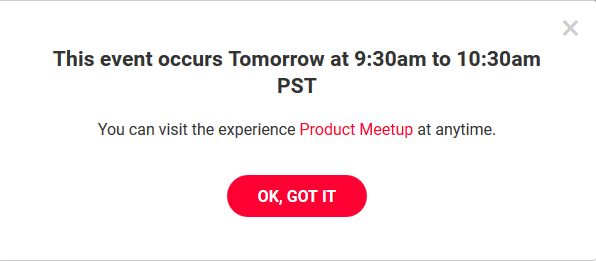
Clicking on either the image or the title for an event will display a pop-up message, again repeating the day / time of the event, and which also give the URL for the host experience, allowing users to visit it via the experience’s web page & then launching the client.

Clicking on the image / title of an event will display a pop-up which includes a link to the hosting experience’s Atlas page, allowing people the visit the experience

Currently, the events are limited to those run by Linden Lab – simply because these are the major form of event in Sansar – such as the daily Community meet-ups and the weekly Product Meetings, as listed.

However, in the future, as the capability grows, users will be able to e-mail the Lab with details of their own experiences for inclusion. I’ll blog on this / update this article once the e-mail address and requirements for submitting an event have been made available.

The Events feature itself will, as noted, be expanded over time to allow more events to be included, although exactly what form it will take (additional tab in the Atlas?) is, I gather, still TBD at the Lab.  Again, I’ll cover further updates as they appear.


Gem’s Chaos in Second Life

Chaos – Gem Preiz

Chaos is the title of a new exhibition of Gem Preiz’s fractal art, now open at  The Eye art gallery, curated by Mona (MonaByte). It is an exhibition those familiar with Gems work might find surprising in terms of the visual style of the images presented.

“Confronted with the mysteries of the origins, Gem says in describing the exhibition, “And with the question of the determinism of the Nature, Man has, from Hesiod’s Theogony to the most recent mathematical theories, attempted to tame Chaos, first by naming and personifying it, then much later by putting it in equations which remain unsolved.”

Chaos – Gem Preiz

And so it is that we are presented with twelve images which are raw in nature,  very different to the sweeping vistas of fractally generated architecture, landscapes and deep space scenes we are perhaps more familiar with seeing.  Instead, these images present a far more primal force, one both alien and yet familiar.

Examining these pieces is like looking back at the formation of Earth itself. In some, the reds and golds suggest a time when volcanism was rife across the planet, giving rise to swirling, sluggish rivers of lava and molten rock which crept outwards from craters and fissures, flowing over a prehistoric landscape, shaping it and, as they cooled, becoming part of it before other flows replaced or added to them. In others, the blues and whites suggest the points where land and water met and engaged in a battle for dominance.

Chaos – Gem Preiz

All are representative of primordial settings, places utterly uninhabitable – but which, in their formation and evolution, helped bring forth the very stuff of life itself: liquid, chemicals and minerals, which in turn gave rise to the first living organisms, setting off a chain of events which led down through the aeons to – us.

There is also something else here. We often speak of order arisen out of chaos; as Gem points out, there is something of a poetic balance in these images. Each of which presents a chaotic scene, yet each one is fundamentally built out of the order of code and mathematics. Thus each of them offers a fresh interpretation of the complex intertwining of order and chaos.

Chaos – Gem Preiz

SLurl Details

SL project updates 45/1: server, viewer

Sol Existence; Inara Pey, October 2017, on FlickrSol Existenceblog post

Server Deployments for Week #45

As always, please refer to the server release thread for updates and the latest news.

On Tuesday, November 7th, the planned Main (SLS) channel deployment was cancelled when the restart system overloaded while trying to restart a few thousand regions around the same time. Some reported that RC regions were also being restarted during the deployment attempt, which may have contributed to the problem – although this has yet to be confirmed as being the case by the Lab.

Once the cause of the problem has been diagnosed, the deployment will be re-tried, although Oz Linden indicated this may not be before the usual Tuesday deployment in week #46.

There is no planned deployment to the RC channels on Wednesday, November 8th, 2017.

SL Viewer

The Wolfpack RC viewer which was functionally identical to the release viewer, but included additional back-end logging, was withdrawn from the Alternate Viewers page at the start of week #45. Otherwise, the viewer pipelines remain as for the end of week #44:

  • Current Release version 5.0.8.329115, dated September 22, promoted October 13 – formerly the “Moonshine” Maintenance RC.
  • Release channel cohorts (please see my notes on manually installing RC viewer versions if you wish to install any release candidate(s) yourself):
    • Alex Ivy 64-bit viewer, version 5.1.0.510354, November 2 (still dated Sept 5 on the wiki page).
    • Maintenance RC viewer, version 5.0.9.329707 October 31.
    • Voice RC viewer, version 5.0.8.328552, October 20 (still dated Sept 1 on the wiki page).
  • Project viewers:
  • Obsolete platform viewer version 3.7.28.300847, dated May 8, 2015 – provided for users on Windows XP and OS X versions below 10.7.

New Premium Benefit

On Tuesday, November 7th, 2017, Linden Lab announced their new Premium benefit: a 90-day transaction history – read more here and here.