Wild Lost Line, now open at MetaLES, curated by Ux Hax and Romy Nayar, is a new art / sound installation by artist and musician Morlita Quan, a physical world artist hailing from Spain and working under the name. Her artistic expression covers 2D and 3D art and music, and all three are very much reflected in her Second Life presence.
The installation should be be viewed with the viewer’s Advanced Lighting Model enabled and local sounds turned on, with local time set to midnight. There is a recommendation to set Shadows to Sun/Moon + Projectors, but given the time-of-day setting and the fact that Shadows can result in a sizeable performance hit for some, I would suggest this isn’t so vital a requirement. I would, however, recommend using headphones to get the full stereo effect of the aural environment. Once you are set-up, touch the teleport board at the MetaLES landing point to jump to the installation.
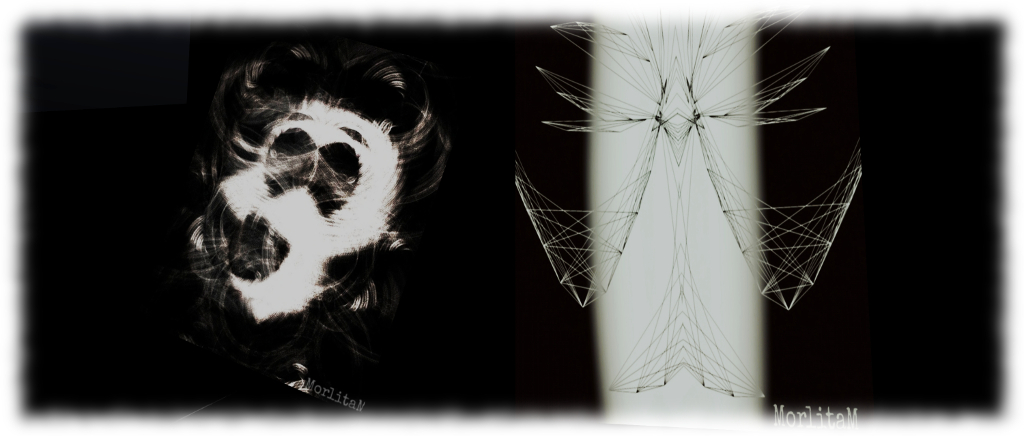
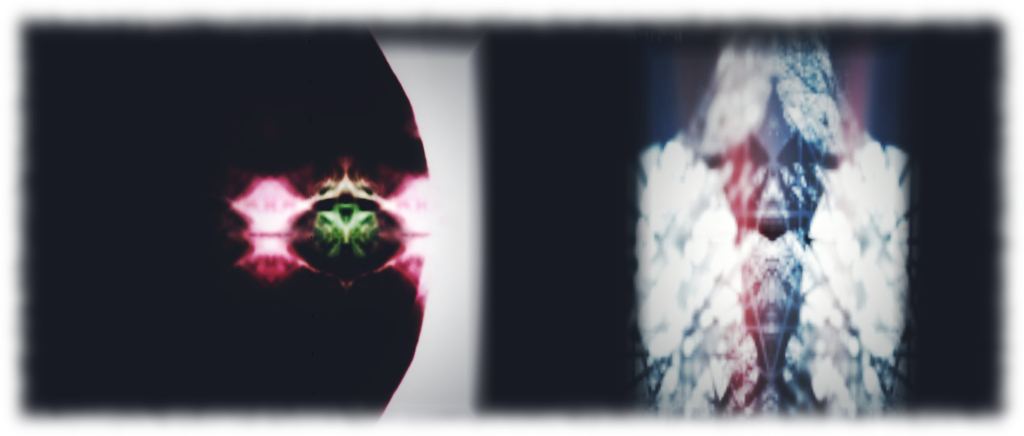
This comprises a path through a series of halls and rooms in which Mori’s art is displayed, the route through them indicated by black or white arrows on floors and walls. The art itself is offered on a huge scale, from drape-like hangings you must walk through, to pieces forming floors and ceilings, as well a those hanging on walls. They are, perhaps, a little too huge – but I’ll come back to that.
The final part of the exhibit takes you along the top of the walls separating the various rooms, allowing you another view of the art on display. at the end of this, a teleport drops you to a 3D element, a flower-like structure surrounded by floating cubes. Touch a white cube at the base of “stem” of this, and you’ll be seated within the “petals”, where touching the surrounding ring of coloured triangles and the small spheres below them will allow you to play various notes and tones. From here, a ramp leads you back into the installation while a teleport board takes you back the MetaLES landing point.
Quantifying Wild Lost Line is difficult. I find Mori’s work to be its most captivating when a piece can be seen in its entirety. This allows one to fully appreciate its complex beauty, the use of line, colour, shade and pattern to present something deeply organic yet also clearly geometrically defined. Such is the overwhelming size of the pieces present in Wild Lost Line, my deeper appreciation born of this appreciation of complexity and form was lost amidst the technicalities of camera juggling and an inability to easily encompass all of a single piece comfortably in my view. Thus, I found myself conflicted in touring the installation.
However, you may see things differently – so why not pay a visit?
The following notes are taken from the Content Creation User Group meeting, held on Thursday March 9th, 2017 at 1:00pm SLT at the the Hippotropolis Campfire Circle. The meeting is chaired by Vir Linden, and agenda notes, etc, are available on the Content Creation User Group wiki page.
HTTP Fetching
As I’ve noted in several recent SL project updates, the Lab is shifting the fetching landmarks, gestures, animations, shapes, sounds and wearables (system layer clothing) away from UDP through the simulators and to HTTP via the CDN(s).
The simulator side of the code is already in place on Aditi and awaiting further testing (see here for more). Vir is heading-up the viewer side changes required to support this work, which is now getting “petty close” to being available in a public viewer (most likely a project viewer). I’ll continue to update on this work through my various SL project update reports.
Rendering Costs
Vir has also been looking at the viewer-side rendering costs of various avatar models to improve the overall rendering cost calculations. This is more a data gathering exercise at the moment, but it is hoped it will lead to improved calculations when determining the overall rendering complexity of models, and will likely mean that, for example, the cost of rendering rigged meshes will at some point be updated.
This isn’t directly related to the potential of animating objects (e.g. for non-player characters). While the Lab is apparently still pondering on this as a possible project, it would mean back-end changes to calculate the land impact of avatar models used as NPCs, rather than alterations to the viewer-side rendering cost.
Animation Transitions
There have been, and continue to be, a number of issues with animation playback, some of which appear to be related to llSetAnimationOverride, one of the server-side functions for controlling your animation state. Some of these were reported early on in Bento, which exacerbated some of them (e.g. quadrupeds crossing their forepaws).
Issues can also occur with jump animation states (pre-jump, jump and landing), as has been reported in BUG-7488. For example, During the meeting, Troy Linden and Medhue Simoni pointed to problems: for Troy, it was with respect of an avatar “sticking” in the landing animation, rather than returning to the expected standing animation; Medhue reports issues in general playback, and whether the transitions will actually play correctly.
It not clear if these issues are all a part of the same problem, but feedback from the meeting is being relayed back to those at the Lab poking at things.
Information and Tools
People are still having problems finding Bento information on the SL wiki – such as the skeleton files. This is partially due to the files being on the Bento Testing page. It’s also not easy for new creators to find information on suitable tools (e.g. Avastar. MayaStar, etc.).
One suggested solution (allowing for the wiki currently being locked from general edits) is to have a general SL tools page where the various tools, etc. can be listed with links to their respective websites. This could include free tools: GIMP, Blender, Wingz 3D, etc.), plus tools which are not specific to SL can be used within (e.g. Maya, Zbrush, etc), and then add-ons like Avastar and Mayastar.
Such an approach, coupled with a clean-up of the Bento information, might be suited to being included in an overhaul of the wiki Good Building Practices pages the Lab is working on as and when resources are available. Troy has made a note to take these ideas back to the Lab.
Other Items
Transparency Rendering Cost
There was some discussion on whether the rendering cost of a rigged mesh should remain high if it is set to transparent. Some felt the cost should be lower, and Vir noted that the system avatar has a special UUID for an invisible texture when can reduce the rendering cost of the system avatar. However, rigged meshes may not be subject to this check, which may also depend on how the mesh is made transparent (i.e. via a texture or via the transparency setting). He also noted that rendering as transparent could add cost over rendering a rigged mesh as opaque.
There was some discussion on whether simply having the mesh in memory, whether or not it is rendered, could add to its complexity. Vir indicated that as he’s not precisely sure how things are handled, he’d have a look at the code.
Calling Animation UUIDs via Script without the Animation Residing in Inventory
A question was asked whether it would be possible to have a script call an animation via the animation’s UUID without the animation being physically in the parent object’s inventory. The short answer to this is “no”.
While animations can be pulled from objects with modify permissions and used elsewhere, many items with animations (chairs, beds, etc.), tend to have animations in them set to No Copy, limiting the ability to freely re-use them. If animations could be freely called via script using their UUID, this protection would be eliminated, as anyone with the UUID could use the animation as often as they wished, regardless of whether or not a version of the animation resides in their inventory.
This conversation edged into the issue of people being able to pull Copy permissioned inventory from a No Modify object by opening it; however, that is something of a separate situation, which was not discussed further.
Avastar Status
AvaStar is now at release candidate 4, with RC 5 on its way, which may be the final RC before a release.
.ANIM Exporter for Maya
Aura Linden is re-working the code on her open-source Maya .ANIM exporter. She was originally working on it in Maya’s MEL scripting, which would make it compatible with all versions of Maya.
However, after encountering some problems, she is now coding it in Python. This means the exporter will only initially work with versions of Maya supporting Python (version 8.5 onwards). It may be that once this work has been finished, Aura hopes to be able to go back and complete the exporter in MEL for older versions of Maya.
Mayastar Update
Cathy Foil will have an update for Mayastar appears shortly. When the .ANIM exporter is available (above), it will be folded in to Mayastar, although it is not exclusively for Mayastar.
Splitting the Avatar Shape into Different Elements
This was suggested some time ago as a possible Bento follow-up as a means of making it easier for users to mix and match heads and bodies by allowing different underpinning avatar shapes for both, which could be worn simultaneously. This was seen as particularly useful for users who are uncertain about customising their form using the sliders, or where creators provide No Modify shape with their head or body product, limiting the suer’s ability to modify one or the other. N definitive proposal has been put together on how this might be achieved.
Supplemental Animations
This was also the subject of early Content Creation meetings with Vir as a possible Bento follow-on project. The idea is to allow “supplemental” animations to run alongside the animation states keyed by llSetAnimationOverride(), effectively allowing them to play together, rather than conflicting with one another as is the case at the moment. This is still be considered, but no work has been carried out as yet.
Next Meeting
As Vir is out of the office in week #11, the next Content Creation meeting will be on Thursday, March 23rd, 2017 at 13:00 SLT.
Fantasy Faire 2017 will open to the public on Thursday, April 20th and run through until Sunday, April 30th, inclusive.
The largest gathering of fantasy designers, enthusiasts, role-players and performers in the virtual world, Fantasy Faire offers eleven days of shopping, live music concerts, DJ parties, auctions, hunts, Literary Festival, dance and theatre performances, fantasy art, events and role-play – all in aid of the American Cancer Society as a part of Relay for Life of Second Life.
2017 marks the ninth anniversary for Fantasy Faire, and the event this year will be held across fifteen regions, each offering a unique environment which can be explored and enjoyed through the event. These are split between ten themed worlds dedicated to fantasy and commerce, and five worlds to connect them through entertainment and more.
The ten commerce-centric worlds are:
Chaddul Ro by Searlait Nitschke: “An outpost of the orcs of Chal Khizzur, Chaddul Ro stands on the edge of their territory. In the centre of the outpost there is a beacon, rising above upon a tower guarded day and night by the orcs. It stands for strength; it stands against anyone who would douse it, a symbol to be seen to guide those from outside the protective barriers and walls back home. For the survivors that seek refuge from battle. It is believed that as long as the fires of the outposts are kept lit that there is always hope, sanctuary to be found and that the tribe remains strong.”
Dawn’s Promise by Marcus Inkpen and Sharni Azalee: “A secret place between times where the old becomes reborn into the new. Majestic crumbling ruins dissolve into a sea of glorious foliage. A place where the lost energies of the past are converted into new life. Springs of life-giving water overflow. Flower petals and creative energy float on the breeze. This is the space between the exhale and the inhale. Full of hope and promise.”
Fantasy Faire 2016: Lucentia by Marcus Inkpen and Sharnee Azalee
Egregore by Mayah Parx: “A fantastical thought form of serene darkness immersed in light, a place where expected purpose is relative and surrealism casts it shadow across the land, inhabited by egregors this fantastical place is born of the collective phantasmagoria of its people.”
Fallen Sands by Sweetgwendoline Bailey and Eldowyn Inshan: “Steampunk in a desert landscape where the Orient and Arabia via for dominance. Exotic plants of alien origin turn the sands into an oasis of life where the turquoise water is the treasure of fountains and the infinite pearls of tan fall to mark the passage of time in this eternal city.”
The Hill by Kilik Lekvoda: “A peaceful and beautiful village built into the rolling hills surrounding a small lake. Breathe in warmth, peace, and maybe a little pipe smoke, A place where friendships sprout as readily as the mushrooms beneath leafy green trees.”
Mudrana by Alrunia Ahn and Luna Barak: “Everyone in Mudrana, the land of the lilypad, praises the godfrog – the legends tell that once the godfrog falls asleep, the pond dries out, and everything dies. The frogs of Mudrana therefore croak and sing for their god to keep it awake to preserve the world from death.”
Raven’s Perch by Kaelis Ember and lrriven: “A Gothic dream in pale hues dotted with the tears of roses. A fairytale with thorns.”
The Rose by Alia Baroque: “In the Garden of senses silent footsteps echo through rich vaults of opulence and decadence, searching for the perfect spot where a stolen kiss can be unseen and languid murderous thoughts hidden behind a mask. This Rose blossoms in April through your gaze that tells her how beautiful she is.”
Fantasy Faire 2016: the Golden Delta by Alia Baroque
San Mora by Jaimy Hancroft and Eowyn Swords: “Once the centre of pharmaceutical greatness, San Mora is now a ruin of its former self. Quarantined at the outbreak of a deadly contagion of its own making, the population was left to survive the best they could. Without law and order the city descended into chaos. The fires have long since burned out, and the city is being reclaimed by a hostile Nature. But all that is silent is not necessarily empty. There are still those who roam among the ruins of San Mora.”
The Spirit Pool by Kayle Matzerath:”Since the beginning of time, The Spirit Pool has served as a resting place for weary adventurers and lingering souls that are not quite yet ready to cut their ties to the physical realm. Mermaids and other seafolk use the pool for gatherings and a constant flow of visitors keep it a popular place for trading.”
Fantasy Faire 2016: Breeze by Kayle Matzerath
The five connecting worlds will comprise:
Fairelands Junction by Saiyge Lotus: the heart of the Fairelands, the world where the veil between the worlds is thinnest, the Portal World to the others, the First Link of the Chain.
Opal Flight by Haveit Neox and Lilia Artis: the arts and entertainment region
Morbus by Kilik Lekvoda and Kayle Matzerath: the Fairelands Quest region
Kakushi Pasu by Lokii Violet: the Literary Festival region
Anansi (Beq Janus and Polysail: the Worldling Cradle – “This year the Fairelands bring the dream seeds with them, the outfits and shapes that they might have taken on, but did not. For now. Worldlings are Fairelands that could have been, Fairelands that might still be.”
Blogger registrations will open on Thursday, March 23rd.
As usual, I’ll be covering Fantasy Faire in these pages, but to keep right up to date with news and announcement, keep an eye on the links below. And to whet appetites, I’ll close with a video preview I shot for last year’s event.
Now open as the ground level of DaphneArts is a new interactive installation by Angelika Corral and Sheldon B, The Journey, which builds on their recent work with mixed media, notably with January’s celebration of Edgar Allen Poe (see: A dream within a dream: celebrating Poe in Second Life).
“The Journey is an imaginary world, telling a fantastical story, using metaphor, analogy and fable,” Angelika and Sheldon say of the installation. “Perhaps a different story to each and everyone, according what the individual is searching to find out, about who and what they are throughout life, as they make choices based on their experiences, beliefs, and outlook. But the search for meaning in life is a Hydra; one question answered leads to many more to contemplate…”
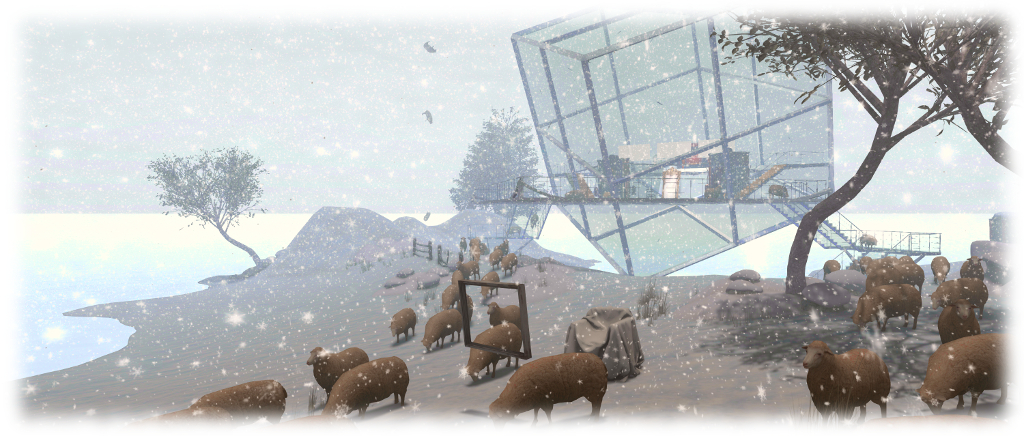
Visitors start their journey on the upper level of a large, cube-like glass and steel structure where they will be asked to allow the attachment of a HUD – which they should allow, as it provides the means to experience the interactive elements of the installation. Instructions on how best to view the installation are provided via information boards, including setting the preferred windlight (if your viewer doesn’t adopt it automatically), and a short video introducing the piece. Below this, on the main floor, sheep appear to be emerging from two large machines, pointing the way forward, to a snowy world outside the cube.
Core to the piece are three seats: one inside the cube, one out on the snow, the third on the water. sitting on them will trigger a recital of a poem, read by Angelika. All three poems offer reflections on life’s journey. Each of them – Fire, by Dorothea MacKellar, A Journey by Nikki Giovanni and Paul Laurence Dunbar’s We Wear The Mask – provoke thinking through their use of metaphor, give us pause to consider our own outlook on life and the journey we are taking through it.
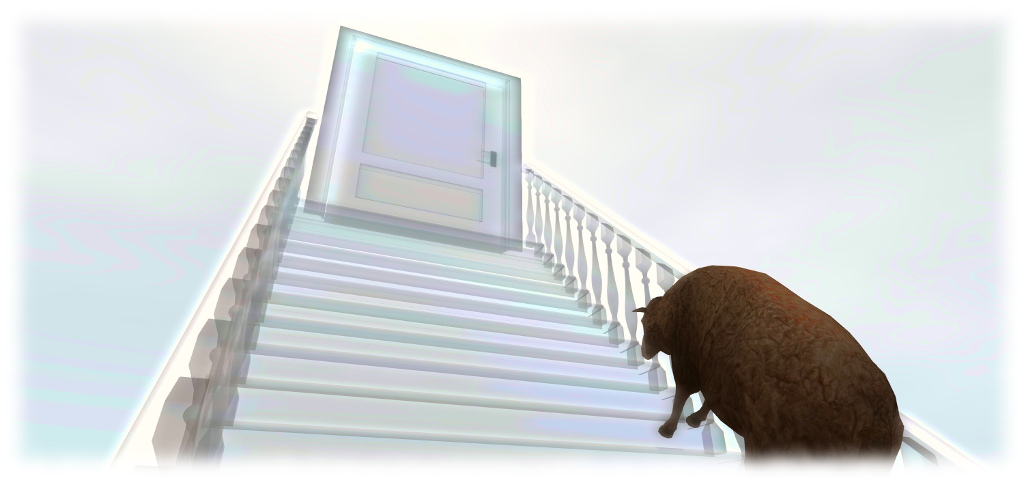
Metaphor is richly presented throughout the installation, from the poems themselves, to the guiding lines of sheep and fences (a reference to sleep, the gateway to our deepest imaginings, and thus to this imaginary world), to the crows with their reference to death, the inevitable destination of life’s journey, no matter how we attempt to dress it up – such as through a glowing ascent to the heavens. Even the snow falling thick and fast might be seen as a metaphor.
A journey is a fascinating piece, one which depends entirely upon our own experiences, outlook and desires / hopes / fears in life. It is a piece which, as Sheldon as Angelika note, for every question asked and possibly answered, a dozen more raise their heads. Thus, interpreting the installation is genuinely a subjective matter, driven by the questions we bring to it, and those which follow them.
Now open at Split Screen, curated by Dividni Shostakovich, is Bleeding Books, an installation by Haveit Neox which offers a commentary on how language and information can be both abused and overwhelming.
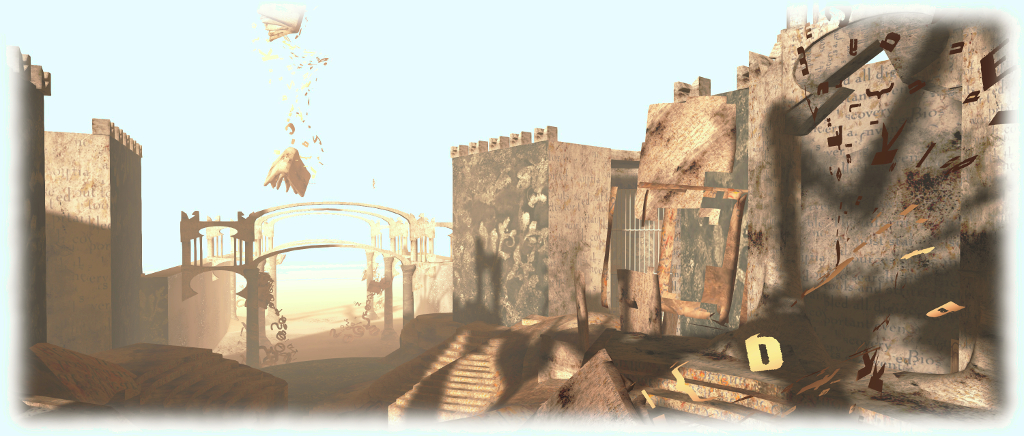
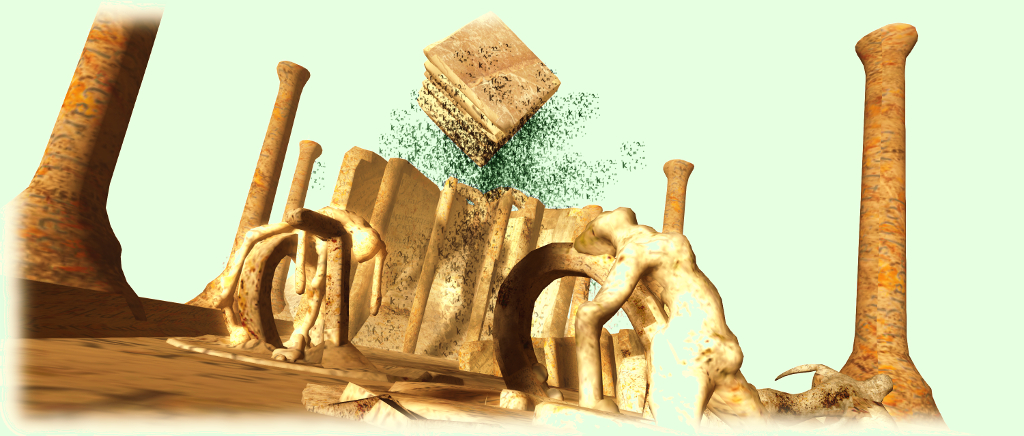
Three huge platforms float in the sky; one is the landing point where information on the installation and Split Screen can be obtained. The remaining two, one reached via a walk through a tornado of golden letter and the other by flying down to it, offer huge columned but roofless halls. The floors of each resemble printed pages from which stone letters partially rise, draped with human figures who appear to be merging with them. Over both, giant books spill a black torrent of letters.
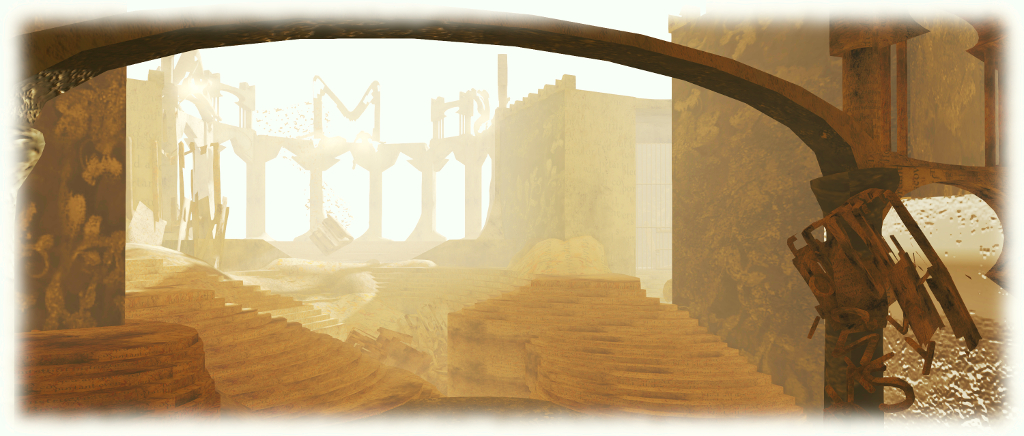
Beneath all three, at ground level (fly down to reach it) is an enormous fortress, slowly decaying, the roof gone, the floors pitted and broken, the walls collapsing. Throughout its bulk can be found the essence of words: letters can be seen parts of the walls or hang like broken chains from columns, printed pages form the lumps and undulations of the floor. More letters are locked within great cells, or have fallen into the pitted floor.
“It is a story in my ongoing series on abuse as seen through the lens of language,” Haveit says of the piece. “What happens when knowledge is so disrespected that it is freely contaminated with doses of falsehood? There are avenues to properly sort facts in this information age, yet we easily turn a blind eye to certain evidence if it goes counter to our beliefs – even when our choices may cause immeasurable harm.”
In truth, words and literacy have always been seen as a focus of power (such as the withholding of literacy from the masses in times long past) and as a means of conducting war (be it hot or cold, political or ideological, through the use of propaganda and misinformation). What makes Bleeding Books perhaps particularly relevant is that today, we collectively have access to so many channels of communication and alongside them, so much data and information, that the ability to freely contaminate what we read, see and hear is becoming a significant issue.
Worse still, facts and counter-facts are increasingly forced to vie with so-called “alternative facts” and outright misinformation, that it is often far easier for us to retreat into our own bias and seek only the information which fits that bias, no matter how damaging it might be politically, ideologically, ecologically or personally in our health and daily lives.
Thus the metaphor is clear: such is the flood of information flowing around, over and even through us, that the power of words to define truth, objectivity, reason, understanding – their very ability to present reality to us – is being eroded and broken, both intentionally by others and through our own unwillingness to set aside our own biased outlook, no matter what the consequences.
Bleeding Books is not necessarily an easy piece to understand, nor may it sit easy on the conscience. But neither of these points mean it should be avoided. Rather, it is a piece that the longer you spend within it, the more clearly it speaks to you.
While we’re all awaiting the arrival of the new Second Life Community Platform, Linden Lab took the opportunity to deploy an updated Second Life home page at secondlife.com.
Now, if you’re generally logged-in to your Second Life dashboard, you’ve probably not noticed. While I did notice while twiddling around waiting for the Community Platform, it didn’t exactly register with me for various reasons – so my thanks to Whirly Fizzle for the extra nudge, and to Pete Linden for confirming I wasn’t going entirely bonkers.
To see the new layout if you are normally logged-in to your dashboard (at secondlife.com), you’ll have to log out. If you don’t tend to log-in to your dashboard, you should see the updated layout by simply going to secondlife.com.
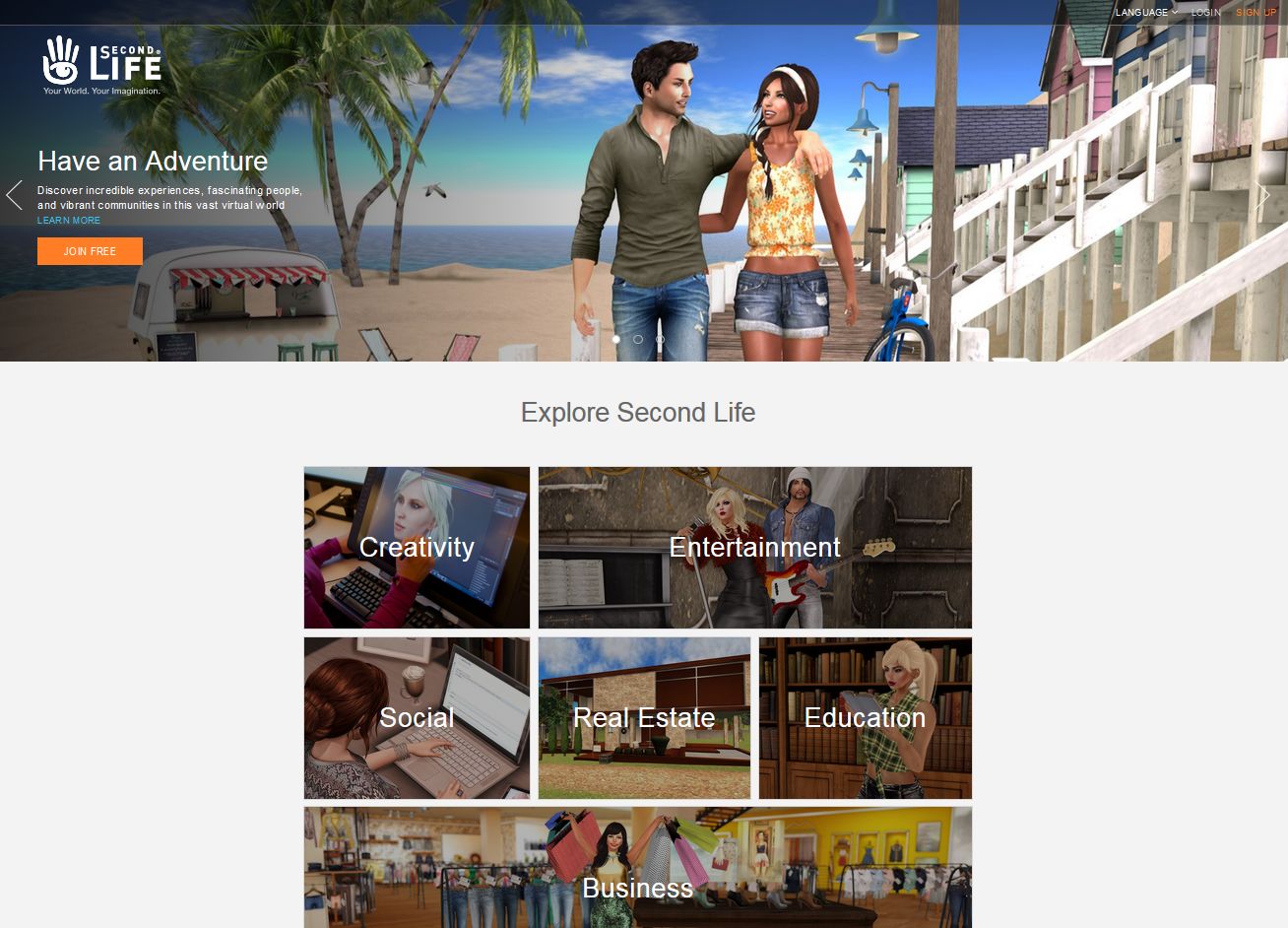
A portion of the new secondlife.com home page (seen when you are *not* logged in to your dashboard!)
At the top is a set of banner images, which periodically change. These include the sign-up, log-in and language options in the top right corner, together with the SL logo and old strapline “Your World, Your Imagination” on the left. Beneath this, and changing with the images, is descriptive text together with a LEARN MORE button.
Depending on the banner image displayed, clicking LEARN MORE will either take you to the business or creators Community Landing Pages, or display the Destination Guide. Each banner also include a JOIN button which will launch the sign-up button.
Below this is a further section providing more insight into Second Life in the form of a set of tiled images – Creativity, Entertainment, Social, Real Estate, Education and Business. Four of these – Creativity, Social, Education and Business – again link to their respective Community Landing Page. Of the remaining two, Real Estate provides an overview of land “ownership” in Second Life, while hovering the mouse over the Entertainment tile will display a series of five category buttons. With the exception of the GAMES button, which goes to the Games section of the Destination Guide, these also all go to their associated Community Landing Page.
The Entertainment tile on the revamped homepage, displaying the five category buttons
Below this there is a further section linking to the Destination Guide, before a section displaying one of the Drax Files World Makers series, together with a link to YouTube channel for the series.
The entire design is fresh and clean and, as noted, has much in common with the Community Landing pages and the Places pages, helping to present something of a unified front end to the Second Life web spaces (although the Places pages do stand slightly apart, as they are designed to be customised by users).
While they have yet to be seen in the flesh, it would appear the new Community Platform pages may have something of a similar approach as well, although we will, at the time of writing, have to wait a while longer to see those.







 Inara Pey: Living in a Modemworld