Philosophical frenemies: Altberg and Rosedale

High Fidelity - a composite promotional shot. Credit: High Fidelity (via Wired)
High Fidelity – part of a composite promotional shot. Credit: High Fidelity (via Wired)

Yesterday, a Tweet from Jo Yardley pointed me to an interesting article in Wired by Rowland Manthorpe, entitled Second Life was just the beginning. Philip Rosedale is back and he’s delving into VR. It’s a lengthy, fascinating piece, arising out of a week Manthorpe spent with High Fidelity, while also taking time to poke his head around the door of Linden Lab, offering considerable food for thought – and it kept me cogitating things for a day, on-and-off.

There’s some nice little tidbits of information on both platforms scattered through the piece. For those that have tended to dismiss High Fidelity as a place of “cartoony” avatars, the images provided with the article demonstrate that High Fidelity are walking along the edge of the Uncanny valley; compare the Rosedale-like figure seen the a High Fidelity promo shot within it with a photo of the man himself (below). There’s also further indication that in terms of broader creativity and virtual space, High Fidelity is “closer” to the Second Life model of a virtual world than Sansar will be.

On the Lab’s side of things, we also get confirmation that multiple instances of the same space in Sansar will not be in any way connected (“One school group visiting the Egyptian tomb won’t bump into another – they will be in separate, identical spaces.”). There’s also a hint that Linden Lab may still be looking at Sansar as a “white label” environment.

High Fidelity can still be critiqued by some in SL for it's "cartony" avatar. The reality is however, that for those who wish, avtars in High Fidelity can be extremely life-like, as this picture of what Philip Rosedale might look like in High Fidelity (r) shows when compared to an actual photograph of him. Credits: High Fidelity / Jason Madara
High Fidelity can still be critiqued by some in SL for its “cartoony” avatar. The reality is however, that for those who wish, avatars in High Fidelity can be extremely life-like, as this picture of what Philip Rosedale might look like in High Fidelity (r) shows when compared to an actual photograph of him. Credits: High Fidelity / Jason Madara

But what really makes the piece interesting is the philosophical differences apparent in developing these platforms; each is very much rooted in the nature of the man at the helm of each company.

Rosedale is a dreamer – and that’s not a negative statement. He’s been driven by “dreams” and “visions” throughout most of his post Real Networks career. He also leans heavily into the collaborative, open borders model of development. Both have influenced the working spaces he builds around him. Reading Manthorpe’s piece, the High Fidelity office appears to be run along a similar laissez-faire approach as marked the early years at Linden Lab:  people dabble in what interests them, focused on the technology; there’s a belief that if the company cannot solve a problem (such as practical in-world building using hand controllers), someone “out there” will, and all will be well.

By contrast, Altberg is more consumer / direction oriented with Sansar. Initial market sectors have been identified, work has been broken down into phases. A structured development curve has been set; as we’ve seen from Lab Chat and other sessions, there’s a reasonably clear understanding of what should be tackled first, and what can be pushed further down the development path. The platform itself is closed, controlled, managed.

Sansar Screen Shot, Linden Lab, August 2016, on Flickr Sansar (TM) Screen Shot, Linden Lab, October 2016, on Flickr

In adopting these approaches, and given their somewhat complicated business relationship (Rosedale still have “sizeable” financial holding in Linden Lab; linden Lab was one of the small investors in High Fidelity’s $2.4 million round of seed funding), Rosedale and Altberg describe their relationship as “frenemies”. They are both working towards similar goals, and dealing with the same consumer-facing technology, and are equally sniffy of the other’s product. Rosedale sees Sansar is being potentially too closed, too pigeon-holed in terms of how it will be perceived by consumers; Altberg sees High Fidelity as being to focused on the technology, and perhaps demanding more effort than most on-line consumers in the Facebook pre-packaged content age might be willing to invest.

When looked at from outside, the Rosedale / High Fidelity approach is perhaps more in keeping with the state of VR once all the hyperbole surrounding it is brushed aside:  VR may well be part of our future, but no-one can honestly say at this point just how big a part of our future it will be. The Altberg / Linden Lab approach is rooted business pragmatism: identify your markets and seek to deliver to those markets; build your product to reflect the market as it grows.

Neither approach is necessarily “right” or “wrong”, and there is certainly no reason why both cannot attract their own market share. But I have to admit I find myself leaning more in Altberg’s direction.

This is admittedly partly because a lot of Rosedale’s broader comments about High Fidelity, the Internet, etc., come across as re-treads of things said ten years ago about Second Life and a transformative future never realised. But it’s more particularly because  – as noted above – no-one really knows how pervasive VR will be on a broad level. Other technologies such as augmented reality (AR) and mixed reality (MR) currently lie within the shadow cast by the hyperbole surrounding VR, but have the potential for far greater impact in how we conduct our lives and business. So identifying a market share and aiming for it seems to be the more solid approach insofar as establishing a user base and revenue flow might be concerned*.

Time will obviously tell on this; but one fact is clear: however you regard the philosophies held by Rosedale and Altberg, Manthorpe’s article is a must read. A considered, well presented, in-depth piece, it is sits as a catalyst for considerable thought and potential discussion.

*Edited 25 October 2015, to include this sentence, which was accidentally removed from the initial publication of this piece.
2016 viewer release summaries: week 42

Updates for the week ending Sunday, October 23rd

This summary is published every Monday, and is a list of SL viewer / client releases (official and TPV) made during the previous week. When reading it, please note:

  • It is based on my Current Viewer Releases Page, a list of all Second Life viewers and clients that are in popular use (and of which I am aware), and which are recognised as adhering to the TPV Policy. This page includes comprehensive links to download pages, blog notes, release notes, etc., as well as links to any / all reviews of specific viewers / clients made within this blog
  • By its nature, this summary presented here will always be in arrears, please refer to the Current Viewer Release Page for more up-to-date information.

Official LL Viewers

  • Current Release version: 4.1.1.320331 (dated dated October 4th), promoted October 10th – no change
  • Release channel cohorts (please see my notes on manually installing RC viewer versions if you wish to install any release candidate(s) yourself):
    • Project Bento  RC (avatar skeleton extensions), updated to version 5.0.0.320815 on October 20th – parity with release viewer, minor fixes
    • Maintenance RC viewer updated to version 4.1.2.320804 on October 20th – parity with release viewer
  • Project viewers:
    • No updates.

LL Viewer Resources

Third-party Viewers

V4-style

V1-style

  • Cool VL viewer Stable branch updated to version 1.26.18.29 and the Experimental branch updated to version 1.26.19.31, both on October 22nd (release notes).

Mobile / Other Clients

Additional TPV Resources

Related Links

A metaphorical Tumor in Second Life

MetaLES: Tumor
MetaLES: Tumor

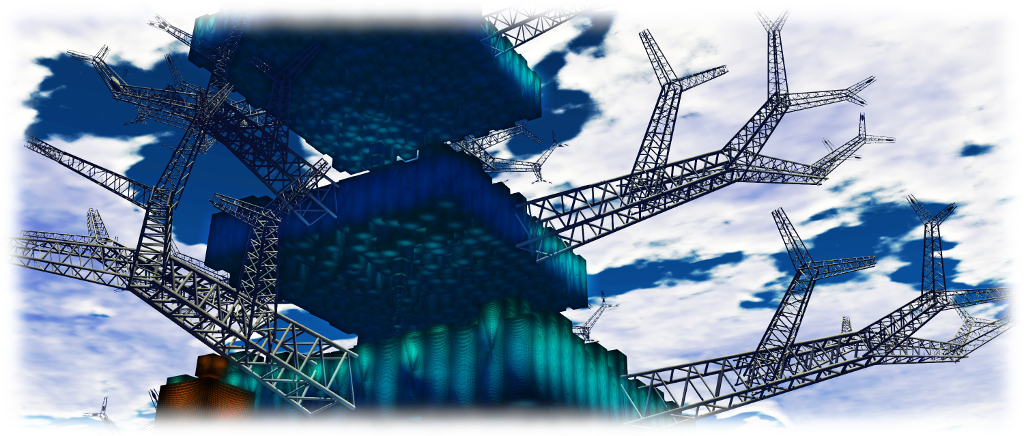
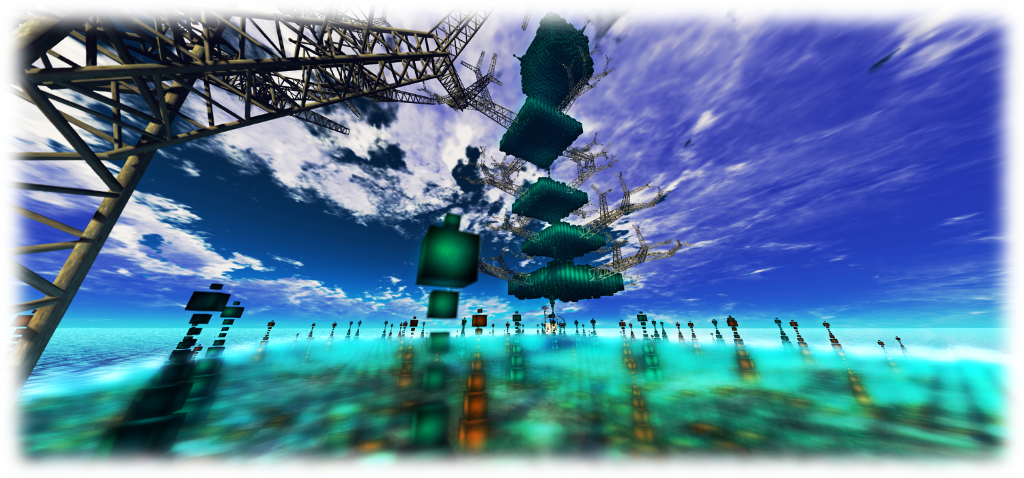
“This work is my acknowledgement of greed for material things of human kind which is so powerful that it is going to cost us our own existence,” Igor Ballyhoo states of his new installation, Tumor, now open at MetaLES. “This is not [an] effort to fight it, it is not made in least hope to change anything, it is just a recording of my observation of human society at this point.”

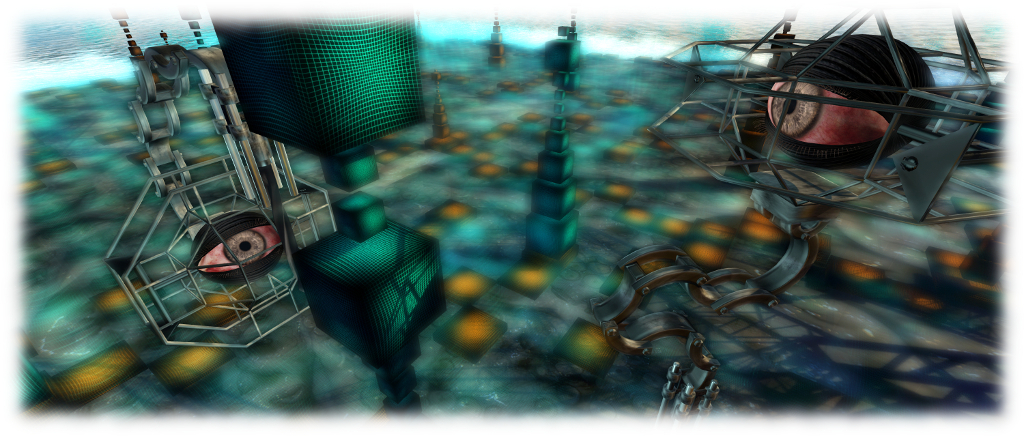
Across a flat, misted plain – reached via teleport of the region’s skyborne landing point – strange structures rise, strange cubic conifers, denuded of branches and leaves. Underfoot, square stepping-stones of brown earth vie with an oily, sludge-like morass pulsating around them, The glowing mist hovers above this, with closer examination revealing it to be sheets of a digital grid pattern which blurs this strange, almost alien landscape into a soft focus.

MetaLES: Tumor
MetaLES: Tumor

But none of this holds the attention for long. Across the region a massive steel pylon raises multiple arms splitting and branching over and again as they reach into the sky. It stands as the embodiment of a the great metal pylons which march across many countries of the world, feeding our insatiable need for energy. Even the metal arms, rising into pincer-like pairs which seem to pluck and pull at the ball of the Sun overhead, offer a further metaphor for our energy greed.

More of these grasping metal arms and fingers can be seen overhead, stretching out from the sides of huge structures rising into the sky. Their blocky forms shimmering in the sunlight and defying the eye to pick out details, they rise one atop the last like great drilling platforms, oblivious of the strange, denuded and oozing landscape below, topped by a strange gigantic cube of cubes.

MetaLES: Tumor
MetaLES: Tumor

As a statement and as an art installation, Tumor is a powerfully visual piece, underlined by its dedication to  Georgina Hope “Gina” Rinehart, climate change sceptic and CEO of Hancock Prospecting, a company which could be said to have questionable concerns over the environmental impact of its projects. It will remain open until the end of November. At the time of writing, it overlaps lanjran Choche’s photographic exhibition, 5Y Smoking, which can also be reached via teleport from the landing point.

SLurl Details

Tumor (MetaLES, rated Moderate)

Space Sunday: success, loss and safe modes

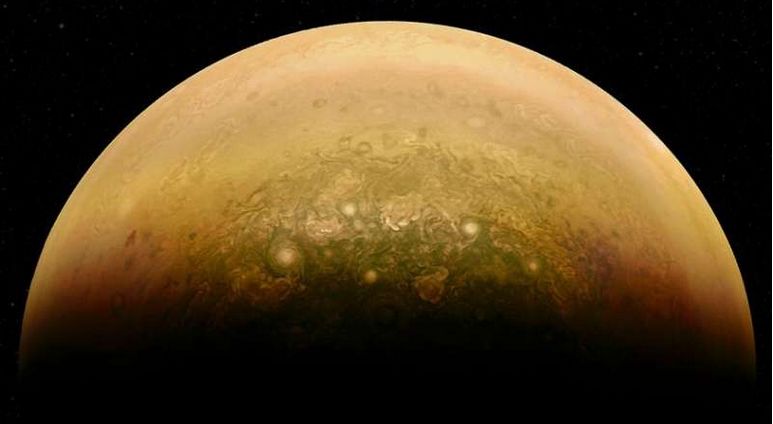
A colour-enhanced image of Jupiter's south pole, created by "citizen scientist" Alex Mai, as a part of the public Junocam project. using data from Juno's JunoCam instrument. Credit: NASA/JPL / SwRI / MSSS / Alex Mai - see later in this article for an update on the Juno mission
A colour-enhanced image of Jupiter’s south pole, created by “citizen scientist” Alex Mai, as a part of the public JunoCam project. Credit: NASA/JPL / SwRI / MSSS / Alex Mai – see later in this article for an update on the Juno mission

On Wednesday, October 19th, 2016, the European Space Agency (ESA) attempted, for them, a double first: placing a vehicle successfully in orbit around Mars (the Trace Gas Orbiter, or TGO) and landing a vehicle on the planet’s surface (the Schiaparelli demonstrator).

Launched in March 2016, TGO is the second European orbiter mission to Mars, the first being Mars Express, which has been operating around the red planet for 12 years. TGO’s mission is to perform detailed, remote observations of the Martian atmosphere, searching for evidence of gases which may be possible biological importance, such as methane and its degradation products. At the same time, it will to image Mars, and act as a communications for Europe’s planned 2020 Mar rover vehicle.

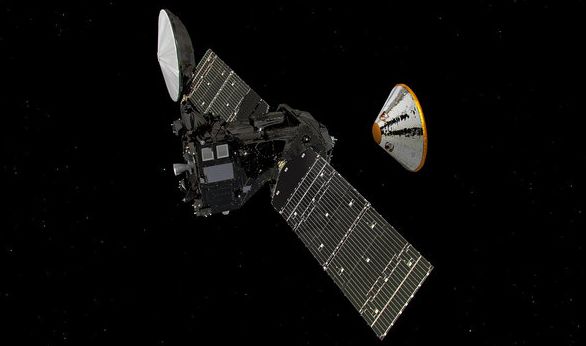
October 16th, 2016: the Schiaparelli EDM separates from ESA's TGO, en-route for what had been hoped would be a safe landing on Mars. Credit: ESA
October 16th, 2016: the Schiaparelli EDM separates from ESA’s TGO, en-route for what had been hoped would be a safe landing on Mars. Credit: ESA

TGO’s primary mission won’t actually start until late 2017. However, October 19th marked the point at which the vehicle entered its preliminary orbit around Mars.  Orbital insertion was achieved following a 139-minute engine burn which slowed the vehicle sufficiently  to place  it in a highly elliptical, four-day orbit around Mars. Early next year, the spacecraft will begin shifting to its final science orbit, a circular path with an altitude of 400 km (250 mi), ready to start its main science mission.

On Sunday, October 16th, prior to orbital insertion, TGO had bid farewell to the 2-metre diameter Schiaparelli  Entry, Descent and Landing Demonstrator Module (EDM), which it had carried to Mars. The EDM was specifically designed to gather data on entry into, and passage through, the Martian atmosphere and test landing systems in preparation for ESA’s 2020 rover mission landing. 

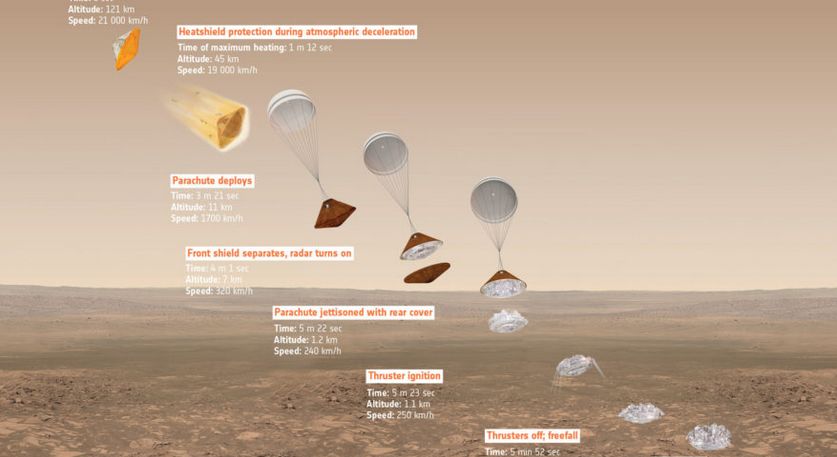
Schiaparelli's route to the surface of Mars. Credit: ESA
Schiaparelli’s route to the surface of Mars (click for full size). Credit: ESA

Once separated from TGO, Schiaparelli travelled ahead of the orbiter, entering the Martian atmosphere at a speed of 21,000 km/h (13,000 mph; 5.8 km/s / 3.6 mi/s), at 14:42 UT on October 19th. After using the upper reaches of the Martian atmosphere to reduce much of its velocity, Schiaparelli should have proceeded to the surface of Mars using a mix of parachute and propulsive descent, ending with a short drop to the ground, cushioned by a crushable structure designed to deform and absorb the final touchdown impact. Initially, everything appeared to go according to plan. Data confirmed Schiaparelli had successfully entered the Martian atmosphere and dropped low enough for the parachute system to deploy. Then things went awry.

Analysis of the telemetry suggests Schiaparelli prematurely separated from its parachute, entering a period of free fall before the descent motors fired very briefly, at too high an altitude and while the lander was moving too fast. Shortly after this, data was lost. While attempts were made to contact the EDM using ESA’s Mars Express and NASA’s Mars Reconnaissance Orbiter (MRO) it was not until October 20th that Schiaparelli’s fate became clear.

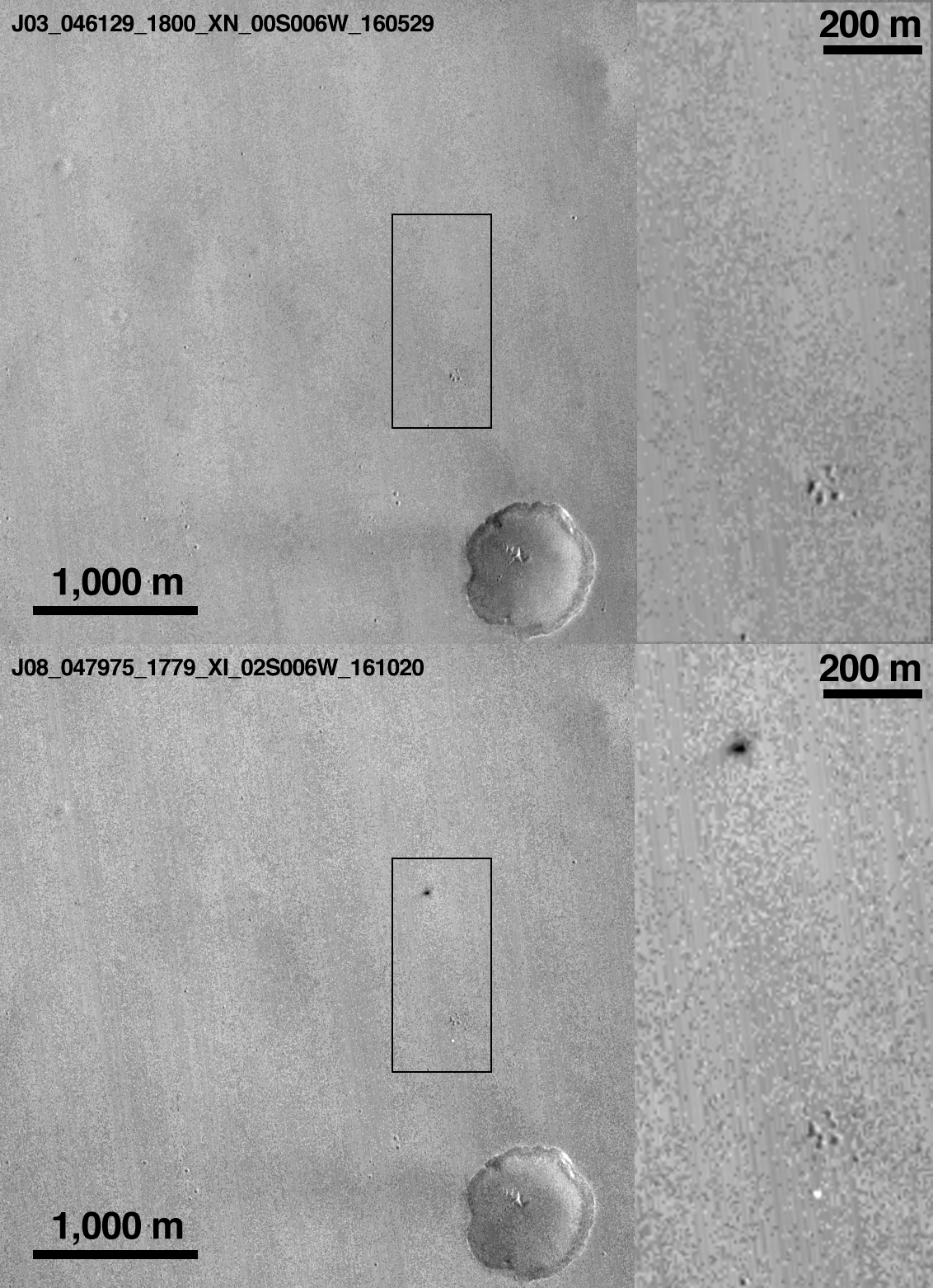
Images taken by MRO  of Schiaparelli’s landing zone revealed a new 15x40m (49x130ft) impact crater, together with a new bright object about 1 kilometre south of it. The crater is thought to be Schiaparelli’s impact point, and the latter the lander’s parachute and aeroshell.

In releasing the NASA images on October 21st, the European Space Agency stated,”Estimates are that Schiaparelli dropped from a height of between 2 and 4 km (1.4-2.4 mi), impacting at a  speed greater than 300 km/h (186 mph). It is also possible that the lander exploded on impact, as its thruster propellant tanks were likely still full.”

Point of impact: on the left, images of Schiaparelli's landing zone taken in May 2016 and on October 20th, 2016, superimposed on one another, the October 20th image clearing showing an impact feature. On the right, an enlarged view of the same two images, showing the impact feature and, south of it, the white canopy of Schiaparelli's parachute. Credit: NASA/JPL / MSSS
Point of impact: on the left, images of Schiaparelli’s landing zone taken in May 2016 and on October 20th, 2016, superimposed on one another. The October 20th image clearly shows an impact feature with a bright object to the south, thought to be Schiaparelli’s parachute canopy. On the right, an enlarged view of the same two images. Credit: NASA/JPL / MSSS

While the lander carried a small suite of science instruments which would have been used to monitor the environment around it for a few days following the landing, the major part of the mission was to gather data atmospheric entry and the use of parachute and propulsive descent capabilities. ESA believe this part of the mission to have been a success, even with minimal data gathered on the propulsive element of the descent.

In the meantime, TGO is currently on a 101,000 km x 3691 km orbit (with respect to the centre of the planet). It is fully functional, and will undertake instrument calibration operations in November, prior to commencing the gentle aerobraking manoeuvres designed to reduce and circularise its orbit around Mars.

Continue reading “Space Sunday: success, loss and safe modes”

Graveyards, Lucifer, the fantastic and the spooky in Second Life

It’s time to kick-off a week of story-telling in voice, brought to our virtual lives by the staff and volunteers at the Seanchai Library. As always, all times SLT, and events are held at the Library’s Second Life home at Bradley University, unless otherwise indicated.

Sunday, October 23rd 18:00 Magicland Storytime

TheGraveyardBook_HardcoverJoin Caledonia Skytower as she reads selections from Neil Gaiman’s 2009 Newbery Medal winning children’s fantasy novel, simultaneously published in Britain and America during 2008, which also collected the annual Hugo Award for Best Novel from the World Science Fiction Convention and the Locus Award for Best Young Adult Book selected by Locus magazine subscribers.

Nobody Owens, known to his friends as Bod, is a normal boy. He would be completely normal if he didn’t live in a sprawling graveyard, being raised and educated by ghosts, with a solitary guardian who belongs to neither the world of the living nor of the dead. There are dangers and adventures in the graveyard for a boy. But if Bod leaves the graveyard, then he will come under attack from the man Jack—who has already killed Bod’s family . . .

Monday October 24th, 19:00:  The War Hound and the World’s Pain (Von Bek #1)

von-bekGyro Muggins opens the covers of Michael Moorcock’s 1982 supernatural novel.

Europe, the 17th century: nations are ravaged by the Thirty Years’ War, driven by religion and engulfing most of the Great Powers. Weary of the fighting, disillusioned, faithless and cynical, Ulrich von Bek, the War Hound, deserts his troops and travels through a Germany ruined by the war and religious persecution.

Coming to a strange forest, he finds within it a castle which appears to have escaped the war. He decides to seek shelter within its walls – only to find this is no ordinary castle. The lord within it is none other than Satan himself.

Von Bek discovers he has been allowed into the castle so that Satan might seek his help. In return for his soul, the Devil asks him to seek out the Cure for the World’s Pain, so that Satan might use it as proof to God that he wishes to be reconciled with heaven.

The hosts of Hell, however, aren’t that keen on the idea of reconciliation…

Tuesday October 25th, 19:00: Fantastic Tales: Visionary and Everyday

With this posthumously published anthology and  successor to his best-selling Italian Folktales, Italo Calvino, a contemporary surveyor of the otherworldly, pays homage to twenty-six of his nineteenth-century precursors.

Join Trolley Trollop on a journey through this volume, which is both an education in the history of fantastic literature and a roller-coaster ride of wonder and terror, vampires, ghosts, and the rebellious creatures of our own psyches.

Wednesday October 26th, 19:00: Haunts and Ghosts

Shandon Loring reads from his personal haunted library!

Thursday, October 27th, From the Shadows

More spooky tales with Shandon Loring in Second Life and Kitely. Check Kitely event announcements for specific grid location

Sunday October 30th, 13:00: The Great Boo at Holly Kai Park

A buffet of the scary, the spooky, and other thrilling tales of the season.  Two hours of stories with a delightful selection of storytellers, live in voice at the Storyteller’s Circle, Holly Kai Park!


Please check with the Seanchai Library SL’s blog for updates and for additions or changes to the week’s schedule.

The featured charity for September-October is Alex’s Lemonade Stand Foundation (ALSF), a childhood cancer foundation dedicated to raising funds for research into new treatments and cures for all children battling cancer.

Additional Links

Revisiting the Reshade injector with Second Life

Reshade is a real-time post-process injector allwoing you to overlay Second Life with various shader options, individually or collectively, to produce assorted effects and results
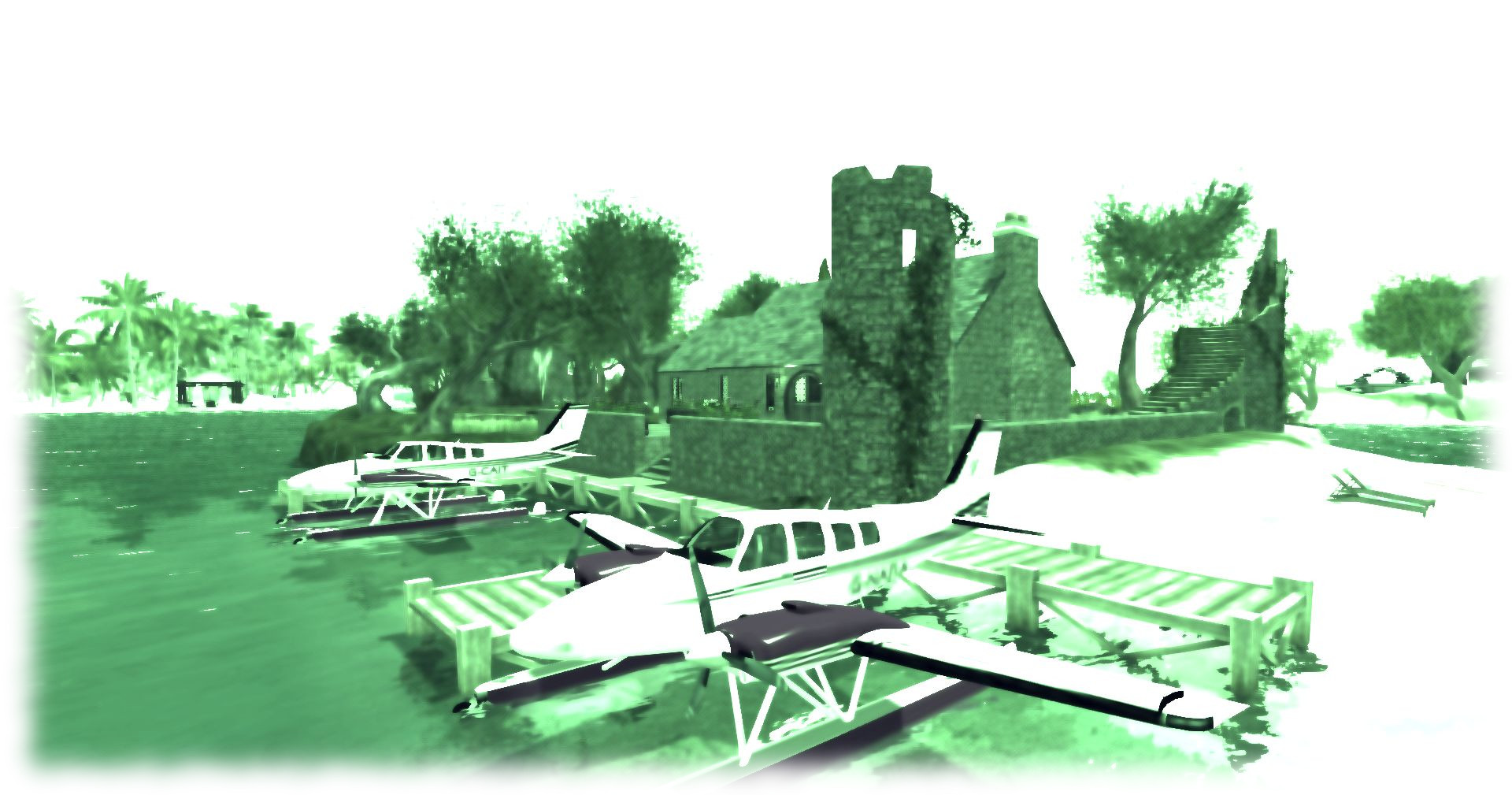
Reshade is a real-time post-process injector allowing you to overlay Second Life with various shader effects, individually or collectively, to produce assorted results, real-time, in both images and video

Back in August 2015, I blogged about Reshade, a post-processing injector for games and video software available for Windows. When installed and associated with a game or application like Second Life, it can be used to overlay the screen with a wide range of shader-based effects. These can them be used in screen captures or when recording machinima, to provide “real-time” visual effects.

Since that time, Reshade has been through a couple of iterations, with version 3.0.3 appearing on October 21st. As I’ve not revisited Reshade since that 2015 article, I thought I’d provide a short overview of installation and general use of this latest version.


A quick and dirty demo video I made with Reshade 1.0, showing how it can be used used in Second Life machinima filming

Installation

Please ensure you’re logged out of Second Life when setting-up ReShade.

  • Go to the Reshade website and download the installer, double-click to run it.
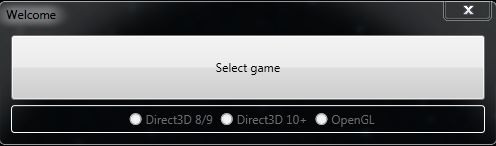
  • You will be prompted to select a programme for association with Reshade:

install-1

  • Click Select Game and navigate to the installed folder of the viewer with which you want to use Reshade and click on the viewer EXE file.
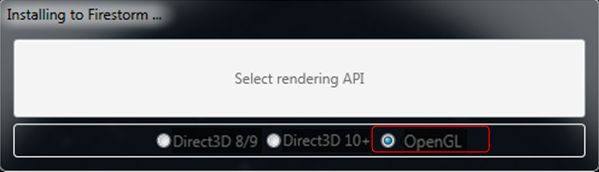
  • You will be prompted to Select Rendering API:

install-2

  • Click on OpenGL (note this may already appear to be selected – click on it anyway). You will be asked if you want to install the shaders- make sure you do.
  • The shaders will be downloaded and installed in a folder in your viewer’s installation location on your computer.
  • The Reshade installer will report Done, and can be closed.

To associate Reshade with any other viewer you have installed on your PC, you will have to follow these instructions again. You do not necessarily have to install the shaders again (although this is easiest) – you can set any additional versions of Reshade to point to shaders already installed.

Using Reshade

Note: the following is not intended to be an exhaustive guide to using Reshade. It is intended to get you started. The best way to gain familiarity with Reshade is to use it; should you need additional assistance, please refer to the Reshade forums. I don’t profess to be an expert in the applications, and will probably not be able to help with detailed technical support!

Reshade is available whenever you launch the viewer with which it has been associated. To access it, press SHIFT-F2. This will display the UI panel which may enter Tutorial mode, if you haven’t saved any presets.

  • Click the Continue button in the Reshade panel.
  • The preset selection bar will be highlighted. Click on the + button to the right of it to open the Name bar, and type in anything you like – this will become the name of a preset INI file, which yo can save and then select at a later date, loading all the sahder settings you have established in it.
  • The available shaders are loaded (and highlighted in red in the tutorial). Read the explanatory text and click continue.
  • The settings panel is highlighted and briefly explained. Read and click Finish.
  • The full Home tab will be displayed.
The Reshade Home tab
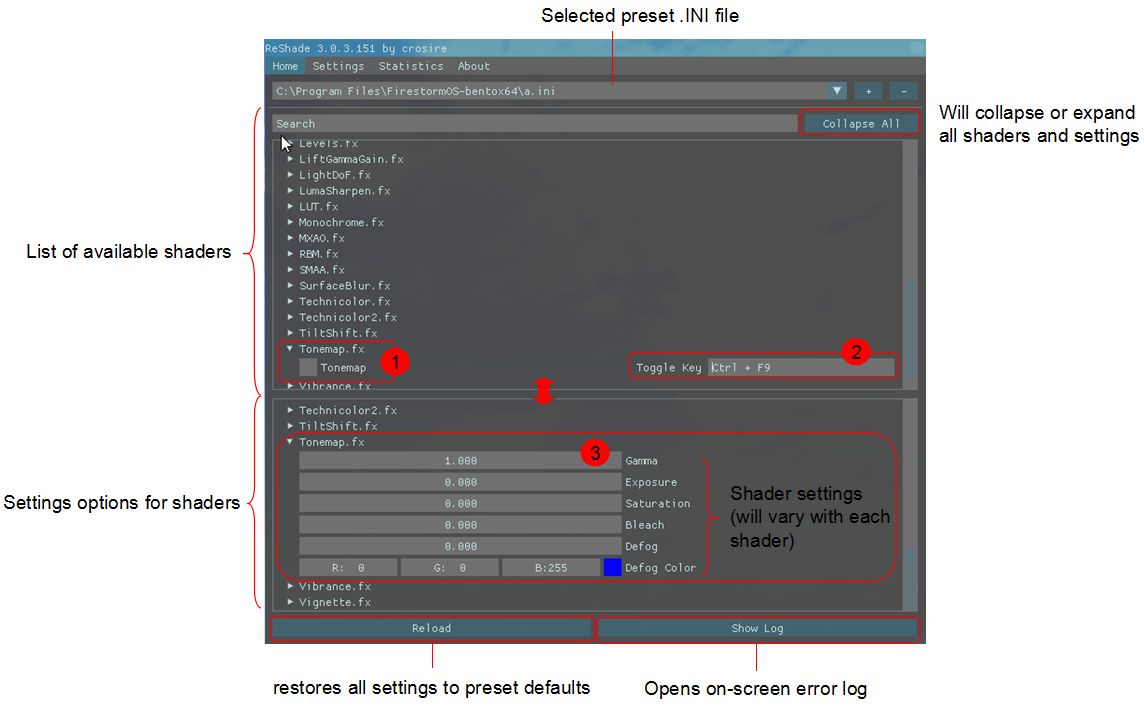
The Reshade Home tab – click for full size

This comprises 5 sections:

  • Preset selection area (top), with + (create a new preset INI) and – (delete selected preset INI)
  • The shader search bar  – type in all or part of a shader to display just that shader and its settings options. This also includes the Collapse / Expand toggle for opening / collapsing all shaders in the upper and lower panes of the tab
  • A scrollable list of available shaders. Clicking on any one of these will open it to display the activation button (1), above, and the hotkey toggle option (2), above – you can type-in any key combination you like here to automatically select the shader.
  • A scrollable list of settings, by shader (3), above).
  • The Reload button (reset everything to defaults) and Show error log buttons.

The two main panes in the tab – shader list and settings – can be adjusted by clicking on the divider between them and moving it up or down.

Continue reading “Revisiting the Reshade injector with Second Life”