Casablanca: Rick’s Café Américain – “Of all the gin joints, in all the towns, in all the world, she walks into mine.” – blog post
Server Deployments
The Main (SLS) channel was updated on Tuesday, March 1st, with the server maintenance package deployed to the three RC channel is week #8. This comprises a server crash fix and “minor internal improvements.”
The server deployment thread lists any RC deployments for the week as “TBD”. however, speaking at the Simulator User Group meeting on Tuesday, March 1st, Simon Linden indicated it is unlikely there will be any RC deployment until week #10 (week commencing Monday, March 7th 2016). These will apparently have an update that addresses a means by which a simulator can be intentionally crashed.
SL Viewer
Currently, the official viewer from LL remain unchanged from the end of last week:
Current Release version: 4.0.1.310054, January 15 – formerly the Maintenance RC viewer download page, release notes
Release candidate viewers:
Maintenance RC viewer version 4.0.2.311655, dated February 26th
HTTP updates and Vivox RC viewer version 4.0.2.311302, dated February 22nd
Quick Graphics RC viewer version 4.0.2.311103, dated February 17th
Project viewers:
Project Bento (avatar skeleton extensions) version 5.0.0.310099, dated January 20th
Oculus Rift project viewer version 3.7.18.295296, dated October 13th, 2015
Obsolete platform viewer version 3.7.28.300847 dated May 8th, 2015.
OpenSSL Update
As noted in my last TPVD meeting notes, the Lab were awaiting an update to OpenSSL. This has now been released and there is minimal impact for SL. This therefore should require any fast-tracked update to the viewer.
Grid-wide Experiences
The simulator user group meeting saw a general discussion about allowing broader access to the Experience Keys database (the KVP) without land owners necessarily having to grant permission to specific Experiences.
The idea here is that there are applications which rely on persistent data or utilise grid-wide data exchange (e.g. a teleport network, a vending system network, etc.), and applications which require script settings survive the script reset. Currently, the way to achieve this is to use external data stores (see BUG-11499 for one example).
Some feel that if there were a way to dissociate the KVP database from things like avatar influences, then it could be used for such applications, removing the need for external data stores and the rick of those data stores vanishing / not being available. However, this is not something the Lab is particularly keen on, for a number of reasons. For example, it could result in their servers storing a lot of data and carrying a lot of database quires and updates, something that might not scale terribly well with volumes and associated storage space cost. Nor would it necessarily safeguard the data any better (if the Experience owner downgrades to Basic or ceases paying their Premium subscription, the data will be lost).
During the discussion Oz indicated that the Lab has no plans to make grid wide experiences available any time soon, due to concerns about how “certain internal features” would scale.
Krissy Sinclair: Virtual Worlds, Disability, and New Cultures of the Embodied Self, Ethnographia Island
In January 2016, I wrote about an interview with Tom Boellstorff (Tom Bukowski in Second Life), a professor of anthropology at the University of California, Irvine, and which appeared in that august body’s newsletter, UCI News.
WithinA (virtual) world without Parkinson’s, Heather Ashbach discussed Tom’s work, touching on the fact that it is now part of a National Science Foundation funded study examining how on-line environments affect social interaction and self-understanding as well as physical-world experiences of disability. Having commenced in July 2015, this study will run through run through until June 2018, and one element of the work is currently taking place in Second Life at Ethnographia Island. Jadyn Firehawk, one of the participating artists in the Ethnographia Island study, IM’d me about it, prompting me to hop over and take a look.
The formal title of the research at Ethnographia is Virtual Worlds, Disability, and New Cultures of the Embodied Self, and Tom is co-Principal Investigator alongside Donna Z Davis (Tredi Felisimo in Second Life), a strategic communications professor at the University of Oregon. Donna specialises in mass media & society, public relations, strategic communication, virtual environments and digital ethnography. The work they are undertaking focuses on the experiences of people with disabilities who are using immersive virtual spaces to represent themselves free of the shadow of any disability, and do things they may not be able to do in the physical world.
In their introduction to the work, Donna and Tom describe it thus:
Since some early human first picked up a stick to use as a cane, people with disabilities have been at the forefront of technology innovation. What can their creative uses of and adaptions to on-line social interaction teach us? The researchers will explore this question by studying how people with disabilities create and interact socially in virtual worlds, and how they use different kinds of devices in their homes to experience these on-line environments.
Donna Z Davis and Tom Boellstorff (Tredi Felisimo and Tom Bukowski in Second Life), co-researchers in Virtual Worlds, Disability, and New Cultures of the Embodied Self, supported by the University of California, Irvine; the University of Oregon; and the National Science Foundation.
Twenty 32×32 metre studio parcels have been made available to applicants with disabilities, who have been invited to share their experiences, insights, and thoughts on their disability: what impacts has it had on them in terms of their experiences, social interactions, dreams, and how have they used it? How have they used it to change their experiences living with that disability?
How applicants use their space has deliberately been left open, although some pointers were given as to how they might think about using it: for expression through 2D or 3D art, thought media presentations / displays, as a space in which they can develop art or expression through external media such as blogs, or the creation of interactive spaces designed to give others insight into their experience or as a game – or any combination of these ideas.
Jadyn Firehawk at her installation, Reconstructing Identity After Disability, Virtual Worlds, Disability, and New Cultures of the Embodied Self, Ethnographia Island
The result is a series of studies, widely varied in nature and content, some of which – such as Jadyn’s own Reconstructing Identity After Disability. This is a beautifully presented and moving story of how she has come to deal with her bipolar disorder after the condition left her unable to continue in her career as an assistant professor at the University of Texas, Austin, and how the use of virtual spaces in Second Life and the friends she has made here have empowered her creativity in both the digital and physical realms.
“When I sent in my application to participate in the project, I did not know yet what I wanted to build,” Jadyn says of the installation. “All I knew was, I wanted to create an installation that somehow represents the many-faceted, (re)enabled life that SL has made possible for me, but I had no idea exactly what I was going to build.
“I started looking back in my inventory to things that dated back to my earliest days in SL, and realised it essentially documents my entire time in SL. From that I got the idea of perhaps doing my build as a sort of museum exhibit, telling the story of my time in SL.”
Involvement in the project has been both cathartic and insightful for Jadyn, providing her with a clearer view of the last fifteen years of her life, the changes her condition has wrought and a understanding of ow she has come to terms with it.
Solas NaGealai chose to produce a 3D representation of Edmund Blair Leighton’s 1901 painting The accolade, allowing visitors to become a part of the setting, sharing in both her creativity and her love of nostalgia.
“I met Tom and Donna through the Parkinson’s disease support group at Creations Park four years ago, and I’m thrilled to be taking part,” Solas NaGaelai says of her involvement in Ethnographia. “Not just for the creative aspect but to be amongst others that have disability. I have a hunger for learning and adapting, and from what I see so does each individual involved in the project. The insight of dealing with their life challenges to me is a very enlightened experience, and helpful one.”
Solas was diagnosed with a particular form of Parkinson’s Disease known as Young Onset Parkinson’s Disease (YOPD) – the same form of the disease which struck Michael J. Fox. When first diagnosed, she was a full-time fashion designer. However, as the illness progressed, she was forced to leave that career behind. Fortunately, her discovery of Second Life provided Solas with a means to re-engage in her passion for design, notably through her Blue Moon Enterprise label.
For her piece, Solas has created a model based on Edmund Blair Leighton’s 1901 painting The Accolade. It’s an interactive piece in which visitors will be able take free costumes she has designed and dress as either the queen or the knight and take their places within the scene. As such it reflects both the creative freedom Solas has found in Second Life, and offered her the mean to present visitors with the opportunity to share in her love for a bygone era, as depicted by Leighton and his peers.
Slatan Dryke: Virtual Worlds, Disability, and New Cultures of the Embodied Self, Ethnographia Island
Virtual worlds, as Tom and Donna note, are just a part of the much larger domain of internet technology and on-line presence which we can use to define ourselves and potentially reach beyond our personal limitations, whatever form they may take. But studying the “whole” of the digital environment really isn’t that possible; as such, smaller scale studies like Virtual Worlds, Disability, and New Cultures of the Embodied Self allow researchers to focus down on smaller communities and groups and investigate specifics.
Through it, and the involvement of those participating in it, both Donna and Tom are confident they will be able to present a better understanding about how new on-line technologies influence how we think about our bodies, how we think about social interaction, and how we think about the role of the internet in everyday life, all of which will have implications for improving health care and social support for people with disabilities.
Visitors are welcome to tour the installations, and I recommend taking a look at the accompanying website when doing so – the links are given again below for convenience.
STOP PRESS NEWS
Having opened its doors in November 2015, Ethnographia Island had originally been set to run through until March 2016. However, as I worked on this article, Tom and Donna were in discussions concerning additional funding for the work.
On Friday, February 19th, they were able to tell me that the funding had been confirmed, and that as a result, Ethnographia Island is set to double in size with the addition of a second region.
“This means not only more spaces for individual disabled folks to have parcels for some creative building, but also some larger, collaborative parcels where groups of people with disabilities can let their imaginations run free!” Tom said as they passed on the news to me.
So, if you have a disability of any kind and would be interested in a parcel, please IM Donna (Tredi Felisimo in SL) or Tom (Tom Bukowski in SL), or email them at dzdavis@uoregon.edu or tboellst@uci.edu. They would love to have you participate!
“I create in Second Life for my own amusement, things for photos, things to adorn my avatar with, things just to see if I can,” Zib Scaggs says of her work as a creator and photographer. “I share many of those creations with others who adorn their avatars and take their own photos too. Simple enough.”
Simple it may be, but it is also something that has led to Zib becoming the latest artist to be invited to exhibit her photography at Dathúil Gallery, operated by Max Butoh and Lυcy (LucyDiam0nd). Entitled Slow Motion Riot and a Nude, the exhibition opens on Thursday, March 3rd at noon SLT, and will run through until the end of the month.
“The images,” Zib says of the exhibition, “are of those things I have made, or avatars I adorn.” She also notes that she doesn’t look for hidden messages or nor deeper meanings in life or art.and doesn’t hide them in her own work. Thus, Slow Motion Riot and a Nude presents a series of images, some in muted colours and tones, some black-and-white, which should be interpreted exactly as the eye sees them, and not with any idea that there is a particular story or nuance behind them.
Sitting between the images are little behatted zebras in ones and twos (and which also feature in one of the images in the exhibition). When touched, these will offer the visitor a little gift created by Zib, and which may be one of the items featured in the pictures around the gallery.
Given the artist’s statement about her work, I’m loathe to say too much on it, lest I perceive meanings which aren’t intended to be there. What I will say, however, is that each of the pieces offer at Dathúil is both intriguing and eye-catching; when taken together, they present another exhibition which should not be missed.
As noted towards the top of this piece, Slow Motion Riot and a Nude officially opens on Thursday, March 3rd at noon SLT, and runs through until March 30th.
There are certain places in Second Life to which I always enjoy making a return. One of these is Binemist, Biné Rodenberger’s Homestead region, which changes as the mood or season takes her, and which has long been a particular favourite of mine. I was therefore surprised to realise that it is actually more than a years since I last blogged about it, and almost a year since I last dropped in.
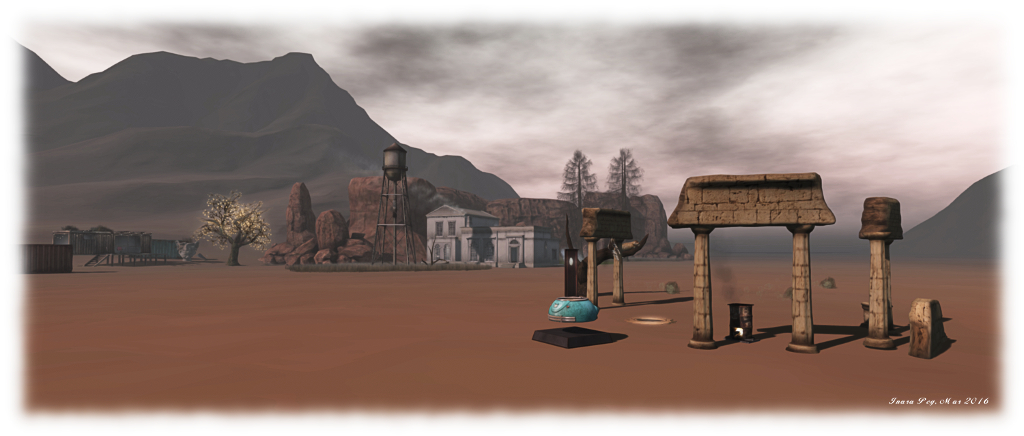
Those familiar with the region (you can also read about it here, here and here if not) will know it has traditionally been a water region – one of the reasons it has always endeared itself to me. However, in its new iteration for the start of 2016, this is no longer the case: Binemist has become a desert landscape.
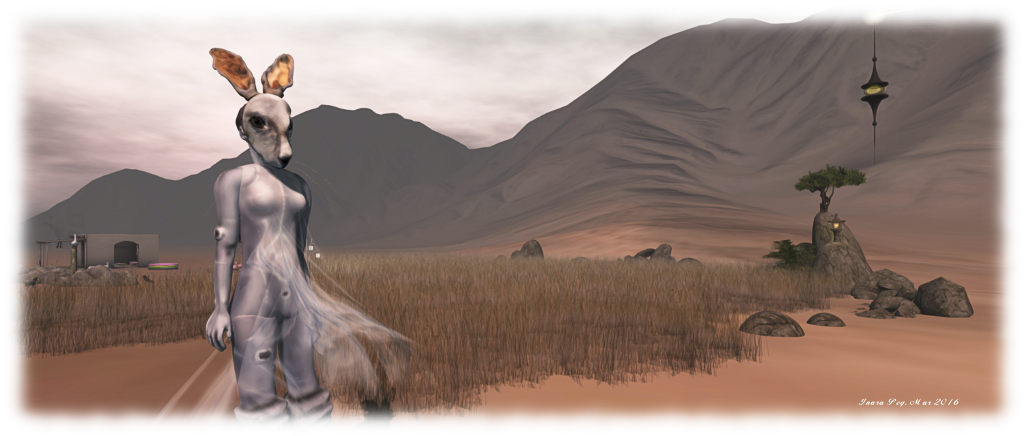
“I love the colours, and I love the early morning sun,” Biné say of the new design, and I have to admit it is dramatic: an iron flat expanse of sand bounded by mountains on two sides, and across which are scattered a series of scenes visitors are invited to explore as crab-like robots skitter across its sandy surface.
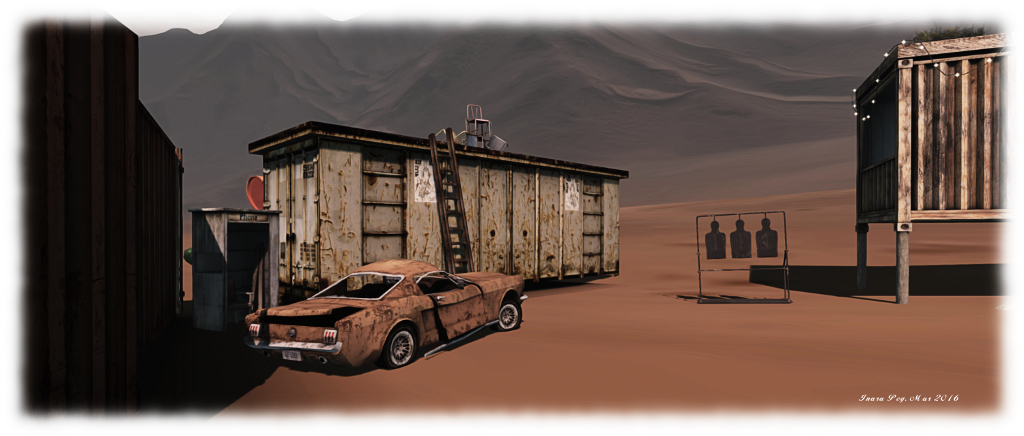
Two of these, located south of the landing point, are dwellings: a stone-built house with its own lush garden, complete with an attempt to cultivate a carpet of grass beyond its high walls, and a converted shipping container sitting among a collection of its peers (which also features a most unusual and adult take on a playground ride!). It is alongside these two homes that the otherwise flat expanse of the land is broken by a rocky upthrust of rock offering two plateaus linked by a stone span.
Northwards, across the sands from these, sits a little vignette visitors to Binemists Past will likely find familiar: the Buddha and floating eye, a gathering of pink flamingos, a grouping of mystic stones with an ethereal floating spire nearby and, standing at the very edge of the region while staring off to a distant horizon snuggled between the mountains, Bryn Oh’s White Balloon. Also, Just off sim to the east sits the familiar form of the wrecked Viking ship which has always been a motif got the region, while over in the north-west corner of the region sits Haveit Neox’s Ship of Fools.
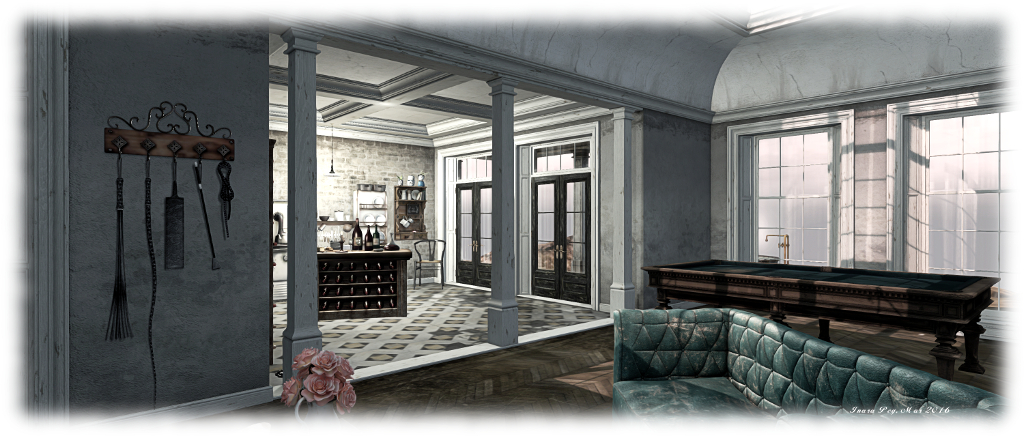
In addition to the ground level layout, the landing point offers two teleport portals to skyborne locations. The first of these is the sky rock which used to be the landing point for the region, where sits a rural scene reached by a teleport hole set in the ground. The second is a skybox set out as the interior of a house, where Biné experiments with interior design, and which is reached via a teleport door.
The new Binemist is very different to past iterations, and even though I perhaps miss the water and what could be found beneath it, there is a wonderful, desolate beauty about the new design which is equally as attractive and photogenic. And for the adventurous, there’s also the opportunity to ride around the sand in a novel little “bubble car”!
The HTC Vive and Microsoft HoloLens: available to pre-order (sort-of in the case of the HoloLens) – credits; Vive via HTC, HoloLens via Microsoft
Monday, February 29th 2016 saw HTC / Valve open the doors for pre-ordering of the consumer version of the Vive VR headset, while Microsoft started accepting pre-orders for the Development Edition of the AR / mixed reality HoloLens system.
The first batches of each system are expected to start shipping around the same time as Oculus VR commences the first shipments of the Rift headset, which was made available for pre-order in January: the Rift is expected to start shipping on March 28th, world-wide, with the Vive starting on April 5th, also world-wide (although the latest update on the UK order page now states shipping will be in May 2016, possibly as a result of initial order received). The HoloLens will commence shipping on March 30th – but only to developers in the USA and Canada.
HTC initially announced the US consumer price for the Vive – US $799 excluding sales and shipping – on Sunday February 21st. This is some US $200 more than the Oculus Rift, but the prices does includes two wireless hand controllers; Rift buyers will have to purchase similar controllers separately, either from a third-party or through Oculus VR when their Touch system launches some time in Q2 2016. While no prices have been confirmed for the latter, many are taking Palmer Luckey’s comments that bundling Touch with the Rift would have “significantly” raised the price of the latter to mean that Touch is liable to cost between US $100 and US $200 – markedly closing the gap between the two systems.
The Vive pre-order kit comprises the headset unit, two wireless hand controllers, two room sensors and a pair of ear buds – although the headset includes a jack socket for those wishing to use their own headsets / ear buds (credit: HTC)
On February 28th, 2016, HTC further announced the Vive’s international pre-order pricing. This see the Vive pitched at £689 (around US $960) in the UK and €899 (US $977) in Europe, both inclusive of VAT but exclusive of shipping costs (£57.60 for UK customers). Customers in Canada can expect to pay CAD $1149 + tax and shipping.
The Vive package includes the headset, which has a similar technical specification to the Oculus Rift (but with a 9:5 aspect ratio rather than 16:9, the former being said to result in a more natural and convincing “feel” to images on the headset’s screens), the two wireless controllers, a pair of Vive base station sensors, a Vive Link Box, and a pair of Vive ear buds. For a “limited period” pre-order units will additionally ship with two free VR games: Job Simulator: The 2050 Archives and Fantastic Contraption and will also include Google’s Tilt Brush VR painting system.
As an added sweetener for developers, and as reported by Tech News World, Unity Technologies has announced their game platform will have native support for the HTC Vive and Steam VR, while Valve have introduced an advanced rendering plug-in developed for Unity. There is also a Vive Developer’s portal, which includes support for Unreal Engine.
The computer hardware specifications for the Vive also pretty much resemble those of for the Oculus Rift, and like Oculus VR, Steam are offering an application that potential purchasers can download to test whether their PC is “VR ready”, while HTC offer a page of recommended PC hardware suppliers who can provide “Vive optimised systems” to US customers.
The Vive Pre consumer edition now available for pre-order (credit: HTC)
As I reported in January, the headset includes two interesting additions. The first is the front mounted “pass through” camera, which allows the user to see an overlay of the room around them projected into their virtual view. This fades in if they approach a physical object (e.g. a wall or desk, etc.), or can be manually triggered via the hand controllers, and allows for collision avoidance when using the headset with the room sensors to move around within a VR environment. The second is “Mura correction” (“mura” being a Japanese term meaning “unevenness” or “lack of uniformity”), which removes the inconsistent brightness levels between one pixel and the next on earlier Vive headsets, presenting a far more uniform and cleaner image.
Further information can be obtained from the HTC Vive pre-order website and via Valve’s Steam website.
Avatars representing the Dalai Lama and TV Radio personality Cathy Wurzer in Second Life during the Dalai Lama’s address to Mayo Clinic staff, Monday, February 29th
Monday, February 29th saw a special event take place at the chapel of Saint Marys Hospital in down town Rochester, Minnesota, when the Dalai Lama addressed Mayo Clinic staff in a special event which was livestreamed on the Internet and into Second Life, using the Mayo clinic’s in-world facilities.
The address, entitled Compassion in Healthcare, followed on from the 80-year old spiritual leader, who has been undergoing period treatment for prostate cancer at the clinic, speaking for 3 hours – twice what had been planned – before a crowd of 3,000 people in Minneapolis on Sunday, February 21st. That event was to mark the Tibetan New Year, and his Holiness’ address, delivered in English and Tibetan, focused on valuing education and compassion.
The Dalai Lama at the chapel of Saint Marys Hospital, Rochester, Minnesota, where he addressed Mayo Clinic staff, with his words streamed to an audience in Second Life (image credit: event livestream)
The February 29th address was introduced by Mayo Clinic President and CEO John Noseworthy, and moderated by Minnesota TV and radio host Cathy Wurzer. As the address began, both Ms. Wurzer and the Dalai Lama were represented in-world by avatars at the Mayo clinic’s Second Life conference centre. In both cases, care had been taken to ensure the avatars resembled their flesh-and-blood counterparts.
While I missed the first part of the session, when I did arrive, some 80 people from across Second Life were in attendance, and the Dalai Lama himself sounded energised and related stories with good humour and aplomb through his address, and responded to questions from the audience at the venue, it was not clear to me if any questions were taken from the in-world audience.
The Dalai Lama “addresses” the audience in Second Life
While some be tempted to critique the event on the basis that the avatar in-world was not actually operated by the Dalai Lama, they would actually be missing the point. While his holiness may not have been operating the avatar, being seated in the chapel of Saint Marys Hospital, the thoughts and words steaming into Second Life were his, and as such, the event offered a means for people who might never otherwise get to hear him speak, listen to and appreciate his wisdom in an almost first-hand way.
The address, with a question and answer session, lasted a little over 90 minutes. The livestream is currently being archived by the Mayo Clinic, and the event was also filmed in-world. I’ll update this article when either video is publicly available.






 Inara Pey: Living in a Modemworld