Project Bento – now a part of the Kokua Second Life viewer and the Restrained Love Viewer
Kokua and Restrained Life have become the latest viewers to update to v5.x status, with release of versions support the Project Bento code.
Kokua 5.0.0
Kokua 5.0.0..40327 for Second Life (release notes) appeared on Saturday, December 17th, bringing with it Bento rendering support, plus additional fixes and improvements:
FMOD Ex audio streaming libraries updated to version 4.44.64.
Avatar texture display now works.
Pie menu updates.
Pie menu “Sit here” response no longer ignores llSetSitText(string), and should now display the defined scripted target prompt (e.g. “Ride” or “Fly”, etc., rather than “Sit Here”).
Just in case there is anyone who missed it, Project Bento adds numerous new bones to the avatar skeleton to improve and enhance support mesh avatars (Bento does not work with the Second Life system avatar). This makes it easier to create and animate things like additional wings and limbs, and offers the opportunity for greater facial animations with mesh heads and faces, and even finger manipulation on mesh hands.
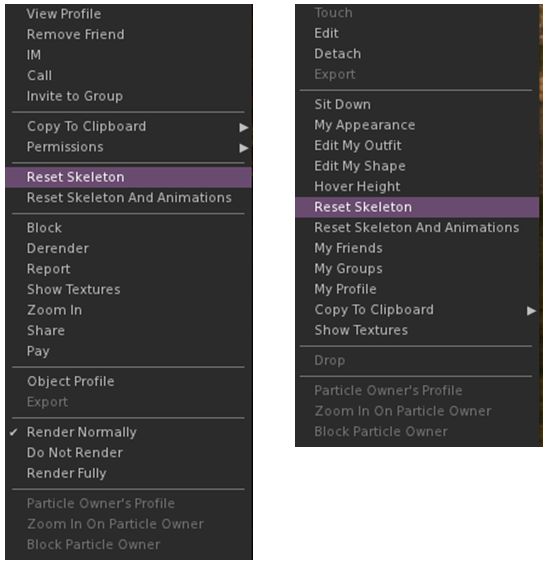
As with all Bento viewers, the visible viewer update is to the avatar menus (both right-click context and pie menu in the case of Kokua), where the Reset Skeleton and Reset Skeleton with animation options can be found.
Reset Skeleton options on Kokua 5.0.0 on the right-click context menus for other avatars (l) and your own avatar (r). With the pie menus they can be found under More > More > Reset (other avatars) and Appearance > Reset on your own avatar
These options have been added because sometimes, when changing between one mesh avatar and another, the basic SL avatar can become deformed, resulting in it looking squished, stretched, caught between two looks, or something else. This problem is generally the result of race conditions when the avatar’s appearance is being updated, and both of these buttons are intended to correct the problem – the option to reset animations being intended to fix deformations which may be due to animations also kicking-in incorrectly / at the wrong time as well, which may cause an avatar to deform.
Restrained Love Viewer
Restrained Love Viewer 2.9.21 (release notes), released on Friday December 16th, brings Bento support to that viewer as well. As with Kokua and other Bento capable viewers, this also sees the Reset Skeleton and Reset Skeleton with Animations options added to the right-click avatar context menus as the most visible sign of Bento support (outside of Bento meshes rendering correctly!).
In addition the update includes a minor change to RLV, with the “?” symbol no longer being used to identify a cheat inside emotes, as some emotes may end with genuine questions.
This summary is published every Monday, and is a list of SL viewer / client releases (official and TPV) made during the previous week. When reading it, please note:
It is based on my Current Viewer Releases Page, a list of all Second Life viewers and clients that are in popular use (and of which I am aware), and which are recognised as adhering to the TPV Policy. This page includes comprehensive links to download pages, blog notes, release notes, etc., as well as links to any / all reviews of specific viewers / clients made within this blog
By its nature, this summary presented here will always be in arrears, please refer to the Current Viewer Release Page for more up-to-date information.
Official LL Viewers
Current Release version: 5.0.0.321958, dated December 1, promoted December 5 (no change) – formerly the Project Bento RC viewer download page, release notes.
A mosaic of Mastcam images captured by NASA’s Curiosity rover on November 10th, 2016 (Sol 1,516), showing the lower slopes of “Mount Sharp”. Variations in the rocks colour hint at the diversity of their composition. The purple tone of the foreground rocks has been seen in other rocks where hematite has been detected. Winds and windblown sand help to keep rocks relatively free of dust which would otherwise obscure their colour differentiation. These images have been white balanced, so the scene appears as it would under typical Earth daylight conditions. Credit: NASA/JPL / MSSS
For more than a year now, NASA’s Mars Science Laboratory rover, Curiosity, has been slowly climbing the lower slopes of “Mount Sharp” – more formally called Aeolis Mons, the 5 kilometre (3 mi) high layered deposit extending off of the central peak of Gale Crater. Whilst still on the lower slopes of the mound, the rover has already found minerals absent from lower levels within the crater, and these, together with the ample evidence for water once having existed in the crater, further point to Mars perhaps having once been habitable.
Details of the latest findings from Curiosity were presented at a meeting of the American Geophysical Union (AGU), which commenced on Monday, December 12th, in San Francisco. Making the presentation were members of the current MSL science team and its former principal investigator, John Grotzinger, – the Fletcher Jones Professor of Geology at Caltech.
Mineral veins are an important way to study the movements of water within a location, as they are result of cracks in layered rock being filled with chemicals that are dissolved in water. This alters the chemistry and composition of rock formations, providing vital clues on the prevailing conditions around the time they were deposited.
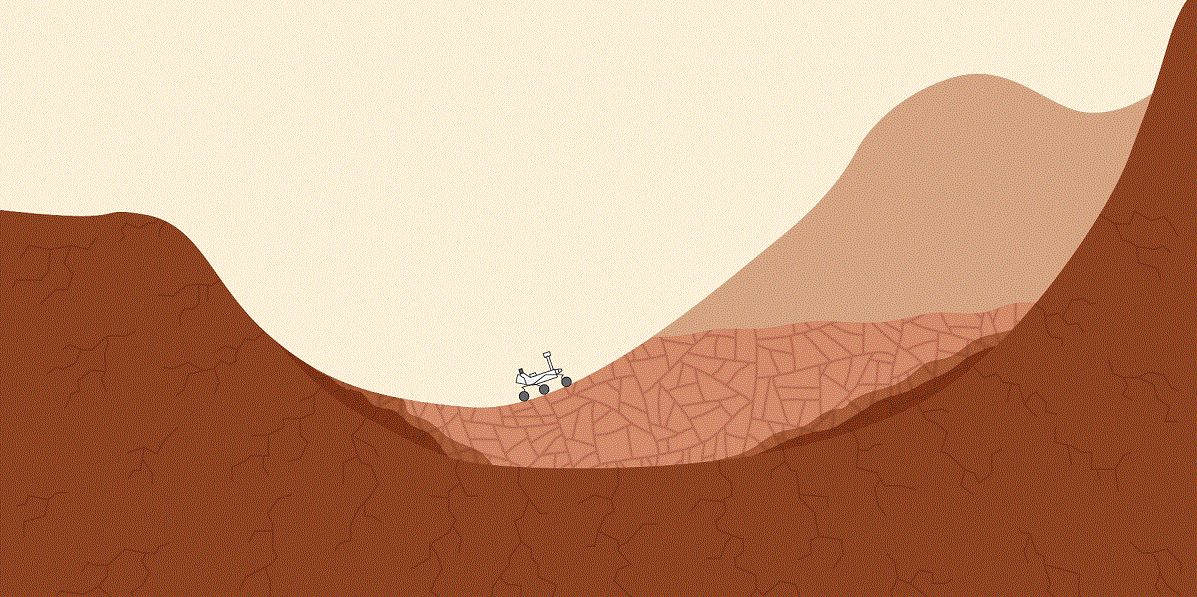
An illustration shown Gale Crater today, with the crater rim (l) and the central impact peak (r), against which “Mount Sharp” rises, which Curiosity climbing its lower slope (obviously not to scale). Credit: NASA/JPL
In the case of the slopes most recently examined by Curiosity, the science team have found that hematite, clay minerals and boron are more abundant than has been found in the lower, older layers. These point to a complex environment where groundwater interactions led to clay-bearing sediments and diverse minerals being deposited over time, effectively creating a “chemical reactor” which, although no actual evidence for Martian microbes having existed within the minerals has been found, still creates an environment which may have been beneficial life.
“There is so much variability in the composition at different elevations, we’ve hit a jackpot,” Grotzinger said during the presentation. “A sedimentary basin such as this is a chemical reactor. Elements get rearranged. New minerals form and old ones dissolve. Electrons get redistributed. On Earth, these reactions support life.”
As Gale Crater might have looked billions of years ago, showing how the circulation of groundwater led to chemical changes and mineral deposits. Credit: NASA/JPL
The increasing presence of hematite found by the rover as it continues up “Mount Sharp” suggests both warmer conditions and more interaction with the atmosphere at higher levels. In addition, the increasing concentrations of hematite, relative to magnetite at lower levels further suggests that iron oxidisation increased over time, creating the “chemical reactor” Grotzinger referenced: the loss of electrons through the oxidisation process can provide the energy necessary for life to sustain itself.
Another ingredient increasing in recent measurements by Curiosity is the element boron, which the rover’s laser-shooting Chemistry and Camera (ChemCam) instrument has been detecting within calcium sulphate mineral veins. Boron is famously associated with arid sites where much water has evaporated away. However, the amounts found so far are so minor, they make it much harder to determine the environmental implications of their presence.
Currently the team is considering at least two possibilities. In the first, the evaporation of the lake thought to have once existed within Gale Crater formed a boron-containing deposit in an overlying layer, not yet reached by Curiosity, then water later re-dissolved the boron and carried it down through a fracture network into the layers the rover is currently investigating, where it accumulated along with fracture-filling vein minerals. In the second, changes in the chemistry of clay-bearing deposits, such as evidenced by the increased hematite, affected how groundwater picked up and dropped off boron within the local sediments.
Curiosity’s 4-year, 10 kilometre (6.2 mi) Trek from its landing site (the blue star), through the Yellowknife Ridge area, key to early findings by the rover, then down along the foothills of “Mount Sharp” to the climb up the mound’s lower slopes. The blue triangles denote way-points on the route, where science work was carried out. The images of Gale Crater and “Mount Sharp” are composed of high-resolution images obtained by the HiRISE camera aboard the Mars Reconnaissance Orbiter. Credit: NASA/JPL / MSSS
Sunday, December 18th marks the finale for this year’s The Dickens Project SL, presented by Seanchai library and hosted by Kultivate magazine. And it promises to be a real Dickens of a time!
Throughout the week, Seanchai volunteers and friends have been reading the five staves of Charles Dickens’ A Christmas Carol in a specially constructed series of sets representing elements of the the story – Christmas Present, Christmas Past and Christmas Yet To Come / The End Of It All. Along the way there have been a variety of additional events and activities (see my preview , including a chat with the event’s Director, Caledonia Skytower, here).
For the grand finale, commencing at 12:00 noon SLT, on Sunday, December 18th, Seanchai Library will be presenting The Big Read, featuring all five staves of the story over some 3.5 hours. The reading will take place in the Square of Christmas Present, and the audience is invited to attend in suitable period costume, if they wish. You don’t have to stay for the entire performance – although doing so is really worth the time – and the rest of the scenes will be open to explore both before and after the readings.
As a special treat, immediately prior to The Big Read, at 11:00 SLT, there will be an hour of dancing to traditional 17th and 18th Century songs presented by Wald Schriddle. Be sure to get there early for this as well, as the Raglan Shire Tiny Carolers are rumoured to perhaps be making one final, triumphant Wootmas 2016 appearance!
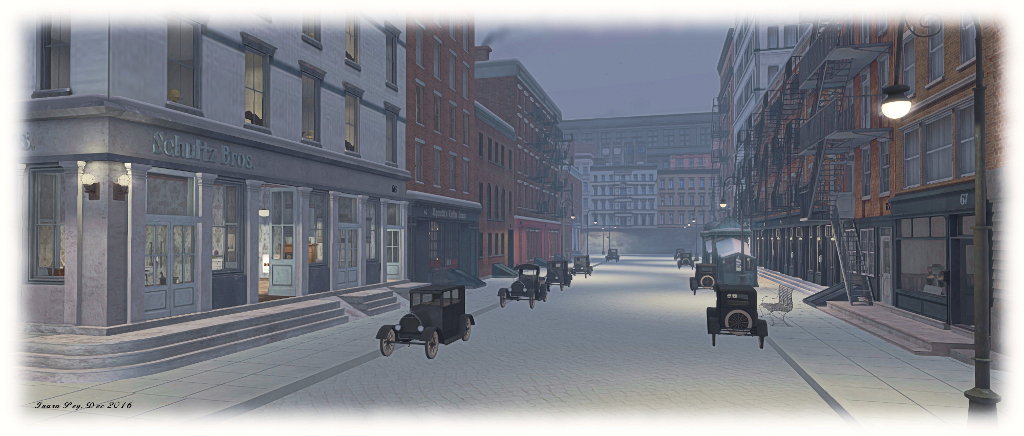
“I’d been considering doing a 1920’s New York Project for a long time, wanted to make sure I had the time and resources for a project this big,” Jogi Schultz (yogijo) – “Mr. S” to the folk in his neighbourhood – told me as we emerged from the subway station into the world of New York in the mid-1920s, as modelled by his 1920s New York Project.
As we stood at the roadside, a few cars parked at the kerb, he continued, “New York City has been my favourite city since I was a kid. There is so much history here, even in the buildings themselves. And it’s so diverse in what it has to offer.”
I’d first come across the project via Annie Brightstar. Her article was enough to pique my curiosity and encourage me to hop over to take a look – and that encouraged me to contact Jogi to find out more.
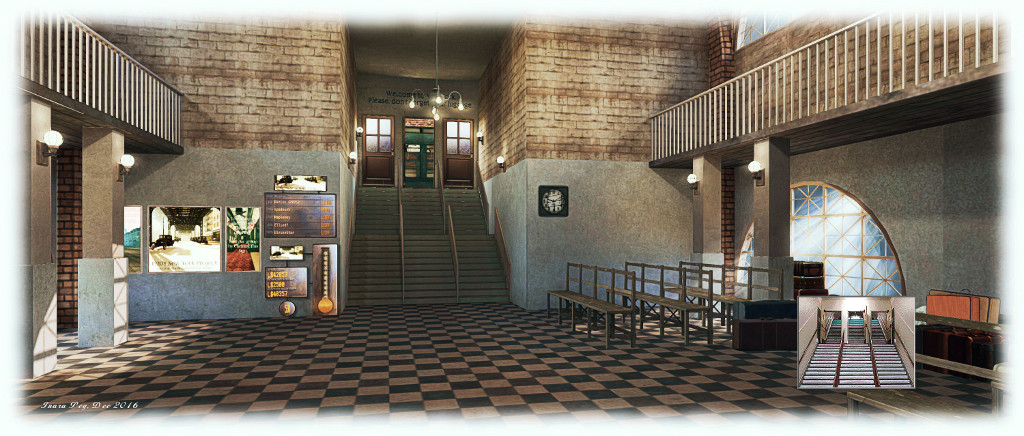
1920s New York Project: the landing point, model on the Detention Hall, Ellis Island, complete with the Stairway of Separation (and the real thing, inset)
“I started back in September,” he told me as we stood chatting. “I’m doing everything by hand; none of the builds are intended for sale to others. It’s all for the project.” And by ‘everything’, he means just that: buildings, roads, sidewalks, street lamps, the elevated rail line, the ornate iron subway stair copulas – even the period cars parked at the kerb side – everything has come from Jogi’s research, and been carefully designed and constructed. “We’re at a quarter region now, and I’m just starting on the next quarter, in time the project will extend over a full.”
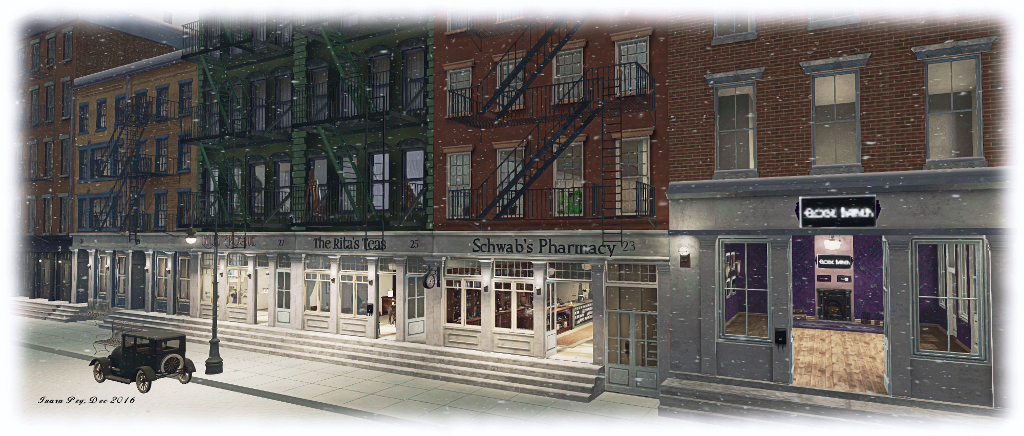
The work completed so far is impressive. Jogi has taken extraordinary care to recreate buildings from the period which actually existed (some of which still do today) along streets such as Pearl St and Water St in lower Manhattan. At street level, stores and boutiques line the sidewalks, with brick-faced and concrete apartment blocks rising 3, 4 or 5 stories above them, fronts often hung with the wrought iron railings and stairs of fire escapes, great ladders ready to drop to street level should they ever be needed.
Nor are these simply empty structures. “The aim here is authentic role-play,” Jogi told me. “We have around 50 rentals in total. Already all the available apartments have been rented, and the stores are filling up. When we formally open, a dress code will be in place, and visitors will be encouraged to dress the part on arriving. We’ll be requesting all open chat is kept in character, and everything else, questions and things, are kept to IM.”
As if to echo this, one of the local tenants came by, a bonnet protecting her head and hair from the cold, heavy coat falling to her knees. “afternoon Mistah S,” she greeted, with a nod and a smile to Jogi.
“Afternoon, Matilde,” Jogi replied, lifting a finger to touch the brim of his fedora in a polite salute.
Visitors to 1920’s New York Project arrive below a subway station in a large hall, on one side of which is a broad stairway leading up to the station’s platform. “It is actually modelled on the detention area at Ellis Island, New York”, Jogi told me. “And the stairs are the Stairs of Separation. When immigrants came to New York by ship, they’d arrive at Ellis island and checked. Some would be detained due to illness or other concerns, and get directed down the stairs to the detention area, where they might face deportation.”
It’s a sobering start to a visit to the project – but one not entirely out-of-context in a way. 1920s New York Project, as noted, is intended to be a period environment, and so the hall acts as a point at which arriving visitors can read the rules, understand things like the period dress code. Then, they can either pick up a suitable period outfit from the free vendors or, if they feel it is not for them, they can “deport” themselves by teleporting home or elsewhere.
Those taking the stairs up from the hall will pass by way of the station’s platform and ticket hall to street level. “Obviously, there isn’t a real subway platform connected to the Ellis Island hall,” Jogi said, “but it all seemed to fit together visually here. At street level, the station is actually a couple of blocks over from where we’re standing, but after seeing the original, I thought one would really complete the picture I was going for. In fact, I actually started the entire project with the subway.”
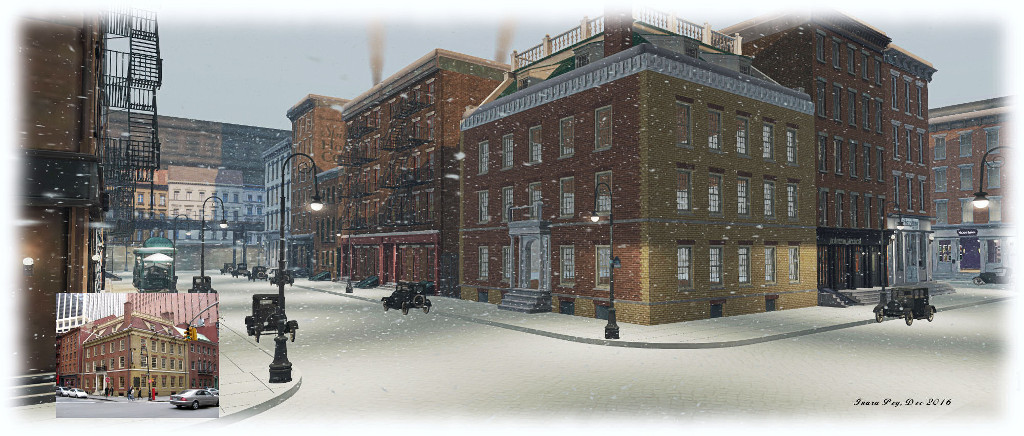
Jogi indicates a building across the street from the stations entrance. “That’s one of the oldest blocks in New York; still in existence today, actually. When picking an area, I really wanted something typical New York, but which offers things like a park, a waterfront, the elevated subway, and something like Fraunces Tavern and its history.”
The current build is centred on a one-block area of lower Manhattan, running from Broad Street up to Coenties Slip, and from Water Street across to Pearl Street, not far from either the East River or Battery Park. The second block, occupying a further quarter region area, is currently under construction, but even without this, the opportunities for role-play are clear. The apartments offer room for tenants to establish themselves (all who rent are aware the entire build will be re-locating in the future), while there are a number of businesses set-up specifically for the purposes of role-play.
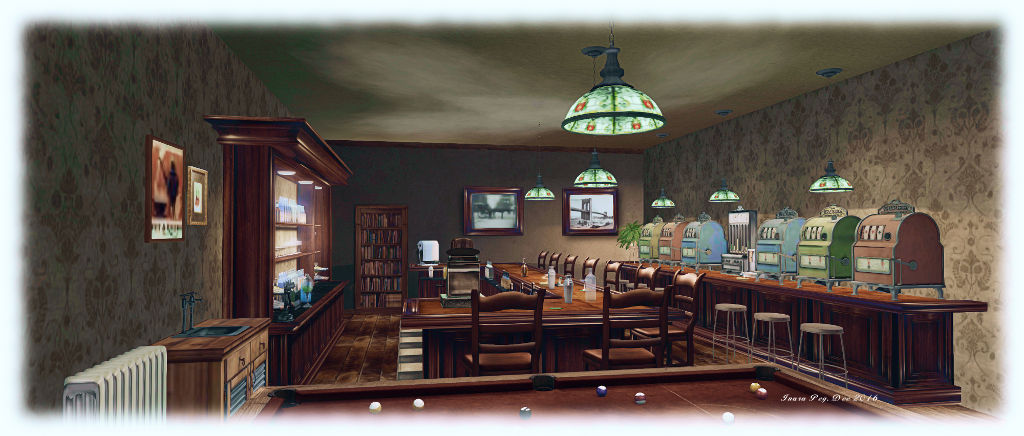
Take the men’s barber’s shop on Water Street, for example, and remember that the 1920s were the era of Prohibition. Following the sign for the restrooms, you’ll come across a back room speakeasy, where the booze flows in secret (I’ve heard it’s run by Mr. S himself, but I cannot confirm or deny the rumour). While there, make sure you try the slot machines and games on the counter: they’re exquisitely made by Jogi, and all of them work.
“That’s one of the reasons I chose this era,” Jogi replied when I asked him about prohibition and the boom / bust cycle of the 1920s. “That, and the 1920 and 1930s have always been one of my favourite periods of history. So much changed in that time for better and for worse. New York offered so many Americans the chance at a new life.
“But the 1920’s weren’t just a decade of happy times. This city was tough, and to make it here took a lot of effort & major sacrifices. My goal is to help people learn about that, and experience it themselves.”
I wondered if the name of the environment was a reflection on a certain other recreation of the period in Second Life. Jogi laughed. “I’m a fan of the Berlin Project; always have been. It helped me realise what could be achieved in Second Life. Jo [Yardley] likes my sim and I enjoy hers. Originally, this was going to be just 1920’s New York, but that name was already taken; and since this is a project & work in progress, we added ‘Project’ to the end.”
Given all that has already been achieved,1920s New York Project is already a fascinating build and I look forward to witnessing it grow. The amount of effort already poured into it is amazing, and with all of the apartments already rented, the streets are starting to come live with local residents and characters. During our explorations, Caitlyn and I bumped into several and received a warm welcome each time. We both look forward to return trips to see how things grow.
Radegast client is the leading lightweight client for many users with disabilities
Thanks to an article by Beq Janus and news passed to me by Whirly Fizzle, this blog was recently able to cover the issues of Voice installation failures in the Radegast lightweight client, and the work put into rectifying the problems.
In short, it was discovered that Radegast would no longer install the SL Voice package due to the location the installer was pointing to being a) not provided by Linden Lab; b) no longer valid. Shortly after this was discovered, Beq found a temporary workaround to get things going using the Radegast version of the SL Voice package, and Whirly found a means to manually get Radegast to work with the current SL Voice package from Linden Lab.
In response to a plea from Beq for developers to consider helping to provide a more robust solution, Cinder Roxley stepped in, and in short order had Radegast’s installer updated to work with the current SL Voice package.
Cinder has now confirmed she hopes to continue maintaining working on Radegast.
“It would just be a shame to see Radegast become obsolete considering how useful it is, especially in terms of accessibility.” she told me, after I heard confirmation she’d be continuing the work. “Right now, Voice is updated, and Bento is now in. I still need to do AIS v3 [inventory handling].”
Given that the current website for Radegast can no longer be accessed for updates, Cinder is working on a new site as well, although as she notes, bringing everything together will take time and energy.
“I already have a full plate with work and life and Alchemy,” she said, “So anyone else who wants to help out is more than welcome to.”
There’s no immediate time line for a further Radegast update, but knowing the work is continuing is likely to come as good news to a lot of people – and if other developers are interested in helping out, please contact Cinder in-world.
In the meantime, thanks to Cinder for taking up the challenge.







 Inara Pey: Living in a Modemworld