Revisiting Roche in Second Life

Roche
Roche

I first visited Roche in 2012 (see here). Then held by ddsm2 Mathy, the region offered a rural setting which was instantly attractive, making it a popular destination for SL travellers. In 2015, it was announced Roche would by closing. However,  Ricco Saenz pointed out to me, it later re-opened as Up to U, a collaborative effort between Fio and ありえす (ArieS Magic), offering a new look and beauty, which I wrote about here.

Over the course of the next year, I lost track of the region, so I was intrigued to catch word from Annie Brightstar that Roche would once again be closing at the end of September, as announced by the region’s current holder, Uta (xoYUUTAox). Intrigued, Caitlyn and I went to have a look.

Roche
Roche

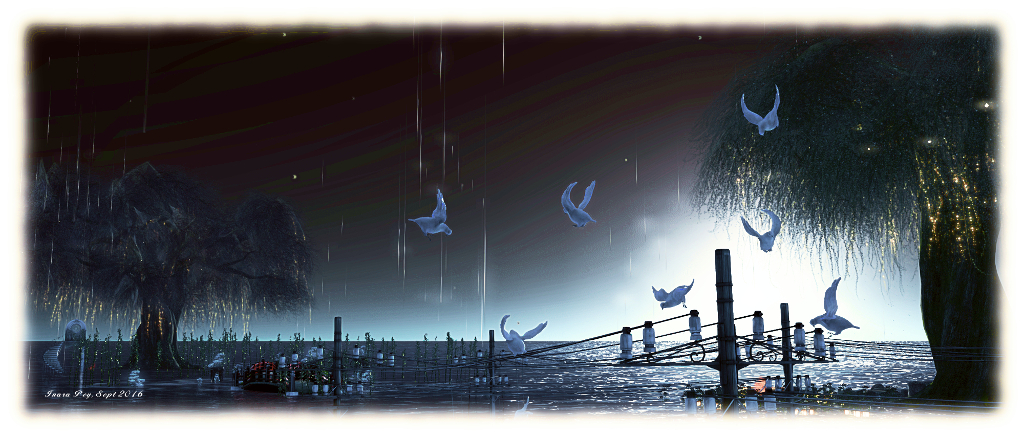
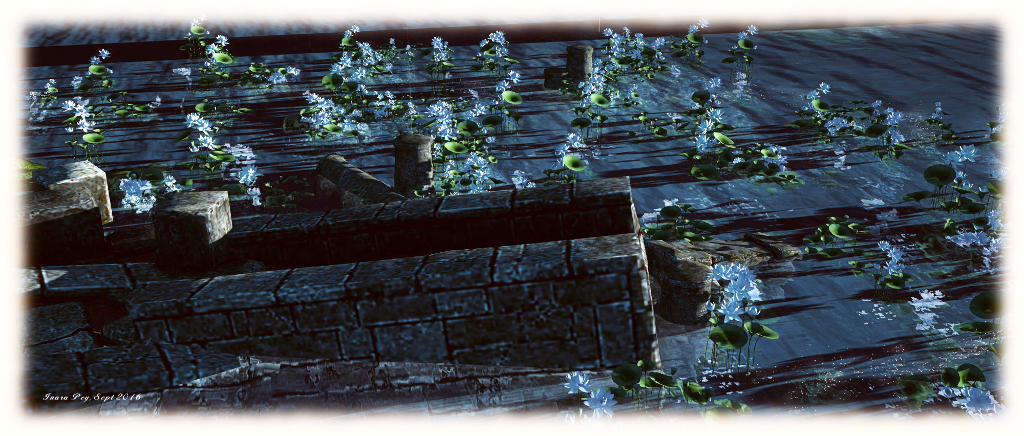
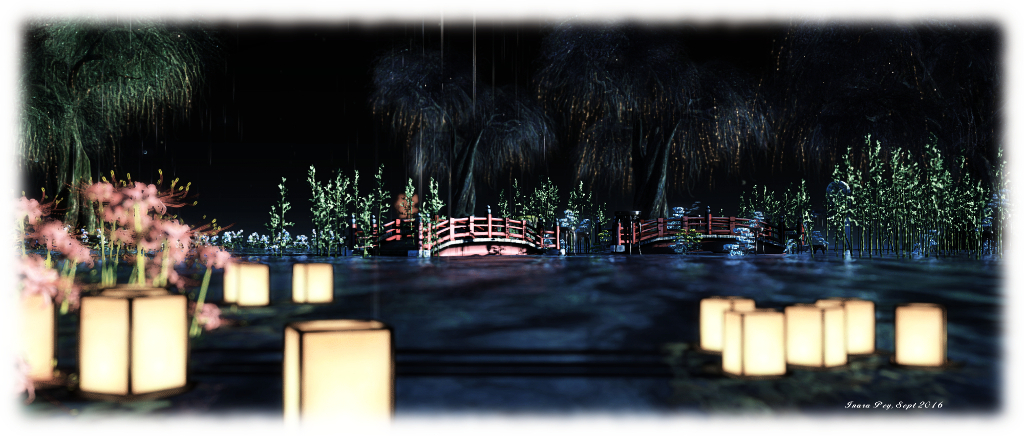
Mostly given over to water, the region sits beneath a dark sky, lit to one side by a bright white star caught forever just above the horizon, giving the region a magical, otherworldly feel. Tall trees are scattered across the shallow waters, their willow-like branches glowing dimly and strung with lights as much as leaves. Blue and red lilies carpet the water under some of the trees,  whilst a grove of bamboo stands guard around two oriental style bridges, which rise from the water to span the water, sharing the space with tables of alien-looking blue plants caught in the light of that distant star.

Ruins can be found among the carpets of lilies, and to one side of the region a single rocky outcrop pushes its way clear of the dark water, a giant piglet asleep on its grassy head.  The remaining occupants of the region can be found flapping above a dual line of old electrical poles, or fussing around the litter of chairs and seats scattered in the lee of the poles.

Roche
Roche

With light falling like raindrops from a cloudless, starry sky and lanterns floating on the water, Roche is a strange, but enchanting place. There is no ambient sound scape; instead the gentle sound of piano solos is offered via the audio stream. For those seeking somewhere to sit, places can be found among the jumble of chairs and seats, at the top of a curving flight of steps, among the ruins, or against the giant piglet on his island.

Roche has always offered unique environments, and Uta’s design is no exception. Whether or not the next incarnation of the region maintains that tradition remains to be seen; as does whatever comes next from Uta’s imagination; I gather she is already thinking about something new elsewhere. In the meantime, if you’ve not paid her vision for Roche a visit, you might want to do so before the region changes hands once again.

Roche
Roche

SLurl Details

  • Roche (Rated: Moderate)


2016 viewer release summaries: week 36

Updates for the week ending Sunday, September 11th

This summary is published every Monday, and is a list of SL viewer / client releases (official and TPV) made during the previous week. When reading it, please note:

  • It is based on my Current Viewer Releases Page, a list of all Second Life viewers and clients that are in popular use (and of which I am aware), and which are recognised as adhering to the TPV Policy. This page includes comprehensive links to download pages, blog notes, release notes, etc., as well as links to any / all reviews of specific viewers / clients made within this blog
  • By its nature, this summary presented here will always be in arrears, please refer to the Current Viewer Release Page for more up-to-date information.

Official LL Viewers

  • Current Release version: 4.0.7.318301 (dated dated August 8), promoted August 11 – formerly the Maintenance RC viewer download page, release notes
  • Release channel cohorts (See my notes on manually installing RC viewer versions if you wish to install any release candidate(s) yourself):
    • Visual Outfit Browser viewer updated to version 4.0.8.319463, on September 9 – ability to preview images of outfits in the Appearance floater (download and release notes)
  • Project viewers:
    • No updates.

LL Viewer Resources

Third-party Viewers

V3-style

  • No updates.

V1-style

  • Cool VL viewer Stable branch updated to version 1.26.18.23 and the Experimental branch updated to version 1.26.19.25, both on September 10th (release notes)

Mobile / Other Clients

  • No updates.

Additional TPV Resources

Related Links

Windlight Gallery Fellows September-October 2016

Windlight Fellowship Exhibition, September / October 2016
Windlight Art Gallery Fellowship Exhibition, September / October 2016

Now open at the Windlight Art Gallery is the September-October 2016 Fellowship exhibition, which features the work of artists Jesse Boren (Tatjab Resident), Cadence Caine (heathermknopp Resident), Kaijah Chrome, MIlly Patton (MillyWH Resident), Bluesrocker Resident, ChloeElectra Resident, KodyMeyers Resident, Pacesoftly Resident, Tisephone Resident, and Inquisitor Titanium, together with Windlight Gallery artists in residence Pam Astonia, Honey Bender and Warm Clarity, Windlight Gallery’s Select Artist, Wicca Merlin, and – yours truly 🙂 .

Windlight Fellowship Exhibition, September / October 2016

On offer once again is a rich mix of styles and subject matter – landscapes, avatar studies, some abstract work and some images from the physical world. It is this mix of styles and subject which makes the Windlight Exhibitions more than worth the visit; the Gallery design encourages the visitor to focus attention on each artist in turn whilst at the same time allowing individual styles and approaches to be compared and contrasted, helping one to appreciate further the skills evidence by each artist in creating their work.

I’m particularly proud to be a part of this exhibition: showing my work is not entirely my strong suit, so being offered the opportunity to do so is gratifying. So much so, that if there are artists who are shy about showing their work in public, or find they’re uncertain about how to go about presenting their work in-world, I thoroughly recommend the Fellowship as offering an excellent starting point. Find out more below.

Windlight Fellowship Exhibition, September / October 2016 - toot! toot! It's me :)
Windlight Fellowship Exhibition, September / October 2016 – toot! toot! It’s me 🙂

The Windlight Artist Fellowship Programme

In promoting and supporting artists and photographers, the Windlight Art Gallery operates the Windlight Artist Fellowship Programme. This allows artists to apply for free exhibition space at the Windlight gallery for a period of 30 days. Applications are open to artists from across Second Life, and the criteria for acceptance can be found in the Artist Fellowship Programme application form.

SLurl Details

Space Sunday: mesas, dunes NEOs, comets and launches

A dramatic look back: in the foreground is the lower slope of one of the "Murray Buttes", in the far distance the tall peaks of Gale Crater's huge rim. One of the final images taken by Curiosity from within the region of the buttes on Thursday, September 8th, the rover's 1,454 sol on Mars. Credit: NASA/JPL / MSSS
A dramatic look back: in the foreground is the lower slope of one of the “Murray Buttes”, in the far distance the tall peaks of Gale Crater’s huge rim. One of a series of images taken by NASA’s Curiosity rover on Thursday, September 8th, the rover’s 1,454 sol on Mars. Credit: NASA/JPL / MSSS

NASA’s Mars Science Laboratory rover, Curiosity, has said “farewell” to “Murray Buttes” in a stunning series of images, as it continues its climb up the slopes of “Mount Sharp”, a massive mound of deposited material located at the central impact peak of Gale Crater.

The mesas of “Murray Buttes” mark the upper extend of the transitional “Murray Formation”, where the material deposited during the earliest centuries of “Mount Sharp’s” formation merge with the rock comprising the crater floor. Curiosity has been passing by the area of the buttes for a little over a month now, carrying out examinations of the rock surface and gathering samples of mudstone for analysis.

Murray Buttes with the faint outlines of Gale Crater beyond, as images on Thursday, September 8th 2016, by NASA's Curiosity rover during its 1m454 sol on Mars. Credit: NASA/JPL / MSSS
“Murray Buttes” with the faint outlines of Gale Crater beyond, as images on Thursday, September 8th 2016, by NASA’s Curiosity rover during its 1,454 sol on Mars. Credit: NASA/JPL / MSSS

Believed to be the eroded remnants of ancient sandstone that originated when winds deposited sand after lower “Mount Sharp” had formed, the buttes rival anything of a similar nature found on Earth in terms of dramatic looks and structure. So much so that while we’re hardly likely to see Clint Eastwood ride his horse around the base of one, they would nevertheless fit neatly into a Sergio Leone western.

Several of the pictures – mosaics of images captured by the rover which have been white-balanced to match typical Earth daylight lighting conditions and then stitched together to offer complete scenes – reveal the deeply layered nature of the sandstone, sandwiched in what is referred to as “cross-bedding”. This indicates that the formations are the result of both wind deposition of material and then wind erosion, further confirming the idea that “Mount Sharp” was initially formed as a formed as a result of Gale Crater once being home to a great lake, before the waters receded and wind action took over.

A closer view of the layered nature of the sandstone deposits forming "Murray Buttes", showing the "cross bedding" of the layers, indicative of the role that wind played in their deposition / formation. This picture comprises a mosaic of images captured by Curiosity rover on Thursday, September 8th, 2016 during its 1,454 sol on Mars. Credit: NASA/JPL / MSSS
A closer view of the layered nature of the sandstone deposits forming “Murray Buttes”, showing the “cross bedding” of the layers, indicative of the role that wind played in their deposition / formation. This picture comprises a mosaic of images captured by Curiosity rover on Thursday, September 8th, 2016 during its 1,454 sol on Mars. Credit: NASA/JPL / MSSS

The images were taken as Curiosity traversed the base of the final butte, where it gathered a final drilling sample on September 9th. On completion of the sample-gathering, the rover will continue farther south and higher up Mount Sharp, leaving these spectacular formations behind.

Curiosity's route up the slopes of "Mount Sharp". Credit: T.Reyes / NASA/JPL
Curiosity’s route up the slopes of “Mount Sharp” – click for full size. Credit: T.Reyes / NASA/JPL

The Sand Dunes of Shangri-La

On September 7th, NASA issued a video showing the latest radar images captured by the Cassini probe of the surface of Saturn’s largest moon, mighty Titan. The data was gathered as the probe swept by the huge moon – which is blanketed by a thick atmosphere and is known to have lakes and rivers of liquid hydrocarbons on its surface – at a distance of some 976 km (607 mi) on July 25th, 2016 – one of the closest passes over the moon the vehicle has ever made.

Because of the moon’s thick atmosphere, conventional camera systems cannot be used to probe Titan’s mysteries, so Cassini uses a radar system to “map” surface features in black-and-white. Of particular interest to mission scientists during the July 25th flyby was a dark patch along Titan’s equator, previously images by the radar system at much greater distances and dubbed “Shangri-La”. And area which revealed itself to be – in part – a region of linear dunes, mostly likely comprised of grains derived from hydrocarbons that have settled out of Titan’s atmosphere, and which have been sculpted by Titan’s surface winds. Scientists can use the dunes to learn about winds, the sands they’re composed of, and highs and lows in the landscape.

Also captured by the radar is an arena dubbed “Xanadu annex”, believed to be an out-thrust of chaotic terrain from a region dubbed “Xanadu” just to the north of “Shangri-La”. First imaged by the Hubble Space Telescope in 1994, just before the Cassini / Huygens mission was launched, “Xanadu” and its annex are thought to be remnants of the moon’s icy crust before it was covered by organic sediments from the atmosphere.

OSIRIS-REx Lifts-off as an Asteroid Sweeps By Earth

On Thursday, September 8th, NASA successfully launched OSIRIS-REx on a 7-year trek to reach asteroid Bennu, where it will gather surface samples and return them to Earth for analysis. The mission, which I previewed in my last Space Sunday report, lifted-off flawlessly from Space Launch Complex 41 at Cape Canaveral Air Force Station at 19:05 EDT, atop its Atlas V booster at the start of a journey which will carry it a total of 7.2 billion kilometres (4.5 billion miles).

The Atlas V booster carrying OSIRIS-REx shortly after lift-off on Thursday, September 8th. Credit: Ken Kremer

Witnessing the launch was principal investigator Dante Lauretta, from the University of Arizona. “I can’t tell you how thrilled I was this evening, thinking of the people who played a part in this,” he said following the launch.

“This represents the hopes and dreams and blood, sweat and tears of thousands of people who have been working on this for years.”

The mission will gather samples from the surface of the asteroid – a remnant from the formation of the solar system – and will also map Bennu’s orbit around the Sun and the influences affecting it.

This is because the asteroid is a near-Earth object (NEO): an asteroid which periodically passes across Earth’s orbit around the Sun, and can come very close to our planet whilst doing so. So close, in fact, that some estimates of Bennu’s future orbit suggest it will collide with Earth towards the end of the next century.

Continue reading “Space Sunday: mesas, dunes NEOs, comets and launches”

Hounds, aliens, magic, cults and swords in Second Life

It’s time to kick-off a week of story-telling in voice, brought to our virtual lives by the staff and volunteers at the Seanchai Library. As always, all times SLT, and events are held at the Library’s Second Life home at Bradley University, unless otherwise indicated.

Sunday, September 11th

13:30: Tea Time at Baker Street

Tea-time at Baker Street returns for the summer, featuring a new location – 221B Baker Street at the University of Washington iSchool in Second Life. Caledonia Skytower, John Morland and Kayden Oconnell invite you to join them as they return to what is quite possibly the most famous of Sir Arthur Conan Doyle’s works, and present their fourth reading from The Hound of the Baskervilles.

Baskervilles-1902The third full-length novel written about Sherlock Holmes, this is likely to be the one Holmesian story which – at least in outline – known to most, whether or not they have actually read any of Holmes’ adventures.

But how many of us know the story as it was originally written? Over the decades it has been adapted for film and television more than 20 times, starting as early as 1914/15 with the 4-part series, Der Hund von Baskerville, and continuing on through to Paul McGuigan’s The Hounds of Baskerville, featured in the BBC’s brilliant Sherlock series.

All of these adaptations have offered their own take on the tale. Some – such as McGuigan’s, have simply taken the title of the story and used it to weave a unique tale of their own; others have stayed true to the basics of the story whilst also adding their own twists and turns quite outside of Conan Doyle’s plot in order to keep their offering fresh and exciting to an audience.

So why not join Cale, John and Kayden as they read from the 1902 original, and discover just how Sir Arthur Conan Doyle unfolded this apparently supernatural tale of giant hounds and murder, and the pivotal role played by John Watson himself?

18:00: Magicland Storytime

It’s a Small World of Folktales at The Golden Horseshoe in Magicland Park with Caledonia Skytower.

Monday September 12th, 19:00: The Crucible of Time

crucibleGyro Muggin’s takes his audience into the fix-up by John Brunner. First published as two-part story which appeared in Isaac Asimov’s Science Fiction Magazine, it’s an ambitious tale of alien intelligence which grew to a series of six linked tales pushed as a single novel in 1983.

Far off in space is an alien race which is so much like us, yet so un-alike. From the birth of their earliest civilisation through to their attainment of star flight as their star system passes through the galaxy, we follow their development through the ages.

Aquatic by nature, this race presents some significant challenges well outside the realms of anything encountered by humanity. But they are also driven by all too familiar hopes, fears, desires, needs, wants, prejudices, impact of religious ideologies, and the quest for knowledge we have experienced in the growth of our own civilisation.

Charting six periods of time, each a thousand years after the previous, the six stories focus on the efforts of a group of individuals in each era as they face one or more challenges, their success in overcoming these challenges inevitably leading them towards a greater understanding of their planet’s plight, and ultimately, the ability to deal with that plight and the survival of their civilisation.

Tuesday September 13th, 19:00: The Old Country

The Old Country“So this is what it’s like to have fingers,” the girl laughed, and pointed the bow at Gisella. “How does the world look from the other side of the crossbow?”

And so it is that Gisella learns the truth in the warning never look too long into the eyes of a fox, as she finds herself trapped in the fox’s body, as the fox makes off with her own. But such is the way of things in the Old Country, where “all the fairy tales come from, where there was magic – and there was war.”

Now she must cross a country torn by war, encountering magic, bloodshed and more as she seeks to find her own body and stare once again into the eyes of the fox possessing it, and so reclaim it. But such are her experiences in crossing the ravaged land, that once she finds her body, she faces a surprising revelation and choice about her own nature.

Join Faerie Maven-Pralou as she takes her audience through the enchanting pages of Mordecai Gerstein‘s 2005 novel.

Wednesday September 14th, 19:00: A Monstrous Regiment of Women (Mary Russell #2)

MonstrousReturn to 221B Baker Street at the University of Washington’s iSchool, Second Life, for the latter-day adventures of Mr. Sherlock Holmes (retired) and his young orphaned protégé, Mary Russell, originally from the United States, as written by Laurie R. King.

Taking a trip to London, Mary encounters Veronica Beaconsfield, a friend from Oxford, who in turn introduces her to the charismatic and enigmatic Margery Childe, leader of something called “The New Temple of God.”

Sect-like, and seemingly involved with the suffrage movement, the New Temple and its leader offer both curiosity and intrigue for Mary, who is not convinced either are entirely above-board.

Her suspicions appear to be correct when several of the Temple’s wealthy young female volunteers and financial contributors are murdered. With Holmes keeping a watchful eye in the background, Mary turns her curiosity into an investigation; in doing so, she faces her greatest danger yet.

Thursday, September 15th, 19:00  Dark Agnes De Chastillon, Sword Woman

Shandon Loring reads from another of Robert E. Howard’s short series, focusing on Agnes de Chastillon in 16th century France. Spanning three stories, two written in full by Howard, with the third finished by Gerald W. Page. In Sword Woman is both the title of Agnes’ origin story by Howard, and the title of the volume bringing her tales together under a single cover. To discover more, join Shandon in both Second Life and Kitely (check Seanchai Library’s Kitely event announcements for specific grid location details).


Please check with the Seanchai Library SL’s blog for updates and for additions or changes to the week’s schedule.

The featured charity for September-October is Alex’s Lemonade Stand Foundation (ALSF), a childhood cancer foundation dedicated to raising funds for research into new treatments and cures for all children battling cancer.

Additional Links

Submerged in Second Life

The White Canvas Gallery: Submerged

Now open at the White Canvas Gallery (formerly the Good Days Gallery), curated by Goodcross is Submerged, a selection of aquatic-themed images by Elizabeth (ElizabethNantes), which she calls “an immersive experience” – a description which highlights the unique approach taken in presenting this collection.

Visitors arrive on the edge of a glass-sided pool of water, spray breaking against the rocky edge, the art displayed under the rippling surface. To view the art properly requires jumping into the tank, and then exploring it from beneath the “surface”, where bubbles drift upwards, fish and jellyfish swim and drift by, and a platypus floats gently, watching the ducks swimming above.

The White Canvas Gallery: Submerged

Eight of the images – all of which present figures at play on and under the water – are displayed around the inner walls of the tank, and are offered for sale; they face an additional four images arranged on the faces of a cube. The entire impression is that you are fully immersed in the environment – not just by being “underwater”, but very much a part of some of the scenes as those in them look towards you through the water.

This feeling of being immersed is further heightened by the careful placement of transparencies carrying the animated ebb and flow of foamy waves. These give the impression of the water’s surface (see in the centre image and the one above as a dark shade across the upper portions of the images), positioned so that some of those featured in the pictures do indeed have their heads above water. Only one – the image seen on first arrival (and heading this review)- is effectively “out” of the “water”; and even this is positioned to suggest the subject is rising from the surrounding pool.

The White Canvas Gallery: Submerged

I opted to photograph the collection against a night backdrop, as that was the local estate time when Caitlyn and I visited. However, tweaking Phototools also suggested that early morning or late afternoon windlight settings with the Sun low in the sky worked particularly well if a background of sky is required.

An imaginative collection presentation creatively presented.

SLurl Details