In June, Kultivate Magazine published the first volume of Quill and Pen, a new twice-yearly publication focusing on the work of writers and poets from across Second Life. It features short stories (including flash stories), non-fiction and poetry, and is published each June and December.
You can obtain / read this first volume in a number of e-formats on-line and on mobile devices:
On August 22nd, 2016 Kultivate announced submissions for the second volume of the journal are now open, with the publication date set for December 5th, 2016. Writers and poets from across Second Life are invited to submit their work for consideration / publication, with submissions are welcome in the following categories:
Poems: one poem per page, single spaced and left justified, maximum of six pages
Non-fiction: one essay up to 3,000 words, double spaced, no extra space between paragraphs, white space for section breaks only
Fiction:
Full-length stories: one story up to 3,000 words, double spaced, no extra space between paragraphs. White space for section breaks only
Flash fiction: up to 700 words, double spaced, no extra space between paragraphs. White space for section breaks only.
To submit your work, please complete the Quill and Pensubmission form.
Please do not copy / paste your work into the form when applying. All work should be made available via Google Documents or a similar service, with the link to its location included in the submission form. Kultivate will then download your work from the provided link, thus preserving formatting for publication. Thank you.
Crap Mariner has been working on a new Arts wiki page on the SL wiki – on which I’ll have more in a future article – when he contacted me earlier in August to let me know that SL wiki editing had been locked to a limited number of permitted editors / users.
The locking has since become more widely seen, prompting Soft Linden to issue an e-mail update as a result of enquiries on what is happening, made via the open-source dev e-mail list. In the e-mail, Soft states:
There is a ridiculously persistent party who uses numerous wikis to promote fake Microsoft support phone numbers. Given the fraud or malware potential, we couldn’t let that keep returning.
There’s a less intrusive long-term solution in the queue, currently blocked by other work.
Hopefully, whatever is blocking the long-term solution will be cleared soon, allowing full edit access to the wiki to be restored.
In the meantime, those requiring urgent access to wiki pages to maintain data / information, are asked to create a support ticket (I’d suggest include which pages need to be accessed and why, rather than just raising a generic request to gain access). Third-party viewer developers who require wiki edit rights can also contact Oz Linden to request access to their wiki pages. If you only require access to update you profile or add a discussion point to a page, etc., it might be advisable to wait until after the wiki has been re-opened to all, rather than filing a support ticket.
This isn’t the first time the wiki had to be placed in lock-down. In October 2014, a lock-down was initiated while the wiki underwent an extensive security update, resulted in limited edit access for users through until January 22nd, 2015. Hopefully, this current period of lock-down, which started in early August, will not be for as long.
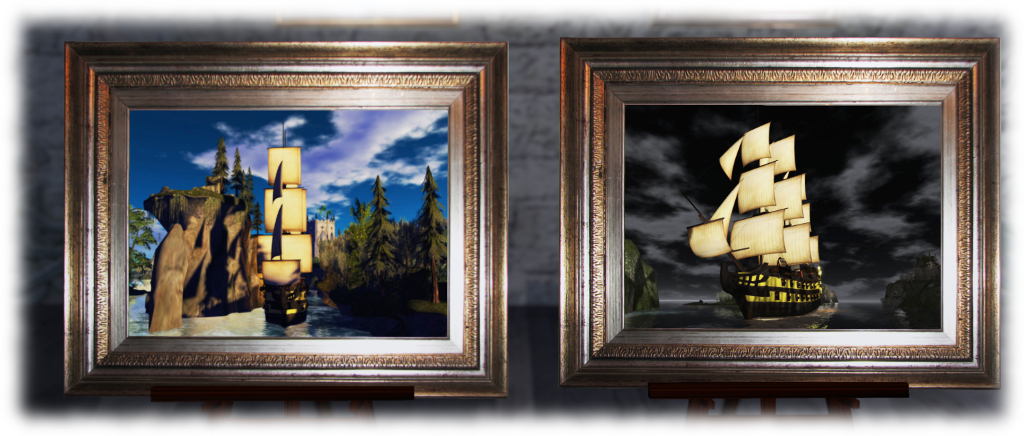
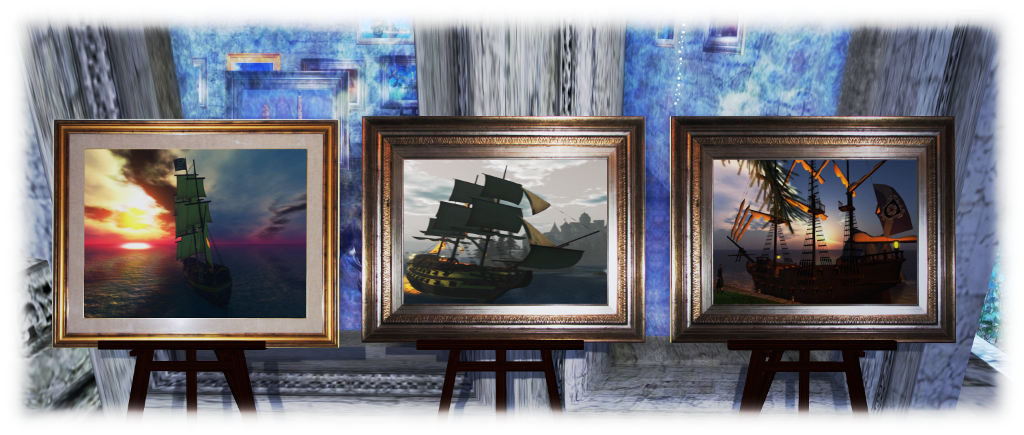
Now open at Ce Soir Arts is Sailing, a nautical-themed exhibition of photography by friend and long-time Second Life resident, Wildstar Beaumont.
Perhaps best known for his work as the official photographer of Relay For Life, and featured artist during the intermission period on Designing Worlds, as well as being the feature photographer for both the former Primgraph magazine and for Prim Perfect, Wildstar visually documents the ever-changing face of Second Life.
As well as sharing a common interest in Second Life photography, Wildstar and I are also avid Second Life sailing enthusiasts and lovers of tall ships; little wonder, then, that I was drawn to this exhibition. Tall ships are a particular focus in the pictures, but other vessels are also offered, with many of them also offering unique views of Second Life’s most famous water-bound locations.
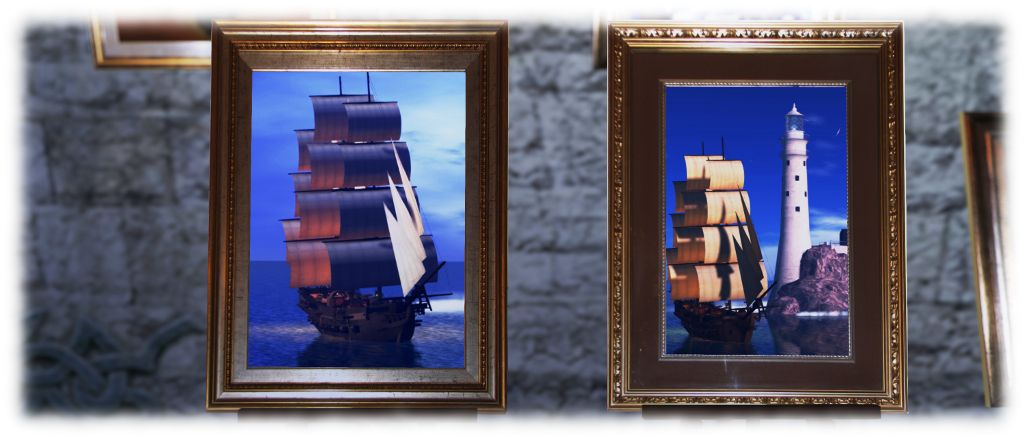
Fastnet Rock lighthouse (Crows Nest) can, for example, be seen in several of the images. Other images incorporate places such as the Leviathan’s Skeleton (Ahab’s Haunt), the marina at Starboard’s Yacht Club, the paddle steamer quays at Dutch Harbor (see my August 2014 article on the magnificent vessels moored there), and the Temple of Neptune looking out over Blake Sea, to name a handful.
But I confess, it is the tall ships which capture my eye and heart. There is a romance to the great sailing ships of old which belies the often harsh life aboard them, whether merchantman or warship. Who cannot be moved by the sight of such a vessel, sails unfurled, white-foamed sea curling back from curved bows as it runs before the wind, unfettered and in full career – if I might borrow from Brecht. Or, equally as moving, laying at anchor, sails furled as the sun casts its last rays of the day across masts and deck.
Wildstar captures all this and more in his images; so much so that to point a finger at any one is perhaps unfair, but I admit to being very drawn to his images of the Star of Winterfell, (shown on the right in the banner image for this article) and the trio of studies showing the Bright Star passing the Fastnet Rock Lighthouse (below right, alongside a closer viewer of the Bright Star).
All of the pictures in the exhibition are for sale at a very modest price, and are presented pre-framed and ready to hang at home. And believe me when I say, they will more than grace any home with wall space to spare. For anyone in love with sailing or who appreciates Wildstar’s work, this is a must-see exhibition.
The Second Life Marketplace is both a convenience and a pain. Convenience because it provides an ease of selling / buying to users. Pain because its sheer size can make it difficult to effectively police, leaving it open to various forms of abuse.
However, Strawberry Singh has highlighted one area of concern content creators are facing, and has asked for people to pass the word on.
In Full Perm Marketplace Scams,Strawberry points to the abuse of full permission items content creators make available on the Marketplace. Typically, these items are offered individually or in kits as templates for people to re-use in their own creations, and they generally come with an end-user licence agreement (EULA) specifying their intended use. More often than not, these EULAs forbid the re-sale of such items on an “as is” basis and / or re-sale as full permission items. And if a dedicated EULA isn’t offered, the fact that the items are not intended for full perm resale can generally be found in the listing description.
However, there are unscrupulous individuals doing just that: purchasing the items and reselling them unchanged, as full permission items, thus violating the original creator’s intent and licensing. To add insult to injury, the items undercut the original creator’s own market price.
To help raise awareness of the problem, Strawberry offers some advice on how to identify or avoid such items:
Before purchasing look at the seller’s other listings. If there is a hodgepodge of brand names and the vendors all look different, they are most likely an illegal seller.
Purchase the items from the in-world store of the full perm creator instead of the marketplace, to ensure that you are not purchasing from an illegal seller.
Most of the illegal sellers have blank profiles. Real full perm sellers usually have a full profile filled with links to their websites, main stores and marketplace stores.
Most Full Perm sellers have started using water marks on the vendor ads which say the name of the avatar that is supposed to be selling it. The illegal sellers are still using those ads, even with the watermark. So it is important to look at the name of the creator on the watermark, and if it isn’t that person selling it, don’t buy it.
Try to find a way to report these items, either to Linden Lab by flagging the listing or to the original creator of the items.
It’s sound advice for anyone looking at full permission items. I’d perhaps only expand a little on point (5.) for clarity. While we may grumble about the DMCA process, it is the means by which such items can be most effectively removed from the Marketplace, as the nature of DMCA filings requires that Linden Lab respond to them accordingly.
So, if you believe an item on the Marketplace is being illegally sold and can identify, or are aware of the original creator, do be sure to contact them directly and make them aware of your concern. Provide information on the item: where it can be found (listing, etc.), so that they might investigate for themselves, and if necessary, file a DMCA. This approach not only helps the creator take the required action to have violating listings removed, it also potentially helps to establish a history of violations which they can also put to the Lab, if necessary, which might in turn encourage the Lab to take more stringent action against repeat offenders.
This summary is published every Monday, and is a list of SL viewer / client releases (official and TPV) made during the previous week. When reading it, please note:
It is based on my Current Viewer Releases Page, a list of all Second Life viewers and clients that are in popular use (and of which I am aware), and which are recognised as adhering to the TPV Policy. This page includes comprehensive links to download pages, blog notes, release notes, etc., as well as links to any / all reviews of specific viewers / clients made within this blog
By its nature, this summary presented here will always be in arrears, please refer to the Current Viewer Release Page for more up-to-date information.
Official LL Viewers
Current Release version: 4.0.7.318301 (dated dated August 8), promoted August 11 – formerly the Maintenance RC viewer download page, release notes
Visual Outfit Browser viewer updated to version 4.0.8.318686, on August 17 – ability to preview images of outfits in the Appearance floater (download and release notes)
VLC Media Plugin Viewer RC updated to version 4.1.1.318504 on August 15 – replaces the QuickTime media plugin for the Windows version of the viewer with one based on LibVLC (download and release notes)
Cool VL viewer Stable branch updated to version 1.26.18.20 and the Experimental branch updated to version 1.26.19.22, both on August 20th (release notes)
Mobile / Other Clients
Group Tools updated to version 2.2.41.0 on August 16th – no change log provided (download)
July 14th: Jupiter with Io, Europa and Ganymede as seen by Juno after the craft had finished its critical engine burn to slip into a 53.5 day orbit around the giant planet. Juno will once again skim Jupiter’s cloud tops on Saturday, August 27th. Credit: NASA / JPL; SwRI / MSSS
NASA’s Juno mission to Jupiter is swinging back in towards the gas giant, on route to complete the first of some 37 planned polar orbits of the planet between now and February 2018 which are designed to probe the mysteries of the giant planet as never before.
As I reported in early July, the Juno space vehicle arrived at Jupiter on July 4th, where it completed a critical burn of its UK-built Leros-1b engine to ease its way into a highly elliptical orbit around Jupiter after a voyage of 2.8 billion km (1.74 billion miles) and 5 years, during which the craft first looped out past the orbit of Mars before falling back towards Earth to pick up a “gravity assist” to accelerate it on to its rendezvous with Jupiter.
The July 4th braking manoeuvre placed Juno in an orbit which, at its closest to Jupiter, skims just a few thousand kilometres above the planet’s cloud tops, and at its furthest sees Juno over 3 million kilometres from the planet. That first braking manoeuvre was undertaken with the probe’s science systems powered-down as a precautionary measure, and were powered-back up a few days after closest approach.
On August 27th, the vehicle will complete the first of these 53.5-day during “long” orbits, once again passing to within 4,200 km (2,600 mi) of Jupiter’s cloud tops at the equator, after arcing down over the planet’s north pole – and this time, all of the science instruments will remain operational, including JunoCam, the vehicle’s imaging system.
JunoCam has actually be in continuous operation in ” marble movie” mode since July 11th, 2016, capturing 5 full-colour images per hour, watching Jupiter spin from a distance (a sample of this movie is embedded blow – not Jupiter’s spin is greatly speeded-up). However, Jupiter is so small in most of the images – just 50 pixels across – that these haven’t been a source of interest to the media. As Juno approaches Jupiter on August 27th, however, the imaging system will switch from “marble movie” mode to gathering images at a higher rate to fully capture the close flyby as the craft passes over Jupiter’s north pole, curls around the planet north-to-south, before heading back out into space once more on the second of its “long” orbits.
JunoCam has a relative narrow field of view, so the images it captures on August 27th will be tightly focus on Jupiter’s clouds, and not as panoramic as those we’re been accustomed to seeing from the Hubble Space Telescope and from the now defunct Galileo mission. But they should still hopefully prove spectacular.
The next time Juno makes a close approach to Jupiter after this will be on October 19th. At that time, the science instruments will again be powered-off while the craft makes a second orbital burn, this time to reduce its orbit around Jupiter of 53.5 days to just 14 days, allowing the primary science mission to start.
This is intended to improve our understanding of Jupiter’s formation and evolution. The spacecraft will investigate the planet’s origins, interior structure, deep atmosphere and magnetosphere. Juno’s study of Jupiter will help us to understand the history of our own solar system and provide new insight into how planetary systems form and develop in our galaxy and beyond. It will also, for the first time, allow us to “see” below Jupiter’s dense clouds.
Selling the ISS?
This past week, NASA hosted a Journey to Mars showcase, looking at the space agency’s plans for developing the means to send humans to Mars in the 2030s. The actual plans for doing so are still pretty nebulous, but much of in revolves around the current development of the Orion Multi-Purpose Crew Vehicle (MPCV) and its supporting systems (including deep-space habitat modules), and the rocket system which will be used to launch it, the Space Launch System (SLS).
This being the case, the event was hosted at NASA’s Michoud Assembly Facility in New Orleans, where the core stage of the SLS vehicle the Orion MPCV. Included in the event was a trip to see a further test firing of one of the RD25 engines which will power the SLS at launch, and were previously used to power the space shuttle during its ascent to orbit.
However, what particularly grabbed the attention of the media was the announcement that the space agency is looking to sell the International Space Station to a private entity or entities in the mid-2020s, under the understanding that said entity/ies will keep the station active and continue to allow NASA to have access to it.
The move is a bold one. Currently, the ISS is the biggest single component of NASA’s budget, (just over US $3 billion in 2016 and projected to pass US $4 billion in 2020), and is only funded through until 2024. Thus, selling it to a private concern, could allow NASA to continue to make use of the station for research purposes beyond 2024 without having to meet all of the hefty costs involved in actually operating the station, potentially freeing-up some of the money dedicated for ISS support for use elsewhere.
Quite who would be willing to buy the ISS – both SpaceX and Boeing are apparently on NASA’s list of potential interested parties, although the interest may not be reciprocal – and quite how NASA’s international partners feel about the idea, is unclear.





 Inara Pey: Living in a Modemworld