 The Pluto – Charon system is, as I’ve reported through various Space Sunday reports, turning out to be far more remarkable a place than scientists ever imagined. While NASA’s New Horizons space vehicle, which zapped past both Pluto and Charon during its closest approach to both on July 14th, 2015.
On February 18th, NASA revealed the most recent surprise to be revealed by New Horizons: Charon may have once had a subsurface ocean that has long since frozen and expanded, pushing outward and causing the moon’s surface to stretch and fracture on a massive scale.
The side of Charon imaged by NASA’s probe is characterised by a system of “pull apart” tectonic faults, which are expressed as ridges, scarps and valleys—the latter sometimes reaching more than 6.5 kilometres (4 miles) deep. Charon’s tectonic landscape shows that, somehow, the moon expanded in its past, fracturing as it stretched.
The outer layer of Charon is primarily water ice. This layer was kept warm when the tiny world / moon was young by heat provided through the decay of radioactive elements, as well as Charon’s own internal heat of formation. Scientists say Charon could have been warm enough to cause the water ice to melt deep down, creating a subsurface ocean. However, as it cooled over time, this ocean would have frozen and expanded (as happens when water freezes), lifting the outermost layers of the moon and producing the massive chasms we see today.

In an image gathered by the Long-Range Reconnaissance Imager (LORRI) in July 2015 and release by NASA on February 18th, reveals a vast equatorial belt of chasms on Charon. This network is around 1,800 km (1,100 mi) long and in places is 7.5 km (4.5 mi) deep. By comparison, the Grand Canyon is 446 km (277 mi) long and around 1.6 km (1 mile) deep.
The inset images on the picture show one section of the network of chasms, informally named “Serenity Chasma”, with a matching colour-coded topography map. Measurements of “Serenity Chasma” strongly suggest Charon’s water ice layer may have been at least partially liquid in its early history, and has since refrozen.
SpaceShipTwo Unveiled
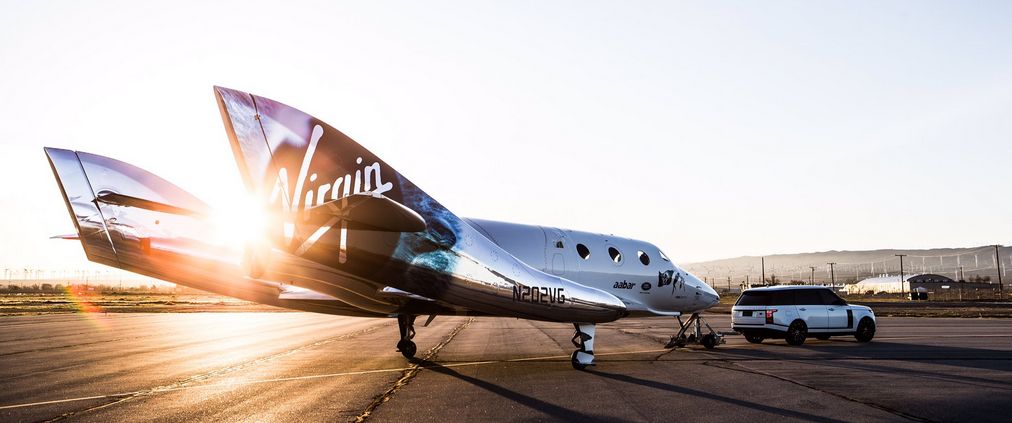
Virgin Galactic, Sir Richard Branson’s private venture company which is aiming to become the world’s first commercial space line, offering fare-paying passengers sub-orbital flights into space. rolled out it new SpaceshipTwo vehicle on Friday February 19th.
The event came more than a year after the loss of the first SpaceShipTwo craft, the VSS Enterprise, in a tragic accident in which the craft broke up in mid-air on October 31st, 2014, killing co-pilot Michael Alsbury, and seriously injuring pilot Peter Siebold. At the time of the accident, several other figures involved in private sector space efforts were quick to point to Virgin Galactic’s use of nitrous-oxide as a vehicle propellant and to suggest corner-cutting by the company as causes of the accident.
However, after investigating the incident, the US National Safety Transportation Board (NTSB) drew the conclusion that the incident was largely the result of pilot error: the “feathering” mechanism designed to be used at the edge of space to allow the vehicle to gently re-enter the denser layers of Earth’s atmosphere was inadvertently deployed by co-pilot Alsbury, resulting in the immediate aerodynamic destabilisation and break-up of the vehicle. As a result of these findings, and as a part of a series of improvements made to the vehicle, the new SpaceShipTwo includes a locking mechanism designed to prevent the feathering system being deployed in error.

The new vehicle, christened VSS Unity by Professional Stephen Hawking (assisted by Branson’s year-old granddaughter), was rolled-out at a special media event held at Virgin Galactic’s operations and flight facilities in the Mojave Desert, California. It marks the start of a long programme to get the vehicle to a point where it is ready to undertake its first powered flight.
This programme will include a series of ground tests of various vehicle systems, followed by taxi tests on the runway at the Mojave Air and Space Port. after these will come “captive carry” flights, where SpaceShipTwo remains attached to its WhiteKnightTwo carrier aircraft, then unpowered glide flights before the first in a series of powered test flights. While this test programme is not expected to be as protracted as the flight evaluation programme undertaken by VSS Enterprise prior to its crash, iy does mean that the company is not ready to provide any suggested dates by which fare-paying flights might commence.
Continue reading “Space update: Charon’s ocean, Virgin’s spaceplane and your art in space”





 Inara Pey: Living in a Modemworld