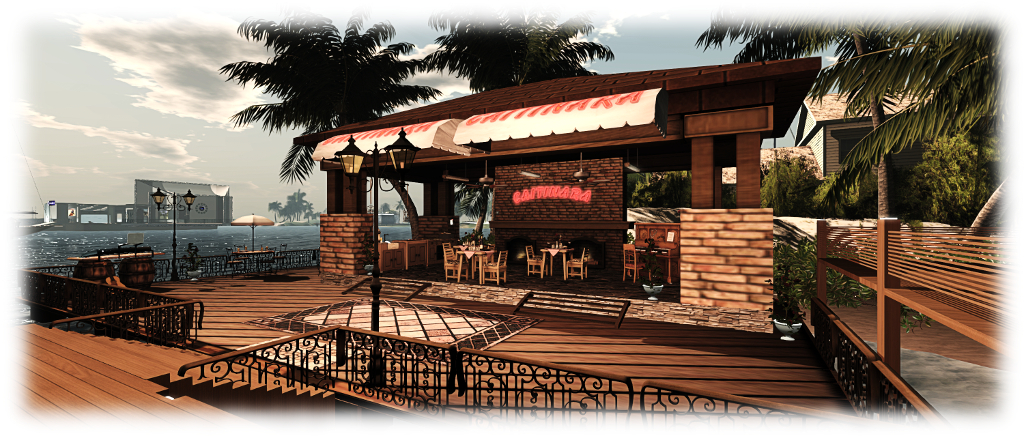
Join us once again at Caitinara Bar for 2 hours of music on Wednesday, February 24th, as Anthony Wesburn spins some of the best tunes available in Second Life from 16:00 through 18:00 SLT.
Tonight, the set will feature The British Invasion: Bands of the ’60s. It started with Beatlemania and went on to involve singers like Dusty Springfield, Petula Clark, Donovan and Tom Jones, and groups and bands as diverse as The Dave Clark Five, the Hollies, the Bachelors, the Zombies, Manfred Mann, Freddie and the Dreamers, the Who and, of course, the Rolling Stones.
So join Anthony, Boudicca, Caitlyn and myself for another 2 hours of great music – and remember, if you come by boat, moorings are available right next to the bar on the west side of the park.
On Tuesday, February 16th, the Alchemy team announced the release of Alchemy 4.0.0.37374 Beta.
The release – as indicated by the version number shifting to 4, incorporates code for the Chromium Embedded Framework (CEF) for media handling. Already in the official release viewer on some TPVs, CEF replaces the ageing QTWebkit framework, and supports all modern web technologies including HTML5, CSS3, and WebGL.
This release also implements the Lab’s auto update feature, which means that when a new version of Alchemy is release, users well get a notification prompting them to allow the updater to run and install the latest update when they log into an older version.
Perhaps a more visible change to the viewer is the ability to initiate nearby chat through a local chat bar, rather than either through the Conversations floater or having the detached Nearby Chat bar always open either full-sized or minimised.
As with similar local chat bar options found in other TPVs, this will only work if you set the viewer so that pressing letter keys starts local chat (Preferences > General). You also need to ensure that Preferences > Chat > Open Conversations When Initiating Nearby Chat is unchecked. Once done, starting to type within the viewer window will open a compact chat bar, which will close automatically upon pressing Enter.
The new local chat bar offers a convenient means of typing local chat, complete with gear icon options, and can be enabled by ensuring pressing the letter keys on your keyboard initiates typing (rather than movement), and that the option to Open Conversations when Initiating Nearby Chat (shown above) is unchecked (leaving it checked will open the Conversations floater in full or the Nearby Chat floater, is detached from it)
Removed from this version of Alchemy is media pop-ups, which aren’t supported by CEF. Other updates are reported to be directed at OpenSim use, together with a few “hidden gems” and also under-the-hood updates intended to improve performance. There are also a number of fixes implemented, as indicated in the release notes.
There was no scheduled Main (SLS) deployment on Tuesday, February 23rd. On Wednesday, February 24th, all three RC channel should all receive the same new server maintenance package, comprising a server crash fix and “minor internal improvements.”
It is likely the server deployments will remain at a slower pace over the next few weeks as the Lab focuses on internal infrastructure changes.
SL Viewer
On Monday, February 22nd the HTTP / Vivox RC viewer updated to version 4.0.2.311302. The see the additions of the following fixes:
MAINT-5295 Extra setopt in PUT case for llcore::http forces PUT to POST
MAINT-5625 [Project Azumarill] Selected Objects Show Land Impact of 0
MAINT-5628 [Project Azumarill] When posting to Flickr, Upload button does not grey out when upload is in progress, clicking Upload more than once results in all images failing to post
MAINT-5629 Viewer Makes Request for SRV Records on Login
MAINT-5676 Azumarill repeatedly requests weight of selected objects in edit mode
MAINT-5978 Convert the Vivox state machine over to a coroutine implementation
MAINT-6071 Reference to a UUID used after iterator is lost.
MAINT-6086 Crash when removing non added Vivox session.
The remaining RC and project viewers remain unchanged from week #7:
Quick Graphics RC viewer, version 4.0.2.311103 dated February 17th Avatar Complexity options and the new graphics preset capabilities
Maintenance RC viewer, 4.0.2.310545 dated February 2nd – 38 updates. fixes and tweaks
Project Bento (avatar skeleton extensions), version 5.0.0.310099 dated 20th
Oculus Rift project viewer, version 3.7.18.295296 dated October 13th, 2015
Obsolete platform viewer version 3.7.28.300847, dated May 8, 2015 – provided for users on Windows XP and OS X versions below 10.7.
This all leaves the release viewer unchanged: version 4.0.1.310054, dated January 15th.
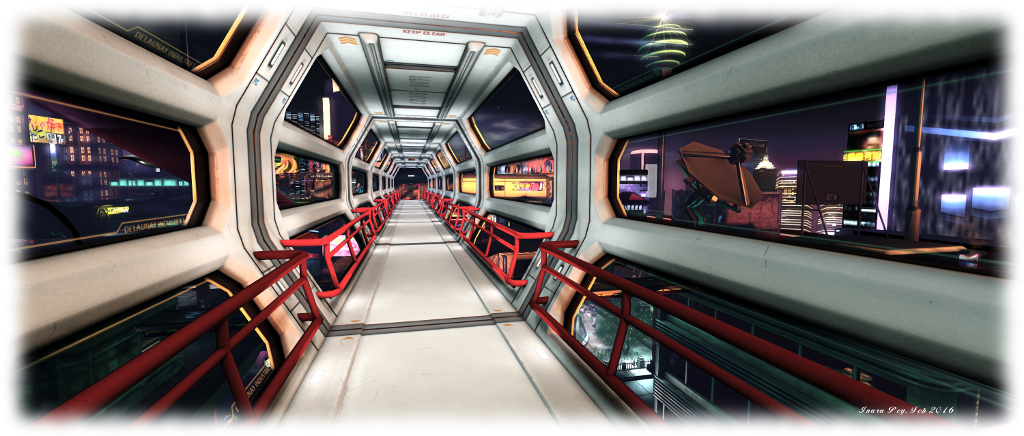
Arriving in Imesha, Shaman Nitely’s and Ime Poplin’s multi-level cityscape, one might be forgiven for thinking they’ arrived in a corner of a city made famous on the big screen though the likes of Blade Runner or on television via Total Recall 2070. Buildings rise on all sides, elevated roads and sidewalks passing along the deep gorges formed between the gaudily lit towers, ramps and stairways providing links between the different levels, allowing passage between them. Each level is perhaps just a little darker than the one above, until at the lowest, the visitor eventually comes to brick buildings of a much earlier era, graffiti strewn façades tired, old original roads, where visible, cobbled and aged.
But Imesha is no direct homage to either Ridley Scott’s film (or those which copied its approach to a dystopian view of future cities), nor is it an echo of the Los Angeles of Total Recall 2070. While it may contain similar fusion of occidental-Sino-Japanese influences, it is very much its own place, and a quite spectacular one at that.
From the upper levels s setting sun can be seen, limning the tallest buildings, its glow competing with their own brightly lit surfaces and myriad lights. Flashing billboards stare down at visitors from side sides of some of the buildings, the oriental faces on them flickering and smiling, the ambient sound scape shifting and changing to suit the environment as one explores.
And there is plenty to be found when exploring! “We added as much detail as we could for a homestead,” Shaman informed me when I bumped into him and Ime re-working a part of the landing area. “That’s why we are constantly replacing stuff with lower prim alternatives!”
As we chatted, a Chinese paper lantern drifted by, doubtless riding on the air currents winding around the buildings. Watching it pass, I commented on the nods to Blade Runner etc. “Yes we wanted that Sci fi look,” Shaman replied, “but we also wanted to make it a bit more homely; not cold.”
A teleport system is available at the landing point, providing the means to hop directly to the various local destinations – the club, the diner, the art garden, etc. However, I’d strongly advise anyone making a visit to eschew this and strike out of foot. The best way is through the doors leading to the club space, or up the stairs alongside them. Both will lead you to routes connecting the platform to other parts of the region.
Finding your way between all the levels may take a little time, but this will also allow you to hopefully see all of the detail and care put into this build. Do make sure you have ALM enabled as well (you don’t have to enable Shadows, which are the big performance hit); excellent use of materials is made in much of the region, so having ALM on increases the visual appeal of the Imesha.
All told, this is a fabulous deign and build, and one that should be enjoyed by all who visit. Should you do so, please consider supporting Ime’s and Shaman’s efforts to offer it to Second Life, by making a donation at one of the tip jars found throughout the region.
The 9th annual Virtual Worlds Best Practice in Education (VWBPE) conference will take place between Wednesday, March 9th, 2016 and Saturday, March 12th, 2016 inclusive. A global grass-roots community event focusing on education in immersive virtual environments which attracts 2200-3500 educational professionals from around the world each year.
The conference will be primarily hosted on Second Life with additional and special events also being hosted by AvaCon Grid, and the conference programme is now available. Highlights of the latter include:
Wednesday, March 9th
17:00 – Signalling a New Reality with Bronwyn Stuckey: “a look at some of the signals in the past year of a blurring of what is virtual. I have always been the person to call out people who use the real and virtual dichotomy, much preferring to use real and physical. That last year has produced many signals that show even these poles might become redundant. I hope the example we look at in the keynote will trigger your imaginations and help challenge many of the assumptions we hold about the place of our work in virtual worlds. These are the things that could readily be on our horizons so much sooner than we think. For us as educators it is less about keeping abreast of the technological advances but having audacious goals and imaginings. Intrigued? Come along and let’s share our visions!”
Bronwyn Stuckey
Bronwyn Stuckey has been engaged in educational community and games in learning development for the past 15 years. She has worked to explore virtual worlds, games in learning and how we can cultivate identity, agency, citizenship, leadership, and community for students and teachers.
Since leaving lecturing and learning design in the higher education sector her research, consultation and design have been in gamification and game-inspired designs for classroom contexts and professional learning and communities of practice. She is a current post-doctoral research fellow of the Arizona State University Centre for Games & Impact and independently consults to global groups like Intel and Microsoft programs and education communities.
18:00 – Grid Watch with Ebbe: Ebbe Altberg, Linden Lab CEO, will discuss issues of importance to the Second Life communities. His primary aim for the session, however, is to listen to Second Life residents and respond to questions.
Thursday, March 10th
14:00 – OpenSimulator Featured Panel: Cynthia Calongne, Selby Evans, Stephen Gasior and Maria Korolev engage in a discussion on the different perspectives of people who use OpenSimulator as an alternative, or in addition to, Second Life. This will be a thoughtful discussion on dedication, awareness, perception, and opportunity of the various communities of OpenSimulator.
17:00 – Virtual Worlds on the Go with Stephen Downes: In this presentation Stephen Downes examines the intersection of learning, performance support, and mobile virtual worlds and simulations and discusses the real world applications for this technology, describing a variety of learning scenarios, and background and infrastructure needed to support such a system. Additionally, he examines the role of educators and content publishers, identifying the need for institutions to provide learning support and scaffolding to draw out the benefits of what might be called virtual worlds on the go.
Stephen Downes is a specialist in on-line learning technology and new media. He speaks from practical experience both as a college and university teacher and the author of learning management and content syndication software. He has developed and deployed a series of progressively more innovative technologies, beginning with multi-user domains (MUDs) in the 1990s, open on-line communities in the 2000s, and personal learning environments in the 2010s. As a teacher and designer, he is also known as the originator of the Massive Open On-line Course (MOOC). As a theorist, he is known as a leading proponent of connectivism, a theory describing how people know and learn using network processes. He has published hundreds of articles on-line and in print and has presented around the world to academic conferences in dozens of countries on five continents.
Friday, March 11th
13:00 – Reaching the Engagement Horizon in Virtual Worlds: Crafting Engagement Through Games and Gamification with Karl Kapp: The use of games for learning seems like a good match, but we can’t blindly take it for granted. Instead, we need to explore questions to make sure the intuitive link between games, gamification and virtual worlds reaches its full potential. In this keynote, we’ll answer questions like: How does one mix virtual world and game-based learning experiences? How should games be integrated into a curriculum? Can attitudes and behaviour change result from playing a game in a virtual world? What elements of games can learning designers borrow from game designers? Can flying around as a superhero in a virtual world make you a nicer person? Discover evidence-based techniques for increasing on-line engagement, interactivity and, most importantly, learning.
Karl Kapp, Ed.D., is a full-professor of Instructional Technology at Bloomsburg University in Bloomsburg, PA. He teaches subjects related to games, gamification and learning technologies, and is also the director of Bloomsburg’s Institute for Interactive Technologies, working with organisations to create interactive instruction including games and simulations, co-founder of educational game company 2Klearning.com and founder of The Wisdom Learning Group. He has authored or co-authored six books, and served as a Co-Principle Investigator on two National Science Foundation (NSF) grants related to games and simulations and serves as an external evaluator on a third game-related NSF grant.
Saturday, March 12th
18:00 – Closing Ceremony and Thinkerer Award Winner Annoucement: closing remarks from Phelan Corrimal and other VWBPE Committee Chairs, the opportunity to learn about VWBPE 2017 and hear the 2016 Thinkerer Award recipient announced.
Registration and Passport to the Metaverse
Those wishing to attend VWBPE 2016 are strongly encouraged by the organisers to register (free of charge or donations towards costs accepted).
Passport to the Metaverse offers the opportunity to explore nine interactive and engaging locations on the Horizons of teaching and learning. Opening of Sunday, February 28th, and running through to Sunday, March 20th inclusive (but exclusive of the conference dates), details on these experiences can be found on the VWBPE website and in the conference programme.
This summary is published every Monday, and is a list of SL viewer / client releases (official and TPV) made during the previous week. When reading it, please note:
It is based on my Current Viewer Releases Page, a list of all Second Life viewers and clients that are in popular use (and of which I am aware), and which are recognised as adhering to the TPV Policy. This page includes comprehensive links to download pages, blog notes, release notes, etc., as well as links to any / all reviews of specific viewers / clients made within this blog
By its nature, this summary presented here will always be in arrears, please refer to the Current Viewer Release Page for more up-to-date information.
Quick Graphics RC viewer updated to version 4.0.2.311103 on February 17 – provides the new Avatar Complexity options and the new graphics preset capabilities for setting, saving and restoring graphic settings for use in difference environments / circumstances (download and release notes)







 Inara Pey: Living in a Modemworld