Update: The Lab has also now blogged on this offer, and also indicate that the Haunted House experience has re-opened in Second Life, which is open to anyone via the Portal Park.
Linden Lab has launched the latest Premium membership offer alongside a seasonal Halloween gift offer for new and existing Premium members.
The Premium membership discount applies to the first quarter of the Quarterly Billing plan (remaining quarters all billed at the full price of US $22.50 per quarter), and runs from now through until 08:00 SLT on Monday, November 2nd, 2015.
The Premium Discount is once again on offer, together with a set of Halloween gifts
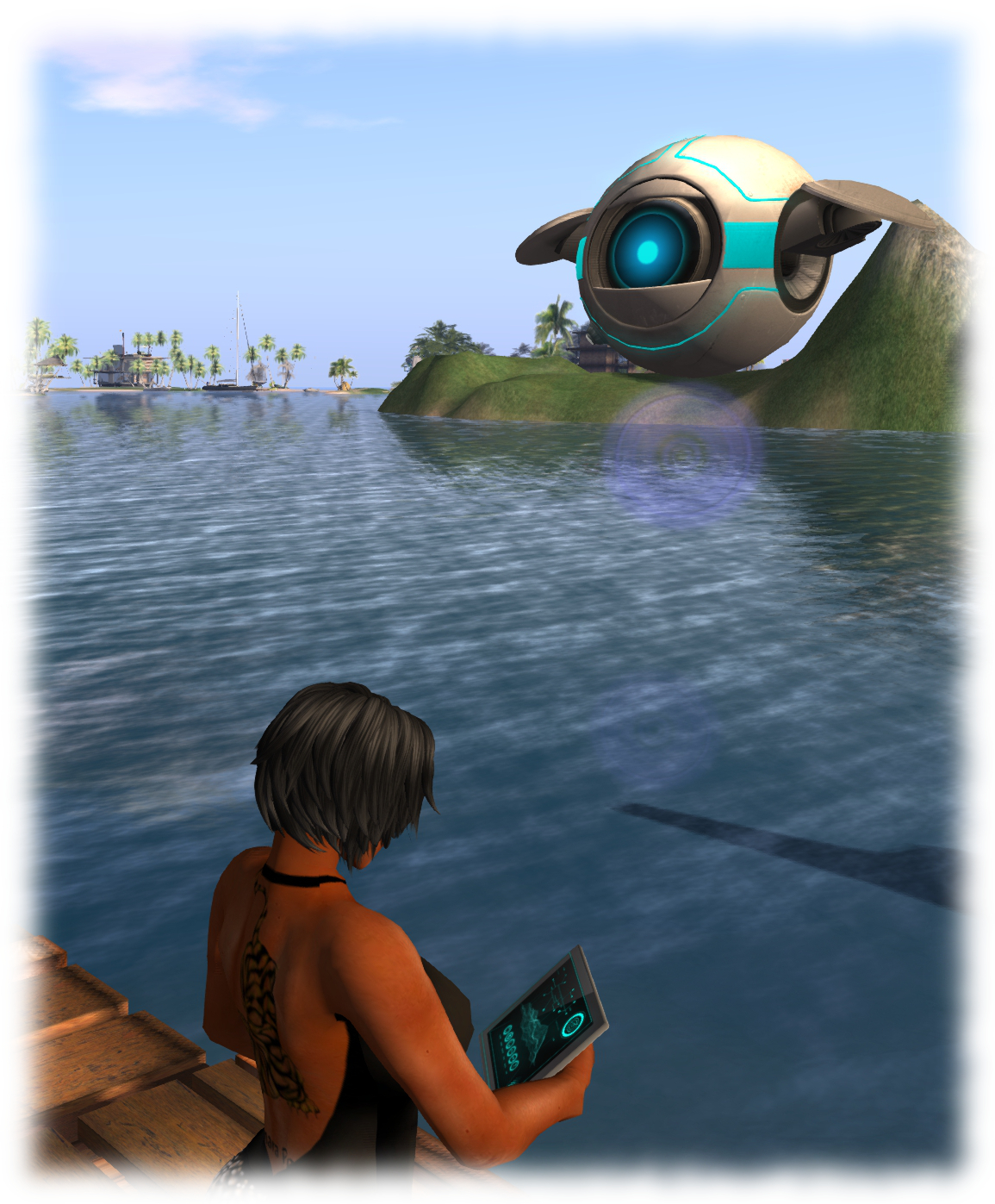
The Halloween gifts come in three parts: a ridable flying dinosaur (with aviator helmet for the rider), which is clearly intended to link to the PaleoQuest game; two “ghostly” avatars (male and female) with HUD and alpha mask; and finally, a drone system, comprising a wearable iPad-style controller, a HUD, and an update system.
I’ve tended not to be overly enthusiastic about such gifts (with the odd exception, such as the sailing boat – which at least got me into sailing in SL), and to be brutally honest, these do little to break the mould. The dino and the ghost avatars have a certain yawn factor about them which had me rezzing to take a look, trying and deleting.
Playing with the drone
The drone could be seen as a little fun item, and has a number of interesting features. You can, for example, slave your camera to it, and fly it around, or you can set it to automatically follow you (or someone else who is within range) as you wander around (it’ll self-delete should you teleport out of the current region), while the radar function will list the names of other avatars in the region and their distance from your avatar. There are also options for customising the drone and setting its “mood”, and it’ll get a tad naggy if you forget it is there.
That said, I’m not entirely sure just how long the drone is likely to remain a novelty item for most; if you want to have a free-flying camera, a suitable controller and the flycam mode in the viewer are both far more efficient (as is alt-camming). However, it can be entertaining (I admit to having a giggle when it spooked a helo crew hovering next to my house), and could offer options in some RP scenarios, while the iPad and its associated animations might find a use from time-to-time, even if the drone doesn’t.
As usual, if you are considering the move up from Basic, might I offer some thoughts (as long in the tooth as they might be) as someone who has bounced from Premium to Basic and back again?
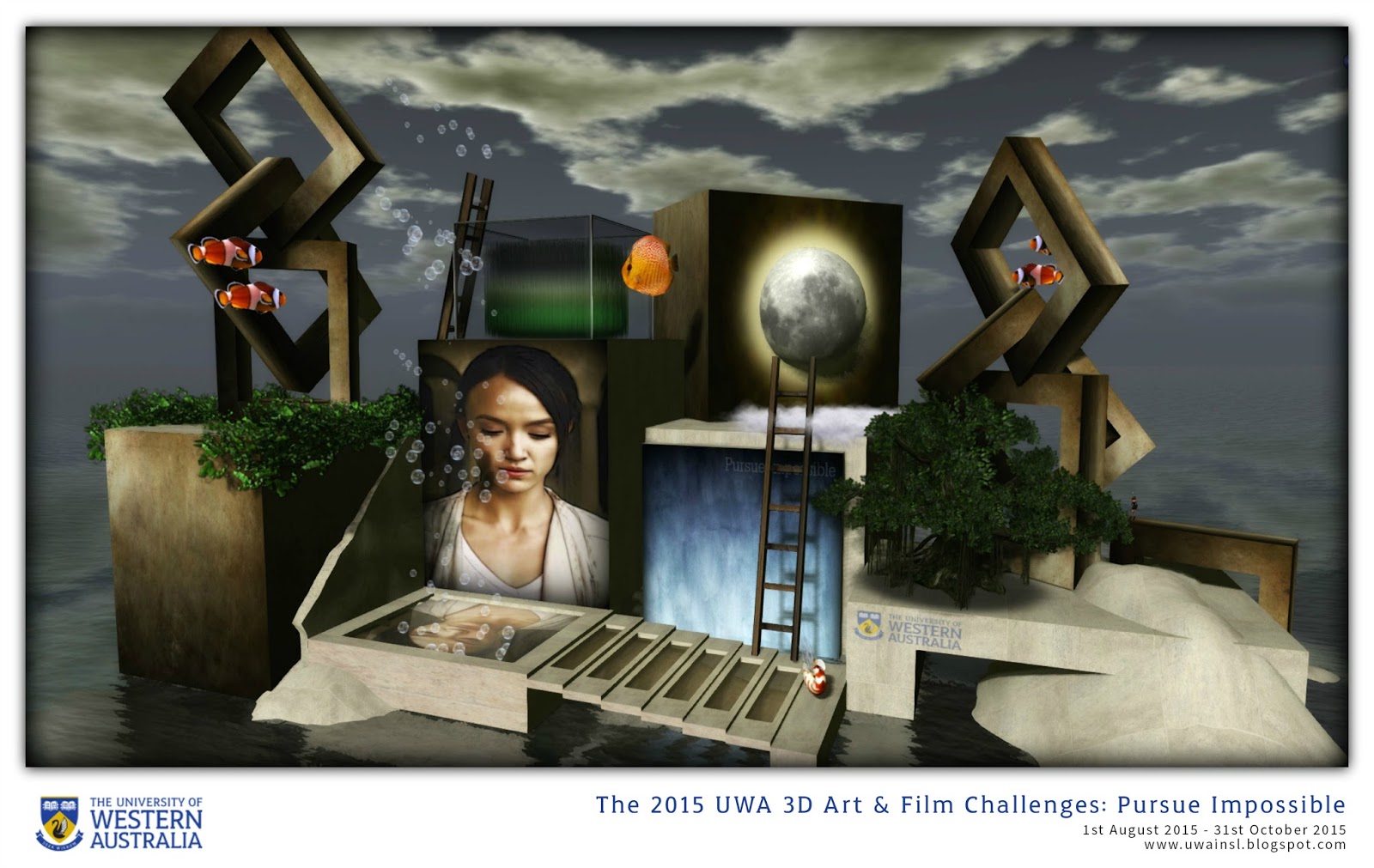
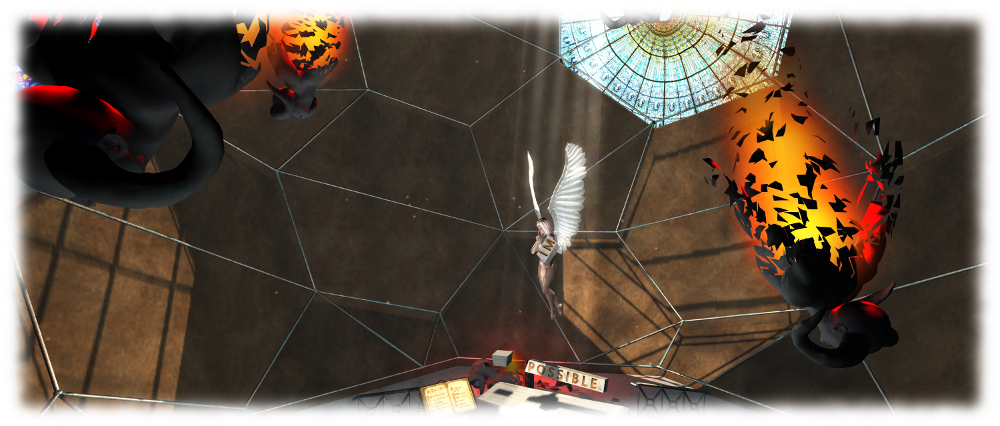
The University of Western Australia’s (UWA) latest 3D art and machinima challenge, Pursue Impossible is counting down the final days before entries close at midnight SLT, on October 31st, 2015. With a prize pool for participants in both the art and machinima categories standing at over L$ 560,000, there have already been some amazing submissions – and there is still time for artists and film-makers to create and submit their own entries.
Pursue Impossible takes its theme from the UWA’s clarion call to students in the physical world to achieve their fullest possible potential by studying with the university. Within the challenge, it calls on entrants to consider what their “impossible” might be.
Perhaps it might be something personal, a goal achieved individually or by a loved one or friend. Or perhaps it is consideration of those things we deem to be impossible, but which we may still pursue and conquer as individuals or collectively. Perhaps it is itself a clarion call for us all to face the things we consider impossible and rise above them; or maybe it is an illustration of how virtual environments empower people to visualise, create and push the boundaries of the possible. There are many options and opportunities to consider.
Currently, the first prize for each category stands at L$60,000 plus a cover feature with BOSL magazine. Should you wish to enter either or both categories, full details of entry requirements can be found on the Pursue Impossibleannouncement page. However, a brief outline of the key points to keep in mind is given below.
Art submissions are limited to one per entrant, must have COPY permissions, should not exceed 150 LI, and must be free from any copyright issues – if third-party content is used in an entry, permission must and been sought and granted from the creator for its inclusion in the Challenge
Entrants can submit as many machinima pieces as they wish, but films should preferably be no longer than 4 minutes and 30 seconds (although this is not a “hard” rule), and should be made specifically for this challenge. All films must include “For The University of Western Australia’s MachinimUWA VIII: Pursue Impossible” in the opening credits
All submissions should allow casual viewers to interpret how the theme is represented, or provide a means by which the piece can be understood in the context of the challenge theme, either via note card (art) or text in the video description when uploaded to YouTube, Vimeo, etc.
As well as the art and machinima category prizes, there will also be special cash prizes for audience participation. The total prize pool for this currently stands at L$41,000, and prizes will be awarded to those members of the audience whose top 10 lists most closely align to the final juried top 10 entries in each category.
Details on how to enter the audience participation part of the challenge will be announced in due course. In the meantime, don’t forget to check the art entries at the UWA Gallery and the video submissions on the UWA blog.
Romy Abovitz talks Magic Leap at WSJD Live (image courtesy of Engagdet)
Magic Leap, the augmented reality company established by enigmatic entrepreneur Rony Abovitz, and which gained over US $500 million from the likes of Google in 2014 (see my article from October 2014), revealed a little more about its product during a WSJD Live interview recently.
As reported by Nicole Lee for Engadget, Abovitz and Chief Content Officer Rio Caraeff talked in general terms about the system which has caused no small amount of excitement among those who have actually seen it in action. People such as Google’s CEO Sundar Pichai, who sits on the Magic Leap board and was one of the driving forces behind Google’s lion’s share of the half-billion funding mentioned above, and who shares a place on the board with Qualcomm’s executive chairman, Paul Jacobs, another investor from that round of funding.
The technology has also wowed leading lights from the entertainment industry such as Weta Workshop’s co-founder Richard Taylor (one of the first to invest in Magic Leap), and Thomas Tull, CEO of Legendary Entertainment (aka Legendary Pictures). For those outside, however, Magic Leap has perhaps come over as a riddle bordering on smoke and mirrors.
The Magic Leap website splash screen (no pun intended)
Talking at the WSJD event, Abovitz indicated Magic Leap won’t be tied to a particular platform or OS, but will be entirely self-contained and with a dedicated OS. He also indicates that in difference to those dismissing AR on the grounds that “no-one likes to wear glasses for long”, the form factor for the unit will be something people won’t fight shy of wearing. He also states it will allow them to maintain a normal relationship with others when in use – a little dig, no doubt, at the first generation of cumbersome and isolating VR headsets about to hit the market.
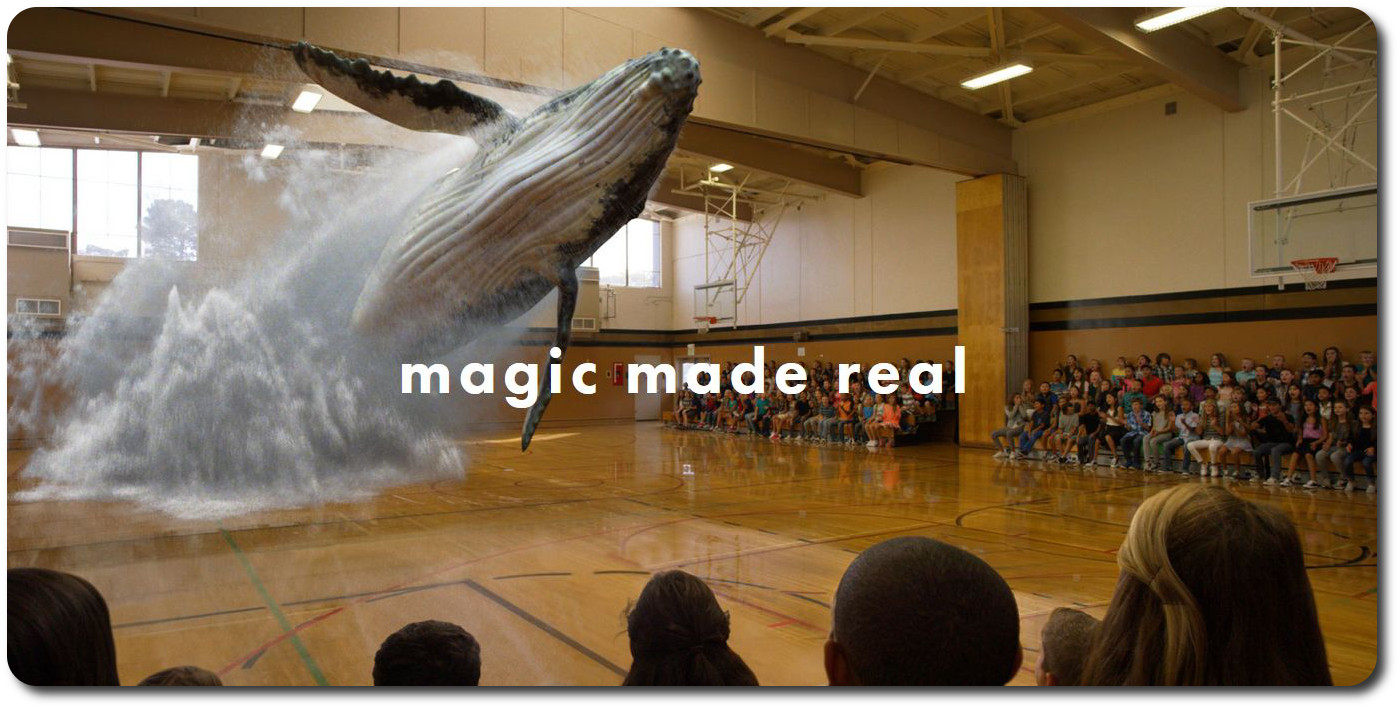
Alongside of the interview, Magic Leap also released a new video which they state is filmed entirely through Magic Leap technology and with no special effects or compositing.
Quite how the system works, however, is still a mystery. No headsets are shown in any of the company’s promotional material, and much is made of the use of a “Dynamic Digitized Lightfield Signal” (which we can call “Digital Lightfield™”). In speaking at WSJD, Abovitz and Caraeff both skirted specifics, with the former only saying, “We treat human biology as our centre point; everyone already has a head-mounted display. It’s your head!”
This suggests the company is perhaps pursuing direct retinal projection, possibly in some form of headset unit that is less intrusive than the kind of units suggestive in the patent filings the company has made in the past. And if this sounds like science-fiction, remember Abovitz made his money developing medical technology, and the company has apparently devoted considerable effort into researching the relationship between the photonic light field and the way the brain functions.
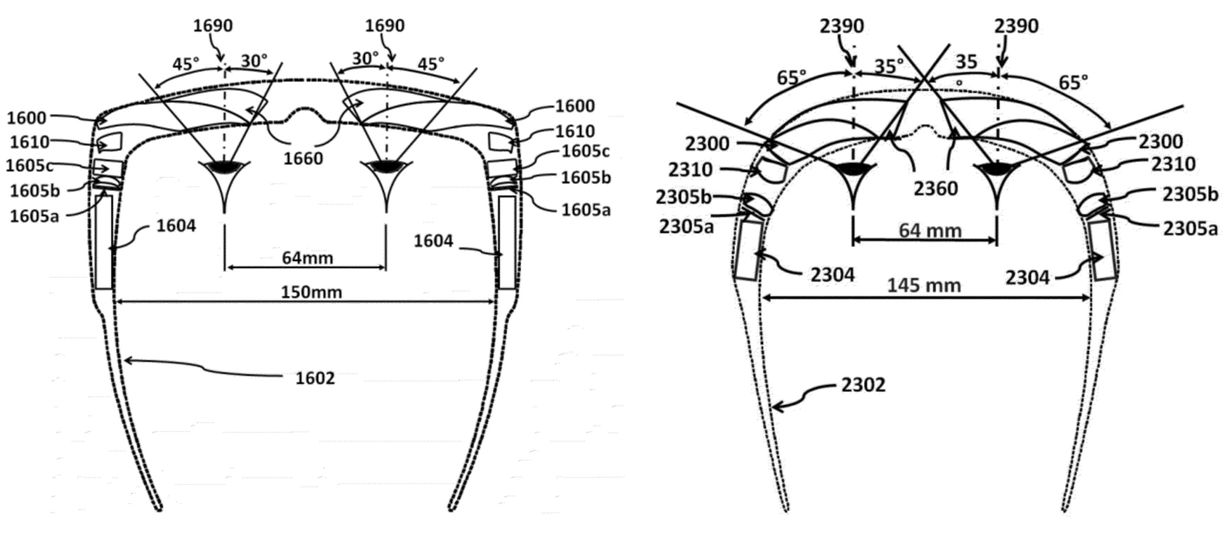
Patent WO 2014043196 A1, filed for Magic Leap by Chunyu Gao for augmented reality headsets styled in both “regular glasses” and “wrap-around” form factors, suggesting some form of headset will be a necessary part of the system – click for full size
So what is the purpose of all this? Caraeff indicated the ultimate am is for Magic Leap to provide broad-based platform for visual computing. “Anything that you can do on your smartphone, on your computer; you’ll be able to do on Magic Leap,” he said, then added, “Where the world is your screen.”
“We believe the future of computing should be natural,” Abovitz stated. “With Magic Leap, your brain doesn’t distinguish what’s real and what’s Magic Leap, because as far as your brain’s concerned, it is real.”
I admit to being far more persuaded that AR will generate a greater mass market presence than VR. Despite the negative memes about people not liking glasses and Google’s misplaced Glass product, AR would appear to be far more inclusive in its use than VR, and have the same potential reach into many of the markets being hailed as VR’s territory: business, medical, education, healthcare and entertainment.
Whether Magic Leap will actually pave the way in this regard as units start to roll off the company’s new production line in Florida at some point in the future, is open to debate. I do, however, admit to being more intrigued by the potential of AR systems like it and CastAR than I am with the first generation of VR headsets we’re about to see.
Additional material on the WSJD Live event via The Verge.
The Firestorm Gateway regions: setting for a special Spooky Hunt, but merchant assistance sought
Firestorm will be opening their new Gateway regions to the public on Saturday, October 31st, with both a special Halloween party and the launch of their Spooky Nights Hunt, which will run through until Monday, November 30th.
The Firestorm Gateway is one of up to 20 new Community Gateways which will soon be opening as a part of a trial of a new Community Gateway programme initiated by the Lab, and which I previewed back in September.
The idea is to allow communities and groups within Second Life to build their own gateways focused on bringing new users into Second Life and to help get them started. These gateways will include web pages to attract new users to them, which will include a registration API to allow those users to sign-up to SL and create and account without necessarily having to go through the central registration process at secondlife.com.
The Firestorm Gateway regions, once officially opened, are intended to help incoming users gain familiar with SL, gain support, and experience some of the activities to be found in-world, such as socialising, flying, boating, playing games, and – as shown here – scuba diving and underwater exploring
The Firestorm party and Spooky Nights hunt do not mark the official opening of the new Gateway programme as a whole – the Lab will hopefully be announcing this is due course. However, they do present the opportunity for Second Life users to explore the Firestorm Gateway regions, five of which will be featured in the hunt, which will also serve as the first event designed to attract new users to Second Life via Firestorm’s website.
A special stage area has been created for the party on October 31st, which will feature Mankind Tracer and Nance Brody, among others. There will be more details on this announced by the Firestorm team in due course.
The Firestorm Gateway regions also include areas suitable for introducing people to role-play, etc. – and you can explore them once the Spooky Hunt opens on October 31st
The Spooky Nights Hunt will take place across the five activity regions of the Gateway, and it is hoped it will provide fun and interaction for both established and new users. Right now, and in support of the hunt, the Firestorm team are reaching out to Merchants who are willing to provide goodies as hunt prizes, with Jessica Lyon, the Firestorm project manager noting:
Although it is a Halloween hunt, the hunt remains open after Halloween. You can make a spooky gift or not.
If you are a Merchant interested in supporting the hunt, please hop over the Firestorm website and the Spooky Hunt application page for further information.
As well as participating in the hunt, newcomers and visitors will be able to explore all six of the Firestorm Gateway regions, which include an orientation region for people new to Second Life and a social area where people can meet and interact (and where questions on using Second Life can be answered). In addition, they’ll be able to participate in any of the activities offered across the regions. These are designed to present a broad feel for the things people can enjoy in Second Life, and include fly aircraft, sailing, jet skiing, scuba diving, playing games, etc. In addition, they can explore a simple role-play environment, or use the sandbox area to learn the basics of building.
The Firestorm Gateway opening will focus on a Halloween party of Saturday, October 31st, followed by a month-long Spooky Nights Hunt in the 5 activity regions of the Gateway
One of the most important aspects of any Community Gateway is providing volunteers who are willing to spend time in-world providing help and support for new users as they arrive. If you would be interested in supporting the Firestorm Gateway by becoming a mentor there, please send a note card with your name and relevant background information (e.g. whether you have been a mentor in the past, experience in helping newcomers and users, etc.), to Jessica Lyon.
To keep up to date with preparations for the party and the hunt, as well as with further news on the Firestorm Gateway, keep an eye on the Firestorm website. I’ll hopefully have more news on the Gateway programme itself as it is announced by the Lab and / or more Gateways come on-line.
If you are participating in the Gateway trial programme, and would like your Gateway to be previewed in this blog, please use the contact form to drop me a line, or contact me in-world.
On Tuesday, October 20th, Linden Lab issued a blog post highlighting upcoming technical improvements to the service, particularly viewer-side updates, which will shortly be making an appearance, or which are already available in the form of release candidate or project viewers.
Regular readers of this blog will hopefully already be aware of most of the improvements mentioned by the Lab’s post, as I’ve covered them through various updates and focus articles in these pages.
The first to get a mention is the Project Valhalla viewer, which introduces Chromium Embedded Framework functionality to Second Life to replace the ageing LLQTwebkit functionality, and which I initially previewed here. Commenting on this viewer, the Lab blog post states:
A new age of modern HTML5 content is upon us, and we’re overhauling the way shared media (aka “media on a prim”) works so that you can enjoy all kinds of modern web content within Second Life. Chromium Embedded Framework (CEF) is coming to replace the ageing QTWebkit framework. What you can now see in a Project Viewer is the latest released version of Chrome – so it will render all modern web technologies – like HTML5, CSS3, WebGL; has the latest security patches; and will be easy to keep updated to a recent version. What does this mean for your Flash content? What about QuickTime? They may still work, but because both can only be viewed if the user has correctly installed a 3rd party plugin, we can’t promise support and you shouldn’t expect that it will work for everyone. Standard HTML5 is the way of the future and this Viewer will enable it for anyone. There are still bugs to squash, and we’re iterating quickly to bring you a smooth in-world media and browsing experience. If you have comments about this feature – please post to the forum thread about this topic – located here.
My own quick-and-dirty demo of using a viewer with the CEF code (in this case, the Black Dragon TPV, as I don’t have a video using the Valhalla viewer) to access WebGL content displayed both on prims in-world, and via the viewer’s built-in browser. The WebGL demonstrations are provided via David Walsh (with thanks to Whirly Fizzle for the link), and this video is intended to offer a simple overview of some of the capabilities, which as mentioned in the notes from the Lab are actually far more extensive.
The major take-away from the CEF introduction at this point is that if you make use of media within your products (e.g. TVs, etc.), or as a part of you in-world presence, now is the time to be looking to convert them to using HTML / WebGL, etc., testing them against the Valhalla project viewer, and reporting any issues / highlighting any concerns. The Lab is more like to address matters / consider changes while the viewer is will at project status, rather than when it reaches a release candidate status.
Also mentioned in the post is the new Notifications RC viewer and the Quick Graphics viewer, both of which are both available as release candidate viewers. The former provides a new front-end for handling incoming notifications (and which I previewed here). The latter provides both the new Avatar Complexity functionality (which replaces the old ARC / ADW) and the abilities to create, save and quickly re-use sets of your own graphics presets for use in different environments and settings. Again, I’ve previewed both of these here and here.
The notifications viewer offers a new way of managing notifications and is featured in the Lab’s blog post
Additional insight into Avatar Complexity is provided, both through the post and via a link to the Knowledge Base article on it. a request is also given that anyone who has general comments on the capability to please post them to the related forum thread (comments posted to this blog may not be read by the Lab).
Mention is also made of the HTTP updates which have been undertaken by Rider Linden (Project Azumarill) and which are also available in a release candidate viewer. This project builds on the foundations laid by Monty Linden with his HTTP work, further enhancing the use of HTTP capabilities to provide more robust communications capabilities with the simulators and back-end services. Finally – at least in terms of available viewers – the updated mesh importer viewer, recently promoted to de facto release status, gets a mention.
The Quick Graphics viewer allows you to create and save your own graphics presets to suit different requirement,s and which can be quickly loaded and used with just a couple of mouse clicks
Also referred to, although it has yet to appear in a project viewer, is a further inventory related project. This is being led by Aura Linden, and the aim is to improve the overall robustness of inventory handling, the work being carried out in two parts, as I was (again) able to preview recently, courtesy of a Third-Party Viewer Developer meeting:
The first part will see the removal of all of the old UDP inventory messaging paths used by the viewer which have already been replaced by more robust mechanisms, but which have until now remained a part of the viewer’s code – this aspect of the work should be appearing in a project viewer viewer soon
The second part will comprise a refactoring of the viewer inventory files and functions with the overall aim of making the code more readable and easier to maintain.
As the Lab’s blog post indicates, this project further builds on the on-going work we’ve seen during the course of the last few months to improve inventory performance, reduce the number of inventory losses users may suffer, and provide assistance with inventory-related problems which affect things like logging-in to to SL.
Finally, the Labs blog post also reveals that Flash has now been removed from the secondlife.com website, noting:
Due to the numerous recent security problems affecting Flash, it has been completely removed from our website. A modern way to animate starter avatars in the join carousel and some other exciting news for registration is coming out really soon. Keep an eye out!
This announcement again signifies that while the Shining Project many have ended, and things may have been a little quiet of late, things are still being progressed. As it stands, the notifications updates may well be promoted to the de facto release viewer in week #44 (week commencing Monday, October 26th). In the meantime, the links below will take you to the latest (at the time of writing) versions of the viewers mentioned here and in the Lab’s blog post. If you find any reproducible issues with any of them, please raise a JIRA, and remember to post any general comments you may have on the viewers to the official forum threads mentioned above.
There was no deployment to the Main (SLS) channel on Tuesday, October 20th.
On Wednesday, October 21st, all three RCs should receive the same new server maintenance package, which include server-side improvements for delivering group notice attachments, which is hoped will provide some improvements to issues of trying to open such attachments from the group notice notifications.
The update also includes some simulator crash fixes, and while not advertised in the release notes, should also include simulator-side code to prevent the uploading of “hacked” mesh content (e.g. mesh items which show a LI of 1 no matter what their actual complexity, or which spoof a creator’s name).
The Quick Preferences RC viewer was updated to version 3.8.6.305942 on October 19th, most likely bringing it up to parity with the current release viewer.
Commenting on the status of the current RC viewers during the open Source Developer’s meeting on Monday, October 19th and in relation to any possible viewer promotion in week #44, Oz Linden said, “The Quick Graphics viewer has too many bugs to promote; mostly minor, but there’s no reason to go forward with it yet. HTTP has a couple of significant bugs to fix. So if I had to bet on the next promotion I’d guess the Notifications viewer.”
Expect more news on viewers following the TPVD meeting on Friday, October 23rd.
Other Items
A question was asked during the Simulator User Group meeting on Tuesday, October 20th about making script time for in-world objects in a parcel available to the parcel holder (e.g. an extension of the region-wide Top Scripts functionality available to region / estate owners / managers). The idea here being to help parcel owners better understand how in-world objects within their parcel might be impacting simulator resources (see this forum thread and SCR-60 as well).
Commenting on the idea, Simon Linden said:
Since we send it to the viewer already, you have access to the info … You can probably get some of that info by scanning but I can see it would be a lot easier to get that in a different format. One of the limits (I’m sure you all know) of LSL is it’s not good with large data sets, so I’m not sure how you can expose that info for a large number of items … so maybe the top 10 or 25 objects on a given parcel? I can totally see the need for that to manage land.
… HUDs and attachments add a twist to it … they would probably be lumped together with the AV as they are now. I wonder if it would be easy to add something like PARCEL_SCRIPT_TIME to llGetParcelDetials()? that doesn’t give you what you want, but is a higher level for finding the parcels with the most scripts.
Those looking for such a capability are advised to raise a JIRA feature request.





 Inara Pey: Living in a Modemworld