SL project updates 44/1: server, viewer, attachment points

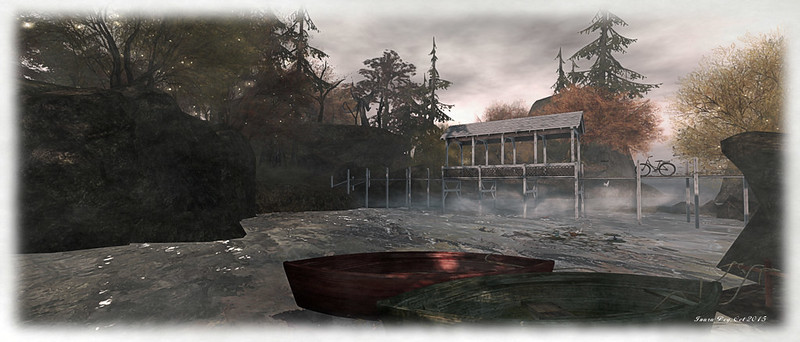
Loch Noble, Pinewinds; Inara Pey, October 2015, on Flickr KiLu, Majorca (Flickr) – blog post

Server Deployments – Week #44

As always, please refer to the server deployment thread for the latest updates.

On Tuesday, October 27th, the Main (SLS) channel received the same  server maintenance package as deployed to the three RC channel in week #43. This comprised server-side improvements for delivering group notice attachments, together with some simulator crash fixes and code to prevent the uploading of “hacked” mesh content (e.g. mesh items which show a LI of 1 no matter what their actual complexity, or which spoof a creator’s name).

On Wednesday, October 28th, the RC channels should be updated as follows:

  • BlueSteel and LeTigre will each receive the same new server maintenance package, comprising a simulator crash fix
  • Magnum will also receive a new server maintenance package, comprising the same simulator crash fix as BlueSteel and LeTigre, together with a fix for a security issue.

SL Viewer

On Monday, October 26th, the Notifications viewer was promoted to the de facto release viewer. Version 3.8.6.305981 comprises the new floater for managing incoming notifications (Group, Transactions, Invitations, System).

The notifications viewer became the de facto release viewer on Monday, October 26th.

Also on Monday, October 26th the HTTP release candidate viewer updated to version 3.8.6.306549, which includes fixes for the following issues:

  • MAINT-4952 Replace old http client usage with llcorehttp
  • MAINT-5283 Viewer doesn’t connect to Facebook
  • MAINT-5693 [Project Azumarill] Avatar often bakes fails on Azumarill
  • MAINT-5732 [Azumarill-RC] Viewer actually crashes when connection is lost instead of disconnecting.
  • MAINT-5780 Viewer crashes when trying to create webprim
  • MAINT-5788 Secondlife has stopped working error, after canceling TOS
  • MAINT-5791 Terms of service are not loading.

Other Items

Rigging Mesh to Attach Points – BUG-10543

In my last project update, I reported on asset upload validation checks, and the Lab’s work to move them from the viewer to the simulator (e.g. checks to ensure animations are what they say they are, further checking of mesh uploads to ensure they can be rendered correctly, etc.). the overall aim is to improve reliability in SL. However, one impact of these changes is that once implemented,  it will no longer be possible to upload mesh items weighted to attach points.

While the Lab  has never regarded this as a supported means of handle mesh attachments, it has nevertheless been widely used by creators in SL. So much so that when Firestorm removed the ability to upload such meshes from their viewer, it caused some consternation (see FIRE-17144).

Once implemented, the change should only affect new uploads of mesh weighted to attachment points, and not affected any items already uploaded and in use within SL. However, a JIRA on the matter has now been raised directly with the Lab on the issue (see BUG-10543), in which creators who use the technique can provide input and use-cases to the Lab on why the approach is used (if you wish to leave a comment, please try to make it constructive and provide examples / reasoned argument, as these work better than rants).

Commenting on the JIRA, Troy Linden has said, “We realise that there will be a lot of residents/assets affected by this and currently looking into it. Sorry for the inconvenience and worries it caused. Please stay tuned.”

Adding to this at the Simulator User Group meeting on Tuesday, October 27th, Oz Linden said:

Up until a couple of days ago, we didn’t know anyone was doing it. You’d be amazed how often that happens. So please allow us a little time to digest what we’ve been learning. It’s actually one of the great things about working on SL. While we don’t always love how people apply their creativity, we all just love seeing how creative our users are.

Region Edge Issues

There has been an occasional problem encountered along the edges of simulators in which, when terraforrming and using the Smooth option, a very thin “cliff” can be raised into the air (see BUG-5979), or where when an avatar gets close to a region, it falls  through a “gap” (see BUG-242).

Various reasons have been identified for this – as noted in the bug reports – and at the Simulator User Group meeting, Simon Linden said, “I think I found the cause of those odd region edges you sometimes see, where you can’t move in the areas you think you should at the edge of the land. It’s actually not the navmesh [which had been thought to be one of the possible causes] but it is the physics shape of the land.”

Essentially, the simulator, where no longer connected to a region which might once have been next to it, gets confused as to what it thinks should be alongside it. It then attempts to match the physics and land to what it thinks is in the “neighbouring” region,  rather than simply resetting itself.

Trick or Treating in Second Life

Carver's End
Carver’s End

Pulse Games have been bringing Halloween themed games to Second life for eight years. In 2014, they created Don’t Panic, an enticing and fun little adventure-come-hunt built around the story of paranormal investigators and mysterious goings-on, as I reviewed at the time, having previously encountered their 2013 event, System Failure. So when I heard the news their offering for the 2015 Halloween season was open, I was curious to find out what it might be like.

Carver’s End is billed as a trick-or-treat adventure which takes the turn for the worst. as one might expect, participants are out doing the trick or treating as things  get decidedly odd and increasingly gory as they progress  through what might otherwise be the sleepy little hamlet that goes by the titular name.

A Blood Moon hangs over Elm Street Baptist Fellowship, Carver's End (Paster: F. Krueger?)
A Blood Moon hangs over Elm Street Baptist Fellowship, Carver’s End (Paster: F. Krueger?)

Things start innocently enough at the arrival point. Here you’ll need to grab a copy of the free play pack, which includes introductory notes, instructions on game play. Do make sure you heed the notes on minimising lag and divesting yourself of unnecessary facelights. It’s also a good idea to have sound on as well, although essential information is also delivered through chat. There’s also a game HUD in the form of a radio, which you’ll need to wear. With this in place, you’re ready to proceed via the “tunnel” leading to the town.

As Carver’s End uses Experience Keys, you must grant it permission to act on your avatar when you reach the tunnel entrance. The requested permissions are displayed in the dialogue, and as with all Experience keys activities, the permissions granted will be automatically revoked when you leave the game play regions.

"They're heeerrrreee...."
“They’re heeerrrreee….” – the TV has some strange offerings in Carver’s End!

On granting the permissions, you’ll be transported to Carver’s End (population 666). From here on in, what happens and where you go is entirely up to you. As with all Pulse Games, progress is very much as case of explore, touch and listen for hints (given both over your radio (local sounds) and in chat).

And when I say “explore” and “touch”, I mean exactly that; don’t take anything for granted, and take your time. There are prizes large and small to be found (with the black rats in particular handing out hunt prizes), while doors, gates, manhole covers, ladders, and so on may well teleport you to another area of game play.

The game HUD - LEDs mark your progress, and if you get lost, HOME will take you back tot he landing point
The game HUD – LEDs mark your progress, and if you get lost, HOME will take you back to the landing point so you can start over

It is at this point that a small problem does occur. One of the really attractive elements of Don’t Panic, was the fact it was structured around a storyline with a defined starting point and purpose. This, combined with the various ways one could progress through the challenge, made it  and engaging activity.

Carver’s End has a similar free-form approach to it, which offers the same different routes through it, allowing different things to be found over several runs through the town. However, it does lack any underpinning story. This left me leaving a little disappointed with the experience when compared to Don’t Panic; there was little to really keep me engaged to the same degree, which was a shame.

That said, for anyone who does enjoy hunts in Second Life and fancies one with a horror twist, Carver’s End will be open through until mid-November; there’s plenty on offer as you find those little black rats!

SLurl Details

Alchemy 3.8.5: skinning and getting under the hood

Alchemy-logoOn Sunday, October 25th, the Alchemy team announced the release of version 3.8.5.36974 of their viewer. This is an update which primarily focuses on a lot of under-the-hood updates and fixes which may not always be obvious to users, but which are intended to further improve viewer stability and improvements. However, it also includes some interesting tweaks as well, of which more below.

As always with any viewer release, please refer to the release notes for details on updates, improvements and fixes, as provided by the development team.

The first noticeable change with this release lies with the version number, which leaps from 3.8.2 from the last release to 3.8.5 – the result of Alchemy (alongside UKanDo and Kokua) pacing the Lab’s version numbers for viewer updates. The idea with this is to make it easier to quickly identify which of the recent releases from the Lab has been merged into a release from any TPV with a matching version number. So in this case, Alchemy is merged-up to the Lab’s 3.8.5 code and the October Maintenance release viewer.

The other major visual change to the viewer with this release is a new skinning option. This allows users to choose the look of the viewer UI skin, and to create their own skins, which they can use on their own or share with others, marking alchemy as the latest viewer to offer support for custom skins.

The option can be found under Preferences > Skinning, and as the release notes indicate, the viewer currently includes just two options at present, in order to keep the install size down: Alchemy’s own dark skin (default) and the Lab’s classic V3 viewer skin.  However, the release notes appear to suggest that further skins may be added to the viewer – or perhaps made available for download through the alchemy website – in due course. There will also apparently be a guide produced, offering users instructions on making their own skins.

The Skinning option, new with Alchemy 3.8.5 allows the use of custom UI skins with the viewer

Using a skin simply requires selecting it from the list of available options, clicking the Apply button and then confirming your selection by clicking on Yes in the follow-up dialogue box. Restarting the viewer will then apply the selected skin.

Other Updates

The Alchemy 3.8.5 refresh option allows you to refresh textures / meshes worn by yourself or other avatars

As well as the above, the 3.8.5 release of Alchemy includes:

  • libcurl 7.45.0, boost 1.59, the replacement of C++11 with C++14
  • ALCH-312 – a Refresh option has been added to assist with loading avatar mesh and textures
  • ALCH-278 – the Group list (CTRL-SHIFT-G) now includes an “eye” icon to show if the group can be viewed in your Profile (icon shown) or is hidden (icon not shown) – groups are hidden through the Group Profile floater, as usual
  • ALCH-270 – a message logger and builder for packet and message inspection for debugging and fixing OpenSim. This feature will be locked to developer builds
  • ALCH-297 – the Fast Timers legend is now scrollable by the scroll wheel
  • ALCH-290 – the Destination Guide now updates when teleporting between OpenSim grids
  • Numerous bug fixes and many under-the-hood changes.

There is still no RLV support for Alchemy with this release, which may disappoint some. However, what is there makes for a useful update, and ensures Alchemy stays on par with the Lab’s continuing run of updates and additions to the official viewer.

Related Links

Medical Centre granted $3.5 million to study diabetes education in Second Life

Draxtor Despres pointed me towards Second Life shows new promise as virtual forum for diabetes education, an article written by Nidhi Subbaraman for the technical section of the Boston Globe’s on-line edition.

In it, Ms Subbaraman reports on a Boston Medical Centre trial which utilised Second Life to help diabetes sufferers better manage their condition, and which has paved the way for an even more in-depth examination of the use of virtual world environments in matters of personal healthcare.

Nidhi Subbaraman writing in the Boston Globe about Diabetes studies using Second Life
Nidhi Subbaraman writing in the Boston Globe about diabetes studies using Second Life

The trial was initiated by  2009 by Dr. Suzanne Mitchell, a family physician at Boston Medical Centre and assistant professor at the Boston University School of Medicine. The intent was to investigate whether and how virtual group sessions held in Second Life might help diabetes sufferers made changes to their eating habits and lifestyles to better manage their illness.

In particular, the trial involved African-American women, many from low-income families and / or holding down busy jobs. This demographic was specifically targeted because the U.S. Department of Health and Human Services Office indicates that a quarter of African-American women over age 55 have type 2 diabetes, which is a significantly high percentage.

Half of the study participants attended hospital classes to help them cope with their condition, the other half were provided with computers and modems and shown how to access Second Life and attend classes in-world. As Ms. Subbabaman notes:

Some days the virtual group “met” at the Second Life BMC classroom, but the group also took field trips into the on-line world. Once, the course leaders led a session on diet and explained how slow, mindful eating was one way to control portions and manage diet. The participants found that when their avatars sat down to eat at the cafeteria location, their utensils moved very slowly, echoing the lesson. Another time the group met at an exercise facility within Second Life, where participants could try out the treadmill or exercise bikes, or take a swim.

Not only did the trial reveal the participants attending virtual activities faired at least as well as those attending regular hospital classes, it also showed that they formed friendships and their own support network, swapping recipes, and trying to encourage friends to join them in-world as well. Most interestingly of all, the study suggested that those participating in the virtual aspect of the study reported exercising more than the group that met in class, suggesting the virtual experience might result in lasting lifestyle changes.

This isn’t the first time that activities in Second Life and virtual environments like it have been shown to have a positive impact on people’s lifestyle choices. In 2012, for example, I reported on a study led by Dr. Elizabeth Behm-Morawitz at the University of Missouri which showed that people who have a strong sense of self-presence with their avatar enjoy an improved self-image and took better care of themselves health-wise, and tended to enjoy better relationships with others.

Dr. Suzanne Mitchell

However, as Ms. Subbabaman reports, the work carried out by Dr. Mitchell and her colleagues has now resulted in the National Institute of Diabetes and Digestive and Kidney Diseases (NIDDK) awarding them a US $3.5 million grant to finance a further 5-year study into how the use of Second Life can help people diagnosed with diabetes better manage their condition.

“We know that in order to actively participate as partners in healthcare, patients with diabetes need self-management support,” Dr. Mitchell said in a BMC press release announcing the grant and the study. “What is remarkable about this study is we’ll be educating and interacting with some of the patients, and they’ll be interacting with each other, all through group visits in a virtual world.”

As with the initial trial, participants will be placed in either the control group (classroom education) or asked to join Second Life. Those involved in the Second life element of the study will not only be monitored to see how participation in in-world group session helps them better understand their condition, but also how the relationship with their avatar in general has an impact on their self-care and willingness to undertake lifestyle changes.

In this Dr. Mitchell and her colleagues are very keen to chart what is called the “Proteus Effect”. This is a term coined by Nick Yee in his 2014 book, The Proteus Paradox: How Online Games and Virtual Worlds Change Us– and How They Don’t to define the increasingly complex relationship we have with our digital Doppelgängers, and how it can have a profound and often positive effect on us (also see my article from January 2014).

The Proteus Effect was very much in evidence during the original BCM trial, and was also the effect noted by Dr. Elizabeth Behm-Morawitz’s study, so Dr. Mitchell is keen to explore how deeply it may affect and benefit people afflicted with diabetes.

Currently, it is estimated that some 387 million people globally live with diabetes, and the World Health Organisation estimates that the disease could be the 7th leading cause of death by 2030. given this, studies like the one announced by Dr. Mitchell and her colleagues could offer important new insights into the ways and means by which virtual world environments could encourage better self-management for the disease.

What’s more, it is possible the results of this study could be applicable to helping people better manage a range of long-term illnesses and conditions for themselves and alongside of medical support.  As such, it will be interesting to see how this study progresses, and I very much hope that I’ll be able to carry further updates on the study in the future.

Further Reading

Don’t forget that 2015 marks the first Team Diabetes season in Second Life, raising money in support of  the American Diabetes Association. In particular, November 2015 will see the Art in Hats event, which will lead up to World Diabetes Day. on November 14th. I’ll have up-to-date news on activities occurring throughout Art in Hats in due course.

2015 viewer release summaries: week 43

Updates for the week ending Sunday, October 25th

This summary is published every Monday, and is a list of SL viewer / client releases (official and TPV) made during the previous week. When reading it, please note:

  • It is based on my Current Viewer Releases Page, a list of all Second Life viewers and clients that are in popular use (and of which I am aware), and which are recognised as adhering to the TPV Policy. This page includes comprehensive links to download pages, blog notes, release notes, etc., as well as links to any / all reviews of specific viewers / clients made within this blog
  • By its nature, this summary presented here will always be in arrears, please refer to the Current Viewer Release Page for more up-to-date information.

Official LL Viewers

  • Current Release version: 3.8.5.305531- no change  download page, release notes
  • Release channel cohorts (See my notes on manually installing RC viewer versions if you wish to install any release candidate(s) yourself):
    • Quick Graphics RC viewer updated to version 3.8.6.305942 on October 19 – provides the new Avatar Complexity options and the new graphics preset capabilities for setting, saving and restoring graphic settings for use in difference environments / circumstances (download and release notes)
  • Project viewers:
    • No updates.

LL Viewer Resources

Third-party Viewers

V3-style

  • Alchemy updated to version 3.8.5.36974 on October 25th – core updates: parity with LL 3.8.5 code base, new skinning capability, libcurl 7.45.0, boost 1.59 – release notes

V1-style

Mobile / Other Clients

  • No Updates.

Additional TPV Resources

Related Links

Space Sunday: from the Sun to Charon, and the death of a planet

Astrophotographer Mia Stålnacke caught this aurora display over Kiruna, Sweden, in March 2015

The Sun is the only star we can directly observe in detail. As such, it has been the subject of study for a long time, significantly so since the birth of the space age. As such, you’d think we know pretty much all there is to know about it; but the fact is that the Sun still has many mysteries – and surprises – of its own awaiting understanding and discovery.

One of these mysteries has been strange particle emissions rich in helium-3. These don’t form part of the more familiar coronal mass ejections (CMEs), which can have an elevated impact on Earth magnetosphere giving rising to more energetic aurorae, or with collimated X-ray flares. The cause of these helium-3 rich outbursts has until now been hard to trace because in order to be detected by the Advanced Composition Explorer (ACE) craft which is designed to study such energetic particles, they have to originate very close to the Sun’s limb, making any associated events hard to observe.

A look at the Sun’s right limb on January 26, 2010. Within the marked red square, a large-scale blast wave travels through the Sun’s atmosphere. These images were obtained with the help of NASA’s STERO A probe and show the Sun’s atmosphere in extreme ultraviolet light.
A look at the Sun’s right limb on January 26, 2010. Within the marked red square, a large-scale blast wave travels through the Sun’s atmosphere. These images were obtained with the help of NASA’s STEREO A probe and show the Sun’s atmosphere in extreme ultraviolet light.

However, on October 13th, two teams of scientists working independently of one another, but using the same data and images gathered from NASA’s STEREO solar observation vehicle and the Earth-orbiting ACE platform, announced they had pin-pointed the cause of the outbursts. They are the result of huge explosions occurring in the Sun’s atmosphere, which in turn create gigantic atmospheric shock waves in the Sun’s atmosphere which can extend over half a billion kilometres (300,000 miles) and advance at speeds of 300 km (190 mi) per second. It is believed the sheer speed of the shock waves from these explosions is sufficient to accelerate  the helium-3 (itself produced as a part of the overall fusion process in the Sun’s core), into a stream of particles thrown off into space.

While it has been confirmed the initial explosions are not related to CMEs or sunspots or other known solar phenomena, the precise reason for the explosions themselves has yet to be determined.

Charon Revealed

Images and data returned by the New Horizons space vehicle at the start of October have provided more details about Pluto’s companion, Charon, revealing it to be an even more fascinating world than had been anticipated.

Charon as revealed in the highest resolution images yet returned of that tiny world by New Hotizons (image: NASA/JPL / JHUAPL / SwRI)
Charon as revealed in the highest resolution images yet returned of that tiny world by New Horizons (image: NASA/JPL / JHUAPL / SwRI)

The images, captured in black and white by the probe’s LORRI camera, have been combined with images and data gathered by the RALPH suite of instruments to present a beautiful full-colour image of almost all of one face of Charon, as seen by New Horizons as it swept through its closest approach to both Charon and Pluto on July 14th, 2015.

Some 1,214 kilometres (753 miles) in diameter, Charon is about half the size of Pluto, and was only discovered in 1978.  Quite how it formed has been the subject of much debate. Prior to New Horizons’ visit, the most popular theory was that Charon coalesced from the debris of a collision between Pluto and another Kuiper belt object. However, New Horizons has so far failed to return any images of Pluto that hint at such a collision, and the make-up of the two worlds is less similar than might be expected were one the offshoot of the other. So the theory gaining ground now is that both bodies were already formed when they fell into orbit around one another.

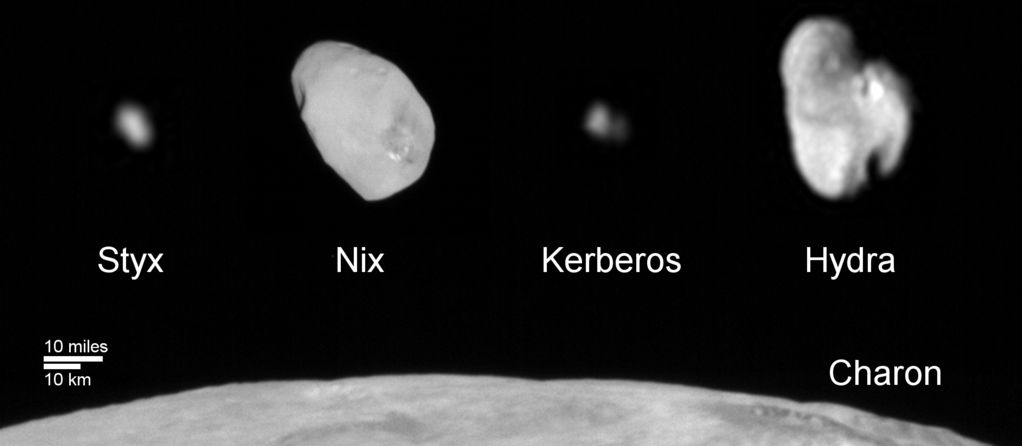
A comparison of the Moons of Pluto as images by New Horizons, and their relative size

The latest images of Charon reveal a striking world, every bit as varied as Pluto, and marked by a massive series of fractures across its midriff, suggesting a massive upheaval in Charon’s past which split open its crust. The southern hemisphere also has a more youthful appearance than the region north of the fracture, suggesting that widespread resurfacing took place following the event, and that cryovolcanism (ice volcanoes) may today be contributing to maintaining the relatively smooth appearance of Charon’s southern regions. So like Pluto, Charon may still be an active world.

Continue reading “Space Sunday: from the Sun to Charon, and the death of a planet”