J’arrive: a new chapter begins

CuriosityOn Thursday September 11th, a special teleconference was held by the NASA Jet Propulsion  Laboratory to discuss the status of the Mars Science Laboratory and the Curiosity rover.

The conference featured Jim Green, director, Planetary Science Division, NASA Headquarters, Washington, John Grotzinger, Curiosity project scientist, California Institute of Technology, Pasadena and Kathryn Stack, Curiosity Rover mission scientist, NASA’s Jet Propulsion Laboratory, Pasadena. California, and marked the first direct conference on the mission hosted by JPL since the start of the year.

The focal point for the briefing was to announce that just over two years since its arrival on Mars, having covered a distance of some 6 kilometres and having already fulfilled its primary mission objective – to locate a region on Mars which shows both chemical and geological indications that it may once have been amenable to development and support of microbial life – the rover had, again in geological terms, arrived at its primary exploratory target: Aeolis Mons, which NASA refers to as “Mount Sharp”.

Curiosity still has around two kilometres left to drive before it can be said to be actually “on” or climbing Mount Sharp, but the changes in geology and terrain which it is now encountering are sufficiently clear for the science team to state the rover is effectively traversing the “boundary” between the floor of Gale Crater and the slopes of Aeolis Mons itself.

Originally, it had been intended to drive the rover further south from its current location near an uprising dubbed the “Pahrump Hills” – originally seen as a potential target site for further sample drilling – to a series of low buttes named after the late co-founder of The Planetary Society, Bruce Murray. From orbit, this had been seen as the best route by which the rover could skirt an extended line of sand dunes lying between it and “Mount Sharp” and commence a climb up onto the lower slopes.

However, further examination of the terrain adjacent to the Pahrump Hills / Zabriskie Plateau has revealed it to be softer than the terrain than the rover has been crossing, and potentially more suited to driving onto the slopes of the mound. Dubbed the “Murray Formation”, this terrain also forms a visible boundary between the Mount Rainer-sized mound of “Mount Sharp” and the crater floor sediments, and so offers the potential for further science discoveries. Thus, from a driving characteristics point of view and a science perspective, it offers a shorter, more interesting route onto the mountain proper.

The view from “Amargosa Valley”: a mosaic of images capture by Curiosity’s Mastcam showing the “Pahrump Hills” (centre of the image, just above the scale bar), above which sits the Murray Formation and the revised route up onto the lower slopes of Mount Sharp (click any image for full size)

As well as being geologically different to the sediments of the crater floor, the Murray Formation is topographically different as well, which is driving a lot of interest in the science team in terms of what it might indicate about the way in which “Mount Sharp” was formed. The floor of Gale Crater – more correctly known as Aeolis Palus – bear the marks of considerable cratering which can be seen from orbit. However, the layers of the Murray Formation – essentially a scarp between the crater floor and Aeolis Mons – have almost no visible cratering at all.

The topological differences between the plains of Gale Crater and the slopes of Mount Sharp can be seen in this false colour image. Note the rich cratering evident across the sedimentary basin of Gale Crater and the almost complete absence of cratering along the Murray Formation.

During the course of the next few weeks, the rover will pass over / around Pahrump Hills, hopefully gathering a suitable rock sample using the “compressed drilling” routine,. Then it will turn more sharply southwards than originally planned, travelling directly onto the Murray Formation, rather than continuing in a more south-westerly direction to Murray Buttes before turning onto the slopes of the formation. The rover will still study the area of the Murray Buttes, but will now do so at their eastern extremes, allowing the science team to also investigate some nearby sand dunes.

While “Bonanza King” proved to be unsuitable for drilling for an actual sample for analysis, it did provide sufficient data to help the team in determining a revised science programme, and in their decision to traverse the Murray Formation and onto “Mount Sharp” proper sooner rather than later. This is because spectral analysis for the rock revealed it to have very high silica content (the only location on Mars so far studied with similar levels of silica is half a world way and was studied by the Spirit MER), which stands a marked contrast to rock samples so far gathered by the rover.
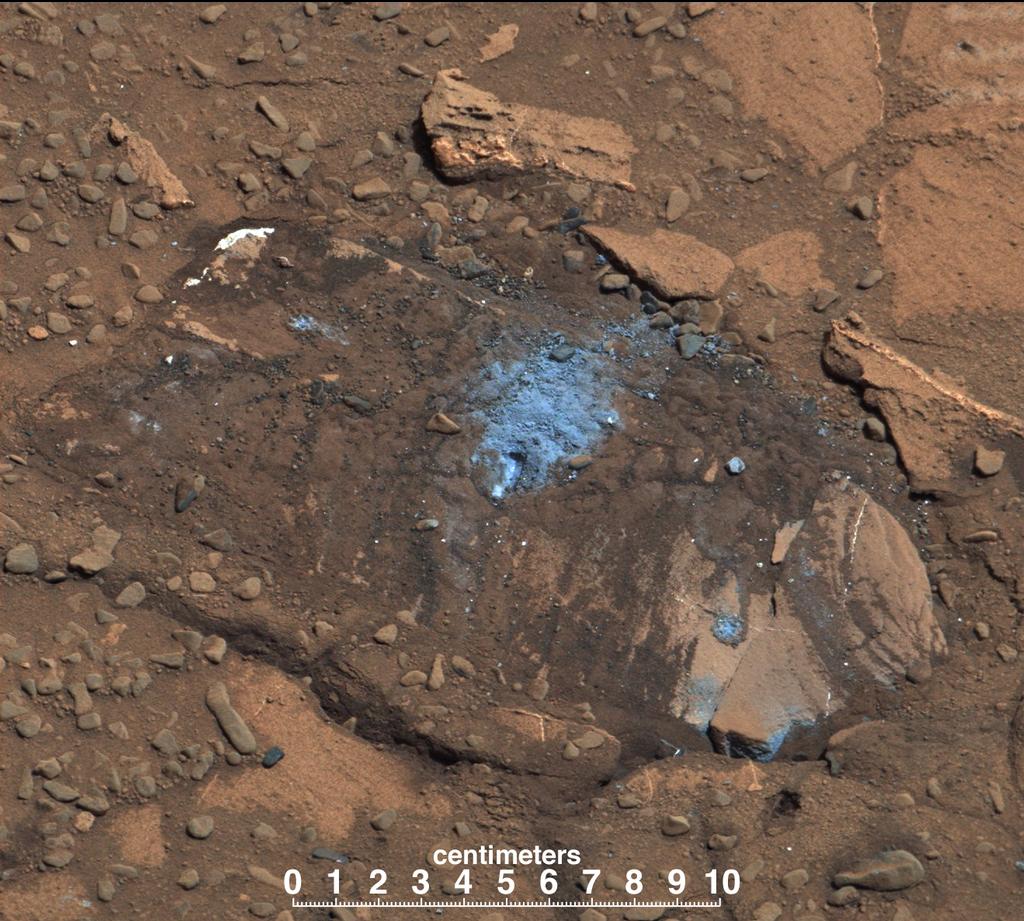
The interior of “Bonanza King”, seen here following the “mini drill” test to assess its suitability for sample drilling, showed intriguing promise. Sadly, the rock moved too much during the test drilling to be deemed safe for sample gathering. Evidence of the movement can be seen in the way the light-coloured tailing have unevenly flowed away from the drill cut, rather than circling it

Continue reading “J’arrive: a new chapter begins”

SL project updates week 37/2: miscellaneous items

Server Deployments, Week 37 Re-cap

  • There was no deployment to the Main (SLS) channel on Tuesday September 9th, largely as a result of there having been no RC deployments in week 36.
  • On Wednesday September 10th, the RC channels all received the same server maintenance project, which includes crash fixes and a fix for a bug that prevented some people from leaving Skill Gaming regions – notably Linden staff who entered a region using their admin powers …

SL Viewer

The Experience Keys projects viewer got its long-awaited update on Wednesday September 10th, with the release of version 3.7.16.293901. The viewer remains at a project viewer status, but now has parity with the current release viewer.

Group Chat

There is no major news here; as noted in part one of the week’s report, the Lab are still working on adjustments to the group chat code, but according the Maestro Linden, there isn’t anything as yet ready for further testing on Aditi – although the implication seemed to be that there may well be in the near future, as the comment on the work was made in terms of “upcoming stuff”.

In the meantime, people have been reporting further increases in group chat issues, prompting questions on whether increasing the number of servers used in support of the chat service might help. However, when this idea was last discussed, it was indicated that increasing the amount of available hardware isn’t considered to be a suitable solution at the moment, as it is the exponential manner in which ancillary messages (status updates, etc.) flood the service is seen to be the issue; something which just the provision of new hardware may not resolve / ease. As such, bringing the volume of the messages under better control is seen as key step in improving the service.

Other Items

Gesture and Object Sounds Parcel Restrictions

During the Server Beta meeting the subject of restricting sounds between parcels came up, with a request for a parcel setting to restrict sounds from other parcels being heard within a parcel. Currently, there is an option to restrict sounds from objects and gestures played within a parcel to that parcel, this can be found under About Land > Sound.

The option to restrict sounds from gestures and objects to a parcel will also block the same sounds originating from other parcels
The option to restrict sounds from gestures and objects to a parcel will also block the same sounds originating from other parcels from being heard within the parcel where set

The question led to an experiment with this option, which revealed, to the surprise of several at the meeting (myself included), that the setting is actually bi-directional: enabling it not only restricts sounds from objects and gestures being heard outside of a parcel, it blocks such sounds played from other parcels from being heard within the parcel as well. In some respects, that the options is bi-directional shouldn’t really have been a surprise; the other parcel options of a similar nature – restricting voice, restricting avatar visibility and chat, for example, are bi-directional, so why not gestures and sounds?

The option may not be perfect; looped sounds, for example, may not be restricted, and during a short test at the meeting,  some indicated they could still hear a sound generated on one parcel when moving from it to a parcel with the gesture and objects sounds restriction set, prompting Maestro Linden to muse if the restriction was enforced server-side or in the viewer. However, if you are troubled by sounds from a neighbouring or nearby parcel, it might be worth trying the option if you haven’t already.

Disappearing down the rabbit hole in Second Life

Dysphoria - Alice in Wonderland, Oxygen Island; Inara Pey, Septmber 2014, on FlickrDysphoria – Alice in Wonderland, Oxygen Island; (Flickr)

Dysphoria – Alice in Wonderland offers the lovers of fairy tales, the adventures of Lewis Carroll’s Alice, and fantasy an atmospheric and intricate place to explore which comes with a slight twist. This homestead region is the work of sim designer Muse Muliaina, who defines herself and her work through a quote from Alert Einstein which should perhaps be the manner in which we all approach Second Life – if not life itself:

Imagination is more important than knowledge. For while knowledge defines all we currently know & understand, imagination points to all we might yet discover and create.

The landing point for the region is up in the air, and from the moment you arrive, the fact that you’re in a region that takes as its foundations Alice’s adventures is immediately clear – there is only one direction to take, and that’s down the rabbit hole!

Dysphoria - Alice in Wonderland, Oxygen Island; Inara Pey, Septmber 2014, on FlickrDysphoria – Alice in Wonderland, Oxygen Island; (Flickr)

This will bring you down to a very large room with a very small door. There’s a bottle labelled Drink Me under the table, but given your relative size, it’s probably safe to say you may have drunk from it without realising .. although there is nothing stopping you from taking a further sip…

To proceed further, you’ll need to join the region’s group, which involves a slice of cake and a key. Once this has been done, you can proceed through the little door (an anywhere teleport door), which will deliver you to the region proper – but before you do, make sure you have either accepted the region’s windlight setting or have set your viewer to midnight or a nighttime windlight; that way you’ll experience the region as Muse intends.

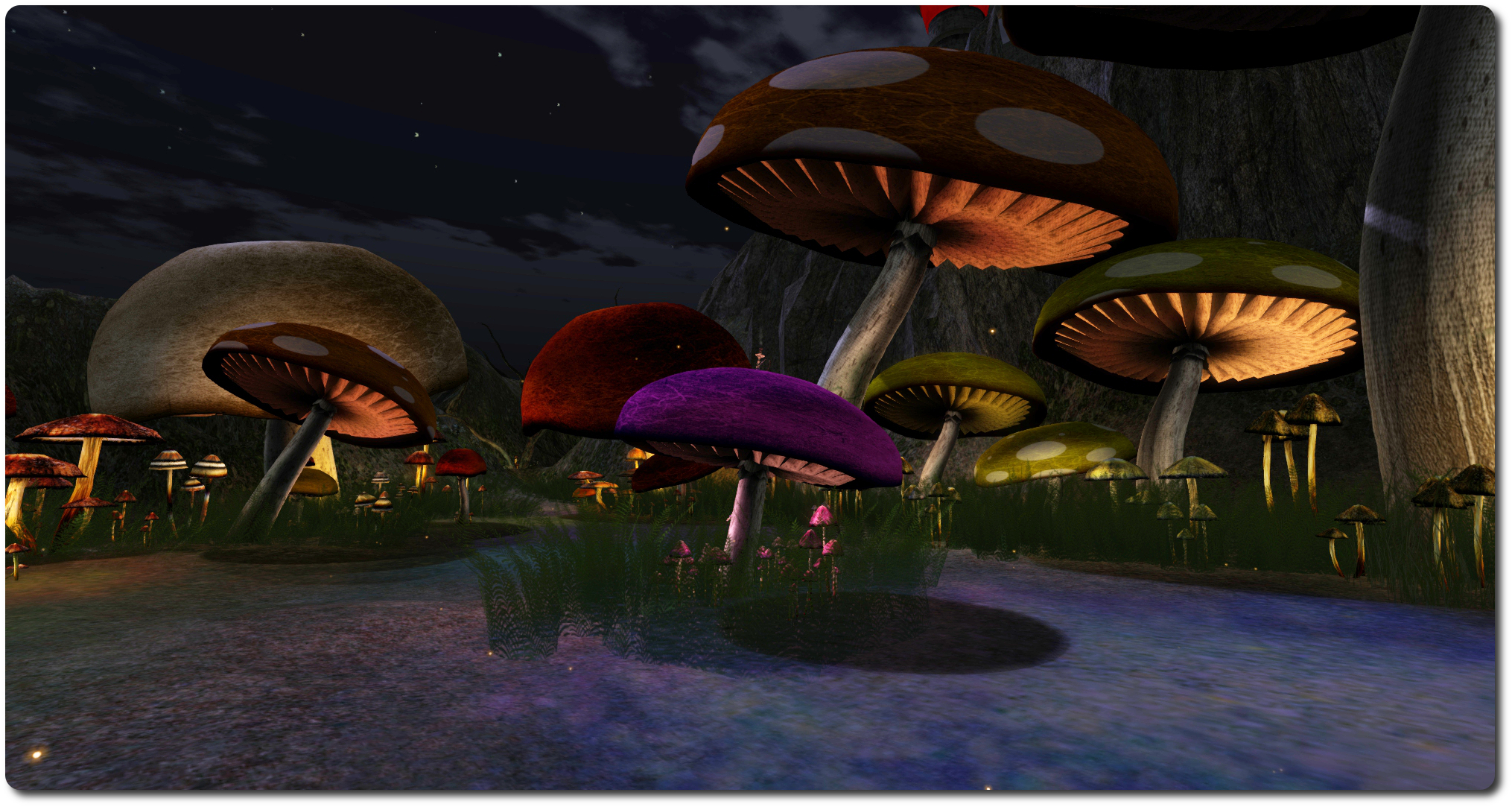
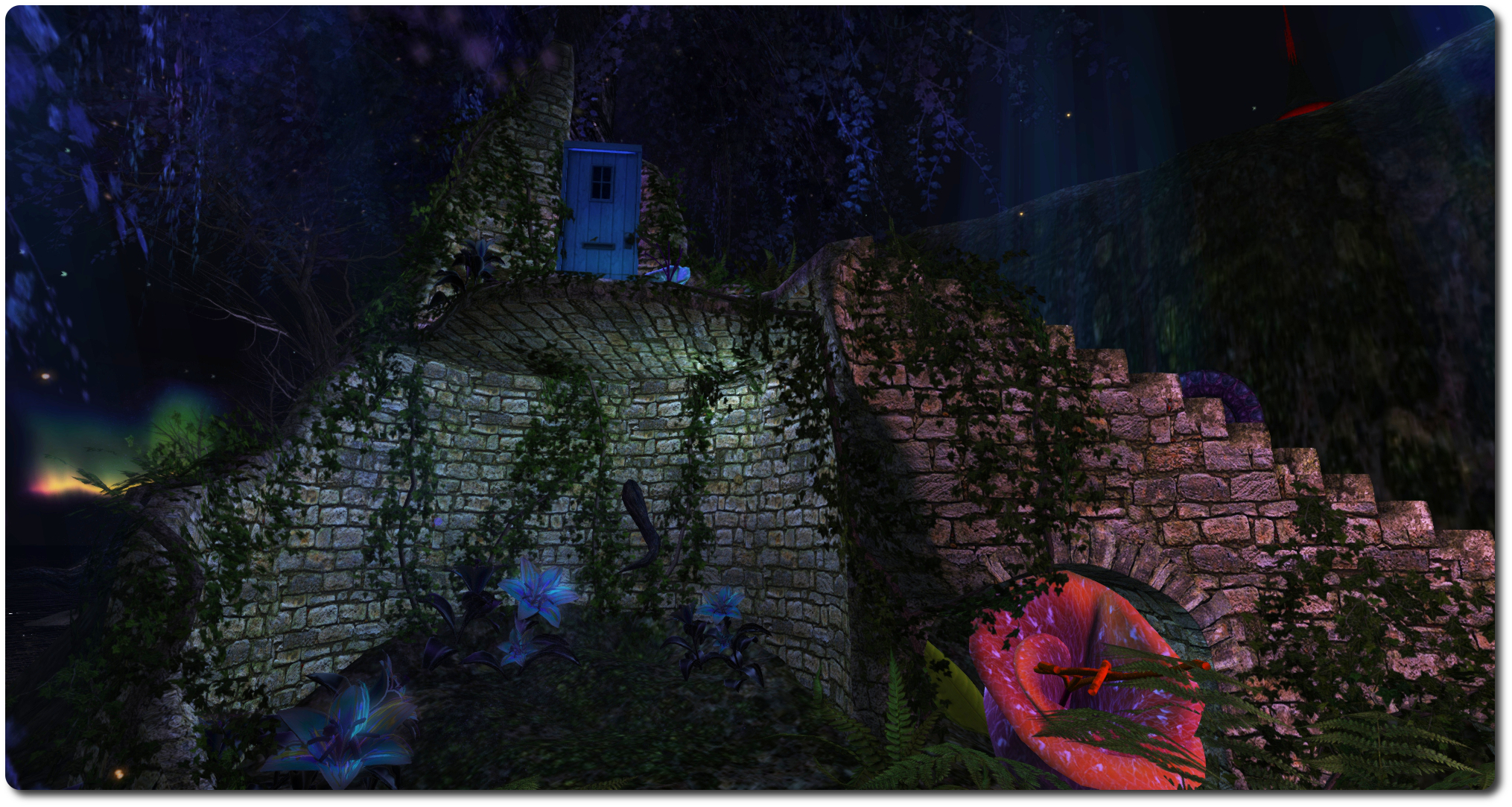
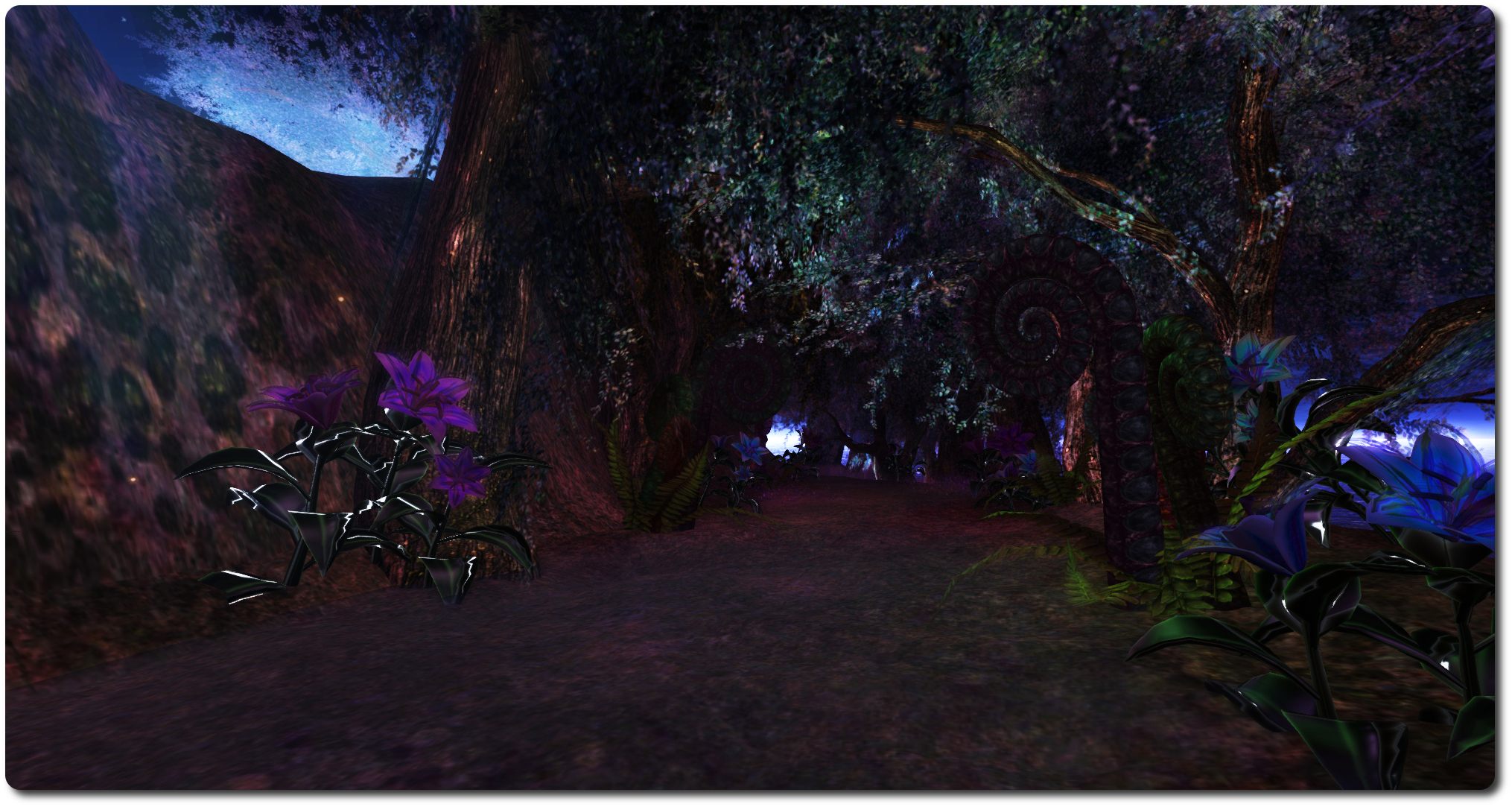
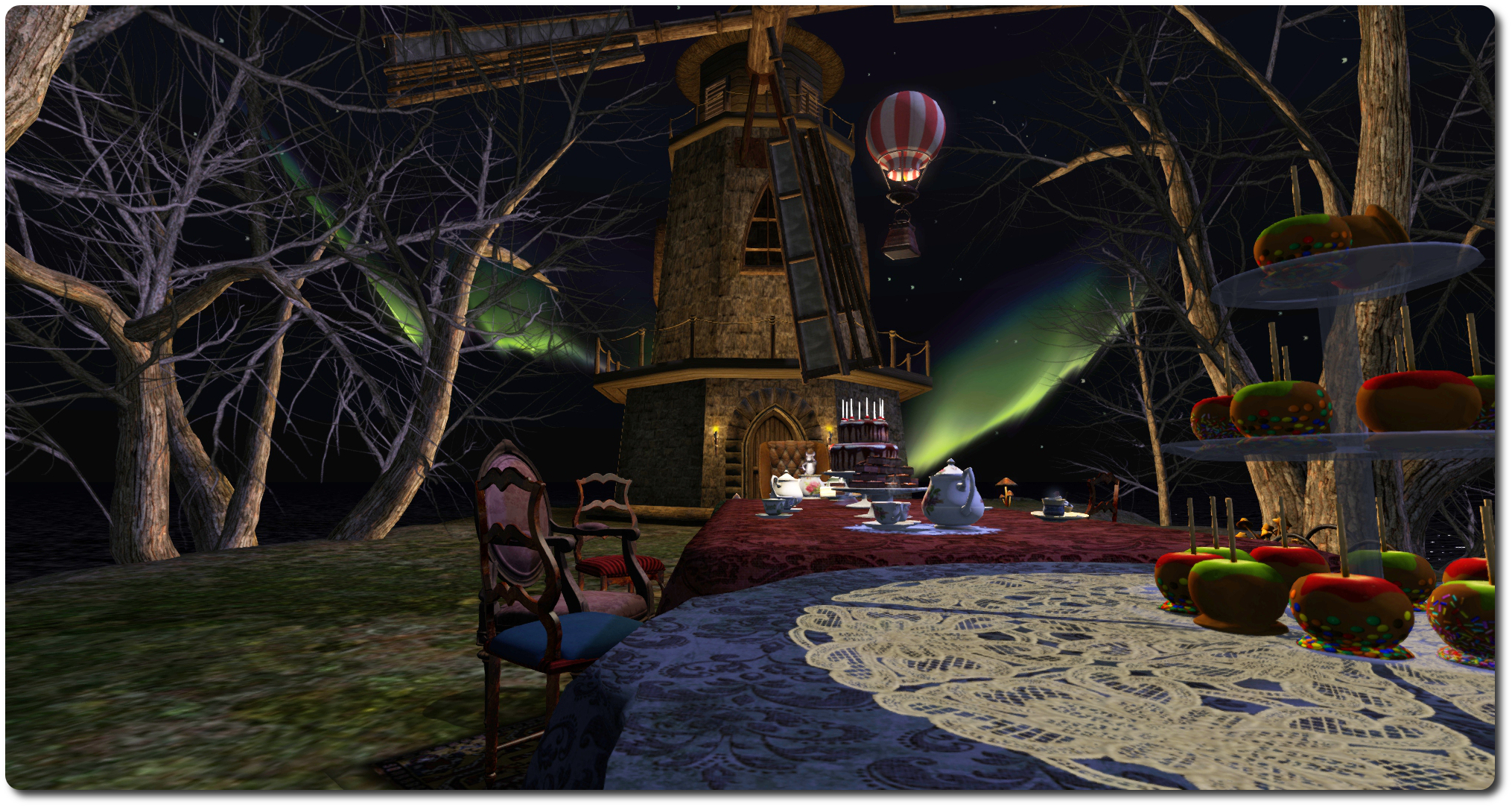
Now, as mentioned, this is a place that brings together fairytale, fantasy and elements of Alice’s adventures. So in your travels you can make your way to the Enchanted Forest and Gardens, through the Wonderland Warren, visit the Mushroom Circle, sup at the Mad Hatter’s Tea Party and make your way to the Red Queen’s castle.

Dysphoria - Alice in Wonderland, Oxygen Island; Inara Pey, Septmber 2014, on FlickrDysphoria – Alice in Wonderland, Oxygen Island; (Flickr)

However, not all here is quite as it seems. So if you find the Cheshire Cat’s grin a little unsettling, or the White Rabbit’s reading matter a little curious (not to mention the things he tends to hide under the fireside rug) or what happens when you accept the invitation to sit in his bedside chair leaves you a little uneasy, it is all entirely intentional.

From the White Rabbit’s place, you can make your way through the swamp, under the gnarled trees and past the ghost. Then, if you hang a left at the bloody red glow, you can make your way up to the Red Queen’s castle. Or, if this isn’t to your liking, the continue on and you’ll reach the Mushroom Circle, and from there it is a short walk to the Mad Hatter’s tea party.

Despite the darker elements to it, this is actually a quite delightful and enchanting region which can quickly captivate, particularly in the richness of detail and subtle touches – note the recurrence of the chessboard motif, echoing Alice’s looking glass adventures, and that of the deck of cards, reference her trip to Wonderland. Do please make sure you use the default or a nighttime windlight; if you don’t, you stand to miss out on a lot of the charm and whimsical elements of the region. Whether or not you are a fan of Lewis Carroll’s (or should I say Charles Dodgson’s?) classic, Dysphoria – Alice in Wonderland offer an intriguing and quite photogenic place to visit, and well deserving of its selection as an Editor’s Pick in the Destination Guide.

Dysphoria - Alice in Wonderland, Oxygen Island; Inara Pey, Septmber 2014, on FlickrDysphoria – Alice in Wonderland, Oxygen Island; (Flickr)

Related Links

Colouring a Cat

My PBY6A sitting on the ramp in Cousteau Society colours
My PBY-6A sitting on the ramp in Cousteau Society colours

I have a new obsession in Second Life. It’s my PBY-6A Catalina flying boat – although the admission of the obsession probably comes as no surprise to regulars on my SL feed of late *coughs*.

I reviewed the Cat toward the end of August, commented that I hoped someone would produce a paint kit with RAF colours, because although the Catalina comes with UV maps, etc., so you can paint it yourself, I’m not sure I’m up for the cut.

Fortunately, fellow SL aviator and friend, Terag Ershtan, alerted me via Twitter to Josh Noonan, who produces a range of paint kits for various customisable aircraft, including the Shana Carpool Catalina. Josh is based on Hollywood Airport, one of my regular spots for starting / ending flights, so I hopped over to see him. And indeed, there on the wall of his hanger was a vendor which included a range of paint kits for the Catalina – although none in RAF colours.

Even so, there was one in the Cousteau Society’s markings, which I simply had to have. Purchasing it, I mentioned RAF colours to Josh, and he said “got any examples?” Well, I didn’t, but it was one of those times I knew Google was my friend, and so passing him a couple of links, I went on my way to paint my Cat in Cousteau colours.

Josh Noonan's Cousteau Society paintwork for the Catalina
Josh Noonan’s Cousteau Society finish for the Catalina

Dropping back to Josh’s hanger at the start of September, I was thrilled to see that he’d added not one, but two RAF Coastal Command paint kits for the Catalina to his range, both of which quickly went into my inventory.

I should point out here that not only are Josh’s kits exceedingly good, they are also based upon actual aircraft – such as the Cousteau’s PBY (tragically lost in an accident), and the RAF kits are no exception.

My PBY6A in the colours of FP225 from 240 Squadron, RAF
My PBY-6A in the colours of FP225 from 240 Squadron, RAF, sitting on the slip at Honah Lee Field and about to lower its floats ready to enter the water

First up is FP225 (above). This aeroplane flew with No. 240 Squadron RAF Coastal Command, and was originally a PBY-5A Catalina. This squadron saw service in the Battle of the Atlantic before transferring to India, with FP225 serving in the squadron’s “special duties” flight – although I have no idea what that entailed.

The second RAF paint kit converts the Catalina into AH545 / WQ-Z of 209 Squadron (below). This is the aeroplane, originally a PBY-5A as well, which located the battleship Bismarck in 1941, and has the more familiar RAF markings.

My PBY6A in the marking of AH545 from No 209 Squadron
My PBY-6A in the marking of AH545 from No 209 Squadron, sitting outside Josh Noonan’s hanger at Hollywood Airport

If I’m totally honest, I have no idea how often I’ll fly The Catalina in RAF colours, I’m far too enamoured with the Cousteau Society paint work. But if you do see an RAF Catalina passing overhead, give a wave – it might be me (well, same goes should you see one in the white, black and yellow of the Cousteau Society!).  In the meantime, Josh has done a lovely job with both kits, and with the Cousteau kit, and I have no hesitation in recommending his work. If you happen to own an aeroplane which has customisable paint options, you might want to check his hanger and see what he has on offer.

Next up: getting a group of Catalina pilots together for some formation flying; that should be fun!

SL project updates week 37/1: server, viewer

GFrisland  - Laluna Island; Inara Pey, March 2014, on FlickrFrisland – Laluna Island (Flickr) – blog post

Server Deployments

As always, please refer to the server deployment thread for the latest information and updates.

There was no deployment to the Main (SLS) channel on Tuesday September 9th, largely as a result of there having been no RC deployments in week 36.

On Wednesday September 10th, the RC channels should all receive the same server maintenance project, which includes crash fixes and an “obscure bug”.

Describing the crash mode fixes at the Simulator User Group meeting, Simon Linden said, “The crash fixes aren’t normal usage but some edge cases that needed attention. The “obscure bug” was one that Maestro Linden had mentioned at the last Server Beta meeting, describing it as preventing Lindens from being able to leave Skill Gaming regions. Simon expanded on that saying, “It wasn’t just Lindens, but it was really anyone that didn’t have proper access.” Quiet what the proper access might be, isn’t clear.

A separate issue with Skill Gaming regions is that some who have had payment information files with the Lab for some time, but who have not actually used it for a period of time, may have to refresh their information prior to being able to access such regions.

SL Viewer

Release Viewer

Monday September 8th saw the Snowstorm contributions RC promoted to the de facto release viewer, version 3.7.15. 293376. This viewer includes assorted contributed fixes and updates, including the unified snapshot floater and support for ‘older than’ when inventory filtering).

The new snapshot floater by Niran V Dean is now available within the official viewer

There has been a report of this installation of this viewer pausing with the message “unable to find Second Life Crash Logger”, but that clearing the message will see the viewer complete installation OK. As there are reports that this has happened with other releases of the viewer and where allow automatic updates has been enabled, it might be connected to the automatic update process within the viewer itself, possibly as a result of the viewer not shutting down correctly as a part of the automatic update process, although this is by no means certain.

RC Updates

A new maintenance release viewer arrived in the release channel as an RC on Friday September 5th. Version 3.7.15.293253, which includes fixes for inventory and outfit management; appearance editing; group & group ban management; camera controls; multi-grid support for favourites; notifications management; stability, plus bug and crash fixes (download and release notes).

New Viewer Autobuild Process

The Lab’s new viewer autobuild process is now in the final phases of preparation for deployment, with Oz Linden reporting at the Open-source Dev meeting that there are only “minor fixes here and there” that seem to be required. There are expected to be some further updates to the new autobuild wiki page to assist self-compilers.

Other Items

Viewer Fixes in the Works

In week 34, I referred to a Mac Cocoa issue with theapplicationShouldTerminate function,   reported by Cinder Roxley, and which she described as:

Say you are logged into sl, and you open appstore and there is an update that needs a restart to complete. Normally you click restart and it shuts down all apps completes the update and when you login your apps are reopened. Because the viewer is sending a bad value back to OSX, OSX will not close it, and it stops the restart from happening.

The fix for this, submitted by Cinder under STORM-2053, is now under review, and so should be progressing forward soon.

STORM-2053, “Viewer no longer asks for confirmation before ejecting a member from a group like in previous releases, also no confirmation for banning”, also submitted by Cinder is also in the same state.

OPEN-268, “FFLOAD_XML missing on linux and darwin, FFSAVE_XML missing on darwin”, also from Cinder Roxley, may be a little more obscure, given it is apparently a long-standing issue which hasn’t previously been reported, but it to is progressing the Lab’s internal review phase.

Opting Out of Group Chat

As noted in my SL project updates, the Lab is working on trying to improve group chat (see the Group Chat tag list for articles). While this doesn’t form a part of the Lab’s work, Cinder Roxley has submitted STORM-2079, “As a group member, I would like to opt out of joining chat”.

The JIRA itself is still pending, but it highlights one of the ways in which some of the message load face by the group chat service might additionally be reduced. As previously noted, the major issue with group chat is not so much the volume of actual chat messages being sent, but with the number of updates the service must send as people log-in and out of SL, and as they join / leave group chat sessions. However, cumulatively, this still adds up to a lot of message traffic. So having a means by which users can opt-out of group chat altogether (and just receive notices, for example), could help reduce the load in terms of actual messages being sent and with the volume of updates for people joining / leaving group chat sessions.

Firestorm already provides a toggle for opting-out of group chat either on a group-by group basis from within a Group Profile floater, or en masse via options in Preferences > Chat > Firestorm. However, these options only cause the viewer to discard incoming messages, they don’t actually reduce the volume of messages being sent by the chat servers.

Firestorm includes options to discard group chat messages  - but this doesn't reduce the volume of messages being sent
Firestorm includes options to discard group chat messages – but this doesn’t reduce the volume of messages being sent

As a result of the JIRA and a brief discussion at the Open-source Dev meeting, there is likely to be some more poking around to identify where values relating to received group notices and chat are stored in the viewer with a view of seeing what might be leveraged towards helping reducing the volume of chat related traffic.

It’s all change again at home

Living on the island: new home, same house

I’ve been a tad quiet on the blogging front as I’ve been in the process of moving house. This wasn’t actually something I’d planned, having been more than happy living on a corner parcel of a region in the United Sailing Sims; but there’s this Catalina flying boat I recently came across, and have, quite frankly, fallen in love with.

I had been content to simply pull the Cat out of inventory when wanting to fly it, but then Terag Ershtan pointed me towards Josh Noonan, who produces paint kits for a number of aircraft, including the Catalina, one of which represents the aircraft in Cousteau Society colours, which I had to have. And the plane looks so good in the colours, I wanted a place I could leave it parked out and visible … and the house move grew from that … !

I’m still within the United Sailing Sims and not far from Blake Sea, but I now have my own little island. This came to me by chance; I had actually looked at it prior to it becoming available, and thought it might be perfect; however it was at that time already rented. Then Nber informed me it was about to become available, so talk about serendipity!

Living on the island: aerial view showing the overall layout

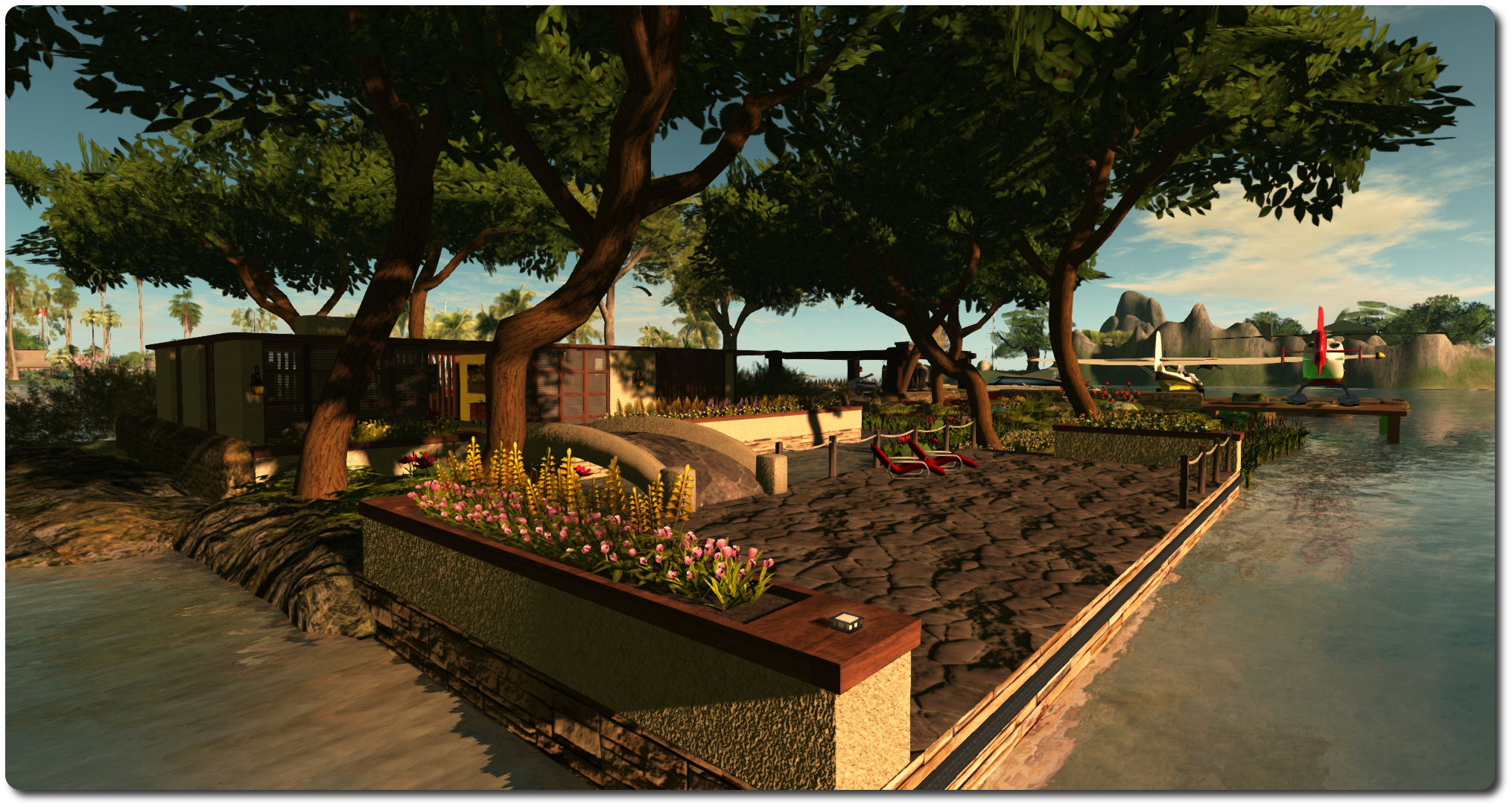
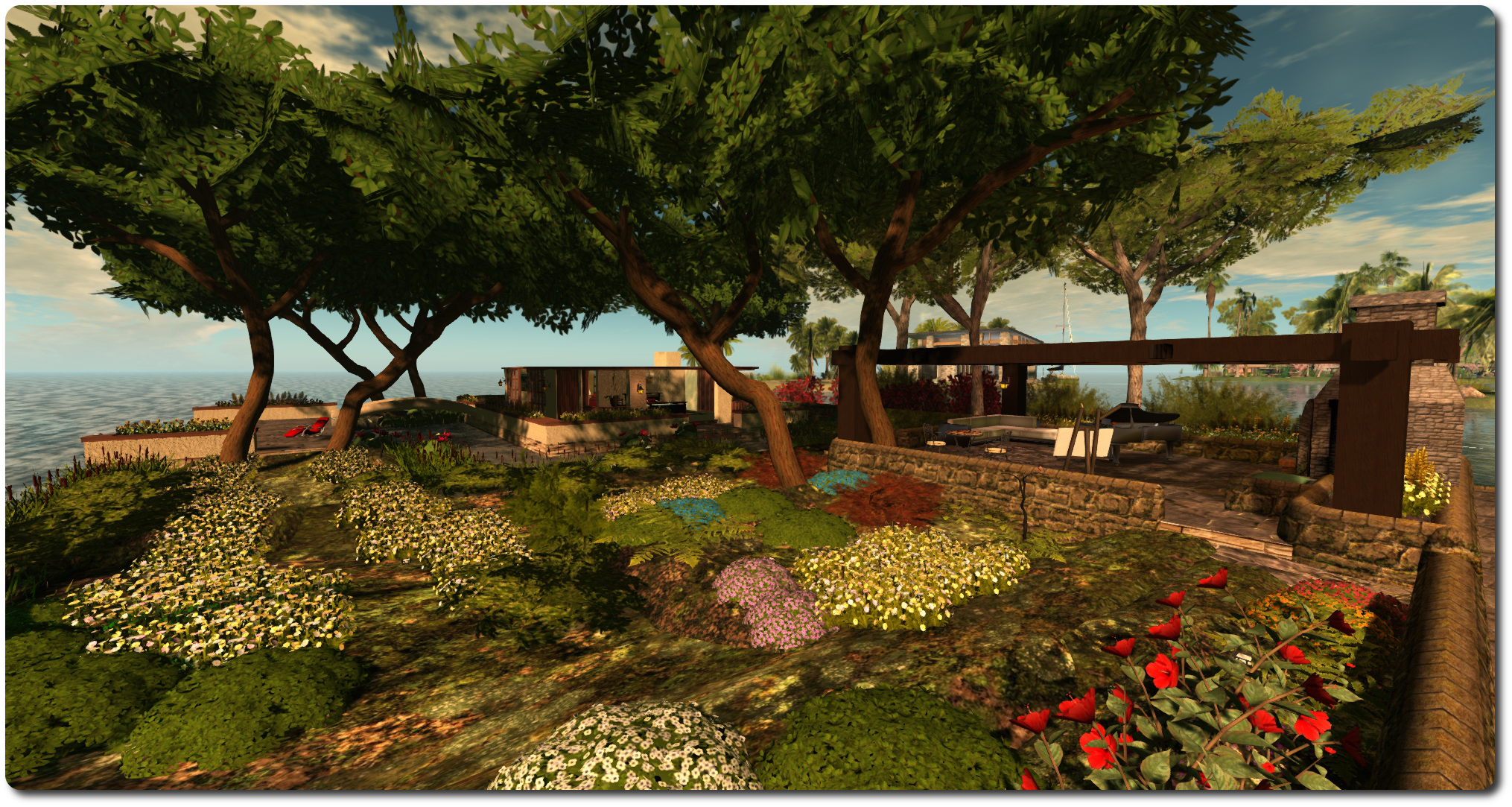
The move hasn’t seen me change the house very much – I’ve kept to the same design I re-worked recently, and simply added a few more trees and plants around the garden and the land. The layout of the island leads itself perfectly to my having a parking area for the Catalina, and also provided the ideal spot to re-position the main mooring area for a boat. Admittedly, the Lady of Calas 2 was too big for the latter, but the land was perfect for cutting to make a space for Lady Of Calas, my E-Tech Sparrow, and without really altering the shape of the island too much in the process.

Alex Bader’s rustic wall came in handy for creating retaining walls around parts of the island, helping to give additional form (I think) to the place, their aged look hopefully suggesting the house has been situated on an island once given over to an older stone build of some description, the foundations now having been put to new use.

Living on the island: the garden has some new plants and shrubs

The south side of the island is given over to the parking area and ramp for the Catalina. This has footpaths and flower beds (Kayle Matzerath’s brilliant Lumenaria mesh flowers again) running around it, and a large sort-of terrace area which might come in handy for something at some point. I’ve just no idea what… The Catalina handles the ramp very well, and I’m getting used to the relatively small area in which to turn it around following a flight.

The total LI for the house, grounds and wildlife is 501, with the boat, Catalina and helicopter accounting for another 233 and my cat & his accoutrements claiming for a further 35. All of which, if I say so myself, isn’t bad, and leaves me with a comfortable buffer of additional land capacity should I need it.

I just hope the neighbours don’t object to the noise from the Catalina when I’m coming and going by air!

Living on the island: all set to fly!
Living on the island: all set to fly