 The 16th edition of The Drax Files Radio Hour delves into something many of us overlook: the people who actually work at Linden Lab and keep Second Life running and available to us. Having travelled to Santa Cruz, Drax gets to spend time with a group of Lab employees, and interviews one of the more senior folk there, Don Laabs.
Also discussed is the new user experience – where sadly, in some respects, views are expressed which come over as somewhat devoid of any appreciation – or at least acknowledgement – of what has been tried before and the fact that the Lab actually does have a lot of data on how well what we may consider to be “obvious” may not have actually turned out that well in the past. It’s both the new user experience element and the Don Laabs interview which form the mainstays of the show for me, so they’re what I’m focusing on here.
The new user experience discussion stems from Skyspinner Soulstar’s video, which has been featured on numerous blogs and subject to much debate. I have to admit that when seeing videos like this, I have two reactions.
The first is that the new user experience is a mess, and that more thought needs to be given to ways in which people coming into Second Life a) have a much clearer understanding of why they’re signing-up to the platform and what they might like to do, and b) how the sign-up / log-in experience can be better geared to ensuring those coming into SL can be better grasp the very basics of the viewer and can be delivered more readily to environments where they can connect with those things that caused them to sign-up to SL and which present them with the ability to connect to others who share that interest.
My second reaction is that, by their very nature, videos made by established SL users are somewhat biased from the outset, because they are invariably driven by what we think new users need, rather than what new users may actually require, or they are invariably seen as a means of reinforcing our own particular views on what we “know” is required in order to “solve” the issue of the new user experience. This latter point is demonstrated in the podcast itself, where Draxtor admits that the video reinforces his belief that the new user experience can be “solved” through the introduction of social interaction into the process (which, ironically, is not something I tend to actually agree with in general terms).
The problem here is that by reinforcing our own perceptions of what is “obviously” needed can perhaps blind us to other issues which may well be inherent in the overall process. Hence why, when it comes to discussions about how to solve the new user experience, particularly when they are directed at solution X or approach Y or idea Z, I find myself pointing to a comment Ebbe Altberg made during his VWBPE address:
In general, I’ve found that the customer is often wrong when they ask for something specific.
Now, when they say, “I have this pain” or “I have this need”, they’re pretty much always right. But when they say, “it needs to be solved this way”, they’re usually wrong …
The very attractiveness of Second Life and the fact that it is such a blank canvas to user engagement and retention really does mean there is no single solution that is going to work, and that what is needed is in fact a far more broad-ranging, holistic approach to matters which encompasses multiple approaches, leveraging things that both the Lab and the community can collaboratively supply.
Given the renewed openness and direct approach the Lab is presenting in its relationship with the broader user community, we are perhaps closer to reaching a point where such a collaborative, holistic approach could actually be undertaken by both Lab and users than we’ve been in a very long time. If the opportunity does arise, I hope both sides will grasp it without any need to rake over the coals of past mistakes in Lab / user relationships.
For his first Linden interview [25:32], Drax sits down with Don Laabs, Linden Lab’s Senior Director of Product for Second Life, and who is also known as Danger Linden.

I first made mention of Don Laabs back in September 2012, back when there was much gnashing od teeth over the misconception that the Lab was somehow “abandoning” SL in favour of developing new products. At that time, I pointed to the fact that the Lab had actually brought-in Don Laabs from EA games earlier in the year in order to ensure that SL would continue to be developed, while responsibility for emerging products was placed under the separate control of John Laurence, reporting into Don.
The interview is interesting and wide-ranging, starting as it does with a brief potted history of Don’s time with EA games, his thoughts on whether SL is a game or not – he characterises it as not a game, but “play”, and points to the over-arching difference between SL and the OASIS of Ready Player One being the latter having gameplay as central to its function, whereas SL has gameplay elements for those who wish to use them, before delving into a host of other issues, including the highly anticipated experience keys (also referred to elsewhere as experience permissions) which should further assist in the creation of tailored, region (/estate?) based activities – think Linden Realms with more on offer.
An interesting aspect of this discussions – other than it touching upon the fact that while SL may not be a game, it most certainly is a legitimate platform for gameplay mechanisms and activities – is that alongside of the developing the experience capabilities themselves, the Lab are in the process of putting together a couple of experiences they hope will showcase the capabilities and springboard their wider use.
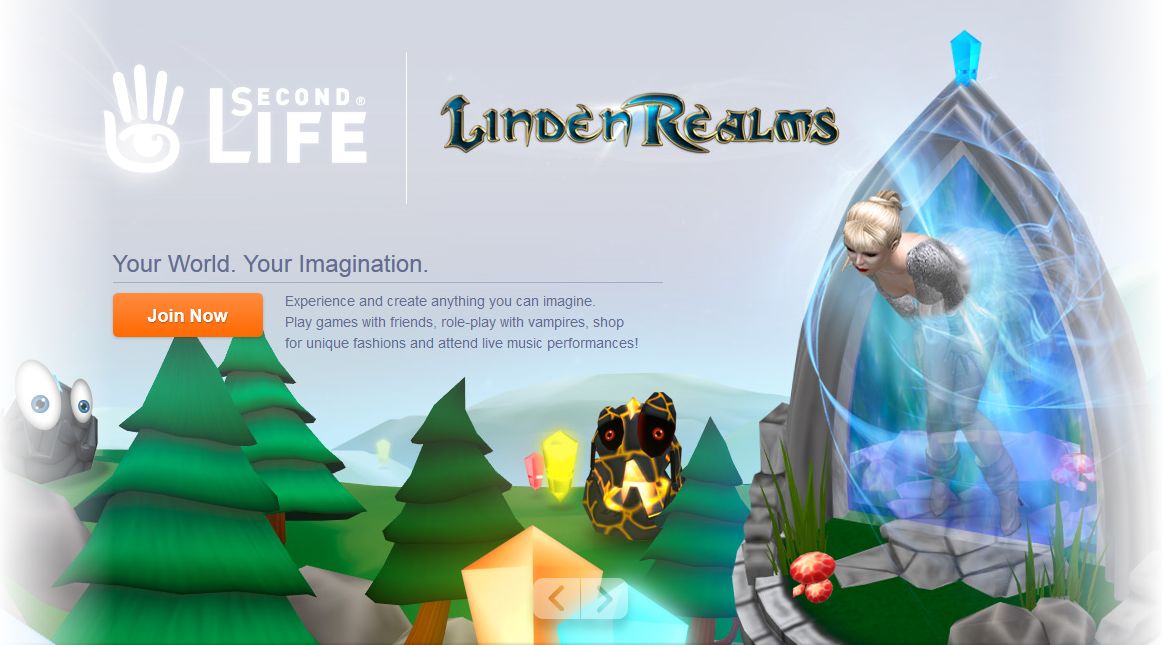
While having the Lab provide in-world experiences tends to be a twitchy subject for some, taking this kind of approach – particularly if coupled with good supporting resources (wiki pages, etc.), isn’t actually a bad way to go. While it may be critiqued as looking and perhaps feeling a little twee, the Linden Realms game did, at the time it was launched, help promote what might be done with the initial experience permissions and tools (it was just a shame things went a be pear-shaped when the tools were initially rolled-out). As such, I do wonder – technical complexity not withstanding – how pathfinding might have been received had it been rolled out with a comprehensive example of what might be achieved using the tools, linked to the resources needed to create pathfinding based experiences.
A further interesting element touched upon in the interview is that maintaining something like SL is actually a lot more complex than people perhaps credit. As Don states, even if the SL code were effectively frozen today, changes in the world at large – to operating systems, to tools the platform uses (webkit and the issues around MOAP video & YouTube being a classic example – or indeed, the Mac Cocoa situation being another) mean than SL will still require ongoing and invasive maintenance even in order for it to remain accessible to users – and even to meet users’ changing habits.
The conversation here segues into a discussion of Second life and relevance. While it is true that Second Life itself doesn’t face any real competition in terms of virtual worlds (no disrespect here to OpenSim – but it is not of a scale which can be considered in any way competitive to SL, either in terms of established user base or – more particularly – in its ability to directly attract new users on a scale equivalent to SL), the platform does face enormous competition in terms of gaining traction on people’s time. This means that SL is competing with a whole range of other activities people could be doing – web browsing, playing games, engaging with family and friends through Facebook, and so on.
The problem here, in terms of relevance, comes in several forms. There is the matter of legacy content, for example – and the expectation by users that such content will always be around, no matter how dated it may look. This impacts on what can and cannot be done technically with the platform in terms of maintaining relevance with emerging capabilities and so on. At the same time, system performance needs to be managed, but the platform needs to remain relevant to content creators of all standards and abilities as a place for creativity without unduly limiting how they create (such as by limiting polygon counts on models, etc.). So relevance is a complex mixture of technical capabilities, maintaining legacy content, performance, and offering freedom of creative expression – anyone one of which can turn people away from SL as much as attract them.
This is again another excellent interview, and sets the bar for the upcoming shows and chats with other Lab staffers. Obviously, I’ve only touched on what interests me personally, and I do recommend that you take listen-in to all that is discussed.
Elsewhere in the show, the prickly issue of net neutrality is discussed, something which is having considerable air-time in the USA, but which isn’t garnering too much attention here in the UK, despite the fact we seem to be in much the same boat on the matter. Education also gets a further mention, with a most excellent OpenSim / Oculus Rift experiment at a school in Ireland getting media coverage. Despite being accused of “not understanding” the value of VR in SL, such work is actually where I see HMDs and added immersiveness in VWs as having value. Indeed, I’d go so far as to say that historical recreations like this, perhaps coupled with the new experience keys and something along the lines of Fuschia Nightfire’s intriguing Ghost Castle, as could offer uniquely interactive, educational, and eye-popping experiences within SL.

And even without the headset, I still recommend Fuschia’s installation as more than worthy of a visit.


 Inara Pey: Living in a Modemworld